Milk fat and fatty acid (FA) profile affect milk and cheese quality as well as organoleptic characteristics, while specific FAs have potential health benefits. Based on studies performed mainly in cattle, some candidate genes putatively affecting the milk fat and FA content could include the acyl-CoA:diacylglycerol acyltransferase 1 (DGAT1), the fatty acid synthase (FASN) and the steroyl-CoA desaturase 1 (SCD1) genes. Although the exon harboring DGAT1 K232A single nucleotide polymorphism (SNP), well established to affect milk fat and FA content in dairy cattle (Schennink et al., Reference Schennink, Heck, Bovenhuis, Visker, van Valenberg and van Arendonk2008), was monomorphic in some sheep breeds (Scatà et al., Reference Scatà, Napolitano, Casu, Carta, De Matteis, Signorelli, Annicchiarico, Catillo and Moioli2009; Miltiadou et al., Reference Miltiadou, Tzamaloukas, Genethliou, Papachristoforou, Chatziplis and Orford2010), two SNPs outside the coding region of the ovine DGAT1 gene were associated with milk fat content (Scatà et al., Reference Scatà, Napolitano, Casu, Carta, De Matteis, Signorelli, Annicchiarico, Catillo and Moioli2009) and a SNP in exon 17 affected milk FA traits (Dervishi et al., Reference Dervishi, Serrano, Joy, Sarto, Somera, González-Calvo, Berzal-Herranz, Molino, Martinez-Royo and Calvo2015). SNPs within the FASN gene, catalyzing the de novo synthesis of small to medium chain FAs, have been associated with the bovine and ovine milk FA content (Crisà et al., Reference Crisà, Marchitelli, Pariset, Contarini, Signorelli, Napolitano, Catillo, Valentini and Moioli2010), while the SCD1 gene affecting the milk FA profile in dairy cows, is involved in mammary FA desaturation (Schennink et al., Reference Schennink, Heck, Bovenhuis, Visker, van Valenberg and van Arendonk2008). Additionally, the acetyl-CoA acyltransferase 2 (ACAA2) gene, encoding an enzyme catalyzing the last step in FA β-oxidation, is located in an area where quantitative trait loci (QTL) for milk, fat and protein yields were mapped in sheep (Gutiérrez-Gil et al., Reference Gutiérrez-Gil, El-Zarei, Alvarez, Bayón, de La Fuente, San Primitivo and Arranz2009). A SNP detected in the 3′ untranslated region (UTR) of the ACAA2 gene was associated with milk yield, protein content and fat yield in dairy Chios sheep and exhibited differential allelic expression (Orford et al., Reference Orford, Hadjipavlou, Tzamaloukas, Chatziplis, Koumas, Mavrogenis, Papachristoforou and Miltiadou2012; Miltiadou et al., Reference Miltiadou, Hager-Theodorides, Symeou, Constantinou, Psifidi, Banos and Tzamaloukas2017a).
Due to the fundamental functional role of the above genes in lipid metabolism and/or their location in chromosomal regions associated with milk content, polymorphisms within these genes may partially explain the variation of fat content and/or FA composition in sheep milk. Therefore, our objectives were to (i) identify polymorphisms in the DGAT1, FASN, SCD1 and ACAA2 genes and (ii) examine their association with milk fat percentage and FA profile in Chios sheep breed, a highly productive and well adapted breed of the Mediterranean region.
Material and methods
Animals, phenotypic data and sampling
Three monthly consecutive samplings from 429 purebred Chios dairy ewes in mid-lactation from four farms were obtained by machine milking twice daily and samples were kept as described in Symeou et al. (Reference Symeou, Tsiafoulis, Gerothanassis, Miltiadou and Tzamaloukas2019). Standard records for the date of lambing, lactation number, ewe age at lambing and date of sampling were also collected.
DNA extraction, SNP identification and genotyping
Blood samples were collected for DNA extraction, using the Genomic DNA Blood kit (Macherey-Nagel, Duren, Germany). A cost effective direct DNA sequencing protocol (Miltiadou et al., Reference Miltiadou, Orford, Symeou and Banos2017b) was performed for SNP identification and genotyping. Thirty randomly selected animals were used to sequence the exon 10 of the ACAA2 gene, the 3′UTR of the DGAT1 gene, exon 31 of the FASN gene and the 5′ and 3′UTRs of the SCD1 gene (online Supplementary Table S1).
Milk analysis
Milk samples were kept at 4°C for fat content determination through thermo-optical procedures (LactoStar 3510, Funke Gerber, Berlin, Germany), whereas a subsample was kept at −20°C for FA analyses as described in Tzamaloukas et al. (Reference Tzamaloukas, Orford, Miltiadou and Papachristoforou2015). At the end of the process, 1184 fat content and 37 718 FA percentage records were available for statistical analysis.
Statistical analysis
The impact of each identified genotype in each locus on the studied traits was determined using a mixed linear model presented in online Supplementary Material.
Results and discussion
The descriptive statistics obtained from Chios sheep milk regarding the mean (±sd) of fat percentage, individual FAs, FA groups and indices are presented in online Supplementary Table S2. Mean fat percentage was 5.3 (±0.9), consistent with the fat content previously recorded for the Chios breed in Cyprus (Orford et al., Reference Orford, Hadjipavlou, Tzamaloukas, Chatziplis, Koumas, Mavrogenis, Papachristoforou and Miltiadou2012; Tzamaloukas et al., Reference Tzamaloukas, Orford, Miltiadou and Papachristoforou2015; Miltiadou et al., Reference Miltiadou, Hager-Theodorides, Symeou, Constantinou, Psifidi, Banos and Tzamaloukas2017a). The milk fat fraction expressed in wt/wt included approximately 73% SFA, 26.3% UFA from which 22.4% were MUFA and 3.9% were PUFA. The highest percentage of MUFA and PUFA was oleic acid and linoleic acid, respectively, followed by CLA and linolenic acid PUFA. Similar results were previously obtained for most of the FAs from different ovine breeds (De La Fuente et al., Reference De La Fuente, Barbosa, Carriedo, Gonzalo, Arenas, Fresno and San Primitivo2009) and for Chios sheep (Tzamaloukas et al., Reference Tzamaloukas, Orford, Miltiadou and Papachristoforou2015).
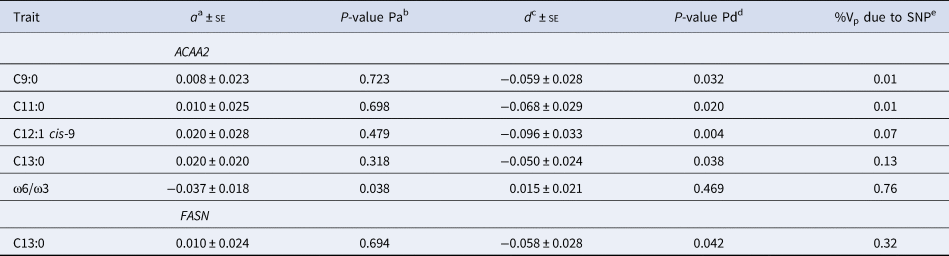
In the present work, informative polymorphisms were only observed for the ACAA2 and FASN genes (Tables 1 and 2). Allelic frequencies in the ACAA2 SNP locus were 0.47 and 0.53 for the C and T alleles, respectively, similarly to Orford et al. (Reference Orford, Hadjipavlou, Tzamaloukas, Chatziplis, Koumas, Mavrogenis, Papachristoforou and Miltiadou2012) and Miltiadou et al. (Reference Miltiadou, Hager-Theodorides, Symeou, Constantinou, Psifidi, Banos and Tzamaloukas2017a), while genotypic frequencies were found to deviate from Hardy-Weinberg equilibrium (online Supplementary Table S3), consistently with our latest study where the frequency of the genotypes carrying the T allele was higher probably due to directional animal selection for increased milk yield (Miltiadou et al., Reference Miltiadou, Hager-Theodorides, Symeou, Constantinou, Psifidi, Banos and Tzamaloukas2017a). In the FASN SNP locus, the respective frequencies for the C and T alleles were 0.67 and 0.33 (online Supplementary Table S3), whereas the C allele frequency reported for the Altamurana and Gentile di Puglia breeds was 0.93 and 1 in Sarda breed (Crisà et al., Reference Crisà, Marchitelli, Pariset, Contarini, Signorelli, Napolitano, Catillo, Valentini and Moioli2010), suggesting important inter-breed differences.
Single Nucleotide Polymorphism (SNP) allelic effects in the ACAA2 and FASN gene loci and corresponding percentage of total phenotypic variance explained

a a = additive genetic effect; negative additive effect (a > 0) indicated T allele decreased the trait.
b P-value for assessing the additive effect on the trait.
c d = dominant genetic effect.
d P-value for assessing the dominant effect on the trait.
e Vp = percentage of phenotypic variance; based on the allele frequencies observed in sample (ACAA2: P = 0.47 for C and q = 0.53 for T; FASN: P = 0.67 for C and q = 0.33 for T).
Genotypic means for milk fatty acids (FA) and milk FA indices associated with the g.2982T/C SNP in the ACAA2 gene locus and the g.14777C/T SNP in the FASN gene locus

a,b Means within a row with 2 different superscripts differ as follows: a,bP < 0.05.
1 Predicted from the mixed model association analyses, after adjusting for all significant fixed and random effects.
2 Significance of pairwise genotype contrast assessed using a 2-sample t-test.
In this study, the UTRs of DGAT1 and SCD1 genes were examined for polymorphisms, since the coding regions of those genes were either monomorphic or the polymorphism had very low frequency for the minor allele in other sheep breeds studied (García-Fernández et al., Reference García-Fernández, Gutiérrez-Gil, García-Gámez and Arranz2009; Scatà et al., Reference Scatà, Napolitano, Casu, Carta, De Matteis, Signorelli, Annicchiarico, Catillo and Moioli2009; Dervishi et al., Reference Dervishi, Serrano, Joy, Sarto, Somera, González-Calvo, Berzal-Herranz, Molino, Martinez-Royo and Calvo2015). However, no polymorphisms were found, which could be possibly attributed to a founder effect due to the low number of animals initially used to establish the Chios sheep population in Cyprus (Miltiadou et al., Reference Miltiadou, Hager-Theodorides, Symeou, Constantinou, Psifidi, Banos and Tzamaloukas2017a).
In the current study, the ACAA2 g.2982T>C SNP exhibited negative dominance effects on C9:0, C11:0, C12:1 cis-9 and C13:0, while a negative additive effect for the FA index ω6/ω3 was also found, explaining 0.76% of the total phenotypic variance for that index (Table 1). Therefore, the SNP previously associated with milk yield (Orford et al., Reference Orford, Hadjipavlou, Tzamaloukas, Chatziplis, Koumas, Mavrogenis, Papachristoforou and Miltiadou2012; Miltiadou et al., Reference Miltiadou, Hager-Theodorides, Symeou, Constantinou, Psifidi, Banos and Tzamaloukas2017a), protein content and fat yield in Chios sheep (Miltiadou et al., Reference Miltiadou, Hager-Theodorides, Symeou, Constantinou, Psifidi, Banos and Tzamaloukas2017a) is also correlated with ω6/ω3 content, an index associated with human health benefits. Similarly to Miltiadou et al. (Reference Miltiadou, Hager-Theodorides, Symeou, Constantinou, Psifidi, Banos and Tzamaloukas2017a), fat percentage was not affected by the identified ACAA2 polymorphism.
The association detected between the ACAA2 gene and the FA contents (odd chain FA and ω6/ω3 ratio) could be attributed to either a functional role directly affecting the studied traits or linkage and/or linkage disequilibrium with the causal locus or loci. Long chain FA reach the udder through blood circulation. Similarly, the ω6/ω3 ratio depends on the availability of ω6 and ω3 from diet, while C18:2 ω6 and C18:3 ω3 FA are metabolized to longer chain ω6 and ω3 FA (Palmquist, Reference Palmquist2009). Therefore, acetyl-CoA produced in mitochondria by the ACAA2 enzyme, could be used in the formation of malonyl-CoA, utilized for the FA chain elongation (Eaton et al., Reference Eaton, Bartlett and Pourfarzam1996). Therefore, the ACAA2 g.2982T>C SNP may be indirectly associated with the ω6/ω3 ratio by producing the substrates for elongation of the C18:2 ω6 and C18:3 ω3 precursors. On the same basis, even-chain and odd-chain FA are elongated with the aid of acetyl-CoA. Furthermore, β oxidation provides energy for such anabolic reactions.
In the current study, we confirm the presence of the g.14777C>T SNP (Crisà et al., Reference Crisà, Marchitelli, Pariset, Contarini, Signorelli, Napolitano, Catillo, Valentini and Moioli2010) in the FASN gene of Chios sheep and provide evidence of a significant association with an odd chain FA (C13:0) with a negative dominant effect (Tables 1 and 2), explaining 0.32% of the total phenotypic variance. Crisà et al. (Reference Crisà, Marchitelli, Pariset, Contarini, Signorelli, Napolitano, Catillo, Valentini and Moioli2010) described that the allele T of the FASN SNP in exon 31 had a positive substitution effect on the medium-chain milk FA (C10:0, C10:1, C12:0 and C14:0) in Altamurana and Gentile di Puglia sheep. Odd-chain FAs are in low percentage in milk compared to the corresponding FA with even number of carbon atoms that have been previously associated with FASN polymorphism (Crisà et al., Reference Crisà, Marchitelli, Pariset, Contarini, Signorelli, Napolitano, Catillo, Valentini and Moioli2010). Although the majority of odd-chain FA derive from ruminal bacteria, another small proportion is de novo synthesized (C5:0 to C13:0) from propionate in the mammary gland of ruminants (Vlaeminck et al., Reference Vlaeminck, Fievez, Cabrita, Fonseca and Dewhurst2006). Heck et al. (Reference Heck, van Valenberg, Bovenhuis, Dijkstra and van Hooijdonk2012) also suggested that odd-chain FA are de novo synthesized as a much larger proportion of their variance is explained by genetic rather than herd parameters, suggesting a possible involvement of FASN in odd chain FA synthesis.
Studies in cows have yielded important findings for consistent and well established gene effects on the milk FA profile. This kind of knowledge would be useful for the small ruminant industry as it could possibly facilitate the improvement of milk and cheese FA composition. In the case of dairy sheep, a large number of locally adapted breeds are commonly used in different countries and, therefore, breed specific associations have been detected. In the present study, we report the association between polymorphisms within the ACAA2 and FASN genes and milk fatty acid profile in ewe milk. The effect of ACAA2 SNP on ω6/ω3 content, an index with well-established effects in human health, could be possibly incorporated in a selection scheme including other SNPs affecting the ω6/ω3 index toward improvement of milk FA quality. Further studies are needed to investigate if the association of the ACAA2 gene with the FA profile is breed specific or could also be observed in other ovine breeds.
Supplementary material
The supplementary material for this article can be found at https://doi.org/10.1017/S0022029919000992.
Acknowledgements
This work was funded by the Cyprus Research Foundation [HEALTH/FOOD/0311(BIE)/01]. G. Banos was also supported by the Rural & Environment Science & Analytical Services Division of the Scottish Government.