




No CrossRef data available.
The impact of high neuroticism in parents on children's psychosocial functioning in a population at high risk for major affective disorder: A family–environmental pathway of intergenerational risk
Published online by Cambridge University Press: 13 April 2004
Abstract
Behavioral genetic studies indicate that nongenetic factors play a role in the development of bipolar and major depressive disorders. The trait of neuroticism is common among individuals with major affective disorders. We hypothesized that high neuroticism among parents affects the family environment and parenting practices and thereby increases the risk of psychosocial problems among offspring. This hypothesis is tested in a sample of participants at high and low risk for major affective disorders, which contained parents with bipolar disorder (55), major depression (21), or no mental disorder (148) and their 146 children between 4 and 14 years of age. Parents with high neuroticism scores were characterized by low psychosocial functioning, poor parenting, more dependent stressful life events, and the use of more emotion-focused and less task-oriented coping skills. High neuroticism in parents was associated with internalizing and externalizing problems among the children, as assessed by parent and teacher ratings on the Child Behavior Checklist and clinician ratings. The results suggest that high neuroticism in parents with major affective disorders is associated with inadequate parenting practices and the creation of a stressful family environment, which are subsequently related to psychosocial problems among the offspring.This work was supported by a grant to the Research Team for the Study of the Development of Affective Disorders (Drs. S. Hodgins, A. Schwartzman, L. Serbin, O. Bernazzani, C. Laroche, W. R. Beardslee, G. A. Carlson, and R. Rende) from the Fonds de la Recherche en Santé du Québec and by grants from the combined program of the Conseil Québecois de la Recherche Sociale and Fonds de la Recherche en Santé du Québec (1994–1998) as awarded to S. Hodgins. M. A. Ellenbogen is supported by a postdoctoral fellowship from the Canadian Institutes of Health Research. The authors would like to thank members of the Research Team for the Study of the Development of Affective Disorders and anonymous reviewers for their helpful comments on these findings.
Information
- Type
- Research Article
- Information
- Copyright
- © 2004 Cambridge University Press
Recent results from a U.S. epidemiological investigation suggest that as many as 12.7% of men and 21.3% of women experience at least one episode of major depression (MD), another 1.6% of men and women suffer from bipolar disorder (BD), and another 4.8% of men and 8.0% of women succumb to minor forms of depression (Blazer, Kessler, McGonagle, & Swartz, 1994). Large proportions of adolescents now meet the diagnostic criteria for MD (Cicchetti & Toth, 1998) and about half of all cases of BD are identified before 20 years of age (McMahon, Stine, Chase, Meyers, Simpson, & DePaulo, 1994; Weissman, Livingston–Bruce, Leaf, Florio, & Holzer, 1991). The high rates of these major affective disorders (MADs) and the burden that they impose on society (Murray & Lopez, 1996) underscore the need to develop primary prevention programs. Consequently, the understanding of the intergenerational transfer of risk for MADs is an important goal for developmental psychopathology.
Both heredity (Bertelsen, Harvald, & Hauge, 1977; Gershon, Hamovit, Guroff, Dibble, Leckman, Sceery, Targum, Nurnberger, Goldin, & Bunney, 1982; Kendler, Neale, Kessler, Heath, & Eaves, 1992; Mendlewicz & Rainer, 1977; Pekkarinen, Terwilliger, Bredbacka, Lonnqvist, & Peltonen, 1995; Torgersen, 1986; Weissman, Fendrich, Warner, & Wickramaratne, 1992) and nongenetic factors play an important role in the development of MAD (Kaufman & Charney, 2001; Post, Leverich, Xing, & Weiss, 2001). Among the latter, exposure to negative life events during childhood and adolescence may represent an important early risk factor (Goodyer, 2001; Van Os & Jones, 1999). Repeated stress early in life can alter the development in the hypothalamic–pituitary–adrenal axis and corticolimbic networks implicated in emotional disorders (Graham, Heim, Goodman, Miller, & Nemeroff, 1999; Heim & Nemeroff, 1999). Further, persons with MD and BD experience more negative life events than do nondisordered persons (Rudolph, Hammen, Burge, Lindberg, Herzberg, & Daley, 2000). Consequently, determining the specific roles played by negative life events and stress in the development of MAD could shed light on the ways in which environmental factors interact with hereditary factors during development to cause an affective disorder. This article examines the impact of parents' personality and psychosocial functioning and their parenting practices on their children's psychosocial functioning among families with a parent with BD or MD and those with no mental disorders. We hypothesize that the personality trait of neuroticism in parents constitutes an important risk factor for problems among the offspring because it is associated with stressful family environments and poor parenting.
The Trait of Neuroticism and MAD
Neuroticism is defined as a personality trait ranging from emotional stability to instability, with the high end of the dimension reflecting a susceptibility to negative emotions such as fear, anger, sadness, embarrassment, guilt, and disgust (Costa & McCrae, 1992). This susceptibility to emotional and psychological distress is believed to lead to several forms of maladjustment, including impulse control problems, irrational ideas, and ineffective coping in response to stress. Heritability estimates for the trait of neuroticism are approximately 50% (Eysenck, 1990). The heritable component of BD and MD includes several genes (Baron, 1992; Berrettini & Pekkarinen, 1996), one or several of which may be specifically associated with neuroticism (Eley & Plomin, 1997). Four lines of evidence suggest that high neuroticism may be associated with the genetic vulnerability for MAD. First, a longitudinal study of twins found that the heritability estimates for MD largely overlapped with that for the trait of neuroticism (Fanous, Gardner, Prescott, Cancro, & Kendler, 2002; Kendler, Neale, Kessler, Heath, & Eaves, 1993). Moreover, a recent study of monozygotic twins discordant for MD suggested that the relationship between neuroticism and MD is attributable to shared genetic influence and not individual environmental experiences (Kendler & Gardner, 2001). Second, high neuroticism is associated with the occurrence of both MAD and anxiety disorders (Bagby, Bindseil, Schuller, & Rector, 1997; Bienvenu, Nestadt, Samuels, Costa, Howard, & Eaton, 2001; Solomon, Shea, Leon, Mueller, Coryell, Maser, Endicott, & Keller, 1996). Quantitative genetic and longitudinal studies of the comorbidity of MD and anxiety disorders indicate that these disorders share the same genetic liability (Eley & Plomin, 1997; Jardine, Martin, & Henderson, 1984; Stein, Fuetsch, Müller, Höfler, Lieb, & Wittchen, 2001). Thus, high neuroticism may represent a common genetic liability for both depressive and anxiety disorders. Third, two studies report higher levels of neuroticism among the healthy first-degree relatives of probands with MD than among the first-degree relatives of nondisordered persons (Hirschfeld, Klerman, Lavori, Keller, Griffith, & Coryell, 1989; Maier, Minges, Lichtermann, Franke, & Gänsicke, 1995). Fourth, an intriguing association between neuroticism, MAD, and the serotonin transporter gene has been reported in some studies (Lesch, Bengel, Heils, Sabol, Greenberg, Petri, Benjamin, Müller, Hamer, & Murphy, 1996; Ogilvie, Battersby, Bubb, Fink, Harmar, Goodwin, & Smith, 1996) but not all of them (Ball, Hill, Freeman, Eley, Strelau, Riemann, Spinath, Angleitner, & Plomin, 1997; Deary, Battersby, Whiteman, Connor, Fowkes, & Harmar, 1999). The association between a serotonergic dysfunction and neuroticism may represent a mechanism by which the genes associated with the trait of neuroticism increase the risk for MAD. Thus, high neuroticism in parents may represent one facet of the genetic vulnerability for MAD.
The relationship between neuroticism and risk for MAD may also be mediated through an indirect mechanism, one in which neuroticism affects behaviors and the social environment in a way that increases the risk for an affective disorder. We propose that high neuroticism predisposes parents to develop ineffective coping skills in stressful circumstances, which in turn leads to higher levels of stress and a chaotic and unstable family environment. Reactions to stress and the likelihood of experiencing negative life events are partly determined by hereditary factors (Kendler & Karkowski–Shuman, 1997; McGuffin, Katz, & Rutherford, 1991; Plomin, Lichtenstein, Pedersen, McClearn, & Nesselroade, 1990; Saudino, Pedersen, Lichtenstein, McClearn, & Plomin, 1997). Perhaps genetic factors confer behavioral tendencies measured as personality traits, and these traits predispose the individual to develop a pattern of behavior that “generates” stress (Gunthert, Cohen, & Armeli, 1999; Saudino et al., 1997). For example, high neuroticism in mothers and their children was associated with increased sensitivity to negative life events and psychopathology in a prospective study of a British birth cohort (Van Os & Jones, 1999). Furthermore, individuals with high neuroticism are more likely to be exposed to stressors, and they tend to use ineffective coping strategies in response to negative life events and daily problems (Aldwin, Levenson, Spiro, & Bosse, 1989; Bolger, 1990; Bolger & Schilling, 1991; Gomez, Holmberg, Bounds, Fullarton, & Gomez, 1999; Gunthert et al., 1999; Van Os, Park, & Jones, 2001). Importantly, the relationship between neuroticism and life events was shown to be independent of the well-known relationship between neuroticism and psychopathology (Van Os & Jones, 1999). The influence of heredity on life events appears to be entirely mediated by the personality traits of neuroticism, extraversion, and openness to experience, at least among women (Saudino et al., 1997). These findings suggest that an individual's reaction to stress, likelihood of experiencing negative life events, and ability to cope with stress is determined in part by traits such as neuroticism. Thus, we hypothesize that parents' neuroticism may confer risk to children “indirectly” by creating a family environment that is stressful, chaotic, and unstable.
Parents with high neuroticism may adversely influence their children by their poor psychosocial functioning and ineffective parenting. High scores on neuroticism have been associated with low levels of psychosocial functioning in college students (Halamandaris & Power, 1997) and in individuals with BD (Carpenter, Clarkin, Isman, & Patten, 1999; Hammen, Gitlin, & Altshuler, 2000). Poor parenting and negative emotionality in parents are associated with behavioral and emotional problems among their offspring (Dix, 1991; Jackson, Brooks–Gunn, Huang, & Glassman, 2000; Kochanska, Clark, & Goldman, 1997; Rubin, Hastings, Chen, Stewart, & McNichol, 1998), and high neuroticism has been associated with poor parenting practices (Belsky & Barends, 2002). Therefore, parents with high neuroticism may adversely affect their child's psychosocial functioning by creating a stressful family environment and by using parenting practices that fail to protect the children from stress.
Objectives of the Present Study
The goals of this study were to test the hypotheses that (a) high neuroticism in parents represents an environmental risk factor for behavioral and emotional problems among offspring who are at elevated risk for MADs and (b) high neuroticism in parents is associated with indices of genetic risk for MAD. The sample was composed of parents with BD, MD, and no mental disorder. First, we tested our proposal that parental neuroticism confers risk to offspring indirectly through its effects on the family environment. It was hypothesized that parents with high scores on neuroticism exhibit lower levels of psychosocial functioning, ineffective coping skills, and more negative life events that result in part from their own behaviors, cognitive deficits, and poor parenting practices compared to parents with average or low neuroticism scores. Second, we tested our proposal of a direct link between neuroticism and indices of genetic risk for MAD. The estimates of genetic risk for MAD were the number of first-degree relatives with MAD and the age of onset of these disorders (Blehar, Weissman, Gershon, & Hirschfeld, 1988; Johnson, Andersson–Lundman, Aberg–Wistedt, & Mathe, 2000; McMahon et al., 1994; Mendlewicz, Fieve, Rainer, & Fleiss, 1972; Schurhoff, Bellivier, Jouvent, Mouren–Simeoni, Bouvard, Allilaire, & Leboyer, 2000). It was hypothesized that parents with high scores on neuroticism have an earlier age of onset of MAD and a higher prevalence of MAD among first- and second-degree relatives than parents with average or low scores on neuroticism.
Third, we assessed whether the trait of neuroticism in parents confers risk to the offspring independently of other parental characteristics such as the presence of MAD, family history of MAD, psychosocial functioning, intelligence, and parenting practices. The children's psychosocial functioning and mental health were assessed by parents and teachers using the Child Behavior Checklist (CBCL; Achenbach, 1991) and by clinicians using the Child Assessment Schedule (CAS; Hodges, Gordon, & Lennon, 1990), which is a structured diagnostic interview protocol. We hypothesized that parental neuroticism predicts child internalizing and externalizing problems and that this relationship is partly mediated by the parents' psychosocial functioning and parenting practices. Specifically, we hypothesized that parental neuroticism predicts child internalizing problems directly and through its effects on psychosocial functioning, but the impact of parental neuroticism on externalizing problems is mediated largely through parenting practices. We hypothesized that there are different pathways leading to internalizing and externalizing problems for the following reasons. Neuroticism is typically associated with depression and anxiety (Bagby et al., 1997; Bienvenu et al., 2001), but not with conduct problems. As reviewed earlier, the association between neuroticism and MADs may be partly due to genetic mechanisms. Thus, a child who inherits vulnerability for neuroticism may present internalizing problems early in life. In contrast, parental neuroticism is hypothesized to predict offspring externalizing problems, because parental support, discipline, and monitoring are linked to aggressive and externalizing problems among offspring (Dishion & Bullock, 2002; Dishion, French, & Patterson, 1995). Although structured equation modeling would be optimal to test these hypotheses, the current sample is not large enough for this type of analysis. Instead, multiple regression analyses were used to determine whether parental neuroticism is predictive of offspring functioning and whether the variance explained by neuroticism is independent of other parental characteristics entered later into the equation.
Method
Participants
Participants were recruited for a prospective investigation comparing the development of the offspring of parents with BD to that of the offspring of parents with no mental disorders. The criteria for inclusion in the study were (a) adults raising at least one biological child between the ages of 4 and 14 years, (b) fluency in either French or English, and (c) being raised and educated in Canada. Exclusion criteria included a chronic physical disease, physical handicap, or IQ outside the normal range in either member of the couple or one of the children. Adults with a diagnosis of BD, their spouses, and children were recruited from the psychiatric departments of general hospitals and from consumer groups. Diagnoses were confirmed by the Structured Clinical Interview (SCID; Spitzer, Williams, Gibbon, & First, 1992) for DSM-III-R. Parents with no mental disorder, their spouses, and their children were recruited from the same geographic sectors as the BD subjects. These parents had no current or lifetime axis I disorder (except past episodes of substance abuse, anxiety disorders, and eating disorders) as documented on the SCID.
For the purpose of the present study, all parents (index participants and their spouses/partners; n = 208) from the 105 families (58 with one parent with BD and 47 comparison families with no mental disorder) participating in the longitudinal study were included in the sample. Among families with a parent with BD, 55 (29 males, 26 females) index parents diagnosed with BD and 63 spouses or partners of BD parents were included. Three parents with BD did not complete the Revised NEO Personality Inventory (NEO-PI-R; Costa & McCrae, 1992) and were thus excluded from the present study. Among the spouses or partners of index parents with BD, 21 (7 males, 14 females) were diagnosed with MD1
We did not plan, or expect, such a high prevalence of assortative mating. In fact, 21 of the parents with BD were married to individuals with MD.
Among the families with no mental disorder, 90 (44 males, 46 females) parents from the 47 control families were included in the study. Although none of these parents met the criteria for a current disorder, 2% (1/44) of fathers and 2% (1/46) of mothers met the criteria for a past anxiety disorder, 4.5% (2/44) of fathers and 0% of mothers met those for past alcohol abuse and/or dependence, and 7% (3/44) of fathers and 2% (1/46) of mothers met those for past drug abuse and/or dependence. In total, the sample of parents included 76 (36 males, 40 females) parents diagnosed with MAD (either BD or MD) and 132 (65 males, 67 females) diagnosed with no mental disorders. The mean age of the parents was 38.8 ± 5.2 years at the time of testing (range = 23–56 years).
Sixty-nine male and 77 female offspring, with a mean age of 7.9 ± 2.5 years (range = 4–14 years), were included in the study. Of these 146 children, 77 (39 males, 38 females) had at least one parent with BD and 69 (30 males, 39 females) had parents diagnosed as not having any mental disorder. Among children with a parent with BD, the affected parent was the father for 42 children and the mother for 35 children.
Measures
Assessment of the parents.
SCID
The SCID I and II (Spitzer et al., 1992) were used to assess parents. Interviews were conducted by experienced clinicians who were specifically trained and supervised in the use of the official French version of the SCID (Laboratoire de Psychogénétique Moléculaire du Centre Hospitalier, l'Université de Laval). The interrater agreement for MAD obtained on 15% of the interviews was excellent (κ = 1.0). Three scales of psychosocial functioning were completed by the clinician who conducted the SCID interview: the General Assessment of Functioning (GAF); the General Assessment of Relational Functioning (GARF); and the Social, Occupational, and Family Assessment of Functioning (SOFAS). These scores ranged from 0 (low) to 100 (high) levels of functioning. One parent with no mental disorder did not complete the SCID II.
Wechsler Adult Intelligence Scale—Revised (WAIS-R)
The vocabulary and block design subtests of the French version of the WAIS-R were administered to the parents (Wechsler, 1981).
NEO-PI-R
This five-factor personality inventory includes 240 items that assess neuroticism, extroversion, agreeableness, openness, and conscientiousness (Costa & McCrae, 1992). High internal consistency, with coefficients ranging from .89 to .95, and temporal stability over 6 years have been reported (Costa, Herbst, McCrae, & Siegler, 2000; Costa & McCrae, 1992; Rolland, Parker, & Stumpf, 1998). Many studies have also demonstrated convergent and discriminant validity of the NEO-PI-R (Costa & McCrae, 1992). Excellent psychometric proprieties have been demonstrated with the French translation (Rolland et al., 1998).
Coping Inventory for Stressful Situation—Adult (CISS)
Parents completed the adult version of the CISS (Endler & Parker, 1990, 1991). This version includes 44 items and yields standardized T scores for the three primary styles of coping: task-oriented, emotion-focused, and avoidance-oriented strategies. The data from one parent with MD were missing (n = 207).
Psychiatric Epidemiological Research Interview—Life Events Scale (PERI-LES)
This scale evaluates the presence of positive and negative life events, which are coded into dependent and independent events (Dohrenwend, Krasnoff, Askenasy, & Dohrenwend, 1978). Dependent life events refer to stressful experiences that are partially attributable to the individual's own behavior, such as divorce or legal problems. In contrast, a natural disaster or a death in the family, which the person has no control over, refers to an independent negative life event (Hammen, 1991). Data were obtained in a subsample of 141 parents, 48 with BD and 93 with no mental disorder.
Dyadic Adjustment Scale (DAS)
Parents reported on their marital adjustment during the last year using the DAS (Spanier, 1976). The validity of the DAS has been documented for both English and French speaking persons (Bouchard, Sabourin, Lussier, & Wright, 1991; Spanier & Thompson, 1982). The total summary score for marital adjustment was used throughout. Because the DAS could not be administered to parents having no current partner, data were obtained for 177 parents. Forty-one parents with BD, 16 with MD, and 120 with no mental disorder completed this questionnaire.
Arizona Social Support Interview Schedule (ASSIS)
Parents completed the French version of the ASSIS, which measures different types of social support. Test–retest reliability ranged from r = .59 to .88 (Barrera, Sandler, & Ramsay, 1981). Norms are available for both U.S. and Quebec populations (Barrera et al., 1981; Lepage, 1988). Two scores were used: the size of the parent's social network and the frequency of social contact.
Conflict Tactics Scales (CTS)
Parents completed the CTS (Gelles & Strauss, 1988), which has been shown to successfully elicit information on family violence (Touliatos, Perlmutter, & Strauss, 1990). The frequency of verbal violence within couples (n = 174) and toward children (n = 201) was used in the present study. For the former, there were missing data from 16 parents with BD, 5 with MD, and 13 with no mental disorder. For the measure of verbal aggression toward children, the data were missing from 2 parents with MD, 1 parent with BD, and 4 parents with no mental disorder.
Parenting Dimensions Inventory (PDI)
Parents completed the PDI to assess parental support (affective quality of the parent–child relationship), structure (organization, predictability, and consistency of parenting), and control (amount and disciplinary strategies; Boggio, 1987; Sharp, 1988; Slater & Power, 1987). In order to reduce the number of predictors entered into the regression analyses, a composite score of parenting was derived from a principle component analysis of the PDI dimensions.2
The initial principle component analysis revealed that structure (0.87) and support (0.69), but not control (0.36), loaded onto one factor. Thus, control was dropped from the analysis. For each subject, a score was computed from the one-factor solution of the scores on the structure and support dimensions of the PDI. The eigenvalue for this factor was 1.3 and it accounted for 66.7 of the variance; both structure (0.82) and support (0.82) had high positive loading on this factor.
Family Interview for Genetic Studies
Each parent identified two first-degree relatives who knew their family well and who agreed to participate. All parents and informants were interviewed individually using the Family Interview for Genetic Studies (Maxwell, 1992). Each interview began by drawing a family pedigree including all first- and second-degree relatives of the parent, and if possible third and fourth degree. Next, general screening questions were asked about mental retardation, emotional or nervous disturbances, affective disorders, schizophrenia, paranoia, antisocial behaviors, substance use problems, and suicidal behavior of each member of the pedigree. When a relative was suspected of having any of the above disorders or behaviors, the parent or informant was asked to complete a questionnaire providing details about the symptoms, psychosocial functioning, mental health intervention, and the frequency and quality of his/her relationship with the relative in question. Whenever possible, a symptom checklist was also completed. The senior clinician of the project and if necessary, a psychiatrist, who were blind to the diagnostic status of the probands, reviewed all questionnaires and checklists from both the parent and informant. In the present study, only first-degree relatives for whom information was available indicating that they had been diagnosed and/or treated for either MD or BD were counted as affected. The data were obtained in a subsample of 146 parents: 47 with BD, one with MD, and 98 with no mental disorder.
Assessment of the offspring.
CBCL
The CBCL Parent Report Form (CBCL-PRF) and CBCL Teacher Report Form (CBCL-TRF) were used to assess social, attention, internalizing, and externalizing problems among the offspring. For the CBCL-PRF, 1-week and 3-month test–retest reliabilities for externalizing problems were reported to be .95 and .84, respectively (Barkley, 1988). For the CBCL-TRF, 1-week and 4-month test–retest reliabilities for externalizing problems were reported to be .89 and .64, respectively (Edelbrock & Achenbach, 1984). Concurrent validity was established between the CBCL and other parent-reported behavior scales and the Diagnostic Interview Schedule for Children (Barkley, 1988). For children with both parents participating in the study, CBCL-PRF scores were averaged across parents. The CBCL-TRF was obtained for a subsample of children (n = 106), with 54 children having at least one parent with BD and 52 having parents with no mental disorders.
CAS
The CAS (Hodges, Cools, & McKnew, 1988; Hodges et al., 1990), a validated structured diagnostic interview protocol, was used by trained child clinicians to assess offspring. Only the symptoms identified during an interview with the child were used in the present study. CAS data were obtained in 136 children: 72 children having at least one parent with BD and 64 having parents with no mental disorders.
Procedure
Parents with BD were recruited from consumer groups and outpatient clinics of local hospitals and they completed the interviews and questionnaires when they were symptom free. Following a telephone screening, participants completed the SCID interview at home or at the university. If the parent met the criteria for BD, they completed two subtests of the WAIS-R and the CTS. The NEO-PI-R, CISS, ASSIS, DAS, and PDI were then completed at home. Next, their spouses were contacted and they completed the same interviews and questionnaires. Subsamples of parents and spouses were contacted at a later date to complete the Family Interview for Genetic Studies and PERI-LES. Parents with no mental disorder were recruited through articles in the local newspapers and pediatricians' offices and they completed the same assessments. Participants who met the criteria for a current disorder following the SCID interview were excluded from the study.
Once the assessment of the parents was complete, children underwent a diagnostic interview by clinicians using the CAS and each parent independently completed the CBCL-PRF. For those parents not present at this interview, the CBCL-PRF was filled out at home. In a subsample of families, consent was given to request a CBCL-TRF from the child's teacher. All procedures were approved by the Ethics Committee of the Université de Montréal.
Analyses
Before conducting the analyses, all data were screened and adjusted for outliers and distributional anomalies that violated statistical assumptions. Group × Gender multivariate analyses of variance (MANOVAs) were used to compare parents with high, average, and low neuroticism scores. When the main effect of group or the Gender × Group interaction achieved multivariate significance, univariate ANOVAs were conducted on each dependent variable. Because of the possibility of dependence among parent data, and thus potential alpha inflation (Stevens, 1996), an alpha value of .01 was adopted for these analyses. Main effects of gender were not followed up, because the overall gender differences were not of interest in the present study. Multivariate significance was determined with Wilk's lambda. When appropriate, post hoc multiple comparisons were conducted with the Tukey honestly significant difference test. For dichotomous variables, chi-square analyses were used to assess group differences. Hierarchical multiple regressions were used to examine the relative contributions of various parental characteristics (neuroticism, family history, parenting, etc.) on offspring functioning. To maintain conceptual clarity and maximize power, the composite variables of relevant predictors were created through principle component analysis and entered into regression equations.
Results
Correlates of high neuroticism in parents
Parents' psychosocial functioning
Parents were classified into high, average, and low groups based on their NEO-PI-R normalized T scores for neuroticism. As specified by the authors of the NEO-PI-R (Costa & McCrae, 1992), high, average, and low neuroticism are defined as T scores greater than 55, between 45 and 55, and below 45, respectively. Thirty men and 34 women had high neuroticism scores, 36 men and 38 women had neuroticism scores in the average range, and 35 men and 35 women had low neuroticism scores. Of the 76 parents with MAD, 44 (21 males, 23 females) had high, 21 (9 males, 12 females) had average, and 11 (6 males, 5 females) had low scores on neuroticism.
As presented in Table 1, among the parents, the prevalence of axis 1 and axis 2 mental disorders increased with the levels of neuroticism. Axis 1 disorders consisted primarily of BD and MD, and axis 2 disorders included 5 (2.4%) parents with cluster A personality disorders (paranoid, schizoid, and schizotypal), 11 (5.3%) with cluster B disorders (antisocial, borderline, narcissistic, and histrionic), and 16 (7.7%) with cluster C disorders (avoidant, dependent, and obsessive–compulsive).3
Axis 1 disorders in parents included bipolar disorder (high neuroticism, 36/64, 56%; average neuroticism, 15/74, 20%; low neuroticism, 4/70, 6%), major depression (high neuroticism, 8/64, 12%; average neuroticism, 6/74, 8%; low neuroticism, 7/70, 10%), anxiety disorders (high neuroticism, 12/64, 19%; average neuroticism, 3/74, 4%; low neuroticism, 3/70, 4%), alcohol abuse or dependence (high neuroticism, 16/64, 25%; average neuroticism, 7/74, 10%; low neuroticism, 2/70, 3%), and drug abuse or dependence (high neuroticism, 9/64, 14%; average neuroticism, 4/74, 5%; low neuroticism, 6/70, 9%). For axis 2 disorders, a cluster A personality disorder (paranoid, schizoid, and schizotypal) was found in 3 (5%), 2 (3%), and no parents with high, average, and low neuroticism scores, respectively. Cluster B disorders (antisocial, borderline, narcissistic, and histrionic) were found in 6 (9%), 2 (3%), and 3 (4%) parents with high, average, and low neuroticism scores, respectively. Finally, a cluster C disorder (avoidant, dependent, and obsessive–compulsive) was found in 11 (17%), 5 (7%), and no parents with high, average, and low neuroticism scores, respectively.
Comparisons of parents with high, average, and low neuroticism scores

Negative life events, coping skills, and parenting practices
A Group × Gender MANOVA revealed that parents with high neuroticism reported more dependent negative life events during the previous 6 months (stressful experiences that are at least partly due to the individual's own behavior) than parents with average or low neuroticism scores: main effect of group, F (4, 268) = 3.2, p < .05 (see Table 1). The neuroticism groups did not differ in the number of independent negative life events reported. A Group × Gender MANOVA of the CISS subscale scores revealed significant multivariate main effects of neuroticism, F (6, 398) = 19.1, p < .001, and gender, F (3, 199) = 3.1, p < .05, but no significant interaction. As shown in Table 1, parents with high neuroticism reported using more emotion-focused and avoidant coping behaviors and less task-oriented strategies than parents with average or low neuroticism.
A group × gender MANOVA of the scores on the support, structure, and control subscales of the PDI revealed significant multivariate main effects of neuroticism, F (6, 392) = 6.6, p < .001, and gender, F (3, 196) = 10.0, p < .001, but no significant interaction. Parents with high neuroticism scores reported that their parenting practices were less supportive and structured than parents with average or low neuroticism scores (see Table 1). No differences were observed on the subscale measuring control.
Correlates of high neuroticism in parents with MAD
The parents with a MAD obtained higher neuroticism scores than the parents with no mental disorder, thus making it difficult to tease apart neuroticism and MAD. Consequently, the parents with BD or MD (n = 75) were examined separately, comparing those with high neuroticism scores (n = 43) to those with either low or average scores on neuroticism (n = 32) on measures of psychosocial functioning, coping, and parenting. One parent with MD did not complete the CISS and was excluded from the analysis. Because of the small sample size, this analysis included only years of education, block design scores of the WAIS-R, number of social contacts, scores on the emotion-focused coping scale of the CISS, and ratings on the GAF and SOFAS. A Group × Gender MANOVA revealed a main effect of group, F (6, 66) = 5.8, p < .001; no gender or interaction effects were found. Among the disordered parents, compared to those with low or average scores, those with high neuroticism scores had fewer years of education, high neuroticism = 12.9 ± 2.6, low/average neuroticism = 14.6 ± 3.0, F (1, 71) = 6.8, p < .05; fewer social contacts, high neuroticism = 8.6 ± 4.4, low/average neuroticism = 12.2 ± 9.6, F (1, 71) = 4.3, p < .05; used more emotion-focused coping skills, high neuroticism = 58.4 ± 9.6, low/average neuroticism = 48.2 ± 8.6, F (1, 71) = 22.9, p < .001; obtained lower scores on the GAF, high neuroticism = 61.6 ± 11.1, low/average neuroticism = 71.5 ± 12.7, F (1, 71) = 14.0, p < .001; and lower scores on the SOFAS, high neuroticism = 62.7 ± 11.4, low/average neuroticism = 73.1 ± 11.2, F (1, 71) = 17.8, p < .001. Block design scores did not differ between groups. In regards to parenting practices, parents with high neuroticism scores provided less structure to their offspring than those with low or average neuroticism scores, high neuroticism = 8.3 ± 1.3, low/average neuroticism = 8.9 ± 1.1, F (1, 65) = 3.9, p = .05.
Family history and age of onset of MAD
To assess whether neuroticism is associated with indices of genetic risk for MAD, we examined the relationship between the family history of MAD and the age of onset of the disorder and parents' neuroticism score. Family history data were available for 146 parents. Parents with high neuroticism scores were more likely to have at least one affected first-degree relative (33/42, 79%) than parents with low (19/49, 39%) or average scores on neuroticism (27/55, 49%; χ2 = 15.3, df = 2, p < .001). The number of first-degree relatives with MAD was significantly correlated with parents' neuroticism scores (r = .25, p < .005). However, the greater prevalence of a family history of MAD among parents with high neuroticism is partly due to the high prevalence of BD in this group. Parents with BD comprise 6% of the low neuroticism group, 20% of the average neuroticism group, and 56% of the high neuroticism group. Among parents with high neuroticism scores, those with low scores on extraversion (T scores < 45, “neurotic introverts”) were compared to those with average and high scores on extraversion. Parents classified as neurotic introverts were more likely to have a family history of MAD (18/18, 100%) than those with high or average scores on extraversion (15/24, 63%; χ2 = 8.6, df = 1, p < .005).
Among parents with BD or MD, the age of onset was available for 60 participants. The age of onset was significantly earlier among parents with high neuroticism scores (22.1 ± 8.2 years, n = 38) than among parents with low and average neuroticism scores, 26.9 ± 9.5 years, n = 22; F (1, 58) = 4.2, p < .05. No difference in the age of onset was observed between neurotic introverts and the other parents with high neuroticism scores. In sum, these findings support our view that high neuroticism scores are associated with indices of genetic risk for MAD.
Summary
High neuroticism scores were associated with poor psychosocial functioning, lower visuospatial ability, a greater number of dependent negative life events, ineffective coping strategies, and poor parenting practices. These findings support our hypothesis that high neuroticism in parents is associated with a stressful family environment. It is important that the associations between neuroticism and key measures of psychosocial functioning, negative life events, coping skills, and parenting practices were even detected when examining only the parents with MAD. Thus, the relationship between neuroticism and these various behaviors cannot be fully explained by the frequent co-occurrence of MAD and high neuroticism. High neuroticism in parents was also associated with a younger age of onset and a positive family history of MAD, thus supporting our hypothesis that high neuroticism scores among parents are associated with indices of genetic risk for MAD.
Predictors of child outcome
Predicting parent ratings of child behavior on the CBCL
Hierarchical multiple regressions were conducted to predict the scores on the externalizing and internalizing scales of the parent version of the CBCL. Predictors included the child's age and five parental characteristics: a diagnosis of MAD (0 = no parent with MAD, 1 = 1 parent with BD or MD, 2 = 2 parents with BD or MD), the normalized score for the neuroticism scale of the NEO-PI-R, family history, nonverbal intelligence, global functioning, and parenting. Family history was indexed by the number of first-degree relatives of the parent who had been diagnosed and/or treated for MAD, squared to correct for a skewed distribution. A composite score of global psychosocial functioning was derived from a principle component analysis of the GAF, GARF, SOFAS, marital adjustment from the DAS, and number of social contacts and social interactions from the ASSIS.4
To reduce the number of predictors for regression analyses, a principle component analysis was conducted on variables assessing psychosocial functioning. The composite score was based on a one-factor solution of these variables, which had an eigenvalue of 3.1 and accounted for 50.1% of the variance. The factor loadings were as follows: SOFAS (0.88), GAF (0.85), GARF (0.82), number of social interactions (0.58), number of social contacts (0.56), and the DAS (0.49).
As shown in Tables 2 and 3, the parents' neuroticism scores accounted for a significant proportion of the variance in the prediction of both internalizing and externalizing problems among their offspring. Regression equations predicting internalizing, R = 0.57, F (7, 114) = 7.7, p < .001, and externalizing, R = 0.62, F (7, 114) = 10.2, p < .001, problems were significant, accounting for 28 and 35% (adjusted R2) of the variance, respectively. Four findings are of importance. First, neuroticism scores in parents significantly predicted both internalizing and externalizing scores of the offspring whereas the number of relatives with MAD did not. Second, the influence of parents' neuroticism scores decreased substantially when the other parental characteristics were entered into the equation. In the predictions of both internalizing and externalizing behavior scores, approximately one-third of the variance initially accounted for by parent's neuroticism in Step 3 was explained by psychosocial functioning in Step 4 and parenting practices in Step 5. However, parents' neuroticism remained a significant predictor of child internalizing and externalizing problems even after all variables were entered into the equation. Third, the presence of MAD in parents had limited predictive power, failing to achieve significance when all variables were entered into the equation. Fourth, the averaged score of parenting practices obtained for mothers and fathers made a significant contribution to both internalizing and externalizing scores, accounting for 5 and 9% of the variance, respectively. Of note, exploratory regressions using all three subscales of the PDI revealed that low scores on the structure scale, but not the support or control scales, were predictive of both internalizing and externalizing problems in children. In sum, these results suggest that parent's level of neuroticism has both direct and indirect influences on offspring's behavior. The indirect influence seems to be mediated by parents' poor psychosocial functioning and parenting practices. The associations between parents' neuroticism scores and ratings of the offspring on individual CBCL scales are depicted in Figure 1.
Parents' characteristics as predictors of offspring internalizing problems: Results of a hierarchical multiple regression analysis

Parents' characteristics as predictors of offspring externalizing problems: Results of a hierarchical multiple regression analysis


Parent ratings of offspring internalizing, externalizing, attention, and social problems on the Child Behavior Checklist in children (n = 146) with two parents with high neuroticism scores, one parent with a high score on neuroticism, one or two parents with average scores on neuroticism, and two parents with low scores on neuroticism. Children with one or two parents with high scores on neuroticism obtained higher scores on all problem scales than children with parents with low or average scores on neuroticism. *One-way ANOVAs, F (3, 138) = 3.8 − 11.0, p < .05.
The regression analyses were repeated using the extraversion, conscientiousness, agreeableness, and openness factors of the NEO-PI-R, each of which were entered in Step 3. Only the conscientiousness factor was predictive of externalizing and internalizing scores on the CBCL. However, it was no longer significant after the psychosocial functioning in parents was entered into the equation (data not shown). Exploratory analyses also revealed that the effect of conscientiousness on child behavior disappeared if neuroticism was entered into the equation (data not shown). Compared to neuroticism, the other NEO-PI-R factors were poor predictors of child behavior.
Predicting clinician-rated symptoms in children
Because the previous analyses were based on parents' assessments of child behaviors, the results could be attributable to a rating bias, such that parents with high neuroticism scores report more problems in their children than parents with low neuroticism scores. To overcome this problem, analyses were conducted using information on the offspring behavior collected from independent observers. The first regression was conducted on the total number of symptoms documented by clinicians using the CAS. The data from 20 children were excluded because of missing data. Analyses were conducted on 65 children of parents with BD and 51 children of parents with no mental disorder (n = 116). The same predictors were entered into the equations as in the previous analyses (see Tables 2 and 3). The regression equation was significant, R = 0.39, F (7, 108) = 2.8, p < .05, accounting for 10% (adjusted R2) of the variance. The only step that achieved statistical significance was Step 3, F change (1, 111) = 18.3, p < .001; adjusted R2 = 0.10, where parents' neuroticism scores (r = 0.32, t = 4.3, p < .001), but not the presence of a mental disorder in parents (r = 0.04, t = 0.6, ns) or parenting (r = −0.19, t = −0.7, ns), predicted the number of symptoms in children. Parents' neuroticism scores were still significant when all other variables were entered into the equation (t = 3.6, p < .001).
Predicting teacher ratings of child behavior on the CBCL
Table 4 presents teacher-rated CBCL subscale scores comparing children with two parents with high scores on neuroticism, one parent with high scores on neuroticism, one or two parents with average scores on neuroticism, and two parents with low scores on neuroticism. Consistent with the previous findings, the children of one or two parents with high neuroticism scores obtained significantly higher scores for social problems and internalizing behaviors than did the children of parents with low and average neuroticism scores. Although the scores for externalizing behaviors and attention problems for the four groups of children were not significantly different, the differences were in the expected direction. Using the same predictors as in previous analyses (see Tables 2 and 3), regression equations were calculated including the 99 offspring (53 children of a parent with BD and 46 children of a parent with no mental disorder) for whom complete data were available. Regressions for externalizing and internalizing problems failed to achieve statistical significance. Of interest, parenting was a significant predictor of teacher-reported externalizing (r = −0.29, t = −2.2, p < .05), but not internalizing, problems in these analyses.
Teacher-rated Child Behavior Checklist (CBCL) scores of offspring of parents with high, average, and low neuroticism scores

Predicting behavior ratings in the children of parents with MAD
To make sure that the previous results were not due to the high neuroticism scores of the parents with MAD, the regression analyses (Tables 2 and 3) were repeated including only the parents with BD or MD and their offspring. Regression equations predicting parent-rated internalizing, n = 68, R = 0.62, F (6, 61) = 6.3, p < .001, and externalizing, n = 68, R = 0.56, F (6, 61) = 4.7, p < .005, scores on the CBCL and clinician-rated symptoms, n = 65, R = 0.45, F (6, 58) = 2.5, p < .05, were significant, accounting for 32, 25, and 12% (adjusted R2) of the variance, respectively. The results of these analyses were similar to those reported for the full sample, indicating that parents' neuroticism and parenting practices were significant predictors of parent-rated child behaviors on the CBCL. Only parental neuroticism predicted clinician-rated child symptoms. Because the relationship between parental neuroticism and offspring behavior was present in families with a parent with BD or MD, this relationship cannot be fully attributed to the co-occurrence of MAD and high neuroticism scores. The above regressions were repeated in the offspring of parents with no mental disorders (n = 54, data not shown). No statistically significant effect of parental neuroticism on child functioning was observed, suggesting that the relationship between neuroticism in parents and offspring behavior was limited to families having a parent with a MAD. However, the latter analyses should be interpreted cautiously, because they lacked sufficient power to adequately address this issue.
Summary
Parents' neuroticism scores were associated with internalizing, externalizing, social and attention problems among their offspring in middle childhood, particularly in those families with a parent with MAD. The concordance of results using parent, teacher, and clinician ratings of child behaviors and symptoms suggest that parental neuroticism is a potent risk factor for offspring problems and that the association of parental neuroticism and offspring behavior does not result from overreporting of child problems by parents with high neuroticism. Further, parents' level of neuroticism was a more robust predictor of children's psychosocial problems and symptoms than the presence of a MAD in either the parent or among first-degree relatives. There was no evidence that the association between parents' neuroticism scores and child functioning is an artifact of the frequent co-occurrence of MAD and high neuroticism among parents.
Discussion
The present study examined the influence of high neuroticism on parent and child psychosocial functioning in a high risk population composed of families with a parent with BD, some of whom married persons with MD, and parents with no mental disorders. As hypothesized, among the parents the high neuroticism scores were associated with a host of psychosocial deficits that included poor occupational, social, and familial functioning; difficulty in intimate relationships; and low levels of social support. Consistent with previous research (Gomez et al., 1999; Gunthert et al., 1999; Van Os et al., 2001), compared to those with lower scores, parents with high neuroticism scores experienced more negative life events that were due in part to their own behavior and they used more emotion-focused and less task-oriented coping strategies in response to stress. These highly neurotic parents provided low levels of emotional support to their offspring, as well as a lack of organization, predictability, and consistency. These results suggest that the trait of neuroticism is associated with impaired psychosocial functioning, ineffective coping, poor interpersonal skills, and inadequate parenting, which subsequently leads to the frequent generation of negative life events.
The hypothesis that an early age of onset and a family history of MD and BD would be associated with high scores on the trait of neuroticism was supported. Parents with high neuroticism scores had a lower age of onset and a greater number of first-degree relatives with a MAD. Although genetic interpretation based on family history and age of onset should be interpreted cautiously, these results are consistent with the view that both neuroticism and MD share a common genetic vulnerability (Fanous et al., 2002; Jardine et al., 1984; Kendler et al., 1993; Kendler & Gardner, 2001). We could not determine whether the association between parents' neuroticism and a family history of MAD was independent of the presence of MD or BD, because 40 of 48 parents with an affective disorder also had a family history of MAD. Of course, this would be expected if neuroticism and family history were both markers of a similar genetic vulnerability for MADs.
Our hypothesis that parents' high neuroticism scores would predict poor psychosocial functioning and symptoms among the offspring was supported. Parents' scores on the neuroticism scale predicted parent-rated internalizing and externalizing scores, even after psychosocial functioning and parenting were entered into the equation. Children of parents with high compared to low neuroticism scores were rated as having more somatic complaints, anxiety–depression, withdrawal, aggression, social problems, and attention problems, particularly among the offspring of a parent with a MAD. Parents' neuroticism scores were a more robust predictor of child problems than the presence of a MAD. Teacher ratings of children's behavior and clinician diagnosed symptoms were also associated with parents' neuroticism. The hypothesis that neuroticism in parents would influence internalizing problems directly and externalizing problems indirectly was not supported. Both types of child problems were influenced directly by parent's neuroticism and indirectly through parents' poor psychosocial functioning and parenting. High neuroticism in parents is likely a nonspecific risk factor for poor psychosocial functioning in children. The lack of association between traditional markers of risk (parent mental disorder, family history) and child outcome may be a function of the age of the children, who have not yet entered the age of risk for the MADs. As they age, other risk factors that are specifically associated with the development of these disorders may emerge. In sum, the results support our view that parents' neuroticism is associated with a host of psychosocial risk factors in families, as well as indices of genetic risk for MAD. The key finding was that parents' neuroticism, partly through its influence on psychosocial factors, was predictive of child social, emotional, and behavioral functioning during middle childhood, particularly among families having a parent with BD. In contrast, indices of genetic risk for the MADs had no direct impact on child functioning.
Pathways of intergenerational transfer of risk
The results of the present study are consistent with a number of models of the etiology of MADs. The associations observed between parents' neuroticism and stressful experiences that are due, at least in part, to their own behavior and their child's psychosocial functioning are consistent with life-stress and interpersonal models of depression (Goodyer, 2001; Rudolph et al., 2000). These models propose that MADs result from reciprocal interactions between stressful experiences, contextual factors, and the individual (including his/her genetic vulnerabilities). In addition to the well-known effects of stress on the organism (Chrousos, 1998; McEwen, 1999), the individual plays a critical role in selecting environments where stress is more prevalent and in generating negative stress. Individuals with MD and BD experience elevated numbers of dependent, but not independent, negative life events (Adrian & Hammen, 1993; Grégoire, 2000; Hammen, 1991). In a large community sample of sibling pairs, personal life events, such as marital dissatisfaction or change in relationship, were more closely related to measures of depression and anxiety than network stressors, such as death in the family (Rijsdijk et al., 2001). Similar findings have been reported in clinic-referred adolescents, where depression was associated with significantly more interpersonal dependent stressors, but not noninterpersonal stressors like academic problems. In contrast, externalizing disorders were associated with a greater number of noninterpersonal dependent events (Rudolph et al., 2000). These findings indicate that it is the stressful life events resulting from the individual's own behavior, and not just stress in general, that is associated with affective disorders. Consequently, individual characteristics such as personality traits, coping skills, and parenting behaviors may be key mediators of the association between stress and psychopathology. For example, a prospective investigation of mothers with BDs found that mother's frequent displays of anger and irritability toward her children predicted the development of mania among the offspring in young adulthood (Meyer, Ronsaville, Gold, Radke–Yarrow, & Martinez, 2001).
We are postulating a similar model to explain the associations between personality, stress, and risk for psychopathology (Hodgins, Faucher, Zarac, & Ellenbogen, 2002). We hypothesize that one facet of the genetic vulnerability for MAD is expressed as the trait of neuroticism. That is, the child who inherits the genes associated with MD or BD inherits a tendency to react emotionally to stressors and daily problems. In addition to the direct transmission of genes, the vulnerable child is raised by one or two parents who have high levels of neuroticism. Parents with high neuroticism respond to stress and daily problems with frequent and intense emotional responses and poor problem-solving skills. This pattern of overreactivity and ineffective coping in these parents creates an environment that is stressful, chaotic, and unpredictable. In addition, these parents model the use of ineffective strategies for dealing with life's problems and do not provide adequate support and structure for their children, all of which may lead to deficits in emotional and behavioral regulation among the children (Derryberry & Rothbart, 1997). Further, high levels of neuroticism in parents are also associated with low levels of psychosocial functioning, two aspects of which (low income and low educational attainment) are specifically related to impoverished psychosocial functioning in children (Chase–Lansdale & Brooks–Gunn, 1995; Duncan & Brooks–Gunn, 2000; Serbin, Cooperman, Peters, Lehoux, Stack, & Schwartzman, 1998). All of these factors create an environment in which children are exposed to high stress and instability and where they fail to learn effective coping and self-regulatory strategies to respond to stress. Preliminary data from the present sample suggest that hypothalamic–pituitary–adrenal dysfunction, as indicated by high daytime levels of cortisol, may represent one such self-regulatory deficit in high risk offspring during adolescence (Ellenbogen, Hodgins, & Walker, 2004). In sum, our model proposes that parents' neuroticism plays an important role in the development of MADs among their offspring via two distinct pathways: one environmental and one genetic. Although our results suggest some overlap between neuroticism and indices of genetic risk for MADs, an understanding of the genetic pathway of intergenerational risk will require further study using genetically informed designs, such as longitudinal twin studies. However, the present study has begun to elucidate an environmental pathway, where the family–environmental effects of parents' neuroticism negatively influences child functioning and adaptation.
Parenting practices and risk
Consistent with a large body of evidence (Dix, 1991; Jackson et al., 2000; Kochanska et al., 1997; Rubin et al., 1998), the present study found that poor parenting was predictive of parent-reported internalizing and externalizing problems and teacher-rated externalizing problems. For clinician-reported symptoms, the relationship between parenting practices and mother's personality was observed only among the older half of the sample (8–14 years of age, data not shown). Although this discrepancy may be due to biases in the parent reports of child behavior, it is likely due to differences in the behaviors assessed by parents using the CBCL and by clinicians diagnosing symptoms. Parent CBCL ratings and numbers of symptoms were only moderately correlated (r = 0.23–0.26).
The personality of parents plays an important role in child development through parenting practices (Belsky & Barends, 2002; Kochanska et al., 1997). For example, parents' high neuroticism was associated with more negative emotional interactions, lower sensitivity, and less cognitive stimulation for their toddlers, as well as more daily problems and negative mood (Belsky, Crnic, & Woodwarth, 1995). This description of the quality of parenting by parents with high levels of neuroticism resembles the anger and hostility that were found to distinguish mothers' with BD whose offspring also developed BD (Meyer et al., 2001). The results of the present study suggest that the predictability, organization, and consistency of parenting are important mediators of the relationship between parents' neuroticism and child behavior during middle childhood, at least for parent- and teacher-reported child behavior. In sum, the present results are consistent with the view that high levels of neuroticism in parents influence child functioning indirectly through parenting. These results extend previous research in this area by identifying this relationship in a population at high risk for MADs.
Strengths and limitations
The strengths of the study include the unique sample of parents with BD and their young offspring, a large sample size, diagnostic interviews conducted on all parents, high interrater reliability coefficients for diagnoses, and measures of parent and child behavior from multiple informants using validated instruments. However, the study has limitations. Because these results are cross-sectional, all suggestions of a causal relationship between parent characteristics and child outcome are speculative. Still, trait measures of personality, shown to be stable across the life span (Costa et al., 2000), should theoretically precede psychosocial functioning in parents, parenting practices, and child behaviors. It is possible that the current results are confounded by a lack of independence between measures. This was not a problem for child behaviors because ratings from different informants (parent, teacher, clinician) were obtained with converging results. Parent ratings of neuroticism, coping, parenting practices, and stressful life events may be subject to this bias.
The degree to which MADs and high levels of neuroticism represent distinct entities, each with a different psychobiological substrate, remains a question. In the present study, among those parents who obtained high scores for neuroticism, 80% had at least one axis I diagnosis and 31% at least one axis II diagnosis, a finding that is consistent with other studies (Bagby et al., 1997; Hecht, van Calker, Berger, & von Zerssen, 1998; Sauer, Richter, Czernik, & Ludwig–Mayerhofer, 1997). Using statistical procedures, we parceled out the effect of parents' mental disorder on child functioning and our analyses all led to the same conclusion: High levels of neuroticism in parents were associated with poor psychosocial functioning and problematic behaviors among their offspring independently of the presence of an affective disorder. Nonetheless, it is possible that the effects of parent's neuroticism on child behavior could be attributed to symptom severity or other factors associated with the course of the disorder.
Another limitation of the present study is the wide range of age of the offspring (4–14 years). The variables that were examined may have differentially influenced children at different developmental stages. Although the sample size was not large enough to examine different age groups, exploratory regression analyses comparing 4- and 7-year-old children with 8- and 14-year-olds revealed results similar to those observed for the full sample, with some noteworthy differences. Among the younger children, high parental neuroticism and poor parenting practices were predictive of parent-reported externalizing problems but not internalizing problems. This finding was not surprising because very few of the younger children presented internalizing problems. Further, parenting practices and the psychosocial functioning of the parents had a greater impact on older than younger children. In fact, among the older children, but not the younger ones, the effect of parental neuroticism on parent-reported internalizing and externalizing behaviors in offspring was fully mediated by parenting and the parents' psychosocial functioning.
Future Research and Conclusions
The results of the present study provide a basis for future research examining the role played by the trait of neuroticism in the intergenerational transfer of risk for the MADs. Prospective studies of symptom-free adolescents with high emotionality or neuroticism would begin to answer questions regarding the temporal relationship between this trait and the development of psychopathology. Future research will need to delineate the distinctions between maternal and paternal influences on child behavior, which were not addressed in the present study. More importantly, prospective investigations aimed at assessing developmental pathways involving stress generation and reactivity, coping, and poor psychosocial functioning are needed. An understanding of these developmental processes and the time during development when they emerge would provide information essential for early childhood prevention programs that target high risk populations. Moreover, such studies would begin to elucidate the complex interactions of genetic and nongenetic factors over the life span (Rutter, Pickles, Murray, & Eaves, 2001).
There is a need to better understand the biological, psychological, and social factors that are associated with the trait of neuroticism. The findings from the present study indicate that high levels of neuroticism are associated with low levels of psychosocial functioning, poor marital adjustment, limited social support, lower performance IQ, ineffective coping skills, inadequate parenting skills, and verbal aggression. The influence of different combinations of personality traits in parents on specific pathways of intergenerational risk for affective disorders remains unexplored. The combination of high neuroticism and low extraversion (neurotic introverts), for example, has been hypothesized to represent the personality structure underlying anxiety (Gray, 1987). In the present study, we noted that among parents with MADs and high neuroticism, those with low extraversion had more relatives with similar disorders compared to those with average and high extraversion. The possibility of a link between this constellation of personality traits in parents and a vulnerability for MADs represents an important hypothesis for future research.
Research aimed at identifying psychobiological abnormalities associated with high levels of neuroticism is also needed. High levels of neuroticism are associated with selective attention to signals of punishment (Derryberry & Tucker, 1994) and a narrow focus of attention that excludes the processing of important contextual and peripheral details (Wallace & Newman, 1998). High scores on neuroticism also correlate with increased activation in the temporal and frontal cortices in response to negative pictures, but not to positive (Canli, Zhao, Desmond, Kang, Gross, & Gabrieli, 2001). High levels of emotion focused coping could be associated with the heightened neural activation to negative stimuli, whereas ineffective problem solving may be related to attentional biases that impede successful evaluation of the situation. Future work examining these issues would provide a better understanding of neuroticism as a risk factor for the affective disorders.
Future studies in this area need to identify factors that could protect children from the stressful family environment created by parents with high levels of neuroticism. The results of the present study suggest that interventions aimed at promoting effective parenting, improving parents' problem-solving abilities, and decreasing their reliance on emotional coping skills may contribute to reducing stress in the family and providing greater stability for the children. If the parents learn and model more effective coping skills, and if the offspring are also taught similar skills, the cycle of self-generated stress might be broken.
References
REFERENCES
Achenbach, T. M.
(1991).
Manual for the Child Behavioral Checklist and 1991 Profile.
Burlington, VT:
University of Vermont, Department of Psychiatry.
Adrian, C., &
Hammen, C.
(1993).
Stress exposure and stress generation in children of depressed
mothers.
Journal of Consulting and Clinical Psychology
61,
354–359.Google Scholar
Aldwin, C. M.,
Levenson, M. R.,
Spiro, A., &
Bosse, R.
(1989).
Does emotionality predict stress? Findings from the Normative Aging
Study.
Journal of Personality and Social Psychology
56,
616–624.Google Scholar
Bagby, R. M.,
Bindseil, K. D.,
Schuller, D. R., &
Rector, N. A.
(1997).
Relationship between the five-factor model of personality and
unipolar, bipolar and schizophrenic patients.
Psychiatry Research
70,
83–94.Google Scholar
Ball, D.,
Hill, L.,
Freeman, B.,
Eley, T. C.,
Strelau, J.,
Riemann, R.,
Spinath, F. M.,
Angleitner, A., &
Plomin, R.
(1997).
The serotonin transporter gene and peer-rated neuroticism.
NeuroReport
8,
1301–1304.Google Scholar
Barkley, R. A.
(1988).
Child behavior rating scales and checklists. In
M. Rutter &
A. H. Tuma (Eds.),
Assessment and diagnosis in child psychopathology (pp.
113–155).
New York:
Guilford Press.
Baron, M.
(1992).
Molecular genetics of affective psychoses. In
J. Mendlewicz &
H. Hippius (Eds.),
Genetic research in psychiatry (pp.
1–17).
Berlin:
Springer–Verlag.
Barrera, M.,
Sandler, I. N., &
Ramsay, T. B.
(1981).
Preliminary development of a scale of social support: Studies on
college students.
American Journal of Community Psychology
9,
435–447.Google Scholar
Belsky, J., &
Barends, N.
(2002).
Personality and parenting. In
M. Bornstein (Ed.),
Handbook of parenting: Vol. 3. Being and becoming a parent
(2nd ed., pp.
415–438).
Mahwah, NJ:
Erlbaum.
Belsky, J.,
Crnic, K., &
Woodwarth, S.
(1995).
Personality and parenting: Exploring the mediating role of
transient mood and daily hassles.
Journal of Personality
63,
905–929.Google Scholar
Berrettini, W. H., &
Pekkarinen, P. H.
(1996).
Molecular genetics of bipolar disorder.
Annals of Medicine
28,
191–194.Google Scholar
Bertelsen, A.,
Harvald, B., &
Hauge, M.
(1977).
A Danish twin study of manic-depressive disorder.
British Journal of Psychiatry
130,
330–351.Google Scholar
Bienvenu, O. J.,
Nestadt, G.,
Samuels, J. F.,
Costa, P. T.,
Howard, W. T., &
Eaton, W. W.
(2001).
Phobic, panic and major depressive disorders and the five-factor
model of personality.
Journal of Nervous and Mental Disease
189,
154–161.Google Scholar
Blazer, D. G.,
Kessler, R. C.,
McGonagle, K. A., &
Swartz, M. S.
(1994).
The prevalence and distribution of major depression in a national
community sample: The National Comorbidity Survey.
American Journal of Psychiatry
151,
979–986.Google Scholar
Blehar, M. C.,
Weissman, M. M.,
Gershon, E. S., &
Hirschfeld, R. M. A.
(1988).
Family and genetic studies of affective disorders.
Archives of General Psychiatry
45,
269–292.Google Scholar
Boggio, R. M.
(1987).
The predictive validity of the Parenting Dimensions Inventory: A
replication and extension.
Unpublished master's thesis,
University of Houston.
Bolger, N.
(1990).
Coping as a personality process: A prospective study.
Journal of Personality and Social Psychology
59,
525–537.Google Scholar
Bolger, N., &
Schilling, E. A.
(1991).
Personality and the problems of everyday life: The role of
neuroticism in exposure and reactivity to daily stressors.
Journal of Personality
59,
355–386.Google Scholar
Bouchard, G.,
Sabourin, S.,
Lussier, Y., &
Wright, J.
(1991).
The factorial structure of the French version of the Scale of
Dyadic Adjustment.
Canadian Journal of Counselling
25,
4–11.Google Scholar
Canli, T.,
Zhao, Z.,
Desmond, J. E.,
Kang, E.,
Gross, J., &
Gabrieli, J. D.
(2001).
An fMRI study of personality influences on brain reactivity to
emotional stimuli.
Behavioral Neuroscience
115,
33–42.Google Scholar
Carpenter, D.,
Clarkin, J. F.,
Isman, L., &
Patten, M.
(1999).
The impact of neuroticism upon married bipolar patients.
Journal of Personality Disorders
13,
60–66.Google Scholar
Chase–Lansdale, P. L., &
Brooks–Gunn, J.
(1995).
Escape from poverty: What makes a difference for children?
New York:
Cambridge University Press.
Chrousos, G. P.
(1998).
Stressors, stress and neuroendocrine integration of the adaptive
response: The 1997 Hans Selye Memorial Lecture.
Annals of the New York Academy of Sciences
851,
311–335.Google Scholar
Cicchetti, D., &
Toth, S. L.
(1998).
The development of depression in children and adolescents.
American Psychologist
53,
221–241.Google Scholar
Costa, P. T. J.,
Herbst, J. H.,
McCrae, R. R., &
Siegler, I. C.
(2000).
Personality at midlife: Stability, intrinsic maturation, and
response to life events.
Assessment
7,
365–378.Google Scholar
Costa, P. T. J., &
McCrae, R. R.
(1992).
The NEO Personality Inventory (NEO-PI) and NEO Five Factor
Inventory (NEO-FFI) professional manual.
Odessa, FL:
Psychological Assessment Resources.
Deary, I. J.,
Battersby, S.,
Whiteman, M. C.,
Connor, J. M.,
Fowkes, F. G., &
Harmar, A.
(1999).
Neuroticism and polymorphisms in the serotonin transporter gene.
Psychological Medicine
29,
735–739.Google Scholar
Derryberry, D., &
Rothbart, M. K.
(1997).
Reactive and effortful processes in the organization of
temperament.
Development and Psychopathology
9,
633–652.Google Scholar
Derryberry, D., &
Tucker, D. M.
(1994).
Motivating the focus of attention. In
P. M. Niedenthal &
S. Kitayama (Eds.),
The heart's eye: Emotional influences in perception and
attention (pp.
167–196).
San Diego, CA:
Academic Press.
Dishion, T. J., &
Bullock, B. M.
(2002).
Parenting and adolescent problem behavior: An ecological analysis
of the nurturance hypothesis. In
J. G. Borkowski &
S. L. Ramey (Eds.),
Parenting and the child's world: Influences on academic,
intellectual, and social–emotional development. Monographs in
parenting (pp.
231–249).
Mahwah, NJ:
Erlbaum.
Dishion, T. J.,
French, D. C., &
Patterson, G. R.
(1995).
The development and ecology of antisocial behavior. In
D. Cicchetti &
D. J. Cohen (Eds.),
Developmental psychopathology: Vol. 2. Risk, disorder, and
adaptation (pp.
421–471).
New York:
Wiley.
Dix, T.
(1991).
The affective organization of parenting: Adaptive and maladaptive
processes.
Psychological Bulletin
110,
3–25.Google Scholar
Dohrenwend, B. S.,
Krasnoff, L.,
Askenasy, A. R., &
Dohrenwend, B. P.
(1978).
Exemplification of a method for scaling life events: The Peri Life
Events Scale.
Journal of Health and Social Behavior
19,
205–229.Google Scholar
Duncan, G. J., &
Brooks–Gunn, J.
(2000).
Family poverty, welfare reform, and child development.
Child Development
71,
188–196.Google Scholar
Edelbrock, C. S., &
Achenbach, T. M.
(1984).
The teacher version of the Child Behavior Profile: I. Boys aged
6–11.
Journal of Consulting and Clinical Psychology
52,
207–217.Google Scholar
Eley, T. C., &
Plomin, R.
(1997).
Genetic analyses of emotionality.
Current Current Opinions in Neurobiology
7,
279–284.Google Scholar
Ellenbogen, M. A.,
Hodgins, S., &
Walker, C.-D.
(2004).
High levels of cortisol among adolescent offspring of parents with
bipolar disorder: A pilot study.
Psychoneuroendocrinology
29,
99–106.Google Scholar
Endler, N. S., &
Parker, J. D. A.
(1991).
Coping inventory for stressful situation: Manual.
Toronto, Canada:
Norton.
Endler, N. S., &
Parker, J. D. A.
(1990).
Multidimensional assessment of coping: A critical evaluation.
Journal of Personality and Social Psychology
58,
844–854.Google Scholar
Eysenck, H. J.
(1990).
Genetic and environmental contributions to individual differences:
The three major dimensions of personality.
Journal of Personality
58,
245–261.Google Scholar
Fanous, A.,
Gardner, C. O.,
Prescott, C. A.,
Cancro, R., &
Kendler, K. S.
(2002).
Neuroticism, major depression and gender: A population-based twin
study.
Psychological Medicine
32,
719–728.Google Scholar
Gelles, R. J., &
Strauss, M. A.
(1988).
Intimate violence.
New York:
Simon & Schuster.
Gershon, E. S.,
Hamovit, J.,
Guroff, J. J.,
Dibble, E.,
Leckman, J. F.,
Sceery, W.,
Targum, S. D.,
Nurnberger, J. I.,
Goldin, L. R., &
Bunney, W. E., Jr.
(1982).
A family study of schizoaffective, bipolar I, bipolar II, unipolar,
and normal control probands.
Archives of General Psychiatry
39,
1157–1167.Google Scholar
Gomez, R.,
Holmberg, K.,
Bounds, J.,
Fullarton, C., &
Gomez, A.
(1999).
Neuroticism and extraversion as predictors of coping styles during
early adolescence.
Personality and Individual Differences
27,
3–17.Google Scholar
Goodyer, I. M.
(2001).
Life events: Their nature and effects. In
I. M. Goodyer (Ed.),
The depressed child and adolescent. Cambridge child and adolescent
psychiatry
(2nd ed., pp.
204–232).
New York:
Cambridge University Press.
Graham, Y. P.,
Heim, C.,
Goodman, S. H.,
Miller, A. H., &
Nemeroff, C. B.
(1999).
The effects of neonatal stress on brain development: Implications
for psychopathology.
Development and Psychopathology
11,
545–565.Google Scholar
Gray, J. A.
(1987).
The psychology of fear and stress.
New York:
Cambridge University Press.
Grégoire, D.
(2000).
La parenté biologique des personnes souffrant du trouble
bipolaire.
Unpublished doctoral dissertation,
Université de Montréal, Montréal, Canada.
Gunthert, K. C.,
Cohen, L. H., &
Armeli, S.
(1999).
The role of neuroticism in daily stress and coping.
Journal of Personality and Social Psychology
77,
1087–1100.Google Scholar
Halamandaris, K. F., &
Power, K. G.
(1997).
Individual differences, dysfunctional attitudes, and social
support: A study of the psychosocial adjustment to university life of
home students.
Personality and Individual Differences
22,
93–104.Google Scholar
Hammen, C.
(1991).
Generation of stress in the course of unipolar depression.
Journal of Abnormal Psychology
100,
555–561.Google Scholar
Hammen, C.,
Gitlin, M., &
Altshuler, L.
(2000).
Predictors of work ajustment in bipolar I patients: A naturalistic
longitudinal follow-up.
Journal of Consulting and Clinical Psychology
68,
220–225.Google Scholar
Hecht, H.,
van Calker, D.,
Berger, M., &
von Zerssen, D.
(1998).
Personality in patients with affective disorders and their
relatives.
Journal of Affective Disorders
51,
33–43.Google Scholar
Heim, C., &
Nemeroff, C. B.
(1999).
The impact of early adverse experiences on brain systems involved
in the pathophysiology of anxiety and affective disorders.
Biological Psychiatry
46,
1509–1522.Google Scholar
Hirschfeld, R. M. A.,
Klerman, G. L.,
Lavori, P.,
Keller, M. B.,
Griffith, P., &
Coryell, W.
(1989).
Premorbid personality assessments of first onset of major
depression.
Archives of General Psychiatry
46,
345–350.Google Scholar
Hodges, K.,
Cools, J., &
McKnew, D.
(1988).
Test–retest reliability of a clinical research interview for
children: The Child Assessment Schedule.
Journal of Consulting and Clinical Psychology
1,
317–322.Google Scholar
Hodges, K.,
Gordon, Y., &
Lennon, M. P.
(1990).
Parent–child agreement on symptoms assessed via a clinical
research interview for children: The Child Assessment Schedule
(CAS).
Journal of Child Psychology and Psychiatry and Allied Disciplines
31,
427–436.Google Scholar
Hodgins, S.,
Faucher, B.,
Zarac, A., &
Ellenbogen, M. A.
(2002).
Children of parents with bipolar disorder: A population at high
risk for major affective disorders.
Child and Adolescent Psychiatric Clinics of North America
11,
533–553.Google Scholar
Jackson, A. P.,
Brooks–Gunn, J.,
Huang, C.-C., &
Glassman, M.
(2000).
Single mothers in low-wage jobs: Financial strain, parenting, and
preschoolers' outcomes.
Child Development
71,
1409–1423.Google Scholar
Jardine, R.,
Martin, N. G., &
Henderson, A. S.
(1984).
Genetic covariation between neuroticism and the symptoms of anxiety
and depression.
Genetic Epidemiology
1,
89–107.Google Scholar
Johnson, L.,
Andersson–Lundman, G.,
Aberg–Wistedt, A., &
Mathe, A. A.
(2000).
Age of onset in affective disorder: Its correlation with hereditary
and psychosocial factors.
Journal of Affective Disorders
59,
139–148.Google Scholar
Kaufman, J., &
Charney, D.
(2001).
Effects of early stress on brain structure and function:
Implications for understanding the relationship between child
maltreatment and depression.
Development and Psychopathology
13,
451–471.Google Scholar
Kendler, K. S., &
Gardner, C. O.
(2001).
Monozygotic twins discordant for major depression: A preliminary
exploration of the role of environmental experiences in the aetiology
and course of the illness.
Psychological Medicine
31,
411–423.Google Scholar
Kendler, K. S., &
Karkowski–Shuman, L.
(1997).
Stressful life events and genetic liability to major depression:
Genetic control of exposure to the environment?
Psychological Medicine
27,
539–547.Google Scholar
Kendler, K. S.,
Neale, M. C.,
Kessler, R. C.,
Heath, A. C., &
Eaves, L. J.
(1992).
A population-based twin study of major depression in women.
Archives of General Psychiatry
49,
257–266.Google Scholar
Kendler, K. S.,
Neale, M. C.,
Kessler, R. C.,
Heath, A. C., &
Eaves, L. J.
(1993).
A longitudinal twin study of personality and major depression in
women.
Archives of General Psychiatry
50,
853–862.Google Scholar
Kochanska, G.,
Clark, L. A., &
Goldman, M. S.
(1997).
Implications of mothers' personality for their parenting and
their young children's developmental outcomes.
Journal of Personality
65,
387–420.Google Scholar
Lepage, L.
Adaptation et validation d'une mesure de réseau de
support social applicable en soins infirmiers.
Unpublished master's thesis,
Université de Montréal,
Montréal, Canada.
Lesch, K.-P.,
Bengel, D.,
Heils, A.,
Sabol, S. Z.,
Greenberg, B. D.,
Petri, S.,
Benjamin, J.,
Müller, C. R.,
Hamer, D. H., &
Murphy, D. L.
(1996).
Association of anxiety-related traits with a polymorphism in the
serotonin transporter gene regulatory region.
Science
274,
1527–1530.Google Scholar
Maier, W.,
Minges, J.,
Lichtermann, D.,
Franke, P., &
Gänsicke, M.
(1995).
Personality patterns in subjects at risk for affective disorders.
Psychopathology
28,
59–72.Google Scholar
Maxwell, M. E.
(1992).
Manual for the FIGS.
Bethesda, MD:
National Institute of Mental Health, Clinical Neurogenetics Branch.
McEwen, B. S.
(1999).
Stress and hippocampal plasticity.
Annual Review of Neuroscience
22,
105–122.Google Scholar
McGuffin, P.,
Katz, R., &
Rutherford, J.
(1991).
Nature, nurture and depression: A twin study.
Psychological Medicine
21,
329–335.Google Scholar
McMahon, F. J.,
Stine, O. C.,
Chase, G. A.,
Meyers, D. A.,
Simpson, S. G., &
DePaulo, J. R.
(1994).
Influence of clinical subtype, sex, and lineality on age at onset
of major affective disorder in a family sample.
American Journal of Psychiatry
151,
210–215.Google Scholar
Mendlewicz, J.,
Fieve, R. R.,
Rainer, J. D., &
Fleiss, J. L.
(1972).
Manic-depressive illness: A comparative study of patients with and
without a family history.
British Journal of Psychiatry
120,
523–530.Google Scholar
Mendlewicz, J., &
Rainer, J. D.
(1977).
Adoption study supporting genetic transmission in manic-depressive
illness.
Nature
268,
327–329.Google Scholar
Meyer, S. E.,
Ronsaville, D. S.,
Gold, P. W.,
Radke–Yarrow, M., &
Martinez, P. E.
(2001).
A prospective study of children at risk for mood disorder. In
G. Carlson (Chair),
Juvenile bipolar disorder.
Symposium conducted at the International Society for Research on
Child and Adolescent Psychopathology, Vancouver, Canada.
Murray, C. J., &
Lopez, A. D.
(1996).
Evidence-based health policy—Lessons from the Global Burden
of Disease Study.
Science
274,
740–743.Google Scholar
Ogilvie, A. D.,
Battersby, S.,
Bubb, V. J.,
Fink, G.,
Harmar, A. J.,
Goodwin, G. M., &
Smith, C. A.
(1996).
Polymorphism in serotonin transporter gene associated with
susceptibility to major depression.
Lancet
347,
731–733.Google Scholar
Pekkarinen, P.,
Terwilliger, J.,
Bredbacka, P. E.,
Lonnqvist, J., &
Peltonen, L.
(1995).
Evidence of a predisposing locus to bipolar disorder on Xq24-q27.1
in an extended Finnish pedigree.
Genome Research
5,
105–115.Google Scholar
Plomin, R.,
Lichtenstein, P.,
Pedersen, N. L.,
McClearn, G. E., &
Nesselroade, J. R.
(1990).
Genetic influence on life events during the last half of the life
span.
Psychology and Aging
5,
25–30.Google Scholar
Post, R. M.,
Leverich, G. S.,
Xing, G., &
Weiss, S. R. B.
(2001).
Developmental vulnerabilities to the onset and course of bipolar
disorder.
Development and Psychopathology
13,
581–598.Google Scholar
Rijsdijk, F. V.,
Sham, P. C.,
Sterne, A.,
Purcell, S.,
McGuffin, P.,
Farmer, A.,
Goldberg, D.,
Mann, A.,
Cherny, S. S.,
Webster, M.,
Ball, D.,
Eley, T. C., &
Plomin, R.
(2001).
Life events and depression in a community sample of siblings.
Psychological Medicine
31,
401–410.Google Scholar
Rolland, J. P.,
Parker, W. D., &
Stumpf, H.
(1998).
A psychometric examination of the French translations of the
NEO-PI-R and NEO-FFI.
Journal of Personality Assessment
71,
269–291.Google Scholar
Rubin, K. H.,
Hastings, P.,
Chen, X.,
Stewart, S., &
McNichol, K.
(1998).
Interpersonal and maternal correlates of aggression, conflict, and
externalizing problems in toddlers.
Child Development
69,
1614–1625.Google Scholar
Rudolph, K. D.,
Hammen, C.,
Burge, D.,
Lindberg, N.,
Herzberg, D., &
Daley, S. E.
(2000).
Toward an interpersonal life-stress model of depression: The
developmental context of stress generation.
Development and Psychopathology
12,
215–234.Google Scholar
Rutter, M.,
Pickles, A.,
Murray, R., &
Eaves, L.
(2001).
Testing hypotheses on specific environmental causal effects on
behavior.
Psychological Bulletin
127,
291–324.Google Scholar
Saudino, K. J.,
Pedersen, N. L.,
Lichtenstein, P.,
McClearn, G. E., &
Plomin, R.
(1997).
Can personality explain genetic influences on life events?
Journal of Personality and Social Psychology
72,
196–206.Google Scholar
Sauer, H.,
Richter, P.,
Czernik, A., &
Ludwig–Mayerhofer, W.
(1997).
Personality differences between patients with major depression and
bipolar disorder: The impact of minor symptoms on self-ratings of
personality.
Journal of Affective Disorders
42,
169–177.Google Scholar
Schurhoff, F.,
Bellivier, F.,
Jouvent, R.,
Mouren–Simeoni, M. C.,
Bouvard, M.,
Allilaire, J. F., &
Leboyer, M.
(2000).
Early and late onset bipolar disorders: Two different forms of
manic-depressive illness?
Journal of Affective Disorders
58,
215–221.Google Scholar
Serbin, L. A.,
Cooperman, J. M.,
Peters, P. L.,
Lehoux, P. M.,
Stack, D. M., &
Schwartzman, A. E.
(1998).
Intergenerational transfer of psychological risk in women with
childhood histories of aggression, withdrawal, or aggression and
withdrawal.
Developmental Psychology
34,
1246–1262.Google Scholar
Sharp, M. E.
(1988).
A multiple rater validation of the parenting dimensions inventory.
Unpublished master's thesis,
University of Houston.
Slater, M. A., &
Power, T. G.
(1987).
Multidimensional assessment of parenting in single-parent
families. In
J. P. Vincent (Ed.),
Advances in family intervention, assessment and theory (pp.
197–228).
Greenwich, CT:
JAI.
Solomon, D. A.,
Shea, M. T.,
Leon, A. C.,
Mueller, T. I.,
Coryell, W.,
Maser, J. D.,
Endicott, J., &
Keller, M. B.
(1996).
Personality traits in subjects with bipolar I disorder in
remission.
Journal of Affective Disorders
40,
41–48.Google Scholar
Spanier, G. B.
(1976).
Measuring dyadic adjustment: New scales for assessing the quality
of marriage and similar dyads.
Journal of Marriage and Family
38,
15–28.Google Scholar
Spanier, G. B., &
Thompson, L.
(1982).
A confirmatory analysis of the Dyadic Ajustment Scale.
Journal of Marriage and Family
44,
731–738.Google Scholar
Spitzer, R. L.,
Williams, J. B.,
Gibbon, M., &
First, M. B.
(1992).
The Structured Clinical Interview for DSM-III-R (SCID). I:
History, rationale, and description.
Archives of General Psychiatry
49,
624–629.Google Scholar
Stein, M. B.,
Fuetsch, M.,
Müller, N.,
Höfler, M.,
Lieb, R., &
Wittchen, H. U.
(2001).
Social anxiety disorder and the risk of depression: A prospective
community study of adolescents and young adults.
Archives of General Psychiatry
58,
251–256.Google Scholar
Stevens, J.
(1996).
Applied multivariate statistics for the social sciences
(3rd ed.).
Mahwah, NJ:
Erlbaum.
Torgersen, S.
(1986).
Genetic factors in moderately severe and mild affective disorders.
Archives of General Psychiatry
43,
222–226.Google Scholar
Touliatos, J.,
Perlmutter, B. F., &
Strauss, M. A.
(1990).
Handbook of family measurement techniques.
Newbury Park, CA:
Sage.
Van Os, J.,
Park, S. B. G., &
Jones, P. B.
(2001).
Neuroticism, life events and mental health: Evidence for
person–environment correlation.
British Journal of Psychiatry,
178
(Suppl. 40),
s72–s77.Google Scholar
Van Os, J., &
Jones, P. B.
(1999).
Early risk factors and adult person–environment relationships
in affective disorder.
Psychological Medicine
29,
1055–1067.Google Scholar
Wallace, J. F., &
Newman, J. P.
(1998).
Neuroticism and the facilitation of the automatic orienting of
attention.
Personality and Individual Differences
24,
253–266.Google Scholar
Wechsler, D.
(1981).
Wechsler Adult Intelligence Scale—Revised, WAIS-R Manual.
Washington, DC:
Psychological Corporation/Harcourt Brace Jovanovich.
Weissman, M. M.,
Fendrich, M.,
Warner, V., &
Wickramaratne, P.
(1992).
Incidence of psychiatric disorder in offspring at high and low risk
for depression.
Journal of American Academy of Child and Adolescent Psychiatry
31,
640–648.Google Scholar
Weissman, M. M.,
Livingston–Bruce, M. L.,
Leaf, P. J.,
Florio, L. P., &
Holzer, C.
(1991).
Affective disorders. In
L. N. Robins &
D. Regier (Eds.),
Psychiatric disorder in America (pp.
53–80).
New York:
MacMillan/Free Press.
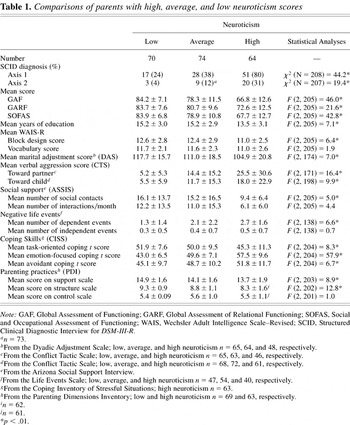
Comparisons of parents with high, average, and low neuroticism scores
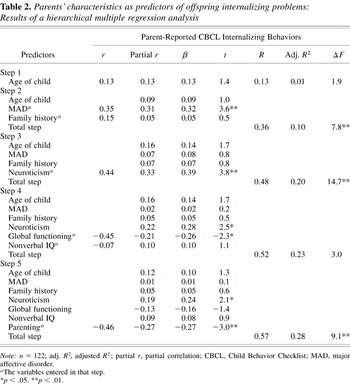
Parents' characteristics as predictors of offspring internalizing problems: Results of a hierarchical multiple regression analysis

Parents' characteristics as predictors of offspring externalizing problems: Results of a hierarchical multiple regression analysis
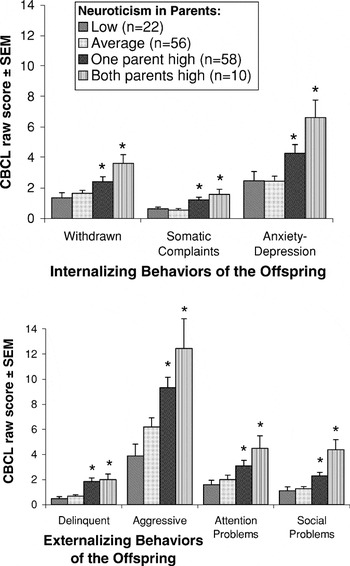
Parent ratings of offspring internalizing, externalizing, attention, and social problems on the Child Behavior Checklist in children (n = 146) with two parents with high neuroticism scores, one parent with a high score on neuroticism, one or two parents with average scores on neuroticism, and two parents with low scores on neuroticism. Children with one or two parents with high scores on neuroticism obtained higher scores on all problem scales than children with parents with low or average scores on neuroticism. *One-way ANOVAs, F (3, 138) = 3.8 − 11.0, p < .05.
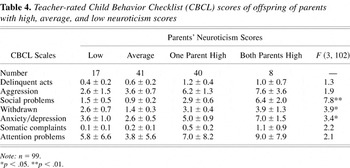
Teacher-rated Child Behavior Checklist (CBCL) scores of offspring of parents with high, average, and low neuroticism scores
 You have
Access
- 71
- Cited by