I. INTRODUCTION
Carbon nanotubes (CNTs), the new members of carbon isomers, were discovered in the soot of the arc-discharge method by Iijima in 1991.Reference Iijima1 Their unique quasi-one-dimensional geometry structures have attracted considerable attention in research for electronic and optical applications.Reference Cui, Wei, Park and Lieber2, Reference Wang, Liu, Liu, Xiang, Li and Gong3 However, CNTs show a variety of electronic behaviors from metallic to semiconducting, depending on the tube diameter and the chirality.Reference Crespi, Cohen and Rubio4–Reference Odom, Huang, Kim and Lieber7 Controlling these parameters during synthesis is still a challenge for current research, which seriously restricts the future applications of CNTs. Doping CNTs with other chemical elements (B or N) provides an effective way to solve this problem.Reference Lin, Lagoute, Chacon, Arenal, Stéphan, Repain, Girard, Enouz, Bresson, Rousset and Loiseau8, Reference Satishkumar, Govindaraj, Harikumar, Zhang, Cheetham and Rao9 Theoretical calculations have demonstrated that substitutional N doping into CNTs gives rise to metallic behaviors, because N atoms provide additional free electrons for the conduction band.Reference Sen, Satishkumar, Govindaraj, Harikumar, Raina, Zhang, Cheetham and Rao10, Reference dos Santos and Alvarez11 Such nanotubes exhibit the advantage that their electronic properties mainly depend on composition and are relatively easy to control.
N-doped MWNTs have been studied extensively.Reference Ma, Wang, Zhou, Jefferson, Chen, Deng, Xu and Yuan12–Reference Wang17 Sen et al. first synthesized N-doped MWNTs by the pyrolysis of aza-aromatics over Co nanoparticles in an Ar atmosphere in 1997.Reference Sen, Satishkumar, Govindaraj, Harikumar, Renganathanb and Rao18 The current-voltage curve of as-grown N-doped MWNTs obtained from UHV-STM studies shows a conductance of 1.2 nA/V, which is higher than that of the undoped MWNTs.Reference Sen, Satishkumar, Govindaraj, Harikumar, Raina, Zhang, Cheetham and Rao10 Suenaga et al. successfully synthesized N-doped MWNTs by the direct current magnetron sputtering method in 1999.Reference Suenaga, Johansson, Hellgren, Broitman, Wallenberg, Colliex, Sundgren and Hultman19 These nanotubes were grown in a highly packed perpendicular form on a sodium chloride substrate. Maldonado et al. prepared N-doped MWNTs with a range of N content from 0 to 10 at% by a floating catalyst chemical vapor deposition (CVD) method.Reference Maldonado, Morin and Stevenson20 The compositional and structural properties of the N-doped MWNTs were studied by x-ray photoelectron spectroscopy (XPS) and Raman microscopy in detail. Recently, well-aligned carbon nitride (CNx) nanotubes have attracted extensive study for their potential application in the field of emission display. Terrones et al. prepared aligned CNx nanotube films by the pyrolysis of melamine over the surfaces of the catalytic metal particles, created by laser etching of thin Fe or Ni film on silica.Reference Terrones, Terrones, Grobert, Hsu, Zhu, Hare, Kroto, Walton, Kohler-Redlich, Ruhle, Zhang and Cheetham21 Han et al. also prepared aligned CNx (x < 0.1) nanotubes by pyrolyzing a ferrocene/C60 mixture at 1050 °C in an ammonia atmosphere.Reference Han, Kohler-Redlich, Seeger, Ernst, Ruhle, Grobert, Hsu, Chang, Zhu, Kroto, Walton, Terrones and Terrones22 Wang et al. reported the field-emission properties of well-aligned CNx nanotubes in a large area with a high content of N (x ≤ 9%).Reference Wang, Liu, Zhu, Zhang, Ma, Yao and Zhang23 The turn-on field was found to be 1.5 V/μm, with a current density of 80 μA/cm2 for the field as low as 2.6 V/μm, considerably better than their undoped counterparts. To synthesize large-scale N-doped MWNTs with high N content, the exact experimental conditions should be taken into account, including the temperature, reaction time, choice of catalyst, and stability of the carbon and N precursors under the given reaction conditions.Reference Ewels24 According to Lee’s report, the reaction temperature has a significant effect on the N content, structure, and crystallinity of N-doped MWNTs.Reference Lee, Lyu, Kim, Lee and Cho25 Liang et al. have also studied the relationship between the growth temperature and the structure of N-doped MWNTs by Raman spectroscopy.Reference Liang, Ding, Zhang, Guo and Du26 However, to date, the mechanisms responsible for this phenomenon have not been studied systematically and the influence of reaction temperature on the yield, bonding properties, and morphology of N-doped MWNTs should also be researched thoroughly.
In this paper, free-standing N-doped MWNTs were synthesized in a large quantity by the CVD method using nano-Ni/bergmeal powder as a catalyst in the temperature range of 750–950 °C. The dependence of the structure, composition, and bonding configuration of the as-grown samples on the growth temperature was analyzed.
II. EXPERIMENTAL
N-doped MWNTs were synthesized by the CVD method using nano-Ni/bergmeal powder as the catalyst and pyridine as both C and N sources. The catalyst (1.0 g) was placed in a ceramic boat and preloaded into a quartz tube reaction chamber. Next, 10 mL pyridine was injected into the tube furnace as a precursor solution at a rate of 0.33 mL/min. The precursor solution was vaporized in the reaction chamber where the temperature is higher than 120 °C, and carried into the reaction zone by the carrier gases. To investigate the effect of temperature, N-doped MWNTs were grown at different temperatures of 750, 800, 850, 900, and 950 °C in atmospheres of Ar or H2 with flow rates of 100 and 40 sccm, respectively. The deposition time was set to 30 min. The initial product, which includes catalyst and amorphous carbon, should be purified before various measurements are carried out. The products were soaked in a 30% hydrofluoric acid solution for 24 h to remove the residual bergmeal, and the residual Ni catalyst was eliminated by a 18% hydrochloric acid solution. Finally, the products were heated in a 30% hydrogen peroxide solution at 90 °C for 6 h to remove the amorphous carbon. After each filtering process, the products were thoroughly rinsed with the deionized water until the pH of the rinsate was neutral. After these processes, the N-doped MWNTs grown at various temperatures had similar purities.
A transmission electron microscope (TEM; TECNAI G22, FEI, The Netherlands) was used to investigate the morphology of the undoped and N-doped MWNTs. The stoichiometries of the carbon and N atoms in the nanotubes and the N bonding configuration were examined by x-ray photoelectron spectroscopy (XPS; ESCALAB 250, Thermo Fisher Scientific, USA). A thermogravimetric analysis (TGA; DSC822/TGA/SDTA851e, Mettler-Toledo, Switzerland) was used to evaluate the thermal stability of N-doped MWNTs. Raman spectroscopy (Renishaw inVia plus, Renishaw, UK) with an excitation wavelength of 632.8 nm was used to estimate the crystallinity of the products. An electronic balance (AL 204, Mettler-Toledo, Switzerland) was used to measure the weight of the products exactly.
III. RESULTS AND DISCUSSION
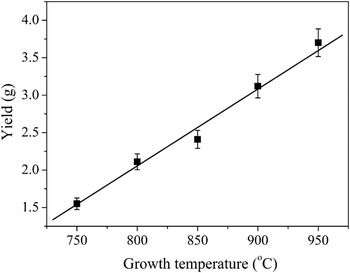
Figure 1 shows the yield of as-grown N-doped MWNTs as a function of growth temperature. As shown in the figure, the weight of N-doped MWNTs grown at 750 °C is measured to be 1.55 g, whereas the weight reaches as high as 3.7 g when the growth temperature is increased to 950 °C. The increasing growth temperature gives a linear increase in the yield of N-doped MWNTs, which means that the growth rate of N-doped MWNTs can be enhanced by an increase in growth temperature. It is well known that CNTs are synthesized by the catalytic decomposition of a carbon-containing gas on a hot surface. The diffusion behavior of C atoms in Ni nanoparticles plays a key role on the growth rate of MWNTs. The diffusion coefficient of C atoms in Ni nanoparticles can be calculated by the following equation:

The yield of N-doped MWNTs as a function of the growth temperature.

where D 0 is the diffusion constant (m2/s), Q is the diffusion activation energy (J), k is Boltzmann’s constant (J/k), and T is the absolute temperature. It can be seen from Eq. (1) that the diffusion coefficient of C atoms in Ni nanoparticles increases exponentially with increasing reaction temperature, which results in an enhanced yield and growth rate.
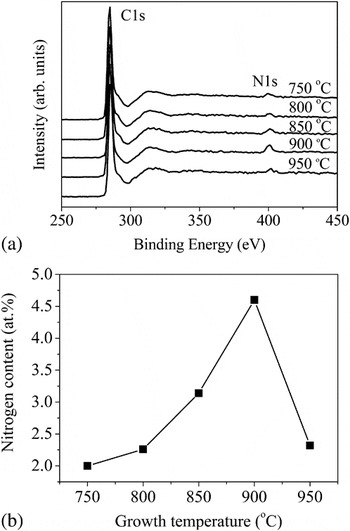
XPS analysis was carried out to investigate the relationship between the growth temperature and N content of the as-grown N-doped MWNTs. The XPS spectra of N-doped MWNTs synthesized at various temperatures are shown in Fig. 2(a). There are two peaks located at 289 and 401 eV, corresponding to C 1s and N 1s signals, respectively.Reference Nath, Satishkumar, Govindaraj, Vinod and Rao27Figure 2(b) shows the average N content in the N-doped MWNTs according to the variation of the growth temperature. The N content in N-doped MWNTs grown at 750, 800, 850, 900, and 950 °C were measured at 2.0, 2.3, 3.1, 4.6, and 2.3 at%, respectively. As the growth temperature increased, the N content increased to a maximum of 4.6 at% at 900 °C and then decreased with further increase in growth temperature.
(a) XPS analysis of N-doped MWNTs grown at the various temperatures. (b) N doping content as a function of growth temperature.

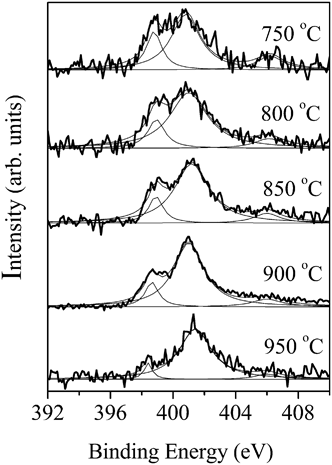
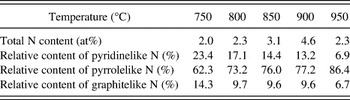
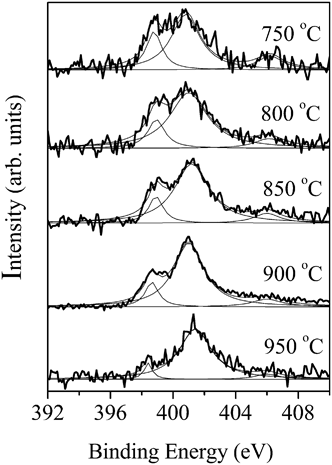
High resolution XPS analysis was adopted to elucidate the identity of N coordination in the N-doped MWNTs. Figure 3 shows the N 1s spectra of N-doped MWNTs prepared at various temperatures. The N 1s signal can be divided into three peaks by Lorentzian fit, locating at 399.0 ± 0.2, 400.9 ± 0.2, and 405.4 ± 0.2 eV, respectively. In general, they are called pyridinelike, pyrrolelike, and graphitelike N bonding.Reference Wang, Liu, Zhu, Zhang, Ma, Yao and Zhang23 In other words, the N atoms are incorporated into the graphitic network in three different bonding characters. The peak at 399.0 eV is assigned a tetrahedral N phase that contributes one p electron to the π-system. The peak at 400.9 eV is assigned a trigonal N phase that contributes two p electrons to the π-system.Reference Wang, Liu, Zhu, Zhang, Ma, Yao and Zhang23, Reference Casanovas, Ricart, Rubio, Illas and Jimenez-Mateos28, Reference Terrones, Terrones, Redlich, Grobert, Trasobares, Hsu, Terrones, Zhu, Hare, Reeves, Cheetham, Rühle, Kroto and Walton29 The peak at 405.4 eV is still difficult to assign, and some researchers suggest it should be assigned to be chemisorbed N oxide,Reference Choi, Park and Kim30, Reference Björnholm, Nilsson, Sandell, Hernnäs and Mrtensson31 or graphitic N.Reference Wang, Liu, Zhu, Zhang, Ma, Yao and Zhang23 The relative content of the three types C-N bonding character are summarized and listed in Table I for the N-doped MWNTs prepared at different temperatures. As shown in Table I, the relative content increases for the pyrrolelike N atoms with an increase in growth temperature, but decreases for the pyridinelike or graphitelike N atoms.
The N 1s XPS spectra of the N-doped MWNTs grown at various temperatures. The Lorentzian fit of the N 1s spectra reveal the presence of three peaks at 399.0 ± 0.2, 400.9 ± 0.2, and 405.4 ± 0.2 eV.
The content of N and relative content of different N-C bonds for the samples prepared at the various temperatures.

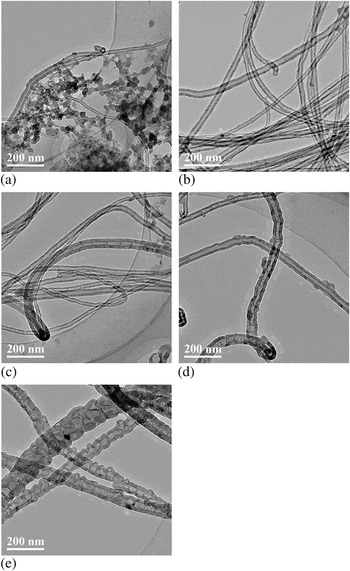
The influence of the growth temperature on the morphology of N-doped MWNTs was analyzed by TEM measurement. Figure 4 shows the typical TEM images of N-doped MWNTs grown at 750, 800, 850, 900, and 950 °C. It is found that N-doped MWNTs synthesized at different temperatures all exhibit a bamboolike structure with a series of compartment layers. However, significant differences in the morphology of nanotubes are also observed. Note that the product prepared at 750 °C is of poor quality, consisting of a few nanotubes and much amorphous carbon. The poor quality of this specimen is due to the fact that the synthesis temperature of 750 °C cannot provide enough thermal energy for the formation of N-doped MWNTs.
TEM images of N-doped MWNTs obtained by the pyrolysis of pyridine in an Ar/H2 atmosphere at the various temperatures: (a) 750 °C, (b) 800 °C, (c) 850 °C, (d) 900 °C, and (e) 950 °C.

The growth temperature can also affect the morphology (i.e., the compartment distance and the diameter) of the as-prepared nanotubes. A slight increase in diameter (10–20%) can be observed with the increase of the growth temperature. Note that nanotubes grown at 950 °C are composed of irregular drumlike nanobells. Similar structures were presented by Nath et al.Reference Nath, Satishkumar, Govindaraj, Vinod and Rao27 The formation of the drumlike nanobells depends on the growth temperature and develops according to the following mechanism. According to the widely accepted push-out growth mechanism, the reaction precursors first decompose on the surface of a catalyst particle, producing H, C, and N atoms. The C and N atoms dissolve within the individual catalyst particles and diffuse through the particles and precipitate to form graphite layers at the catalyst particle surface. The incorporation of N atoms into the graphite network encourages pentagon formation, thus inducing layer curvature during growth.Reference Sjöström, Stafström, Boman and Sundgren32
At this point, our case differs, in that the formation of the curved graphite sheets does not depend solely on the total N content. It can be seen from Fig. 3 and Table I that the relative N content of pyrrolelike structures increases with increased growth temperature. This finding is due to the result that N atoms in a pyrrolelike graphite sheet strongly favor the formation of pentagons, which give rise to the formation of irregular graphite sheets.Reference Wang, Liu, Zhu, Zhang, Ma, Yao and Zhang23, Reference Robertson and Davis33 In the most extreme case, drumlike nanobells are formed at the higher temperature of 950 °C. The mechanism for the development of this morphology is as follows. When tens of graphite layers are formed, the carbon shell outside the particles is pushed out suddenly as the stress in the layers accumulates to a critical value. Then another carbon shell is formed outside of the particle, which is again pushed out by the formation of another nanobell.Reference Zhong, Liu, Zhang and Wang34 In this process, metal particles are ejected in a direction contrary to the growth direction. According to Eq. (1), the diffusion rates of C and N atoms within a nickel particle increase with the increase in temperature. In addition to the more violent catalytic reactions at a higher temperature, more layers are formed on the surface of the particle, resulting in a rapid accumulation of stress on the catalyst particle. Note that plastic deformation readily occurs at high temperatures. The particle is squeezed and plastically deformed to an elliptic shape at a temperature of 950 °C. Note that graphite layers preferentially form where there is a high stress accumulation. When the catalyst particles are pushed out, the graphite layer is distorted by the stress and forms the drumlike structure. The deformation of the catalyst particle is also a reason for the formation of the drumlike structure.
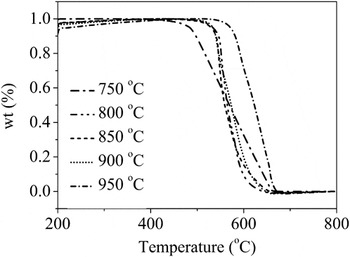
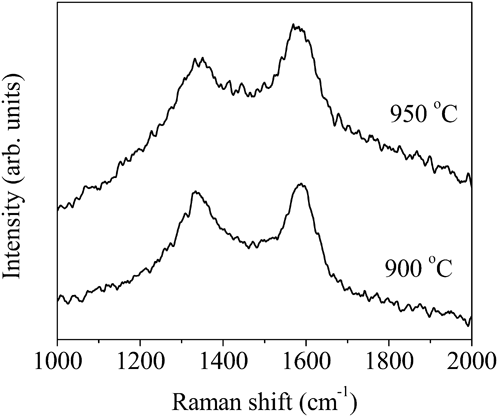
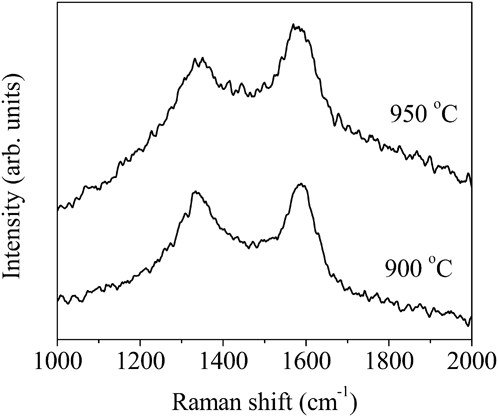
The thermal stability of N-doped MWNTs was evaluated by the TGA measurement. Figure 5 shows the weight loss in percentage of N-doped MWNTs prepared at various temperatures as a function of the oxidizing temperature. The percentage weight loss curve between 200 and 800 °C is plotted by adjusting 100% for the weight loss at 800 °C. As shown in Fig. 3, the N-doped MWNTs synthesized at 800, 850, and 900 °C possess a similar oxidizing temperature of 506 °C even though they have different N content. The sample prepared at 950 °C possesses the highest oxidizing temperature of 535 °C. It is no wonder that the sample prepared at 750 °C starts to gasify at the lowest temperature (443 °C), because the products have a high content ofamorphous carbon and carbon nanoparticles. The thermal stability of N-doped MWNTs is affected not only by the N content, but also by the growth temperature. The crystallinity of the graphite sheets decreases with increasing N content by introducing more N atoms into the graphite lattice,Reference Maldonado, Morin and Stevenson20, Reference Lee, Kim, Bae, Park, Yu, Ryu and Lee35 which may result in a worse thermal stability. On the other hand, the crystallinity of CNTs tends to increase with the increase in growth temperature, which results in a better thermal stability. The apparent thermal stability of our samples should be a total effect of the two factors. That is the reason why the oxidizing temperatures are almost the same for the samples prepared in the range of 800–900 °C. However, a higher oxidizing temperature appears for the sample prepared at 950 °C. This result can be explained by the decrease in N content. The first-order Raman spectra for N-doped MWNTs prepared at 900 and 950 °C are presented in Fig. 6. There are two obvious bands located at ~1332 cm−1 (D band) and ~1586 cm−1 (G band). The intensity ratio of the D mode to G mode is usually applied to estimate the local defects in the graphite sheets. The I D/I G is measured at 0.95 for N-doped MWNTs prepared at 900 °C and at 0.82 for those prepared at 950 °C, which indicates N-doped MWNTs prepared at 950 °C possess better crystallinity. The Raman measurement result is consistent with the TGA data.
TGA data of weight loss (%) versus oxidation temperature for N-doped MWNTs grown at the various temperatures.

The first-order Raman spectra of N-doped MWNTs prepared at 900 and 950 °C.
IV. CONCLUSIONS
In conclusion, N-doped MWNTs were synthesized by the pyrolysis of pyridine at various temperatures in the range of 750–950 °C. N-doped MWNTs with high purity can be massively synthesized in the range of 800–950 °C. Increasing growth temperature gives rise to an increase in growth rate. The N content of N-doped MWNTs synthesized at 750, 800, 850, 900, and 950 °C are about 2.0, 2.3, 3.1, 4.6, and 2.3 at%. N-doped MWNTs synthesized at 950 °C present a unique drumlike structure with the highest oxidation temperature (535 °C). The deformation of catalyst particles is the dominant mechanism responsible for the drumlike structures. Further, the thermal stability of the samples can be decreased by an increase in N content but enhanced by an increase of the prepared temperature. The growth temperature provides a simple but effective way to control the composition and structure of N-doped MWNTs.
ACKNOWLEDGMENTS
This work is supported by the National Natural Science Foundation of China (Grant Nos. 50772018 and 50402025), the Program for New Century Excellent Talents in University of China (NCET-07-0139).