Introduction
Almond cultivation in Morocco is represented by two sectors of production: modern, consisting of regular orchards with selected varieties, and traditional, based on open pollinated seedlings (Laghezali, Reference Laghezali1985; Mahhou and Dennis, Reference Mahhou and Dennis1992; Lansari et al., Reference Lansari, Azoulay and Kester1998; Oukabli et al., Reference Oukabli, Mamouni, Laghezali, Oufquir, Quennou, Amahrach, Lahlou, Allabou, Mekkaoui and Ibrahimi Abdelwafi2006, 2013; Oukabli, Reference Oukabli2011; Kodad et al., Reference Kodad, Oukabli, Mamouni, Socias i Company, Estopañán and Juan2011). Outbreeding events are enhanced by the species gametophytic self-incompatibility (Socias i Company, Reference Janick1990) and therefore contribute to the extension of genetic diversity. The use of selected varieties in commercial orchards restricts the genetic diversity of the species and limits the progress made in breeding programmes. Plant collections carried out in the South of Morocco (Barbeau and El Bouami, Reference Barbeau and El Bouami1979), in the North of Morocco (Laghezali, Reference Laghezali1985), and in the Center and South of Morocco (Oukabli et al., Reference Oukabli, Mamouni, Laghezali, Oufquir, Quennou, Amahrach, Lahlou, Allabou, Mekkaoui and Ibrahimi Abdelwafi2006, 2007) have led to the establishment of local plant material along with foreign varieties in a single collection. This collection represents an essential resource for maintaining and widening the genetic diversity that remains and would be valuable in breeding programmes combining important traits.
The assessment of genetic diversity and relationships between almond varieties is of great importance in the determination of gene pools, development of conservation strategies and identification of genetic resources (Gradziel et al., Reference Gradziel, Martinez-Gómez, Dicenta and Kester2001; Martínez-Gómez et al., Reference Martínez-Gómez, Arulsekar, Potter and Gradziel2003; Xie et al., Reference Xie, Sui, Chang, Xu and Ma2006; Fernández i Martí et al., Reference Fernández i Martí, Alonso, Espiau, Rubio-Cabetas and Socias i Company2009; El Hamzaoui et al., Reference El Hamzaoui, Oukabli, Charafi and Moumni2013). Tools developed for the study of the genetic structure of plants are mainly molecular and morphological in nature (Martínez-Gómez et al., Reference Martínez-Gómez, Sánchez-Pérez, Rubio, Dicenta, Gradziel and Sozzi2005). The combination of approaches using these two types of tools is a main priority in the characterization of germplasm, which leads to knowledge and a better understanding of the genetic structure and diversity and definition of core collections (Martínez-Gómez et al., Reference Martínez-Gómez, Sánchez-Pérez, Rubio, Dicenta, Gradziel and Sozzi2005; Čolić et al., Reference Čolić, Rakonjac, Zec, Nikolić and Akšić2012; Zeinalabedini et al., Reference Zeinalabedini, Sohrabi, Nikoumanesh, Imani and Mardi2012).
If morphological evaluation is essential for germplasm characterization, molecular markers act as useful tools for characterizing agricultural crop diversity. Among the various molecular markers, microsatellites, defined as short tandem repeats, are widely used because of their high frequency and dispersion throughout the genome (in both coding and non-coding regions), high polymorphism, co-dominant inheritance, transferability to related taxa, and reproducibility (Gupta et al., Reference Gupta, Balyan, Sharma and Ramesh1996; Martínez-Gómez et al., Reference Martínez-Gómez, Sánchez-Pérez, Dicenta, Howad, Arús, Gradziel and Kole2007; Wünsch, Reference Wünsch2009; El Hamzaoui et al., Reference El Hamzaoui, Oukabli, Charafi and Moumni2012, Reference El Hamzaoui, Oukabli, Charafi and Moumni2013).
In previous studies, the genetic structure of Moroccan almond germplasm has been investigated on the basis of traditional multivariate statistical analysis (El Hamzaoui et al., Reference El Hamzaoui, Oukabli, Charafi and Moumni2012, Reference El Hamzaoui, Oukabli, Charafi and Moumni2013). Recently, a new method has been developed for studying structure in natural populations using molecular markers and structure analysis (Pritchard et al., Reference Pritchard, Stephens and Donnelly2000). This method can be used to study genetic structure and diversity in germplasm collections (Zeinalabedini et al., Reference Zeinalabedini, Sohrabi, Nikoumanesh, Imani and Mardi2012). The objectives of the present study were to evaluate both local and foreign varieties maintained in the INRA collection (Morocco) for morphological diversity and to analyse the collection using the Bayesian clustering approach. In this way, the collection's genetic diversity can be assessed and potential new genitors can be identified for the creation of new almond varieties and the optimization of conservation and management of plant resources.
Materials and methods
Plant material
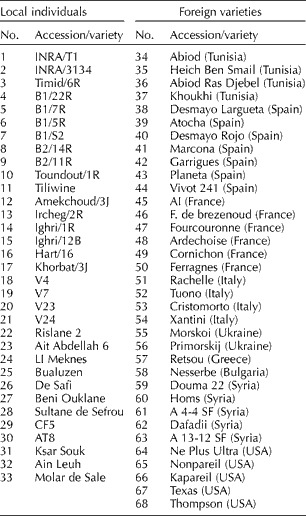
The plant material used in this study included 33 local Moroccan almond accessions collected in different regions of Morocco and 35 introduced foreign varieties considered as references from different countries planted at the INRA experimental station in Ain Taoujdate (Table 1). Local varieties were selected on the basis of their agronomic characteristics such as productivity and fruit size and of their late flowering. The trees were 6 years old at the onset of the study, planted at a spacing of 5 m × 3 m, irrigated with drip (1500 m3/ha), and subjected to regular horticultural practices (pruning, fertilization and pest treatments).
Clones and almond cultivars used in the study

Morphological evaluation
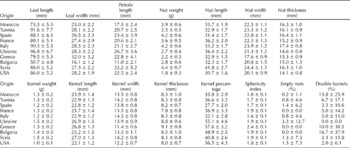
Observations were made for a period of 2 years (2010 and 2011) and were focused on 15 morphological traits related to leaf and fruit based on descriptors of the almond tree developed by Bioversity International (Gülcan, Reference Gülcan1985) (Table 2, Tables S1 and S2, available online). Morphological traits studied were leaf length (mm), leaf width (mm), petiole length (mm), nut length (mm), nut width (mm), nut thickness (mm), nut weight (g), kernel length (mm), kernel width (mm), kernel thickness (mm), kernel weight (g), kernel percentage (kernel weight/nut weight) × 100), sphericity index (kernel length/kernel width), empty nuts (%) and double kernels (%). These measurements were carried out on 30 leaves and 30 fruits per accession.
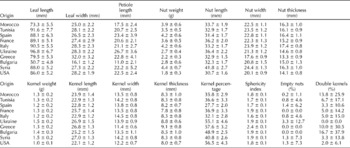
Mean statistics per origin of the morphological traits of the 68 tested almond clones/cultivars
Data were analysed using hierarchical classification based on the farthest-neighbour analysis using the Gower general similarity coefficient (Gower, Reference Gower1971) with the MVSP software (version 3.1; Kovach Computing services, Pentraeth, Wales, UK). Principal component analysis (PCA) was carried out using the standardized mean values for each accession. This statistical procedure reduces the dimensions of the original data matrix and transforms independent variables into autonomous ones. Factor loadings >0.6 were considered to be significant. When data were denoted through percentages of proportions, an arcsine transformation was conducted to ensure a normal distribution. Statistical analysis was carried out using the SPSS statistics software version 17.0 (SPSS, 2008).
Molecular assessment
After flowering, young leaves were collected from each sample and total genomic DNA was extracted according to the method described by Doyle and Doyle (Reference Doyle and Doyle1987). It was quantified using a spectrophotometer and diluted to 20 ng/μl and then stored at 20°C for PCR amplification.
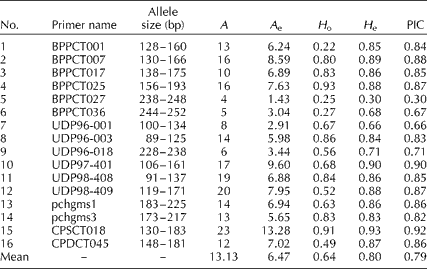
The DNA was amplified by PCR using 16 microsatellite primer pairs (Table 3) developed based on peach (Cipriani et al., Reference Cipriani, Lot, Huang, Marrazzo, Peterlunger and Testolin1999; Sosinski et al., Reference Sosinski, Gannavarapu, Hager, Beck, King, Ryder, Rajapakse, Baird, Ballard and Abbott2000; Testolin et al., Reference Testolin, Marrazzo, Cipriani, Quarta, Verde, Dettori, Pancaldi and Sansavini2000; Aranzana et al., Reference Aranzana, García-Mas, Carbó and Arús2002; Dirlewanger et al., Reference Dirlewanger, Crosson, Tavaud, Aranzana, Poizat, Zanetto, Arús and Laigret2002) and selected for their high polymorphism. Amplification reactions were carried out in a volume of 10 μl using the Taq PCR Master Mix Kit (QIAGEN PCR buffer) containing DNA, Taq polymerase and dNTPs and the QIAGEN Multiplex PCR Kit containing MgCl2, 2 pmol of each primer and 20 ng of genomic DNA. PCR programme included an initial denaturation step at 95°C for 5 min, 35 cycles of 30 s at 94°C, and 1 min at annealing temperature and 1 min at 72°C, followed by a terminal phase of 7 min at 72°C. PCR products were detected using a capillary ABI3130 XL 16 sequencer. The standard marker used in the sequencer was GeneScan™ 500 Liz® (Applied Biosystems).
Names and sequences of the 16 nuclear-microsatellite primer pairs and their calculated diversity data used in the study

A, number of alleles observed; A e, effective number of alleles; H o, observed heterozygosity; H e, expected heterozygosity; PIC, polymorphic information content.
The sizes of fragments were determined automatically using the Gene Mapper 4.0 software (Applied Biosystems). The information obtained using the 16 simple sequence repeats (SSRs) (Table 3) allowed the calculation of several parameters of diversity. To analyse different genetic diversity data, PopGene 1.32 (Yeh et al., Reference Yeh, Yang, Boyle, Ye and Xiyan2000) was used. Various parameters were calculated including the number of observed alleles (A), effective number of alleles (A e), expected heterozygosity (H e) and observed heterozygosity (H o). Polymorphic information content (PIC) was calculated as described by Botstein et al. (Reference Botstein, White, Skolnick and Davis1980) and modified as described by Anderson et al. (Reference Anderson, Churchill, Sutrique, Tanksley and Sorrels1993).
Differences among the samples were calculated with the Bayesian clustering approach using the Structure software version 2.3.1 (Hubisz et al., Reference Hubisz, Falush, Stephens and Pritchard2009). This software generates clusters of individuals that are based on their genotypes at multiple loci. A model of ancestry that involved admixture and the correlated allele frequency model with a burn-in period of 50,000 iterations and 50,000 Markov Chain Monte Carlo repetitions were used to calculate the probable number of genetic clusters (K). Ten independent runs for each value of K ranging from 2 to 10 were performed, and the ΔK method of Evanno et al. (Reference Evanno, Regnaut and Goudet2005) was used to choose the most likely value of K. A graphical representation of genetic structure with the highest likelihood was produced.
Results
Leaf characteristics
Descriptive statistics for three morphological leaf traits are given in Table 2 and Table S1 (available online). A large variability in these traits was observed among the varieties from each country and between those of different geographical origins. The Ukrainian varieties had larger leaves, averaging 96.8 mm in length and 28.3 mm in width, while the Bulgarian accessions were characterized by smaller leaves, 50.7 mm in length and 16.1 mm in width. Mean petiole length varied between 11.0 and 26.7 mm for the Bulgarian and Ukrainian varieties, respectively (Tables 2 and Table S1 (available online)).
Pomological characteristics
Statistical data related to 12 morphological fruit traits are given in Table 2 and Table S2 (available online). All the varieties exhibited a high variation in these traits. With respect to nut dimensions, the Syrian varieties were characterized by the biggest nuts (41.8 and 24.4 mm for averages of length and width, respectively). The Italian varieties had the thickest nuts (on average, 17.4 mm). By contrast, the American varieties were characterized by the smallest nuts with averages of 30.7, 20.1 and 14.1 mm for length, width and thickness, respectively. The Syrian varieties had the highest nut weights (on average, 4.4 g), while the American varieties had the lowest nut weights (on average, 1.8 g). Kernel dimensions (length, width and thickness) and their weights followed the same pattern as the nut dimensions. In fact, the Syrian and American varieties had, respectively, the highest and lowest values for these traits. The Syrian varieties had values of 1.5 g for kernel weights, while the American varieties had values close to 1.0 g. Large variations in kernel percentage were detected between the whole varieties. The Greek variety had the highest yield (57.6%), followed by the American varieties with a yield of 56.5%, on average. However, the Spanish varieties had low kernel percentage (on average, 27.7%). The studied accessions also exhibited large variations in sphericity index. The Greek variety had the highest sphericity index (2.4), while the Italian varieties had the lowest sphericity index (1.6). The percentage of empty nuts was generally low for all the varieties: ‘Garrigues’ and ‘Primorskij’ had the highest values (6.7%) for this trait (Table S2, available online). Double kernel percentage was low for most of the varieties, except for the Moroccan accessions, which had slightly higher values, reaching 70% for the ‘Ighri/12b’ accession (Table S2, available online).
Morphological relationships
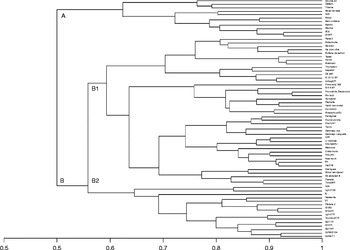
Morphological relationships among the almond accessions are shown in Fig. 1, and the measured traits for each group are summarized in Table S3 (available online). Genotypes were divided into two groups: group A and group B. Group A comprised accessions characterized by the highest averages for most of studied traits (leaf length and leaf width and nut and kernel weight and dimensions). It also had the highest sphericity index compared with group B (Fig. 1 and Table S3 (available online)). The latter can be subdivided into two clusters: cluster B1 and cluster B2. Cluster B1 comprised varieties that had the highest averages for petiole length and empty nut percentage (Fig. 1 and Table S3 (available online)). Cluster B2 comprised varieties that had the lowest averages for the majority of morphological traits, but the accessions in this cluster were distinguished by the highest kernel percentage (39.7%) (Fig. 1 and Table S3 (available online)).
Farthest-neighbour dendrogram based on the Gower general similarity coefficients for morphological traits of 68 almond cultivars.

The morphological similarity matrix derived from the 68 accessions indicated that the most similar accessions were ‘Ain Leuh’ and ‘Fournat de Brezenoud’ (0.943), followed by ‘Sultane de Sefrou’ and ‘Ne Plus Ultra’ (0.935). The similarity value for groups A and B was 0.50 and that for clusters B1and B2 was 0.558.
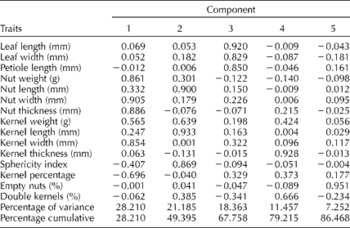
Results of PCA placed all traits into five components which explain 86.5% of the total variation. The eigenvalues and percentage of variance associated with each principal component are given in Table 4. The first component (PC1) accounted for 28.2% of the total variation related to nut weight, nut width, nut thickness, kernel width and kernel percentage with the highest loading values. The second component (PC2) accounted for 21.2% of the total variation related to nut length, kernel weight, kernel length and sphericity index with the highest loading values. The third component (PC3) accounted for 18.4% of the total variation mainly related to leaf traits. The fourth component (PC4) accounted for 11.5% of the total variation related to kernel thickness and double kernels. The fifth component (PC5) accounted for 7.3% of the total variation related to only the empty nut trait (Table 4).
Eigenvalues and percentage of variance for the first five principal components among the 15 traits for the 68 almond cultivars

Molecular assessment
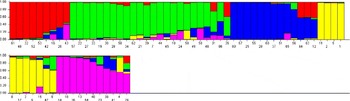
High molecular variability was detected in the studied plant materials. A total of 210 alleles were generated for all the genotypes with the 16 studied SSRs, ranging from 4 for the locus ‘BPPCT027’ to 23 for the locus ‘CPSCT018’. The A e ranged from 1.43 to 13.28 with an average of 6.47 per locus. The sizes of alleles ranged from 89 to 252 bp (Table 3). The mean of H o per locus was 0.64, ranging from 0.22 for the locus ‘BPPCT001’ to 0.93 for the locus ‘BPPCT025’, and the H e ranged from 0.30 for the locus ‘BPPCT027’ to 0.93 for the locus ‘CPSCT018’, with an average of 0.80 per locus. PIC values ranged from 0.30 to 0.92 with an average of 0.79 per locus, with the highest and lowest values being obtained for the loci ‘CPSCT018’ and ‘BPPCT027’, respectively (Table 3). Bayesian clustering analysis revealed five clusters using the Structure software (Fig. 2).
Bar plots for individual almond samples generated by the Structure software version 2.3.1 on the basis of 16 SSR markers. The groups are represented by different colours. Each bar is divided into segments indicating its genetic composition. The longer the segment, the more the sample resembles one of the groups. The labels below the bar plots are the corresponding numbers for each individual, based on the data given in Table 1.

Discussion
Phenotypic characterization of almond varieties of different geographical origins in an ex situ collection revealed the existence of high diversity in the measured traits. The majority of Moroccan varieties have small leaves in comparison with the varieties from Mediterranean countries. These results are in agreement with the arid climatic conditions of the area from where these varieties were collected. These observations are consistent with those reported by Lansari et al. (Reference Lansari, Iezzoni and Kester1994), who stated that differences in effective leaf size are due to natural selection for drought resistance conditions. Similarly, Talhouk et al. (Reference Talhouk, Lubani, Baalbaki, Zurayk, AlKhatib, Parmaksizian and Jaradat2000) and Sorkheh et al. (Reference Sorkheh, Shiran, Rouhi, Asadi, Jahanbazi, Moradi, Gradziel and Martínez-Gómez2009) found that almond populations located in dry areas have smaller leaf sizes than those located in humid regions. Consequently, these traits could be considered as potential traits for drought tolerance, especially when the main goal is the establishment of orchards under rain-fed conditions (Nikoumanesh et al., Reference Nikoumanesh, Ebadi, Zeinalabedini and Gogorcen2011). Differences in pomological characteristics between varieties are associated with the origin of the plant material wherein some traits are improved in foreign varieties, but have not yet been established in the Moroccan accessions. In comparison with the results obtained in the same climatic context but under rainfall conditions (Oukabli et al., Reference Oukabli, Mamouni, Laghezali, Oufquir, Quennou, Amahrach, Lahlou, Allabou, Mekkaoui and Ibrahimi Abdelwafi2006), the increase in kernel weight was about 32% and abortion rates were generally lower and less than 23% found in some varieties. The loading of trees for increased production can lead to a strong competition for hydro-mineral resources and therefore contribute to reduced nut size. Varietal sensitivity to drought could also be responsible for the high level of nut abortion (Oukabli et al., Reference Oukabli, Mamouni, Laghezali, Oufquir, Quennou, Amahrach, Lahlou, Allabou, Mekkaoui and Ibrahimi Abdelwafi2006). The high average of double kernel rates (13.8%) obtained for the Moroccan accessions reflects the selection pressure practised by farmers on the local plant material derived from seedlings, as has been reported in previous studies (Lansari et al., Reference Lansari, Iezzoni and Kester1994; Oukabli et al., Reference Oukabli, Mamouni, Laghezali, Oufquir, Quennou, Amahrach, Lahlou, Allabou, Mekkaoui and Ibrahimi Abdelwafi2006). Therefore, kernel quality was lower than that of the foreign varieties, which were probably selected against this trait.
Morphological classification led to the separation of the 68 varieties into two distinct groups where their similarity coefficient (0.761) was slightly higher than the value reported by Kadkhodaei et al. (Reference Kadkhodaei, Shahnazari, Khayyam Nekouei, Ghasemi, Etminani, Imani and Ariff2011) when studying 53 almond genotypes from Iran (value of 0.453). This result indicates a decrease in morphological diversity, similar to the restriction in molecular diversity level as reported by El Hamzaoui et al. (Reference El Hamzaoui, Oukabli, Charafi and Moumni2012) for almonds in Morocco compared with the centre of origin. Varieties from the same country did not form a ‘cluster’ alone. Genetic proximity between the varieties from different regions could be explained by the exchange of plant material between countries and by the probable existence of common ancestors (Grasselly, Reference Grasselly1972; Oukabli et al., Reference Oukabli, Mamouni, Laghezali, Oufquir, Quennou, Amahrach, Lahlou, Allabou, Mekkaoui and Ibrahimi Abdelwafi2006; El Hamzaoui et al., Reference El Hamzaoui, Oukabli, Charafi and Moumni2013). Proximity of some Moroccan accessions with some American almond varieties was found, and this result confirms an advantage of the hypothesis suggested by Grasselly (Reference Grasselly1972).
SSR loci used in this study are powerful; they revealed sufficient alleles to characterize all the genotypes. The increase in A e (and not necessarily the total number of alleles per locus) led to an increase in H e and also indirectly to an increase in the ability of the loci for the separation of genotypes through an increase in the number of allelic genotypes as reported by Kadkhodaei et al. (Reference Kadkhodaei, Shahnazari, Khayyam Nekouei, Ghasemi, Etminani, Imani and Ariff2011). The high mean value of PIC (0.79) indicated that microsatellite markers exhibited high performance in genetic identification. The grouping of most varieties was done by country and genetic proximity, as has been shown in a previous study by El Hamzaoui et al. (Reference El Hamzaoui, Oukabli, Charafi and Moumni2013). This could be due to DNA sharing by plants from similar regions through intra-location hybridization among them (Nikoumanesh et al., Reference Nikoumanesh, Ebadi, Zeinalabedini and Gogorcen2011).
In comparison with morphological classification, varieties were divided into five groups according to the Bayesian clustering approach and therefore exhibited high degree of separation on analysis using molecular tools. There is some agreement between the two grouping approaches used in this study where American cultivars and some Moroccan accessions were found to be close genetically. Molecular markers are used to investigate the whole genome, including both coding and non-coding regions, while morphological traits are related to only coding regions (Williams et al., Reference Williams, Kubelik, Livak, Rafaiski and Tingey1990; Kumar, Reference Kumar1999). Several studies have compared the use of morphological and molecular techniques and showed a low level of correlation between both the techniques (Sorkheh et al., Reference Sorkheh, Shiran, Gradzeil, Epperson, Martinez-Gómez and Asadi2007; Kadkhodaei et al., Reference Kadkhodaei, Shahnazari, Khayyam Nekouei, Ghasemi, Etminani, Imani and Ariff2011; Nikoumanesh et al., Reference Nikoumanesh, Ebadi, Zeinalabedini and Gogorcen2011; Zeinalabedini et al., Reference Zeinalabedini, Sohrabi, Nikoumanesh, Imani and Mardi2012).
Almond collections established with both local and foreign genotypes present some genetic variability, which is necessary for national breeding programmes to improve some morphological traits. For example, the varieties ‘Molar de Sale’ and ‘B1/5R’ (Morocco), ‘Xantini’ (Italy) and ‘Primorskij’ (Ukraine) are interesting for their high average kernel weights (>1.5 g). The varieties ‘De Safi’ (Morocco) and ‘Thompson’, ‘Kapareil’ and ‘Nonpareil’ (USA) are important for their kernel percentage. This study demonstrates that there is rich and valuable plant material available in the INRA collection for almond improvement. It constitutes the first insight, based on morphological and molecular analyses, into the genetic structure and diversity of Moroccan almond germplasm.
Supplementary material
To view supplementary material for this article, please visit http://dx.doi.org/10.1017/S1479262114000094
Acknowledgements
This study was supported by the Moroccan National Agricultural Research Institute (INRAM) and by the PRAD Project No. 10-06, which includes ‘Centre d'Ecologie Fonctionnelle et Evolutive’, UMR CEFE (Montpelier, France) and ‘Centre Regional de l'INRA Meknès, Maroc’ and the Fruit Med project. DNA extraction was performed at the INRA and genotyping was carried out at ‘Service Commun de Marqueurs Génétiques en Ecologie’ of the CEFE. The authors are grateful to all the members of the ‘Service Commune de Marqueurs Génétiques en Ecologie’ for their technical assistance.