Introduction
Haiti is among the top 20 countries in the world requiring international humanitarian assistance.1 The devastating 2010 earthquake, subsequent cholera epidemic, baseline food insecurity, and recent impact of Hurricane Matthew (2016) all quickly overwhelmed a country whose front-line medical staff have limited knowledge in disaster management. In general, countries most affected by disasters are often those with the highest economic, environmental, political, societal, and security fragility.2 This fragility limits these countries’ ability to weather the impact of disasters.3
International humanitarian response strives “to provide a needs-based emergency response aimed at preserving life, preventing and alleviating human suffering, and maintaining human dignity wherever the need arises if governments and local actors are overwhelmed, unable, or unwilling to act.”4 Standards have been defined by the global community and include, among others, the Sphere standards, the Core Humanitarian Standard, and the International Committee of the Red Cross (ICRC; Geneva, Switzerland) Code of Conduct.Reference Greaney, Pfiffner and Wilson5–7 Yet, despite global progress in education on and standards for international humanitarian response, integration of local actors in low-resource countries remains limited.
As of December 2018, ReliefWeb, a specialized digital information service for the Office for the Coordination of Humanitarian Affairs of the United Nations (UN-OCHA; New York USA/Geneva, Switzerland), listed 610 training workshops available globally. Of those focusing on subjects related to international humanitarian response, only two were located in countries where humanitarian crises and disasters had the most impact.8
With this limited availability, it is a challenge for local actors to access training that allows them to effectively and efficiently interact with and access international response mechanisms. Becoming an informed local partner requires understanding the UN-OCHA coordination system, its minimum standards, and many international actors, items that are generally not on the radar of national disaster officials in disaster-prone countries with limited resources.Reference Walker, Hein, Russ, Bertleff and Caspersz9
In May 2017, the first Haiti Humanitarian Response Course (HHRC) was implemented in Mirebalais, Haiti to increase capacity of those who will be in the front lines of the next disaster and allow for effective engagement with international humanitarian actors. Although one prior training on Sphere standards occurred in 2011, to the authors’ knowledge, this is the first multi-day, interactive course on international humanitarian response systems to train local responders in their own community. This paper outlines the course, which can provide the foundation for similar programs in the future.
Report
Ethical Approval
This article describes a programmatic implementation of a course and data collected for future course improvement. No research studies were done during the execution of this course.
Course Site
The HHRC was executed at Hôpital Universitaire de Mirebalais (HUM) in Mirebalais, Haiti. Located in central Haiti and opened in 2013, HUM is jointly run by Partners In Health/Zanmi Lasante and the Haitian government. The HUM is a 300-bed teaching hospital with a primary catchment area of 180,000 and a secondary catchment area of 2.4 million people. The HUM emergency department has an annual volume of approximately 15,000 patients, and its out-patient clinics serve over 1,000 patients per day.10 The HUM is one of Haiti’s four major referral centers and has the country’s only Emergency Medicine (EM) residency program.
Course Faculty
In collaboration with the HUM Department of Medical Education and EM residency program, four physicians from the Division of Global Emergency Care and Humanitarian Studies at Brigham and Women’s Hospital in Boston, Massachusetts (USA) facilitated the HHRC course. All course faculty had prior experience in Haiti as humanitarian responders and/or as partners of the HUM EM residency program. A local psychologist taught the portions of the course on mental health and resilience.
Course Overview
Accounting for trainer availability and a desire to repeat the course twice to train as many participants as possible while assuring continued clinical coverage at HUM, training duration was set at three days. The HHRC course included 11.5 hours of lectures with simulation activities and 5.5 hours of interactive group exercises. Prior to the course, participants had to complete the online Building a Better Response and Sphere Handbook in Action E-learning courses in either French or English,11,12 for a total of 15 hours of pre-course preparation.
The HHRC course curriculum, introduced and applied through lectures, simulation activities, and group exercises, focused on a simulated scenario centered around response to a major earthquake. The sensitivity of this scenario to local participants, in light of the 2010 earthquake, was discussed prior to the course and approved by local stakeholders. To provide a team-building environment and simulate coordination with UN-OCHA, course participants were divided into teams, each simulating well-known nongovernmental organizations (NGOs). Each team assessed the disaster scenario through their NGO’s lens using information presented through lectures and simulated interactive exercises. For the culminating course activity, teams developed and presented a proposed action plan from their NGO to potential “funders,” played by the course directors. Because The Sphere Handbook: Humanitarian Charter and Minimum Standards in Humanitarian Response is one of the most widely accepted and respected resources created to improve accountability and quality of humanitarian aid, the HHRC curriculum focused on key components, core principles, and defined minimum standards of this resource.Reference Greaney, Pfiffner and Wilson5 Slides and educational materials were presented in English, though sessions were taught in a mix of English and French, depending on the individual facilitator.
Participants
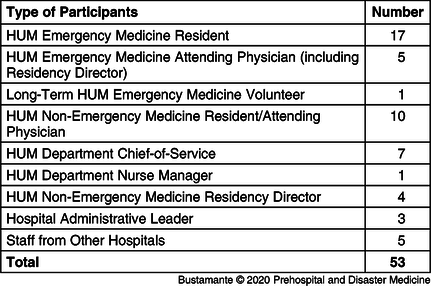
The course was repeated twice and a total of 53 staff members participated. Given their training and their anticipated roles as future emergency response teachers and trainers for other Haitian hospitals, EM physicians and staff were prioritized for the course. All EM physicians and nurse leaders were invited to attend, and other hospital services (medicine, pediatrics, surgery, orthopedics, intensive care unit, rehabilitation, pharmacy, and mental health) were invited to send one to four participants, depending on their department’s size. Although not all of these departments are traditionally trained in disaster response, increasing their capacity is important in the local context, as these services all play roles in responding to local disasters. Hospital leadership was also invited, as were two to four participants from each of the other Haitian academic teaching hospitals and one partner hospital. Table 1 describes the breakdown of participants. To ensure participants had adequate one-on-one instruction, enrollment was limited to 30 participants per course (for four facilitators).
Course Participants

Abbreviation: HUM, Hôpital Universitaire de Mirebalais.
Course Curriculum
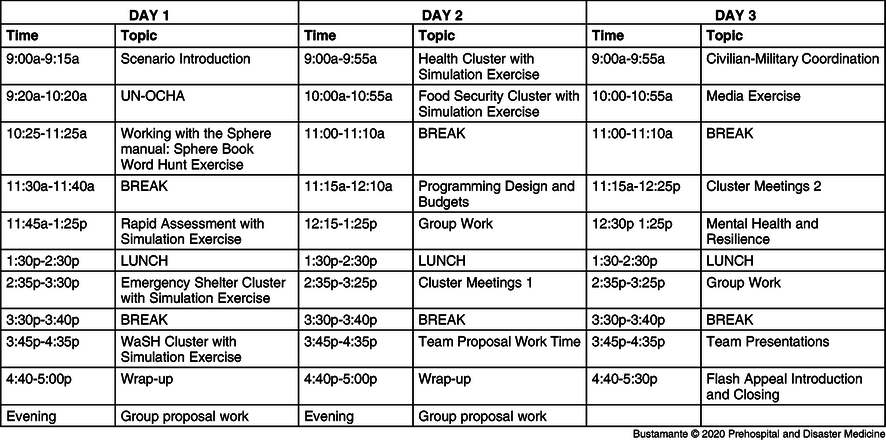
Table 2 outlines the course curriculum. Participants were first introduced to the UN-OCHA cluster approach and Sphere standards. After a brief introduction to the organization and coordination of international humanitarian response, participants completed a simulated rapid assessment using previously recorded videos and in-person actors to represent local community members, health officials, and government officials. These individuals revealed facts about the aftermath of the simulated earthquake disaster, used to complete the rapid assessment and for subsequent exercises calculating minimum standards.
Course Curriculum Outline

Abbreviations: UN-OCHA, United Nations Office for the Coordination of Humanitarian Affairs; WaSH, water, sanitation, and hygiene.
Following the rapid assessment, a series of lectures and exercises familiarized participants with key UN-OCHA clusters: Emergency Shelter; Water, Sanitation, and Hygiene (WaSH); Food Security; and Health. For each subject area, participants calculated minimum standards through interactive group exercises based on the simulated earthquake scenario. Each team had access to a copy of the Sphere Handbook for reference throughout the course.
The course also introduced concepts of response program design, proposal development, budgeting, and coordination between civilian and military entities. A media skills lecture prepared participants for media interviews and included an exercise where one participant from each group was asked to represent their NGO for a simulated on-camera interview. These interviews were played to participants to demonstrate common pitfalls and best practices for media communication.
The second day concluded with a simulated cluster meeting, during which teams cross-referenced information from lectures and the rapid assessment exercise to calculate minimum standards and begin to plan a response. Course facilitators represented leads from the Emergency Shelter, WaSH, Food Security, and Health clusters, and participants represented their assigned NGOs during the meeting. This exposed participants to the cluster meeting format and allowed facilitators to clarify facts, if needed. By design, the participants represented large international NGOs. However, the course emphasized methods of coordination between local NGOs and these international NGOs. Introducing simulated local Haitian NGOs into the scenario during the cluster meetings and then incorporating them throughout the remainder of the course allowed participants to understand how local actors can effectively interact and access international response mechanisms.
Finally, participants were introduced to key aspects of program proposal and concept notes. The importance of responder mental health was also highlighted through a lecture by a local mental health expert. At the end of the course, in order to demonstrate understanding of the UN-OCHA coordinator system and critical aspects of the course, each group presented program proposals for their respective NGOs to simulated international funders, played by the course facilitators.
To receive a certificate of completion, attendance at 90% of course sessions was required and recorded on a daily sign-in sheet. Participants were asked to complete a short evaluation at the end of the course to help refine the course for future iterations.
Course Expenses
The course was provided using donated time and resources. Flights for course facilitators were donated. The HUM provided food and lodging for facilitators. Facilitators donated their time. The course was free for participants.
Course Evaluation
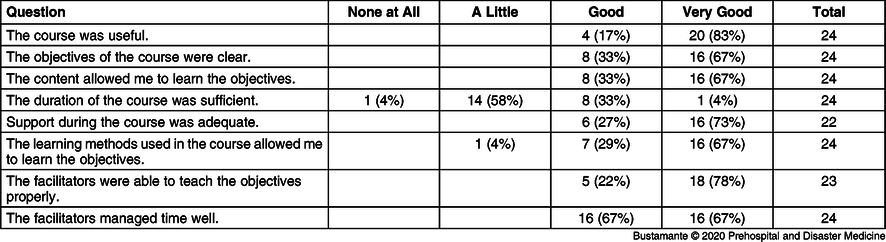
Due to a clerical error, evaluations were only given to participants in the first course (n = 28). Evaluations were given in French, which was spoken by all respondents. Response rate for course evaluations was 86% (24/28). Table 3 describes the course evaluations. The majority of respondents felt the course was useful and clear, and that the content allowed them to learn course objectives. Approximately three-quarters of respondents felt sufficient support during the course and felt learning methods were appropriate. Most felt course objectives were taught properly and time was managed well. Only one-half of respondents felt that the duration of the course was sufficient and evaluation comments included a need for the course to be longer. Additional training was requested from most participants.
Course Evaluations

Discussion
A gap currently exists in training local populations in international humanitarian response, especially in crises and disaster-prone environments. During the 2016 World Humanitarian Summit (Istanbul, Turkey), the United Nations Secretary-General, Ban Ki-Moon, called for a change in the humanitarian field paradigm “from delivering aid to ending need.” Ban urged reinforcement of local disaster response systems through expertise, and building capacity based on good practice.3 In 2017, the Global Health Assistance Report highlighted the fact that local and national responders are often the primary responders during a disaster, but only receive a small proportion of direct humanitarian assistance and training.2 The HHRC presents a novel approach to narrow these critical gaps.
Haiti Humanitarian Response Course
The HHRC provides the foundation for national actors to better access international humanitarian response mechanisms when the local disaster response is exhausted or overwhelmed. The skills and curriculum in the HHRC will allow local responders to better drive international resources into their organizations and/or communities and improve response. Most importantly, it can begin a shift in power differential and build local capacity for future events, especially in disaster-prone countries with limited resources.
It is important to recognize that there are several factors unique to the HHRC that contributed to its success. The participants were all highly educated individuals, most of whom worked at a large academic medical center, and were taught with a curriculum tailored to language, culture, and practice in the region. Many participants, particularly those in the EM program, were accustomed to collaborating with international faculty. Most participants lived through and/or responded to the 2010 earthquake, which may have made the course particularly relevant and/or motivated participation. The fact that three of the four facilitators had prior experience teaching at HUM, one as the co-director of the EM Department, facilitated trust and allowed lectures to be targeted to local knowledge bases.
Cost and Travel
A survey published by Enhancing Learning and Research for Humanitarian Assistance (ELRHA; Cardiff, Wales/London, UK) in 2012 cited cost and limited abilities to travel for training as prominent barriers to professional development of humanitarian responders.Reference Russ13 The HHRC’s in-country setting addressed these challenges and limited expenses to domestic ground travel (only for participants from other hospitals). The course was free to participants—a drastic change to the cost of courses in humanitarian health of academic affiliated training centers in North America, which start at USD$2,000/course.Reference Burkle, Walls and Heck14 Low-cost training is crucial given that the countries most affected by humanitarian crises and disasters are located in regions where the Gross Domestic Product/GDP per capita averages less than USD$5,000.2,15
Investing in courses similar to the HHRC in the future would be beneficial given the impact training local responders can have on international humanitarian response. Focused funding for these initiatives could reduce overall need in future disasters, provide a more effective use of funds available, and improve efficiency in humanitarian responses. Even though flights for HHRC were donated, the potential cost of flying four experienced instructors to train almost 60 local responders could equate to the average expense of sending one person to a reputable international course. Alternatively, organizations could invest in key personnel to attend established humanitarian courses and then promote internal training of local staff. Long-term, train-the-trainer models for either approach that include routine interval refresher courses would be ideal.
Language
Although proficiency in English was required for HHRC, as all written materials and most lectures were delivered in English, two French speaking facilitators helped minimize linguistic barriers by delivering some lectures in French and answering questions on any topic in French. Still, there were several course candidates who were unable to take the course due to a lack of English proficiency, which is unfortunate since all key local responders should be able to be trained in critical skills from which their community would benefit. Therefore, it is preferable for future programs to be taught entirely in the local language. A 2014 analysis concluded that regionalized training in French, Arabic, or Spanish may reduce the burden to find interpreters and obtain visas, while reducing costs and improving logistics for participants.Reference Jacquet, Obi, Chang and Bayram16
Structure
To ensure participants learned the required content in three days, significant online pre-work was required. Though HUM has high-speed internet access, participants reported that limited bandwidth made online pre-work difficult; this was accentuated for participants outside of HUM. Even with this pre-work, participants felt the course length should be extended. However, barriers to expanding the course, including the need for trainees to have time off work and availability of trainers who are donating time, would need to be addressed. If the in-person course cannot be extended, alternate methods to expand course duration should be considered, such as distance learning for preparation or follow-up sessions. Downloadable modules or other forms of pre-learning could address the difficulty in taking these courses with limited internet access. Research to evaluate the efficacy of these models in this particular setting would be beneficial. Finally, a single three-day training is insufficient for a train-the-trainer model, so future curricula should keep this in mind. The HHRC provided the first step for such a model, but this group of authors continues to seek out additional training for key participants who can then lead additional trainings.
Future Steps
Research on outcomes and perceived confidence of responders trained by HHRC in future events is needed to evaluate the course’s full impact. Other designs to expand training should be considered, including training local responders for future events post-disaster when responsibilities are transferred back to local communities. While the immediate post-disaster phase may preclude training, the international community should consider making such training standard after the acute crisis has calmed. This could alleviate future impact and provide a more effective and cost-efficient response. Further research could also focus on evaluations of how local NGOs could support and be incorporated into established mechanisms and access resources in future events. A consensus on outcome measures of trainings of local actors across all sectors could guide standardization of this field and would establish a way to monitor training effectiveness.
Conclusion
As the professionalization of humanitarian response continues to develop, and humanitarian training continues to grow, it is important to train local responders in international humanitarian response standards. High-quality training will result in a more efficient resource utilization, improved knowledge sharing, and better disaster response. The HHRC demonstrates a potential new method for future humanitarian and disaster training. Despite its limitations, with its variety of teaching methods, integration of the local language, and in-country, low-cost execution, the course offers a model for local capacity building in other disaster-prone countries.
Conflicts of interest
none