Introduction
Acetylcholinesterase (AChE, EC 3.1.1.7), encoded by ace1- and/or ace2-type locus, terminates the nerve impulses at the cholinergic synapses in the central nerve system of insects by catalyzing hydrolysis of the neurotransmitter, acetylcholine (Toda et al., Reference Toda, Komazaki, Tomita and Kono2004; Kim & Lee, Reference Kim and Lee2013). The ace1- and/or ace2-type locus are found in most insects, except Drosophila and Musca domestica that contain only ace2-type locus (Huchard et al., Reference Huchard, Martinez, Alout, Douzery, Lutfalla, Berthomieu, Berticat, Raymond and Weill2006; Alout et al., Reference Alout, Berthomieu, Hadjivassilis and Weill2007; Kim & Lee, Reference Kim and Lee2013).
It is commonly believed that the reduced sensitivity of AChE due to ace1 mutation is a major factor relating to the resistance of insects to organophosphates (OPs) and carbamates (CBs) (Fournie & Mutéro, Reference Fournie and Mutéro1994; Revuelta et al., Reference Revuelta, Ortego, Díaz-Ruíz, Castañera, Tenllado and Hernández-Crespo2011; Wang et al., Reference Wang, Wang, Xie, Sun, Gu, Ma, Li, Zhao, Yang, Shen and Li2014). In general, the expression of ace1 gene in insects is significantly higher than that of ace2 (Huchard et al., Reference Huchard, Martinez, Alout, Douzery, Lutfalla, Berthomieu, Berticat, Raymond and Weill2006; Kim & Lee, Reference Kim and Lee2013; Wang et al., Reference Wang, Wang, Xie, Sun, Gu, Ma, Li, Zhao, Yang, Shen and Li2014). It was believed that mutation(s) in ace1 alone induced the resistance in insects that have both of the genes (Huchard et al., Reference Huchard, Martinez, Alout, Douzery, Lutfalla, Berthomieu, Berticat, Raymond and Weill2006; Wang et al., Reference Wang, Wang, Xie, Sun, Gu, Ma, Li, Zhao, Yang, Shen and Li2014). In Propylaea japonica (thunberg), a high activity on AChE1 (coded by ace1) was shown, but none could be detected on AChE2 (coded by ace2) (Kim & Lee, Reference Kim and Lee2013). Whereas, Alout et al. (Reference Alout, Berthomieu, Hadjivassilis and Weill2007) observed ace2 playing an important role in the resistance to OPs and CBs in Drosophila and M. domestica. Some other researchers also speculated involvement of ace2 in the resistance of some insects, such as Culex tritaeniorhynchus (Nabeshima et al., Reference Nabeshima, Mori, Kozaki, Iwata, Hidoh, Harada, Kasai, Severson, Kono and Tomita2004), Myzus persicae (Javed et al., Reference Javed, Viner, Williamson, Field, Devonshire and Moores2003), and Helicoverpa armigera (Ren et al., Reference Ren, Han and Wang2002), which contain both of the two genes with no differences on amino acids in ace1 between the insecticide-resistant (R) and insecticide-susceptible (S) strains.
AChE in insects is targeted by the commonly applied OPs and CBs for pest control. Consequently, most studies on the insecticide-induced resistance in insects have focused on this particular enzyme. With the ever-increasing information on AChE at the molecular level becomes available, the evolution mechanism of the insecticide-resistance in insects would be revealed sooner or later. In fact, seven structural regions in AChE have already become known. They include the catalytic triad, acyl-binding pocket, choline binding sites, peripheral anionic sites, oxyanino hole, back door, and aromatic amino acids. Resistance-related alterations on amino acids could be found in these domains or other conserved districts. The resistance-associated AChE mutations had been found in many insects (Mutero et al., Reference Mutero, Pralavorio, Bride and Fournier1994; Menozzi et al., Reference Menozzi, Shi, Lougarre, Tang and Fournier2004; Lang et al., Reference Lang, Zhu and Zhang2012). For example, the following mutants have been reported in the literature: (1) S291G, which modifies the bindings of OPs and other ligands to the esteratic subsite in the catalytic center and the peripheral anionic site in Colorado potato beetles (Leptinotarsa decemlineata) (Zhu et al., Reference Zhu, Lee and Clark1996; Malekmohammadi et al., Reference Malekmohammadi, Hejazi, Mossadegh, Galehdari, Khanjani and Goodarzi2012); (2) A303S, which is in the cholinesterase activity center (FGESAG) and close to the catalytic triad S303; (3) G329A, which affects the orientation of S276 and L554S in the conserved region in Bombyx mori (Wang et al., Reference Wang, Wang, Xie, Sun, Gu, Ma, Li, Zhao, Yang, Shen and Li2014); (4) G365A, which is in the gorge above the catalytic site S235 in Bactrocera dorsalis (Jiang et al., Reference Jiang, Zhou, Liang, Zeng and Wen2014); (5) F439 H, which is in the aromatic amino acid domain in Laodelphax striatellus (Zhang et al., Reference Zhang, Shuo, Xu, Guo, Zi, Wang, He and Fang2013); (6) G119A, which is in the oxyanino hole; (7) F/Y330S, which is in the choline binding sites and the aromatic amino acid domain; (8) F331H, which is in the oxyanino hole, and I332L, which is near FGESAG in Nilaparvata lugens (Kwon et al., Reference Kwon, Min, Lee, JPark and Lee2012; Li et al., Reference Li, Chen, Liu, Zhang, Bao, Cheng, Zhu and Zhang2012), (9) I161V, which affects the mobility or static characteristics of W83; (10) G265A, which is close to the catalytic site S235; (11) F330Y, which is in the acyl-binding pocket; (12) G368A, which is in the choline binding sites in M. domestica and D. melanogaster; (13) F115S, which changes the structure of the active center gorge; (14) I199V or I199T, which are close to W84 of the choline binding sites; (15) G303A, which affects Ser of the catalytic triad; (16) F368Y, which is in the acyl-binding pocket (Mutero et al., Reference Mutero, Pralavorio, Bride and Fournier1994; Lang et al., Reference Lang, Zhu and Zhang2012); (17) F288L/I, which is in the acyl-binding pocket in D. melanogaster (Taylor & Radic, Reference Taylor and Radic1994); (18) F105S, which changes the structure of the active center gorge; (19) G285A, which affects Ser of the catalytic triad; (20) F350Y, which is in the acyl-binding pocket in Aedes aegypti (Vaughan et al., Reference Vaughan, Rocheleau and Ffrench-Constant1997); (21) G262V/A, which affects Ser of the catalytic triad; (22) F327Y, which is in the acyl-binding pocket; (23) G365A, which is adjacent to the glutamate of the catalytic triad in M. domestica (Walsh et al., Reference Walsh, Dolden, Moores, Kristensen, Lewis, Devonshire and Williamson2001; Lang et al., Reference Lang, Zhu and Zhang2012); (24) I214V, which is close to Trp 84 of the choline binding sites; (25) G488S, which is adjacent to the active site in Bactrocera oleae Gmelin (Vontas et al., Reference Vontas, Hejazi, Hawkes, Cosmidis, Loukas and Hemingway2002); and (26) G119S, which is in the oxy-anino hole in Anopheles gambiae and Anopheles coluzzii (Essandoh et al., Reference Essandoh, Yawson and Weetman2013; Verma et al., Reference Verma, Wong, Islam, Tong and Ghavami2015). Some highly conserved mutations, for instance, S431F and A302S in Aphis Gossypii, G227A, A298S and G324A in Plutella xylostella, F455W in C. tritaeniorhynchus, S431F in M. persicae and A585T in H. armigera, could also be found in Lang et al. (Reference Lang, Zhu and Zhang2012). Amino acids in the mutated AChE genes alter the sites in the activity region, which leads to a heightened insecticide-resistance in the insects (Taylor & Radic, Reference Taylor and Radic1994; Menozzi et al., Reference Menozzi, Shi, Lougarre, Tang and Fournier2004; Wang et al., Reference Wang, Wang, Xie, Sun, Gu, Ma, Li, Zhao, Yang, Shen and Li2014). When a single mutation of I161V, G265A, F330Y, or G368A occurred, specific insecticide-resistance in D. melanogaster may result. Conceivably, if 3 or 4 mutations show up in a same gene simultaneously, the level, as well as the spectrum, of the resistance would be substantially expanded (Shi et al., Reference Shi, Lougarre, Alies, Frémaux, Tang, Stojan and Fournier2004).
On the other hand, in the absence of mutation, cases of insensitive AChE were found in the insects, such as H. armigera (Ren et al., Reference Ren, Han and Wang2002), B emisia Tabaci, and Trialeurodes vaporariorum (Javed et al., Reference Javed, Viner, Williamson, Field, Devonshire and Moores2003). Besides mutation, overexpression of AChE gene can also induce insecticide-resistance in insects (Charpentier & Fournier, Reference Charpentier and Fournier2001; Gao & Zhu, Reference Gao and Zhu2002; Kwon et al., Reference Kwon, Clark and Lee2010; Sonoda et al., Reference Sonoda, Shi, Song, Liang, Gao, Zhang, Liu, Matsumura, Sanada-Morimura, Minakuchi, Tanaka and Miyata2014; Wang et al., Reference Wang, Wang, Xie, Sun, Gu, Ma, Li, Zhao, Yang, Shen and Li2014; Lee et al., Reference Lee, Kim, Kwon, Cha and Kim2015).
Thus far, the molecular studies on AChE in R and S insects largely limited to pest strains (Essandoh et al., Reference Essandoh, Yawson and Weetman2013). Full length ace1 and/or ace2 in more than 20 species of insects have been sequenced. However, the insects studied were mostly pests, hardly their natural enemies. In hymenopteran insects, three amino acid substitutions in AChE gene were found in R parasitoid wasp, Oomyzus sokolowskii (Hymenoptera: Eulophidae), as compared with its S counterparts (Zhuang et al., Reference Zhuang, Li and Wu2014). AChE gene was reportedly cloned in Apis mellifera (GenBank, XM-392492) or predicted by the automated computational analysis in Nasonia vitripennis (GenBank, XM-001605518). In coleopterain insects, including the predacious Coccinellidae, no AChE gene other than ace2 of L. decemlineata in either R or S strains was identified (Zhu et al., Reference Zhu, Lee and Clark1996; Malekmohammadi et al., Reference Malekmohammadi, Hejazi, Mossadegh, Galehdari, Khanjani and Goodarzi2012). The facts that the ace1 is expressed 2- to 11-times higher than ace2 and the ace1 alternation significantly increases the susceptibility of Blattella germanica to OP chlorpyrifos suggest that ace1 might be the key target of the insecticide (Revuelta et al., Reference Revuelta, Piulachs, Bellés, Castañera, Ortego, Díaz-Ruíz, Hernández-Crespo and Tenllado2009). Although the genome of the model beetle, Tribolium castaneum, is known (Tribolium Genome Sequencing Consortium, 2008), the ace1 sequences for R and S L. decemlineata were not available for a comparison. The activities of AChE1 and AChE2 were studied in P. japonica by Western blotting method (Kim & Lee, Reference Kim and Lee2013), but their sequences were not reported. The insecticide resistance-related genes in Cryptolaemus montrouzieri (Zhang et al., Reference Zhang, Jiang, Wu, Liu, Xie, He and Pang2012) and P. japonica (Tang et al., Reference Tang, Wang, Jin, Qiu, Wu and Ren2014) were studied based on the transcriptome and digital gene expression analysis. In spite of the target sites of AChE mutation related to the resistance have been identified, to date, the molecular biology of AChE gene in R and S ladybird beetles remains poorly understood.
For over a century, coccinellids have been widely used as a predator for the biological control of pest insects (Obrycki & Kring, Reference Obrycki and Kring1998). Toxicity and selectivity studies on insecticides showed that the induction of insecticide-resistance in predators might be less a common occurrence than that in herbivores, and less in parasitoid wasps than predacious insects and mites (Croft & Strikler, Reference Croft, Strikler, Georghiou and Saito1983). At least ten predator mites, which belong to Amblyseius genus, Phytoselulus genus and Pythlodromus genus, were confirmed to develop high resistance to 12 OPs, two CBs, and five Pyrethroids (Zhao et al., Reference Zhao, Tang, Hu, Geng and An2012). Among predator ladybirds, the resistances toward various insecticides were reported (Duan et al., Reference Duan, Head, McKee, Nickson, Martin and Sayegh2002; James, Reference James2003; Youn et al., Reference Youn, Seo, Shin, Jang and Yu2003; Al-Doghairi et al., Reference Al-Doghairi, AL-Rehiayani, Osman and Elhag2004; Yu et al., Reference Yu, Fu, Lin, Zhang, Liu, Jiang and Brock2014; Li et al., Reference Li, Chen and Liu2015), e.g., Stethorus gilvifrons toward parathion-methyl and bifenthrin (Kumral et al., Reference Kumral, Gencer, Susurluk and Yalcin2011), Eriopis connexa toward pyrethroid (Torres et al., Reference Torres, Rodrigues, Barros and Santos2015), and Listronotus maculicollis toward bifenthrin and bifenthrin combined with synergists affecting three detoxification systems (Ramoutar et al., Reference Ramoutar, Cowles and Alm2009). But, no evolution and physiological mechanisms of the insecticide resistance in the predacious P. japonica were elucidated.
Although insecticide-resistance was less commonly found in predators than herbivores, in our previous studies, two ladybirds (P. japonica and Verania discolor) displayed similar AChE-sensitivity and OPs-susceptibility as those of herbivorous pest insects, such as P. xylostella, Liriomyza sativae, Phytomyza atricornis, and Lipaphis erysimi; and, far lower than those of the hymenopterain parasitoids. It suggested that the characteristics of AChE and evolution of insecticide resistance in some predatory ladybirds (e.g., P. japonica and V. discolor) might be very different from those in parasitoids (Wu & Miyata, Reference Wu and Miyata2005; Wu et al., Reference Wu, Kang, Miyata and Xie2007). Both P. japonica and V. discolor were significantly more tolerant to insecticides than Coccinella repanda, Chilomenes quadriplagiata, or Coccinella septempunctata (Wu & Miyata, Reference Wu and Miyata2005; Wu et al., Reference Wu, Kang, Miyata and Xie2007). Our field observations in the areas near Fuzhou indicated that P. japonica was the dominant species among the ladybird beetles, and was most active from May to December during a year. The R P. japonica was, thus, chosen for this investigation on the mechanisms, AChE sensitivity, and ace1 target-sites relating to insecticide-resistance of the insect.
Materials and methods
Insect sources
A field population of P. japonica was collected from the commercial crucifer fields at Shangji (Sj) (34°480N, 113°180E), 20 km from the campus of Fujian Agriculture and Forestry University, Fuzhou, Fujian, China, in November 2009. The fields were privately owned and heavily sprayed with OPs for pest control in the previous years. The experiment was conducted with permission from the farmers without interfering their regular operations. Since there was no endangered or protected species involved, no specific permits were required for the insect collection. The collected P. japonica were reared on aphids, L. erysimi, in an environmental chamber at 25°C. The aphids were fed on Raphanus sativus seedlings in a separate 25°C chamber. The development time of a P. japonica from egg, larva, pupa to newly emerged adult was approximately 20–25 days. For this study, the field P. japonica collected in November 2009 was designated as F 0 parents and reared starting in November 2009. F 39 progenies of the field P. japonica were used as the S population. In addition to F 0 parents and F 20 progenies, another field P. japonica population collected from the same fields in 2014 was also used as the R population.
Chemicals
Four OPs, i.e., chlorpyrifos (96% pure) and methamidophos (90% pure) from Shangming Insecticide Co., Ltd., Fujian, China, paraoxon from Shanghai Sigma Chemical Co., Ltd, Shanghai, China, and malaoxon from Shanghai Fluka Chemical Co., Ltd, Shanghai, China, were used in this study. Although methamidophos has been banned for applications in vegetable fields in China, it was included in this study because of its historical value, and was treated as a reference for comparison.
Bioassay
The residual film method was used for the bioassay (Wu & Miyata, Reference Wu and Miyata2005). An aliquot of 0.2 ml acetone solution of an insecticide, or acetone without insecticide as control, was poured into a glass vial (1.5 cm in diameter and 10 cm in length). The glass vial was rolled to evenly spread the solution and evaporate acetone leaving a thin coat of insecticide on the inner surface of the vial in preparation for the bioassay. Newly emerged adult P. japonica were placed one in each vial to be kept in the environmental chamber at 25 ± 1°C under a photoperiod of 16:8 (L:D). Monitoring of insect mortality began 48 h afterward. Individual insects failed to respond to a pencil tip prodding were judged to be dead. No death of P. japonica was found in control during the bioassay. LC50 was calculated using 120 adult insects and five insecticide concentrations along with control. Each concentration was repeated three times, with eight individuals per replication.
Determination of bimolecular rate constant
P. japonica from a treatment group were homogenized at 4°C in a 0.066 M, pH 7.5 sodium phosphate buffer with 0.2% (V/V) of Triton X-100. The mixture was centrifuged at 10,000 g and 4°C for 15 min. Supernatants were used to determine AChE activity and bimolecular rate constant (k i). Enzymatic activity was determined following the method of Wu & Miyata (Reference Wu and Miyata2005); and k i, the method of Aldridge (Reference Aldridge1950). In brief, test solutions were incubated with the insecticide inhibitor for various time periods before tipping the mixture into a solution of acetyl thiocholine (ATCh) to measure the remaining AChE activity. All experiments were conducted in triplicate either with or without the added inhibitor.
RNA extraction and cDNA synthesis
Ten F 39, or R P. japonica, adults were used for the total RNA extraction using an RNAsimple Total RNA Kit. A 5 µg of total RNA to reverse transcription (Invitrogen) was the general template. Template of cDNA ends was reversed by using a SMARTer™ RACE cDNA Amplification Kit.
PCR amplification of cDNA fragment, cloning, and sequence analysis on AChE
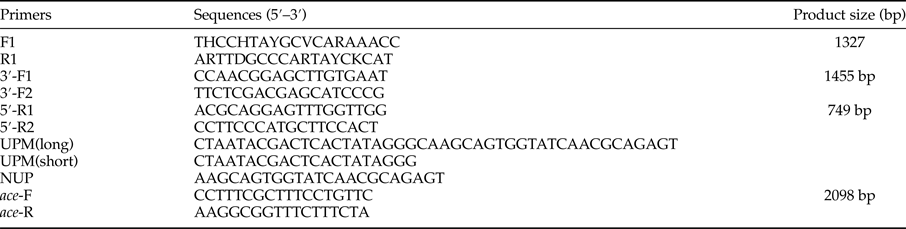
For amplification of the AChE gene of F 39, degenerate primers F1 and R1 (table 1) were designed based on the conserved sequences of several insects, including T. Castaneum (NM001293619.1), L. decemlineata (JF343436.1), N. lugens (HQ605041.1), B. germanica (DQ288249.1), P. xylostella (AY970293.1), Chilo suppressalis (EF453724.1), B. mori (DQ186605.1), and C ydia pomonella (DQ267977.1). The fragment was obtained by PCR consisting of an initial denaturation at 94°C for 5 min followed by 35 cycles (94°C for 30 s, 45°C for 30 s and 72°C for 90 s) and a final extension at 72°C for 7 min. The PCR products of the expected size (1327 bp) was purified from 1% (w/v) agarose/TAE gel using a TaKaRa Agarose Gel DNA Purifi-cation Kit and cloned using pMDTM18-T vector (TaKaRa).
OPs-susceptibilities of R and S P. japonica.

Note: Values of χ2 (df = 3) were lower than 7.82 (=1.81–7.50) indicating a significant fit between observed and predicted regression lines (p ≤ 0.05). The same letter indicated that there were no significant differences in LC50 values among F 0, F 20, F 39 and field population for one same insecticides (p ≤ 0.05).
1Field population was collected from commercial fields at Sj in November 2013.
Rapid amplification of cDNA ends (RACE)
For the 3′-RACE of ace1 in F 39, we designed 3′-F1 and 3′-F2 (table 1) based on ace-R1 as the reverse primer and the Universal Primer A Mix (UPM, table 1) as the forward primer. PCR conditions employed included denaturation at 94°C for 5 min followed by 35 cycles (94°C for 30 s, 53°C for 30 s, and 72°C for 2 min) and a final extension at 72°C for 7 min. A fragment of 1455 bp was obtained by a nested PCR cycle consisting of denaturation at 94°C for 5 min followed by 30 cycles (94°C for 30 s, 57°C for 30 s and 72°C for 2 min) and a final extension at 72°C for 7 min. For the 5′-RACE amplification of ace1, the first-strand cDNA were synthesized from the RNA using a SMARTTMRACE cDNAAmplification Kit (Clontech, Takara, Japan). The 5′-RACE applied the UPM and 5′-F1 (table 1), the round of PCR (35 cycles) consisted of denaturation at 94°C for 5 min followed by 35 cycles (94°C for 30 s, 56°C for 30 s and 72°C for 1 min) and a final extension at 72°C for 7 min. The PCR product was used for re-amplification using the Nested Universal Primer (NUP) and 5′-F2 (table 3), and the round of PCR (30 cycles) consisted of denaturation at 94°C for 5 min followed by 35 cycles (94°C for 30 s, 56°C for 30 s and 72°C for 1 min) and a final extension at 72°C for 7 min. A 749 pb fragment was obtained. Based on the internal fragment and two fragments obtained by 3′- and 5′-RACE, a full length cDNA sequence of ace1-type gene was subsequently edited and assembled for F 39 P. japonica.
Based on the acquired full length sequence for the cDNA, a pair of primers, ace-F and ace-R (table 1), were designed. A fragment including ORF of ace1 was obtained in F 39 as well as field P. japonica. The PCR conditions applied were one cycle at 94°C for 5 min followed by 35 cycles (94°C for 30 s, 48°C for 30 s and 72°C for 3 min) and a final extension at 72°C for 7 min.
The initial 3′- and 5′-RACE and ORF fragments were cloned and sequenced by Shanghai Biosune Biotechnology Co., Ltd., Shanghai, China.
Statistical analysis
LC50 and their 95% confidence level intervals were calculated by the probit analysis using DPS data processing system (Tang & Feng, Reference Tang, Feng, Tang and Feng1997). The full-length cDNA sequences were blasted on the National Center for Biotechnology Information website, and analyzed using the DNASTAR and DNAMAN software package. Phylogenetic analysis was conducted using the neighbor-joining method with the MEGA 6.0 software.
Results
Insecticide susceptibility and AChE sensitivity
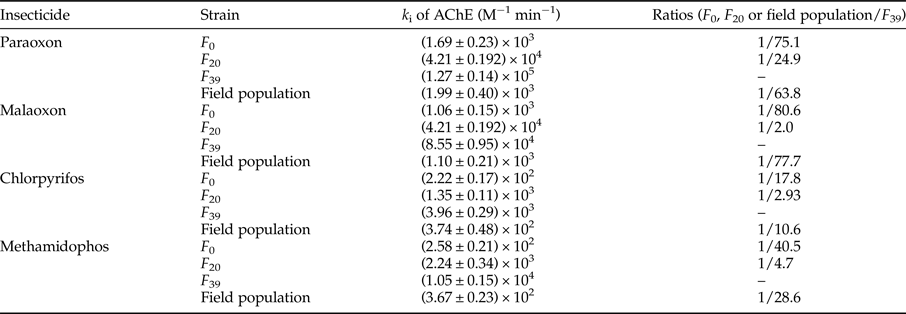
In the commercial fields, P. japonica developed high resistances to chlorpyrifos and methamidophos. However, in the insecticide-free chamber, their resistance to chlorpyrifos decreased greatly after rearing for 20 generations and to methamidophos for 39 generations (table 1). In addition to the heightened susceptibility, F 20 and F 39 also displayed far higher AChE sensitivities to paraoxon, malaoxon, chlorpyrifos, and mathamidophos than their F 0 parents or the field population of P. japonica (table 2).
OPs-sensitivities of R and S P. japonica.

Note: Field population was same as that shown in table 1.
Cloning and sequencing ace1 gene
Based on the sequence of the initial fragment (1327 bp), as well as the 3′- (1455 bp) and 5′-end fragment (749 bp) obtained by 3′- and 5′-RACE, respectively (table 3), a full-length cDNA sequence (2928 bp) of AChE ace1 gene from F 39 P. japonica (GenBank KP403801) was obtained through editing and assembling the cloned sequence (table 3; figs 1 and S1). The ORF sequence was of 1938 bp (from 372 to 2308 bp); the 5′-end sequence, 371 bp (from 1 to 371 bp); and, the 3′-end base sequence, 620 bp (from 2309 to 2928 bp). Based on the sequence of the 2928 bp from F 39, the ace1 sequence with 2098 bp containing open read frame (ORF) encoding 645 amino acids was obtained directly from S F 39 and the field P. japonica by using a pair of primers, ace-F and ace-R (table 3; figs 1 and S1). The primers also fitted ace1 of field P. japonica, which was highly resistant to insecticides, and consequently, used as the R population for this study. The predicted isoelectric point of the cDNA-deduced protein was pH 6.30 with a molecular weight of 72,912.
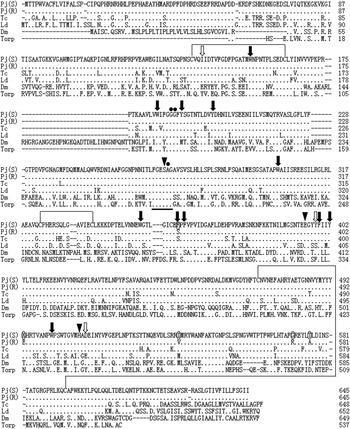
Multiple alignment of ace1 gene. Sequences included in analysis are: Pj (S) (F 39 P. japonica, KP403801), Pj (R) (field P. japonica, KT779500), Tc (Tribolium castaneum, NM_001293619), Ld (Leptinotarsa decemlineata, JF343436), Dm (Drosophila melanogaste, NM_057605) and Torp (Tropedo california, 2ACE_A). An apostrophe indicates 100% similarity on sequences. Conserved sequence FGESAG is underlined. Connecting line symbolizes cysteines that form disulfide bond. Fixed triangle indicates residue involved in catalytic triad; and fixed ring, oxyanino hole. Open arrow represents unconserved; and fixed arrow, conserved aromatic residue. Mutant site between F 39 and field P. japonica is indicated by oblong circle.

Sequences of primers used for cloning ace1 of P. japonica.

cDNA sequences of ace1 in F 39 and field P. japonica
Sequences of the deduced amino acids of S F 39 and R P. japonica contained important conserved domain, FGESAG (position 266–271), which is common for AChE genes (fig. 1). Compared with Tropedo California (Tcal), the typical conserved sequence of the gene also existed in F 39 and the field P. japonica. They included: (1) three amino acids in the catalytic triad, S269, E328 and H509, which corresponded to S200, E327 and H440 in Tcal, (2) F358 and F360 in the acyl pocket that corresponded to F290 and F292 in Tcal, (3) G188, G189, and A270 in the oxyanino hole that corresponded to G118, G119, and A201 in Tcal, (4) W154, Y398, D511, and E268 in the choline binding sites that corresponded to W84, Y330, Y442, and E199 in Tcal, (5) E140, R191, W350, and Y142 in the peripheral anionic site that corresponded to Y70, Y71, W279, and D72 in Tcal, and, (6) C137 and C165 in the omega loop that corresponded to C67 and C95 in Tcal. All of the six sequences were completely conserved. In addition, corresponding to the 14 aromatic amino acids in the gorge in Tcal, they were also found in F 39 and the field P. japonica. Among the aromatics, 11 were conserved (same as Tcal, i.e., Y191, Y200, Y402, W154, W184, W350, W501, W302, F358, F360, and F399 of F 39), and three un-conserved (i.e., Y140, F398, and Y511 of F 39) (fig. 1).
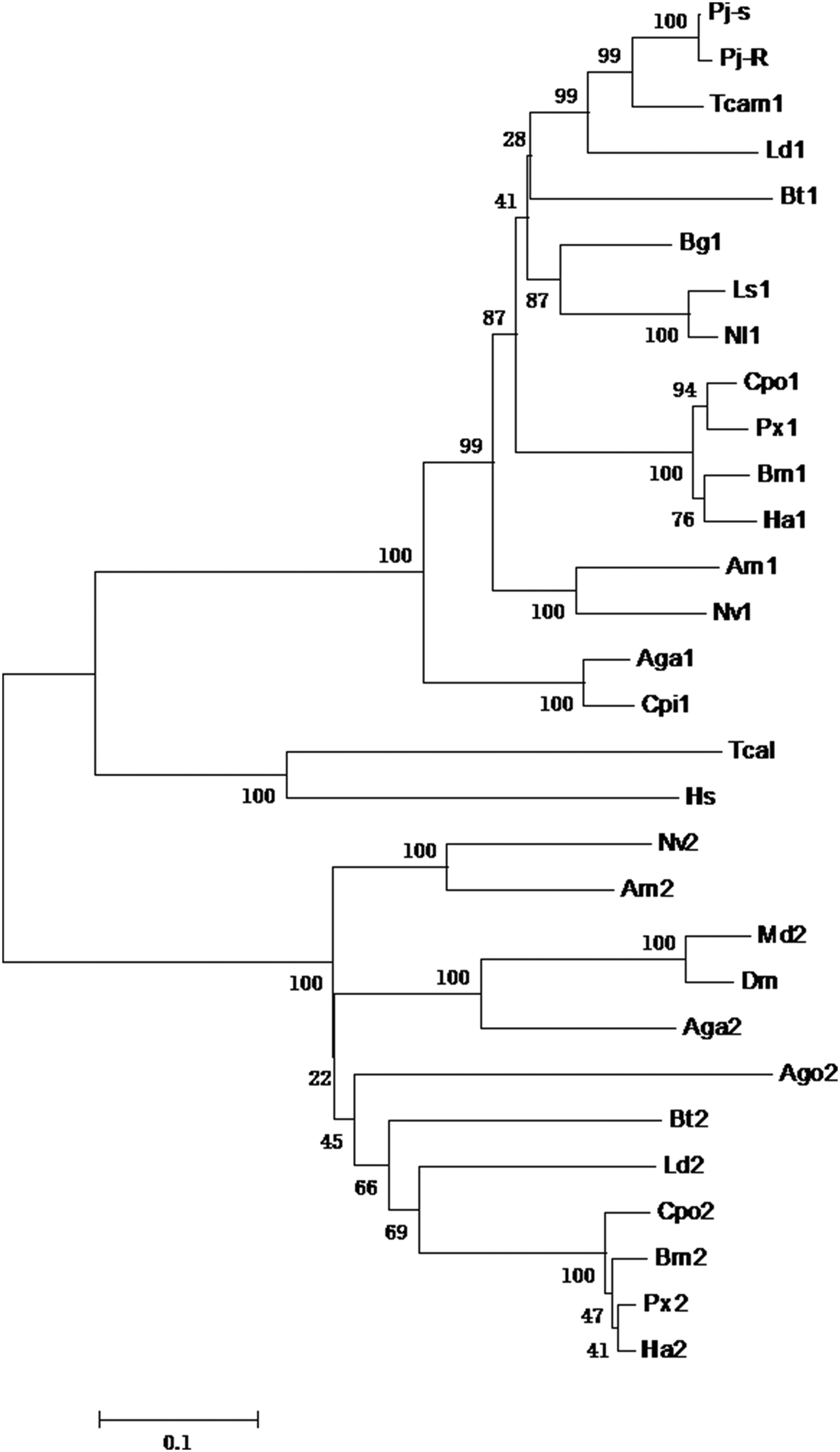
Sequence of the deduced amino acids in S F 39 contained the insect-specific cysteine residue sequence, ICEFPFVP, which is a unique signature of the ace1 gene. According to the Blast results, the homogeneities on amino acids in the genes between F 39 and three coleopateran insects were 85.4% with T. castaneum (AP, NM_001293619), 78.8% with L. decemlineata (AP, JF343436), and 38.5% with L. decemlineata (AO, L41180). The amino acids in the AChE gene of F 39 was 63.5–85.4% identical to those in ace1, and 33.4–39.7% in ace2 of the insects, such as A. gossypii, An. gambiae, P. xylostella, H. armigera, B. germanica, N. lugens, B. mori, B. tabaci, and C. pomonella, that have both ace1 and ace2 genes (data not shown) (fig. 2).
Phylogenetic analysis on AChE genes of P. japonica and other animals. Phylogenetic tree was constructed by neighbor-joining method, with bootstrap values of 1000 trials shown next to nodes. Sequences included in analysis are: Pj (S) (F 39 P. japonica, KP403801), Pj (R) (field P. japonica, KT779500), Tcam1 (Tribolium castaneum NM_001293619), Ld1 (Leptinotarsa decemlineata. JF343436), Bt1 (Bemisia tabaci. EF675187), Bg1 (Blattella germanica. DQ288249), Ls1 (Laodelphax striatella. KC470080), Nl1 (Nilaparvata lugens. HQ605041), Cpo1 (Cydia pomonella. DQ267977), Px1 (Plutella xylostella. JQ085429), Bm1 (Bombyx mori. DQ186605), Ha1 (Helicoverpa armigera. DQ064790), Am1 (Apis mellifera. XM_393751), Nv1 (Nasonia vitripennis. XM_001600408), Aga1 (Anopheles gambiae. BN000066), Cpi1 (Culex pipiens. AJ489456), Tcal (Torpedo californica. 2ACE_A), Hs (Homo sapiens. M55040.1), Ago2 (Aphis gossypii. AF502081), Md2 (Musca domestica. AJ310134), Dm (Drosophila melanogaster. NM_057605), Aga2 (Anopheles gambiae. BN000067), Am2 (Apis mellifera. NM_001040230), Nv2 (Nasonia vitripennis. XM_001605518), Bt2 (Bemisia tabaci. EF675189), Ld2 (Leptinotarsa decemlineata. L41180), Cpo2 (Cydia pomonella. DQ267976), Px2 (Plutella xylostella. AY061975), Bm2 (Bombyx mori. DQ115793) and Ha2 (Helicoverpa armigera. AF369793).

cDNA sequences of F 39 and field P. japonica
Five amino acids on the AChE gene differed between F 39 and the field P. japonica. They were F358S, K493E, I538V, G571R, and T576A (fig. 1). Among them, F358S shared the acyl-binding pocket with F360. Mutation in the acyl-binding pocket changed the insect-specific cysteine residue, ICEFPFVP, to ICESPFVP at the rim of AChE active site on ace1 of AChE gene in the field P. japonica. There were also three additional mutations near the active center. They were K493E and I538V, which were located near the conserved aromatic residues of the gorge, namely, H509, Y511, and W499, and G571R and T576A, which were close to C593 that formed disulfide bonds with C471 (figs 1 and S1).
Discussion
The functional correlation between the AChE sensitivity and the OPs-resistance in pest insects is well described in the literature. On the other hand, similar study focused on R and S predatory ladybird beetles was sparse. The present study demonstrated a direct correlation between the AChE sensitivity and the OPs-resistance in P. japonica. AChE sensitivity was far lower in R P. japonica (including F0 and the field population) than that in S F 39. Coleopterans have both ace1 and ace2 genes (Tribolium Genome Sequencing Consortium, 2008; Malekmohammadi et al., Reference Malekmohammadi, Hejazi, Mossadegh, Galehdari, Khanjani and Goodarzi2012). The phylogenetic analysis based on the multiple alignment and Blast results indicated that AChE genes from S F 39 and R P. japonica were ace1-type gene, as they had a higher homogeneity with ace1 (63.5–85.4%) than ace2 (33.4–39.7%) of other insect species.
Mutated ace1 is known to be involved in OP- and CB-resistance in the insects with two AChE genes (Huchard et al., Reference Huchard, Martinez, Alout, Douzery, Lutfalla, Berthomieu, Berticat, Raymond and Weill2006; Kim & Lee, Reference Kim and Lee2013; Wang et al., Reference Wang, Wang, Xie, Sun, Gu, Ma, Li, Zhao, Yang, Shen and Li2014), except Drosophila and M. domestica, in which ace2 alone could be responsible for the resistance (Alout et al., Reference Alout, Berthomieu, Hadjivassilis and Weill2007). In the present study, ace1 mutations with five altered amino acids in R P. japonica were analyzed (figs 1 and S1) to show that F358S was located in the acyl-binding pocket of the cholinesterase activity center (corresponding to F288 and F290 in Tcal) and close to the catalytic triad, S328. OPs- and CBs-resistance in many insects are related to the reduced sensitivity of the mutated AChE gene to the inhibitors (Taylor & Radic, Reference Taylor and Radic1994), as well as, the usually declined acetylcholine hydrolysis (Zhu & Clark, Reference Zhu and Clark1995; Chen et al., Reference Chen, Newcomb, Forbes, McKenzie and Batterham2001). Km reflects the enzymatic affinity to the substrate. At least in some cases, changes in the affinity can also alter the resistance, as Vmax is not increased or even affected. In the wild population of some insects, such as L. decemlineata and D. melanogaster, the acyl-binding pocket of the gene consisted of Phe 288 and Phe 290 (fig. 1). The two amino acids have their side chains penetrated into the pocket creating steric hindrance. In butyrylcholinesterase (BuChE), the conserved phenylalanines are replaced by L and I or V, providing a hydrophobic but less dimensionally constrained acyl pocket. Therefore, the affinity of BuChE to BuTCh was far greater than that of BuChE to AChE. In the wild D. melanogaster, the affinity of AChE to BuTCh was lower than that of AChE to ATCh because the phenyl group on F288 at the acyl-binding pocket limited the space at the activity center. After F288 I/L, the affinity of AChE to BuTCh increased greatly (Taylor & Radic, Reference Taylor and Radic1994). It was suggested that F358S in R P. japonica provided a hydrophobic but less sterically restricted acyl pocket. F358S mutation was evidenced by the conversion of the unique sequence ICEFPFVP of wild ace1 gene to ICESPFVP of mutational ace1 gene (Toda et al., Reference Toda, Komazaki, Tomita and Kono2004), such as ICEFPFVP in F 39 to ICESPFVP in R P. japonica. Any modification in the active-site gorge would change the interactions between inhibitor and AChE (Harel et al., Reference Harel, Kryger, Rosenberry, Mallender, Lewis, Fletcher, Guss, Silman and Sussman2000). It was suggested that F358S mutation could impact the interactions between insecticides and AChE resulting in a significantly lowered sensitivity to OPs. Similar alterations in acyl-binding pocket (e.g., changes from F to other amino acids) indeed were found in other insects, such as, F330Y in M. domestica and D. melanogaster (Shi et al., Reference Shi, Lougarre, Alies, Frémaux, Tang, Stojan and Fournier2004), F350Y in A. aegypti (Vaughan et al., Reference Vaughan, Rocheleau and Ffrench-Constant1997), and F327Y in M. domestica (Walsh et al., Reference Walsh, Dolden, Moores, Kristensen, Lewis, Devonshire and Williamson2001). Amino acid replacements also occurred in regions on the acyl-binding pocket in several R insects. It seemed to imply a correlation between sites and AChE functions. Mutations, such as K493E, I538V, G571R, and T576A, might also affect AChE activity. They happened at the sites near some conserved aromatic residues of the gorge, or due to C593 that formed disulfide bonds. Our results suggested that these four mutation sites might all play some important roles in the AChE sensitivity of P. japonica. In this study, ace2 gene was not studied. The activity of AChE2 (coded by ace2) was not detected in P. japonica. The five mutations in ace1, in particular F358S, were suspected to be involved in the insensitive AChE of resistant P. japonica.
F 20 and F 39 were developed from F 0 P. japonica collected from the fields in 2009 and reared in an insecticide-free environmental chamber for 20 or 39 generations. The susceptibility and AChE sensitivity to insecticides of F 39 increased greatly as compare to those of F 0. Because ace1 gene sequence of F 0 was not determined, no direct comparison between those of F 0 and F 39 can be made at present. The field P. japonica collected in 2014 from the same fields where F 0 were collected in 2009 were the R samples for the ace1 identification in this study. However, collecting from a same field did not guarantee that they had a similar or same genetic background. Although five different sequences were found between S F 39 and R P. japonica, the polymorphisms might simply reflect the strain differences, not necessarily associate with the insecticide-resistance. On the other hand, significant differences between F 0 and F 39 were found in their susceptibilities and AChE sensitivities to insecticides. Five mutations were detected. In particular, F358S, which was located at the rim of the AChE active site on ace1. Normally, ICEFPFVP is unique to the ace1 gene in wild insects (Harel et al., Reference Harel, Kryger, Rosenberry, Mallender, Lewis, Fletcher, Guss, Silman and Sussman2000; Toda et al., Reference Toda, Komazaki, Tomita and Kono2004) that also existed in S P. japonica (F 39). Since the mutated ICESPFVP was found in R P. japonica, the sequence of R ace1 gene could be reflected by the status of a field P. japonica. Insofar as mutations occurred outside the gene or gene expression are concerned, further investigation will be necessary.
Currently, the primary means of controlling herbivorous pests in vegetable fields remains to be heavy applications of insecticides, such as OPs. Unfortunately, frequent and widespread insecticide applications will inevitably induce or increase the insecticide-resistance in insects, such as L. erysimi (Chen & Wu, Reference Chen and Wu2005) and others (Miyata & Wu, Reference Miyata and Wu2010). However, the hymenopateran parasitoids are far less susceptible to the insecticides than the pest insects they pry on (Wu G & Miyata, Reference Wu and Miyata2005; Wu et al., Reference Wu, Kang, Miyata and Xie2007). For instance, P. japonica, C. septempunctata, and V. discolor showed very low susceptibilities and AChE sensibilities to the insecticides commonly used for pest control (Wu & Miyata, Reference Wu and Miyata2005; Wu et al., Reference Wu, Kang, Miyata and Xie2007). The present study also observed in F 0 a resistance to chlorpyrifos or methamidophos up to 50-times higher and a sensitivity to Ops (e.g., paraoxon, malaoxon, chlorpyrifos, and mathamidophos) 18.7- to 80.6-times lower than those in F 39 P. japonica. Moreover, our field monitoring showed a variation on insecticide-resistance of the insects from year to year, as well as, by varied selection pressures. For example, in May 2004, the difference in the resistance to methamidophos between R and S P. japonica was 506-times, and in November it rose to 2083-times (our unpublished data). When OPs and pyrethroids were sprayed heavily in the fields in 2004 followed by frequent applications of avermectin, emamectin benzoate, and spinosad, the OPs-resistance of the insects declined during this time period. In comparison, the field P. japonica exhibited a 50-times greater resistance toward chlorpyrifos and methamidophos in November 2013 than in 2014. It appeared that some predatory ladybird beetles developed a higher resistance than the herbivorous insects did under the same circumstance. In fact, the phenomenon would be desirable for the integrated pest management. Nonetheless, to take full advantage of it, thorough understanding of the complex interrelations on AChE functions and evolution of insecticide-resistance among the herbivorous, predatory, and parasitoid insects involved would be imperative.
Supplementary material
The supplementary material for this article can be found at https://doi.org/10.1017/S0007485317000682
Acknowledgements
This study was financially supported by the National Natural Science Foundation of China (NNSFC) (31272049), the National Basic Research Program of China (No.2013CB127604) and Key Foundation of Technology Project of Fujian Province (2014N0003).
Data archiving statement
All raw data underlying the main results of this study were archived at Fujian Agriculture and Forestry University, Fuzhou, Fujian, China.
The sequences of ace1 of F 39 and field P. japonica have been filed with GenBanck. Additional supporting information may be found in the online version of this article.
Conflicts of interest
The authors declare that they have no conflicts of interest.
Author contributions
Conceived, designed the experiments and wrote the paper: Wu G. Performed the experiments: Wang MM, Xing LY, Ni ZW, Wu G. Analyzed the data: Wu G, Wang MM.