Most states have enacted laws and/or promulgated administrative regulations mandating data submission and public reporting of healthcare-associated infection (HAI) data.Reference Reagan and Hacker1 As part of this effort, many states have focused their efforts on the occurrence of healthcare-associated Clostridium difficile infections (CDI). The intent of our research was to review these state efforts.
The healthcare burden of CDI is alarming. A 2012 Centers for Disease Control and Prevention (CDC) report stated that the CDI incidence rates, mortality, and associated medical costs have reached historic highs.2 According to the CDC, the number of deaths attributable to CDI is estimated at 14,000 per year.2 Estimates of associated healthcare costs of hospital-onset CDI range from $5,042 to $7,179 per case with a national annual estimate of $897 million to $1.3 billion.Reference Walsh3 Other cost estimates have been much higher.Reference Walsh3
National reviews of reported CDI data indicate more work is needed to control the occurrence of CDI in hospitals. The National Action Plan to Prevent Health Care-Associated Infections: Road Map to Elimination focuses on reducing the incidence of HAIs with a primary focus on 9 national targets.4 Both CDI hospitalizations and infections are national target measures reviewed under that plan on an annual basis.5 Compared with other HAI types, CDI reduction improvements have not been as forthcoming.5
The large burden of CDI as well as the realization that more work is needed to reduce the number of infections have directed attention to the need for stronger surveillance and prevention efforts. As a result, many states now mandate CDI data submission by hospitals as part of state HAI public reporting programs. CDI data are also collected on the federal level as part of the Centers for Medicare & Medicaid Services Hospital Inpatient Quality Reporting program. Under this program, CDI LabID Event reporting began in January 2013 for all acute care hospitals facility-wide using the National Healthcare Safety Network.6
We studied 4 components to determine the trend of CDI state reporting mandates: the number of states mandating CDI data submission by hospitals; progression over time; source of law (state law or federal requirements incorporated into the state law); and legal authority (statutory or administrative) used to impose the mandates.
METHODS
HAI statutes and administrative regulations of the 50 US states, District of Columbia, and US territory of Puerto Rico as of July 1, 2013, were systematically reviewed. (For convenience, the term states will be used to refer to US states, District of Columbia, and Puerto Rico.) Legal research was conducted using Lexis Research System databases, online statutory compilations, and state administrative regulation databases. Queries consisted of variable CDI search terms: Clostridium difficile, C. difficile, C. diff., CDI, Clostridium difficile–associated disease, and CDAD. Additional state resources were reviewed to gather more detail about each state’s CDI data submission mandates. In addition, state HAI coordinators (ie, state employees responsible for coordinating HAI surveillance and prevention efforts) were consulted to confirm the accuracy of the collected data or to provide missing data.
RESULTS
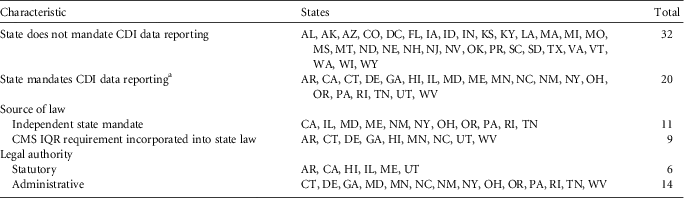
Our results reveal that a minority of states mandate CDI data submission by hospitals. Table 1 demonstrates that, as of July 1, 2013, only 20 states mandate CDI data submission by hospitals.
State Clostridium difficile infection (CDI) reporting mandates as of July 1, 2013

NOTE. The term states here refers to US states, District of Columbia, and Puerto Rico. See the appendix for expansion of abbreviations. CMS IQR, Centers for Medicare & Medicaid Services Hospital Inpatient Quality Reporting program.
a This has been updated from a previous reportReference Herzig, Reagan, Pogorzelska-Maziarz, Srinath and Stone8 to include MD.
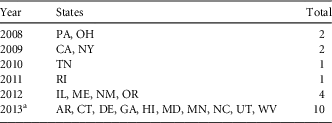
As shown in Table 2, CDI data submission state mandates have gradually increased from 2008 to 2013. The first effort began in 2008 with 2 states. Two states followed in 2009, 1 state in 2010, 1 state in 2011, and 4 states in 2012. The largest increase was made in the first half of 2013 with a total of 10 states.
Effective dates of state Clostridium difficile infection data reporting requirements, by year, as of July 1, 2013
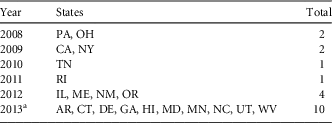
NOTE. See the appendix for expansion of abbreviations.
a This has been updated from a previous reportReference Herzig, Reagan, Pogorzelska-Maziarz, Srinath and Stone8 to include MD.
Table 1 demonstrates that in 11 (55%) of the 20 states with reporting mandates, CDI reporting is independently mandated under state law. Alternatively, in the remaining 9 states (45%), CDI reporting is mandated by adoption or incorporation of the reporting requirements of the Centers for Medicare & Medicaid Services Inpatient Quality Reporting program into the state law.
States use 2 forms of legal authority for imposing CDI reporting mandates. As demonstrated by Table 1, 6 (30%) of the 20 states with reporting mandates specifically include the requirement in a state statute. The other 14 states (70%) require data submission through administrative mechanisms.
DISCUSSION
States have begun to respond to the need for increased CDI surveillance in hospitals. Although only a minority of states throughout the nation mandate CDI data submission by hospitals, the number has steadily increased from 2008 to 2013. This increase was gradual up through 2012, with a marked jump in the first half of 2013. The increased use of CDI mandates throughout the nation will provide useful data for future studies used to determine the impact of reporting mandates on infection rates. Neither the consequences of the approaches to CDI reporting mandates nor the effects of the mandates themselves on CDI infection rates has been studied. As data are collected under state mandates, these areas will be ripe for future research.
The impact of federal guidance has clearly influenced state level CDI surveillance activities. It is likely that the increase in the number of states mandating CDI reporting in 2012 through July 2013 is partially due to the release of the CDC’s CDI Report in early 2012.2 That report, along with other CDC guidance and technical support, directed much-needed attention to the healthcare burden of CDI.
State HAI program surveillance activities have also been heavily influenced by the federal Centers for Medicare & Medicaid Services Inpatient Quality Reporting program’s CDI reporting requirements that became mandatory as of January 1, 2013. This impacted those states incorporating or adopting the Centers for Medicare & Medicaid Services Inpatient Quality Reporting program reporting requirements into their state laws. As it relates to CDI data submission mandates, this is significant because 9 of the 10 states that began reporting CDIs in 2013 did so under this state-federal mechanism.
CDI reporting mandates exist in both statutory and administrative forms. Statutory requirements provide the strongest legal authority for reporting mandates; however, only 6 states (30% of those mandating CDI data submission) have used this form. Alternatively, in many states CDI reporting mandates have not been directly presented in the state HAI statute but instead were added later in the form of an administrative regulation. Experts have expressed that general HAI statutes that contain provisions allowing for the addition of reporting requirements through administrative regulations are less burdensome and more flexible.7 Our study demonstrates that many states have chosen this less burdensome method. Of the 20 states mandating CDI reporting, most (14 states [70%]) use an administrative regulation or some other form of administrative requirement instead of a statutory provision.
We would be remiss in our presentation of data if we did not mention other state-level activities to prevent CDIs. Although some states have not mandated reporting of CDI, they have nevertheless taken other actions to reduce CDIs by implementing CDI prevention collaboratives with financial or technical support provided by the CDC.Reference Reagan and Hacker1 These state efforts reveal strong commitments to reduce or prevent CDIs regardless of the existence of a state legal mandate.
Acknowledgments
A previous analysis of CDI data, covering a shorter period (through January 31, 2013), was encompassed within a much broader analysis of state-mandated HAI reporting requirements (Herzig CT, Reagan J, Pogorzelska-Maziarz M, Srinath D, Stone PW. State-mandated reporting of health care-associated infections in the United States: trends over time. Am J Med Qual 2014; first published online June 20). This current study presents a more focused, updated, and extensive analysis specific to CDI.
Financial support. The National Institute of Nursing Research (grant R01NR010107); the Robert Wood Johnson Foundation as part of their Public Health Law Research Initiative through the Association of State and Territorial Health Officials (grant 270282) and the CDC (grant 400648).
Potential conflict of interests. All authors report no conflicts of interest relevant to this article.
Appendix Appendix A. US state and territory abbreviations
AL, Alabama; AK, Alaska; AR, Arkansas; AZ, Arizona; CA, California; CO, Colorado; CT, Connecticut; DC, District of Columbia; DE, Delaware; FL, Florida; GA, Georgia; HI, Hawaii; IA, Iowa; ID, Idaho; IL, Illinois; IN, Indiana; KS, Kansas; KY, Kentucky; LA, Louisiana; MA, Massachusetts; MD, Maryland; ME, Maine; MI, Michigan; MN, Minnesota; MO, Missouri; MS, Mississippi; MT, Montana; NC, North Carolina; ND, North Dakota; NE, Nebraska; NH, New Hampshire; NJ, New Jersey; NM, New Mexico; NV, Nevada; NY, New York; OH, Ohio; OK, Oklahoma; OR, Oregon; PA, Pennsylvania; PR, Puerto Rico; RI, Rhode Island; SC, South Carolina; SD, South Dakota; TN, Tennessee; TX, Texas; UT, Utah; VA, Virginia; VT, Vermont; WA, Washington; WI, Wisconsin; WV, West Virginia; WY, Wyoming.