INTRODUCTION
Cancer pain remains undertreated in approximately 70–80% of patients, and it is estimated that 5.5 million patients with terminal cancer experience moderate to severe pain (Deandrea et al., Reference Deandrea, Montanari and Moja2008; WHO, 2011). Opioids are the mainstay in treating moderate to severe cancer pain. They work by reducing nociceptive transmission (Pathan & Williams, Reference Pathan and Williams2012). However, their reward effect through the stimulation of mu receptors in the limbic system can lead to misuse in patients who are at risk for chemical coping and addiction (Bruera et al., Reference Bruera, Moyano and Seifert1995).
Opioid use in patients with cancer pain frequently raises concerns about side effects, fear of dependency and addiction, and patient aberrant behavior. Aberrant behaviors include multiple unsanctioned dose escalations, concurrent abuse of related illicit drugs, obtaining prescription drugs from other sources, altering route of drug delivery, selling prescription drugs, prescription forgery, recurrent prescription losses, and stealing or borrowing another person's drugs, to mention just a few (Passik, Reference Passik2009). In patients with advanced cancer, two particular syndromes that commonly include drug-related aberrant behaviors are chemical coping, defined as the use of medication in a non-prescribed way to cope with emotional distress (Bruera et al., Reference Bruera, Moyano and Seifert1995; Passik & Kirsh, Reference Passik, Kirsh, Smith and Passik2008), and pseudoaddiction, defined as an iatrogenic syndrome where a patient displays aberrant behavior developing as a result of inadequate pain management (Weissman & Haddox, Reference Weissman and Haddox1989).
Chemical coping and pseudoaddiction initially present with similar behaviors and pose a treatment dilemma for the physician, as each requires a different therapeutic approach, with chemical copers needing a multidimensional physical and psychosocial approach instead of continued opioid dose escalation or invasive interventions such as nerve blocks, while patients with pseudoaddiction require appropriate increases in pain medications with or without application of invasive pain-reducing interventions. Only after thorough examination over several visits does the distinction between the two become clearer, so that the patient's behavior can be understood in the appropriate context. The purpose of this case series is to describe patients with aberrant drug-related behaviors and similar patterns of dose escalation in whom interdisciplinary assessment reveals different bases for their dose increases.
METHOD
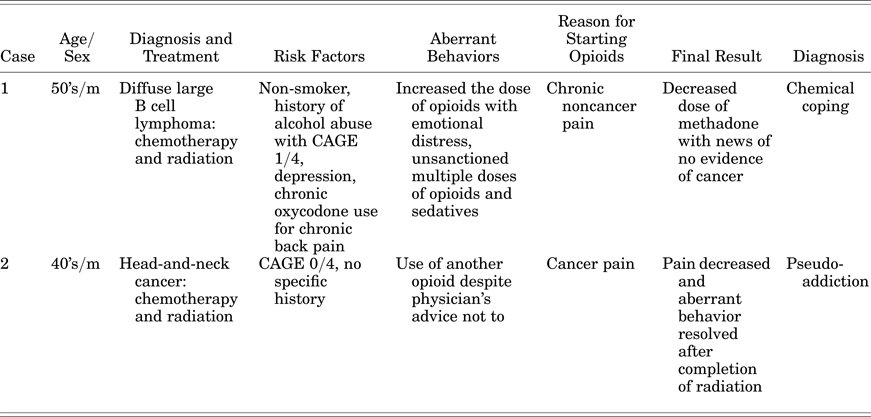
The institutional review board of The University of Texas MD Anderson Cancer Center approved this case series. During the period from December 26 to December 30, 2011, the medical records of two patients with opioid-related aberrant behaviors were reviewed. Patients' characteristics, including CAGE scores (Mayfield et al., Reference Mayfield, McLeod and Hall1974; Ewing, Reference Ewing1984), are summarized in Table 1.
Description of patients

M = male, CAGE = cut down, annoying, guilty, and eye opener.
PATIENT SUMMARIES
Patient 1
A man in his fifties with a history of diffuse large B cell lymphoma, spinal stenosis, depression, and alcohol abuse was referred for management of chronic back and lower extremity pain and anxiety. His pain was initially adequately controlled with sustained-release oxycodone and as-needed hydromorphone. Unfortunately, despite receiving chemotherapy, his imaging exams showed persistence of tumor. Thereafter, his opioid requirements began to increase without a consistent increase in pain score. He was also specifically requesting alprazolam for anxiety. Due to concerns about drug dependency surfacing, opioid rotation to methadone was performed. At this point, he had been receiving numerous sessions of psychosocial counseling from the supportive care counselors for adjustment disorder with mixed features of anxiety and dysphoria. His pain regimen became stable at a morphine equivalent daily dose (MEDD) of 225 mg with methadone and as-needed oxycodone up until stem cell transplantation was being planned. At that point, he started taking unprescribed doses of alprazolam and self-escalated opioids, leading to confusion and drowsiness. When the decision to forego stem cell transplantation and to pursue radiation treatment was made, his pain again appeared better controlled. His disease eventually responded to cancer treatment, and his opioid requirement was decreased to a stable methadone regimen without any breakthrough opiates with an MEDD of 125 mg, even with persistence of chronic back and lower extremity pain from spinal stenosis. He also started working part time at a job that requires him to be on his feet for most of the day.
We classified this patient as chemically coping because his increases in opioid use primarily occurred at times of greater distress (e.g., news of persistence of cancer, stem cell transplantation), and decreased opioid use occurred during periods of less distress (e.g., foregoing stem cell transplantation, cancer response to treatments), even with persistence of nociceptive stimuli for pain.
Patient 2
A man in his forties with head-and-neck cancer undergoing chemoradiation was referred for management of pain, anxiety, and insomnia. He had a history of frequently relapsing attacks of gout. At the time of consultation, he was taking multiple doses of hydromorphone per day with an MEDD of ~240 mg/day and had an Edmonton Symptom Assessment System (ESAS) pain score of 7. Three weeks later, opioid rotation to sustained-release oxycodone was performed, and subsequently to a fentanyl patch, together with immediate-release hydromorphone, due to uncontrolled pain. However, he continued to use both fentanyl and sustained-release oxycodone initially without informing the physician, and then despite physician's continued warnings not to use them concomitantly. His morphine equivalent daily requirement during radiation therapy increased to 930 mg/day. At this point, the patient lost his house due to a large financial burden and also reported the death of his mother. After completion of radiation therapy, dexamethasone was started for adjunct management of nausea and vomiting, severe mucositis, and frequent gouty attacks. Over the next eight weeks, with improvement of his mucositis, his opioid regimen decreased to an MEDD of 270 mg/day. Even when the patient continued to rate his pain at 8/10, and with continued financial and psychosocial distress, his MEDD was further decreased to 170 mg/day concomitantly with gabapentin 900 mg TID, and this remained stable over the next 15 months. He also returned to work full time.
We classified this patient as pseudoaddiction because the decrease in opioid requirements after adequate pain control was achieved despite persistence of continued financial and psychosocial burden.
DISCUSSION
Drug-related aberrant behaviors occur in a broad spectrum of conditions that includes addiction, chemical coping, pseudoaddiction, hyperalgesia, psychiatric disorders, and criminal intent. In the advanced cancer population, the usefulness of traditional definitions of each condition is minimized due to the intense nociceptive input and emotional distress experienced. In a cross-sectional evaluation, it is difficult to differentiate each condition cleanly during the acute phase of severe symptoms, and diagnosis is often made retrospectively. Moreover, such common red flags as a history of substance abuse do not necessarily mean that the patient's increase in opioid intake is due to addiction. In our literature search, there has only been one description of pseudoaddiction in cancer patients (Weissman & Haddox, Reference Weissman and Haddox1989) and a small number of sickle cell and Crohn's disease patients (Porter-Williamson et al., Reference Porter-Williamson, Heffernan and Von Gunten2003; Lusher et al., Reference Lusher, Elander and Bevan2006), making the available narrative experience of the condition limited. In chemical coping, a key identifying factor is obtaining drugs to self-medicate physical and psychological distress, which manifests as aberrant behaviors.
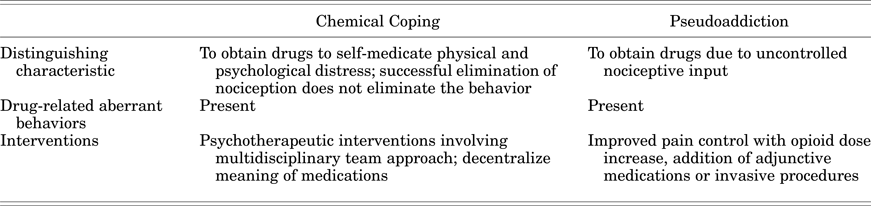
Chemical coping is suspected in patients with high risk factors, including a history of alcoholism and substance abuse, CAGE positivity, mental and psychiatric disorder, high emotional expression, and limited coping mechanisms (Edlund et al., Reference Edlund, Steffick and Hudson2007; Boscarino et al., Reference Boscarino, Rukstalis and Hoffman2010). Aberrant drug use associated with chemical coping has a tendency to increase under stress. The major hallmark of chemical coping is the placement of central importance on procuring pharmacologic agents to control “pain” with an inflexibility to incorporate nonpharmacological components of care, resulting in a failure to move toward psychosocial goals (Passik & Kirsh, Reference Passik, Kirsh, Smith and Passik2008). The aberrant behaviors are motivated by obtaining drugs to self-medicate physical and psychological distress. However, successful reduction of nociception does not eliminate the behavior. In pseudoaddiction, aberrant behaviors are motivated by uncontrolled nociceptive input, and the successful reduction of nociception results in a decrease in the behaviors and stabilization and decrease in drug requirements (Table 2). These behaviors are often mislabeled as chemical coping or even addiction. Only after adequate control of pain is achieved do these behaviors resolve and the opioid dose requirements stabilize and even decrease. A high pain expression does not necessarily diagnose as chemical coping and pseudoaddiction. Close monitoring and several visits are usually required to distinguish the two conditions.
Comparison of chemical coping and pseudoaddiction

A history of alcohol and substance abuse, young age, and specific cancer type (e.g., head-and-neck cancer) were suggested as risk factors for chemical coping in cancer patients (Edlund et al., Reference Edlund, Steffick and Hudson2007; Boscarino et al., Reference Boscarino, Rukstalis and Hoffman2010). Coexistence of psychiatric disease, history or presence of substance abuse, young age, and high dose of opioids were also reported in studies with large chronic noncancer pain populations (Edlund et al., Reference Edlund, Steffick and Hudson2007; Boscarino et al., Reference Boscarino, Rukstalis and Hoffman2010). Some of these risk factors are included in simple screening questionnaires like the opioid risk tool (Kircher et al., Reference Kircher, Zacny and Apfelbaum2011).
Patient 1, who was chemically coping, had multiple risk factors for coping, including having advanced cancer, male gender, and a history of alcohol abuse. The aberrant behaviors displayed by the patient included excessive use of opioids, dose escalation of opioids to cope with emotional distress, high pain expression, aggressive demand for more medications, and use of non-prescribed medications (alprazolam). These aberrant behaviors were suggested as characteristics of chemical coping in previous studies (Passik et al., Reference Passik, Kirsh and McDonald2000; Reference Passik, Kirsh and Donaghy2006).
The second patient was initially classified as chemically coping due to his high pain expression and aberrant drug-related behaviors. He was reclassified as pseudoaddiction during followup. He also demonstrated an initial high pain expression and increasing opioid requirements. Aside from the physical symptoms of his cancer and radiation treatments, he also dealt with numerous emotional and financial burdens. With time to recover from post-radiation lesions and addition of adjunctive pain treatments (corticosteroids, gabapentin), his opioid requirements decreased even with persistent emotional and financial difficulties.
The challenge of pain control lies in the fact that physicians are often faced with the quandary of differentiating between legitimate need for better pain control and high opioid doses due to inappropriate use. A multidimensional approach to pain assessment with a focus on demographics, physical and psychosocial factors, history of mood and behavioral disorders, pain syndrome, and type of medications being used is more advantageous than a unidimensional approach that treats pain as totally organic (Lawlor et al., Reference Lawlor, Walker and Bruera1997). In patients who regularly express a high intensity of pain, focusing on their functional status may provide a better picture of the adequacy of pain control. At times, a harm-reduction approach should be utilized where a realization that complete abstinence may be an unrealistic goal and setting a strict limit to the amount of daily opioid intake is more realistic (Passik & Kirsh, Reference Passik and Kirsh2005). An interdisciplinary approach can help patients who are displaying signs of chemical coping to achieve psychosocial goals with a concomitant decrease in opioid requirements.
FUTURE DIRECTIONS
Randomized controlled trials continue to pose a challenge due to the nature of the disease course of advanced cancer patients, but further reports or retrospective studies may be able to increase the body of clinical knowledge to distinguish between these two syndromes as well as other conditions manifesting aberrant drug-related behaviors, which, in turn, would improve cancer pain management.
ACKNOWLEDGMENTS
David Hui has investigator-initiated studies that receive support from Teva and DepoMed. The authors have no conflicts of interests to declare.