On the afternoon of August 11, 2017, a Fujita level 3 tornado (equivalent to Enhanced Fujita 3 level) with a maximum wind speed of 18.1 m/s Reference Shen and Hwang1 occurred in Keshiketeng qi and Wengniute qi of Chifeng city, Inner Mongolia. The disaster affected 2 towns and 4 villages, resulting in 5 deaths and 58 injuries. More than 30 houses collapsed, more than 2000 residents were affected, and 1238 people were displaced. This destructive tornado disaster occurred after the Yancheng tornado disaster of 2016 in China. Reference Min2 The affected areas (Shaoguo Village, Wutaishan Village, Shilipu Village, and Qianjin Village) are located in remote rural areas and are far away from urban hospitals. Most consist of crop fields, and the housing structures are built mostly from bricks and tiles. Medical conditions are poor, and medical facilities are inadequate. These conditions make emergency rescue difficult and inefficient.
Although a majority of data pertaining to tornadoes describes North American tornadoes, tornado events have also been recorded in Central and South Asia. Reference Sugimoto, Labrique and Ahmad3 While the incidence of tornadoes in China cannot be compared with that in the United States, the damage caused by tornadoes in China cannot be ignored. The previous study recorded a total of 2210 tornadoes killing 2000 people and injuring 30,000 during a 30-year period from 1984 to 2013, Reference Wang, Zhong and Wang4 and the tornado that occurred in Yancheng (Jiangsu Province) in 2016 Reference Wang, Zhong and Wang4 , Reference Jia and Pan5 led to tremendous property damage and loss of life.
Studies of tornadoes that have occurred in China are rare. The first study to document the public health risks and impact of tornadoes in China was conducted by Wang et al. in 2017, who studied and reported about the tornado that struck Yancheng. Reference Wang, Zhong and Wang4 The first study on the pattern and spectrum of tornado injury was the investigation on the Yancheng tornado by Deng et al., which occurred in China in 2018. Reference Deng, Lv and Chen6 Previous investigations related to tornado disasters were mostly conducted in the United States. Reference Sugimoto, Labrique and Ahmad3 , Reference Campbell, Baker and Monroe7 - Reference Chiu, Schnall and Mertzlufft9 Results and recommendations from several surveys have been widely accepted worldwide and have been applied to tornado disaster medical rescue operations. However, these surveys are incomplete, and existing rescue guidelines and plans may not be suitable for remote area of China, such as Inner Mongolia.
While studies about earthquake disaster relief in China are comparatively more comprehensive and abundant, Reference Zhang, Liu and Li10 - Reference Tang and Zhang12 the injury characteristics and disaster assistance of earthquakes are not suitable for tornados. In all, studies concerning medical rescue following tornado disasters in China need to be improved. Few comprehensive studies have described the injury patterns and medical rescue operations pertaining to tornado disasters in remote areas of China.
There are 3 purposes of this research. The first aim is to analyze the injury patterns of a tornado disaster that occurred in a remote, rural area in China. The second aim is to further analyze different tornado-related injury causes that occur indoors versus outdoors. The third aim is to provide advice for prevention, evacuation, and treatment of tornado-related patients for improving future disaster medical assistance in remote rural areas in China.
METHODS
Study Design and Setting
This was a retrospective review of medical data of victims of the 2017 Chifeng tornado (China) collected from 3 local comprehensive Grade 2A hospitals (Keshiketengqi Hospital, Keshiketengqi Mengzhong Hospital, and Wengniuteqi Hospital), which were closest to the affected area and received all of the wounded patients.
Study Protocol
This survey was performed from August 15 to August 20, 2017. Four researchers majoring in social medicine and public health service management were dispatched to Chifeng city, Inner Mongolia Autonomous Region, for data collection. With the help of the local medical staff, we excluded patients with nontornado injuries, such as those with chronic wounds. Of the 58 patients in Chifeng tornado, 4 patients were injured lightly. They were simply bandaged and immediately discharged from hospital without hospitalization. Fifty-four clinical cases of tornado-related injuries were collected from a medical records system in these 3 hospitals. Because of the lack of necessary information (specific diagnosis), 2 cases were rejected, and 52 eligible cases were finally included in this study.
Measures
Data including age, sex, admission time, injury sites (indoor, outdoor), injury causes (house collapse, blow down by tornado, direct physical trauma due to the tornado), injury types (fracture, soft tissue injury, contusion &laceration, crush injury, burns and scalds, closed injury, dislocation), body regions (head, face, neck, thorax, spine, upper extremities, lower extremities and pelvis, abdomen, body surface, and others), and injury severity were extracted from the medical records. Diagnoses issued by the concerned physicians were accepted and used for further analysis. The severity of each injury was identified based on the 2005 version of the Abbreviated Injury Scale (AIS) (AIS-2005). The AIS score is a comprehensive taxonomy of individual injuries to indicate type, anatomical site, and severity of injuries. Severity is scored from 0 (no injury) to 6 (fatal injury). Reference Foreman, Caesar and Parks13 - Reference Palmer, Niggemeyer and Charman15 The AIS scores were calculated by the clinician. All data were extracted independently by 2 researchers, and differences were reconciled by discussion.
Data Analysis
Descriptive statistics was primarily used for data analysis. Classification variables are expressed as frequencies and percentages. Continuous variables are expressed as means and SD. Statistical analysis was performed using SPSS 21.0 software (SPSS Inc., Chicago, IL, USA).
RESULTS
Medical Evacuation and Admission
According to our interview with 3 hospitals, Keshiketengqi Hospital received a rescue order and started the plan 10 min after the disaster. The medical team set off within 30 min and arrived at the scene 90 min after the disaster. The first casualty arrived 210 min after the disaster. Four ambulances were dispatched. Keshiketengqi Mengzhong Hospital received a rescue order and started the plan 20 min after the disaster. The medical team set off within 35 min and arrived at the scene 80 min after the disaster. The first casualty arrived 210 min after the disaster. Two ambulances were dispatched. Wengniuteqi Hospital received a rescue order and started the plan 30 min after the disaster. The medical team set off within 60 min and arrived at the scene 120 min after the disaster. The first casualty arrived 180 min after the disaster. Six ambulances were dispatched.
Shaoguo Village and Wutaizi Village are 78 km from Wengniute Qi Hospital, and the journey takes approximately 91 min. Shilipu Village and Qianjin Village are 76 km from Keshiketengqi Hospital and Keshiketengqi Mengzhong Hospital. The journey takes approximately 115 min.
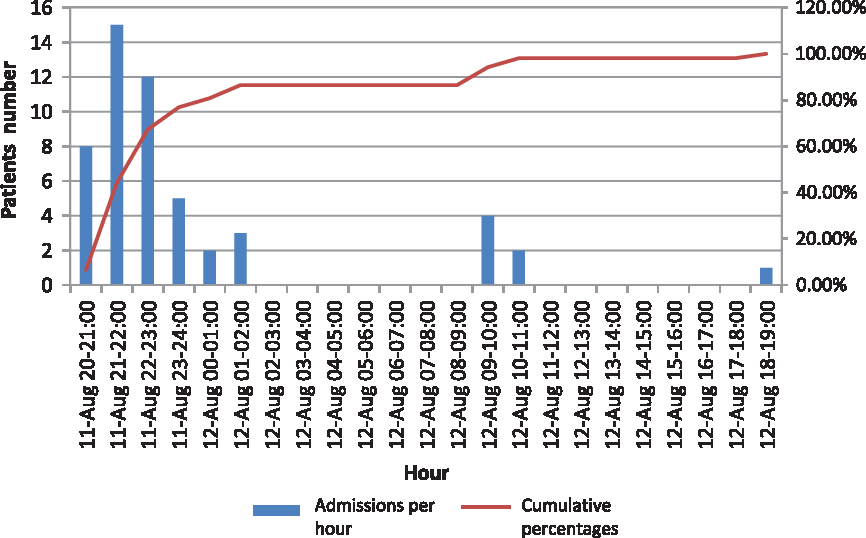
The first group of patients were sent to the hospitals 3 h after the tornado. The peak time for hospital admissions occurred from 3 to 8 h after the tornado. Of the injured patients, 76.9% received hospital treatment within 7 h. The last patient was sent to the hospital 27 h after the tornado. Ambulances were the main means of transportation (Figure 1).
Distribution of Patients With Tornado-Related Injuries Who Were Admitted to 3 Local Hospitals.

Demographic Characteristics
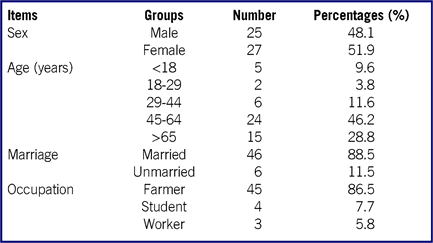
Of all the injured patients, 51.9% were women, 75.0% were middle-aged or elderly (age >45 years). In addition, 88.5% were married, and 86.5% were farmers (Table 1).
Demographic Characteristics of the Injured in Chifeng Tornado

Injury Characteristics, and Injury Cause Based on Location
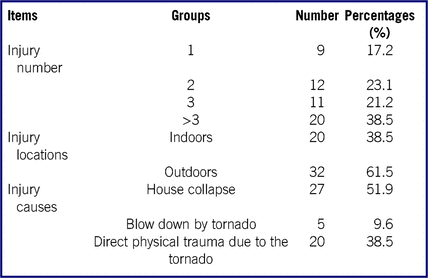
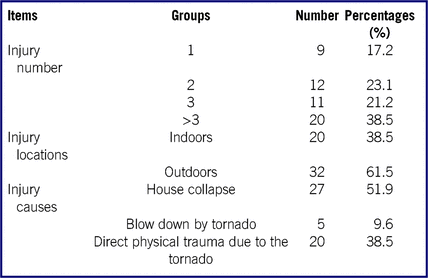
Of the injured patients, most had multiple injuries, and 38.4% had more than 3 injury sites. 61.5% were injured outdoors. Most patients were injured by house collapse, followed by direct physical trauma due to the tornado (Table 2).
Injury Characteristics of Patients in Chifeng Tornado
We also conducted nonparametric rank sum tests to further evaluate the difference in injury causes between indoor and outdoor patients. These analyses demonstrated that the location characteristics had significant effects on injury causes (P < 0.001). Indoor patients were most often injured by house collapse, whereas outdoor patients were most often injured by direct physical trauma due to the tornado and house collapse (Table 3).
Distribution of Location and Cause of Injuries

Affected Body Part
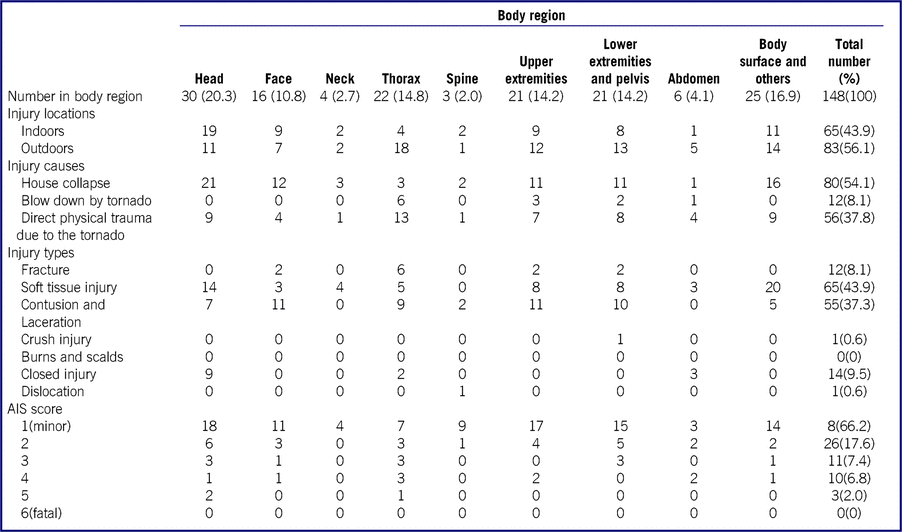
Of the 9 injury sites, the head and thorax were most frequently affected, followed by the upper extremities, lower extremities, and pelvis (Table 4).
Injury Characters of Injuries in Chifeng Tornado

Of the injury locations, 43.9% occurred indoors. The head was most frequently affected, followed by the extremities (upper extremities and lower extremities and pelvis). A total of 56.1% of injuries occurred outdoors. The thorax and extremities were most frequently affected (Table 4).
Of the injury causes, 54.1% were caused by house collapse, in which the head was most affected, followed by the extremities and face. Another 37.8% of injuries were caused by direct physical trauma due to the tornado. The thorax was most affected (Table 4).
Of the injury types, soft tissue injury and contusion and laceration were most frequently recorded, followed by fracture and closed injury (Table 4).
Regarding the severity of injury, 83.8% of patients had AIS scores of 1-2, in which the head and extremities were most commonly affected, followed by the thorax and face. Two percent of patients had an AIS score of 5 (2 head injuries and 1 thorax injury). No patient had an AIS score of 6 (Table 4).
DISCUSSION
Medical Evacuation and Admission
A quick response may be the most important aspect of a medical rescue operation, and effectively reduces the mortality and morbidity rates. Reference Zhang, Li and Carlton16 , Reference Mulvey, Awan and Qadri17 According to the Trauma Golden Hour Policy concept, which was proposed by R. Adams Cowley, Reference Howard, Kotwal and Santos18 the ideal time period to transport disaster-stricken patients from the disaster site to the hospital is 1 h. The 3 hospitals received rescue missions and started the project 10-30 min after the disaster. Through field trips and hospital interviews, we found that the time spent on the journey was 60-65 min less than usual. Although far from the concept of Trauma Golden Hour Policy, considering the geographical factors and the actual situation, the rescue time of the Chifeng tornado was shorter than usual. The first batch of medical staff arrived at the disaster site 30-60 min faster than usual.
Our results also found that the distribution of patients admitted to the hospitals was similar to that attributed to the trailing phenomenon. Reference Stampfer, Willett and Speizer19 As an explanation, it is possible that some tornado victims with a relatively low level of education may have underestimated the seriousness of their injuries and may not have sought medical attention initially. Later, this population of tornado victims may have decided to visit the hospital when the injury worsened. For residents, it is thus important for the local governments to improve basic medical knowledge of the residents to promote a better understanding of disaster-related injuries. For hospitals and other rescue forces, it is important to maintain response to the irregular wounds that follow after the peak period of the wounded.
Injury Locations and Causes
In our study, the injury causes were different between patients injured outdoors and indoors. Of patients injured outdoors, direct physical trauma due to the tornado was the main cause, followed by house collapse. Most patients were injured outdoors (61.5%). This may be due to the fact that the tornado occurred at 15:00-17:00, when farmers were farming outside. For people outdoors, it is important to quickly avoid the tornado and find shelter. Considering the low frequency of tornadoes in China, it is unlikely that every house includes a basement. It is recommended that local governments raise funds to provide shelter when a tornado occurs. Reference Brenner and Noji20
Of patients injured indoors, house collapse was the main cause. It is reported that the cause of 5 deaths was the collapse of the house. Reference Min2 Houses constructed by bricks and tiles in remote areas should be funded by the government to increase the ability of such structures to resist tornadoes and to protect the victims.
Injury Sites
In our study population, the 3 most frequently injured anatomical locations were the extremities (28.4%), head (20.3%), and thorax (14.8%). During the study of the Alabama tornadoes of 2011 by Niederkrotenthaler et al., extremity and pelvic injuries were most common, followed by head injuries, although the latter accounted for 46.5% of hospitalizations, 56.3% of intense care unit admissions, and 71.4% of deaths. Reference Niederkrotenthaler, Parker and Ovalle21 Bohonos et al. reported that head injury was the most common cause of death from tornadoes in the United States. Reference May, McGwin and Lancaster22 , Reference Bohonos and Hogan23 In our study, injuries to the head, extremities, and pelvis were mainly caused by house collapse (70%; 52.4%). Thorax injury was mainly caused by direct physical trauma due to the tornado (53.8%). More attention should be paid to protecting the head. According to previous study, using helmets to protect the head during a tornado has been recommended and been found to be effective. Reference Niederkrotenthaler, Parker and Ovalle21
Injury Types and Severity
In our study, the 2 most common injury types were soft tissue injury (43.9%) and contusion and laceration (37.3%). Previous study showed that the most common problem seen in the emergency department following a tornado is soft tissue laceration. Reference Bohonos and Hogan23 Soft tissue injuries are commonly caused by heavy objects rendered airborne by a tornado. Reference Rosenfield, Mcqueen and Lucas24 - Reference Leibovich26 According to the AIS scores, Reference Listed27 , Reference Gennarelli and Wodzin28 66.2% were minor injuries in our study, while 17.6%, 7.4%, 6.8%, 2.0% were moderate, severe but non–life-threatening, severe and life-threatening, and critical injuries, respectively. There were no fatal injuries, which is because the information about the death was not included. The study by Niederkrotenthaler et al. found that 89% of all injuries associated with the Alabama tornadoes of 2011 were minor, 6% were moderate, and only 5% were severe. Reference Niederkrotenthaler, Parker and Ovalle21 In their study of natural hazards in the Philippines, Salazar et al. drew a similar conclusion, that minor injuries predominated over major injuries such as fractures. Reference Salazar, Pesigan and Law29 The establishment of health institutions such as rural health clinics should be given priority, so that patients with minor injuries can be treated rapidly. Ambulances should be applied to service seriously injured people.
Limitations
First, the sample size was small. Second, due to time limitations, this study did not investigate epidemics and the psychological aspects of the life of victims after tornadoes. Third, we did not collect information about dead victims, because death is a sensitive issue and it would be unacceptable to question the bereaved. These aspects need to be addressed in future studies.
CONCLUSIONS
This study is the first to analyze the complete tornado injury patterns and medical evacuation in remote areas of China from 3 aspects: injury sites, injury types, and injury severity. First, our results indicated a trailing phenomenon in the distribution of time to admission among the victims of the tornado, and although it was longer than the concept of Trauma Golden Hour Policy, considering the geographical factors, the time was shorter compared with nondisaster situations, and the rescue research is timely. Second, we found that the extremities, head, and thorax were the 3 most frequently injured anatomical sites. The high incidence of head injuries and associated high fatality rate should be given increased attention. Third, our results showed different injury causes between outdoor and indoor patients; among patients injured indoors, house collapse was the main cause, and among patients injured outdoors, direct physical trauma due to the tornado was main cause, followed by house collapse.
In consideration of our results, we recommend the following: (i) People in tornado-prone regions should pay more attention to protecting the head as they shelter or evacuate from a tornado, and they should improve their basic medical knowledge. (ii) The rescue forces should pay attention to classification of injuries, so that seriously wounded people receive priority treatment and evacuation. Medical teams should be deployed to assess the disaster situation, and these teams should continue to respond to wounds that follow after the peak period of treating the wounded. (iii) The government should improve housing structures in remote areas and build basement units in villages to provide shelter for villagers when a tornado occurs. The establishment of health institutions such as rural health clinics should be given priority.
We hope this article helps to promote awareness of tornado disasters that occur in China.
Acknowledgments
We thank the professional language editors at Editage, a division of Cactus Communications, who ensure that the language is clear and free of errors.
Funding Statement
This research was funded by the National Natural Science Foundation of China (L.Z., grant 71774167), the Major Project of the National Natural Science Foundation of China (L.Z., grant 71233008), the Great Project of the National Natural Science Foundation of China (L.Z., grant 91224005), the Military Medical Innovation Project of the 13th Five-Year Plan of People’s Liberation Army (L.Z., grant A1), the Major Project of the 12th Five-Year Plan of People’s Liberation Army (L.Z., grant AWS12J002), and the Joint Research Project in Major Disease at the Shanghai Health Service (L.Z., grant 2013ZYJB0006).
Data Availability Statement
The data supporting the results of this study were obtained from 3 local hospitals, but the availability of these data is limited. It is used when it is licensed, so it cannot be provided publicly. This study was approved by 3 local comprehensive Grade 2A hospitals. After reasonable requests, the research team obtained the data.
Ethics Approval and Consent to Participate
All subjects had obtained their informed consent before participating in the study. The study was conducted in accordance with the Declaration of Helsinki, which was approved by the ethics committee of the Second Military Medical College and has an ethics code of 2014LL015.