Introduction
The youth policies that emerged in the 1980s in Australia reflected new economic realities of the era, particularly the shift in emphasis towards the service sector and knowledge industries and away from primary production and manufacturing. To build these industries would require higher levels of education, different skill sets and new approaches to life and work (OECD, 1996). In Australia, as in Canada (Andres and Wyn, Reference Andres and Wyn2010), the UK (Furlong and Cartmel, Reference Furlong and Cartmel2007), New Zealand (Nairn et. al., Reference Nairn, Higgins and Sligo2012), and much of Europe (Leccardi and Ruspini, Reference Leccardi and Ruspini2006), a raft of new education and labour market policies were enacted. These policies aimed to: (a) increase levels of education to provide human capital for emerging industries, and (b) deregulate labour markets to enable national economies to be globally competitive.
This discussion focuses on the enduring impact that these policies have had on the meaning and experience of youth, specifically through the creation of new risks in education and in the labour market. Focusing on Australia, but drawing on related research and discussion from other developed countries, we argue that these policies have had a powerful influence on young people's lives and, as young people have responded to these risks, created a generational shift in dispositions and patterns of living.
A focus on youth ‘transitions’ in policy has paralleled these economic developments, becoming a ubiquitous term in youth and education policy, particularly in Australia, the UK and New Zealand (Richardson and Teese, Reference Richardson and Teese2008). A collapse in the youth labour market in these countries emerged alongside other changes, such as the expansion of post-school education and increase in women's workforce participation, that have reshaped existing life-course patterns. These changes created new opportunities, but also risks and new questions about the attribution of responsibility for managing these risks (Beck, Reference Beck, Beck, Giddens and Lash1994). The focus on ‘transitions’ offered the possibility of managing the youth employment crisis while reinforcing the possibility and desirability of a normative standard of transition within youth and education policies. Supported by the emerging field of youth transition studies, a concept of successful transition to adulthood enabled youth policy to focus on the identification of those who are ‘at risk’, while also articulating the normative patterns of transition from school (by age eighteen) to further education (in the early twenties) and into full-time work (by the age of twenty-five), into which all young people should be ‘included’ (see Foundation for Young Australians, 2011).
There is an increasing consensus that approaches to risk and social inclusion focused on individual transitions have failed to address chronic patterns of disadvantage (Gray and Beresford, Reference Gray and Beresford2008; Bottrell and Goodwin, Reference Botterell and Goodwin2011). Part of the reason for this failure is that understanding youth through the lens of individual pathways and trajectories obscures the way government policy itself creates conditions where young people, along with the rest of society, have to reshape the meaning of youth and adulthood.
In this article we argue that current concepts of youth as transition do not give sufficient grasp of the ways in which risks are created by social processes, or the way that people respond to these risks (Cuervo and Wyn, Reference Cuervo and Wyn2012; Wyn et al., Reference Wyn, Lantz and Harris2012). When transition is understood simply in terms of successful or deviant individual trajectories through study and into the workforce, it impoverishes policy frameworks that seek to bring about social inclusion. To illustrate our argument, we draw on evidence from the longitudinal ‘Life Patterns’ study of young people in Australia.Footnote 1 The analysis of this research reveals how conceptual orthodoxies about youth transitions misrecognise patterns of generational change as instead symptoms of transitional failure, and highlights the ways in which new generational patterns foreshadow new life patterns that enable young adults to live well in changing times.
Policy and new risks in youth
Australia has followed international trends consistent with OECD policy, implementing a series of economic reforms in the 1980s aimed at deregulating the economy, opening Australia to international markets, liberalising the labour market and increasing levels of post-secondary education. These reforms were built on warnings about global economic change flowing in the policy networks of supranational organisations (for example OECD, 1996) and experienced in many countries including the UK (Ball et al., Reference Ball, Maguire and Macrae2000), Canada (Marquardt, Reference Marquardt1996) and New Zealand (Thrupp, Reference Thrupp2001). In Australia, these reforms led to a transformation from modern manufacturing economies into late-modern service and knowledge-based open economies (Andres and Wyn, Reference Andres and Wyn2010).
This ‘neoliberal’ policy shift has had a number of effects that differentiated this generation from the previous one: (a) it created the expectation that young people ‘invest’ in themselves by becoming more educationally qualified, increasing the time spent in education and embedding the idea of life-long education; (b) it increased the costs that individuals incur to become qualified by introducing education fees, creating economic pressures and higher levels of debt; and (c) it created precarious labour markets and reduced workers’ rights.
These expectations have remade the experience of youth. Australians leaving school since the 1990s are the most educated generation in history. The likelihood of a twenty to twenty-four year old having completed secondary school or an equivalent in Australia has grown in recent decades to over four out of five (85 per cent) and almost two-thirds are going on to some post-secondary education (Australian Bureau of Statistics, 2011). Among our Life Patterns group, 87 per cent went on to post-secondary education, while more than half of their parents did not even finish secondary school (Andres and Wyn, Reference Andres and Wyn2010: 97–100).
Not all have benefitted from this expansion however. Many factors, including class, place and indigenous status all continue to correlate with education outcomes. For example, for every ten urban young people attending higher education, only six young people in rural areas do so (James, Reference James2002). Even among the expanded numbers who have gone on to further education, the results have been uneven.
Compared to earlier cohorts, Australians leaving school since the 1990s onward have struggled to establish themselves in the labour market, even those with the right ‘qualifications’ for the job (Andres and Wyn, Reference Andres and Wyn2010). In part this is because the higher-level knowledge and service jobs that were predicted have not emerged at the rates expected. The number of Australians in their twenties with full-time work has decreased by more than half since the 1970s (Australian Bureau of Statistics, 2005). While in 1947, 79 per cent of fifteen to nineteen year old men were employed, by 2006 only 44 per cent were employed (Australian Bureau of Statistics, 2006). In 2011, only 45 per cent of twenty to twenty-four year olds were employed full-time (Foundation for Young Australians, 2011: 9). As manufacturing in Australia has declined, the jobs that have been created are often in the service economy, in retail and hospitality. Young people in particular find themselves in these new insecure and often casual jobs (Furlong and Kelly, Reference Furlong and Kelly2005).
The lives of participants in the Life Patterns study reflect these labour market changes, which, in general, meant studying longer, and taking longer to establish themselves in the labour market and to marry and start families than their parents (Australian Bureau of Statistics, 2006). Alongside this general pattern, diversity has also increased, with many having children and leaving school in their mid-teens (see Australian Institute of Health and Welfare, 2012). Others have found jobs closely linked to their area of study before they graduated (Andres and Wyn, Reference Andres and Wyn2010). In other words, normative descriptions of transitions are less and less useful as tools for analysis because: (a) they do not account for the diversity of transition pathways; and (b) they fail to acknowledge other dimensions of life such as family, relationships, leisure and place.
The field of youth studies has employed different conceptual frameworks to understand these patterns in young people's lives. One approach, built around the concept of school to work transitions, has tended to dominate the field, tracing the stratified outcomes of transitions through youth to adulthood (primarily focusing on the institutions of education and employment), often finding ‘delayed’ or faulty patterns (see Wyn and Woodman, Reference Wyn and Woodman2006).Footnote 2 Recently an approach that draws on the undervalued legacy of the concept of social generation in sociology has come to prominence. We argue that this ‘generational’ approach has a greater capacity to document the impact of the ‘liberalising’ policies of the past three decades on the experience of youth than transitions approaches and through this open up new understandings of the dynamics of risk and social exclusion.
Youth as transition or making generations
Conceptualising the above changes in youth experiences, researchers within a transitions framework have provided a wealth of evidence to show that transitions to adulthood have become more complex and diverse since the 1970s (Leccardi and Ruspini, Reference Leccardi and Ruspini2006; Furlong and Cartmel, Reference Furlong and Cartmel2007; Nairn et al., Reference Nairn, Higgins and Sligo2012). While conceptualised in sociological terms, these models of messy, interrupted and risky transitions follow the contours of the psychological theories of adolescence that emerged in the late nineteenth and early twentieth centuries. These theories where founded on a stage-based, developmental model in which adolescence was a period of ‘storm and stress’ from which a stable adult identity would (or should) emerge (Hall, Reference Hall1904). Adolescence was seen as a period of life in which exploration and some risk taking was positive, as an important stage in the development of a successful adult identity, but also a dangerous period of life with the risk of destructive behaviour or a failed identity (Erikson, Reference Erikson1968).
While youth sociologists rarely explicitly subscribe to this individualist model,Footnote 3 the idea of development from immaturity to maturity has a lasting legacy in youth transitions research, aligning employment and (nuclear) family formation with maturity (Cohen and Ainley, Reference Cohen and Ainley2000: 80). As Blatterer (Reference Blatterer2007) has pointed out, youth transition approaches tend to see adulthood as a final point of transition. This uncritical approach to adulthood as a life stage has led researchers to claim that young people are making faulty or delayed transitions, or are stuck ‘on-hold’ or in a state of ‘post-adolescence’ (Ball et al., Reference Ball, Maguire and Macrae2000; Côté, Reference Côté2000). Although research within this transitions frame has to an extent moved away from some psychological assumption in the face of critiques (Roberts, Reference Roberts2007), the influence of dated developmental understandings of youth continues to shape the inability of some youth researchers to explicitly account for the possibility that the very meaning and experience of both adulthood and youth can change, obscuring the intersections between generational patterns and risk management strategies by young people (Wyn and Woodman, Reference Wyn and Woodman2007; see also Lesko, Reference Lesko1996; Mizen, Reference Mizen2004).
The sociological approach to generations emerged in the wake of the First World War, when Karl Mannheim and others proposed that age cohorts could become collective political actors if they could forge a new collective subjectivity in the face of changing historical conditions (Vincent, Reference Vincent2005). Although these early approaches tended towards functionalist accounts of intergenerational conflict through the emergence of an oppositional generational consciousness that have been critiqued, the kernel of this concept of social generations provides a basis for conceptualising the link between socio-historical milieu and individual biographies, a problem that C. Wright Mills, drawing on Mannheim and others, was later to claim as the central challenge for the sociological imagination (Mills, Reference Mills1959).
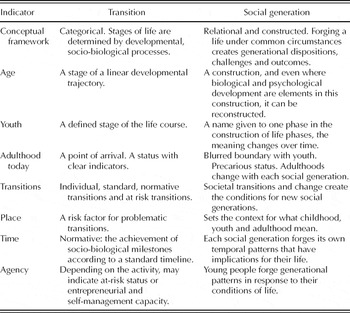
A social generations approach gives weight to not only structural changes, but also the way cultural matters, the valence attached to the institutionalised possibilities for youth and adulthood, are reshaped over time. The limits imposed by structural change may not be recognised; they may be fought or embraced by different age groups (Brinton, Reference Brinton2011). A new generation is not simply created by broad-scale economic and social change, but by policy decisions and the at times unavoidable work of reshaping what it means to be an adult or a young person (Wyn and Woodman, Reference Wyn and Woodman2006; Blatterer, Reference Blatterer2007). Table 1 provides a shorthand guide for comparing how the conception of youth within a social generations framework differs from one based on a conception of youth as a period of developmental transition.
Approaches to youth: social generation and transitionFootnote 4

The above schematises a broader argument that we are not able to present in detail here (see Wyn and Woodman, Reference Wyn and Woodman2006, Reference Wyn and Woodman2007). In summary, however, across all dimensions, including how age, youth and transitions are conceptualised, as well as the meaning of concepts such as place, time and agency, the generations approach acknowledges the interrelationships between people and their social context to a far greater extent than a transitions approach, which tends towards universalising definitions and normative concepts of youth. Tracing the making of a generation provides a reflexive framework for research that minimises the likelihood of researchers implicitly applying their own experience of youth to the patterns of contemporary young people, and judging them as failing on criteria that are no longer applicable. This in turn enables researchers to understand the intersections between biography and history, for individual life patterns and for the distribution of risks.
In arguing for developing the undervalued legacy of the sociology of generations in youth research, we are not calling for a type of universalistic theory of periodised generational shifts or intergenerational conflict, but for youth research that traces the way generational change is made, including through significant shifts in living patterns and in policy frameworks.
The making of a generation
Our Life Patterns participants were among the first cohorts to enter this new world of education and work, created by a recession that began in 1991, and by policy aimed at expanding participation in education and at liberalising labour markets. By their early thirties many felt that they were ‘successful’ in their own terms, but the decisions they have made point to a disconnection between the assumptions driving the policy decisions, aimed at building a post-industrial Australia, and their goals. While they did have modest hopes for material success, in both surveys and interviews conducted with the group over their twenties and thirties, the most sought-after goal was a better ‘balance’, particularly between work and the rest of their lives (Tyler et al., Reference Tyler, Cuervo, Wyn, Beadle, Holdsworth and Wyn2011).
In the face of policy ‘reforms’ that gave employers greater flexibility in contracts and dismissals, while giving employees fewer protections (for example the right to bargain collectively), it took fourteen years from leaving school for the majority of our participants to achieve employment stability. Before this, even with higher education, many were churning in and out of jobs without a long-term contract, combined with either long or variable hours of work (or both). A recurring theme in the interviews was how difficult it was to build and maintain intimate relationships and friendships. In a survey completed when they were twenty-nine, both women and men (68 per cent and 53 per cent respectively) told us that time with their family was suffering due to other, primarily work, commitments. Now, almost a decade later, this sense of missing out on time with family has strengthened even further (70 per cent of men and 80 per cent of women wanted more time to spend with family) (Andres and Wyn, Reference Andres and Wyn2010).
It is in the context of these changes that patterns of inequality need to be understood. In some of the earliest thinking about generations, Mannheim made a distinction between ‘generational units’ that while part of the same set of social changes in the broad sweep, develop different dispositions and attitudes due to occupying different social positions, for example around class or politics, within the generation (Edmunds and Turner, Reference Edmunds and Turner2002). The notion of generational units can be used to distinguish those who are able to make use of the opportunities opened to this generation by the expansion of education and those who cannot.
As such, the story of the making of this generation is also one of inequality. The women in the Life Patterns cohort embraced the call for further personal investment in education, achieving degree-level qualifications at a higher rate than the men. Yet, in the face of credential inflation, the rise of insecure work and ensuing job churning during their twenties, many of the women in our study were unable to establish themselves in a career before deciding they could no longer delay parenthood. In Australia, family friendly policies lag behind many other Western nations (Pocock, Reference Pocock2003). As a result, maintaining the desired work−life balance, particularly one that utilises their significant skills built up over years of education, has proven difficult or impossible for the mothers in our cohort (Andres and Wyn, Reference Andres and Wyn2010).
Further, only some of the young men have seen the benefits promised to them as the Australian economy was liberalised. In a context in which education has been encouraged, but also come increasingly to be understood as a personal investment, education, and more importantly the ability to access networks to convert credentials into job opportunities, has become a primary mechanism by which class inequality is created among this generation (Andres and Wyn, Reference Andres and Wyn2010).
The Life Patterns participants have, in other words, reshaped patterns of parenthood, marriage, cohabitation and work to create relatively complex and diverse life pathways in the face of the policy changes and risks discussed in the first section of this article. As significant markers of transition (for example, marriage, parenthood, full-time work, home ownership) are achieved later than in the previous generations, if at all (see also Australian Bureau of Statistics, 2006; Blatterer, Reference Blatterer2007; Martin, Reference Martin2009), our participants have needed to rethink adulthood in terms not dependent on stability, security and continuity, and to see themselves as responsible for their outcomes, even in the face of significant structural barriers.
Social generations and policy for young people
Just as in academic youth research, youth policy may be based on the understandings of youth held by policy makers who themselves grew up as part of a different generation. In this context, it is easy for young people's failure to take pathways that social change has made difficult or impossible to be seen instead mistakenly as personal failings. Engaging with this re-emerging sociology of generations may give policy makers new tools for tackling inequality.
Although discourse has softened, from achieving social and economic equality to a less contentious notion of social inclusion of at-risk youth, the realities of long-term structural inequality have not changed. For example, in the 1980s, social policies identified the need to address inequalities in educational participation, in particular for young indigenous people, young people living in rural and remote areas and in low socio-economic communities (Dawkins, Reference Dawkins1988). There has been little success.
Many of those who have championed the use of risk and social inclusion language in youth policy have had humanistic intentions, arguing that these terms offered a challenge to the overly economistic approach to social policy, and point to the need for ‘joined-up solutions’ (Turnbull and Spence, Reference Turnbull and Spence2011). For example, risk factors can be used to recognise the multiple influences on individual outcomes, moving the focus beyond single spheres like education or work, or family or juvenile justice. Yet, as critiques have highlighted, in practice the risk and social inclusion agenda tends to be operationalised using a model of risk and protective factors taken from the developmental-psychological model developed, in particular, by Michael Rutter and colleagues (Rutter, Reference Rutter1987). Risk factors are seen to coalesce in particular people or at best particular categories of people, not particular social formations or policy decisions (Turnbull and Spence, Reference Turnbull and Spence2011).
As Kelly (Reference Kelly2001) argues, certain young people are seen as ‘at risk’ of not developing the entrepreneurial and self-managing attitudes and skills needed by contemporary ‘flexible’ economies. Risk as a technology of governing youth reduces the socially situated complexities in young people's lives, so often tied to large-scale social changes and structural inequality, to localised individual characteristics in a personalised calculus of ‘at risk status’.
There is a growing risk consciousness in contemporary societies that is linked in part to the increased complexity and diversity of life-course patterns briefly discussed in this article (Beck, Reference Beck, Beck, Giddens and Lash1994). This complexity makes the tracing of collective patterns of inequality more difficult, while this risk consciousness leads to amplified efforts to attribute responsibility. Unless conceptual tools are available to counter this individualisation, the limited model of the individual (rational) actor can easily come to dominate research and policy.
In this ‘risk’ context, social inclusion policy often turns out to not be very social, instead focused on certain groups of young people and their lack of resources, often behavioural, to become the correct type of adult (Edwards, Reference Edwards2010; France, Reference France2008). In other words, much youth policy also works within a transitions framework. The type of society young people are meant to be included into is rarely brought into question; this is a weak version of social inclusion (Veit-Wilson, Reference Veit-Wilson1998).
When a risk-factor calculus taken from developmental psychology is combined with an understanding of youth as transition, the risks created by government policy are channelled into issues of normative social and personal development. It was, in particular, the labour market and education policies of the Australian government that have produced new uncertainties for young people. In interaction with the way that young people have responded, these decisions have helped make a new generation, a generation who are studying longer, taking longer to find stability in the job market if they find it at all, and often getting married and starting families later as they struggle to balance the new pressures the generational conditions they face have placed on them.
A generational frame can provide a new resource for policy. Daaland and Biggs (Reference Daaland and Biggs2004), looking at aging, rightly point to the inequity of ‘new agism’ where the priorities of one age group are applied through policy to others. Current iterations of policies aimed at social inclusion for young people (as with older people) tend to be based on the priorities of policy makers at a different point in the life course. We would add that this is not simply a cohort effect; contemporary youth research shows that the priorities of youth, adulthood and no-doubt old age can be reshaped by a new social generation (Andres and Wyn, Reference Andres and Wyn2010). Even when they reach middle age, today's young people may not have the same middle-aged priorities.
Conclusion
Young people's changing patterns of life present challenges to policy formation. This article has highlighted the generational shift that occurred in the early 1990s in Australia, and in other developed countries, towards greater participation in post-secondary education and more precarious work opportunities, even for graduates. These two elements have created new risks for young people. In Australia, those who do not gain at least a year 12 qualification, or its equivalent or post-secondary education, are the most likely to be unemployed or underemployed.
This article has focused on the way in which risk is understood through a consideration of discourses about youth transitions. Current youth policy in Australia, with its focus on risk and social inclusion, is underpinned by the concept of development or transition to a normative concept of adulthood that draws implicitly on the life course patterns of those born in the post-war baby boom. Successful transitions to adulthood are seen to be linear, involving set steps at prescribed times: through school, post-secondary education and into full-time work. The reality is that patterns are increasingly diverse, and that this diversity is a defining characteristic of a new generation.
A more robust social framework is needed to frame youth policies that address the realities of young people's lives today, one that focuses not on the individual and their characteristics that lead to or perpetuate social exclusion, but a framework that focuses on what kinds of societies and communities are inclusive, including in the sense of being open to change (for example, by giving a new generation the opportunity for meaningful participation in shaping not just their own future but collective futures). This research framework has to make visible social processes, and how these are being reconfigured, including the decisions made by policy makers in the past.