1. Introduction and general background
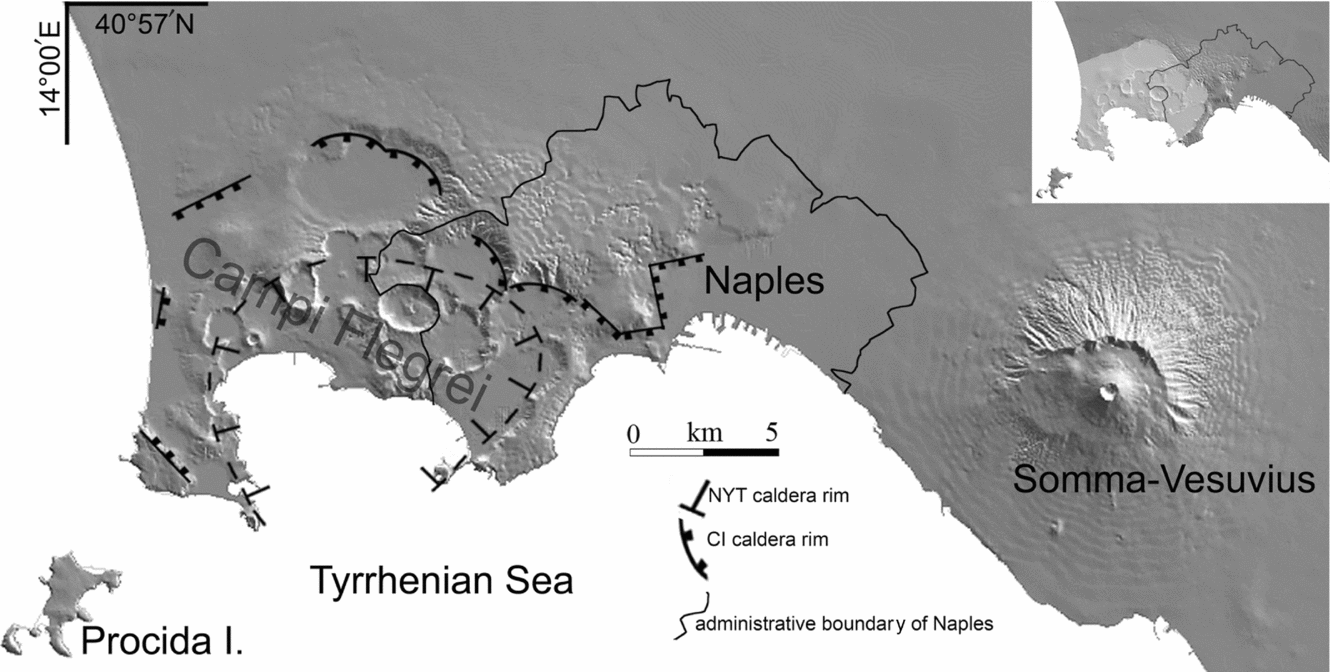
The city of Naples, with a population of c. 1 million people, is located between Somma‑Vesuvius to the east and the restless Campi Flegrei (Phlegraean Fields) volcanic field to the west (Fig. 1). Naples is characterized by numerous hills, remnants of ring- or horseshoe-shaped lava and tuff cones, leading to the early recognition (Breislak, Reference Breislak1801) of its volcanic nature. The western suburbs of Naples have been historically considered part of Campi Flegrei sensu stricto (Fig. 1) (De Lorenzo, Reference De Lorenzo1904; Rittmann, Reference Rittmann1950; Di Girolamo et al. Reference Di Girolamo, Ghiara, Lirer, Munno, Rolandi and Stanzione1984; Rosi & Sbrana, Reference Rosi and Sbrana1987), while more recently the whole city has been considered to be the eastern sector of this volcanic field (Cole, Perrotta & Scarpati, Reference Cole, Perrotta and Scarpati1994) on the basis of analogous volcanic features, including monogenetic vents, an apparent caldera rim and rare lava domes. Possibly owing to increasing urbanization, the geology of Naples has received scant attention in favour of detailed reconstructions of the stratigraphy, geochemistry and geochronology of Campi Flegrei sensu stricto (Di Girolamo et al. Reference Di Girolamo, Ghiara, Lirer, Munno, Rolandi and Stanzione1984; Rosi & Sbrana, Reference Rosi and Sbrana1987; Orsi, de Vita & Di Vito, Reference Orsi, de Vita and Di Vito1996). Recently, urban field investigations have refined the stratigraphic framework of the city of Naples and volcanism within the city limits (Cole, Perrotta & Scarpati, Reference Cole, Perrotta and Scarpati1994; Perrotta et al. Reference Perrotta, Scarpati, Luongo, Morra and De Vivo2006). The chronology of this volcanism is poorly constrained except for two well-dated, large Campi Flegrei ignimbrites: the Campanian Ignimbrite, a widespread, > 100 km3 dense-rock equivalent (DRE) eruption (Barberi et al. Reference Barberi, Innocenti, Lirer, Munno, Pescatore and Santacroce1978) emplaced 39 ka years ago (De Vivo et al. Reference De Vivo, Rolandi, Gans, Calvert, Bohrson, Spera and Belkin2001; Fedele et al. Reference Fedele, Scarpati, Lanphere, Melluso and Morra2008), and the Neapolitan Yellow Tuff, a phreatoplinian, well-stratified deposit that erupted 15 ka years ago (Scarpati, Cole & Perrotta, Reference Scarpati, Cole and Perrotta1993; Deino et al. Reference Deino, Orsi, de Vita and Piochi2004). Most deposits exposed within the city of Naples precede both ignimbrites, whereas the Santa Teresa, Minopoli, Agnano-Monte Spina, Pisani (Di Vito et al. Reference Di Vito, Isaia, Orsi, Southon, de Vita, D'Antonio, Pappalardo and Piochi1999), Nisida Island and Mt Echia tuff (Cole, Perrotta & Scarpati, Reference Cole, Perrotta and Scarpati1994; Fedele et al. Reference Fedele, Insinga, Calvert, Morra, Perrotta and Scarpati2011; Fig. 2) are younger. The few radioisotopic age determinations made on the products of the autochthonous volcanism were not the result of a systematic study and were biased towards post-Neapolitan Yellow Tuff vents. The only pre-Neapolitan Yellow Tuff ages provided in the literature refer to two proximal, thick tephra successions, consisting of several eruptive units separated by palaeosols, cropping out in the western part of the city. A 14C age of > 42 ka has been obtained at the base of the Torre di Franco Tuffs (Alessio et al. Reference Alessio, Bella, Improta, Belluomini, Cortesi and Turi1973); deposits forming the Whitish Tuffs succession have been dated, respectively, at 16.4 ka and 30.3 ka (14C age, Alessio et al. Reference Alessio, Bella, Improta, Belluomini, Cortesi and Turi1973; 40Ar–39Ar age, Pappalardo et al. Reference Pappalardo, Civetta, D'Antonio, Deino, Di Vito, Orsi, Carandente, de Vita, Isaia and Piochi1999). Two minor tephra layers drilled in the western suburbs of the city are dated at 16.1 ka and 44.3 ka (Ponti Rossi tephra, 40Ar–39Ar ages, Pappalardo et al. Reference Pappalardo, Civetta, D'Antonio, Deino, Di Vito, Orsi, Carandente, de Vita, Isaia and Piochi1999). Considering the implications for hazard assessment for the city of Naples, a study was initiated to establish the age of the Neapolitan volcanism, in particular before the Neapolitan Yellow Tuff eruption. We selected some suitable (see Sections 3 and 4 below) pyroclastic units for 40Ar–39Ar dating of potassium-bearing minerals separated from these volcanic deposits. The aim of the present work is thus twofold: to reconstruct the evolution of the autochthonous volcanism in the Neapolitan area; and to integrate Neapolitan and Phlegraean volcanological and geochronological data providing a more complete picture about the formation of the Campi Flegrei volcanic field.
Shaded relief map of the Neapolitan region including the Somma-Vesuvius volcano and Campi Flegrei. Boundaries of the Campanian Ignimbrite caldera (Rosi & Sbrana, Reference Rosi and Sbrana1987; Perrotta et al. Reference Perrotta, Scarpati, Luongo, Morra and De Vivo2006) and Neapolitan Yellow Tuff caldera (Scarpati, Cole & Perrotta, Reference Scarpati, Cole and Perrotta1993) are also shown. Inset: Geographic relationship between Naples and the volcanic field of Campi Flegrei sensu stricto (pale grey area).

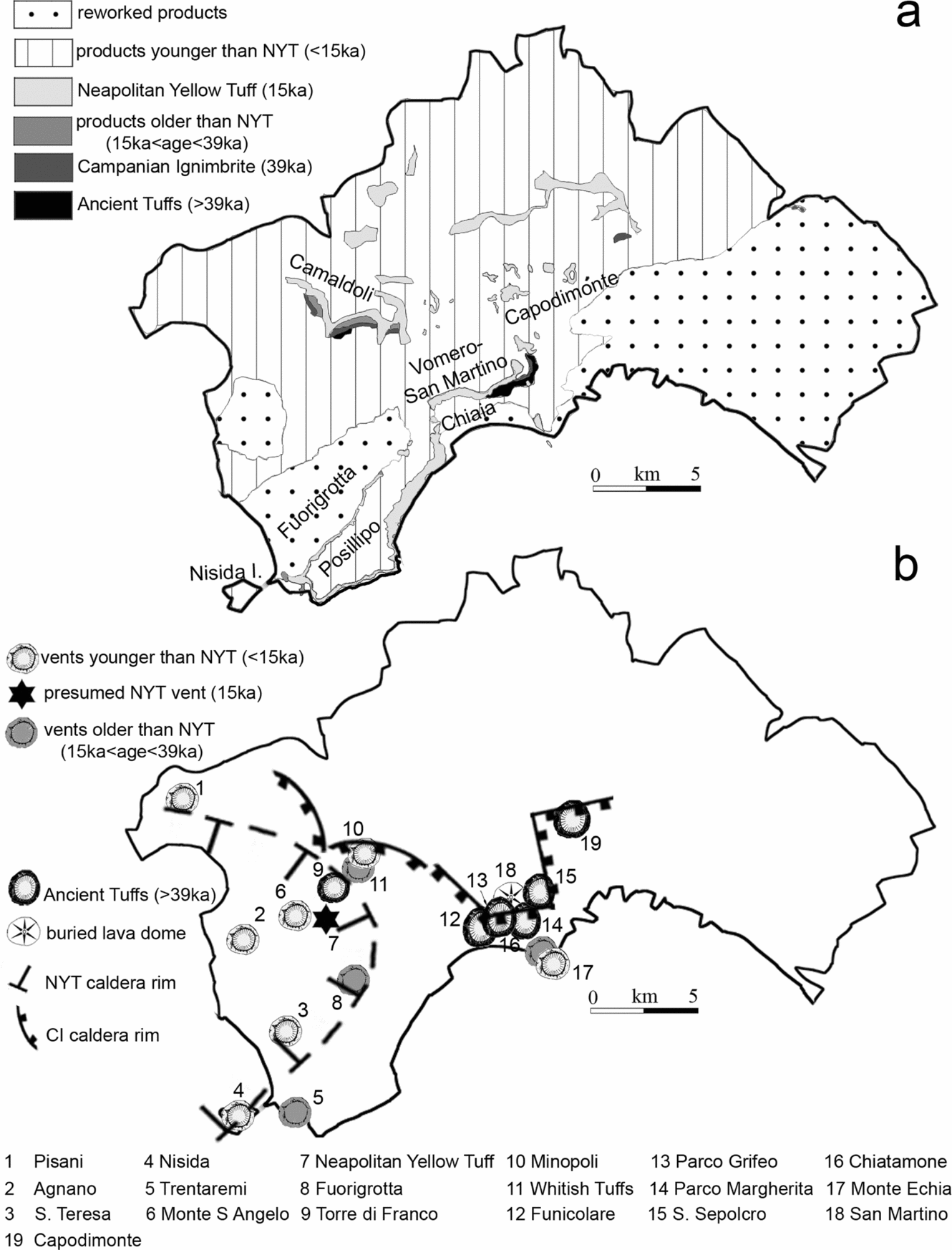
(a) Geological sketch map of the city of Naples. (b) Structural sketch map of the city of Naples with the locations of the eruptive vents and the calderas boundaries. Connections between volcanotectonic lineaments and vent distributions are discussed in the text. NYT – Neapolitan Yellow Tuff.

2. Stratigraphic framework of Neapolitan volcanism
The hilly morphology of Naples is mainly due to the construction of several explosive monogenetic volcanoes and the down-faulting displacement associated with the collapse of two nested Late Pleistocene calderas (Fig. 1). Boreholes scattered throughout the city reveal that the 200–300 m thick volcanic succession lies atop sedimentary rocks. Lava flows are exposed in various tunnels at the base of the pyroclastic sequence.
2.a. Ancient Tuffs
Lithified, pre-caldera pyroclastic deposits, named the Ancient Tuffs, (Fig. 2a) correlate with the remnants of monogenetic vents mainly located in the Chiaia district (Fig. 2a) and with a thick sequence of pumice lapilli beds, cropping out at the base of Camaldoli hill. Overlapping deposits of the Chiaia district vents, including Parco Margherita, Parco Grifeo, Funicolare di Chiaia and San Sepolcro, and a fifth vent to the northeast, Capodimonte (Fig. 2b), contain stratified successions of massive and graded beds. Poorly sorted, ashy sandwave structures with dispersed small, rounded pumice fragments alternate with well-sorted, plane-parallel beds composed of large, angular pumice clasts. Impact sags are frequently observed. These features suggest near-vent emplacement from pyroclastic currents accompanied by ballistic fallout. The fine-ash nature and the presence of accretionary lapilli suggest phreatomagmatic behaviour (efficient magma–water interaction) in these eruptions (Wohletz, Reference Wohletz1983). Lithification of these deposits is related to advanced zeolitization (de’ Gennaro et al. Reference de’ Gennaro, Cappelletti, Langella, Perrotta and Scarpati1999). Vents in the Chiaia district are draped by three coarse, stratified, well-sorted pumice lapilli fall deposits. Ash beds with coarse, rounded pumice clasts rest on erosional surfaces in both the lower and the upper pumice lapilli beds. These pumice beds are possibly related to the Torre di Franco Tuffs (> 42 ka bp, Alessio et al. Reference Alessio, Bella, Improta, Belluomini, Cortesi and Turi1973), the thick pyroclastic fall sequence cropping out at the base of Camaldoli hill (Fig. 2a).
2.b. Campanian Ignimbrite
The Ancient Tuffs are overlain by the proximal facies of the Campanian Ignimbrite caldera-forming eruption (39 ka bp, De Vivo et al. Reference De Vivo, Rolandi, Gans, Calvert, Bohrson, Spera and Belkin2001; Fedele et al. Reference Fedele, Scarpati, Lanphere, Melluso and Morra2008; Scarpati & Perrotta, Reference Scarpati and Perrotta2012). Several units are identified throughout the ignimbrite sequence, from the base upwards: (a) a coarse pumice lapilli fall deposit partially eroded by the overlying ignimbrite; (b) a stratified and incoherent ash deposit; (c) a welded unit (Piperno) with dispersed flattened juvenile fiamme; (d) a lithic-rich, clast-supported, incoherent breccia deposit (Museum Breccia), including a locally interlayered, welded spatter deposit in the lower part of the breccia; and (e) a weakly lithified ash to coarse-ash deposit. Locally, the breccia deposit overlies a grey welded tuff that represents the lateral transition between the proximal coarse and welded products and the typical facies of the Campanian Ignimbrite. A caldera collapse cut through the Campanian Ignimbrite and Ancient Tuffs, forming steep scarps that border the south and east sides of Vomero–San Martino hill, the south side of Capodimonte hill and the south and west sides of Camaldoli hill (Fig. 2b). This collapse is interpreted to be late in the Campanian eruption, likely synchronous with the emplacement of the breccia.
2.c. Eruptive activity between the Campanian and Neapolitan caldera-forming eruptions
The post-Campanian Ignimbrite, pre-Neapolitan Yellow Tuff volcanic activity is characterized by a thick succession of pyroclastic deposits separated by palaeosols and the presence of two monogenetic vents (Fig. 2b). A 70 m thick pyroclastic sequence, the Whitish Tuffs (16 390 ± 180 bp and 15 090 ± 140 bp, Alessio et al. Reference Alessio, Bella, Improta, Belluomini, Cortesi and Turi1973), crops out in the western part of Naples and is correlated with a few-metres thick deposit in the eastern suburbs of the city, suggesting a vent or vents confined between the Camaldoli and Posillipo hills. The Chiatamone vent (completely buried under the Neapolitan Yellow Tuff but visible in tunnels) and the Trentaremi tuff ring are located along the Bay of Naples. The stratigraphic relationships between these deposits are unconstrained owing to their limited distribution.
2.d. Neapolitan Yellow Tuff
The Neapolitan Yellow Tuff (15 ka bp, Deino et al. Reference Deino, Orsi, de Vita and Piochi2004) includes about 50 km3 DRE of material that buried Campi Flegrei sensu stricto and the city of Naples in a thick blanket of pyroclastic material and formed a major caldera collapse inside the earlier Campanian structure (Scarpati, Cole & Perrotta, Reference Scarpati, Cole and Perrotta1993). The Fuorigrotta face of Posillipo hill approximates the southeastern rim of the caldera. Younger eruptive deposits bury the caldera rim elsewhere. Ballistic directions and facies analyses indicate a source area in the Fuorigrotta Plain (Fig. 2b). In proximal areas the thickness of this tuff is up to 150 m (Scarpati, Cole & Perrotta, Reference Scarpati, Cole and Perrotta1993).
2.e. Post-Neapolitan Yellow Tuff
Thanks to well-exposed stratigraphic relationships and well-preserved volcanic structures, the post-Neapolitan Yellow Tuff stratigraphy is better known than that of the older, pre-caldera deposits. Loose and unconsolidated pyroclastic deposits largely cropping out on the slopes of the Neapolitan hills are the products of Phlegraean activity (Fig. 2a). The presence of several volcanic centres – Pisani, Agnano, Monte Sant'Angelo, Monte Echia and Nisida (3.9 ka bp, Fedele et al. Reference Fedele, Insinga, Calvert, Morra, Perrotta and Scarpati2011) – testify to the explosive activity still active inside the city of Naples.
3. Sampling and dating procedure
We performed a total of five 40Ar–39Ar measurements on pyroclastic samples collected from different sections in the city of Naples and representative of different stratigraphic horizons. Age determinations were performed on sanidine crystals extracted from juvenile clasts. Fresh sanidine crystals were separated from pumice using standard mechanical, magnetic and heavy-liquid methods. Samples were encapsulated in Cu foil and loaded in quartz vials along with 27.87 Ma TCR-2 sanidine to monitor neutron flux. Quartz vials were shielded with Cd foil to minimize reactor-derived 40Ar and irradiated for 60 minutes in the Central Thimble of the US Geological Survey TRIGA reactor in Denver, Colorado. Argon was extracted from the standard sanidines with a CO2 laser and from unknowns by resistance furnace and run on a MAP 216 mass spectrometer. Full analytical procedures are described by Lanphere et al. (Reference Lanphere, Champion, Melluso, Morra, Perrotta, Scarpati, Tedesco and Calvert2007).
4. Results
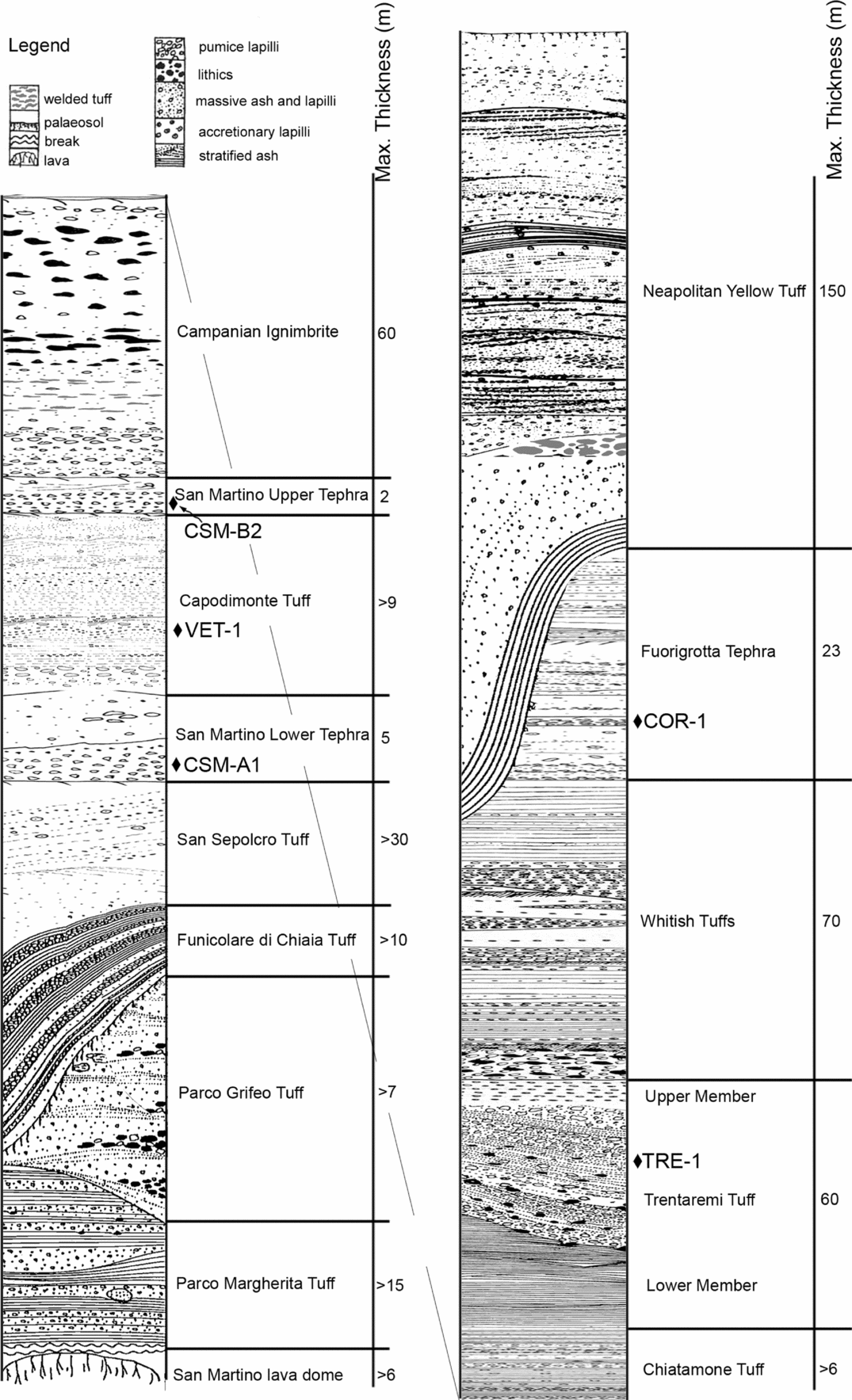
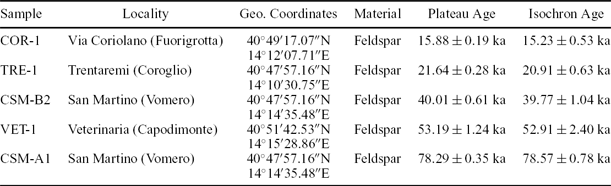
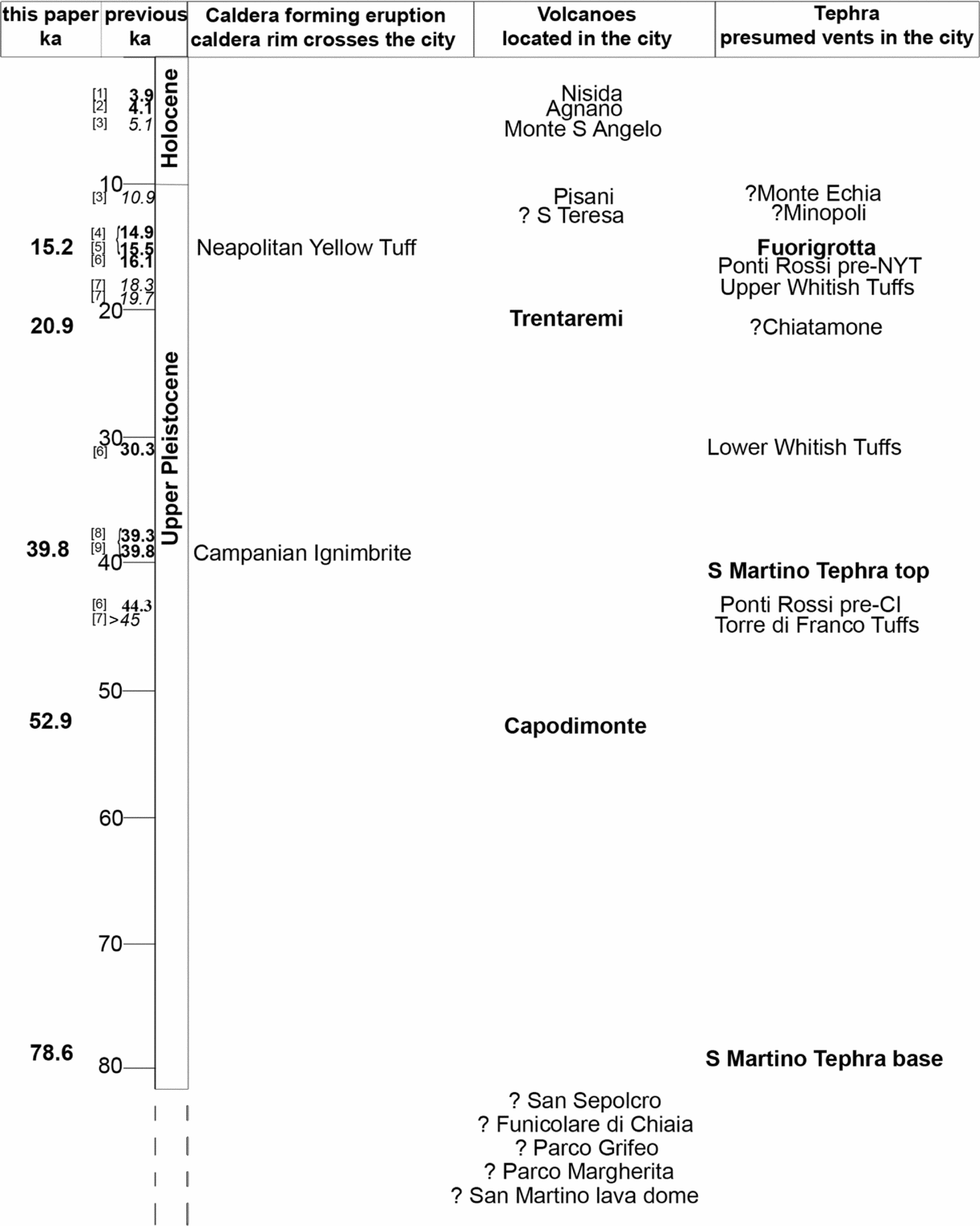
In the urbanized sector of Campi Flegrei (the city of Naples) there have been few attempts (Di Girolamo et al. Reference Di Girolamo, Ghiara, Lirer, Munno, Rolandi and Stanzione1984 and references therein; de Vita et al. Reference de Vita, Orsi, Civetta, Carandente, D'Antonio, Deino, di Cesare, Di Vito, Fisher, Isaia, Marotta, Necco, Ort, Pappalardo, Piochi and Southon1999; Di Vito et al. Reference Di Vito, Isaia, Orsi, Southon, de Vita, D'Antonio, Pappalardo and Piochi1999; Fedele et al. Reference Fedele, Scarpati, Lanphere, Melluso and Morra2008, Reference Fedele, Insinga, Calvert, Morra, Perrotta and Scarpati2011) to constrain the absolute ages of the volcanic deposits. This lack of geochronological data is due to poor exposure, difficult access and alteration (zeolitization) of the tuffs. To overcome this difficulty, we selected only unaltered, juvenile pumice with a sanidine content sufficient for the analysis. The juvenile pumice clasts were collected from tephra layers interstratified with the tuffs and large juvenile bombs scattered in proximal tuffaceous deposits. All the eruptive units selected are older than the Neapolitan Yellow Tuff and three are older than the Campanian Ignimbrite. A stratigraphic column of the volcanic deposits cropping out in the Neapolitan area is shown in Figure 3 and the results of five 40Ar–39Ar sanidine analyses are reported in Table 1.
Composite stratigraphic column of the Neapolitan area. The right column is stratigraphically younger than the left column (as indicated by the broken line). Deposits are not to scale and their maximum thicknesses are reported. Note that the Neapolitan Yellow Tuff rests unconformably on all the older deposits, but in this sketch it is schematically represented overlying the Fuorigrotta tephra. Samples collected for 40Ar–39Ar geochronology are shown.

Geochronological ages of the five samples dated

Samples COR-1 (the Fuorigrotta tephra) and TRE-1 (Trentaremi tuff cone) were collected from pyroclastic deposits exposed in the Neapolitan Yellow Tuff southeastern caldera rim (Fig. 2a, b). Both samples underlie the 15 ka Neapolitan Yellow Tuff. Samples CSM-B2 and CSM‑A1 were collected in two tephra layers underneath a proximal sequence of the Campanian Ignimbrite (Perrotta & Scarpati, Reference Perrotta and Scarpati1994); hence, they are older than 39 ka (40Ar–39Ar age of the Campanian Ignimbrite; Fedele et al. Reference Fedele, Scarpati, Lanphere, Melluso and Morra2008). Sample VET‑1 was collected from the base of Capodimonte hill (Fig. 2a, b) and underlies the Neapolitan Yellow Tuff, but stratigraphic relationships with the Campanian Ignimbrite are not exposed. Below we summarize the main features of the sampled deposits (described in detail in Cole, Perrotta & Scarpati, Reference Cole, Perrotta and Scarpati1994; Perrotta et al. Reference Perrotta, Scarpati, Luongo, Morra and De Vivo2006); new field observations are here presented to describe the Fuorigrotta sequence.
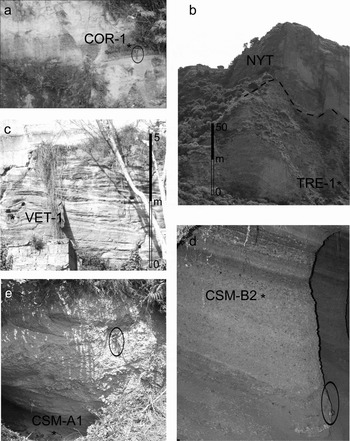
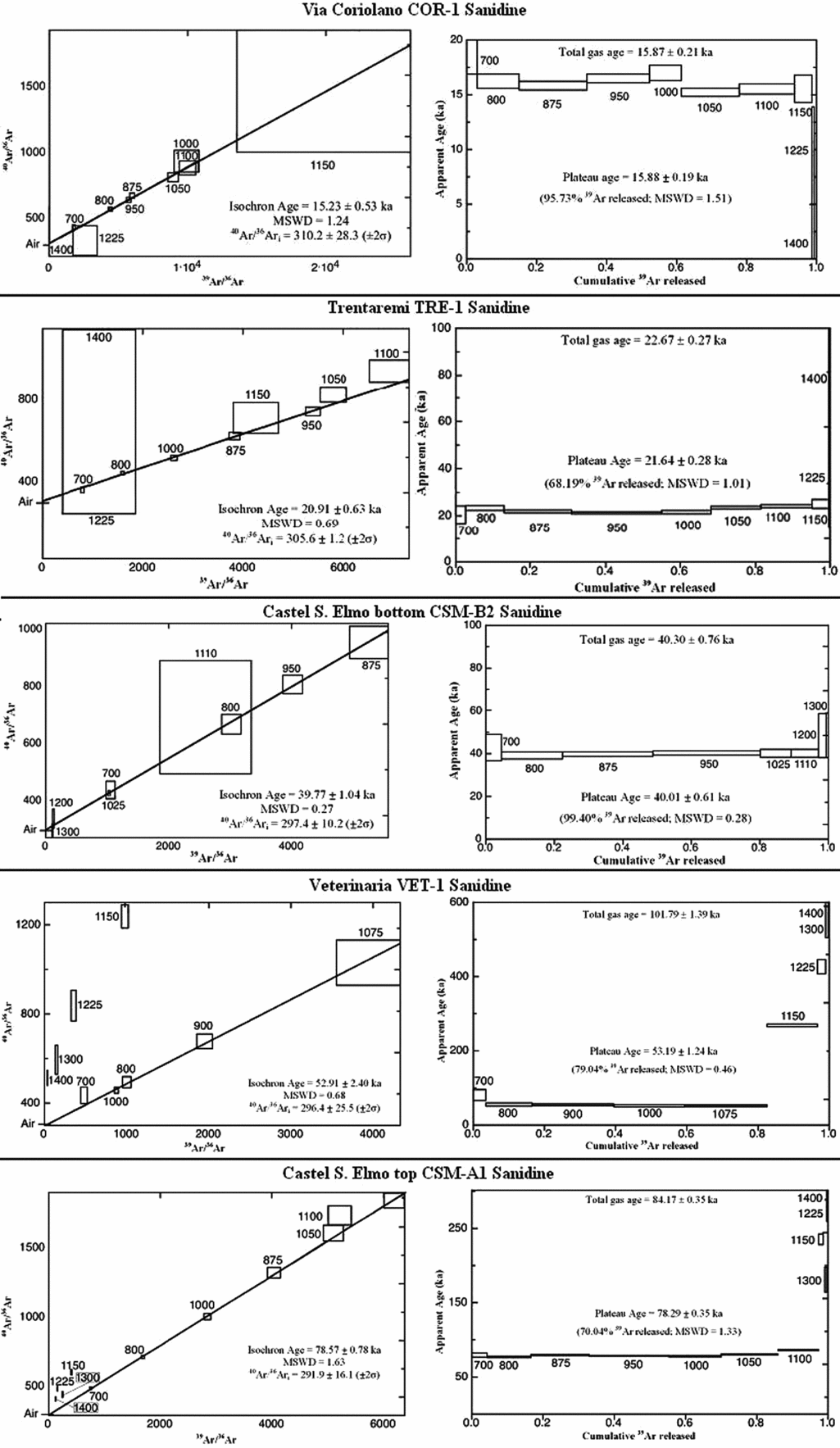
Sample COR‑1 was collected in Via Coriolano (Fuorigrotta district, Fig. 2a). In this area, a well-stratified succession of pyroclastic deposits is exposed, separated by palaeosols and overlain by the Neapolitan Yellow Tuff (Fig. 3). The lowest part of the pyroclastic succession is sub-horizontal, stratified and at least 6 m thick. It is composed of four units that, from the base to the top are: (a) angular pumice lapilli layers interstratified with poorly sorted ash layers that contain rounded pumices; (b) a 1 m thick pumice and ash deposit; pumice clasts are well rounded and up to 30 cm in diameter; (c) a 2 m thick, thinly stratified fine-ash deposit, rich in accretionary lapilli; (d) alternating fine lapilli and lapilli layers, 80 cm thick. Lapilli are angular in shape and range from well-vesiculated light grey pumice clasts to poorly vesiculated dark grey scoriae. A palaeosol separates this succession from the overlying 2 m thick, stratified ash deposit with some discontinuous fine lapilli layers. The described sequence is deeply eroded on the northwest side and cut by an extensional dip-slip fault with a vertical displacement of less than 1 m. Above this unconformity lies a 15 m thick stratified deposit composed of ash layers with minor pumice lapilli horizons. The Neapolitan Yellow Tuff rests on this older deposit. Thickness, facies and grain size suggest that the pre-Neapolitan Yellow Tuff sequence originated from vents located in the Phlegraean area sensu stricto. The sample was collected from the pumice and scoria lapilli deposit (unit d) of the basal eruptive succession (Fig. 4a). Only light grey pumices were selected for dating. Sample COR‑1 yielded a weighted mean plateau age (WMPA) age of 15.88 ± 0.19 ka and a concordant isochron age of 15.23 ± 0.53 ka (Fig. 5).
Sampled deposits; locations are shown in Figure 2b and geographical coordinates in Table 1. (a) Stratified pyroclastic succession overlain by the Neapolitan Yellow Tuff. Sample COR-1 was collected from the pumice and scoria lapilli deposit; (b) Trentaremi Tuff rim mantled by the Neapolitan Yellow Tuff (NYT). Sample TRE-1 was collected from the Lower Trentaremi Member; (c) Capodimonte Tuff. Sample VET-1 was collected from a large ballistic juvenile; (d) and (e) Stratified tephra underneath the Campanian Ignimbrite at San Martino. Sample CSM-B2 was collected from the uppermost of these beds, while sample CSM-A1 was collected at the base of the succession.

Age spectra and isochrons for the COR-1, TRE-1, CSM-B2, VET-1 and CSM-A1 samples.

Sample TRE‑1 was collected along the sea cliff at Coroglio, at the southwestern extremity of Posillipo hill (Fig. 2a). In this locality, a remnant of the Trentaremi volcano is deeply dissected by wave erosion and covered with a thick blanket of Neapolitan Yellow Tuff. The Trentaremi tuff is composed of a lower and upper member separated by a well-developed palaeosol, suggesting that the Trentaremi volcano had more than one eruptive phase, as reported in Cole, Perrotta & Scarpati (1994). The analysed sample was collected from the upper part of the Lower Trentaremi Member succession (Fig. 4b) where the zeolitization was less intense (Fig. 3). Sanidines were separated from large (>20 cm) pumice blocks and yielded a WMPA age of 21.64 ± 0.28 ka and isochron age of 20.91 ± 0.63 ka (Fig. 5).
On the southern side of San Martino hill (Fig. 2a) the basal monogenetic volcanoes are draped by pumice lapilli beds directly overlain by the proximal facies (Museum Breccia) of the Campanian Ignimbrite (Fig. 3). Sample CSM‑B2 was collected from the uppermost of these beds (San Martino Upper Tephra), a coarse and well‑sorted, stratified pumice lapilli deposit (Fig. 4d). For dating, juvenile, vesiculated, grey pumice blocks were selected. Sample CSM‑B2 yielded a WMPA age of 40.01 ± 0.61 ka and concordant isochron age of 39.77 ± 1.04 ka (Fig. 5).
Pumice lapilli sample CSM‑A1 was collected from a thick, well‑sorted fall layer (Fig. 4e) at the base of the succession (San Martino Lower Tephra) stratigraphically between the San Sepolcro volcano and the Campanian Ignimbrite (Fig. 3). The sample yielded a WMPA age of 78.29 ± 0.35 ka and isochron age of 78.57 ± 0.78 ka (Fig. 5).
The remnant of a small tuff cone crops out at the foot of Capodimonte hill (Fig. 2a, b). The lower part of the succession is composed of undulating thin ash and fine lapilli layers and is covered by a 5 m thick deposit with dunes composed of alternating fine-ash layers with accretionary lapilli and coarse lithic lenses in an ash matrix. Numerous coarse juvenile and lithic bombs deform the succession at different stratigraphic heights (Fig. 3). Fresh juvenile bombs (sample VET‑1, Fig. 4c) were selected for dating. Sample VET‑1 yielded a WMPA age of 53.19 ± 1.24 ka and isochron age of 52.91 ± 2.40 ka (Fig. 5).
5. Discussion
5.a. Volcanism of Naples
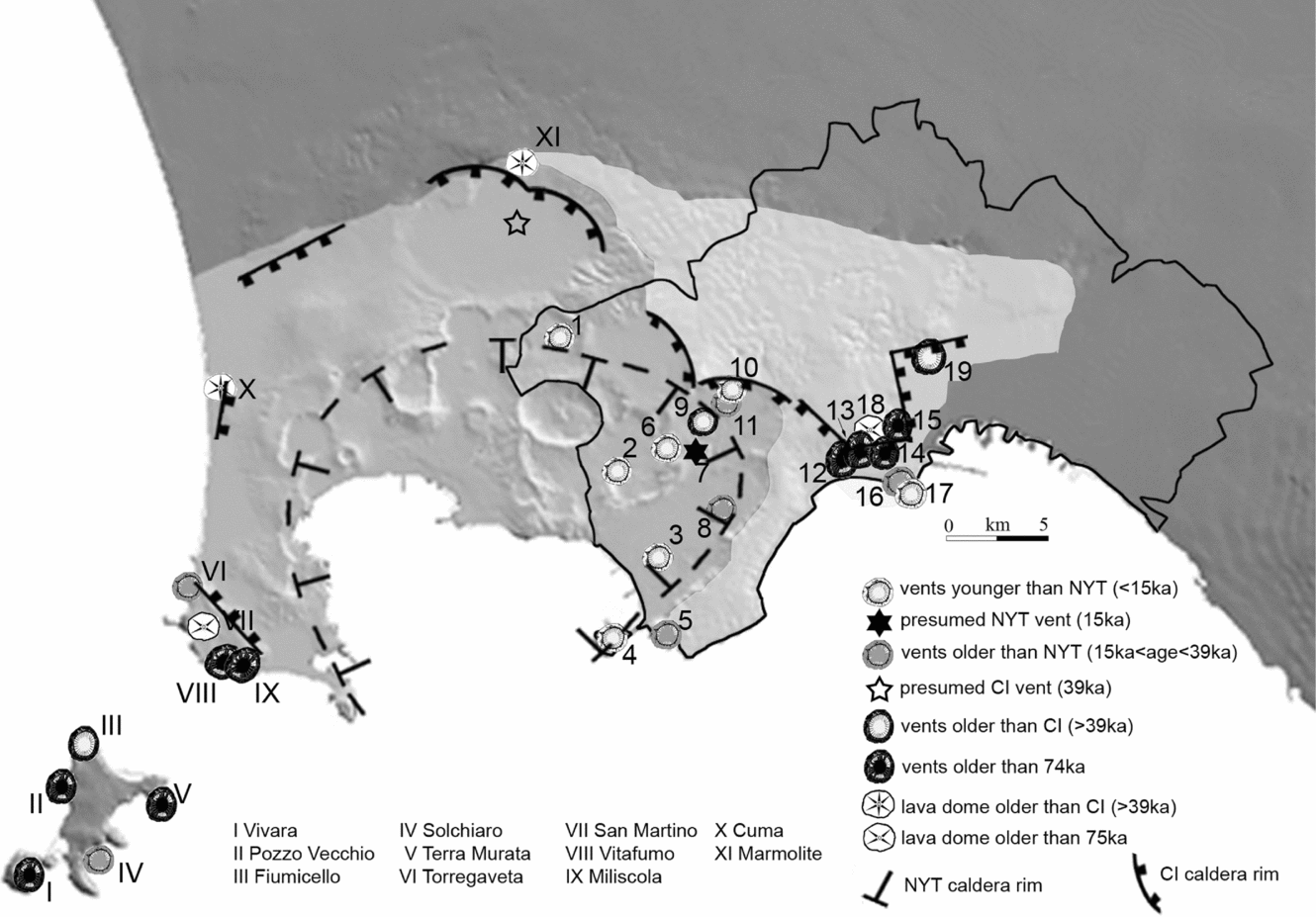
Reliable dates on volcanism from within Naples, in the eastern sector of Campi Flegrei, have been difficult to obtain; in particular pre-caldera ages were almost completely lacking. 40Ar–39Ar dates indicate a long period of volcanism that resulted in a range of volcanic styles and magnitudes: from purely magmatic to essentially phreatomagmatic eruptions and from small cone-building to large plinian events. New 40Ar–39Ar data together with available 14C data (calibrated using CALPAL-2007 software) and several 40Ar–39Ar ages reported in the literature (De Vivo et al. Reference De Vivo, Rolandi, Gans, Calvert, Bohrson, Spera and Belkin2001; Deino et al. Reference Deino, Orsi, de Vita and Piochi2004; Insinga et al. Reference Insinga, Calvert, D'Argenio, Fedele, Lanphere, Morra, Perrotta, Sacchi and Scarpati2004; Fedele et al. Reference Fedele, Scarpati, Lanphere, Melluso and Morra2008, Reference Fedele, Insinga, Calvert, Morra, Perrotta and Scarpati2011) are reported in Figure 6. The volcanism in this urban area produced several eruptive centres that constitute the structure of the hills of Naples (Fig. 7). The temporal succession of Naples volcanism was previously bracketed only by the two main eruptive events of Campi Flegrei, namely the Campanian Ignimbrite and the Neapolitan Yellow Tuff (Rosi & Sbrana, Reference Rosi and Sbrana1987; Orsi, de Vita & Di Vito, Reference Orsi, de Vita and Di Vito1996). Recently, however, detailed field studies constrained stratigraphic relationships between various deposits. The new dating allows the definition of an eruptive sequence that is more comprehensive than those present in the literature (Orsi, de Vita & Di Vito, Reference Orsi, de Vita and Di Vito1996; Bellucci et al. Reference Bellucci, Milia, Rolandi, Torrente and De Vivo2006; Perrotta et al. Reference Perrotta, Scarpati, Luongo, Morra and De Vivo2006; Scandone, Giacomelli & Fattori Speranza, Reference Scandone, Giacomelli and Fattori Speranza2006) and also provides timing information for the area. The oldest dated product is a proximal fall deposit (San Martino Lower Tephra) with an age of about 78.3 ± 0.4 ka, which is ~18 ka older than pyroclastic deposits exposed along the northern rim of Campi Flegrei (Pappalardo et al. Reference Pappalardo, Civetta, D'Antonio, Deino, Di Vito, Orsi, Carandente, de Vita, Isaia and Piochi1999). The Torre di Franco Tuffs (Fig. 7), with a 14C age older than 45 ka, may correlate with the caldera rim pyroclastic deposits. The San Martino Lower Tephra rests on the San Sepolcro tuff cone, constraining the underlying explosive and effusive vents (Funicolare di Chiaia, Parco Grifeo and Parco Margherita volcanoes and San Martino lava dome) to be older than ~78 ka. The easternmost vent in Naples is the Capodimonte volcano (Fig. 7), which yields an age of 53 ± 1 ka. The top of the San Martino succession (Fig. 3) is dated at 40 ± 1 ka, within error of the Campanian Ignimbrite (De Vivo et al. Reference De Vivo, Rolandi, Gans, Calvert, Bohrson, Spera and Belkin2001; Fedele et al. Reference Fedele, Scarpati, Lanphere, Melluso and Morra2008). A palaeosol between the San Martino deposit and the overlying Museum Breccia (Perrotta & Scarpati, Reference Perrotta and Scarpati1994) requires a significant time break between those eruptions. A complex succession of fallout and ignimbritic products was emplaced during the Campanian Ignimbrite eruption. It was responsible for a caldera collapse that cut through the Campanian Ignimbrite and Ancient Tuffs, forming the steep scarps that border the south, east and presumably west sides of San Martino hill, the south side of Capodimonte hill and the south and east sides of Camaldoli hill (Fig. 7). Between 39 ka and 15 ka ago, Campi Flegrei was characterized by moderate explosive activity (Orsi, de Vita & Di Vito, Reference Orsi, de Vita and Di Vito1996). Trentaremi volcano (21.6 ± 0.3 ka) grew during this interval, possibly as a result of multiple eruptions as well as proximal pyroclastic products accumulated in the Fuorigrotta area (15.9 ± 0.2 ka). These eruptive centres, together with the Chiatamone volcano in the Chiaia area, were completely buried by the Neapolitan Yellow Tuff, and testify to the persistence of explosive activity in the city of Naples after the eruption of the Campanian Ignimbrite. Seven volcanic vents are identified within Naples following the great phreatoplinian eruption of the Neapolitan Yellow Tuff (Fig. 7). They are unevenly distributed with respect to the caldera boundaries: two inside, four along the rim and one vent several kilometres east of the rim (Fig. 7). These deposits indicate persistent explosive activity inside the urban borders of Naples.
Chronostratigraphy of Neapolitan volcanism resulting from the integration of 40Ar–39Ar data and 14C calibrated ages. 40Ar–39Ar age in bold type; calibrated 14C age in italic. Question marks indicate undated deposits piled up based on their stratigraphic relationships. Radiocarbon ages were calibrated using the CALPAL-2007 software and the CALPAL-2007HULU dataset (Weninger, Jöris & Danzeglocke, Reference Weninger, Jöris and Danzeglocke2008). References for data sources: 1 – Fedele et al. (Reference Fedele, Insinga, Calvert, Morra, Perrotta and Scarpati2011); 2 – de Vita et al. (Reference de Vita, Orsi, Civetta, Carandente, D'Antonio, Deino, di Cesare, Di Vito, Fisher, Isaia, Marotta, Necco, Ort, Pappalardo, Piochi and Southon1999); 3 – Di Vito et al. (Reference Di Vito, Isaia, Orsi, Southon, de Vita, D'Antonio, Pappalardo and Piochi1999); 4 – Deino et al. (Reference Deino, Orsi, de Vita and Piochi2004); 5 – Insinga et al. (Reference Insinga, Calvert, D'Argenio, Fedele, Lanphere, Morra, Perrotta, Sacchi and Scarpati2004); 6 – Pappalardo et al. (Reference Pappalardo, Civetta, D'Antonio, Deino, Di Vito, Orsi, Carandente, de Vita, Isaia and Piochi1999); 7 – Alessio et al. (Reference Alessio, Bella, Improta, Belluomini, Cortesi and Turi1973); 8 – De Vivo et al. (Reference De Vivo, Rolandi, Gans, Calvert, Bohrson, Spera and Belkin2001); 9 – Fedele et al. (Reference Fedele, Scarpati, Lanphere, Melluso and Morra2008).

Structural sketch map of the Neapolitan–Phlegraean area showing vent locations (roman numerals) older than Neapolitan Yellow Tuff (NYT) eruption (> 15 ka) in the Phlegraean region and all eruptive vents (numbers as in Fig. 2) in the urban area of Naples. Mid-grey shaded area – Campi Flegrei sensu stricto; light grey shaded area – eastern enlargement of Campi Flegrei including the active volcanic area in the central part of Naples. NYT vent location from Scarpati, Cole & Perrotta (1993); Campanian Ignimbrite (CI) vent location from Scarpati & Perrotta (2012).

5.b. Boundaries and evolution of Campi Flegrei
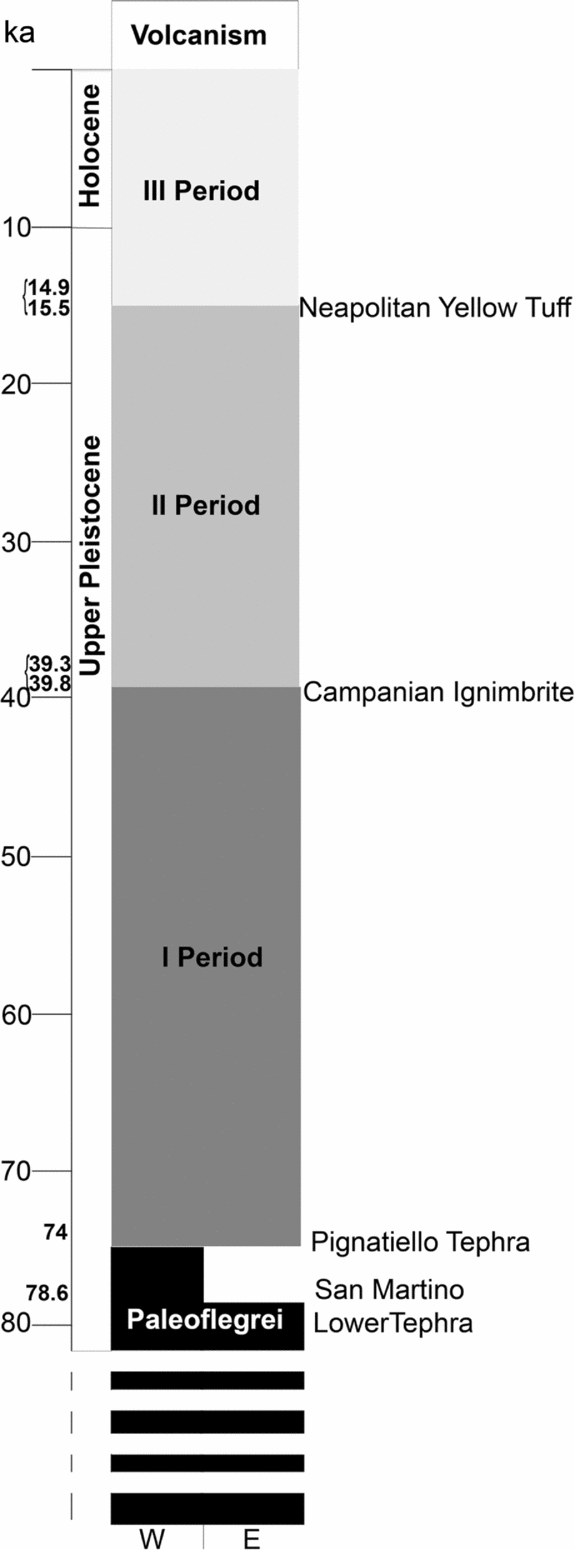
40Ar–39Ar age determinations together with geological data have enabled us to detail the evolution of the Campi Flegrei volcanic field. Previous studies recognized two, three or four main stages of activity for Campi Flegrei. All authors used the Campanian Ignimbrite and, less frequently, also the Neapolitan Yellow Tuff to subdivide the volcanic history of Campi Flegrei. Rittmann (Reference Rittmann1950) and Rosi & Sbrana (1987) used the caldera collapse associated with the Campanian Ignimbrite to separate the volcanism into a pre-caldera and a post-caldera cycle. De Lorenzo (Reference De Lorenzo1904) and many other authors (Scherillo & Franco, Reference Scherillo and Franco1960; Orsi, de Vita & Di Vito, Reference Orsi, de Vita and Di Vito1996; Perrotta et al. Reference Perrotta, Scarpati, Luongo, Morra and De Vivo2006) recognized three periods separated by the two main events (Campanian Ignimbrite, ~39 ka, and Neapolitan Yellow Tuff, ~15 ka). Di Girolamo et al. (Reference Di Girolamo, Ghiara, Lirer, Munno, Rolandi and Stanzione1984) recognized four phases of volcanic activity (pre-Campanian Ignimbrite, Campanian Ignimbrite, pre-Neapolitan Yellow Tuff and post-Neapolitan Yellow Tuff). Absolute ages associated with these different stages of activity have changed with improvements in the geochronological methods (e.g. calibration of radiocarbon ages results in a shift to older values and improved K–Ar techniques). With our recent stratigraphical and geochronological work, we are able to better investigate activity preceding the Campanian Ignimbrite eruption, though the onset of volcanic activity in this area is still unconstrained. Tuff rings and tuff cones with rare lava domes were scattered over a large volcanic field spanning from Procida Island to San Martino hill in the central part of Naples, encompassing an area of about 450 km2 (Fig. 7) that is now partially submerged (Pozzuoli Bay and Naples Bay). These volcanoes are mantled by pumice fall deposits with minor ash beds. All the fall deposits exposed in the western portions of Campi Flegrei and Procida Island represent the distal facies of products erupted at Ischia (Perrotta et al. Reference Perrotta, Scarpati, Luongo, Morra, Groppelli and Viereck-Goette2010). Ischia products are assigned to the Pignatiello Formation of Ischia Island, and are constrained to between 55 ka and 74 ka (Vezzoli, Reference Vezzoli1988). Fall deposits burying the eastern sector of Campi Flegrei are assigned to the San Martino tephra, constrained by our work to between 40 ka and 78 ka. San Martino tephra deposits are relatively proximal (presence of pyroclastic current deposits, ballistic ejecta) and can possibly be correlated with the Torre di Franco Tuffs, likely sourced in the western suburbs of Naples. The age of >45 ka for an eruptive unit belonging to the Torre di Franco Tuffs supports this hypothesis. Pumice fall deposits of the Pignatiello Formation have been recently correlated with distal pumice layers located on the Appennine slopes (Di Vito et al. Reference Di Vito, Sulpizio, Zanchetta and D'Orazio2008) and are considered the products of plinian events. We speculate that pumice fall deposits of the San Martino Lower Tephra can be similarly correlated with distal pumice beds present in the Appennine mountains between 74 ka and 105 ka (Di Vito et al. Reference Di Vito, Sulpizio, Zanchetta and D'Orazio2008). Even though the deposits are poorly preserved, their thickness and regional distribution suggests the eruption was plinian. These Ischian and Phlegraean plinian fall deposits represent continuous stratigraphic markers well preserved in the Phlegraean–Neapolitan area and can be useful for defining an earlier period of volcanic activity, called Paleoflegrei (Fig. 8). The term Paleoflegrei was introduced by A. Perrotta (unpub. Ph.D. thesis, Univ. Napoli, 1992) and Cole, Perrotta & Scarpati (1994) to define the ancient volcanism in the city of Naples; here it refers to the whole Phlegraean–Neapolitan area and is defined as activity prior to, even if slightly diachronic, 78 ka. Thanks to the new lower chronological limit at the base of period I, it is evident that the length of each successive period reduces progressively by almost 10 ka for each eruptive period (Fig. 8). The spatial and temporal extent of volcanic activity sheds light on the persistence of a large volcanic field encompassing Campi Flegrei sensu stricto and the city of Naples (Fig. 7). Activity has lasted at least 78 ka, and probably longer on the basis of the old ignimbrites found beyond the Campanian Plain (De Vivo et al. Reference De Vivo, Rolandi, Gans, Calvert, Bohrson, Spera and Belkin2001). Following caldera collapse, volcanism was focused inside the calderas, except for the Solchiaro eruption after the Campanian Ignimbrite eruption and the Mt Echia eruption after the Neapolitan Yellow Tuff eruption.
Updated chronostratigraphy for the volcanic activity of the Neapolitan–Phlegraean region over the past 80 ka. A new period, named Paleoflegrei, has been added at the base of the chronostratigraphy. The top of this new period is marked by the Pignatiello Tephra in the western sector (W) of Campi Flegrei and by the San Martino Lower Tephra in the eastern sector (E) of Campi Flegrei (urban Neapolitan area), which have slightly different eruptive ages. Age of the Pignatiello Tephra from Vezzoli (Reference Vezzoli1988).

5.c. Eruption recurrence interval
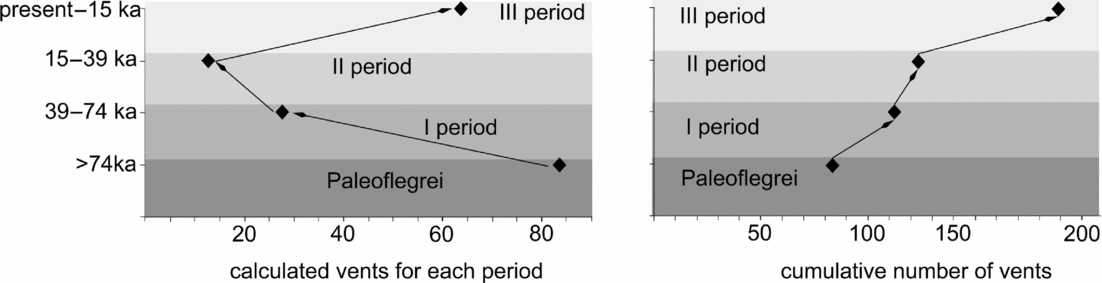
Volcanological details (Perrotta et al. Reference Perrotta, Scarpati, Luongo, Morra and De Vivo2006, Reference Perrotta, Scarpati, Luongo, Morra, Groppelli and Viereck-Goette2010) and new geochronological data presented here allow better reconstruction of the Campi Flegrei volcanic history. In recent years, the eruption recurrence interval at Campi Flegrei has been evaluated considering only the volcanoes belonging to period III (<15 ka, Di Vito et al. Reference Di Vito, Isaia, Orsi, Southon, de Vita, D'Antonio, Pappalardo and Piochi1999). This is because there is good exposure of the most recent stage of activity. For the older periods, the two caldera collapses obscured the geology in a large area, both because of collapse and burial under the accumulated products of the Campanian Ignimbrite, Neapolitan Yellow Tuff and post-caldera volcanic activity. Deep drilling inside the calderas encounters thick sequences of pyroclastic deposits (Orsi, de Vita & Di Vito, Reference Orsi, de Vita and Di Vito1996) above and between the main ignimbrites emplaced during caldera events, though the details available from drilling are not enough to define the number of intracaldera vents. This is quite common in volcanic fields because single deposits are very restricted and frequently fail to overlap those of neighbouring centres (Bebbington & Cronin, Reference Bebbington and Cronin2011). We have used all the available data in an attempt to evaluate the number of events that occurred in the field in the different time periods. We have used the distribution of the vents located outside the collapsed areas to roughly evaluate the number of vents destroyed or obscured within the collapsed area, assuming that the distribution pattern of individual vents is homogeneous in each period of the volcanic field. We can suppose that after both caldera-forming events the basement should present a new pattern of fractures and faults, modifying the intracaldera magmatic feeding system. This likely structural evolution does not invalidate our assumption considering that the oldest two periods (Paleoflegrei and period I) occurred before the oldest caldera collapse; for period III (post-Neapolitan Yellow Tuff) we have used the vents actually exposed in Campi Flegrei. A further condition imposed on this calculation is that our evaluation refers to the subaerial sector of the Campi Flegrei caldera because it is much better understood than the submerged sector (Bruno, Rapolla & Di Fiore, Reference Bruno, Rapolla and Di Fiore2003; Judenherc & Zollo, Reference Judenherc and Zollo2004; Milia, Reference Milia, Groppelli and Viereck-Goette2010). We have calculated the vent density outside the caldera rim (number of vents/area of the volcanic field not involved in the caldera collapse) for each period and have applied this value to the collapsed area. Apparently, the four periods have had significantly different numbers of events, showing waxing (Paleoflegrei and period III) and waning (periods I and II) stages of activity (Fig. 9a). This trend can be altered if we consider the temporal length of each period. Since we do not know the beginning of the oldest period, the Paleoflegrei, we assume that it started at 105 ka, the age of a deposit correlated to Campi Flegrei (Di Vito et al. Reference Di Vito, Sulpizio, Zanchetta and D'Orazio2008). Considering the range of activity of the different periods, it seems that the number of vents (eruptions) is fairly constant during the first three periods and increases in the most recent one (Fig. 9b). This may reflect a true variation in the frequency of the eruptions during the last period, an underestimation of the number of vents of the oldest periods due to the incomplete identification of the remnants of volcanic edifices in the extracaldera area due to erosion or burying, or the focusing of early activity inside the current caldera. Past workers have described the activity of Campi Flegrei as dominated by episodes of high intensity separated by long pauses (Rosi & Sbrana, Reference Rosi and Sbrana1987; Orsi, Di Vito & Isaia, Reference Orsi, Di Vito and Isaia2004). These pulses of high intensity have also been proposed for the better studied period III of Campi Flegrei when epochs of activity appear to be separated by quiescent intervals. However, as more eruptive units are dated, ‘quiescent intervals’ are less apparent (Fedele et al. Reference Fedele, Insinga, Calvert, Morra, Perrotta and Scarpati2011). Our new stratigraphic and geochronological analyses clearly show that this volcanic field has been the site of hundreds of explosive eruptions during its life. Based on this reconstructed volcanic history and assuming a steady-state of the eruption intensity for the past 105 ka, we calculate an average eruption recurrence interval of 555 years. This recurrence interval is a minimum due to the presence of several thin pyroclastic deposits not associated with recognizable vents. We believe that this temporal reconstruction is only a first order approximation of the eruptive behaviour of Campi Flegrei.
(a) Number of volcanic vents calculated for each period in the past history of Campi Flegrei. See text for the details of the calculation. (b) Cumulative time of the volcanic periods at Campi Flegrei against number of vents.

Acknowledgements
The authors wish to thank James Saburomaru, Dean Miller and Erica Brown for help in the preparation of the samples and in the 40Ar–39Ar geochronological analyses, and Lorenzo Fedele for calibration of previous radiocarbon ages. We are indebted to Alison Crook for her critical reading of this manuscript. The editorial expertise of Phil Leat and the constructive comments of Gianluca Groppelli and an anonymous reviewer are appreciated.