INTRODUCTION
Genus Sotalia
The genus Sotalia, family Delphinidae, was once composed of five species. Presently only two species are recognized, the tucuxi (Sotalia fluviatilis) the only exclusively riverine delphinid, and the Guiana dolphin (Sotalia guianensis), which is marine (Cunha et al., Reference Cunha, Da Silva, Lailson-Brito, Santos, Flores, Martin, Azevedo, Fragoso, Zanelatto and Solé-Cava2005; Caballero et al., Reference Caballero, Trujillo, Vianna, Barrios-Garrido, Montiel, Beltran-Pedreros, Marmontel, Santos, Rossi-Santos, Santos and Baker2007).
The tucuxi is a small dolphin, reaching 1.5 m, occurring all along the Amazon Basin (Da Silva & Best, Reference Da Silva, Best, Ridgway and Harrison1994, Reference Da Silva and Best1996). Faustino & Da Silva (Reference Faustino and Da Silva2006) reported groups containing up to 30 tucuxis but usually they are found in one to six individuals. The major aggregations are seen where the river is deeper and wider. Sotalia fluviatilis usually do not go as far into the flooded forests as the boto (Inia geoffrensis), and it is more restricted to the rivers and main channels (Faustino & Da Silva, Reference Faustino and Da Silva2006).
The Guiana dolphin is an exclusively estuarine, marine species. It occurs from Nicaragua (Edwards & Schnell, Reference Edwards and Schnell2001), in Central America, southwards to Baía Norte, in Santa Catarina, southern Brazil (Simões-Lopes, Reference Simões-Lopes1988). The morphological characters are similar to that of tucuxi. However, S. guianensis reaches the maximum length of 2.2 m (Flores & Da Silva, Reference Flores, Da Silva, Perrin, Würsig and Thewissen2009). According to Santos & Rosso (Reference Santos and Rosso2007), the mean group size of these dolphins is 12 individuals, though groups containing up to 60 dolphins have been found. Large aggregations reaching from 250 to 300 dolphins had been observed in the Ilha Grande Bay (Rio de Janeiro State) and in the north of Rio de Janeiro State (Lodi & Hetzel, Reference Lodi and Hetzel1998; S. Siciliano, personal observation).
Sotalia dolphins have a variety of aerial displays, like lateral and vertical jumps, somersaults, surfing in waves made by passing boats, spy-hopping, surface rolling, and porpoising (Da Silva & Best, Reference Da Silva, Best, Ridgway and Harrison1994, Reference Da Silva and Best1996; Flores & Da Silva, Reference Flores, Da Silva, Perrin, Würsig and Thewissen2009). Feeding and travelling are the most common behaviours in coastal areas, but resting and milling are seldom observed (Flores & Da Silva, Reference Flores, Da Silva, Perrin, Würsig and Thewissen2009).
Amazon River dolphin, boto (Inia geoffrensis)
The geographical distribution of I. geoffrensis comprises the Amazon and Orinoco Basins (Best & Da Silva, Reference Best, Da Silva, Ridgway and Harrison1989, Reference Best and Da Silva1993). Only recently, the occurrence of botos was reported in the estuary of Marajó Bay (Emin-Lima et al., Reference Emin-Lima, Rodrigues, Costa, Sousa and Siciliano2007).
The Amazon River dolphin is the largest river dolphin. Females reach a maximum length of 2.3 m and males 2.7 m. They are robust and very flexible and have more ability for twisting and bending themselves than other dolphin species. Younger botos are more pale-grey, turning pinker with age (Best & Da Silva, Reference Best, Da Silva, Ridgway and Harrison1989, Reference Best and Da Silva1993).
These dolphins are moderately social and are rarely seen in groups. When in groups they are usually in mother and calf pairs. Groups are formed for mating purposes, and loose aggregations are formed to feed upon fish concentrations. They are curious and eventually approach boats and swimmers, although they can be cryptic (Best & Da Silva, Reference Best, Da Silva, Ridgway and Harrison1989, Reference Best and Da Silva1993). Martin et al. (Reference Martin, Da Silva and Salmon2004) observed in the confluence of the Amazon and Japurá Rivers, that even if they differ a little in choosing their habitat, S. fluviatilis like I. geoffrensis prefer habitats known as ‘meeting of waters’. This type of habitat is highly productive due to the mixture of white waters, rich in sediments, meeting acid black waters (Martin et al., Reference Martin, Da Silva and Salmon2004).
A better comprehension of the behaviour of Inia geoffrensis and Sotalia spp. and how these dolphins use their habitats may contribute to future conservation and action plans. The occurrence of dolphins in the Belém area, northern Brazil, has been poorly surveyed. In fact, this is the first scientific study of cetaceans in the Belém area. In addition, there has been much speculation on the identity of cetaceans inhabiting these brackish waters. The populations in this study may differ in some biological, ecological and behavioural aspects from those of the western Amazon (more studied nowadays) due to the different environmental conditions in which they live. The objective of this study is to describe the use of habitat, investigate home patterns and analyse size and group composition of the dolphins Inia and Sotalia in the Guamá River, Belém, Pará State, northern Brazil.
MATERIALS AND METHODS
Study area
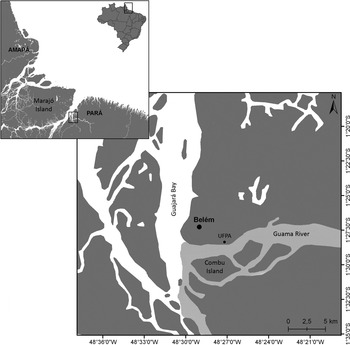
The Guamá River (Figure 1) measures between 1.360 to 2.000 m in width (Ramos, Reference Ramos, Uhly and Souza2004). It has an extension of 700 km and is a tributary of Pará River. It is under the influence of oceanic tides in its mouth, with constant entrance of sediments from Guajará Bay, and it can become slightly brackish at the high dry season (Monteiro et al., Reference Monteiro, Melo, Alves Da Silva and Paiva2009).
Study area location. The parts highlighted in grey were the surveyed areas from on-board ship. Map: Renan Peixoto and Luiz Peixoto.

The precipitation of the Guamá River is typical of tropical areas with high rainfall. It has a rainy season from December to May and a dry one from June to November. The rainiest month is March, followed by April, and the dryer is November, followed by October (Nechet, Reference Nechet1993).
Vantage point observations
Observations were conducted from a vantage point located at Universidade Federal do Pará (UFPA) campus in Belém at the mouth of Igarapé do Tucunduba (01°28 ′60″S 048°27′23″W). These observations were done with Tasco Offshore 7 × 50 binoculars, during one hour, at least, twice a week using the scan sampling method (Altman, Reference Altman1974).
From September to October 2008 a preliminary study of only 18 observation days (59 hours of effort) was made at this same location. As it resulted in a considerable number of sightings, it was selected for a more prolonged study. Between September and October 2008 and from January 2009 to October 2010 there were 111 observation days (178 hours of effort).
Group size and composition were recorded as well as behaviour patterns. The behavioural states were classified in five categories: feeding (diving repeatedly surfacing in multiple directions); socializing (often body contact and surface display like breaching); travelling (unidirectional movement); resting (floating at the surface or moving slowly) and not identified (Shane, Reference Shane, Leatherwood and Reeves1990).
Boat surveys
From May 2009 to November 2010 twenty-one linear transects were made in the Guamá River, totalling 43 hours of effort. The boat surveys were alternated between different areas to cover a greater part of the river.
Transects were conducted in a wood boat with 11 m length powered by diesel. There were two observers using Tasco Offshore 7 × 50 binoculars to apply the scan sampling method (Altman, Reference Altman1974). Visual registers were taken using a Canon EOS 40D digital camera, and the collected data were written on a standardized worksheet. Also on this worksheet, the geographical coordinates obtained through a GPS (Global Position System) CS Map 60, sighting time, sighted species, size and group composition, behavioural category performed (Shane, Reference Shane, Leatherwood and Reeves1990), and additional observations, such as morphological characters (coloration and body marks) were collected. The collected data were related to the tide conditions provided by the Diretoria de Hidrografia e Navegação (DHN/Brazilian Navy).
Data analysis
As the collected data did not present a normal distribution we used non-parametric tests for the analysis. We compared the group size for the species using a Mann–Whitney test with the significance level of 5%.
RESULTS
From vantage point observation effort, there were 44 sightings, comprising 79 individuals. Among these, 56 were I. geoffrensis (71%) and 23 Sotalia spp. (29%). During the transect observations, we recorded 19 sightings comprising 50 dolphins. Among those, 36 were Sotalia (72%) and 14 were Inia (28%).
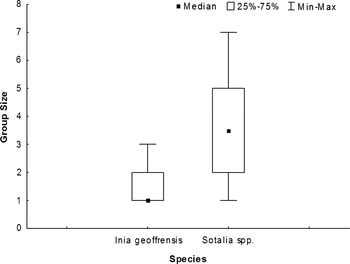
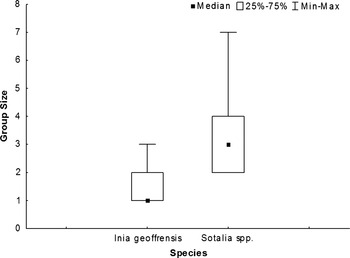
All behaviour states were registered for I. geoffrensis as well as to Sotalia spp., except resting. The group size for Inia ranged from one to four botos, the solitary specimens (57% at land based observations and 67% at boat surveys). Thus, for Sotalia a solitary individual was sighted only once, both, at transects and land based. Sotalia spp. group size ranged from one to seven individuals.
The data for group size presented distribution different from the normal both in boat and vantage point observations, so for the comparison of group size non-parametric tests were used. In vantage point as well as in boat surveys the group sizes of Inia and Sotalia were significantly different from each other (Mann–Whitney test, U boatobs = 13; P boatobs = 0.01; U vantageobs = 31.5; P vantageobs = 0) (Figures 2 & 3).
Box plot for the group sizes of Inia geoffrensis and Sotalia spp. from vantage point observations.

Box plot for the group sizes of Inia geoffrensis and Sotalia spp. from boat surveys.

Lob-tailing were recorded in three sightings of I. geoffrensis. This behaviour was described for S. guianensis by Domit (Reference Domit2006) as chasing with fluke strokes, beginning with the dolphin chasing the prey and ending with a deep dive. From the three registers, in only one the boto was solitary.
Inia as well Sotalia were observed in feeding behaviour next to gillnets. During feeding activity we observed an interaction between Sotalia dolphins and a large-billed tern (Phaetusa simplex).
Inia calves were sighted three times in the land based surveys, in September 2008, September 2009 and February 2010. Calves were recorded at boat surveys too, in May and September 2009. At the land based surveys, Sotalia calves were registered twice, both in March 2009. During boat surveys, three calves were sighted, two in May and one in December 2009. The Sotalia calf sighted in December, in a boat survey, had its dorsal fin bent over the body, indicating that it was a newborn. According to Flores & Da Silva (Reference Flores, Da Silva, Perrin, Würsig and Thewissen2009) females of S. fluviatilis give birth from September to December.
Two botos (I. geoffrensis) were registered in apparent courtship behaviour in April 2010. The male carried a stone that was shown to the female, and then thrown up in the air, as described by Martin et al. (Reference Martin, Da Silva and Rothery2008). The botos often came closer to the right margin of the Guamá River, regularly entering the Igarapé do Tucunduba, usually in feeding behaviour. Inia were seldom recorded at the right margin or in the middle of the river. On the other hand, Sotalia were sighted only in the middle or in the left margin of the river (opposite to the vantage point).
The botos were sighted more at the ebb tide (44%) during boat surveys and at the flooding tide (49%) at vantage point observations, possibly pointing to a preferential use of the area surrounding Igarapé do Tucunduba at this condition. Otherwise, Sotalia dolphins were sighted more in the ebb tide (86%) at the vantage point and during transects more in the low tide (40%).
Sotalia dolphins were observed in the study area only in the rainy season, except for two occasional sightings and one vantage point observation at the dry season. This possibly indicates that the part of the Guamá River monitored during this study, is not the residence site for Sotalia dolphins; it is probably an expansion of its occurrence area during the rainy season.
DISCUSSION
In most cases I. geoffrensis behaviour was not evaluated due to the discreet habits of botos. Sometimes, the animal was sighted only once, emerging to breathe. The predominance of solitary individuals for I. geoffrensis corroborates previous data (Best & Da Silva, Reference Best, Da Silva, Ridgway and Harrison1989, Reference Best and Da Silva1993), confirming the solitary habits of this species. In contrast, Sotalia dolphins were usually found in groups (Da Silva & Best, Reference Da Silva, Best, Ridgway and Harrison1994, Reference Da Silva and Best1996; Faustino & Da Silva, Reference Faustino and Da Silva2006; Flores & Da Silva, Reference Flores, Da Silva, Perrin, Würsig and Thewissen2009).
During the lob-tailing observations of the botos, their bodies arched in a ‘C’ form, which generally precedes a deep dive, usually related to feeding (Podos et al., Reference Podos, Da Silva and Rossi-Santos2002). This record may suggest that the Amazon River dolphins were engaged in a feeding activity similar to that described previously by Domit (Reference Domit2006) for Sotalia guianensis.
The record of three Inia calves in September may be related to the peak of births in this month. These data are different from the data from Best & Da Silva (Reference Best, Da Silva, Ridgway and Harrison1989, Reference Best and Da Silva1993) in the central Amazon—according to them females give birth usually from May to June.
The record of botos nearby the right margin of the river is probably related to the fact that the Igarapé do Tucunduba possibly represents a feeding area for the species. The few records at the opposite margin and in the middle of the river are possibly related to the discreet habits of the species at the surface that makes it difficult to be observed at distance.
The few observations of Sotalia from the vantage point may be connected to the fact that the area is often used by I. geoffrensis. Then, the Sotalia dolphins would not attend to the place avoiding competition. Da Silva (Reference Da Silva1983) verified that among 35 species of fish in the diet of I. geoffrensis and S. fluviatilis, 21% were common to both species (with greater frequency of Sciaenidae and Curimatidae). The fish species in the overlapping zone are S. fluviatilis preferential prey. Inia explores a greater variety of habitats than Sotalia. Therefore, despite their co-existence the niches of the two species tend not to overlap each other, the dominance of one species or another occurring in subareas of the same environment (Da Silva, Reference Da Silva1983). In spite of this the two species were once sighted nearby to each other.
There is, still, the possibility that the area in question is not the preferential area of Sotalia dolphins, considering that these dolphins were observed mainly in the rainy season, which possibly indicates that the part of the Guamá River monitored in this research is not the residential area of the Sotalia dolphins, but represents a rainy season dispersion area. Probably this represents a similar movement pattern as observed in the Amazon with S. fluviatilis, where the tucuxis disperse more in the rainy season in search of fish schools (Faustino & Da Silva, Reference Faustino and Da Silva2006). Further effort of boat surveys exploring a wider area at the Guamá River upstream and neighbouring water bodies is needed to increase our knowledge about the biology of these cetaceans.
Both Inia and Sotalia make frequent use of the Guamá River for breeding and feeding. The differences between the species frequency of occurrence may be related to the fact that I. geoffrensis came closer to the vantage point. Sotalia, does not approach boats and it is considerably smaller than Inia, which makes a distance sighting difficult, even with the assistance of binoculars. The few records of Sotalia in this study, almost exclusively at the rainy season, possibly implies that the Guamá River is only used by Sotalia dolphins as a pathway to another feeding area. It is necessary to continue survey efforts in order to have a better comprehension of the Guamá dolphins' ecology.
ACKNOWLEDGEMENTS
Thanks to the Universidade Federal do Pará and Museu Paraense Emílio Goeldi for the support and structure.
Thanks to Renan Peixoto and Luiz Peixoto for helping with the maps. This work was supported by the Cetacean Society International (CSI) (MTCN:661-042-5224, MTCN: 669-557-6881, MTCN 496-524-0988)/and by the Conselho Nacional de Desenvolvimento Tecnológico (CNPq) (118102/2009-5).