

Introduction
With the development of laser technology, especially of the ultra-short pulse laser technology, laser micro-fabrication has been applied in different fields (Kawata et al., Reference Kawata, Sun, Tanaka and Takada2001; Sun et al., Reference Sun, Dong, Hu, Li and Chu2015; Chu et al., Reference Chu, Sun, Dong, Yin, Luo and Chen2017; Yin et al., Reference Yin, Du, Dong, Wang, Duan and He2017; Zeng et al., Reference Zeng, Hu, Deng, Sun, Su and Lu2017). An ultra-short pulse laser is a laser that emits ultra-short pulses of light, generally of the order of femtoseconds to ten picoseconds. The mechanism of long pulse laser removal machining is thermal ablation, because it takes place on timescales much longer than 10−12 s, which is the energy relaxation time of the lattice. On the contrary, high intensity femtosecond pulse laser, ultrafast phase transition and ablation can occur before thermal process begins (Chichkov et al., Reference Chichkov, Momma, Nolte, Alvensleben and Tünnermann1996; Zhu et al., Reference Zhu, Yin, Zhao, Chen and Zhao2005). Hence, the thermal effect on the workpiece surface is obvious in picosecond laser and other long pulse laser machining (Chu et al., Reference Chu, Sun, Dong, Yin, Luo and Chen2017), whereas the femtosecond laser significantly reduces the thermal effect, greatly weakens the influence of material melting and resolidification (Matsumura et al., Reference Matsumura, Kazama and Yagi2005; Wang et al., Reference Wang, Chu, Duan, Zhou, Yin and Sun2017).
Despite the aforementioned advantages, debris deposition, heat-affected zone (HAZ), and other thermally induced detrimental effects can't be ignored in femtosecond laser machining (Chien and Hou, Reference Chien and Hou2007; Charee et al., Reference Charee, Tangwarodomnukun and Dumkum2016; Deng et al., Reference Deng, Su, Duan, Fan, Sun and Zhou2016). Therefore, vacuum-assisted (Juodkazis et al., Reference Juodkazis, Okuno, Kujime, Matsuo and Misawa2004) and some water-assisted laser ablation technologies are proposed to reduce the negative influence, such as under water, water spray, over-flow, and thin water film (Liu et al., Reference Liu, Wu, Samanta, Shen, Ding and Xu2016). During the laser ablation underwater process, water can reduce the size of HAZ and weaken the redeposition of removed material (Liu et al., Reference Liu, Chen, Wang, Yang, Hao and Si2012; Nguyen et al., Reference Nguyen, Tanabe and Ito2014; Hu et al., Reference Hu, Yue, Duan, Wang and Zhou2017). However, the material as well as the water surrounding the ablation region vaporize rapidly. It results in forming some expanding cavitation bubbles near the top of the laser irradiated area (Chen et al., Reference Chen, Xu, Chen, Shen, Jian and Ni2004; Abreu et al., Reference Abreu, Levy-Bercowski, Yu, Salgueiro, Kalathingal and Susin2005; Tamura et al., Reference Tamura, Sakka, Fukami and Ogata2013).
The constant and unpredictable expansion and decay of the bubbles dynamically change the refraction and scattering of the laser beam underwater during the ablation. The serious consequence is that the actual laser intensity is weaker than that of the laser without bubbles. Meanwhile, the intensity of the light field of the laser focal point is always changing, and its distribution is not uniform (Tomko et al., Reference Tomko, O'Malley, Trout, Naddeo, Jimenez and Griepenburg2017). These optical disturbances are not acceptable for precise laser machining.
The ablated surface morphology and machining performance depend on the bubble size, so eliminating the bubble or reducing the bubble size is helpful to improve the machining quality (Zhang et al., Reference Zhang, Gökce, Sommer, Streubel and Barcikowski2016). The size of cavitation bubble depends on many factors, such as water layer thickness, water temperature, and water speed. Besides, properties of the additives in water, surface characteristics of the workpiece and the focal position of the laser beam with respect to the workpiece surface can also affect the bubble size (Lauterborn and Bolle, Reference Lauterborn and Bolle2006). However, attempts to reduce the size of bubbles drastically by altering these factors are not ideal. The water-assisted laser technologies mentioned above have also tried to diminish the effect of bubbles. However, the water spray technology can only be used in the minimum area of laser irradiation. The over-flow technology is not only difficult to build the experimental platform, but also can't guarantee the uniformity of water flow velocity on all parts of the sample, which reduces the processing quality. Wu (Reference Wu2014) proposed the ultrasound-assisted underwater laser machining, and the investigation in nano-pulse laser machining was done by Liu et al. (Reference Liu, Gao, Wu, Shen and Ding2014). The high frequency vibration caused by ultrasound assistance can obviously break up the cavitation bubbles into smaller ones, and the disturbance caused by bubbles to the laser beam is reduced. The mechanism of this method is shown in Figure 1.
Schematic diagram shows the mechanism of vibration shatters cavitation bubble to improve the quality of laser machining.

As for the existing experiments which mainly study ultrasound-assisted laser machining in air and ultrasound-assisted underwater machining with long pulse laser, a common problem is that the re-deposition of clustered nanoparticles still changes the morphology of the holes. Therefore, we use the ultra-short pulse laser, combine underwater environment, and ultrasound assistance to solve this problem and describe the method in this paper.
Experimental methods
The schematic diagram shows the setup of the experiment of the ultrasound-assisted underwater femtosecond laser machining system (Fig. 2). A commercial Ti:sapphire femtosecond laser generator (Spectra Physics, Inc.) is used, generating horizontal linearly polarized laser pulses (τ = 120 fs, λ = 800 nm center wavelength, f = 1 kHz pulse repetition frequency). The beam is focused onto the underwater samples by a 10× objective lens with a numerical aperture of 0.25. The surface of the water is 1 mm above the sample's surface. And the container with water is placed on the ultrasonic transducer (JP-520, frequency: 20 kHz, power: 15 W, vibration amplitude: 0.5 µm) which is fixed horizontally and can only vibrate in the vertical direction.
Schematic diagram shows the setup of the experiment of ultrasound-assisted underwater femtosecond laser machining system.

The laser drilling is performed on 2 mm thickness AISI 304 austenitic stainless steel. The surfaces of the steel specimens are polished to R a = 0.1 µm. The pulse energies used in the experiments are 20, 40, 60, 80, and 100 µJ. For each energy, holes are produced by different pulse numbers (N = 50, 100, 200, and 500) with the replication of five. The diameter and depth of the hole are measured by a high magnification laser scanning confocal microscope (LSCM, Zeiss Axio LSM700, Germany). The machining morphology including cracks and debris deposition is also observed by a scanning electron microscope (SEM).
Results and discussion
Figure 3 shows the snapshot images of the femtosecond laser focal point underwater without (a) and with (b) ultrasound assistance taken by a complementary metal oxide semiconductor (CMOS, IU500M) camera. The points in the box are the focal points. Since the refractive index of air is less than water, bubbles underwater look brighter than water. In Figure 3b, it can be seen that the visible large bubbles are slightly smaller in size and significantly fewer in number than the left's, which verifies that the ultrasonic vibration can break the large cavitation bubbles generated by underwater laser machining.
Snapshot images of the femtosecond laser focal point underwater without (a) and with (b) ultrasound assistance.

Figure 4 shows the LSCM images of holes drilled by the femtosecond laser in air (a), underwater without (b), and with (c) ultrasound assistance. It can be roughly seen that the crater shape of the hole drilled in air is irregular, whereas the hole drilled in the water is larger and more rounded. The color distribution in the figure with ultrasound assistance is more uniform, which suggests that the change in the height of the hole bottom is small and the hole machining quality is better than the formers’ machining.
LSCM images of holes drilled by the laser in air (a), underwater without (b), and with (c) ultrasound, using 500 pulses with the energy of 40 µJ.

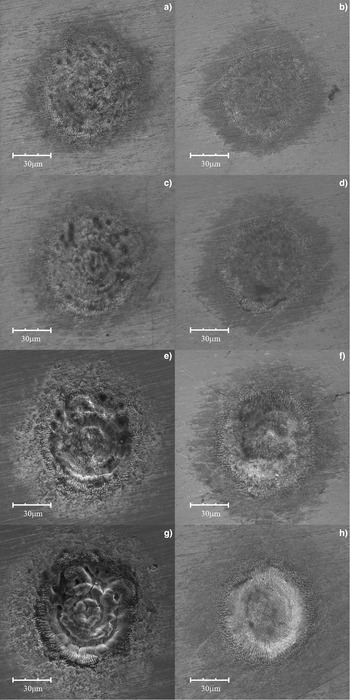
In order to record the drilling process, the SEM images of holes drilled by the femtosecond laser underwater without (the left column) and with (the right column) ultrasound assistance are shown in Figure 5. The pulse energy is 100 µJ, and the pulse numbers are 50, 100, 200, and 500, respectively.
SEM images of holes drilled by the laser underwater without (left) and with (right) ultrasound, using 50 (a, b), 100 (c, d), 200 (e, f), and 500 (g, h) pulses with the energy of 100 µJ.

Comparing two columns in Figure 5, it shows that the diameter of the hole at 50 pulses is slightly smaller than those at 500 pulses, and the depth of the holes increases significantly with the increase of pulse number. However, the situation is different between the hole morphologies produced by femtosecond laser drilling with and without ultrasound assistance. In Vorobyev and Guo (Reference Vorobyev and Guo2007) drilling experiment with femtosecond laser on titanium, they found that with higher pulse numbers and higher energy, the hole's structure would move from a nanometer scale to a micron scale. It can be seen that the morphology of the hole bottom in the left column becomes uneven, and the structure of nanometer scale appears from 50 pulses to 500 pulses. However, under the same number of laser pulses, hole bottoms in the right column are obviously more flat than those in the left that drilled without ultrasound assistance. This is consistent with the profiles measured by confocal microscopy shown in Figure 4. Meanwhile, in the right column, we observe that the non-target processing area around the crater has almost no trace of laser processing, the debris and splash of the crater are obviously less than the left. This is because the slight vibration of water caused by the ultrasonic vibration takes away the splashing debris during processing. At the same time, the less bubbles hardly produce laser scattering during processing, which also ensures the quality of processing.
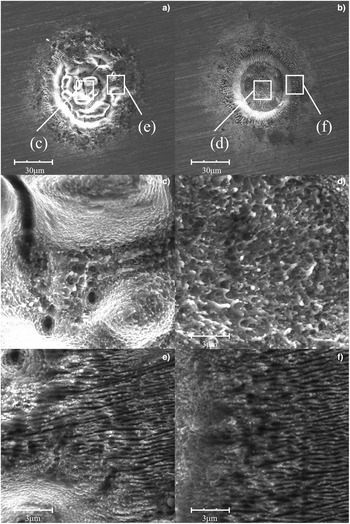
In order to investigate the influence of ultrasound on the three-dimensional (3D) machining topography more prudently, the SEM images of holes with 500 pulse number and 40 µJ pulse energy are exhibited in Figure 6. Local amplified images are also shown there. The two columns are without ultrasound (left) and with ultrasound (right) assistance, respectively. Comparing the images in Figure 6a and 6b, it can be seen that the 3D machining profile of the hole drilled with ultrasound assistance is more regular than that drilled without ultrasound assistance. The bottom of the right hole looks like a plane, on the contrary, the left hole bottom is rugged and uneven. Figure 6c and 6d show the higher magnification SEM images of the central region at the bottom of the holes. It can be seen that many nanodroplets are uniformly formed at the bottom of the right hole. This is attributed to the introduction of ultrasound vibration, the movement of water and debris is more efficient due to local convection, the evaporated material is more likely to escape from the processing area. As a result, the ablated particles have less tendency to agglomerate (Park et al., Reference Park, Yoon and Cho2012; Yin et al., Reference Yin, Duan, Wang, Dong, Song and Luo2016). While in the bottom of the left hole drilled without ultrasound, there are some rugged hills and a few small holes due to the resolidification of molten material without ejection. Figure 6e and 6f show the region of the crater of the hole at a higher magnification with ultrasound and without ultrasound assistance, respectively. Due to the refraction and scattering of the laser beam dynamically changed by the cavitation bubbles, left crater morphology obviously changed more irregular, rough and blurred, while the right's morphology is smoother as the cavitation bubbles are broken into smaller pieces by ultrasound vibration, and the disturbance caused by bubbles to the laser beam is reduced.
SEM images of holes drilled by the laser underwater without (a) and with (b) ultrasound assistance, using 500 pulses with the energy of 40 µJ. Panels (c, e) and (d, f) show the SEM images of selected areas registered at a higher magnification in two different processing methods, respectively.

Figure 7 shows the two-dimensional (2D) profiles of holes drilled by 50, 100, 200, and 500 pulses, respectively, using two different machining methods with the energy of 100 µJ. The profiles are measured using a confocal microscope. It can be seen that as the number of pulses increases from 50 to 500, the hole depth of non-ultrasound-assisted and ultrasound-assisted femtosecond laser underwater drilling increases linearly. It can be seen that the morphology of the hole bottom drilled with ultrasound assistance is better than that without ultrasound assistance from the coordinate data on the Z axis.
Measured 2D profiles of the holes drilled on stainless steel without ultrasound (left) and with ultrasound (right) using 50, 100, 200 and 500 femtosecond laser pulses with the energy of 100 µJ.

Figure 8 shows the change trend of the hole depth with the pulse energy. It is obviously that the depth of the hole drilled by ultrasound-assisted femtosecond laser underwater machining is about 10–48% greater than that of non-ultrasound-assisted. Considering that the ultrasonic vibration frequency is much higher than the laser pulse frequency and the weak amplitude of the ultrasound, the vibration of the sample does not change the focus position significantly. In addition, the hole depth of two types of machining methods both show a tendency that increasing first and then decreasing with the increase of energy. When the laser pulse number is 50, the holes depth drilled with ultrasound assistance starts to decline with 80 µJ, whereas the hole depth drilled without ultrasound assistance starts to decline with 60 µJ. This experimental result is similar to the characteristic of the plasma shielding effect proposed Singh (Reference Singh1996) and Zeng et al. (Reference Zeng, Mao, Greif and Russo2005). A high temperature highly ionized plasma is formed when the laser ablated material itself absorbs the laser beam. Due to the laser fluence, the degree of plasma absorption can vary from 0% to nearly 100% of the incident laser energy. With the increase of the pulse energy, especially when the energy is higher than about 60 µJ, the plasma shielding effect is enhanced, and the holes depth shows the tendency to decrease after increase. The plasma shielding time depends on plasma spatial distribution and electron density. Therefore, it has been found that the ultrasound vibration causes a reduction in plasma density and the holes drilled without ultrasound assistance are more likely to have plasma shielding for it tends to decrease earlier.
The depth of holes drilled with 50 pulses versus laser energy, through the laser underwater machining with and without ultrasound assistance.

Figure 9 shows the diameter of holes as function of the pulse energy with two types of machining methods using four different pulse numbers. All of these holes diameter quickly increase with rising pulse energy in the range from 20 to 100 µJ. We find that under the same experimental conditions, the diameter of the holes drilled with ultrasound assistance is smaller than those non-ultrasound-assisted. The reason is that the cavitation bubbles generated in the water distort the laser beam, expand the ablation region, while the ultrasound vibration shatters the bubbles.
The diameter of holes drilled with and without ultrasound, using four different pulse number versus laser pulse energy.

Figure 10 shows the depth-to-diameter ratio of holes in the function of the laser pulse energy with two types of machining methods, using four different pulse numbers. It can be seen that as the number of pulses increases from 50 to 500, the aspect ratio of non-ultrasound-assisted and ultrasound-assisted femtosecond laser underwater drilling increases linearly, while the aspect ratio is hardly affected by the change in energy. In addition, ultrasound-assisted underwater drilling can improve the depth to diameter ratio about 20%.
The depth-to-diameter ratio of holes drilled with and without ultrasound using four different pulse number versus laser pulse energy.

Conclusions
In summary, ultrasound-assisted femtosecond laser underwater drilling has been studied, under the investigated conditions using 50–500 pulses and 20–100 µJ energy. It is found that with ultrasound assistance, there is no obvious slag splash, burrs, and removed material redeposition on the workpiece surface. Meanwhile, crater morphology changed more regularly, smoothly and clearly. Moreover, ultrasound helps forming a clean and flat holes bottom. This method significantly improves the quality of femtosecond laser drilling underwater. In addition, the hole drilled with ultrasound assistance has a smaller orifice diameter, deeper depth, and larger depth to diameter ratio about 20%. This suggests that the machining efficiency is improved, too.
Acknowledgements
This research work is supported by the National Key R&D Program of China (Grant Nos. 2017YFB1104800) and the National Natural Science Foundation of China (NSFC) (Grant Nos. 51875584, 51875585, 51475482, 51475481).