Introduction
Obsessive-compulsive disorder (OCD) is a highly disabling condition, often characterized by a chronic course, high rates of comorbidity, and unsatisfactory treatment response.Reference Grabe, Ruhrmann and Ettelt 1 , Reference Fontenelle, Mendlowicz and Versiani 2 The fifth edition of the Diagnostic and Statistical Manual of Mental Disorders (DSM–5) included OCD in a separate and autonomous chapter, 3 consistent with the evidence that it is somewhat distinct from anxiety disorders and that it is a key exemplar of a number of other related disorders.
As for other disabling psychiatric disorders, suicidal behaviors represent one of the most severe and tragic consequences of OCD. The prevalence and clinical correlates of suicidal behaviors in OCD have been previously investigated, yielding heterogeneous results. In fact, data about suicidal behaviors among OCD patients are quite mixed, and there is growing evidence that they may reveal an underestimated phenomenon.Reference Kamath, Reddy and Kandavel 4 In this respect, a recent metaanalysis by Angelakis and colleaguesReference Angelakis, Gooding, Tarrier and Panagioti 5 reported an incidence of suicidality in OCD higher than that in the general population, with a median rate of suicidal ideation and suicide attempt (SA) of 27.9 and 10.3%, respectively.Reference Angelakis, Gooding, Tarrier and Panagioti 5 Furthermore, a large Swedish population-based study of 3,6788 OCD patients found that the risk of dying by suicide (an event that occurred in 1.5% of the sample) was ~10 times higher, and the risk of attempted suicide (an event that occurred in 11.7% of the sample) was 5 times higher, compared with what was observed in the general population. This risk remained substantial after adjusting for the different types of psychiatric comorbidities already known to be associated with suicide.Reference Fernández de la Cruz, Rydell and Runeson 6 More recently, a Brazilian studyReference Velloso, Piccinato and Ferrao 7 conducted with 540 OCD patients found a 19.4% rate of history of SA, with the presence of sexual OC symptoms, lower quality of life, severity of depressive symptoms, and the presence of a relative with a positive history of SA being the factors having a major impact on suicidality.
Among the factors accounting for the variability in suicide rates in psychiatric disorders, however, different geographical and cultural issues need to be considered along with the genetic and biological aspects. For instance, indirect evidence of genuine differences within national suicide rates emerged in studies from the United StatesReference Marusic 8 and AustraliaReference Burvill 9 that also demonstrated significant rank correlations between the suicide rates of immigrants and those born in these two nations.
Suicidality in OCD patients has been linked to several conditions, such as tobacco smoking,Reference Dell’Osso, Nicolini and Lanzagorta 10 presence of psychiatric comorbidities (particularly mood disorders),Reference Velloso, Piccinato and Ferrao 7 generic risk factors for suicide (e.g., a positive history of SA and/or suicide ideation),Reference Kamath, Reddy and Kandavel 4 emotional-cognitive aspects (e.g., hopelessness), severity of symptoms (particularly concerning aggressive, symmetry/ordering, and sexual/religious obsessions), and treatment resistance.Reference Angelakis, Gooding, Tarrier and Panagioti 5 , Reference Balci and Sevincok 11 – Reference Gupta, Avasthi, Grover and Singh 13
An Italian studyReference De Berardis, Serroni and Campanella 14 recently indicated alexithymia as a potential risk factor for increased suicidality in OCD patients. Indeed, the inability to recognize and deal with one’s emotions has shown a prevalence of 20 to 40% in patients with OCDReference De Berardis, Campanella and Gambi 15 and has been linked to increased severity of illness and lower insight,Reference Carpenter and Chung 16 resulting in a higher suicide risk.Reference De Berardis, Serroni and Campanella 17 A suicidal act may therefore be a way of expressing intolerable psychological pain.Reference Pompili 18 Finally, a link between serum lipid levels and suicidal ideation has been hypothesized, since some studiesReference Papakostas, Ongür, Iosifescu, Mischoulon and Fava 19 , Reference De Berardis, Serroni and Marini 20 have reported that serum lipid levels might be involved in the pathogenesis of such neuropsychiatric disorders as OCD, and that these parameters have been potentially identified as biomarkers of suicidality.
A better way to characterize suicide risk, the rate of SA, and the characteristics of suicide attempters in OCD is of particular clinical interest in order to implement specific treatment strategies and comprehensive management of individuals at risk. The aim of the present multicenter study was to assess the prevalence of suicide attempts and its associated sociodemographic and clinical features in a large international sample of OCD patients.
Methods
A total of 425 consecutive OCD outpatients of either gender and of any age who were attending different OCD clinics worldwide and participating in the International College of Obsessive-Compulsive Spectrum Disorders (ICOCS)Reference Dell’Osso, Benatti and Hollander 21 network were recruited. This network includes several OCD academic and tertiary clinicsReference Menchón, van Ameringen and Dell’Osso 22 from across the globe: the Americas (Canada, the United States, and Mexico), Africa (Libya and South Africa), Europe (Spain, Italy, Turkey, Bulgaria, and the United Kingdom), and the Middle East (Israel).
Written informed consent and specific approval from local ethics committees and institutional review boards to use patients’ information for research purposes were obtained. The diagnoses were performed using a Structured Clinical Interview based on the DSM–IV criteria (SCID–I and –II).Reference Gibbon, Spitzer and Williams 23 – Reference First, Spitzer, Gibbon and Williams 25 Sociodemographic and clinical variables were collected through the clinical interview according to the standards of care for OCD centersReference Menchón, van Ameringen and Dell’Osso 22 and then included in a online database. In particular, the following variables were analyzed for the present study: age, gender, age of onset (defined as full-blown OCD based on DSM criteria), presence of comorbid psychiatric disorders and poly-comorbidity (more than one comorbid psychiatric disorder), medical comorbidity, OCD severity assessed through the Yale–Brown Obsessive Compulsive Scale (Y–BOCS),Reference Goodman, Price and Rasmussen 26 current pharmacological treatment and cognitive behavioral treatment (CBT), psychiatric hospitalization, and history of SA, SA being defined as engagement in potentially self-injurious behavior in which there was at least some intent to die.Reference Nock, Borges, Bromet, Cha, Kessler and Lee 27 Severity of OCD was also defined by means of a qualitative characterization, identifying the “high severity of illness” category as a score on the Y–BOCS greater than 24.
Patients were categorized into two groups on the basis of a positive or negative history of SA, and the aforementioned sociodemographic and clinical variables were compared between the two subgroups in order to identify any possible difference.
Pearson’s chi-squared tests for categorical variables and the t test for continuous variables were employed to perform comparisons between subgroups.
Further, to assess potential confounders, binary logistic regressions were performed to investigate potentially significant relationships between history of SA (dependent variable) and other variables (included as covariates).
All the statistical analyses were performed using SPSS (v. 22 for Windows) software, with p<0.05 set as the level of statistical significance.
Results
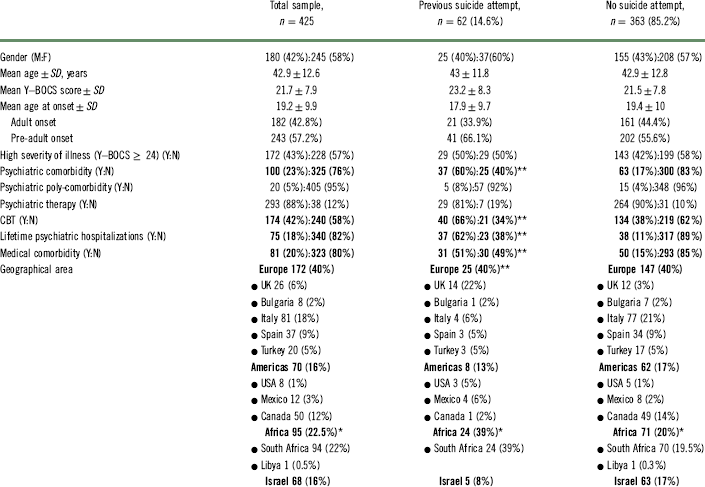
The sociodemographic and clinical variables of our sample are reported in Table 1. The sample was characterized by 58% of women (n=245) and 42% of men (n=180), the mean age was 42.9±12.6 years, and the mean age at onset was 19.2±9.9 years.
Sociodemographic and clinical variables of the total sample and subgroups divided on the basis of the presence of suicide attempt

Values for categorical and continuous variables are expressed as n (%) and mean±SD, respectively. Reported variables had a percentage of missing data ranging from 0 to 22%.
*p<0.05; **p<0.001.
CBT=cognitive behavioral therapy; Y–BOCS=Yale–Brown Obsessive Compulsive Scale.
Patients with a positive history of SA represented 14.6% of the sample (n=62), 60% being female (n=37), and they had a mean age of OCD onset of 17.9±9.7 years.
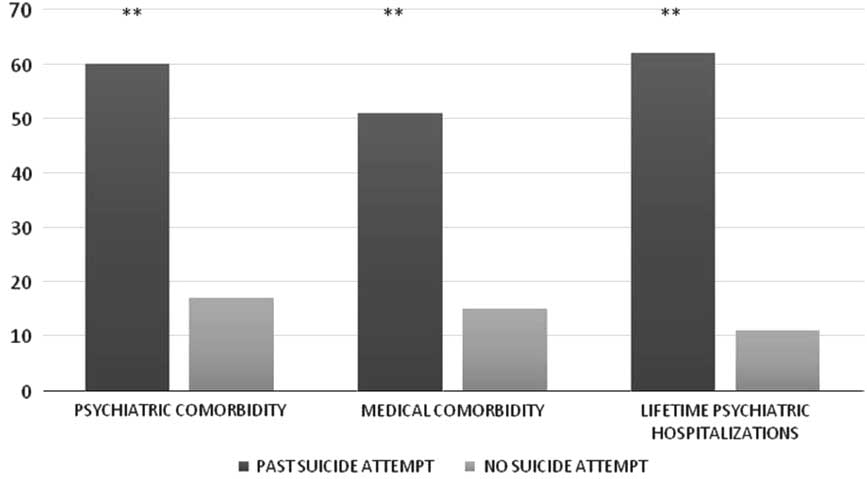
There was a series of significant differences between patients with a history of SA and patients with no previous suicide attempts. Psychiatric comorbidity was significantly more common in patients with a history of SA compared to individuals without a previous SA (60 vs. 17%, χ2=52.7, p<0.001) (Figure 1). In particular, tic disorder (TD) was found to be significantly more represented than other psychiatric comorbidities (41.9%), followed by major depressive disorder (MDD) (8.1%) and Tourette’s syndrome (TS) (1.6%) (χ2=109.2, p<0. 001) in patients with a history of SA. In addition, patients with a previous SA showed a significantly higher rate of medical comorbidity (51 vs. 15%, χ2=42.4, p<0.001) (Figure 1). Moreover, they also demonstrated a higher rate of previous psychiatric hospitalizations (62 vs. 38%, χ2=90.03, p<0.001) (Figure 1).
Presence of psychiatric and medical comorbidities and hospitalizations in subgroups of OCD patients with and without a history of a suicide attempt, expressed in percentages.

No differences in terms of rates of presence/absence of current psychopharmacological treatment were found between the two groups, whereas patients with a history of SA showed a higher rate of past/current CBT (66 vs. 38%, χ2=16.2, p<0.001).
With respect to geographical differences among clinics involved in the ICOCS network, European and South African patients showed significantly higher rates of a history of SA (40 and 39%, respectively) compared to subjects from North America and the Middle East (13 and 8%, respectively; χ2=11.4, p<0.001).
In terms of OCD severity, no quantitative/qualitative differences in relation to Y–BOCS scores were found between the two patient groups.
No differences were found in terms of age at onset between patients with or without a previous SA, nor in terms of pre-adult (<18 years) and adult (≥18 years) onset.
Variables that were entered into binary logistic regression in order to assess which features were more strongly associated with a history of SA included: age at onset of OCD, gender, Y–BOCS scores, comorbid psychiatric disorders, and hospitalizations.
Our model was valid (Hosmer–Lemeshow test: χ2=4.3, df=8, p=0.83), and binary logistic regression was significant overall (omnibus test: χ2=112.33, df=12, p<0.001), predicting 90.5% of cases. However, none of the selected independent variables showed a significant association with a history of suicide attempt.
Discussion
To the best of our knowledge, this is the first and largest international multicenter study to investigate the prevalence and correlates of SA in OCD. In fact, most of the studies in the field are limited by small sample sizes and/or restricted geographical catchment areas, without multicenter international comparisons. Patients with a history of SA represented 14.6% of our whole sample, with a higher rate compared to what was reported in a recent meta-analysis by Angelakis and colleagues,Reference Angelakis, Gooding, Tarrier and Panagioti 5 who found a value of 10.3% for median rates of SA. It should be noticed that our SA rate seems to be positioned in the middle of the range indicated by the available literature, with rates of SA between 3 and 27% in OCD patients,Reference Kamath, Reddy and Kandavel 4 , Reference Hollander, Greenwald, Neville, Johnson, Hornig and Weissman 28 – Reference Alonso, Segalàs and Real 32 also considering the most recent Brazilian and Swedish reports documenting rates of 11.7 and 19.4%, respectively.Reference Fernández de la Cruz, Rydell and Runeson 6 , Reference Velloso, Piccinato and Ferrao 7
It is also noteworthy that, in the present study, significantly higher rates of SA history were reported in OCD patients from Europe and South Africa (40 and 39%, respectively) compared to those from North America and the Middle East (13 and 8%, respectively). Such differences might be due to specific clinical features, including higher severity of illness, presence of comorbidity, early onset, and longer duration of illness, but they might also depend on cultural differences concerning the implications of suicide and suicide attempts for patients and their relatives.Reference Goldsmith, Pellmar, Kleinman and Bunney 33 , Reference Klonsky, May and Saffer 34 The presence of geographical differences and, likely, cultural peculiarities related to suicidal behaviors emerging from our present study may explain the heterogeneity in the observed SA rates reported by some recent and previous studies with OCD patients.
In terms of comorbidity, 23% of our sample had a history of psychiatric comorbid disorders, highlighting the important role played by such comorbidities in OCD.Reference Lochner, Fineberg and Zohar 35 Nonetheless, the psychiatric comorbidity rate found in our study sample was largely smaller than the rates reported in recent studies (ranging from 74 to 91% of the samples) that assessed SA in OCD.Reference Fernández de la Cruz, Rydell and Runeson 6 , Reference Velloso, Piccinato and Ferrao 7 Nonetheless, in the present study, the group with a positive history of SA showed the presence of comorbidity at a rate four times higher than that in the group with no history of SA. Among psychiatric comorbidities, TD was the most represented (41.9%), followed by MDD and TS (8.1 and 1.6%, respectively). In this respect, Viswanath and colleaguesReference Viswanath, Narayanaswamy and Rajkumar 36 reported that OCD, when comorbid with MDD, is more severe and associated with a higher risk of suicide. Moreover, MDD has been linked to the presence of hopelessness that, in turn, was found to be a strong predictor of suicidal ideation in OCD.Reference Brezo, Paris and Turecki 37
Represented the most frequently comorbid condition observed in patients with a history of SA. Even though suicidal thoughts and behaviors have been poorly investigated in patients with TD, it is well established that OCD patients with comorbid TD have generally earlier onset, more significant disability, and a poorer response to pharmacotherapy.Reference Rosario-Campos, Leckman and Mercadante 38 These features may contribute to a worse long-term outcome, including a higher incidence of SA. A recent American multicenter studyReference Storch, Hanks and Mink 39 investigating the frequency and clinical correlates of suicidal thoughts and behaviors in a sample of children and adolescents with chronic TD demonstrated a significantly higher rate of suicidal thoughts and/or behaviors compared to a community control sample (10 vs. 3%). In addition, this studyReference Storch, Hanks and Mink 39 found an association of suicidal attempts and behaviors with tic severity and severity of comorbid OCD, anxious/depressive symptoms, and attention-deficit/hyperactivity disorder. Increased tic symptom severity and related impairment may, in fact, contribute to heightened levels of distress, resulting in an increased amount of suicidal thoughts and a higher risk of suicidal behaviors, potentially expressed in an impulsive manner, when patients feel upset or distressed. Similarly, increased suicidal behaviors in TS have been described in patients presenting with moderate to severe tics, self-injurious behaviors, comorbid affective disorders, OCD, and impulsive-aggressive behaviors.Reference Dávila, Berthier, Kulisevsky and Jurado Chacón 40
In light of the above, our results seem to confirm that specific comorbid conditions, particularly movement disorders (i.e., TD and TS) and MDD may increase the overall burden and disability of OCD patients, contributing to an increased rate of suicide attempts.
Psychiatric poly-comorbidity did not result in significant differences between the two groups, likely due to the presence of only a few positive cases, even though the group with a history of SA had a rate of poly-comorbidity that was two times higher than the other group (8 vs. 4%).
Likewise, the significantly higher rate of medical comorbidities (51%) in patients with a positive history of SA could be interpreted as an additional risk factor, further burdening the already-relevant disability perceived by OCD patients. Data from the literature emphasize the role of medical illness in suicidality, and this relationship is often, but not always, explained by secondary depression.Reference Sanna, Stuart and Pasco 41 Illness or physical pain may sometimes represent the trigger for suicidal ideation in psychiatric patients.Reference Lee, Tsai, Chen and Huang 42 Nonetheless, this result has not been reported to date, to the authors’ knowledge, and it represents a quite original finding in OCD, requiring future confirmation.
Another noteworthy finding from the present study is related to the rate of lifetime psychiatric hospitalization. In fact, 18% of the whole sample showed at least one previous psychiatric hospitalization. This represents a higher rate compared to the 6.4% found by the National Comorbidity Survey study in the United States,Reference Ruscio, Stein, Chiu and Kessler 43 and it may be related to the tertiary clinic setting of the present study, likely reflecting the higher severity of illness of the recruited patients. With respect to the subgroup of patients with a positive history of SA, a higher rate of previous psychiatric hospitalizations (62%) was found compared to the other group (11%).
This result can be interpreted in several ways. First, hospitalization might be related to a globally more severe clinical picture, frequently involving both psychopathological and social aspects, as previously mentioned. Moreover, a specific influence of psychiatric comorbidities may, in turn, contribute to hospitalization, especially in the case of comorbid mood disorders. Ultimately, hospitalizations might be the consequence of a suicide attempt. Actually, all these circumstances have been described as possible causes of hospitalization in OCD patients.Reference Brakoulias and Sara 44
No differences between the two groups were found in terms of current psychopharmacological treatment, while patients with a history of SA had a higher rate of past/present cognitive behavioral treatment (CBT) compared to those with no history of a previous SA (66 vs. 38%). CBT is considered as a first-line treatment for OCD, and medications tend to be reserved for more severe cases and/or for younger patients who fail to respond to psychotherapy. 45 , Reference Geller and March 46 However, it could be speculated that patients with a long duration of illness and worse psychosocial impairment needed CBT, as sole or integrated therapy, to obtain greater benefit.Reference Albert, Barbaro, Aguglia, Maina and Bogetto 47 , Reference Dell’Osso, Benatti and Buoli 48 Moreover, it needs to be underlined that, in the study sample, psychopharmacological treatments were more commonly used than CBT, this potentially reflecting the overall severity of illness in the sample.
In terms of OCD severity, the increase in symptom scores in patients with a history of SA did not reach statistical significance. This result seems to suggest that suicidality in OCD may be the consequence of many risk factors, with severity of illness not necessarily playing the leading role.Reference Alonso, Segalàs and Real 32 Nonetheless, the observed nonsignificant higher mean Y–BOCS scores and higher rates of severe OCD as well as the earlier onset of OCD and the higher rate of pre-adult onset in patients with a positive history of SA seem to converge in identifying an overall more severe and early-onset profile of illness in these subjects compared to individuals with no history of SA. In addition, the severity of illness was measured using the Y–BOCS, which, in spite of being the most widely used scale in clinical practice, may capture only some specific aspects of the overall severity of the illness.
The logistic regression did not find any specific predictor of SA among the main clinical and sociodemographic variables, suggesting that suicidality in OCD may likely be a multifactorial dimension, not necessarily defined by single major predicting factors.
The findings reported in the present study should be interpreted in light of some limitations. First, our study investigated the presence of at least one previous SA and did not explore the overall number of attempts, the methods used in the attempts, the lethality of the attempts, or the presence of suicidal ideation per se, which might provide a more comprehensive scenario for the suicidal dimension in OCD. Moreover, the potential presence of TD-related self-injurious behaviors might in some cases have been mislabeled with suicide attempts in patients with such comorbidities.
The possible presence of recall bias should also be taken into account, since some demographic data (e.g., age at onset) were retrospectively determined. In addition, it should be noted that centers participating in the ICOCS network have well-established expertise in the field of diagnosis and treatment of OCD, and we can speculate that patients attending such services may have shown a higher severity of illness and, therefore, do not necessarily reflect the clinical conditions of the patients usually observed elsewhere. Furthermore, severity of illness was measured using the Y–BOCS, and no instruments assessing disability and quality of life, which may have potentially yielded different results across different groups. Indeed, the reported data may only apply to patients seeking treatment, such a population not necessarily being representative of the entire population of OCD patients. Finally, the data about CBT should be interpreted with specific caution in light of the absence of a clear definition of adequate frequency and duration of CBT trials in OCD. Moreover, specific training for the treatment of OCD is not always part of the professional milieu of CBT therapists.
Further research is required to confirm the present results and to further explore the prevalence of suicide attempts and the clinical features of suicide attempters in OCD.
Conclusions
The present international study found a history of SA prevalence of approximately 15% in OCD patients, with higher rates of psychiatric and medical comorbidities and previous hospitalizations in patients with a previous suicide attempt. Along with potential geographical influences, the presence of the abovementioned features should recommend additional caution in the assessment of suicide risk in OCD patients.
Disclosures
Eric Hollander reports grants from Brainsway, grants from Roche, grants from Curemark, grants from Takeda, personal fees from Shire, and personal fees from Sunovion, outside the submitted work.
Naomi Fineberg reports personal fees from Otsuka, personal fees from Lundbeck, nonfinancial support from Janssen, grants and nonfinancial support from the ECNP, personal fees and nonfinancial support from BAP, nonfinancial support from the World Health Organization, personal fees and nonfinancial support from RANZCP, grants and nonfinancial support from Shire, grants from the National Institute of Health Research, personal fees and nonfinancial support from the College of Mental Health Pharmacists, nonfinancial support from the International Society of Behavioural Addiction, nonfinancial support from the Royal College of Psychiatrists, nonfinancial support from the International College of Obsessive-Compulsive Spectrum Disorders, nonfinancial support from Novartis, grants and nonfinancial support from Servier, personal fees from Bristol-Myers Squibb, grants from MRC, grants from Wellcome, personal fees from Taylor and Francis, and personal fees from Oxford University Press, outside the submitted work.
Dan Stein reports personal fees from Lundbeck, personal fees from Novartis, personal fees from the AMBRF, grants from the NRGF, grants from Servier, grants from Biocodex, grants from MRC, personal fees from CIPLA Inc., and personal fees from SUN, outside the submitted work.
John Grant reports grants from the Trichotillomania Learning Center, grants from the National Institute of Mental Health, grants from the National Center for Responsible Gaming, grants from Brainsway, grants from Forest, grants from Psyadon Pharmaceuticals, and personal fees from Springer Publishing, outside the submitted work.
Carlotta Palazzo, Bernardo Dell’Osso, Beatrice Benatti, Chiara Arici, A. Carlo Altamura, Stefano Pallanti, Christine Lochner, Damiaan Denys, Jose Menchon, Joseph Zohar, Oguz Karamustafalioglu, Luchezar Hranov, Martijn Figee, Lynne Drummond, Carolyn Rodriguez, Humberto Nicolini, Nuria Lanzagorta, Donatella Marazziti, and Michael Van Ameringen do not have anything to disclose.