The space radiation environment
The space environment contains major hazards to space travel, among which are space radiation and micrometeoroids, as depicted in Figure 1. Space radiation consists mainly of electrons and protons, solar particle events (SPEs), and galactic cosmic radiation (GCR). SPEs are events containing a very high number (per unit time) of high-energy charged particles coming from the Sun. They can originate either from a solar-flare site or by shock waves associated with coronal mass ejections. The GCR consists of high-energy charged particles originating in outer space from the supernovae of massive stars and active galactic nuclei. It strikes the Moon, Mars, asteroids, and spacecraft from all directions and is always present as background radiation. The GCR is composed primarily of nuclei (fully ionized atoms) plus a small contribution (∼2%) from electrons and positrons.Reference Simpson and Shapiro1 There is a small but significant component of GCR particles with high atomic number (Z > 10) and high energy (E > 100 GeV).Reference Simpson and Shapiro1 These high-atomic-number, high-energy (HZE) ion particles comprise only 1–2% of the total GCR fluence, but they interact with very high specific ionizations and thus contribute about 50% of the long-term space radiation dose in humans.Reference Wilson, Townsend, Shimmerling, Khandelwal, Khan, Nealy, Cucinotta, Simonsen, Shinn and Norbury2 These GCR particles, which are primarily positively charged, interact with materials mainly through Coulomb interactions with the negative electrons and positive nuclei in the materials and, to a much smaller extent, through collisions with atomic nuclei in the materials.
Space environmental hazards: space radiation and micrometeoroids.

Additional radiation hazards come from neutrons and γ-rays produced in nuclear collisions and from x-rays arising after Coulomb interactions. Neutrons are produced as secondaries when the GCR and SPE interact with the walls and contents of space structures (vehicles, landers, habitats, or spacesuits). Secondary neutrons are also produced when the GCR and SPE interact with the surfaces of Mars, the moon, and asteroids (Figure 1).
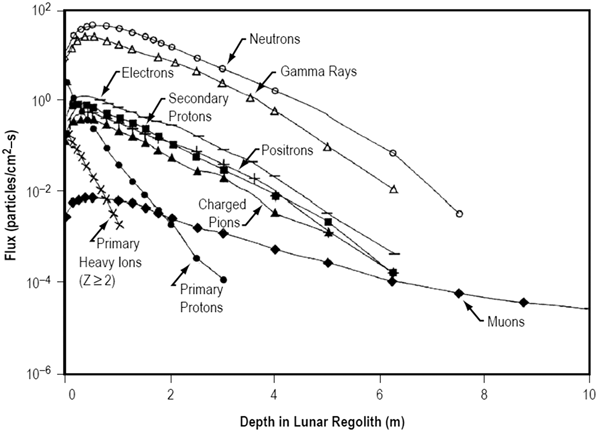
Figure 2 displays the calculated results for secondaries produced when primary GCR interacts with the lunar regolith (the layer of unconsolidated rocky material covering the bedrock).Reference Adams, Hathaway, Grugel, Watts, Parnell, Gregory and Winglee3Figure 2 shows some of the species that are present in the lunar environment. Note that, whereas neutrons are not present in the primary radiation (GCR and SPEs), on the Moon, Mars, and asteroid surfaces, a significant neutron flux gets produced when the GCR and SPEs interact with the surfaces. This secondary neutron radiation has largely been ignored in previous space architectures, even though it is known to be damaging to humans, especially in the formation of radiogenic cancers.
Calculated results for secondary radiation produced when primary galactic cosmic radiation interacts with the lunar regolith.Reference Adams, Hathaway, Grugel, Watts, Parnell, Gregory and Winglee3
MeasurementsReference Zeitlin, Hassler, Cucinotta, Ehresmann, Wimmer-Schweingruber, Brinza, Kang, Weigle, Bottcher, Bohm, Burmeister, Guo, Kohler, Martin, Posner, Rafkin and Reitz4 of the energetic particle radiation in transit to Mars on the Mars Science Laboratory (MSL) showed that, on the 253-day journey to Mars, the dose equivalent inside the spacecraft was 0.66 ± 0.12 Sv (Sievert). Extrapolation from these data leads to a predicted dose equivalent for a human mission to Mars that is close to or exceeds the currently accepted astronaut career limit. Time spent on the surface of Mars would contribute even more to the dose equivalent. Clearly, radiation protection is needed for a human mission to Mars.Reference Cowen5
Nanomaterials for shielding from neutrons
The most significant work in the literature on using nanomaterials for radiation shielding has been on the shielding of neutrons, which are the largest radiation component of concern from nuclear reactors. In space travel, neutrons, although not the primary concern, are generated as secondary particles from the interactions of the GCR and SPEs with matter. Some chemical elements with high thermal neutron absorptions are boron, lithium, and gadolinium.Reference Kim, Lee, Uhm and Miller6 Nanoparticles of gadolinium, which has the highest neutron absorption cross section of all the elements, and boron, which also has a high neutron absorption cross section, are, hence, excellent candidates for neutron shielding. The neutron absorption cross section for the isotope 10B is 3835 barns, so enriching boron compounds with 10B would produce even better protection against neutrons. Compounds of boron, specifically B4C (boron carbide) and h-BN (hexagonal boron nitride) in nanomaterial form, have been used in neutron-shielding materials for potential applications, including nuclear, medical, industrial, and research.Reference Kim, Lee, Uhm and Miller6 Enhancement of thermal neutron attenuationReference Kim, Lee, Uhm and Miller6 was demonstrated in nano-B4C and nano-h-BN dispersed in high density polyethylene (HDPE) nanocomposites for neutron shielding. Boron and its low-Z compounds are suitable for space neutron-shielding applications. The heavier elements are not suitable because their high atomic weight leads to fragmentation yielding secondary radiation.
Shielding from GCR and SPEs
The most significant and challenging space radiation-shielding task is that of shielding against GCR. The GCR particles, which are primarily positively charged, interact with materials mainly by Coulomb interactions with the negative electrons and positive nuclei in the materials and, to a much smaller extent, by collisions with atomic nuclei in the materials. For these reasons, the energy loss of GCR particles increases approximately with the charge-to-mass ratio of the materials. Hydrogen (H), with the highest charge-to-mass ratio of any element, provides the best shielding.Reference Kim, Wilson, Thibeault, Nealy, Badavi and Kiefer7 Because a shield of pure hydrogen is not practicable, hydrogen-containing materials make the most suitable candidates for shielding against GCR.
Hydrogen is effective at (1) fragmenting HZE ions such as are found in GCR, (2) stopping protons such as are found in SPEs, and (3) slowing neutrons such as are formed as secondaries when the GCR and SPEs interact with matter. Hydrogen, however, is not a structural material. Polyethylene, with a molecular formula of (C2H4)n, contains a significant amount of hydrogen and is a solid material. However, it does not have sufficient strength for load-bearing aerospace structural applications or sufficient stability to form the bulk of secondary and interior structures. The current standard for the aerospace industry is to use aluminum alloys for primary structures, retrofitted with nonstructural polyethylene or water (H2O) for radiation shielding.
Radiation-shielding approaches to reduce the risk of cancer from space radiation were evaluated in a 2012 study.Reference Cucinotta, Kim and Chappell8 The conclusion of this evaluation was that developing new multifunctional shielding materials with higher hydrogen content compared with polyethylene should be advocated.Reference Cucinotta, Kim and Chappell8
Polymers and nanofillers for shielding from GCR and SPEs
A study was conducted on the effects of radiation on materials based on single-walled carbon nanotubes (SWNTs), using nanocomposites with nonfunctionalized and 2–5% functionalized SWNTs in a polyethylene matrix.Reference Wilkins, Pulikkathara, Khabashesku, Barrera, Vaidyanathan, Thibeault, Benson, Chipara, Edwards and Phillips9 The radiation sources used were relevant to the upper atmosphere (high-energy neutrons), low Earth orbit (medium-energy protons), and interplanetary space (high-energy protons and heavy ions). The specimens were characterized before and after radiation by Raman spectroscopy, which gave information on the structure of the SWNTs and the state of the sidewall functionalization. Based on results from the nanocomposites made from nonfunctionalized and functionalized SWNTs, the data indicated that the structural integrity and any sidewall functionalization of the SWNTs in the nanocomposites were durable to radiation fluences commensurate with expected exposures on long-term spaceflight. It was also found that the chemistry and processing used to produce the nonfunctionalized and functionalized SWNTs affected the characteristics of the irradiated nanocomposites.Reference Wilkins, Pulikkathara, Khabashesku, Barrera, Vaidyanathan, Thibeault, Benson, Chipara, Edwards and Phillips9 Another studyReference Zhong, Sui, Jana and Miller10 used continuous ultrahigh-molecular-weight polyethylene (UHMWPE) fibers to reinforce an epoxy matrix that contained graphitic nanofibers (nano-epoxy). The composite was irradiated with 1 GeV/nucleon 35Cl ions at the NASA Space Radiation Laboratory located at Brookhaven National Laboratory. It was found that the high radiation-shielding performance associated with the UHMWPE was not degraded by the addition of the graphitic nanofibers to the matrix. The nano-epoxy showed enhanced mechanical properties (strength, modulus, and toughness), thermal properties (glass-transition temperature), and wetting with and adhesion capacity for UHMWPE fibers compared with the neat epoxy. The enhanced properties were attributed to the addition of the graphitic nanofibers. It was concluded that the UHMWPE fiber/nano-epoxy composite had potential for applications in durable space composite structures.Reference Zhong, Sui, Jana and Miller10
A 2012 review articleReference Nambiar and Yeow11 described the state-of-the-art polymer matrix composites filled with microscale materials and nanomaterials for use as radiation shields. Different polymers were included, as well as nanofillers in the form of tubes, fibers, whiskers, particles, and platelets. The potential for polymer composites to be used as radiation-shielding materials in three different industries (aerospace, medical, and nuclear) was discussed. The shielding effectiveness of any material depends on the type of radiation, range of energies, exposure time, and secondary radiation. Additional factors in selecting an effective shielding material include conformability, cost effectiveness, weight, toxicity, and durability. In this regard, polymer composites offer numerous advantages over conventional materials. It was concluded that polymers reinforced with microscale or nanoscale structures have significant potential for use as radiation-shielding materials in all three industries considered.Reference Nambiar and Yeow11
Hydrogen-containing nanostructures
A number of studies on hydrogen storage in nanostructured materials have been published. Nanotubes have been favored to store hydrogen over particles and sheets because they have greater surface areas and higher hydrogen binding energies. Carbon nanotubes (CNTs) and boron nitride nanotubes (BNNTs) have been studied as hydrogen-storage materials since 1997.Reference Dillon, Jones, Bekkedahl, Kiang, Bethune and Heben12 Theoretical ab initio calculations showed that BNNTs are a preferable medium for hydrogen storage compared with CNTs because of the heteropolar binding nature of their atoms.Reference Mpourmpakis and Froudakis13 BNNT bonds, because of their ionic character, offer a 40% higher hydrogen binding energy than CNT bonds. The point charges on the tube’s wall induce a dipole on the hydrogen molecule, resulting in more efficient binding.Reference Froudakis14 The binding energy in BNNTs is even greater than that in planar boron nitride (BN) sheets by about 10%, presumably because of the buckling (curvature with sp Reference Adams, Hathaway, Grugel, Watts, Parnell, Gregory and Winglee3 nature) of BN bonds. The diffusion of hydrogen is slower in small-diameter than larger-diameter BNNTs.Reference Jhi and Kwon15 Therefore, the hydrogen desorption temperature of small-diameter BNNTs is expected to be much higher as well, which is beneficial for use in high-temperature environments. Small-diameter tubes can also provide smaller pores among the bundles, allowing for more effective storage of hydrogen with a higher heat of adsorption.Reference Panella, Hönes, Müller, Trukhan, Schubert, Pütter and Hirscher16
Experimentally, multiwalled bamboo-like BNNTs exhibited up to a 2.6% (by weight) hydrogen storage,Reference Ma, Bando, Zhu, Sato, Xu and Wu17 and collapsed-structure BNNTs could store up to 4.2% (by weight) hydrogen,Reference Tang, Bando, Ding, Qi and Golberg18 even at room temperature, which is significantly higher than for CNTs. The majority (95%) of the adsorbed hydrogen was safely stored up to 300°C–450°C.
Several theoretical studies evaluating the potential for improvement of the hydrogen-storage capacity have been published. It is thought that defects on the BNNT wall can improve the hydrogen storage. The vacancies reconstruct by forming B–B and N–N bonds across the defect site. The defects offer lower charge densities that allow hydrogen molecules to pass through the BNNT wall for storing hydrogen molecules inside the BNNTs.Reference Özdoğan and Berber19 In addition, metal-doped (rhodium, nickel, palladium, or platinum) BNNTs store more hydrogen because the hydrogen interacts highly with metal atoms as a result of the hybridization of the metal d orbital with the hydrogen s orbital.Reference Li, Tian, Huang, Sun and Jiang20 When radiation shielding from GCR and SPEs is a consideration, removal of the heavy-metal catalysts during the process must be addressed, as these would produce fragmentation products during interactions with the incident radiation.
Hydrogenation of BNNTs occurs when hydrogen is bonded covalently with boron or nitrogen or both. The hydrogenation of BN and BNNTs has been studied theoretically.Reference Özdoğan and Berber19,Reference Tanskanen, Linnolahti, Karttunen and Pakkanen21 Hyper-hydrogenated BNNTs, theoretically, can be created with hydrogen coverage up to 100% of the individual atoms. Therefore, higher hydrogen contents can be achieved by this approach compared with the hydrogen-storage approach; however, a systematic experimental hydrogenation study has not yet been reported. Although high-hydrogen-containing BNNTs can be achieved, this approach might sacrifice, to a certain extent, the other attractive structural and thermal characteristics of BNNTs by disrupting conjugated sp Reference Wilson, Townsend, Shimmerling, Khandelwal, Khan, Nealy, Cucinotta, Simonsen, Shinn and Norbury2 BN bonding. Therefore, an optimum degree of hydrogenation should be determined, depending on the particular application.
Combining both, hydrogen-storage and hydrogenation approaches, could provide synergistically improved radiation-shielding effectiveness because modified sp Reference Wilson, Townsend, Shimmerling, Khandelwal, Khan, Nealy, Cucinotta, Simonsen, Shinn and Norbury2 bonds on BNNTs can afford more hydrogen storage.
Research efforts on hydrogen storage in nanotubes (carbon, boron nitride, and silicon carbide), carbon nanoscrolls (structures similar to multiwalled carbon nanotubes, but with a spiral-like rolled-up geometry and open edges), and pillared graphene have been reviewed.Reference Froudakis14 However, it was concluded that, because the interaction between hydrogen and the host material is dominated by weak van der Waals forces, only a small amount can be stored under ambient conditions.
Hydrogen storage using chemical hydrides and metal hydrides has also been reviewed.Reference Niemann, Srinivasan, Phani, Kumar, Goswami and Stefanakos22 This is another approach for getting hydrogen into materials systems. However, as mentioned previously, when radiation shielding from GCR and SPEs is being considered, heavy metals should not be incorporated, as these would produce fragmentation products during interactions with the incident radiation.
Hydrogen-containing nanotubes for shielding from GCR, SPEs, and neutrons
Recent studiesReference Thibeault, Fay, Lowther, Earle, Sauti, Kang, Park and McMullen23,Reference Thibeault, Fay, Earle, Lowther, Sauti, Kang, Park and McMullen24 explored the use of BNNTs for radiation shielding. A number of materials were modeled for their effectiveness in shielding against GCR and SPEs (Figures 3 and 4). The computer code OLTARIS (On-Line Tool for the Assessment of Radiation In Space)Reference Singleterry, Blattnig, Clowdsley, Qualls, Sandridge, Simonsen, Norbury, Slaba, Walker, Badavi, Spangler, Aumann, Zapp, Rutledge, Lee and Norman25 was used. OLTARIS is an integrated tool set using the HZETRN (high-charge and high-energy transport) code developed at the NASA Langley Research Center (LaRC). This tool is intended to help scientists and engineers study the effects of space radiation on shielding materials, electronics, and biological systems. For the GCR calculations, the GCR environment used was the GCR spectra recorded during the 1997 solar minimum,Reference Singleterry, Blattnig, Clowdsley, Qualls, Sandridge, Simonsen, Norbury, Slaba, Walker, Badavi, Spangler, Aumann, Zapp, Rutledge, Lee and Norman25 because GCR is at a maximum during a solar minimum. The SPE calculations used the NASA LaRC model of the August 1972 historical SPE spectra,Reference Wilson, Townsend, Shimmerling, Khandelwal, Khan, Nealy, Cucinotta, Simonsen, Shinn and Norbury2 because this model has been used extensively and is highly acceptable for comparisons. These GCR and SPE spectra give the numbers, types, and energies of the radiation particles present in the space environment.
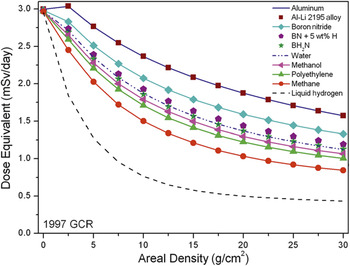
Calculated galactic cosmic radiation (GCR) dose equivalent for some state-of-the-art and proposed radiation-shielding materials.Reference Thibeault, Fay, Lowther, Earle, Sauti, Kang, Park and McMullen23,Reference Thibeault, Fay, Earle, Lowther, Sauti, Kang, Park and McMullen24 The calculations used the 1997 solar minimum GCR environment.Reference Singleterry, Blattnig, Clowdsley, Qualls, Sandridge, Simonsen, Norbury, Slaba, Walker, Badavi, Spangler, Aumann, Zapp, Rutledge, Lee and Norman25

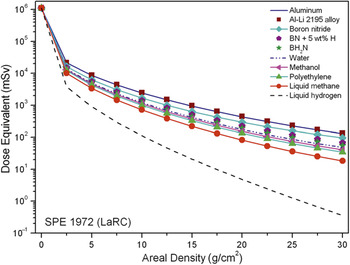
Calculated solar particle event (SPE) dose equivalent for some state-of-the-art and proposed radiation-shielding materials.Reference Thibeault, Fay, Lowther, Earle, Sauti, Kang, Park and McMullen23,Reference Thibeault, Fay, Earle, Lowther, Sauti, Kang, Park and McMullen24 The calculations used the NASA Langley Research Center (LaRC) model of the August 1972 historical SPE spectra.Reference Wilson, Townsend, Shimmerling, Khandelwal, Khan, Nealy, Cucinotta, Simonsen, Shinn and Norbury2

The results of these modeling studiesReference Thibeault, Fay, Lowther, Earle, Sauti, Kang, Park and McMullen23,Reference Thibeault, Fay, Earle, Lowther, Sauti, Kang, Park and McMullen24 showed that the higher the hydrogen content of the material, the better the radiation-shielding effectiveness against both GCR and SPEs. Water contains hydrogen, but it is a liquid and not a structural material. Nevertheless, it can be used as part of the total radiation-shielding system because water is a necessary consumable for all human exploration missions. Polyethylene is a solid material, but it does not have the strength and thermal stability to be a structural material for most space applications. It also has some outgassing and flammability issues and should be encapsulated for many applications.
Because of the work on hydrogen storage in nanostructured materials by others, it was postulatedReference Thibeault, Fay, Lowther, Earle, Sauti, Kang, Park and McMullen23,Reference Thibeault, Fay, Earle, Lowther, Sauti, Kang, Park and McMullen24 that perhaps BNNTs could be used as “vehicles” for carrying more hydrogen into the system. The OLTARIS modeling study indicated that hydrogen-containing BNNTs might offer shielding effectiveness against GCR and SPEs. Figures 3 and 4 show calculated results for GCR and SPE dose equivalents, respectively, for different materials, including BN with varying weight percentages of hydrogen, as functions of areal density (g/cmReference Wilson, Townsend, Shimmerling, Khandelwal, Khan, Nealy, Cucinotta, Simonsen, Shinn and Norbury2). In both figures, it is evident that liquid hydrogen (LH2) appears to be the best shield, but with a density of only 0.07 g/cm3 it is not a structural material. The BN + H materials are solid materials and could possibly be used for structural applications. BNNTs alone (without added hydrogen) do not outperform current state-of-the-art radiation-shielding materials. Adding and keeping hydrogen in the nanotubes is a significant challenge. Because of the boron content, BNNTs have high potential for shielding against neutrons.Reference Thibeault, Fay, Lowther, Earle, Sauti, Kang, Park and McMullen23,Reference Thibeault, Fay, Earle, Lowther, Sauti, Kang, Park and McMullen24
Mechanical properties of hydrogenated BNNTs have also been predicted,Reference Ghazizadeh, Estevez, Kelkar and Ryan26 by using molecular dynamics simulations. The simulations showed that there was a decrease in the Young’s modulus of the BNNTs when hydrogen atoms were bonded to all of the nitrogen atoms in the system. However, the resulting modulus was still higher than that of conventionally accepted and used carbon fibers and, hence sufficiently high to make the material a candidate for space applications.
Nanometals for shielding from electrons and gamma rays
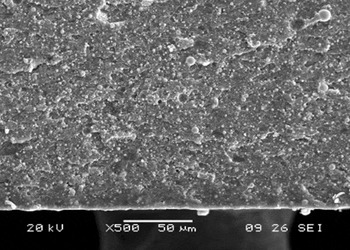
Electronic systems in spacecraft are frequently shielded from space radiation using metallic enclosures. The enclosures are intended to attenuate the energy and flux of the radiation as it passes through, such that the energy per unit mass (or dose) absorbed in silicon is sufficiently below the maximum dose ratings of the electronic components. A study analyzing the radiation-shielding effectiveness of incorporating nanomaterials into composite structures used tungsten nanoparticles and CNTs.Reference Atxaga, Marcos, Jurado, Carapelle and Orava27 Whereas light elements, and in particular hydrogen, are best for shielding per unit mass, heavier elements are best per unit thickness, particularly in shielding from electrons and Bremsstrahlung radiation. Figure 5 shows the microstructure of epoxy resin doped with 30 wt% tungsten nanoparticles and 0.5 wt% CNTs. This nanocomposite was designed for shielding electronics enclosures.Reference Atxaga, Marcos, Jurado, Carapelle and Orava27
Microstructure of epoxy resin doped with 30 wt% tungsten nanoparticles and 0.5 wt% carbon nanotubes. This nanocomposite was designed for shielding electronics enclosures.Reference Atxaga, Marcos, Jurado, Carapelle and Orava27 Reprinted with permission from Reference Reference Atxaga, Marcos, Jurado, Carapelle and Orava27. © 2012 G. Atxaga, J. Marcos, M. Jurado, A. Carapelle, and R. Orava.

Nanofoams for radiation shielding
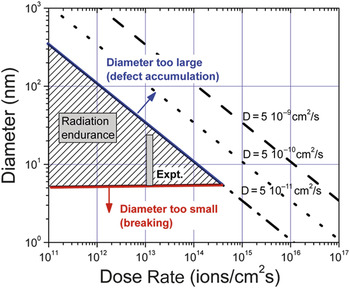
Figure 6 shows the performance of nanofoams in resisting radiation damage.Reference Bringa, Monk, Caro, Misra, Zepeda-Ruiz, Duchaineau, Abraham, Nastasi, Picraux, Wang and Farkas28 The radiation source was 45 keV neon ions, and the irradiation was performed at room temperature. Experiments and computer simulations on nanoscale gold foams showed the existence of a triangular window in parameter space (Figure 6) where foams are radiation-tolerant. Foams with ligament diameters below a minimum value display ligament melting and breaking, as well as compaction that increases with dose. Foams with ligament diameters above a maximum value show bulk damage accumulation. For foams with ligament diameters between these dimensions (∼100 nm for gold), defect migration to the ligament surface occurs faster than the time between cascades, ensuring radiation resistance for a given dose rate. Results are shown for various estimated diffusivities (D) of the defect clusters. The study concluded that foams could be tailored to become radiation-tolerant.Reference Bringa, Monk, Caro, Misra, Zepeda-Ruiz, Duchaineau, Abraham, Nastasi, Picraux, Wang and Farkas28 Because the nanofoams were demonstrated to be radiation-resistant, work is currently continuing to study these nanofoams as potential candidates for radiation shielding.
Validation of the performance of radiation-resistant nanofoams. Experiments and computer simulations on nanoscale gold foams indicated the existence of a triangular window in parameter space where foams are radiation-tolerant. Foams with ligament diameters below a minimum value display ligament melting and breaking, as well as compaction that increases with dose. Foams with ligament diameters above a maximum value show bulk damage accumulation. For foams with ligament diameters between these dimensions (∼100 nm for gold), defect migration to the ligament surface occurs faster than the time between cascades, ensuring radiation resistance for a given dose rate. D is the diffusivity of the defect clusters.Reference Bringa, Monk, Caro, Misra, Zepeda-Ruiz, Duchaineau, Abraham, Nastasi, Picraux, Wang and Farkas28 © 2011 American Chemical Society.

Summary
The radiation-shielding effectiveness of polymer matrix materials has not been demonstrated to be improved simply by the addition of nanotubes. An exception is for the case of adding neutron-capturing elements such as boron. The addition of nanotubes (CNTs and BNNTs), because of their high theoretical strength and high thermal stability, can improve other materials properties and make the resulting nanocomposite multifunctional. The addition of CNTs can improve electrical conductivity and provide electrostatic control to mitigate spacecraft charging. Because BNNTs, CNTs, and other nanostructured materials have the theoretical capacity to store hydrogen and because hydrogen is ideal for radiation shielding, the addition of hydrogen-containing nanostructures could improve the radiation-shielding effectiveness of the resulting materials for shielding from GCR and SPEs. The addition of metal hydrides containing light metals has similar potential. One studyReference Wilkins, Pulikkathara, Khabashesku, Barrera, Vaidyanathan, Thibeault, Benson, Chipara, Edwards and Phillips9 showed that CNTs are durable to the effects of a range of types of radiation and, hence should be durable for use in radiation-shielding applications. This durability is presumably due to the almost complete aromaticity of CNTs, so this result should presumably apply to BNNTs as well. Nanometals are important for shielding electronics in spacecraft, especially from electrons and γ-rays. Nanofoams are beginning to be studied for use as radiation-shielding materials. Nanomaterials could play a role in components and subsystems for the development of active radiation-shielding systems, such as magnetic or electrostatic shielding systems, in the future.