1.1 Introduction
On 27 September 2022, I welcome a colleague from Spain, his wife and three children to Exeter. They have just arrived from Granada and will be in England for a year while their father collaborates with me on various projects at the university. I ask them what they are most looking forward to, and they reply in unison in loud voices with great smiles on their faces: ‘The rain! Wearing wellington boots! Jumping up and down in muddy puddles!’ I smile, thinking to myself that this will soon pass. Because it rains a lot in England, and long school runs in the rain are not fun.
Fast forward ten months, and I am at my allotment in June 2023. It has not rained for weeks on end; the ground is dry and has begun to crack. It looks like a lunar landscape. The soil is too hard for me to be able to sow, and what I had sown early has either perished or not germinated. It is simply too dry and too hot – unusually so for England. Watering is not an option. Not only is it too time-consuming but there also is none available in the communal rainwater tanks. June passes and we enter July, and still hardly anything grows beyond a few courgettes, the fruit trees drop what little treasure they carry, the potatoes die back and turn bitter. Then the sun disappears, and the rain arrives. It is relentless. The tomatoes in the greenhouse that have managed to survive never ripen. There is not enough sun. The weeds grow along with the artichokes, but nothing else thrives.
The growing season 2023 is a write-off, and looking at my diaries in late August, I realize that the previous year was not that different. Maybe, if I wish to harvest crops in the future, I need to change my approach and adapt to what appears to be a new climate. My friends depart Exeter for Granada at the end of August, and contrary to what I thought initially, their love of rain did not evaporate. Even on their very last day, a grey and rainy one, they relish it. They tell me that in Spain it has not rained in months, it is extremely hot and they are not looking forward to returning to that scenario. They worry how they will cope, not so much in the short run, although the heat and drought are unpleasant, but in the future. Maybe one day, we – or our children’s families – will become climate refugees, my friends sigh. It is a real possibility.
My Spanish friends take off, and I walk home through the flower installations that have been put up last week as part of the introduction of a new Low Traffic Neighbourhood (LTN) in my area. A bollard has already been cut down by angry motorists, there is graffiti on the flowerbeds and some plants have been ripped out and thrown to the ground. Over the coming weeks, I see drivers defiantly speeding through as the traffic cameras are yet to be installed, I hear angry voices shout abuse about the inconvenience of the scheme and obstructing the council staff, Facebook groups urging people to sabotage the scheme and commit acts of vandalism swell. The situation becomes increasingly tense, and neighbours look at each other with suspicion. There are heated arguments. Mums angrily say they have a right to drive their children to school in the morning, rather than walk, which is both time-consuming and exhausting. Pensioners proclaim their monthly trips in their cars to the local hospital are going to take at least five minutes longer. I, at times, venture my opinion when asked directly, citing the Danish journalist and activist Signe Wenneberg’s motto ‘no one can do everything, but we can all do something’, and maybe people using my road can contribute to combatting climate change by considering alternative means of transportation. I get told to keep my opinion to myself as I am ‘a foreigner’, and in the end I stop engaging on the topic, and I ask my children not to talk to anyone in the street about the LTN or, indeed, climate change.
In my case, it was not until 2023 that the realities of the global climate crisis really hit home. I had heard about it, I am politically active and follow the news, I grow a lot of the fruit and vegetables we consume at home, I bake our bread on a weekly basis and I have been engaged in activism relating to the Amazon rain forest and human rights since I was a teenager. Yet, I still did not take it highly seriously. Not until climate change affected me and my loved ones directly. I think that is something we can all relate to. However, the global climate crisis is now so serious that most of us will be directly impacted by its negative consequences. We might not have realized this yet, but if we slow down and think about it, we all can probably mention some ways in which we are affected. They might feel minor now, for example, rising prices on household staples such as tomatoes, flour and coffee due to scarcity as harvests fail, but they are likely to become much more significant. Perhaps some of us simply think of these things as inconvenient, whether the rising prices or initiatives such as the LTNs, but we cannot deny that they are there as a consequence of climate change.
In the Global North, reporting in the mainstream news media on climate change has tended to focus on the causes and solutions to climate change, whereas in the Global South, the emphasis has been on the impact on humans. Furthermore, journalists in the Global North have been more inclined to report on climate science as well as climate scepticism compared to their colleagues in the Global South, who instead report much more on the societal dimension of climate change, such as the implications for humans of water scarcity and the loss of habitat, with a view to engage with their audience and foster societal action (Hase et al. Reference Hase, Mahl, Schäfer and Keller2021; Perga et al. Reference Perga, Sarrasin, Steinberger, Lane and Butera2023). However, in 2023, as temperatures reached peak levels in southern France, Italy and Spain, and as wildfires ravaged parts of Canada, Greece, Spain and the United States with devastating consequences, reporting on climate change in the Global North evidently started to shift as these so-called focusing events directed public attention towards specific issues related to climate change – and particularly the societal consequences and impact on humans – in a similar fashion to what has long been the case in the Global South. Yet, while some news outlets in the Global North began to reflect the clearly global nature of the climate crisis, reporting remained sporadic in many cases (Hertsgaard and Pope Reference Hertsgaard and Pope2023). There was thus little mentioning of the forest fires simultaneously razing large parts of Algeria and Tunisia, nor was there much reporting on the torrential rain that caused flooding and landslides resulting in the displacement of hundreds of thousands of people across sub-Saharan Africa, including in Burundi, the DRC, Ethiopia, Kenya, Rwanda and Somalia in the spring and summer of 2023.
Disappointed with my own failure to take the global climate crisis seriously until it touched me directly, disheartened at the casual attitude to climate change by my peers in the Global North and upset with much of the mainstream media’s lack of willingness to afford space and time to in-depth, holistic analyses of climate change and its impacts, I decided to research and write a book, combining my main expertise in party politics and Middle East studies with my emerging research agenda on the global climate crisis, gender politics and the Global South.
Since April 2023, I have been a lead on the Global Environmental Futures theme in an academic collaborative partnership between the Universities of Exeter and Queensland, and since early 2024 also the Sustainability Advocate for Research at the University of Exeter. Initially, my ambition was to broaden the remits of both roles to incorporate more sustainable development goals (SDGs) into our research, which has thus far been more focused on STEMM-related issues, and I was particularly keen to foster research covering SDGs 1 (no poverty), 2 (no hunger), 4 (quality education), 5 (gender equality), 16 (peace, justice and strong institutions) and 17 (partnerships for the goals). However, as I attended symposia and became involved in the awarding of grants, it grew increasingly obvious to me that boundaries must be pushed. Research on the global climate crisis needs to be more holistic and intersectional if it is to present sustainable solutions. When exploring the possibilities of, for example, mining for transition-critical minerals (TCMs), scholars must look beyond the benefits to the Global North and also consider the costs and benefits to the Global South, where these raw materials are often found. Will they add to pollution there? What about violent conflict? Will people in the Global South benefit directly too? Could this be considered a new form of colonialism? When conducting research on alternative food sources in a response to climate change-induced pollution and scarcity, we must also consider what is genuinely possible. For instance, what role does poverty play? Can the islanders on the Galapagos realistically reduce their consumption of fish significantly? Have we asked them what they think is within their remit and considered indigenous knowledge?
In this book, this is what I intend to do: to decolonize the topic of climate change; to listen to and amplify the voices of those who are the most negatively impacted by the global climate crisis, yet who are often not heard, because they are politically marginalized. As I detail later in Chapter 3, the book rests primarily on nearly a hundred qualitative interviews with female activists and members of parliament (past and present) from across the Middle East and North Africa (MENA).1 But the conclusions reached can be extrapolated from. They apply globally, but particularly in the Global South, where the context in which the global climate crisis is faced and fought differs considerably from that in the Global North.2 Nevertheless, the lessons are relevant to all of us – maybe especially to those in the Global North making policy and working as aid practitioners, because they rarely have the access or the time to truly listen to what the politically marginalized in the Global South have to say.
The subsequent sections set out the foundations of the book, beginning with a basic discussion of what is climate change and the global climate crisis. The chapter then moves on to the important Global North–Global South colonial context and the fundamental issues of environmental justice, climate justice and carbon colonialism. From there, the discussion ventures into an overview of who bears the brunt of climate change, concluding in a final section on the calls for a gender-based approach to solving the global climate crisis and the rationale for the book.
1.2 What Is Climate Change?
Climate change refers to long-term shifts in temperatures and weather patterns. Throughout history, the climate of Earth has changed several times. According to NASA, over the last 800,000 years, there have been eight cycles of ice ages and warmer periods.3 The current – or ‘modern’ – climate era and the beginning of human civilization began with the end of the last ice age, which took place approximately 11,700 years ago. But evidence suggests that Earth’s climate is beginning to change once more as temperatures start to rise – a situation commonly referred to as global warming – causing extreme weather events such as heat waves, cyclones and floods (Ebi et al. Reference Ebi, Vanos and Baldwin2021). According to the Intergovernmental Panel on Climate Change (IPCC), Earth’s surface is now 1.1°C warmer than it was during the pre-industrial period (1850–1900), a reality that can be attributed to the emission of greenhouse gases (carbon dioxide, nitrous oxide and methane) from human activities, which in the case of CO2 emissions have increased by approximately 46 per cent in the same period. Furthermore, scientists predict that within the next two decades, global temperatures will rise a further 0.5–1°C unless very urgent action is taken to limit greenhouse gas emissions (Masson-Delmotte et al. Reference Masson-Delmotte, Zhai and Pirani2021).
The rising temperature of Earth’s surface and CO2 concentration in the atmosphere are not the only gauges of climate change. In fact, some 25 per cent of anthropogenic CO2 emissions in the past decade have been absorbed by the oceans, and other indicators of climate change thus include Arctic sea–ice extent difference, global sea level difference and ocean heat content, as well as El Niño southern oscillation difference.4 Referencing the IPCC, a recent report edited by Johnson and Lumpkin (Reference Johnson and Lumpkin2022: 153) highlights the extent of oceanic changes linked to anthropogenic causes. The authors conclude that: ‘Owing to increases in greenhouse gases in the atmosphere, the oceans have been warming for decades, storing about 91% of the energy gained by Earth’s climate system from 1971 until 2018. […] Ocean thermal expansion from warming accounted for about 50% of the increase in global average sea level during this same period’.
While long-term shifts in temperatures and weather patterns can be natural and have habitually been attributed to changes to the amount of solar energy Earth receives as a consequence of variations in its orbit, since the nineteenth century, human activities have been the main driver of climate change; it is anthropogenic. Research shows that the current episode of global warming is primarily due to the human consumption of fossil fuels (coal, natural gas and oil), land clearing, agriculture and the resulting release of significant amounts of carbon dioxide and methane into the atmosphere.5 Once in the atmosphere, these greenhouse gases create what is commonly referred to as a ‘blanket’ around Earth, causing it to heat up (Nyambuu and Semmler Reference Nyambuu and Semmler2021).
This reality has led scholars to call for a broadened perspective on climate change, situating current events in their long-term context. Clark et al. (Reference Clark, Shakun and Marcott2016), for instance, argue that the policy debate on climate change and mitigation, which tends to focus on observations and events during the past 150–250 years, needs to be drastically expanded to the last twenty millennia and the very distant future, if we are to comprehend the problems associated with climate change. The authors maintain that: ‘ … policy decisions made in the next few years to decades will have profound impacts on global climate, ecosystems and human societies – not just for this century, but for the next ten millennia and beyond’ (Clark et al. Reference Clark, Shakun and Marcott2016: 360).
1.3 What Is the Global Climate Crisis? The Consequences of Climate Change
Climate change has very real and immediate consequences as well as more long-term effects. Although many of these consequences are interrelated, they can be roughly grouped into three separate categories – natural consequences, social dangers and threats to business – which facilitate an easier overview of a very complex issue.
1.3.1 Natural Consequences
Natural consequences of climate change include the increase in the average global temperature and related weather extremes such as heatwaves, which tend to affect the most vulnerable members of the population the hardest. There are also indications that the geographical distribution of climate zones will change, thereby resulting in an altered distribution and occurrence of plant and animal species, which also affects agriculture and livestock. Animals are further under threat as their phenology is likely to be affected by the rising temperatures. Scholars anticipate this will ultimately lead to a multiplication in pests and invasive species as well as in human diseases and their impact (Weiskopf et al. Reference Weiskopf, Rubenstein and Crozier2020).
Rising temperatures also lead to an increase in the evaporation of water, which causes desalination (affecting the availability of fresh water and biodiversity in coastal habitats) and drought (for instance causing wildfires and the loss of agricultural land), which is further exacerbated by the reduction in precipitation. Global warming, in other words, also affects rainfall patterns (less rain combined with sudden extreme rainfall), the melting of glaciers and sea levels rising. These changes, in turn, are expected to result in a decline in water quality while simultaneously causing water scarcity and flooding, particularly in the Global South, thereby leading to large-scale economic losses, migration and the displacement of people (Chancel, Bothe and Voituriez Reference Chancel, Bothe and Voituriez2023; Díaz et al. Reference Díaz, Settele and Brondízio2019).
1.3.2 Social Dangers
Climate change is now one of the key drivers of migration and displacement, and those living in the poorer countries in the Global South are the most affected. This is due to the reality that their livelihoods often depend heavily on their natural environment, yet the resources they have at their disposal to mitigate climate change are the most scarce. It is also a well-known fact that those living in low-income areas with poor infrastructure are more exposed to climate impacts, most notably in terms of their health, as are the ageing population and the unemployed and socially marginalized. In other words, those with intersecting identities, for example, unemployed women or elderly people on a low income living in infrastructure-poor areas of the Global South, are the most vulnerable and have the least agency (Abate and Kronk Reference Abate, Kronk, Abate and Kronk2013; Chancel, Bothe and Voituriez Reference Chancel, Bothe and Voituriez2023; Kaijser and Kronsell Reference Kronsell2013).
The United Nations High Commissioner for Refugees (UNHCR) asserts that climate change is: ‘causing an average of more than 20 million people to leave their homes and move to other areas in their country each year. Some people are forced to cross borders in the context of climate change and disaster and may in some circumstances be in need of international protection’.6
Furthermore, it is estimated that some 40 per cent of refugees and some 70 per cent of internally displaced people are hosted in highly climate vulnerable countries with fewer resources at their disposal, therefore leading to an increasingly hostile environment.7 Recognizing that: ‘the effects of climate change are felt disproportionately by segments of the population that are already marginalized or in vulnerable situations owing to geography, gender, sexual orientation, age, indigenous or minority status, disability, or living in situations of conflict, violence, or displacement’, the UNHCR has called for the promotion and protection of human rights in the context of climate change.8
1.3.3 Threats to Business
Finally, productivity and the viability of all economic sectors are impacted by climate change. This reality is tied to workforce availability (skills, health and natural hazards), and in some sectors also to their dependence on stable climate conditions. As supply chains and infrastructure (e.g., roads, ports and buildings) are disrupted, and the cost of materials and energy supplies simultaneously increase, small- and medium-sized enterprises (SMEs) are particularly at risk (Crick et al. Reference Crick, Eskander, Fankauser and Diop2018). Small- and medium-sized enterprises within agricultural production and tourism are likely to be the most affected by climate change, especially in the Global South, as tourists veer towards destinations with less extreme weather, and farmers struggle to cope with the high temperatures, both in terms of crop cultivation and livestock care (Hoogendoorn and Fitchett Reference Hoogendoorn and Fitchett2016; Tai et al. Reference Tai, Martin and Heald2014). The rise in temperatures – and the resulting more frequent occurrence of flooding, droughts and fires – is expected to cause nutrient leaching, the reduction of organic matter in the soil and an increase in pests and diseases, which combined with water scarcity makes it difficult for farmers to sustain a living, particularly in the Global South where these factors more frequently occur together, thus resulting in food shortages, increased hunger and poor nutrition, which again is likely to fuel migration and displacement (Chancel, Bothe and Voituriez Reference Chancel, Bothe and Voituriez2023; Hermans and McLeman Reference Hermans and McLeman2021).
1.4 The Global North–Global South Colonial Context
The climate crisis affects all humans, no matter where we live on the globe. That said, we are not all equally affected, as detailed previously, nor have we all contributed equally to greenhouse gas emissions, whether directly or indirectly.
1.4.1 Emissions, Wealth and Poverty: Inequality on a Local and Global Scale
According to data from the World Inequality Report (2022), the top 1 per cent of the world’s wealthiest are responsible for nearly 20 per cent of all CO2 emissions, while the top 10 per cent contribute nearly 50 per cent, and the bottom 50 per cent, that is, the world’s poorest, emit 12 per cent. Hence, carbon inequalities within countries are now greater than between countries, that is, a small group of people contribute disproportionately to greenhouse gases via their consumption and investment patterns (Chancel, Bothe and Voituriez Reference Chancel, Bothe and Voituriez2023). If we look closer at the data, to give just a few examples (see Table 1.1), in the MENA, the poorest 50 per cent contribute 5.3 per cent of the region’s emissions, whereas the top 10 per cent emit 77.8 per cent. In terms of tonnes emitted, the poorest 50 per cent of the population in sub-Saharan Africa contributed the least (0.5 tonnes per year) in 2019, while the heaviest emitters were the top 10 per cent wealthiest in North America (73 tonnes per year) – a whopping difference of 72.5 tonnes per year. Furthermore, while the poorest half of the population in wealthy countries are nearing the 2030 climate targets (expressed on a per capita basis), it appears the consumption habits of the wealthiest have not changed, to some extent as a consequence of the fact that initiatives such as carbon taxes tend to disproportionately impact low- and middle-income groups.9
| East Asia | Europe | North America | South and Southeast Asia | Russia and Central Asia | MENA | Latin America | Sub-Saharan Africa | |
|---|---|---|---|---|---|---|---|---|
| Bottom 50% wealth | 3.1 | 5.1 | 9.7 | 1.0 | 4.6 | 2.3 | 2.0 | 0.5 |
| Middle 40% wealth | 7.9 | 10.6 | 21.7 | 2.5 | 10.2 | 7.3 | 4.7 | 1.7 |
| Top 10% wealth | 38.9 | 29.2 | 73.0 | 10.6 | 35.1 | 33.6 | 19.2 | 7.3 |
What is also interesting to note, especially in light of the carbon colonialism debate presented a little later on, is the reality that the carbon footprint and territorial emissions of the various regions differ. That is, regions such as sub-Saharan Africa, the MENA, East Asia, Russia and Central Asia in particular, but also South and Southeast Asia and Latin America to some extent, have smaller carbon footprints than territorial emissions. In the case of East Asia, for example, the carbon footprint was 8 per cent lower than territorial emissions, meaning that ‘nearly one tonne of carbon per person is produced in East Asia to satisfy the needs of individuals in other parts of the world’.10 In contrast, in North America and in Europe, territorial emissions are lower than the regional carbon footprints and, thus, while the carbon emissions are attributed to these two regions, the actual release into the atmosphere takes place elsewhere.
Likewise, and perhaps more well known, it is an unescapable fact that those living in the Global South disproportionately bear the burden of the current global climate crisis, while the Global North contributes the most to greenhouse gas emissions (Houtan et al. Reference Houtan, Tanaka, Gagné and Becker2021; Porter et al. Reference Porter, Richards and Verlie2020). In the words of Chancel, Bothe and Voituriez (2023: 19): ‘North America and Europe created half of all accumulated global GHG emissions since 1850. Thus these two continents have contributed as much anthropogenic climate change as all the other countries put together, despite having but a small fraction of the global population’.
Adding further perspective, the data shows that North America has contributed no less than 27 per cent of historical emissions since 1850, while Europe is a close second with a contribution of 22 per cent. At the other end of the scale, sub-Saharan Africa has contributed 4 per cent and Latin America 6 per cent (Chancel, Bothe and Voituriez Reference Chancel, Bothe and Voituriez2023: 20).
1.4.2 Climate and Colonial Locations
What many people do not realize is that the Global North’s role in accelerating climate change dates further back than the pre-industrial period, stretching into the fifteenth century and the onset of colonialism. In fact, there is no denying that climate, science and imperialism are intertwined. The material realities of climate shaped colonialism, both in terms of territorial expansion and theories of racial superiority. Climate shaped the behaviour of colonizers on the ground and informed imperial projects and scholarship on, for example, forestry, agriculture and human health (Mahony and Endfield Reference Mahony and Endfield2018).
With the objectives of making up for scarcity at home and simultaneously expanding their economies, European countries embarked on imperialist projects as far back as 1402 with the colonialization of the Canary Islands by the Crown of Castile and Ceuta in 1415 by the Portuguese. The destinations for these efforts were habitually based on considerations relating to the climate as portrayed in the writings of explorers, merchants and naval figures. For instance, there was the belief that in the tropics there was abundance and that high biological productivity required very little human effort, while the southern Atlantic coast of North America was believed to have a climate similar to the Mediterranean, thereby offering an opportunity to reduce trade imbalances, particularly in the case of Britain (Grove et al. Reference Grove, Damodaran and Sangwan1995; Meyer Reference Meyer2000). Beyond determining geographical sites for potential business ventures, theories about the climate of various locations also played a role with health in mind. It was a firm belief that health/disease and climate were directly linked and, therefore, there were favourable and unfavourable (i.e., healthy and unhealthy) locations, with those locations with climates most similar to the imperial state deemed more favourable (Kupperman Reference Kupperman1984).11 In short, from an imperialist perspective, climate presented opportunities as well as dangers.
Colonies were not simply states captured by imperial powers, but were often spaces without formal boundaries, although frontier zones did exist in the pre-colonial era (Ajala Reference Ajala1983). The present-day state boundaries that are in place in many states found across the Global South thus trace back to the colonial era. For example, in the case of African state formation and state borders, these were drawn up by the European powers as they partitioned the continent according to the rules established by the Berlin Conference of 1884–85 (Griffiths Reference Griffiths1986; Horowitz Reference Horowitz1985). Rather than being guided by the peoples, cultures and traditions of the various locations, the carving up of Africa into colonial states with rigid boundaries was driven by the distribution of territory and resources, such as coal and oil. In some instances, the new borders followed the old administrative boundaries of the Ottoman Empire; there were cases where the new borders followed waterways such as rivers and lakes; but many borders were simply done in a straight line with a ruler, dividing the land between the various imperial powers (Bull and Watson Reference Bull and Watson1984; del Sarto Reference Del Sarto2017). In the process, local peoples and tribes were split, and their access to vital resources as well as their freedom of movement were restricted, a reality that had a detrimental effect on livelihoods and the nomadic way of life of some tribes, creating tension and conflict on such a scale that it has fuelled ethnic cleansing and continued to spark civil wars to this day (Engelbert Reference Engelbert2000; Horowitz Reference Horowitz1985; Morrock Reference Morrock1973).
1.4.3 Colonial Administrations and Economic Development
Once colonies had been established, the climate played a key role in decision-making around planning, alongside security and health concerns (Acemoglu et al. Reference Acemoglu, Johnson and Robinson2001; Beebeejaun Reference Beebeejaun2022). Most notably, the climate influenced the locations and layouts of towns, cities and administrative centres, and it thus had a very tangible impact on the infrastructure of the colonized spaces, including the location of roads, railways and power plants, which lasted well beyond the end of colonialism (Ghilès and Woertz Reference Ghilès, Woertz and Verhoeven2018; Johnston Reference Johnston2013; Roessler et al. Reference Roessler, Pengl, Marty, Titlow and van de Walle2020).
Of most significant and long-lasting impact, however, was the new economic and political institutional set-up introduced by the colonial powers in order to exert control over resources and territories as well as to maximize extraction. It is important to note that the Global South was not devoid of institutions prior to colonialism. In the case of sub-Saharan Africa, for instance, there were territories with a centralized ‘state’ already in place, such as Benin, Ethiopia, Ghana and Rwanda, amongst others; there were territories with white settlement (which replicated European institutions), most notably, Kenya, Namibia, South Africa and Zimbabwe; and there were territories that had little or mixed experience with centralized institutions and white settlement, such as for instance in Sierra Leone, Somalia, South Sudan and Uganda (Heldring and Robinson Reference Heldring, Robinson, Lancaster and van de Walle2018). In the MENA, there were the remnants of Ottoman institutions in place, with power centralized in an absolutist state, which was largely unbound by rules and regulations (Acemoglu and Robinson Reference Acemoglu and Robinson2012; Heper Reference Heper1980), while in Latin America, countries such as Bolivia, Mexico and Peru, which had formed the core of the former Aztec and Inca empires, had institutionally advanced pre-colonial groups (Angeles and Elizalde Reference Angeles and Elizalde2017). In other words, it was not the case that colonialism introduced financial and political institutions to the Global South, but rather that colonialism introduced different institutions, that is, institutions modelled on those in place in the imperial powers. Hence, scholars have convincingly argued that had colonialism not happened, the institutional set-up in the contemporary Global South would have looked very different to how it does now. However, this does by no means imply that the institutions already in place in some countries on the eve of colonialism would not have evolved, only that they would have evolved differently (Heldring and Robinson Reference Heldring, Robinson, Lancaster and van de Walle2018).12
The political and financial institutions put in place by the imperial powers favoured the elite and served the purpose of facilitating minority control and the exploitation of the colonial dominion, particularly in the form of cash crops and minerals, but also via taxation and property rights. The elite was predominantly understood as the colonizers (administrators and settlers) and, to some extent, local representatives of the colonizers and key allies. Consequently, the new extractive institutions, whether palm oil plantations and oil extraction sites in Nigeria, rubber and coffee plantations in Burundi, Rwanda and Tanzania or coal mines in Mozambique, contributed to an increase in wealth – and, by extension, education and health – but only for a minority. For the vast majority of the indigenous population, the impact was negative – the net result was rising inequality (Acemoglu et al. Reference Acemoglu, Johnson and Robinson2001, Reference Acemoglu, Johnson and Robinson2002; Heldring and Robinson Reference Heldring, Robinson, Lancaster and van de Walle2018).13 Furthermore, even after the end of colonialism, these institutions continued to cause inequality. As the imperial powers left, the new indigenous political elites that moved in to fill the power vacuum kept in place the colonial institutions which, although given a tweak, maintained the central element of elite control and privilege. Consequently, although the political elite changed from imperial to indigenous, the indigenous masses have been excluded from full participation in government as well as the commercial economy in the post-colonial period too, and the inequality relating to colonial institutions thus persists to this day, albeit to varying extents (Engerman and Sokoloff Reference Engerman and Sokoloff2000; Ghilès and Woertz Reference Ghilès, Woertz and Verhoeven2018; Nunn Reference Nunn2008; van de Walle Reference Van de Walle2009).
Beyond inequality, which is recognized as a key contributing factor to the climate crisis by the IPCC, colonialism also had a direct impact on climate change as a consequence of environmental destruction. In the early days of colonialism, there was some level of collaboration with members of the indigenous elite as the imperial powers were keen to acquire a deeper knowledge of the colonial dominions, both in terms of how power was maintained – such as the mita system of forced labour used in the Inca Empire – and regarding indigenous practices of cultivation, resource extraction and land maintenance. However, as colonialism became more widespread and the empires grew, so did the racist underpinning narrative of Western superiority, and thus the interest in indigenous knowledge ceased and many indigenous practices were prohibited (Angeles and Elizalde Reference Angeles and Elizalde2017; Mahoney and Endfield Reference Mahony and Endfield2018).
Lacking an understanding of the local climate and with an eye on profit, imperial powers oversaw the felling of vast areas of forest, with the timber either destined for Europe or with deforestation in mind, at times resulting in desertification, such as in Mesopotamia. Some of the cleared areas were later replanted with other more profitable native species that had not previously grown in the area (such as coffee in some areas of India) or non-native species that negatively impacted upon the ecosystem, including the displacement of indigenous peoples (Pouchepadass Reference Pouchepadass1995). In some cases, forests were cleared with a view to expand the territory that was suitable for colonial settler communities. In a similar vein, marshes were drained, and there were concrete plans by the Germans to create artificial lakes that would assist in their efforts to secure and expand on German colonial territory without attempting to capture land from rivalling powers. In short, the imperial powers at times sought to engineer the environment in their colonial dominions with a view to profiteer (Mahoney and Endfield Reference Mahony and Endfield2018; Siiskonen Reference 258Siiskonen2015).
1.5 Environmental Justice, Climate Justice and Carbon Colonialism
Climate engineering, resource extraction and the related profiteering by the imperial powers coupled with the long-term impact of colonial-era political and financial institutions in terms of inequality are growing increasingly central to the international debate on the global climate crisis. Over the years, the calls for reparations have intensified, and the Global South is no longer simply asking for one-off cash transfers or apologies, but rather ‘a systemic approach to redistributing resources and changing policies and institutions that have perpetuated harm’ (Táíwò and Cibralic Reference Táíwò and Cibralic2020). They want justice.
The climate justice debate – both within academia and amongst activists and organizations seeking to address the issue in practice – is rooted in the debate on environmental justice, which brought together activists and thinkers concerned with environmental issues beyond the ‘big outside’. That is, the movement defined environment in a very broad sense, including the non-human realm, but focused in particular on the everyday life and the impact of environmental degradation on disadvantaged communities. The environmental justice movement thus fostered a close relationship with various indigenous, human rights and race-based movements, not only with a view to highlight inequalities but also in terms of moving forward and finding sustainable solutions that do not negatively impact upon marginalized groups. Hence, the environmental justice movement has long looked to indigenous practices as a source of inspiration, and it has pushed ardently for broader inclusion and stronger representation of the voices of the various marginalized communities (Scholsberg and Collins Reference Schlosberg and Collins2014).
The environmental justice movement, which has been particularly powerful in the United States, moved towards a more prominent emphasis on climate change in the wake of Hurricane Katrina in 2005, although steps in that direction had already begun some years earlier with the establishment of the Environmental Justice and Climate Change Initiative during COP6 in 2001. With the advent of Hurricane Katrina, however, came two realizations. Firstly, pollution, for instance, does not simply have a direct impact on the local community in terms of toxic spillage, poor air quality and so on but it also contributes to climate change, causing extreme weather events such as hurricanes, resulting in environmental damage on an enormous scale and hitting marginalized communities disproportionately hard.14 Secondly, following Hurricane Katrina, the environmental justice movement began to rethink its view on the relationship between justice and environment. Whereas previously the focus had been on environmental damage as a symptom of existing social injustice and inequality, post-Katrina, the movement began to see the combat of environmental damage and climate change as prerequisites for social justice (Newell Reference Newell2022; Porter et al. Reference Porter, Richards and Verlie2020; Scholsberg and Collins Reference Schlosberg and Collins2014).15
With the subsequent rebranding of the environmental justice movement as the climate justice movement, the emphasis shifted from community-based work to a policy-focused approach, centring on fossil fuels and what has been termed climate or carbon colonialism and apartheid (Blanc Reference Blanc2022; Dehm Reference Dehm2016; Hamouchene and Sandwell Reference Hamouchene and Sandwell2023; Lang et al. Reference Lang, Manahan and Bringel2024; Táíwò and Cibralic Reference Táíwò and Cibralic2020). The climate justice movement has long maintained that the Global North is continuing its exploitation of the resources of the Global South, this time via the climate agenda. At the core of this argument are critical minerals and carbon off-setting, that is, the practice by which countries – habitually the richer states, usually in the Global North or the Arab Gulf – purchase the right to release greenhouse gases beyond their quota (nationally determined contribution; NDC) by acquiring credits belonging to another country and by investing in carbon sequestration facilities in the country where the credit is purchased, usually in the Global South.16
Some of the problems with this state of affairs are very obvious. Most notably, there is the reality that the biggest climate sinners are afforded the opportunity to emit greenhouse gases beyond their NDC. If this was not allowed, global emissions would be lower. Furthermore, the trade in carbon credits is not a level-playing field. Over the past two decades, and particularly since the adoption of the Paris Agreement of 2015, a clear marketization of climate change has occurred, resulting in the appropriation, commodification and capitalization of nature, in which the Global North harnesses the majority of market forces (Bryant Reference Bryant2019; Fairhead, Leach and Scoones Reference Fairhead, Leach and Scoones2012). In the words of Bryan (2019: 3):
Climate change is produced through capital’s drive to appropriate carbon by burning fossil fuels. Carbon markets commodify carbon by representing different forms of carbon appropriation as tradeable carbon allowances and credits. States are central to both relations, in delivering fossil fuels for capital and instituting carbon markets. While the appropriation of carbon has traditionally supported accumulation in fossil fuel industries, the commodification of carbon makes processes of appropriation a direct object of capitalisation, as carbon-derived financial assets potentially emerge as new forms of capital.
With regard to critical minerals, these are raw materials that are considered crucial for the performance of a country’s strategically important economic sectors, and these thus vary from one state to another. However, there are a number of minerals which are seen as critical not only to economic performance but also for a move away from the current reliance on fossil fuels and reaching net-zero emissions, and these are accordingly referred to as ‘transition-critical materials’ or ‘transition-critical minerals’ (TCMs). Examples of TCMs include cobalt, graphite and lithium, which the World Bank (WB) estimates could increase nearly 500 per cent in demand annually (Hund et al. Reference Hund, Porta, Fabregas, Laing and Drexhage2020). The TCMs are typically found in the Global South and their extraction has been associated with violent conflict and human rights abuses, leading some to refer to these as ‘conflict minerals’ (van den Brink et al. Reference Van den Brink, Kleijn, Tukker and Huisman2019).17 Furthermore, scholars also highlight the reality that the mining and refining of TCMs have significant environmental impacts, such as the destruction of habitats (e.g., forests) and the pollution of water sources due to the use of chemicals during extraction, processing and manufacturing, alongside the demise of livelihoods, for example via the loss of land or fishing grounds as deep sea and seabed mining gain importance too (Levin, Amon and Lily Reference Levin, Amon and Lily2020; Lu Reference Lu2022).
The Global South is accordingly disadvantaged, not only in terms of bearing the brunt of the negative consequences of climate change but also regarding the terms of the carbon market, which favour the wealthy. Caught between a rock and a hard place, the states in the Global South can either sell their unused credits, thereby contributing further to climate change, or can decline and disengage from the carbon market, thus missing out on foreign investment and revenue. Furthermore, and this is a much less talked about issue, when trading carbon credits and entering into agreements on carbon sequestration and mining for TCMs, marginalized communities within the host state are at times negatively impacted as policy makers accept trade-offs between financial gains and social losses (Howe et al. Reference Howe, Suich, Vira and Mace2014; Newell Reference Newell2022; Zhang et al. Reference Zhang, Ricketts, Kremen, Carney and Swinton2007). Across the Global South, whether in China, Asia, Africa, Latin America or the Middle East, authoritarian leaders have exploited the green agenda as a new form of political capital, harnessing it with a view to guarantee regime survival and authoritarian resilience (Beeson Reference Beeson2010; Li and Shapiro Reference Li and Shapiro2020). While in several instances this so-called green authoritarianism has led to positive outcomes for the climate as the lack of checks and balances has allowed authoritarian regimes the freedom to introduce unpopular policies with relative ease, climate carbon sequestration projects and mining for TCMs in the Global South have often come at a heavy cost for politically marginalized groups – most notably indigenous communities – who have been the victims of ‘green grabbing’, that is, forced by the state to give up their land (Chatty and Colchester Reference Chatty and Colchester2002; Dowie Reference Dowie2009; Finley-Brook and Thomas Reference Finley-Brook and Thomas2011; Urzedo and Chatterjee Reference Urzedo and Chatterjee2021). However, there are also examples of the reverse and thus, despite the many negative instances, scholars and practitioners are in general agreement that such projects could potentially in some cases be viewed as presenting an opportunity for marginalized communities to further their cause. Although little research exists on the subject at present, there is a nascent body of literature, and Astuti and McGregor (Reference Astuti and McGregor2016) as well as Devine (Reference Devine2016) provide interesting examples of how indigenous activists in Indonesia and Guatemala have strategically used the green agenda to successfully pursue land claims against the state and extractive industries.
While the majority of academic works on the topic of climate change approaches and marginalized groups have focused on indigenous communities given the increasing preoccupation with indigenous-led, nature-based solutions (NbS), the conclusions reached apply to marginalized communities more broadly (Chausson et al. Reference Chausson, Turner and Seddon2020; Townsend, Moola and Craig Reference Townsend, Moola and Craig2020). In short, there is a need for partnerships, something also recognized by the United Nations and codified in Sustainable Development Goal 17. To tackle the global climate crisis, scholars and practitioners agree, it is paramount that those with financial resources collaborate with, listen to and learn from those whose voices are not frequently heard, because they are on the fringes of or excluded from politics, because they live in the Global South and/or due to their gender, age, ethnicity, religious orientation, tribal affiliation, indigenous heritage, level of education, personal wealth and so on: those with local knowledge and skills, who have worked and managed the land and who have been passed their knowledge down through generations (Chausson et al. Reference Chausson, Turner and Seddon2020; Howe et al. Reference Howe, Suich, Vira and Mace2014; Mistry and Berardi Reference Mistry and Berardi2016; Price Reference Price2021; Sena Reference Sena2015; Townsend, Moola and Craig Reference Townsend, Moola and Craig2020). As Price (Reference Price2021) argues, local actors have the potential to deliver more targeted, context-relevant and appropriate climate adaption outcomes.
1.6 Who Bears the Brunt of Climate Change?
As already mentioned, it is a fact that just as we do not all contribute the same amount to climate change, we also do not all suffer equally from the consequences of the long-term shifts in temperatures and weather patterns. While natural consequences, social threats and threats to business are felt across the globe, whether in the Global South or in the Global North, scholars, practitioners and policy makers all concur that those who bear the brunt of climate change are the poor. The poor within any given country and, more profoundly, the world’s poorest who are often chronically poor, that is, remain poor for many years and often their whole lives (Greenhill et al. Reference Greenhill, Carter and Manuel2015; Rohwerder Reference Rohwerder2016).18
1.6.1 What Is Poverty?
There are various different definitions of poverty and extreme poverty. However, there is a clear tendency among policy makers and practitioners to use the WB’s poverty definitions and estimates. According to the most recent update to global poverty lines, the WB defines those living in extreme poverty as the people who get by on less than $2.15 a day in low-income countries, $3.65 in lower-middle-income countries and $6.85 in upper-middle-income countries in 2017 prices.19 These poverty lines are based on average national poverty lines in specific groups of countries, and they therefore take into account the income bracket of a country in question. Hence, while a person living on less than $2 in Burundi may be considered poor according to national poverty lines, in Denmark, a person living on less than $30 falls within the same category, because that person is among the poorest in the country (Roser Reference Roser2021). Poverty, in short, is relative.
The WB’s definition of extreme poverty is often criticized for being unidimensional and therefore failing to capture the complexity of extreme poverty. Consequently, some analyses of poverty utilize a much more complex measure, usually the Global Multidimensional Poverty Index (MPI) developed by the Oxford Poverty and Human Development Initiative (OPHI) in collaboration with the United Nations Development Programme, although there are alternatives. The MPI measures not only who is poor but also how they are poor by looking at ten indicators with different cut-offs, covering three standard dimensions of poverty: health, education and standard of living. The different indicators are weighed, and the MPI is therefore a relatively flexible approach, but the complexity of data collection has meant that the measure is applied only to some 100 countries from a pool of what the authors term ‘developing countries’ worldwide, and the scope for comparison is therefore more limited than the WB’s poverty lines and the MPI’s predecessor, the Human Development Index (HDI).20
1.6.2 Where Do the World’s Poorest Live?
People living in poverty can be found in every country across the globe. However, the vast majority of poor people live in the Global South in countries in Africa, the Middle East, the Caribbean, Latin America and Asia. Data from the WB, which as discussed earlier allows global comparison, shows that between 1990 and 2019, the share of people worldwide who lived in extreme poverty was reduced by 66 per cent, from 2 billion to approximately 660 million. In short, the share of the global population living in extreme poverty was reduced from some 38 per cent in 1990 to 8.5 per cent in 2019. In 1990, the majority of the extreme poor lived in East Asia or South Asia, but as a consequence of strong economic growth, poverty was significantly reduced in those regions. However, during that same period, the number of extreme poor increased in sub-Saharan Africa, although their share fell from 54 per cent to 35 per cent due to rapid population growth. Hence, while there has been made significant headway in tackling extreme poverty at the global level percentagewise, progress has been somewhat uneven in the sense that East and South Asia have come on leaps and bounds, while sub-Saharan Africa has improved at a much slower pace.21
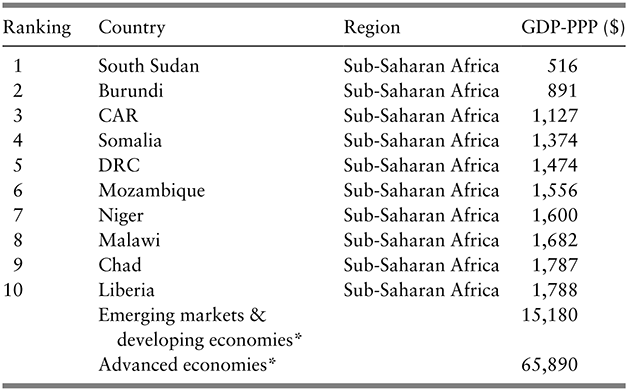
The latest data from the International Monetary Fund (IMF), which illustrates poverty in terms of gross domestic product (GDP) per capita, compensating for differences in living costs and rates of inflation by using purchasing power parity (PPP), shows that the ten poorest countries in the world are located in sub-Saharan Africa (see Table 1.2).

Table 1.2 Long description
The table has 4 columns: Ranking, Country, Region, and G D P-P P P (in U S D). It reads as follows. 1: South Sudan; Sub-Saharan Africa; 516. 2: Burundi; Sub-Saharan Africa; 891. 3: C A R; Sub-Saharan Africa; 1,127. 4: Somalia; Sub-Saharan Africa; 1,374. 5: D R C; Sub-Saharan Africa; 1,474. 6: Mozambique; Sub-Saharan Africa; 1,556. 7: Niger; Sub-Saharan Africa; 1,600. 8: Malawi; Sub-Saharan Africa; 1,682. 9: Chad; Sub-Saharan Africa; 1,787. 10: Liberia; Sub-Saharan Africa; 1,788. Two additional rows read as follows. Emerging markets and developing economies: 15,180 U S D. Advanced economies: 65,890 U S D.
* For definitions and countries included in each group, please refer to www.imf.org/en/Publications/WEO/weo-database/2023/April/groups-and-aggregates
Digging deeper into the data on poverty to add a little further perspective, in 2021, 85 per cent of the population of South Sudan were living in extreme poverty, while that was also the case for 80 per cent of the population of Burundi. At the same time, amongst the member states of the Organization for Economic Cooperation and Development (OECD), rates of extreme poverty were significantly lower. The OECD country with the highest rate of extreme poverty in 2021 was Costa Rica at 20.3 per cent, while the OECD member state with the lowest rate of extreme poverty, the Czech Republic, had a rate of 5.6 per cent. The United Kingdom and the United States had extreme poverty rates of 11.2 per cent and 15.1 per cent respectively in 2021.22
Many of those suffering under extreme poverty thus live in low-income fragile states, but that is not the case for everyone.23 Evidence suggests that inequality is presently rising, particularly in middle-income countries, and extreme poverty and inequality are also very much present among high-income countries. In short, the gap between the rich and the poor is intensifying within countries, as poor people grow increasingly poorer and the rich become even wealthier. In 2021, the richest 10 per cent of the global population took home 52 per cent of global income, whereas the poorest 50 per cent made 8.5 per cent. On average, an individual from the top 10 per cent of the global income distribution earns $118,180 more per year than an individual from the poorest 50 per cent. Furthermore, the poorest half of the global population possesses a mere 2 per cent of total global wealth, in sharp contrast to the richest 10 per cent, who own 76 per cent of all wealth. The most unequal region in the world is the MENA.24
1.6.3 Who Are the Poor? Women and Girls Are Most at Risk
More than 80 per cent of poor people live in rural areas, and children under the age of eighteen account for over 50 per cent of the 1.1 billion poor people globally (UNDP/OPHI 2023). Furthermore, children account for 44 per cent of the extreme poor, with girls across all ages more likely to be living in extreme poverty than boys. On a global scale, as children grow older, so does the gender poverty gap. The gender poverty gap is the widest between the ages 25–34, with 123 women for every 100 men living in poor households (Boudet et al. Reference Boudet, Bhatt, Azcona, Yoo and Beegle2021; Sánchez-Páramo and Muñoz-Boudet Reference Sánchez-Páramo and Muñoz-Boudet2018).
It is important to note that although women and girls make up the majority of the world’s poor and those living in extreme poverty, the gender differences in poverty rates diminish between the ages 40 and 65, and then emerge again in the elderly years in the reverse, with widowed men particularly prone to live in poverty (Sánchez-Páramo and Muñoz-Boudet Reference Sánchez-Páramo and Muñoz-Boudet2018). Yet, despite this reality, women and girls are still the most likely to experience lifelong poverty, partly because women’s share of labour income on a global scale remains below 35 per cent. In the MENA, the female labour income share is the lowest of all regions, hovering around 15 per cent, although there is an emerging upward trend. In sub-Saharan Africa and Latin America by comparison, the share of female labour income is close to 30 per cent (Greenhill et al. Reference Greenhill, Carter and Manuel2015; Rohwerder Reference Rohwerder2016).25
Beyond labour income share, the gender poverty gap can largely be explained by factors such as having children, lacking education or other household characteristics (e.g., size, composition, marital status), but there are still unexplained gender differences, which disproportionately affect women up to the age of thirty. These factors are frequently referred to as ‘the poverty penalty’ and scholars are increasingly looking at potential explanations that go beyond household headship, analysing issues such as consumption at the individual level, clothing, asset ownership and nutritional status (EIGE 2013; Sánchez-Páramo and Muñoz-Boudet Reference Sánchez-Páramo and Muñoz-Boudet2018).
Due to the gender poverty gap, women and girls are disproportionately affected by the negative consequences of climate change. The WHO, for instance, concludes that: ‘Many of the health risks that are likely to be affected by ongoing climate change show gender differentials. Globally, natural disasters such as droughts, floods and storms kill more women than men, and tend to kill women at a younger age’ (WHO 2014: 3).
Similarly, research on higher temperatures and more frequent heatwaves as a consequence of climate change has found that women are more negatively impacted than men.
The groups most affected were young children, the elderly, the sick and the poor. More women than men are elderly and poor, and women are the ones providing care for children, sick and elderly persons: they are, therefore, affected in multiple ways with regard to their own health as well as to care responsibilities imposed by the impact of climate change.
Consequently, scholars and practitioners have emphasized the gender-differentiated impacts of climate change, but there has been a tendency to focus on factors and indicators relating to health, such as access to water (drinking, cooking, hygiene), access to cleaner energy sources (cooking, heating), food and nutrition insecurity, sexual and reproductive health, thus overlooking or diminishing the role of other relevant factors. In reality, the picture is much more intricate and multifaceted. Not only do many of the ways in which women are negatively affected by climate change extend beyond health, they also vary from country to country and region to region. Furthermore, intersectionality plays a key role. That is, the gender-differentiated impacts of climate change vary among women, depending on, for example, their level of education, income, ethnicity, religious orientation, place of residence (rural vs urban), age and marital status.26 The gender-differentiated impacts of climate change are thus highly complex and therefore difficult to capture. With a view to provide some clarity and facilitate comparison, the European Institute for Gender Equality (2012) has developed a framework for analysis that operates with six dimensions of gender and climate change: (1) socio-psychological, which relates to gender identities and cultural understandings of what it means to be a man or a woman with specific emphasis on consumption patterns and values; (2) socio-economic, focusing on the gendered division of labour as well as paid and unpaid work; (3) socio-cultural, that is, entrenched cultural patterns relating to the use of public services and the radius within which women and men move; (4) legal, referring in particular to gender income gaps and gendered access to loans; (5) political, stressing how the social sectors that have the greatest influence in climate-related decision-making are male dominated; and (6) physical and biological, focusing on the health impacts of climate change from a perspective that is not related to behaviour.
While EIGE’s approach is rather comprehensive, there are dimensions that are either overlooked or made implicit, most notably the (human) security dimension of climate change and access to education and information. In a study of the relationship between climate change, human security and war, Barnett and Adger (Reference Barnett and Adger2007: 644) conclude that women in particular, largely as a result of the gendered division of labour, ‘suffer from the direct and indirect depredations wrought by violent conflict’. Examples of consequences of war where women are predominantly affected include sexual violence, domestic violence, loss of property, resource scarcity, migration and displacement (Alam, Bhatia and Mawby Reference Alam, Bhatia and Mawby2015). While some of these are covered by EIGE’s six dimensions, war/violent conflict is an additional dimension that needs including too if we are to adequately capture the gendered effects of climate change.27 Likewise, access to education and information. The Food and Agriculture Organization (FAO) of the United Nations stresses this dimension as key to understanding not only how women and girls are affected by climate change but also how they can contribute to combating the global climate crisis. It is a well-documented fact that most farmers on a global scale are women or girls. However, women and girl farmers generally have lower levels of formal education than their male peers, while simultaneously facing constraints that see them excluded from formal and informal institutions that disseminate information. This, in turn, affects the successful adoption of sustainable soil management practices, which hampers the global effort to combat climate change, but it also means that ‘women’s specific needs and priorities will not be adequately considered’ because their voice is weakened, partly as a result of a lack of credentials, partly as a consequence of lack of access to relevant fora (FAO 2023: 14).
1.7 The Book’s Rationale: Calls for a Gender-Based Approach to Solving the Global Climate Crisis
The overwhelming evidence that the impacts of climate change are gender-differentiated and that women are the most negatively impacted has led to calls for a gender-based approach to solving the global climate crisis. In a blog post from 2023, the UNDP, for instance, states that
the climate crisis, just like nearly every other humanitarian and development challenge, has a greater impact on women. This is due to the unequal sharing of power between women and men, the gender gap in access to education and employment opportunities, the unpaid care burden, prevalence of gender-based violence, and all other forms of deep-rooted gender-based discrimination. […] These are some of the reasons why long-term climate solutions cannot be achieved without pushing for gender equality and women’s empowerment and leadership. Now, more than ever, it is imperative to put gender equality at the heart of climate action.28
Similarly, a recent report commissioned and funded by the Scottish government found that climate change and conflict are gendered in their impacts and undermine human security. Thus, the authors argue, climate change is a form of ‘slow violence’, and effective policy should therefore
not just address gendered impacts of climate change and conflict but also address their shared roots and drivers, which are to be found in our current economic model which, as explained above, relies on the over-exploitation of natural resources, the pollution of the atmosphere, land and oceans, and the appropriation of women’s unpaid labour.
These two quotes showcase the increased appreciation within policy and aid circles of the reality that gender is a central element of the global climate crisis and is thus a key part of the solution too. Furthermore, whereas previously criticisms29 were raised as approaches were deemed to uphold and reinforce stereotypes by defining women as in need of protection and saving, while simultaneously focusing primarily on women as central actors within the household (but subordinate to the male head), these two quotes also represent the step-change seen in recent years in their emphasis on women’s empowerment and leadership as well as human security. At the centre of both analyses – and others like them – are the twin factors of women’s political marginalization, that is, their underrepresentation on political bodies, whether parliaments, governments, climate delegations and so on, and the current capitalist economic model.30 In the words of UN Women (2021: 8), ‘ … going back is not the answer. Instead, a visionary agenda that places sustainability, social justice and gender equality at the centre of economic recovery and transformation, is urgently needed to pave the way towards a new social contract’.
At the same time, however, EIGE (2013) as well as Duncanson, Bastick and Funnemark (Reference Duncanson, Bastick and Funnemark2022) also caution against focusing exclusively on women’s empowerment and participation, as experiences from international development projects have demonstrated that initiatives meant to empower women often lead to an increase in women’s unpaid labour. Another pitfall in this respect is to assume that more equal representation of women on decision-making bodies is going to improve on these simply as a consequence of the increased share of women. If the structures and institutions are corrupt, inadequate and unjust, structural transformation must be a central element too – ‘participation is necessary, but not sufficient’ (Duncanson, Bastick and Funnemark Reference Duncanson, Bastick and Funnemark2022: 15).31
1.7.1 Rationale and Focus of the Book
This book takes its starting point in the calls for a gender-based approach to the solution of the global climate crisis. It does so from a critical position. Not because it finds this perspective wrong or uncalled for but rather due to the way in which it has principally been done. The reports and studies quoted in the previous sections – and many more like them – are primarily rooted in academic literature authored in the Global North and by scholars from the Global North. They rely on reports on aid initiatives carried out in the Global South, but designed and executed predominantly by practitioners from the Global North regardless of the commitment to principles such as local ownership.
Although not discussed yet (this is the subject of Chapter 2), the academic literature on the topics of ‘gender and climate change’ and ‘gender and political representation/power’ in the Global South are not tremendously different in their approach. Of course, they differ in that they are not seeking to make policy recommendations or surveys of the extant literature with policy makers and aid practitioners in mind. They speak to the various academic debates and schools of thought, most often in the form of large-n quantitative studies with a view to generate new theory, or very small-n qualitative studies where the objective is to gain a deep understanding of a particular country or handful of countries. While there is research on pretty much every region of the Global South, studies of the MENA are less prominent compared to other regions (as discussed in Chapter 3). There is a clear tendency to overlook the MENA – especially the Arabic-speaking countries – in the cross-regional, large-n studies due to insufficient, incomplete and/or incomparable data. In the very small-n studies, countries from the MENA are also less favoured as cases, regardless of whether the topic is gender and climate change or women’s political representation, most likely because the Arab world has the smallest share of female parliamentarians on a global scale, and due to the reality that extreme weather events have occurred more regularly and with more devastating consequences elsewhere.
Hence, this is where the book sits: in the nexus between gender, justice, the global climate crisis and Middle East politics. As discussed in more detail in Chapter 3, although the approach is qualitative, the case selection goes beyond a handful of countries. It spans all of the nine Arabic-speaking countries of the MENA where political parties are not prohibited, and where parliamentary elections take place, but excludes countries at war, although not under occupation. In other words, the analysis rests on in-depth interviews with nearly 100 female activists and politicians from Algeria, Egypt, Iraq, Jordan, Lebanon, Mauritania, Morocco, Tunisia and Palestine. The objective of the book is to decolonize the topic by means of a detailed exploration of what women in the Global South themselves think about a gender-based solution to the global climate crisis via the voices of female activists and politicians from the MENA. Is there such a thing as a gender based-solution? What is it? What are their views on women’s participation and empowerment? Do they think that colonialism and capitalism are key issues to be addressed within the context of the climate crisis? What are the priorities in their opinion based on their personal experiences? And how do such opinions and experiences hold up to the policy, practitioner and academic contributions to the debate on gender and the global climate crisis?
The subjects of the book or, rather, the voices at the core, are women activists and members of parliament past and present. The women who are – or have been – involved in politics at the highest level. Who have experience with running for election, gender quotas, party politics, portfolio allocation, policy making, agenda setting and other such political dynamics and processes relating to power: the distribution of power and the exercise of power, formally and informally. Thus, the book contributes not only to the emerging debate on women and the global climate crisis but also to the debate on women’s political representation, the quota discussion and the work on the gendering of portfolios. It adds new perspectives to what we know about the (ine)quality of women’s political representation (including the centrality of intersectionality), the backgrounds of female MPs and activists and the drivers of their success, which, as discussed in Chapter 2, tends to be based on the analysis of large volumes of easily quantifiable statistical data governed by academic principles of research and analysis rooted in the Global North, rather than as experienced and told by the women themselves. In short, on the basis of the testimonies of these female activists and parliamentarians, the book queries the implications for the climate crisis of (1) limited female representation as well as (2) the underrepresentation of women whose identities intersect more than one marginalized group (e.g., woman/poor/rural/illiterate/old/young), which is a topic that is particularly understudied at present. Finally, the book explores the women’s opinions on the issue of climate change. Is it important to them on a personal level? Is the environment/climate change a policy area they covet? Is it seen as a prestigious and/or masculine portfolio? Is it a core priority in politics at the national level? And does it provide an avenue into politics for those marginalized politically?
1.8 Overview of the Book
In the subsequent six chapters, the book will explore in detail the issue of women, representation and the global climate crisis, covering a range of topics, most notably women in politics, unequal political representation, policy priorities and climate colonialism. Chapter 2 is a comprehensive overview and critical assessment of the extant academic literature on gender and the global climate crisis. It begins with a section showcasing how the emphasis has largely been on women at the micro level, which often ends up portraying women as victims that need rescuing, thus habitually overlooking women’s agency. The subsequent section discusses in brief the concept of climate governance, before moving on to a discussion of the theory of representation. This section focuses on Pitkin’s (Reference Pitkin1967) typology of representation as well as extant research on the four dimensions of representation, while simultaneously outlining and anchoring the research questions upon which the book rests. The nine research questions cover a range of topics, including (but not limited to) the factors governing the success of female parliamentarians, gendered portfolios, leadership opportunities, the role of political parties, women representing women, intersectionality and gender quotas.
Chapter 3 centres on case selection and methodological considerations. The discussion opens up with a brief analysis that details how the MENA is understudied from both a climate and gender representation perspective as already alluded to in Chapters 1 and 2, before moving on to a discussion of why it is important to study representation and climate change in authoritarian settings, that is, not only in the MENA but broadly speaking. The discussion in the first part of the chapter also covers the status of the MENA as a so-called ‘climate change hot-spot’, not only in terms of emissions and emissions inequalities but also with regard to impacts such as extreme heat and changes to precipitation patterns, which have resulted in failed harvests and migration/displacement, and government responses, focusing in particular on the issue of fossil fuel reliance, including the use of subsidies and the reluctance to diversify the economy. Finally, a considerable section of the case selection rationale in Chapter 3 is dedicated to the study of gender and climate change within the MENA, which illustrates how the MENA case aligns with studies elsewhere in the Global South, that is, focusing on women at the micro level and their vulnerability. The final (second) part of the chapter goes into detail with the methodology after briefly outlining the approaches favoured in the extant academic literature, coving both qualitative and quantitative methods. Thus, the discussion covers the rationale behind the selected approach, that is, qualitative in-depth interviews that produce personal narratives, interview structure, sampling and saturation (we relied on Guest, Bunce and Johnson Reference Guest, Bunce and Johnson2006), contacting and recruiting participants, online versus in-person interviews, difficulties encountered and mitigated against, as well as ethical matters, including issues surrounding confidentiality, the use of a translator, software choices and participant safety.
Chapter 4 is the first of the four analytical chapters anchored in the qualitative interviews, and focuses on the topic of women’s representation in the MENA at the national level. To start off, the chapter presents an overview of women in parliament in the MENA from independence to the present day, covering the right to vote and stand for office as well as the number of female parliamentarians per country following the most recent elections. From there, the chapter moves on to an analysis of barriers to women’s representation, beginning with the pre-nomination stage and the role of factors such as patriarchy and violence against women. The subsequent sections detail different paths to parliament in the pre- and post-Uprisings eras. Among the topics covered in the analysis are internal party culture and electoral rules, as well as the background characteristics of the women who make it in politics. The final part of Chapter 4 is dedicated to an analysis of the factors behind success at the campaign stage and once in office with particular reference to the importance of extra-party networks, access to finances and qualifications, whether academic or professional, as well as the issues of discrimination and self-discrimination at the time of portfolio allocation.
Chapter 5 explores women’s substantive representation in the MENA. However, whereas most previous studies have focused predominantly on what portfolios female politicians have been offered, the analysis here centres on which policy areas female parliamentarians in the MENA have pursued with a view to uncover the factors behind such choices.32 In other words, do female parliamentarians pursue portfolio areas based on their own gender and the presumed gendering of the portfolio area? According to their own experiences, does the number of women in parliament, women’s status in politics and women in central positions within the party leadership play a role in what policy areas they themselves pursue and are offered? Do they think the electoral system plays a role and, if yes, how? In some ways, the chapter thus builds on the findings in Chapter 4 on the subject of the electoral system and formal and informal rules relating to portfolio allocation. The chapter begins with a discussion and analysis of career prospects and their implications, focusing in particular on experiences and qualifications, the role of gender quotas and the centrality of the constituency. The second part of the chapter centres on the climate (or environment) portfolio and queries the role of geography, qualifications and expertise, while also affording space to the issue of personal interest and commitment, which does not necessarily align with whether a female parliamentarian decides to pursue the portfolio area.
The topic of Chapter 6 is unequal representation with particular emphasis on intersecting identities, voice and agency. The chapter digs deeper into the issue of policy priorities with a view to uncover who – and to some extent also what issues – female parliamentarians in the region represent as well as the reasoning behind their choices, not based on voting patterns as has traditionally been the case in such analyses but anchored in personal narratives. The chapter thus explores the quality of representation (symbolic, descriptive and substantive) and helps us gain an understanding of which women and policy areas are represented, and which are underrepresented in politics at the national level, something which has very significant implications for not only climate change mitigation but also adaptation and impacts. As the analysis progresses, it becomes very clear that the female parliamentarians in the MENA tend to represent ‘people like me’ – those they have a shared affinity with, whether qua their gender, origins, qualifications, class and so on. Thus, it is readily apparent that the reality that most female parliamentarians come from a very narrow segment of society poses a very real problem for the quality of women’s representation, because the majority of women are simply not represented in earnest. The analysis focuses on two neglected groups of women in particular, namely marginalized women, who are often seen as incapable of representing themselves, and the so-called silent majority, that is, the ordinary or average MENA woman, who is neither rich, nor poor, illiterate or university educated, and who therefore does not have much in common with neither the marginalized women nor the female parliamentarians compared to whom the average woman is also much younger. The discussion of the representation of the youth – and young women where the data allows – centres on the climate change issue, where there is evident discord between the priorities of the represented and their representatives.
Finally, Chapter 7 presents the conclusion and perspectives on gender, representation and the global climate crisis, placing them in the broader context of the core themes set out in Chapters 1 and 2: colonialism, justice, equality, culture and norms. The chapter shows how colonialism and the climate issue in the MENA are strongly linked, and how this relationship affects not only development trajectories but also the status of the climate as a policy area as well as women’s representation. In other words, although colonialism has ended, coloniality persists in the form of unequal processes and institutions that perpetuate injustice as the elite – chiefly male and wealthy – remains in control. Beyond factors related to formal and informal institutions and processes, the chapter discusses the role of culture and norms in shaping women’s representation in politics at the national level. The analysis centres on factors such as women’s mobility and violence against women in politics, discrimination and self-discrimination, as well as the perpetuation of culture and norms by female parliamentarians. The final section of the chapter covers Othering, that is, the portrayal of women as vulnerable victims or saviours, focusing on the dangers of feminizing vulnerability and responsibility, while also showcasing how Othering of women in the Global South occurs not only amongst academics, policy makers and practitioners in the Global North but also amid female parliamentarians in the MENA, who primarily see themselves as representing ‘women like me’ rather than women per se. In terms of the global climate crisis, this state of affairs has led to a situation where the climate issue is not prioritized as much as it could be if the female parliamentarians were more accountable to the electorate (i.e., had sustainable careers) and identified more strongly with a broader group of women, that is, beyond the narrow elite segment of the population from which they themselves were recruited. At present, those that are the most passionate about combatting the climate crisis are the youth, whereas those who stand to gain the most are marginalized women – two groups that are nothing like the female parliamentarians, who are supposed to act in their interest.