1. Introduction
Over the last three decades, the study of exceptionally preserved biotas has radically modified our understanding of the early diversification of metazoans during early Palaeozoic time. In his recent review of Burgess Shale-type (BST) preservation, Gaines (Reference Gaines, Laflamme, Schiffbauer and Darroch2014) proposed a ranking of BST deposits based on their richness in soft-bodied taxa. His ‘tier 1’ (>100 soft-bodied taxa) comprises the Cambrian Series 2 (Stage 3) Chengjiang and Series 3 (Stage 5) Burgess Shale deposits only. Except for the Fezouata Shale (Van Roy, Briggs & Gaines, Reference Van Roy, Briggs and Gaines2015; Lefebvre et al. Reference Lefebvre, Lerosey-Aubril, Servais and Van Roy2016a , b), inclusion in this category in the near future seems unlikely for any other lower Palaeozoic Konservat-Lagerstätten. Most of the latter are classified in a second category (‘tier 2’), which regroups deposits that have yielded 10–100 soft-bodied species (Gaines, Reference Gaines, Laflamme, Schiffbauer and Darroch2014). The faunas of the most significant of these ‘tier 2’ BST deposits – the Kaili and Guanshan deposits of South China (Zhao et al. Reference Zhao, Zhu, Babcock and Peng2011; Hu et al. Reference Hu, Zhu, Luo, Steiner, Zhao, Li, Liu and Zhang2013) and the Spence, Wheeler and Marjum deposits of western USA (Robison, Reference Robison, Simonetta and Conway-Morris1991; Robison, Babcock & Gunther, Reference Robison, Babcock and Gunther2015; Foster & Gaines, Reference Foster, Gaines, Comer, Inkenbrandt, Krahulec and Pinnell2016) – actually comprise c. 40–50 of such taxa only.
All in all, exceptional preservation is rather rare in ‘tier 2’ BST deposits, and documenting the diversity of their faunas requires intense and/or repeated collecting effort. This is typically the case of the Drumian (Cambrian Series 3) Wheeler Formation of central western Utah, the fossils of which have been collected by professional and avocational palaeontologists since 1859 and by Pavhant Indians before that (Robison, Babcock & Gunther, Reference Robison, Babcock and Gunther2015). For the last 50 years these middle Cambrian deposits have even been exploited commercially for fossils, especially trilobites. According to Robison, Babcock & Gunther (Reference Robison, Babcock and Gunther2015, list of taxa in appendix) the Wheeler Formation fauna comprises 105 species, mostly arthropods (e.g. trilobites and agnostines), sponges and brachiopods. This includes 46 non- or weakly biomineralizing taxa, making the Wheeler Formation one of the most significant (tier 2) BST deposits of the Cambrian period. Most of these soft-bodied taxa are known from a few incomplete specimens, however, so any new discoveries of exceptional material in these deposits remain important.
Here we describe a new arthropod from the Wheeler Formation in the House Range that we tentatively assign to the family Sanctacarididae. The new taxon illustrates that this group of putative early chelicerates might have expressed a greater morphological diversity than previously considered. This discovery also provides an opportunity to argue for the presence of two distinct exceptionally preserved biotas within the Wheeler Formation.
2. Geological setting
The Wheeler Formation is a succession of dark-grey calcareous mudstone intercalated with subordinate shaly limestone, which can reach up to 300 m in thickness. It is exposed in the House Range, the Fish Springs Range and the Drum Mountains of central western Utah, USA (e.g. Miller, Evans & Dattilo, Reference Miller, Evans, Dattilo, Derby, Fritz, Longacre, Morgan and Sternbach2012; Foster & Gaines, Reference Foster, Gaines, Comer, Inkenbrandt, Krahulec and Pinnell2016), and accumulated within the House Range Embayment, a fault-controlled trough that locally developed within the carbonate platform during Cambrian Epochs 2 and 3 (Rees, Reference Rees1986). More specifically, it represents the initial stage of the infilling of this local basin, uncomformably overlying the Swasey Limestone. This infilling continued with the deposition of the conformably overlying Marjum Formation and ended with that of the Weeks Formation, two lithostratigraphic units also known to preserve exceptional fossil assemblages (Lerosey-Aubril et al. Reference Lerosey-Aubril, Hegna, Babcock, Bonino and Kier2014; Robison, Babcock & Gunther, Reference Robison, Babcock and Gunther2015). The three lithostratigraphic units form a c. 900 m thick, continuous sequence of relatively deep-water deposits (Miller, Evans & Dattilo, Reference Miller, Evans, Dattilo, Derby, Fritz, Longacre, Morgan and Sternbach2012), except for the uppermost part of the Weeks Formation that records a notable shallowing. The depositional environment of the Wheeler Formation has been reconstructed as a relatively deep-water, quiet, open-marine environment, frequently affected by oxygen depletion (e.g. Foster & Gaines, Reference Foster, Gaines, Comer, Inkenbrandt, Krahulec and Pinnell2016).
In the House Range, the Wheeler Formation has yielded a fauna comprising 67 species in total, 23 of which represent ‘soft’-bodied taxa (Robison, Babcock & Gunther, Reference Robison, Babcock and Gunther2015). As discussed below (Section 5), this assemblage significantly differs from that recovered from the Wheeler Formation in the Drum Mountains. Trilobite and agnostid assemblages indicate that, except for its lowest part, the Wheeler Formation is of Drumian age (Cambrian Series 3, Bolaspidella Zone/Ptychagnostus atavus Zones; Robison & Babcock, Reference Robison and Babcock2011).
3. Material and methods
UU 17042.01a and b (part and counterpart, respectively), the only available specimen, was recovered from the ‘New Dig’ quarry, an excavation site commercially exploited for fossils in the Wheeler Amphitheatre, House Range, Utah (coordinates: 39°21′31.80″N, 113°16′43.56″W). The fossil was discovered by the co-owner of the site, Clayton Holman, in a bed known as the ‘paydirt horizon’ within the upper part of the Wheeler Formation. It is composed of an almost complete cephalon, seven more or less complete trunk tergites and the remains of cephalic appendages. The specimen is dorso-ventrally flattened and preserved parallel to bedding. However, the axial region preserves a much greater relief than the flat pleural regions and is bordered by compaction wrinkles laterally, which indicates that it was originally significantly vaulted. The fossil, which is covered by an orange film (yellow when wet) of iron oxides (?) progressively vanishing posteriorly, is essentially made of a material similar to the sediment surrounding it. Part and counterpart were photographed immersed under dilute ethanol, using a Leica IC80 HD digital camera mounted on a Leica 80 microscope. A series of images were taken with manual focusing at different focal planes, and subsequently stacked and assembled in Adobe Photoshop CS6. The resulting high-resolution pictures and the same software were used to make a composite interpretative drawing, combining details of both part and counterpart. Similarity indices (Bray-Curtis, Dice, Jaccard, Kulczynski, Ochiai, Simpson or Raup-Crick) between the Wheeler fauna in the House Range, the Wheeler fauna in the Drum Mountains and the Marjum fauna were calculated using PAST 3.15 (Hammer, Harper & Ryan, Reference Hammer, Harper and Ryan2001). The specimen is deposited in the collections of the University of Utah (prefix UU), Salt Lake City, USA. Abbreviations used include: exs. – exsagittally; sag. – sagittally; T – trunk tergite; and tr. – transverse.
4. Systematic palaeontology
ARTHROPODA von Siebold, Reference von Siebold, von Siebold and Stannius1848
(sensu ‘Deuteropoda’ of Ortega-Hernández, Reference Ortega-Hernández2016)
Subphylum ?CHELICERATA Heymons, Reference Heymons1901
Family ?Sanctacarididae Legg & Pates, Reference Legg and Pates2017
Diagnosis (emended). Arthropods exhibiting the following unique combination of characters: body with wide (tr.) and vaulted axial region, separated by abrupt break in slope from pleural regions that progressively, but strongly narrow (tr.) backwards. Cephalic axial region particularly wide (tr.) and subcircular posteriorly, extending to or close to cephalic margin anteriorly; paired ventral eyes located opposite to anterolateral margins of axial region ventrally, under cephalic margin; five pairs of clustered biramous cephalic appendages, the endopods of which rapidly increase in size posteriorly. Trunk composed of eleven tergites, the length (sag.) of which remains subequal up to mid-trunk, then gently increases up to T10, and then more sharply in T11; latter tergite virtually devoid of pleurae. Telson paddle-shaped, with strengthening lateral flanges terminating in tiny spines and a convex backwards posterior margin, and bearing a more or less complete, convex forwards line running transversally.
Remarks. The family Sanctacarididae was recently created to group the putative oldest representatives of Chelicerata (Legg & Pates, Reference Legg and Pates2017), namely Sanctacaris (Briggs & Collins, Reference Briggs and Collins1988), Utahcaris (Conway Morris & Robison, Reference Conway Morris and Robison1988) and Wisangocaris (Jago, Garcia-Bellído & Gehling, Reference Jago, Garcia-Bellído and Gehling2016). We agree with many, but not all, aspects of the reinterpretation of the morphology of Sanctacaris proposed by Legg (Reference Legg2014), but discussing the assignment of sanctacaridids to chelicerates is well beyond the scope of this contribution; accordingly, the family is only questionably assigned to the subphylum Chelicerata above. Sanctacaris, Utahcaris, Wisangocaris and, to a lesser extent the new arthropod described here, share particularly distinctive features that clearly warrant the creation of a distinct family (Legg & Pates, Reference Legg and Pates2017). However, the diagnosis of this family is emended above to emphasize some morphological traits that we regard as rare or unique in the context of early Palaeozoic arthropods (e.g. lateral flanges and transverse line on telson).
Genus Messorocaris gen. nov.
Type species. Messorocaris magna gen. et sp. nov. (by monotypy).
Etymology. From the Latin ‘messor’ and ‘caris’, meaning ‘reaper’ and ‘crab’, respectively, in reference to the sickle-shaped trunk pleurae.
Diagnosis. Sanctacaridid arthropod characterized by the following unique combination of characters: cephalon with axial region laterally constricted anteriorly, and wide (tr.) pleural regions; trunk tergites long and significantly overlapping (sag.), exhibiting wide (tr.), broadly spaced (exs.), sickle-shaped pleurae.
Discussion. Messorocaris gen. nov. is tentatively assigned to the Sanctacarididae based on the following features: the morphology of its cephalic axial region (wide (tr.) and subcircular posteriorly, extending to anterior margin anteriorly), the clustering and rapid size increase posteriorly of the endopods of its cephalic appendages, and the significant vaulting of its axial region compared to pleural regions in both cephalon and trunk. A more definitive assignment to this family is prevented by the absence of data on the morphology of the posterior body, especially the telson, which is particularly distinctive in sanctacaridids.
Messorocaris gen. nov. is rather similar to Sanctacaris regarding the morphology of the cephalon, especially the rather wide (tr.) pleural regions, and the clustering of cephalic appendages and their size increase posteriorly (e.g. Briggs & Collins, Reference Briggs and Collins1988, text-fig. 1, pl. 71; see also Legg, Reference Legg2014, figs 2a, b, 3). However, the absence of a medial protrusion of the anterior cephalic margin and the long (sag.) trunk tergites with sickle-shaped pleurae easily distinguish the new taxon from the type genus of sanctacaridids. The same trunk characters also differentiate it from Wisangocaris and Utahcaris. Moreover, Messorocaris gen. nov. exhibits wide (tr.) cephalic pleural regions that significantly narrow (exs.) abaxially, while in the Australian Wisangocaris they have spinose lateral margins that run subparallel (exs.) to sagittal axis (Jago, Garcia-Bellído & Gehling, Reference Jago, Garcia-Bellído and Gehling2016, fig. 1C–G). The new genus possibly shares with Utahcaris the presence of a slight lateral constriction of the cephalic axial region anteriorly (Legg & Pates, Reference Legg and Pates2017, fig. 1a, not represented on their fig. 1b), but its pleural regions in both the cephalon and trunk are much wider (tr.) than those of the Spence Shale sanctacaridid.
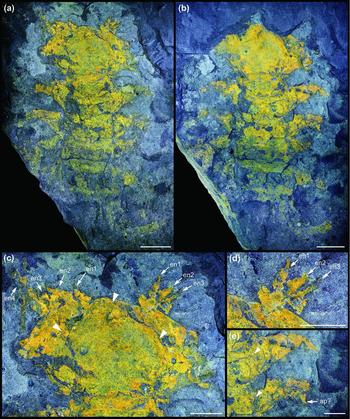
Messorocaris magna gen. et sp. nov. from the upper Wheeler Formation, Drumian (Ptychagnostus atavus Zone), Wheeler Amphitheatre, House Range, Utah, USA. (a–e) Holotype (UU 17042.01), anterior body region of a dorso-ventrally flattened individual, showing the dorsal exoskeleton and remains of cephalic appendages; photographed immersed in dilute ethanol, anterior end facing to the top. (a, c, d) Part (UU 17042.01a). (a) General view. (c) Detail of the cephalic region. Note the wide (tr.) axial region extending to anterior margin (arrow heads) and the clustered cephalic appendages (compare to Fig. 2). (d) Detail of endopods of three cephalic appendages on the right side. (b, e) Counterpart (UU 17042.01b). (b) General view and (e) detail of the sickle-shaped left pleurae of T2–3; both photographs are mirrored. Note the compaction wrinkles (arrow heads) separating the axial and pleural regions, and possible appendage remains under T3. ap? – possible remains of appendages; en1–4 – endopods of cephalic appendages 1–4. Scale bars: (a, b) 1 cm; (c–e) 5 mm.

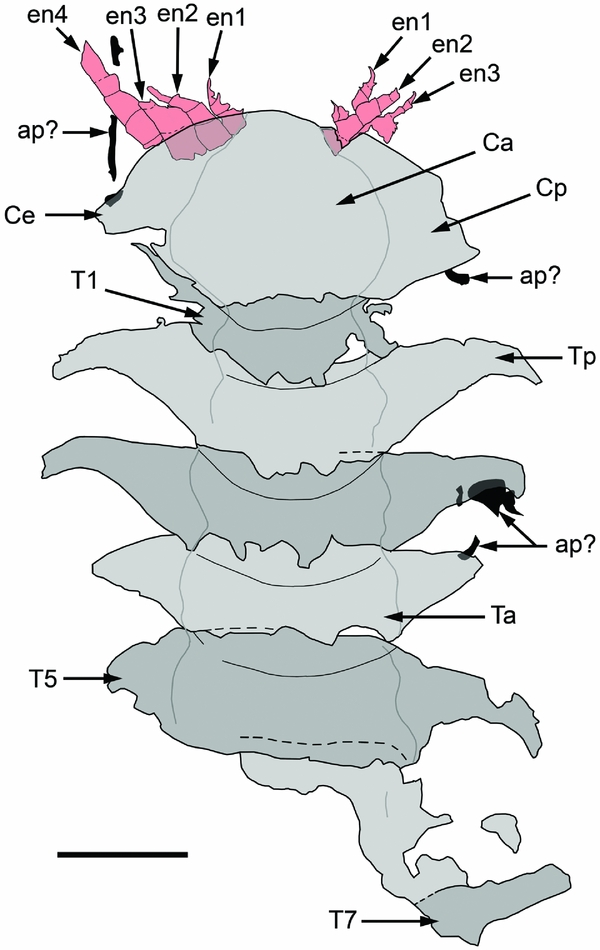
Messorocaris magna gen. et sp. nov. from the upper Wheeler Formation, Drumian (Ptychagnostus atavus Zone), Wheeler Amphitheatre, House Range, Utah, USA. Composite interpretative drawing, combining details of both part and counterpart. Podomere boundaries represented using dashed lines are uncertain. ap? – possible remains of appendages; en1–4 – endopods of cephalic appendages 1–4; Ca – cephalic axial region; Ce – cephalon; Cp – cephalic pleural region; T1, 5 and 7 – trunk tergites 1, 5 and 7; Ta – trunk axial region; Tp – trunk pleural region. Scale bar: 1 cm.
Since the assignment of Messorocaris gen. nov. to the Sanctacarididae is uncertain, it might be worth extending comparisons to a couple of other taxa outside this group. The most relevant of these is Dicranocaris, which is known with confidence from a single specimen found in the Wheeler Formation in the Drum Mountains (Briggs et al. Reference Briggs, Lieberman, Hendricks, Halgedahl and Jarrard2008, fig. 5.1–3); the other specimens tentatively assigned to this taxon are from either the Wheeler Formation or the Marjum Formation in the House Range. The new genus shares with Dicranocaris the presence of long (sag.) trunk tergites relative to the cephalon, which are characterized by a raised axial region separated from broadly spaced (exs.) pleurae by breaks in slope, rather than furrows. However, Dicranocaris apparently does not possess sickle-shaped trunk pleurae, and its cephalon has a more rounded outline, probably semi-circular in dorsal view, rather than lens-shaped as in Messorocaris gen. nov. There is also no indication of a well-differentiated axial region in the cephalon of the kind characterizing the new genus and sanctacaridids. The other specimens questionably assigned to Dicranocaris are preserved in lateral view and show no details of the pleural regions of the dorsal exoskeleton, which prevents comparisons with the fossil described here. Some of these specimens have been tentatively reassigned to a new taxon, ‘Dytikosicula’, which is apparently restricted to the Marjum Formation (Conway Morris et al. Reference Conway Morris, Selden, Gunther, Jamison and Robison2015). We are not completely convinced that Dicranocaris and ‘Dytikosicula’ truly represent distinct taxa, but in any case Messorocaris gen. nov. is easily differentiated from ‘Dytikosicula’ by its lens-shaped, rather than ovoid, cephalon and once again the sickle shape of its trunk pleurae.
Messorocaris magna gen. et sp. nov.
Figures 1, 2
Material, locality, horizon. Holotype (UU 17042.01), part and counterpart of a partial, dorso-ventrally flattened dorsal exoskeleton, including the cephalon and more or less complete T1–7, and the remains of cephalic appendages; dark-grey shale of the upper part of the Wheeler Formation, Bolaspidella Zone (polymerid trilobites), Ptychagnostus atavus Zone (agnostoids), early Drumian, Cambrian Series 3, ‘New Dig’ commercial quarry (39°21′31.80″N, 113°16′43.56″W), Wheeler Amphitheatre, House Range, Utah, USA.
Etymology. From the Latin ‘magnus’, meaning ‘great’; associated with the genus name, it refers to the French expression ‘the Great Reaper’ (‘the Grim Reaper’; i.e. personification of Death).
Diagnosis. As for the genus.
Description. The holotype and only available specimen is 71 mm long (sag.; appendages excluded) and 21 mm in maximum half-width (tr.; at T3). Although incomplete (Figs 1a, b, 2), the specimen shows that the body was elongate and composed of a vaulted axial region, which slightly widens (tr.) posteriorly in the trunk, and flat pleural regions forming sickle-shaped lateral extensions (one pair per sclerite). Cephalon long (Figs 1a–c, 2) – at least 50% longer (sag.) than longest trunk tergite (T2) – and exhibiting broadly elliptical anterior and (apparently) posterior margins that extend abaxially into broad-based (exs.) pleural projections, the tips of which are missing. Axial region higher than pleurae despite flattening, more than half the width (tr.) of the preserved part of the cephalon at mid-length (sag.), and subcircular in outline posteriorly, but forming a laterally constricted extension that reaches cephalic margin anteriorly (Figs 1c, 2).
The preserved part of the trunk comprises the remains of seven tergites (Figs 1a, b, 2), the five anterior-most of which exhibit a rise axial region (despite flattening), and noticeably lower sickle-shaped pleurae (Fig. 1e). T1 at least twice shorter (sag.) than any of the more posterior tergites, mostly represented by axial region, broken along its posterior margin, and poorly preserved left pleura; a faint line anteriorly indicates that the anterior third of T1 was initially concealed under cephalon (Figs 1a, b, 2). T2 is better preserved and therefore allows a more accurate description of typical morphology of trunk tergites; axial region is about 25% wider (tr.) than long (sag.), bearing darker-coloured line anteriorly marking original posterior extension of T1, and with posterior margin convex backwards; pleural region subtriangular adaxially – with transverse anterior and oblique posterior margins – and forming abaxially a hook-like spine projecting postero-laterally. T3–5 similar to T2, except for a slight widening of axial region, apparently at the expense of pleural regions (Figs 1a, b, 2). T6–7 essentially represented by poorly preserved remains of right pleurae and adjacent parts of axial region. No sculpture discernible on trunk tergites or cephalon.
The remains of clustered cephalic appendages are visible along the anterior cephalic margin: three partial endopods on the right and four on the left. The preservation prevents a detailed and/or fully confident description of their structure, especially of the locations of podomere boundaries (the pattern illustrated in Fig. 2 is partly tentative). The number of podomeres is therefore uncertain, but some endopods apparently possess at least five of them (posterior-most endopod on the left side; Fig. 2). Endopods rapidly increase in size posteriorly, with each endopod slightly overlapping the endopod immediately posterior to it.
5. Discussion
Sanctacaridids were already known from the Cambrian Stage 4 of South Australia and Stage 5 of southeastern British Columbia (Canada) and northern Utah (USA). If our assignment is correct, Messorocaris gen. nov. extends the stratigraphic range of the group to the Drumian and its geographical distribution to the House Range of western Utah. It also contributes to the documentation of a greater morphological diversity in this arthropod family than previously acknowledged. One of the most noticeable variations in these forms concerns the development of pleural regions relative to the axial region, which is rather limited in Wisangocaris (e.g. Jago, Garcia-Bellído & Gehling, Reference Jago, Garcia-Bellído and Gehling2016, fig. 1B) and possibly Utahcaris (Legg & Pates, Reference Legg and Pates2017, fig. 1), and much more important in Sanctacaris (e.g. Briggs & Collins, Reference Briggs and Collins1988, pl. 71, figs 2, 3) and the new genus (Figs 1a, b, 2). These pleural regions may also display characters specific to a single taxon, such as the cephalic marginal spines of Wisangocaris (Jago, Garcia-Bellído & Gehling, Reference Jago, Garcia-Bellído and Gehling2016, fig. 1C–G) or the sickle-shaped trunk pleurae of Messorocaris gen. nov. (Fig. 1c). Another source of morphological variation concerns the length of trunk tergites. Notwithstanding the fact that it is apparently much greater relative to cephalic length in the new genus than in other sanctacaridids, it may remain virtually unchanged (Sanctacaris) or increases posteriorly in a more (Utahcaris) or less (Wisangocaris) gradual way (Jago, Garcia-Bellído & Gehling, Reference Jago, Garcia-Bellído and Gehling2016). As to the telson, it varies from elongate triangular (Wisangocaris; e.g. Jago, Garcia-Bellído & Gehling, Reference Jago, Garcia-Bellído and Gehling2016, fig. 2a, c, d) to subcircular (holotype of Utahcaris; Legg & Pates, Reference Legg and Pates2017, fig. 1) in shape, that of Sanctacaris being somewhat intermediate in this regard (e.g. Briggs & Collins, Reference Briggs and Collins1988, pl. 71, figs 2, 3, pl. 72, figs 3, 5). The only other specimen of Utahcaris known exhibits a much more elongate telson than the holotype (Legg & Pates, Reference Legg and Pates2017, fig. 2), but it is twice as short (sag.) as the latter, so this difference might relate to ontogeny.
The description of a new non-biomineralizing arthropod from the Wheeler Formation could be regarded as a confirmation of the significance of this Konservat-Lagerstätte, according to Gaines’ criterion (Reference Gaines, Laflamme, Schiffbauer and Darroch2014). With a fauna totalizing 106 species, among which 47 are ‘soft’-bodied (data of Robison, Babcock & Gunther, Reference Robison, Babcock and Gunther2015; updated with the inclusion of new taxon), it is after all one of the most prolific tier 2 BST deposits in the world. However, exceptionally preserved fossils from this formation originate from two distinct geographic areas – the House Range and the Drum Mountains – and it is questioned whether they can really be regarded as a single coherent entity, as in the recent community structure analysis of Foster & Gaines (Reference Foster, Gaines, Comer, Inkenbrandt, Krahulec and Pinnell2016). Analysis of Robison, Babcock & Gunther's data (Reference Robison, Babcock and Gunther2015; updated with the inclusion of new taxon) shows that the Wheeler fossil assemblages in the House Range (HR) and Drum Mountains (DM) are roughly equivalent in diversity (68 and 71 species, respectively), but significantly differ in composition. Indeed, they only share 33 species (including 7 soft-bodied taxa), that is, less than a third of the diversity of the Wheeler fauna as a whole, and less than half of the diversity of each assemblage. Actually, calculation of similarity indices demonstrates that the HR Wheeler and DM Wheeler faunas are less similar to one another than either of them is to the younger Marjum fauna, regardless of whether all or only soft-bodied taxa are considered (Table 1). In the former case, the HR Wheeler and Marjum faunas are the most similar; in the latter case, the DM Wheeler and Marjum faunas show the greatest similarity. This major difference in composition between the two Wheeler faunas most likely relates to the fact that they inhabited different environments. Indeed, the Wheeler Formation is in the DM at least twice as thick and more calcareous than in the HR, which indicates a location of the depositional environment higher up the carbonate ramp (i.e. more proximal and shallower-water; Brett et al. Reference Brett, Allison, DeSantis, Liddell and Kramer2009). This lateral variation of overall lithofacies is accompanied by a clear discrimination of two biofacies and, accordingly, it seems more appropriate (and interesting) to consider the HR and DM faunas as subcontemporaneous, but distinct faunas, especially to address evolutionary and a fortiori ecological questions.
Composition similarities of the Wheeler fauna from the House Range (HR), the Wheeler fauna from the Drum Mountains (DM) and the Marjum fauna.

Bray-Curtis values when the complete faunas are considered (upper triangle) or only soft-bodied components (lower triangle) are presented; Bray-Curtis values range from 0 (not a single taxon in common) to 1 (all taxa present in a fauna occurs in the other fauna). Different values, but the same general results were obtained using Dice, Jaccard, Kulczynski, Ochiai, Simpson or Raup-Crick indices.
6. Conclusion
Acknowledging the distinctiveness of the two Wheeler faunas diminishes the significance of this Konservat-Lagerstätte from a quantitative perspective (i.e. using Gaines’ criterion, Reference Gaines, Laflamme, Schiffbauer and Darroch2014), but definitely not from a qualitative perspective. It actually brings a whole new dimension to how the Cambrian Konservat-Lagerstätten of central western Utah enlighten the evolution of marine life at that time. The high-resolution data they provide can be used to study how marine animal communities evolved locally through a c. 5 Ma interval (succession Wheeler–Marjum–Weeks faunas in the HR), but also spatially at a given time (HR- v. DM-Wheeler faunas). In this context, it is more than ever critical to describe any new exceptional fossils recovered from these deposits.
Acknowledgements
We are particularly grateful to Clayton Holman, the discoverer of the fossil, for making this specimen available for study, Quintin Sahratian for curatorial help, Javier Ortega-Hernández for early discussion on the affinities of the new taxon, Stephen Pates for sharing pictures of Utahcaris orion, and the two reviewers, Stephen Pates and Peter Van Roy, for their constructive comments.
Declaration of interest
None.