Introduction
The concept of women's empowerment refers to processes that strengthen a woman's ability to formulate strategic choices and control resources and decisions that affect important life outcomes (Malhotra et al., Reference Malhotra, Schuler and Boender2002). This concept has generated an important body of ideas and studies, including a thorough (yet now a decade-old) review of the empirical literature addressing gender power imbalances and their impact on sexual and reproductive health (Blanc, Reference Blanc2001). In the family planning field, research has addressed, among other themes, the relationship between women's household decision-making (HDM) power and contraceptive use, a topic that stands out by virtue of its straightforward, although generally implicit, assumptions. One is the notion that wives with greater HDM clout have an increased likelihood of overcoming husbands' opposition to contraception when they disagree on controlling fertility (e.g. Mason & Smith, Reference Mason and Smith2000). The other assumption is the view that women's freedom of movement, authority to use economic resources and the habit of taking care of their own health function as facilitators of access to family planning methods (e.g. Albania Institute of Statistics/Institute of Public Health & ICF Macro, 2010). Indeed, positive and significant power–contraception relationships prevail in the literature. However, the circumstances that favour their occurrence are not well understood. The mixed results may depend on the conceptual approach implemented. Some research (Govindasamy & Malhotra Reference Govindasamy and Malhotra1996; Schuler et al., Reference Schuler, Kashemi and Riley1997; Moursund & Kravdal, Reference Moursund and Kravdal2003; Chavoshi et al., Reference Chavoshi, Abbasi-Shavazi and McDonald2004; Kishor & Gupta, Reference Kishor and Gupta2009; Woldemicael, Reference Woldemicael2009) has been concerned with particular decision areas (e.g. participating in household budget decisions jointly with the husband). Other research has targeted behavioural dimensions: for example, freedom of movement, which may encompass the power to visit a friend's or relative's home, a local health centre, a local community centre, a community fair, a neighbouring villa and the like (Mason & Smith, Reference Mason and Smith2000; Sathar et al., Reference Sathar, Callum and Jejeebhoy2001; Jejeebhoy, Reference Jejeebhoy2002; Moursund & Kravdal, Reference Moursund and Kravdal2003; Roy & Niranjan, Reference Roy and Niranjan2004; Saleem & Bobak, Reference Saleem and Bobak2005). A sum of power scores captures what is common to these items (Nunnally & Bernstein, Reference Nunnally and Bernstein1994). The impression left by these studies is that neither power in specific areas nor dimensions of power consistently influence contraceptive use; considerable outcome variability is observed across items, scales and settings.
Overall household decision-making power
More positive results have been found when dealing with overall HDM power. Demographic and Health Surveys (DHSs), using a dichotomy of women's participation in HDM that differentiates woman making the decision herself or jointly with her husband from the husband making the decision alone, aggregates the participation scores for: ‘Final say regarding own health’, ‘Decisions to purchase large household items’, ‘Decisions to purchase for daily needs’, ‘Visits to family or relatives (and friends in some cases)’, and, less often, other items. This measurement strategy targets the general level of power that women sustain across power dimensions. Sixteen DHS country studies, out of 22 reporting results up to 2010, present monotonic increases in contraceptive prevalence rate depending on whether the woman participates in 0, 1–2 or 3 or more decisions, which does not necessarily imply a lack of positive relationships in the other six countries. An alternative model of overall HDM power focuses on the extent of control over the decision by assigning a larger score to women's autonomous decisions than joint HDM, the lowest score being given to husband's autonomy. Sums of control scores encompassing items from different HDM areas have generated positive and significant predictions of contraceptive use (Casique, Reference Casique2003; Al Riyami et al., Reference Al Riyami, Afifi and Mabry2004; Saleem & Bobak, Reference Saleem and Bobak2005; Feldman et al., Reference Feldman, Zaslavsky, Ezzati, Peterson and Mitchell2009; León, Reference León2011). A few failures, however, can be noticed, either with respect to overall participation (Hogan et al., Reference Hogan, Berhanu and Hailemariam1999, Table 6) or overall control (Mumtaz et al., Reference Mumtaz, Slaymaker, Salway and Kishor2005, Table 6). In sum, the participation model considers any form of women's participation in HDM (autonomous or joint HDM) versus all the decisions being made by the husband. The control model entails a hierarchy of women's power that ranges from a lack of participation, to joint HDM with the husbands to autonomous HDM. Both models ignore the level of importance of the decision areas.
The empirical validity of these models has not been compared. Furthermore, their construct validity is challenged by recent findings from Eritrea indicating that, while women's autonomous HDM in purchases for daily needs and joint HDM with the husband to decide on visits functioned as positive determinants of contraceptive use, autonomous HDM in large purchases emerged as a negative determinant (Woldemicael, Reference Woldemicael2009). Both the participation and control models imply that autonomous HDM in any household area promotes contraceptive use. The Woldemicael findings suggest that the use of family planning is facilitated when the woman is part of an egalitarian couple ready to make practical arrangements. In this type of couple, women make autonomous decisions in matters of secondary importance but make decisions jointly with the husband when important issues for the couple are at stake. This egalitarian model can be expected to be conducive to the use of contraception despite the fact that autonomous HDM in large purchases emerged as a stronger predictor of contraceptive use than joint HDM in the same household area in India (Kishor & Gupta, Reference Kishor and Gupta2009). In a country with a dominant prevalence of female sterilization, power–contraceptive use relationships express to a considerable extent associations between facts of the remote past (sterilizations performed on average several years earlier) and facts of the present (current women's power behaviour). When cases of sterilizations that had occurred two or more years before the survey were excluded from the India data set, joint HDM for large purchases emerged positively related and autonomous HDM negatively related to contraceptive use (León, Reference León2011).
Third variables
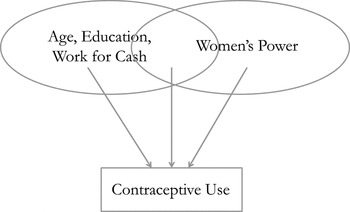
Research on the topic has also considered the role of third variables. Age, education and work for cash determine HDM power consistently across countries (Kishor & Subaiya, Reference Kishor and Subaiya2008; see also Heaton et al., Reference Heaton, Huntsman and Flake2005, and Anderson & Eswaran, Reference Anderson and Eswaran2009). These variables were used as proxies for women's power, which was measured indirectly in early studies that explored the relationship (Blanc, Reference Blanc2001). Subsequently, they have been entered as covariates of directly measured women's power in regressions having contraceptive use as the dependent variable and have shown superior predictive strength (Govindasamy & Malhotra, Reference Govindasamy and Malhotra1996; Hogan et al., Reference Hogan, Berhanu and Hailemariam1999; Al Riyami et al., Reference Al Riyami, Afifi and Mabry2004; León, Reference León2011) as well as a partial overlap of their effects with those of directly measured women's power (Steele et al., Reference Steele, Amin and Naved2001; Moursund & Kravdal, Reference Moursund and Kravdal2003; León, Reference León2011). Figure 1 depicts the three possible sources of effects. As women grow older and meet their fertility goals, they become more motivated to use family planning (Gray & McDonald, Reference Gray and McDonald2010); education increases the woman's likelihood of learning about family planning methods and how to gain access to them (Ainsworth et al., Reference Ainsworth, Beegle and Nyamette1996); by working for cash, women enter into contact with users of contraception and can imitate their behaviour (Steele et al., Reference Steele, Amin and Naved2001). These are independent effects of the proxies on contraceptive use. But as women grow older, they gain experience, and experience may grant them power; education enhances women's ability to control their household environment; and working for cash can affirm women's freedom of movement, whereas the earnings obtained can confer them instrumental and social power. In these cases the path of influence goes from proxy for contraceptive use via women's power. The third source entails effects of women's power on contraceptive use that do not simply reflect the proxies' levels; an amount of power–use covariance is left when the covariance explained by proxies has been discounted (Mason et al., Reference Mason, Smith and Morgan1998; Casique, Reference Casique2003; Kishor & Gupta, Reference Kishor and Gupta2009; Woldemicael, Reference Woldemicael2009; León, Reference León2011).
Assumptions about the relationships between proxies, women's power and contraceptive use.

To delineate with greater detail the nature of the power–contraception relationship, the present study compared the validity of the participation, control and egalitarian models of women's overall domestic power as predictors of family-planning use, considering proxy-dependent and proxy-independent components and excluding cases with long gaps between sterilization and survey.
Methods
Data
Demographic and Health Surveys assist national institutions in the conduct of surveys. These surveys use a multistage, stratified sample design. The survey is designed so that all women of the country who satisfy the inclusion criteria (e.g. ever-married, 15–49 years of age) have a similar probability of being sampled. Initial target sample sizes are stipulated for each region, state, department or province (depending on the country) and each of a number of selected cities on the basis of the latest census. The sample size targets are adjusted considering specific research objectives. Urban and rural samples are drawn independently in each region (or state, etc.). A two-stage procedure is generally followed in rural areas (villages, households) and a three-stage procedure in urban areas (wards, blocks, households); both include random sampling at the last stage. All women in the household who satisfy the inclusion criteria tend to be interviewed. Household response rates are above 95% and women's rates above 90%. Since 1999–2000, DHS questionnaires have included items on women's HDM. The coding of women's responses in raw country data sets is standardized over countries by DHSs' Individual Re-code. All available Individual Re-code data sets containing power variables were targeted for inclusion in this study, the latest being selected when there was more than one per country. Twenty-six came from sub-Saharan Africa (Benin 2006, Burkina Faso 2003, Cameroon 2004, Democratic Republic of Congo 2007, Eritrea 2002, Ethiopia 2005, Ghana 2008, Guinea 2005, Kenya 2008–09, Lesotho 2004, Liberia 2007, Madagascar 2008–09, Malawi 2004, Mali 2006, Mozambique 2003, Namibia 2006–07, Niger 2006, Nigeria 2008, Rwanda 2005, Senegal 2005, Sierra Leone 2008, Swaziland 2006–07, Tanzania 2004–05, Uganda 2006, Zambia 2007, Zimbabwe 2005–06), eight from North Africa/West Asia/Europe (Albania 2009, Armenia 2005, Azerbaijan 2006, Egypt 2008, Jordan 2009, Moldova 2005, Morocco 2003–04, Ukraine 2007), six from Central, South and South-east Asia (Bangladesh 2007, Cambodia 2005, India 2005–06, Indonesia 2007, Nepal 2006, Philippines 2008) and six from Latin America and the Caribbean (Bolivia 2008, Colombia 2005, Dominican Republic 2007, Haiti 2005–06, Honduras 2005–06, Peru 2004–08). The DHS survey methodology has not been invariant. In Cambodia and Haiti, the women's empowerment module of the questionnaire was administered only in one out of every four households, and nationally representative samples of married/cohabiting women have been targeted in some countries while all women of reproductive age have been interviewed in others. Since the concept of domestic power is not applicable to never-married, divorced or widowed women, these cases were excluded from the analyses.
Measurements
Contraceptive use
Women were asked ‘What method are you using?’ The response codes referred to each of the family planning methods that were available in the country. This variable was re-coded so that women who said they were not using any contraceptive method received a 0 score and those who mentioned any traditional or modern method received a 1 score. (The DHS categorizes the pill, condom, injectable, sterilization, IUD, Norplant, vaginal, and lactational amenorrhoea as modern methods, and rhythm, withdrawal and folkloric use of plants as traditional methods.) Women who had been sterilized two or more years earlier were excluded from the analyses. Women's individual differences in risk of pregnancy, fertility desires and success in overcoming barriers to access to contraception are encompassed when contraceptive use is utilized as the dependent variable (León et al., Reference León, Lundgren, Sinai and Jennings2011).
Women's power
Respondents were asked ‘Who usually makes the following decisions: mainly you, mainly your husband, you and your husband jointly, or someone else?’ In some countries, a ‘you and someone else jointly’ option was added. To measure participation, responses to ‘large household purchases, ‘household purchases for daily needs’ and ‘visits to family or relatives’ (in some countries, friends were considered, too) were re-coded as ‘husband’ and ‘someone else’=0 and ‘respondent’, ‘respondent and husband’ and ‘respondent and someone else’=1. A summated participation score over the three items was then computed, generating a 4-point scale that ranged from 0 to 3. Who has the final say regarding own health, lacking in various data sets, was ignored, as were the countries lacking any of the other three items (e.g. Nicaragua 2001). Measurement of control required re-coding ‘husband’ and ‘someone else’=0, ‘respondent and husband’ and ‘respondent and someone else’=1, and ‘respondent’=2. Egalitarian power scores were generated by using the control scores of purchases for daily needs and, in the case of large purchases and visits, assigning a 0 to ‘husband’ and ‘someone else’, a 1 to ‘respondent’ and a 2 to ‘respondent and husband’ and ‘respondent and someone else’. The summations of control and egalitarian power scores produced 7-point scales ranging from 0 to 6. Each sum's internal consistency was measured in each country by Cronbach's α, which depends on the number of items and their inter-correlations.
Age
Age in completed years was calculated from the century month code of the date of birth of the respondent and the century month code of the date of interview. Women were asked ‘In what month and year were you born?’ and ‘How old were you on your last birthday?’ and inconsistencies were corrected.
Education in single years
The same educational level may imply a different number of years of education depending on the country's educational system. The educational variable selected for these analyses was constructed considering the educational level (primary, secondary, etc.), the highest grade attained at that level, and the number of years taken to reach that grade since the woman's inception in the educational system.
Work for cash
Variables V731 and V741 of the DHSs' Individual Re-code entail the woman's work and the type of earnings for her work. They were combined by assigning a 0 score to women who did not work during the last 12 months or worked but were paid only in kind, and a 1 score to those who worked and were paid in kind and cash or in cash alone.
Female enrolment
This variable comes from the United Nations Development Programme's Human Development Report (2007). It is a combined gross enrolment ratio for primary, secondary and tertiary education.
Analyses
Multilevel logistic regression analysis was discarded because there was an interest in the clusters themselves (i.e. the countries). Power and proxy scores were converted into standard scores (z), per country. Six binary logistic regressions predicting contraceptive use from women's standard power scores were designed per country, two per type of summated power scores (participation, control, egalitarian). A Model I regression utilized the power measure alone as predictor. Model II added age, education and work for cash as covariates. Thus, odds ratios (ORs) obtained from the standardized predictors provided information on the odds of contraceptive use that can be expected given a one standard deviation increase in the predictor. In addition to making easily comparable the results from predictors with different metrics, the standardizations provided an additional defence against the undesirable effects of multi-colinearity; the main defence was the use of large sample sizes. All the variables were analysed for main effects and a Type III method for calculating the reduction in error sum of squares was employed; in this method, the effect is added after all other effects are adjusted. The ORs were counted or averaged, per groups of countries or in the total set, and α values were similarly treated. This type of treatment is not new to the family planning literature (e.g. Mason & Smith, Reference Mason and Smith2000). The SPSS statistical package, version 17, was utilized in data analysis.
Results
The power measures emerged highly inter-correlated (from r=0.83 to r=0.97). Since sub-Saharan Africa displayed singular characteristics, it is differentiated from the other regions in the following tables and figures.
Internal-consistency reliability
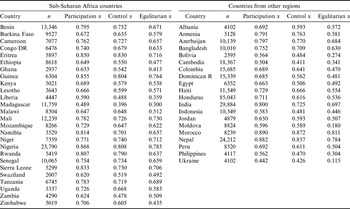
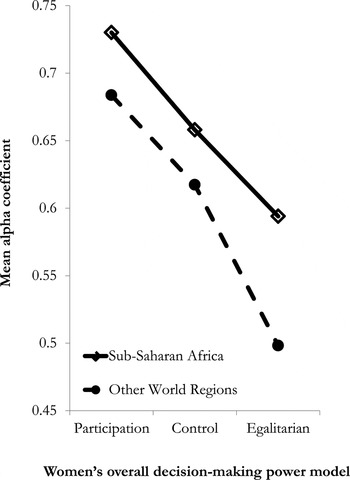
The internal consistencies (see Table 1) were generally quite high considering the very small number of items (n=3). Sub-Saharan Africa presented power measures with higher internal consistency than the other world regions (see Fig. 2). The participation model showed greater internal consistencies than the others and the egalitarian model smaller consistencies across regions. Egalitarian power scores exhibited very low α values in Ukraine, Moldova, Bolivia, Philippines and Madagascar. These and subsequent results recurred when medians were computed instead of means.
Internal consistency (α) of three measures of women's overall decision-making power, by region and country

Internal consistency of three power measures, by world region.

Models' predictive strength
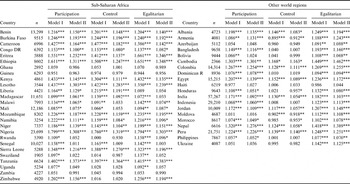
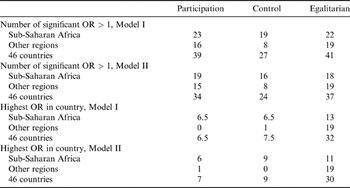
Table 2 presents results from the regression analyses and Table 3 offers a summary. The control model was particularly weak outside sub-Saharan Africa; it even exhibited significant ORs below 1.00 (p<0.05) in Armenia, Honduras, Moldova and Morocco. The egalitarian model emerged with the greatest number of significant positive ORs. Yet, neither it nor the other models significantly accounted for contraceptive use in Ghana, Guinea, Haiti or Zambia; these failures are not explained by either sample size or weak internal consistency. The egalitarian model showed the strongest validity as a predictor of contraceptive use in pairwise comparisons considering the ORs up to the third decimal place (highest OR in country). The difference, however, particularly evident outside sub-Saharan Africa, virtually disappeared within the sub-continent under Model II.
Odds ratios for three power predictors of contraceptive use under Model I and Model II regressions, by region and country

Model I only includes the power measure. Model II includes the power measure, age, education and work for cash. Jordan lacked work for cash data.
**p<0.05; **p<0.01; ***p<0.001.
Relationship between women's overall decision-making power and contraceptive use (OR): counts for sub-Saharan Africa, other regions of the world and the full set of countries, by power model

Proxies
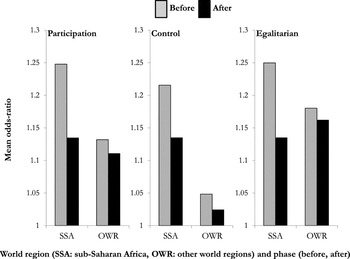
Figure 3 depicts average ORs by power model, region and regression model. The level of ORs decreased in all instances when proxies' effects were controlled. Under the Model I regressions, i.e. before removing effects from the proxies, the relationships were clearly stronger in sub-Saharan Africa than in the other world regions, regardless of the power model. This, however, was not so under the Model II regressions; in this case, the ORs were clearly greater in sub-Saharan Africa only where the control model was concerned. The power models' empirical validity did not differ much in sub-Saharan Africa; in fact, the participation and egalitarian models produced virtually identical results regardless of regression model. On the other hand, the validity of the egalitarian model displayed a higher level than that of the participation or control models in the other world regions regardless of regression model. The control model exhibited considerable inadequacy to explain contraceptive use outside sub-Saharan Africa. What the other two power models show is that the inter-regional differences were greater under Model I than under Model II. Moreover, the egalitarian and participation models showed a substantial inter-regional difference under Model I that virtually disappeared under Model II. That is, what varied importantly across regions was the effect of the proxy-dependent component on contraceptive use.
Mean odds ratios from regressions of contraceptive use on three women's power models, before and after removing effects accounted for by proxies, by world region.

Table 4 presents summary ORs for the proxies from the Model II regressions entailing egalitarian power. (The proxies' effects were very similar across the three power measures used as covariates.) Age was a positive determinant of contraceptive use in specific countries, such as Egypt, Jordan and Uganda, but emerged with significant ORs below 1.00 in an important number of sites. Education diverged from the other proxies by its high impacts, consistently stronger than those of women's power. These impacts were not only more powerful in sub-Saharan Africa than in other regions, but were also very strong in every sub-Saharan country. Work for cash varied from non-significance to moderate or large positive and significant effects (e.g. Ghana, Kenya, Namibia).
Age, education and work for cash as predictors of contraceptive use: mean odds ratios (and range), controlling for egalitarian power and the other proxies, by region

Geography and education
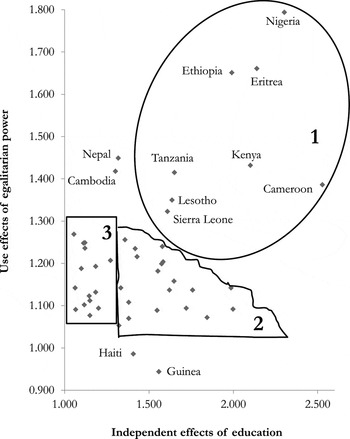
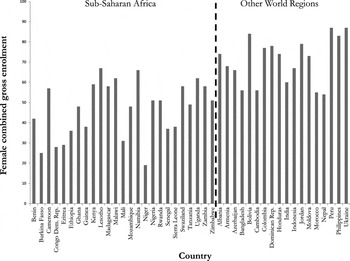
Figure 4 depicts the full effects of egalitarian power (Model I) and those of education that were independent of egalitarian power, age and work for cash (Model II) on contraceptive use. Three clusters of countries are distinguished. Only sub-Saharan Africa is represented in Cluster 1, defined by a strong influence of both power and education; this cluster includes the most populated countries of the region. Cluster 2, defined by strong effects of education and relatively weak effects of women's power, encompasses all the other sub-Saharan countries, except Guinea, plus Bolivia; this cluster includes five of the six countries with the largest contraceptive prevalence rates of sub-Saharan Africa that were included in the study. Cluster 3, defined by relatively low impacts of both education and women's power, includes most countries from the other regions of the world. Two Asian countries and Guinea and Haiti fell outside the clusters. It can be seen in Fig. 5 that female education in sub-Saharan Africa is considerably worse than in other regions of the world.
Country scatterplot according to level of effects of women's overall egalitarian power and independent effects of education on contraceptive use.

Female combined gross enrolment ratio for primary, secondary and tertiary education, by country and world region (from United Nations Development Programme, 2007). Data for Egypt, Haiti and Liberia were unavailable.

Discussion
Since the women's power models shared the same components, their differences in empirical validity were small and non-significant within the countries; but they were consistent. The egalitarian model outperformed the other models as a predictor of contraceptive use in 19 out of 20 countries outside sub-Saharan Africa, regardless of the regression model used. The probability of finding only one exception in a set of 20 countries just by chance is smaller than 0.001 (two-tailed). The egalitarian model also outperformed the other models in sub-Saharan-Africa countries, though considerably less consistently.
The study revealed three important challenges to the egalitarian model's construct validity. One pertains to its internal consistency. The higher internal consistencies associated with the participation model can be attributed to the inclusion of autonomous and joint HDM into the same response category, which diminished the inconsistencies that could occur across decision areas. In contrast, the control model's α decreased when the woman made an autonomous decision in one area and a joint decision in another area instead of making decisions of the same type across areas. The egalitarian model was even less internally consistent than the control model. This reveals that more inconsistencies occurred between joint HDM in important areas and autonomous HDM in unimportant areas than between autonomous and joint HDM across the board. The mode of implementation of the concept of decision importance in the measurement of egalitarian power may have caused this situation. Large household purchases and purchases for daily needs self-classified, respectively, as important and less important decision areas, but visiting family/relatives was assigned to the first category considering the Eritrean findings (Woldemicael, Reference Woldemicael2009). If visits to family/relatives were less important to couples in Ukraine, Moldova, Bolivia, Philippines and other countries that showed low α values, a 2 score should have corresponded to autonomous HDM and a 1 score to joint HDM, rather than the scoring used in such settings. The egalitarian model does not refer to specific behaviours, such as visits, but to the importance of decision areas to the couple; variations of area importance over cultures can be expected. Hence, development of a general formulation of decision importance that takes into account cross-cultural differences may be a key task in the way to strengthening the new power model. This corrective endeavour should also consider that questionnaire items may not have exactly the same meaning across countries (Ghuman et al., Reference Ghuman, Lee and Smith2004).
The second challenge is one of further differentiation from the participation model. The three models' general effectiveness did not differ much in sub-Saharan Africa. Since the main element that the models have in common is the assignment of a 0 score to husband's autonomy, one possibility that should not be discarded is that the 1 and 2 scores of the control and egalitarian models functioned in practice as a single score greater than 0 in this region. This does not necessarily imply that the 1 and 2 scores failed to validly differentiate between the levels of women's HDM power, but announces some plausibility in the hypothesis that the key to contraceptive use in sub-Saharan Africa is whether women participate in HDM, and not whether they make autonomous or joint decisions. That is, the concept of participation, transcending the specific DHS measure, might suffice to explain contraceptive use in sub-Saharan Africa. Women outside sub-Saharan Africa evidenced greater behavioural differentiation in two ways. First, the internal consistency of their power scores was lower according to the α values; sub-Saharan women sustained to a greater extent the same power behaviours across decision areas. Second, the egalitarian model's validity clearly prevailed outside sub-Saharan Africa, as if beyond this sub-continent the differences between 1 and 2 power scores were relevant to contraceptive behaviour. Hence, research geared to enhance our understanding of how the 1 and 2 power scores function regarding effects on contraceptive use in specific sub-Saharan Africa settings is a second key task required to improve the egalitarian power model.
Egalitarian power significantly accounted for contraceptive use in 41 countries, but neither it nor participation or control did so in Ghana, Guinea, Haiti or Zambia. Does this mean that women's power is irrelevant to contraceptive use in these countries? Overall HDM power may be irrelevant, but this author further analysed the data and found that participation in large purchases in Guinea, participation in visits in Ghana, and joint HDM in large purchases in Haiti and Zambia were effective predictors in regressions that had the other decision areas as covariates. These power effects are not part of the overall women's power; they are uncorrelated effects. Hence, the situations in which uncorrelated power effects significantly outperform the overall power models in explaining contraceptive use should be better understood. A contingent egalitarian model could emerge in the form of a more encompassing rule indicating when the overall women's power can be expected to be most valid and when uncorrelated power behaviours would explain contraceptive use better. The three-cluster typology of countries that emerged from the combination of power and education effects on contraceptive use provides some leads. A deprivation theory would suggest that the greater the deprivation, the stronger the effect of the variable. Sub-Saharan women are substantially less educated than women from other regions of the world (United Nations Development Program, 2007); thus, small increases in education could be expected to produce larger effects on contraceptive use in this region, as observed in Fig. 4. If the same is true of women's power, the cases of Ghana, Guinea, Haiti and Zambia could be explained by extreme deprivation of power in the particular areas of large purchases or visits, respectively. The deprivation theory could also explain the more extended success of the egalitarian model outside sub-Saharan Africa, where women are more powerful than in this region according to either the Gender-Related Development Index or the Gender Empowerment Measure (United Nations Development Program, 2007). Given the greater deprivation of women's power in sub-Saharan Africa, small increases in power, e.g. mere participation in HDM, would produce large effects on contraceptive use in this region.
The second study topic entailed the roles of age, education and work for cash. Removal of these variables' effects from the relationship between women's power and contraceptive use resulted in a general reduction of the ORs. Nonetheless, the findings also showed that the effects of women's power that are independent from the proxies' are no smaller than the dependent effects. More suggestively, the differences that were observed between sub-Saharan Africa and the other world regions in women's power effects on contraceptive use are attributable in greater part to the proxy-dependent than to the proxy-independent component of overall women's power. This leads to the question, what factor that varies little over world regions could underlie the independent effects? Researchers and programmes interested in women's power have paid considerable attention to couple's communication (Blanc, Reference Blanc2001), usually viewing it as a result of husband attitudes. Little attention has been paid to the fact that communication is also related to temperament and personality (e.g. Wahba et al., Reference Wahba, Saunders and McCroskey2005). This suggests that assertiveness, an aspect of extraversion, one of the Big Three (Eysenck & Eysenck, Reference Eysenck and Eysenck1985) or Big Five (Goldberg, Reference Goldberg1993) personality-trait factors, underlies the independent effects of women's power on contraceptive use. Men are more assertive than women and this difference transcends societies and cultures, but individual variation in assertiveness within the genders is greater than the variation between them (Maccoby & Jacklin, Reference Maccoby and Jacklin1974; Feingold, Reference Feingold1994; Costa et al., Reference Costa, Terracciano and McCrae2001). Assertiveness would explain why women who are young, uneducated and full-time wives may still exhibit important levels of HDM power. Since traits are behavioural predispositions with a dominant biological foundation, assertiveness may be similarly distributed in sub-Saharan Africa and in other world regions and may produce similar effects on contraceptive behaviour. Therefore, the women's power that impinges on contraceptive use could be construed as a function of Assertiveness+Age+Education+Work for Cash. Recognition that the assertiveness trait underlies women's power could bring further conceptual clarity to the research, along with the practical advantage of providing links to the specialized literature: from the study of specific types of assertiveness training (Lazarus, Reference Lazarus1966) through the social consequences of being an assertive woman (Carli, Reference Carli2001). This, however, will represent mere speculation until the personality trait is directly measured and related to the other components of women's HDM power and to contraceptive use.
This article left unaddressed important issues. The association between contraceptive use and women's power ignores the desired fertility of women. Women's power may result not only in higher levels of contraceptive use, but also levels that are closer to desired fertility levels, filling the gap of unmet need. Consideration of the unmet need for contraception would be more in line with the post-ICPD objective of family planning programmes. Along these lines, the different levels of desired fertility that appear to exist between men and women could explain the greater association between women's power and contraceptive use observed in sub-Saharan Africa, where a greater divergence between the desired fertility of men and women can be hypothesized (see Kulczycki, Reference Kulczycki2008). Moreover, the study failed to consider men's gender norms. By just focusing on women's self-reported power, the research ignored the theoretically likely role of men's gender norms in determining the household power environment that is relevant to the use of family planning. Women's power and men's normative beliefs may not be redundant in the prediction of contraceptive use. These issues, however, exceed the scope of this article.
Acknowledgments
Funding for this research was provided by Nina Bustamante de León. The author is grateful to his wife and partner, as well as to Caroline Gallimore for her editorial assistance; Jim Foreit and Sara Woldehanna, who introduced the author to the topic and the data; others at AED's C-Change program and USAID who provided valuable comments to a precursor of the research presented in this article, which grew from a consultancy to AED funded by USAID and Demographic and Health Surveys for granting access to the data sets.