If sound itself may be likened to a disembodied emanation, its ‘grain,’ its uniqueness, its individually identifying factors come from and refer back to the materiality of the producing body.Footnote 1
It was Carl Friedrich Cramer (1752–1807) – professor of theology at the Danish-governed University of Kiel, biographer of Klopstock and admirer of C. P. E. Bach – who confided to the readers of his periodical, the Magazin der Musik, that Bach's Fantasia in A major, h278, was composed (in the composer's own testimony) ‘in tormentis’, specifically during the agonies of rheumatism and gout:
Die zweyte dieser Phantasien z. B. weis ich, hat er zu seinem Vergnügen an einem Tage verfertigt, wo ihn ein verdrießlicher Rheumatismus plagte, und er pflegt sie daher scherzend gegen seine Freunde die Phantasie in tormentis zu nennen, nach der Analogie der berühmten Gemählde des hochseligen Königs von Preussen. Ich würde es niemand verdenken, der, hierauf fußend, sich eine ganze Theorie der Gichtschmerzen daraus abstrahiren wollte, in dem weitausschweifenden, beym zweyten Ansatze so gleich so original in die Secundquartsexte ausweichenden Laufe ihre herumfliegende Pein, in den kleinern stoßenden Stellen ihre Stiche, den Eindruck des Aergers auf die Seele etc. leibhaftig gewahr würde. Doch das sind Grillen! sagt ein ernsthafter Leser. Mags denn drum seyn!Footnote 2
I happen to know that the second of these two Fantasias was written for his own enjoyment on a day when he nursed irksome rheumatism, and so to his friends he jokingly used to call it the fantasia in tormentis, with reference to the celebrated paintings of the blessed King of Prussia. I wouldn't blame anyone who, based on this, wanted to abstract an entire theory of gout pain, according to which [the music] would incarnate flying pain in the rambling runs that are immediately repeated on an evasive 6/4/2 chord; stabbing pain in the short, jerky passages; the impression of a troubled soul etc. ‘No, that's fanciful!’, says a serious reader. So be it, then!
Like Cramer's ‘serious reader’, musical scholarship has passed over this anecdote, even though the long review of Bach's fourth collection of keyboard music für Kenner und Liebhaber (1783) in which it appears is often hailed as a breakthrough in the aesthetics of instrumental music. Many have sensed the stirrings of idealism, even the idea of absolute music, in Cramer's ambivalent rejection of what he called a Rousseauian theory of music.Footnote 3 That theory, in Cramer's telling, equated music's aesthetic force and ethical value with its powers of representation, specifically the imitation of passionate utterance. Against, but also alongside, this framework, Cramer experimented with what can seem like a pure-music perspective that abstracts music from the human voice and feeling. And in so far as the review serves to usher in a later idea of musical purity, Cramer's anecdote about the gout must be passed over because it invokes all-too-worldly domains of the body and representation.
This is not to deny that Cramer was restless under the yoke of French theories of musical imitation. In the passage below, deeply influenced by the manifesto Von Deutscher Art und Kunst (Of German Style and Art; 1773) by Herder, Goethe and others, Cramer pitted Teutonic genius and an ideal of authorial originality against the fetters of French theory.Footnote 4 The author- and imagination-based account of art provided by Herder (writing on Ossian and Shakespeare) and Goethe (on gothic architecture) was marked by notions of profusion and seeming irregularity, which in turn supplied Cramer with a language of beautiful disorder for C. P. E. Bach's music. The well-known but linguistically taxing passage warrants rereading and retranslation here:
Wer also nur nicht mit Rousseau ausschließend das Wesen und die ganze Kraft der Music in Nachahmung und Leidenschaft sezt, wer nicht gegen die Instrumentalmusic insbesondre, so bald sie nicht mahlt, gefühllos ist, und auch solchen Folgen von Tönen, denen keine genaubestimmbaren Empfindungen oder Ideen entsprechen, und die auch sogar bisweilen für das Ohr keinen entschiedenen Reiz haben, demohngeachtet aus andern Gründen Werth zugestehen kann, dem wird eine solche Sammlung von momentaneen [sic] Einfällen, Gedanken, Capriccio's, kurz solche freye Ausbrüche der musicalischen Dichterwut, von denen man wie Polonius von Hamlet sagen kann: Though this is madness, yet there's method in it, sicher die unterhaltendste Geistesbeschäftigung verleihen, und das um so viel mehr, je mehr er mit den geheimern Regeln der Kunst vertraut geworden, and je tiefer er in das Heiligthum derselben gedrungen ist. Denn für den Denker eröfnen sich hier bey jedem Schritte die mannigfaltigsten Aussichten. Das Neue so vieler oft ganz heterogenen, aber doch immer mit harmonischer Richtigkeit und Kunst zusammengewebter Gedanken, ihr Unerwartetes, und weil gar kein Thema genommen wird, das das Gedächtniß des Hörers auf Zukünftiges vorbereitet, immerdar Ueberraschendes; die Kühnheit der Modulationen, der Abschweifungen und Wiedereinlenkung, die Unerschöpflichkeit an Gängen und Wendungen, die Mannigfaltigkeit der einzelnen Figuren, aus denen das Ganze zusammengesezt ist, und denn das Brilliante im Spiele der Hand, das auch für den Unerfahrensten wenigstens das Vergnügen des Anstaunens überwundner Schwierigkeiten mit sich führt: alles dieß sind große und wichtige Seiten, von dem man solche Werke der Kunst, solche Studia ansehen, und in Rücksicht auf welche ein Mann wie Bach auf diese auch nur von wenigen genossene, und von wenigen genießbare Werke einen nicht geringen Theil seines Ruhms gründen kann.Footnote 5
Thus whoever doesn't side with Rousseau in attributing the entire nature and power of music to imitation and passion, whoever isn't insensitive to instrumental music in particular as soon as it doesn't paint, and thus can confer merit on other grounds to successions of notes that correspond to no precisely definable feelings or ideas, and even sometimes do not charm the ear, he will certainly deem such a collection of momentary whims, thoughts, capriccios – in short such free outbursts of musical-poetic fury (of which one can say, with Polonius of Hamelt ‘though this is madnesss, yet there's method in it’) the most entertaining occupation for the spirits, and all the more so, the more he is conversant with the secret rules of art, and the deeper he has penetrated into their sanctuary. Because, for the [musical] thinker, the most diverse vistas are revealed with every step. The novelty of so many, often quite heterogeneous ideas, which are yet always artfully woven together, in harmonically correct fashion; their unexpected and constantly startling character (since no definite theme is presented to the memory that can set up expectation); the boldness of the modulations, the digressions and returns, the inexhaustibility of paths and turns, the diversity of individual figures, out of which the whole is constructed, and the brilliant fingerwork that at least affords even the most inexperienced the pleasures of astonishment at difficulties overcome: all these are significant and important perspectives from which to view such works of art, such studies that are savoured and enjoyed by only a few, and on which a man like Bach rests no small part of his reputation.
However, Cramer's break with mimesis is both temporary and ultimately illusory. It is temporary because, in the sentence that immediately follows the quotation above, he returns to Rousseau: ‘Und wer vermag überhaupt zu sagen, wie weit auch aus jenen Gesichtspunkten, die ich der Kürze halber die Rousseauischen nennen will, betrachtet, sie noch ihren eigenthümlichen großen und frappanten Werth haben, und, wie Er sich ausdrückt, un principe d'imitation in sich enthalten können?’Footnote 6 (and after all, who is in a position to say how far, even from those vantage points that I want for brevity's sake to call the Rousseauean, [the fantasias] still possess their peculiarly great and striking merit, and, as Rousseau puts it, contain a principle of imitation?). Later in the review Cramer spells this out, praising in the first Fantasia in E flat major (h277) not only the ‘opening Solfeggio’ (‘almost negotiable by Bach's fingers alone’), but also ‘the speaking quality of the melody throughout [the rest of the fantasia]’.Footnote 7 The break with mimesis is illusory because the ‘abstract’ music generated by the inspired improviser is referred back to the movements of body and mind that create and recreate it. The narrative effect of heterogeneous and abrupt ideas – Cramer's ‘collection of momentary whims, thoughts, capriccios’ – models the state of inspiration in something like real time. The ‘opening Solfeggio’ of the Fantasia in E flat major is about the dexterity of fingers – not least Bach's own. And the main types of material in the first unmeasured section of the A major fantasia can be heard to represent the pain and suffering of the gouty body. In other words, Cramer's notion of gout pain is not extraneous but a key to the review, and taking it seriously offers a different perspective on the abstraction of the free fantasia: the seemingly non-representational gestures of improvisatory music (their proto-modernist abstraction) relate dialectically to the nervous materiality of the body, to language (that is, passionate utterance) and to embodied feeling and thinking.
GOUT CULTURE
But isn't Cramer's anecdote about gout too flimsy a basis for such theorizing? A ‘serious reader’ might object that Cramer links gout pain and music as a humorous thought-experiment. After all, Bach ‘jokingly’ named the piece ‘in tormentis’ and did so with reference to the gouty paintings of King Friedrich Wilhelm I of Prussia.Footnote 8 Indeed, the reference to those paintings inspires a Shandean moment, as Cramer directs readers to a swollen footnote where the joshing continues, now between the gout-afflicted monarch and his courtiers:
Man weis nämlich, daß dieser, und gemeiniglich mit blauer Farbe, Gemählde verfertigte, wenn ihn das Podagra plagte, und auf sie denn schrieb: In doloribus pinxit Fridericus. Er machte zuweilen den Spaß damit die Schmeicheley seiner Hofleute zu deconcertiren, indem er sie fragte, was sie wohl werth wären? und wenn sie denn unter vielen Bücklingen einen sehr hohen Preis nannten, zur Antwort gab: Er solls dafür haben. – Bis er endlich einmal an einen Schlauern gerieth, der ihm in tiefer Devotion auf seine Frage: Was hält Er das Stück wohl werth? versezte: O Ihro Majestät, es ist unschäzbar.Footnote 9
Specifically, it is known that the King painted pictures – usually in blue – when he suffered gout, and that he wrote on them: In doloribus pinxit Friedericus. Sometimes he played a joke on his courtiers, seeming to invite their flattery, by asking what the pictures might be worth; and when they, amidst much bowing and scraping, named a high price, he answered: you shall have it for that! But eventually he met his match: in answer to his question ‘what is the picture worth’ a clever fellow answered with all due respect ‘Oh, your majesty, it is priceless’.
The erudition and levity attending these anecdotes about art and gout do something other than trivialize the issue, however: they invoke gout's frames of reference, its culture. Something more is at stake than the enduring idea of music as palliation for physical and emotional suffering.Footnote 10 In their survey Gout: The Patrician Malady, Roy Porter and G. S. Rousseau highlight the consistently ludic representation of a condition figured as the inheritance, the patrimony, of elite men. Testifying to pedigree, fine dining, sexual potency and a strong constitution, gout was historically something to endure as much as cure, the downside of a life of the mind, and the pleasures of the senses, that was said to leave the less privileged, and almost all women, untouched.
The ludic element expressed the notion of laughter as remedy, but also a conviction that gout was (paradoxically) salutary: its fevers, convulsions and sweats, and the chalky lumps sent to distant joints, were (in the humoral framework) thought to rid the body of congested humours and so restore health. Of course, death was never that far from thinking about ill health – Bach's own letters link illness and piety – but in medical discourse gout was also an indication of longevity.Footnote 11 Agonizing but benign, swollen toes, feet, knees and knuckles inspired rhetorical bravura from poets and politicians, gout's rise and fall, its stiffening and weakening of the body, attracting sexual and political metaphor. The feminocentric culture of sensibility, fostering sympathetic identification with the suffering of others, made only modest inroads into gout culture.Footnote 12 Satirical and learned, bawdy and witty, gout culture was the stuff of the gentleman's club. In visual lampoon, it afflicted older men, patriarchs of strong constitution, pictured in paradoxical states of arousal and incapacitation. The correspondence and diaries of sufferers also linked gout with periods of self-cultivation and the experience of privacy. (Though Porter and Rousseau do not say this, it can seem as though gout culture offered gentlemen a bizarre equivalent of female confinement and childbirth.) In its acute phases, gout sequestered its victims, demanding retreat from public duties and social life. Bawdy elements notwithstanding, gout discourse linked the suffering male body to the life of the mind, even becoming a context for genius and authorship.Footnote 13
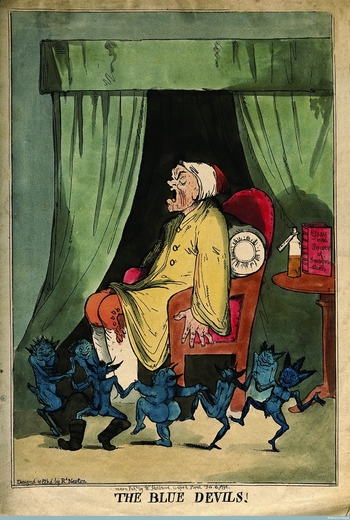
A satirical engraving by Richard Newton, entitled ‘The Blue Devils’ (1795), captures many of these themes (Figure 1). Gleeful devils with horns, hooves and tails celebrate a ring dance around a tormented gout sufferer. Their blue-black coloration, conventional for malevolent spirits, also recalls the blue employed by Friedrich Wilhelm in his ‘invalid’ painting (presumably this was Prussian blue). The aged, male sufferer, immobile and contorted, is sequestered in a domestic interior. A light garment protects his wasted torso from the misery of touch. His tortured face buckles, his fingers stiffen and his bulging, swollen knees (almost breast-like beneath his flesh-coloured breeches) convey gout's agonizing swell. The little devils screen the sufferer's feet and ankles from view even as they personify the diabolical sensations in those most affected areas. How far removed from the restrained countenance of Laocoön in the grip of the writhing serpent, an exemplar for Johann Joachim Winckelmann and Gotthold Ephraim Lessing of the restrained, heroic representation of the male body in pain!Footnote 14 The grotesque corporeality of Newton's sufferer, his mouth a gaping toothless hole, echoes the bizarre physicality of the mischievous devils, emaciated and corpulent, human and animal, ambiguously sexed. On the table a flask of wine or spirits suggests both the cause of and the relief for the malady, and hints perhaps that the sufferer is inebriated. (It is worth noting that Bach's wife, Johanna Maria Dannemann, was the daughter of a wine merchant.) Next to the flask is a book entitled Essay on the Power of Imagination, after Joseph Addison's famous essay from The Spectator of 1712, an ironic illusion given the torments of the sufferer's disordered fancy.
Richard Newton, ‘The Blue Devils’. Coloured etching, self-portrait (London: Holland, 1795). The Wellcome Library, London. Used by permission

BACH'S GOUT
Drawing on his knowledge of the composer's illness, and this discursive field, Cramer offered gout as an edifying context for the A major fantasia. Consider that Cramer's mention of gout ushers in a king, Latin phrases, rhetorical bravura about ‘priceless’ paintings and some medical theorizing (that typology of gout pain), all served up with bantering camaraderie. (There is momentary indecision over the naming of Bach's ailment: Cramer speaks first of rheumatism, but quickly corrects himself. Rheumatism just couldn't compete with gout, though the two conditions were often equated, and, needless to say, neither of these medical terms maps neatly onto modern clinical categories.) Gout provided an apt context for the free fantasia because Cramer situates such pieces at a point of furthest remove from commerce and fashion, to be savoured by (presumably elite male) connoisseurs in private. The notion of ‘the power of imagination’ also links fantasias and gout culture, the imaginative flights that Cramer discovered in such pieces (and which stimulated his own critical fancy) recalling Newton's engraving (Figure 1). There are other hints of gout culture in the review too, as when Cramer evokes a lustful, elderly Bach in connection with the E major Rondo: ‘O Vater Bach! im acht und sechzigsten Jahre solch ein muthwilliges Stück, das der heitersten Stunde des Bräutigamsstandes werth wär! Man sieht wohl, daß das Genie nicht altert.’Footnote 15 (Oh Papa Bach! In [your] sixty-eighth year, such a wanton piece, which would be worthy of the most cheerful hour of a bridegroom – we can see that genius never grows old.)
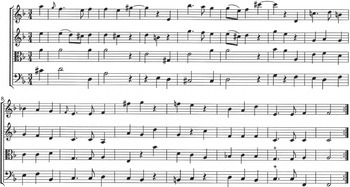
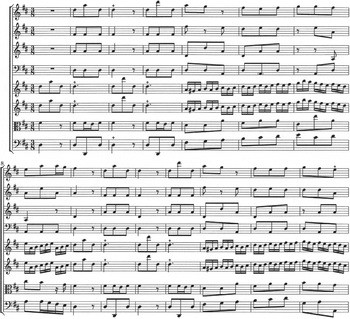
The notion of patrimony or inheritance endemic to discourse on gout is not something Cramer invokes directly, but is obviously suggestive in thinking about a composer whose fantasias and keyboard performance were deeply indebted to J. S. Bach. It can seem as if the art of playing and improvising on keyboard instruments has achieved its gouty apogee with Cramer's review of the fourth collection ‘for connoisseurs and amateurs’. However, when it came to the gout, it was not J. S. Bach, but rather Georg Philipp Telemann, who was Bach's immediate ancestor. Not only did Telemann stand as Carl Philipp Emanuel's godfather, and was his predecessor as Cantor in Hamburg, he had earlier explored gout as a subject for instrumental music in his Ouverture, jointes d'une Suite tragi-comique (twv55:D22), dedicated to Ludwig VIII, Landgrave of Darmstadt, and thought to date from the mid-1760s, when the composer was in his mid-80s.Footnote 16 In Steven Zohn's account, this characteristic overture-suite tapped into the currency of medical advice, and satire of fashionable ailments, in the north German press. The Hamburg doctor Johann August Unzer, for example, published a weekly journal, Der Arzt (The Doctor), between 1759 and 1764. In successive movements, Telemann features three current diseases and their treatment: gout, hypochondria and dandyism, or foppery. In Zohn's characterization, ‘gout’, set as a loure, involves ‘frequent disruptions in the dance's harmonic and melodic progress’ that suggest ‘both halting physical movement and pain shooting through the sufferer's joints’ (see Figure 2a).Footnote 17 The ‘proven treatment’ that follows depicts a ride in a carriage and dancing a minuet (Figure 2b). These remedies were consistent with medical advice that recommended movement and physical activity to help restore the flow of congested humours. Exercise also helped to get the sufferer away from the study and the dining table. Gout was particularly well suited to musical imitation because it involved physical pain (relatively easy to paint musically as dissonance) and the violation of graceful melodic movement. Uniquely among the ailments Telemann depicts, gout employs ‘music’ as both the medium of representation and the mode of treatment, the remedy of dancing minuets harnessing music's rapport with the body.Footnote 18
Georg Philipp Telemann, ‘Le Podagre – Loure’, from Ouverture, jointes d'une Suite tragi-comique (c1763), twv55:D22, bars 1–14, ed. Mario Bolognani <www.baroquemusic.it>. Used by permission. The composer's annotation ‘Violon’ over the top stave implies a string texture

Georg Philipp Telemann, ‘Remède expérimenté. La Poste et la Dance – Menuet en Rondeau’, from Ouverture, jointes d'une Suite tragi-comique (c1763), twv55:D22, bars 1–15, ed. Mario Bolognani <www.baroquemusic.it>. Used by permission. Telemann did not specify the instrumentation. Convention and style of writing suggest four-part strings for the lowest four lines, with flutes or recorders and oboes in the top two staves, then trumpets, then bassoons

There is a difference, however, between Telemann's representation of gout in the abstract, and Cramer's rather indiscrete, if elevating, mention of Bach's own sufferings. Something private and personal, ultimately bearing upon the composer's capacity to play at the keyboard, was made public. We know from Bach's correspondence with Heinrich Wilhelm von Gerstenberg – part of a Danish Bach circle – that the composer could be touchy about publicizing links between authorship and illness, even though such links existed. In a letter of 1773, referring to an unaccompanied keyboard concerto by Johann Nikolaus Tischer, composed (the title page declared) ‘during an illness’ and bearing biblical inscriptions, Gerstenberg attempted to entice Bach into the composition of sonatas evoking passages from the psalms about death and salvation.Footnote 19 Reading Tischer's title literally, the premise seems to be that the practice of instrumental works by music-loving youth also affords them an opportunity for pious reflection on mortality.Footnote 20 In his cagey reply, Bach questioned whether Tischer needed to have mentioned his illness, even as he punned darkly on the composer's name and invoked his own coffin.Footnote 21 This is not to assume, however, that Bach was offended by Cramer's exposé. Perhaps by 1783, when Cramer published his review, Bach had given permission for the disclosure, or perhaps Cramer felt sanctioned by Bach's advanced age. Bach himself had begun to speak of death and his posthumous reputation from at least 1778.Footnote 22
Whatever the authorization, Cramer took a risk in linking Bach's body with an illness that undoubtedly affected the composer's ability to play keyboard instruments. In Bach's gout we discover a flip side to the Versuch über die wahre Art das Clavier zu spielen (1753 and 1762). In that account of performance, supple, healthy hands are trained to the perfect execution of every musical requirement. Bach doesn't imagine music free of the body – on the contrary, he recommends subtle facial expressions during performance, and he urges musicians to play from the soul and to feel what they would have listeners feel – but the body of the performer serves the higher authorities of the composer's message and music's social occasions. Within the (to some extent) courtly regime of the Versuch, a body in pain, damaged or deformed would impair the fulfilment of these duties, though it would also offer temporary freedom from them. Contemporaries (including Charles Burney) reported that Fux, Wagenseil, Hasse, Franz Benda and Joseph Reicha were all rendered incapable of, or hampered in, musical performance by what was styled ‘gout’, affecting fingers, arms and the entire body.Footnote 23
Just how far gout affected Bach's career is ultimately unclear. Possibly gout's episodic course, and the uncertainty of its future severity, influenced the composer's decision to quit the position of chamber musician at the Berlin court and accept the post of Cantor in Hamburg: in his petition for release, now lost, he cited ‘incapacity’ and the need for another post ‘which my physical condition can tolerate’. This much we learn in his letter from 13 November 1767 to Hans Jacob Faber, an appointing member of the Hamburg Senate:
Binnen wenigen Tagen werde ich noch einmahl beÿ dem Könige, welcher anderer vielen Geschäfte mir noch bis dato noch nicht geantwortet hat, um meine Erlaßung bitten, und zugleich das Dimissorial-Schreiben beÿlegen. In meinem Briefe werde ich folgendes vorstellen: Da mein Sr. Maj. Bereits vorgestelltes Unvermögen mich nöthigte die hiesigen Dienste zu verlaßen, so hätte ich mich meine cörperlichen Umstände gewachsen wären. . . .Durch diese Vorstellung setze ich den Senat aus aller Besorgniß, mein Erlaßungsgeschäfte wird beschleuniget und die Attention des Senats nebst meinem aufrichtigen Geständniße muß dem Könige gefallen.Footnote 24
Within a few days I will once again ask my release of the King, who has still not answered me, presumably because of many other obligations, and at the same time I will enclose the letter requesting my dismissal. I will present the following in my letter: ‘Since my incapacity, already explained to Your Majesty, has forced me to leave my present post, I have had to apply for another position which my physical condition can tolerate. . .’ With this presentation I will rid the Senate of all concern, the business of my release will be hastened, and the attention of the Senate [who had forwarded Bach their own letter of petition for him to deliver to the monarch] together with my honest confession are bound to please the King.Footnote 25
Bach's tone here is undoubtedly arch but, pace Stephen L. Clark, it is unlikely that he was simply lying to the King (himself a sufferer from gout, a condition that had cost his father, Friedrich Wilhelm I, the use of an arm).Footnote 26 Indeed, from Bach's letters we learn that gout (so-called) had struck already in 1743, when the composer was only twenty-nine years old, leading to a period of indisposition and convalescence in Töplitz, then a popular spa town in southern Austria.Footnote 27
When and whether Bach's arms, wrists and fingers were affected is unclear, but gout, which first strikes the feet, would have rendered use of the organ pedals difficult. Burney, visiting Hamburg in 1772, reported that Bach regretted having ‘neglected organ-playing. . .[and] lost the use of the [organ] pedals’, a neutral, circumspect locution revised in the second edition of his travelogue to ‘lost all use of the feet’.Footnote 28 In this light, the scarcity of obbligato pedal parts in Bach's organ music may be reflecting more than the alleged limitations of his royal patron Anna Amalia of Prussia.Footnote 29 Pamela Fox, consulting medical specialists, has reported evidence of both gouty stiffness and tremor in Bach's later handwriting, so it is reasonable to assume that his hands were eventually affected as well.Footnote 30 Of course, it can seem as if Bach was always playing, given how frequently those eyewitness accounts by Burney, Reichardt and Cramer are cited by Bach's modern admirers.Footnote 31 But there is only fragmentary evidence for Bach playing the keyboard in public and semi-public concerts in Hamburg, where he more often directed performances of sacred vocal and instrumental music.Footnote 32 The fact that he wrote out and preserved cadenzas in manuscript suggests his concertos were not solely for his own use, and arguably the reverential accounts of the critics above, derived from private interviews, share a quality of idealization, as if capturing something vanishing or already lost in the manner of an apotheosis to the art of keyboard playing.Footnote 33
With an eye to posterity, but not to immediate public announcement, Bach himself referred to his gout in a letter to Forkel of 1775. The critic was already collecting materials for his biography of J. S. Bach, to be published a quarter of a century later, and for his part C. P. E. Bach was keen to link (even dignify) select, fantasia-like keyboard sonatas with his gout:
Den aufrichtigsten Dank statte ich Ihnen, liebster Freund, für die schönen Metwürste und meine wiedergeschickten Noten ab. Die 2 Sonaten, welche Ihren Beÿfall vorzüglich haben und etwas gleiches von einer freÿen Fantasie haben, sind die einzigen von dieser Art, die ich je gemacht habe. Sie gehören zu der, aus dem H moll, die ich Ihnen mitschickte, zu der, aus dem B, die Sie nun auch haben und zu 2en aus der Hafner-Würtembergischen Samlung, und sind alle 6, anno 1743, im Töpziger Bade von mir, der ich damahls sehr gichtbrüchig war, auf einem Clavicord mit der kurzen Oktav verfertiget.Footnote 34
I extend my most sincere thanks to you, dearest friend, for the excellent sausages and for returning my music. The 2 sonatas that particularly pleased you and are somewhat similar to a free fantasy, are the only ones of this type I have ever composed. They belong with the one in B minor I sent to you, with the one in B flat that you now also have and with the 2 from the Haffner-Württemberg collection, and all 6 were composed by me on a clavichord with the short octave in 1743 in Bad Töplitz, where at that time I was suffering greatly from gout.Footnote 35
As the rest of the letter makes clear, one of the things at stake for Bach in disclosing that context was the notion of composing for himself and (as he put it in his autobiography) ‘in complete freedom’.Footnote 36 Indeed, the sentence after ‘gout’ (above) begins ‘Nachher habe ich meist fürs Publicum arbeiten müßen’ (Subsequently, I have had to work mostly for the public).Footnote 37
What Bach doesn't say is that the experience of gout (or its routine amelioration with laudanum) affected the content of these works. For contemporary readers, some notion of delirium (from fever or opiates) was perhaps implied (as were convulsions and spasms). Indeed, Bach was no stranger to the medicine cabinet, writing to Gerstenberg in 1772:
Ich bin seit dem Anfange des vergangenen Februars bis jezt an einem fatalen Magenhusten sehr krank gewesen. Nachdem ich beynahe eine ganze Apotheke eingeschluckt und eine sehr strenge Diät gehalten habe: so bin ich nunmehr durch Gottes Gnade insoweit wiederhergestellt.Footnote 38
From the beginning of February until now I have been very ill with an annoying upset stomach. After swallowing nearly an entire pharmacy and keeping to a very strict diet, I am now by the grace of God half-way recovered.Footnote 39
Cramer, however, is more ambitious for the explanatory potential of gout pain, which he describes as ‘incarnate’ (‘leibhaftig’) in the music – a term that notably sidesteps the question of whether Bach composed the fantasia in the grip of pain or in sombre reflection on the experience. Following contemporary medical accounts of the illness, Cramer identifies three classes of pain, which he matched to specific passages of music: flying pain, stabbing pain and a ‘troubled soul’. This order, shared by Cramer's exposition and the unfolding of the fantasia, is significant: it traces a movement from purely physical sensation to the realm of character, seeming to link the material to spirit. While Cramer might have gone much further – as I will show, Bach left a clue in this piece that passed Cramer by – it is worth tracing his typology of pain in detail. Turning to the score might seem to essentialize Cramer's hermeneutics, to collapse the distinction between music and ascribed meanings, but the intention is rather to capture the specifics of his reading – as well as its problems.
A TYPOLOGY OF PAIN IN h278
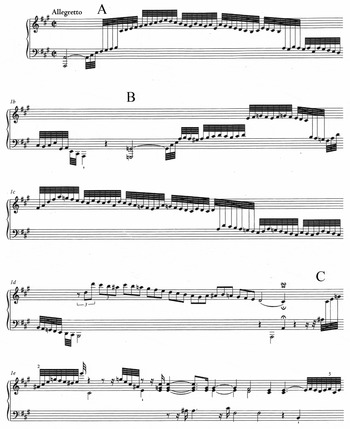
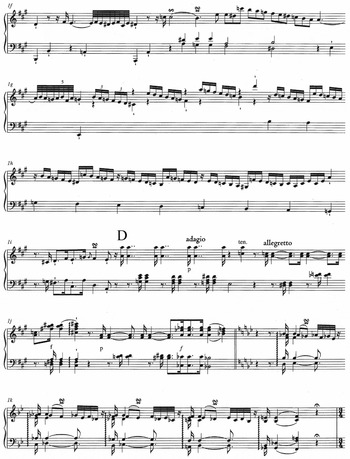
Cramer discovers flying pain ‘incarnated’ in the hemidemisemiquaver scales that open (and close) the piece (annotated as letter A on the score; see Figure 3). The idea appears to be that just as these scales run up and down the clavier, seemingly involuntarily, so pain runs through the body. If this is special pleading for a type of opening generic to the fantasia, it is also rather ingenious: Cramer seizes on the potential of a toccata-like opening – and thus a notion of touching the keyboard – to describe pain as a kind of movement through the metaphorical body, the nerves, of the keyboard player/improviser. I call this ingenious because Cramer avoids a naive equation of musical materials with pain itself; nor does he suggest that Bach's music induces pain in the audience. Indeed, his comments (like Bach's scales) do not lend pain an affective charge, but treat it more abstractly as a quality of movement and function of touch.Footnote 40 For Cramer, Bach's music models (aspects of) the embodied experience of pain, specifically the nature of its travel or movement through the nerves.Footnote 41 Thus he is particularly interested in the unorthodox tonal and rhythmic behaviour of the opening. The scale of A major breaks off abruptly on a staccato bass note at letter B; after this, the flying scale is impulsively repeated out of key, on what Cramer describes as an ‘evasive 6/4/2 chord’. Thus it is not only the metaphorical scales, but also the startling narrative effect of stop and start, and of veering off key, that catch his ear. Although this chord leads conventionally enough to the subdominant, Cramer has a point: Bach's fantasias do not usually question their tonic so soon. This novelty may explain why Cramer imputes something sensational to the octave G♮s. The widespread influence of the nerve-based physiology of Albrecht von Haller (1708–1777) lent a currency and plausibility to such observations, strange as they may appear today.Footnote 42 Reading between the lines, Cramer discovers a sense of involuntary movement, as if the fantasia were composing itself through the improviser's body.
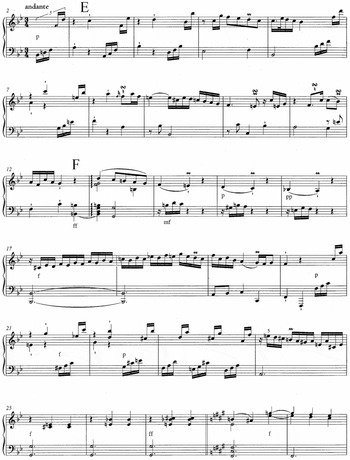
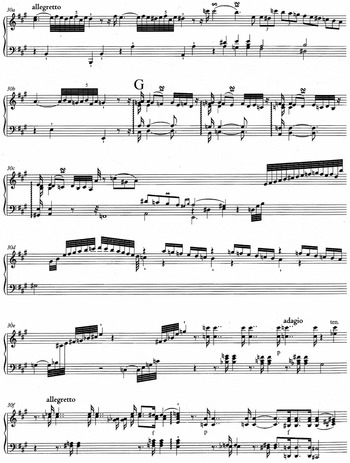
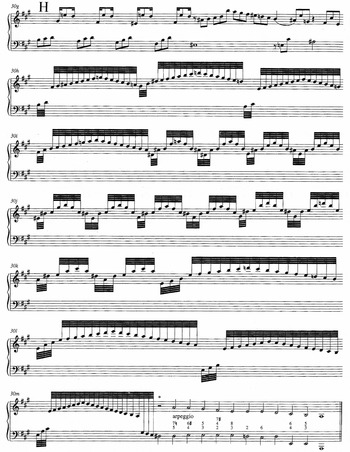
Carl Philipp Emanuel Bach, Free Fantasia in A major, h278, from Clavier-Sonaten und freye Fantasien nebst einigen Rondos. . .für Kenner und Liebhaber, Vierte Sammlung (Leipzig: Breitkopf, 1783) (Carl Philipp Emanuel Bach: The Complete Works, series 1, volume 4.2 (Los Altos: Packard Humanities Institute, 2009), ed. Christopher Hogwood). Used by permission


Next comes ‘stabbing pain in the short, jerky passages’, Cramer presumably referring here to the convulsive arpeggiations of a diminished seventh on A♯ at letter C. This chord suspends (or paralyses) the harmonic course, throwing attention onto the spasmodic rhythms. Heard through Cramer's framework, there is also a patterned continuity, from an intense shudder – up to e3 (the highest note in the piece) – to a less violent twitch, through to a gentler, fitful staggering of hands. The music matches physical sensation not only through isolated figures but by modelling the experience of embodiment in time.
Moving from letters C to D, the twinges of gout temporarily subside, physical pain giving way to Cramer's third category, that of the ‘troubled soul’. Here, at D, the melody dwells on the repeated octave a1/a2, and the chromatic harmony seems to push and pull below; there is a sense of uncertainty or reverie as the tempo slows momentarily to adagio and to an emotive tenuto. Elsewhere in the review, Cramer identified the same musical techniques in the second movement, Larghetto, of the Sonata in G major h273 – speaking there of ‘rather unpleasant feelings’ (‘widrigere Empfindungen’) and how ‘seriousness awakes in [the] soul’ (‘Ernst erwacht in ihrer Seele’) – and in the Fantasia in E flat major, h277, in which he noted ‘the splendidly swelling and melting melancholy’ (‘Die herrlich wachsende, schmelzende Wehmut’).Footnote 43 The way Cramer's comments move from two types of physical pain to a condition of melancholy traces a continuum between what in modern English is distinguished as sensation, on the one hand, and feeling (or emotion) on the other. No such duality was presumed, however, by ‘Empfindung’, a term that refused to commit to either pole. Not just sensation and sentiment, but even the lived experience of thinking came within music's representational domain in Cramer's review under the heading of ‘Empfindungen’, one that Bach himself invoked in one of his last works – the arrangement (h536) of the Free Fantasia in F sharp minor, h300, subtitled ‘C. P. E. Bach's Empfindungen’.Footnote 44
Cramer could have taken things further, though. His theory of gout pain readily extends to the central section: a minuet,Footnote 45 whose dance topic evokes the body in movement (see letter E). Bach's dance seems hampered by the symptoms of disease, even as it recalls Telemann's remedy – dancing minuets. The five-note upbeats can suggest hobbling; if grouped as a triplet and a duplet they convey an awkwardness that the performer must choose to smooth over or make into a feature (the quintuplet bracket is editorial). The staccato crotchets, staggered on beats one and two of the bar, suggest a sprightly, but uneasy, gait, while at letter F the heavy-footed syncopation – starting with fortissimo B♯s – seems to portray not just a disorderly movement of the body, but a disconcerting pring within it. In a gouty context, even the choice of the Neapolitan key, B flat major, can suggest a precarious swelling on the tonic A major rather than an orderly tour of keys.Footnote 46
In the final section of this relatively orderly fantasia the ‘pained’ material of the first part returns, albeit jubilantly, a celebration of the dexterity and fluid movement that gout might preclude. Thinking back to Telemann's ‘Le Podagre’, music may be symptom and cure, the fantasia existing in a dialectical relationship with gout. In this section, Bach inscribes gout in a way that Cramer overlooked, by including a new idea at letter H, which is dropped in out of the blue and comprises an incongruous passage alla zoppa – in ‘limping’ rhythm.Footnote 47 The typesetters struggled with this odd passage, Bach having to write it out again because of errors in the proofs, and insisting on seeing a revised proof of this passage before he gave Breitkopf his blessing for publication.Footnote 48 This level of concern, the clarity of the rhythm's reference to limping, and the way in which Bach drops it in, like a quotation, suggest the composer's musical inscription of gout's effects. Although the final section of the fantasia (A′) mixes up the order of ideas from the first section (A), and provides a peroration of scales and arpeggios, the passage in limping rhythm is entirely new and, as such, stands in relief.
In this light I suggest that Cramer's anecdote of a fantasia ‘in tormentis’ – reportedly originating in the composer's own remarks – is probably reliable (and not just a critical thought-experiment). However, this is not to say that how music might represent sensation is in any way straightforward – again, I do not mean to simplify music's relationship with embodiment. Nonetheless, the Fantasia in A major can join the later fantasia ‘C. P. E. Bachs Empfindungen’, and the ‘Hamlet’ fantasia in Gerstenberg's texting of h75, as music that mediates (various notions of) the self, and introduces a personal element into later eighteenth-century keyboard music – in Bach's words, music ‘for myself’. The notion of the fantasia as an autobiography, as modelling one's own Empfindung, is a more general principle than Bach's one-off use of the title ‘C. P. E. Bachs Empfindungen’ implies.
REPRESENTATION AND ABSTRACTION
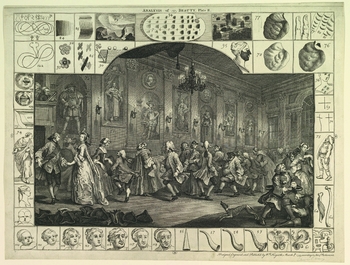
Empfindungen were both abstract and mimetic; they were of the body, but disembodied by their musical representation. That tension had broad currency in theories of the fine arts. Looking again at the central minuet section of the fantasia, the subtle play of physical elegance and deformity, of embodiment and abstraction, in this, the most refined and courtly of dance types, recalls the second of the two plates Hogarth included in his Analysis of Beauty, published in the same year as the first volume of Bach's Versuch and translated into German the following year (1754) (Figure 4). In the minuet, Hogarth discovered ‘the perfection of all dancing’, a multiplication of the serpentine line of beauty – the signature of the beautiful he discovered in Classical statuary and other natural forms:
The ordinary undulating motion of the body in common walking (as may be plainly seen by the waving line, which the shadow of a man's head makes against a wall as he is walking between it and the afternoon sun) is augmented in dancing [the minuet] into a larger quantity of waving by means of the minuet-step, which is so contrived as to raise the body by gentle degrees somewhat higher than the ordinary, and sink it again in the same manner lower in the going on of the dance. The figure of the minuet-path on the floor is also composed of serpentine lines, as [in] fig. [122] [plate 2 in Hogarth's treatise], varying a little with the fashion.Footnote 49
William Hogarth, ‘A Country Dance in a Long Hall’, The Analysis of Beauty, plate 2 (London: Hogarth, 1753). The Wellcome Library, London. Used by permission

Hogarth's illustration allows, however, for some departures from the beautiful. Only the well-matched, courtly couple on the left capture the curving and spiral forms of the line of beauty – with couples to the right embodying every possible kind of ‘ugly’ angularity, abruptness and asymmetry, until, at the extreme right, a one-legged servant crouches over the breeches of his contorted, grimacing master.
Herder, a colleague of Bach's brother Johann Christoph Friedrich in Bückeburg between 1771 and 1776, picked up on Hogarth's comments on minuets, and the line of beauty, in his treatise Sculpture (Plastik) of 1778. Herder's paean to sculpture as an art of the ‘embodied soul’, ‘the living soul [that] animates the entire body’, is broadly resonant with the framework of Cramer's review. Herder discovered in The Analysis of Beauty a link between abstraction and embodiment that he felt Hogarth had not sufficiently emphasized:
Diese Linie der Schönheit mit Allem, was daraus gemacht ist, sagt nichts, wenn sie nicht in Formen und also dem Gefühl erscheinet. . . .Kurz, so wie Fläche nur rein Abstraktum vom Körper und Linie das Abstrakt einer geendeten Fläche ist; so sind beide ohne Körper nicht möglich. . . .alle Umrisse und Linien der Malerei von Körper und lebendigem Leben abhangen. . .Folglich sind alle Reiz- und Schönheitslinien nicht selbständig, sondern an lebendigen Körpern, da sind sie her, da wollen sie hin.Footnote 50
The line of beauty and everything that has been deduced from it tells us nothing if it does not appear on forms and is not thereby accessible to the sense of touch. . . .Just as the plane is only an abstraction from the body and the line an abstraction from the bounded surface, so neither are possible without bodies. . . . The lines of grace and beauty are not self-subsistent; they derive from living bodies and seek to return to them.Footnote 51
Herder's admonition that apparently abstract aesthetic principles not only arise from but return (us) to the body echoes through the contemporary reception of C. P. E. Bach, a pioneer of (in Cramer's word) ‘non-descriptive’ instrumental music who also sought ever deeper connections between wordless music and (various notions of) the human.Footnote 52
Placed in this context, Cramer's criticism is not at odds with, but enriches, the notions of inspiration, genius and the sublime that have featured in recent commentary on the composer's place in eighteenth-century music.Footnote 53 While these categories appear to transcend embodiment and move towards an ontology of music as ‘mind’, ‘soul’ or ‘spirit’, they were, in Bach's world at least, also anchored in the body. As Edward Young advised aspiring writers in his influential Conjectures on Original Composition, ‘dive deep into thy bosom; learn the depth, extent, bias, and full force of thy mind; contract full intimacy with the Stranger within thee; excite, and cherish every spark of Intellectual light and heat, however smothered under former negligence, or scattered through the dull, dark mass of common thoughts; and collecting them into a body, let thy Genius rise’.Footnote 54 In this panegyric, genius is a form of inwardness that also knows about innards.
Burney's celebrated account of Bach's evening performance at the clavichord, during the critic's visit to the composer's home in Hamburg, took this dialectic of body and spirit a step further: inspiration is not only embodied but linked to those salutary fevers, the flow of humours, that were described as remedies for gout. Genius, like a salutary fever, seems to course through Bach's body, manifest in that sweat that Burney so elegantly styled ‘effervescence’. Inspiration, Bach claimed to Burney, promised the medical miracle of rejuvenation:
His eyes were fixed, his under lip fell, and drops of effervescence distilled from his countenance. He said, if he were to be set to work frequently, in this manner, he should grow young again.Footnote 55
Indeed, there is some knowing wit in the parody of this scene by John Bicknell in his Musical Travels Through England (1774), where effusions of genius are bathetically re-read as involuntary physical discharges:
At length, on a sudden, his eyes were fix'd, his underlip fell, and drops of effervescence distilled from his whole countenance. Immediately explosions of the most musical intonation I had ever heard, issued from behind, and enraptured the whole company. After this he successively coughed, sneezed, hiccupped, eructated, squeaked, and whistled, in the most harmonious manner that can be conceived.Footnote 56
To return momentarily to Bach's fantasia h278, Bicknell's ‘explosions of the most musical intonation’ are apt to describe the throbbing double suspensions, repeated in a lavish sequence, in the outer sections (see Figure 3, shortly after letter D and then at letter G). In such visceral moments of pleasure-pain, as in Cramer's theory of gout, and Burney's homage to Bach's ‘effervescence’, we can rediscover the centrality of embodiment not just to the performance of music, and to its effects, but to (notions of) its intrinsic content. Behind the specifics of Cramer's reading is a conviction that improvisatory keyboard music ‘knows’ about the body, as well as the mind, and that it moves between gestures suggestive of thinking, speaking, feeling and corporeal sensation.
Of course, there is nothing novel in my admonition: the body has long been a hot topic in humanities research.Footnote 57 In feminist musical scholarship the body has featured as a site of both constraining discipline and female agency. It was Susan McClary, in her magnificent critique of the musical absolute, who unmasked the politics of pure disembodied music.Footnote 58 As for recent scholarship on later eighteenth-century music, embodiment enjoys currency in understanding the gestures of opera buffa, musical pantomime, dance and the musical language of sensibility, the latter involving sighs, tears, trembling, absorption, forgetting and fainting.Footnote 59
This currency notwithstanding, the relationship between embodiment and musical aesthetics warrants more robust theorizing. The novelty of my argument lies not in its concern with the body, but the relationship it traces between the body and musical abstraction, between representation of sensation and the musical absolute. In arguing that the relationship between these terms is dialectical, I complicate what amounts to an orthodoxy in anglophone scholarship, in which to speak of the body is to speak against ideals of transcendence. Bach's fantasia ‘in tormentis’ reveals a different order, in which music achieves effects of abstraction – of being ‘pure music’ – through its intimacy with corporeal sensation.
I would also caution against fantasies of immediacy that spring up around the topic of music and embodiment. A case in point is Elisabeth Le Guin's imaginative and inspiring essay in carnal musicology that fantasizes her intimacy with Boccherini's body in the act of playing him. But Le Guin arguably short-circuits the difficulties of speaking of the body in music in her fantasy of the composer's ghostly presence to the gifted interpreter of his music.Footnote 60 Bach's sensations are known to us in mediated, stylized ways – even the composer spoke of himself in the third person (‘C. P. E. Bachs Empfindungen’ not ‘Meine Empfindungen’).Footnote 61 Bach does not simply await us at the ends of our fingers. In speaking of music as modelling the experience of (a historically specific) embodiment, we speak at the boundaries of what is possible to know and articulate. Music, like a body, is known in a feeling way that challenges representation in words and images. But these philosophical difficulties notwithstanding, it is possible and worthwhile to recover something of the physical vitality and resonance of Bach's legacy.