Introduction
Americans are a religious people whose convictions shape their politics. The political salience of religion extends to the courts, where religious groups press their interests and values across a wide range of subjects. While religious conservatives usually capture the headlines, religious progressives and mainline faiths also seek to influence political and judicial outcomes. It is therefore best to conceive of the courts as an arena in which rival religious belief systems compete for influence, using amicus curiae briefs as a common strategy for doing so. Only a handful of studies have made religious groups' amicus filings a central focus of their analysis, usually by examining the groups' involvement in First Amendment cases (Ivers Reference Ivers1990; Walsh Reference Walsh2015; Carmella Reference Carmella2020). This study seeks to draw broader insights from amici filings by analyzing how seven major faith-based organizations, three from conservative and four from liberal faith traditions, have used amicus curiae briefs since 1969 to advance their goals and articulate their understanding of the stakes involved in Supreme Court cases. This study focuses on groups that can be characterized as primarily white Protestant, including denominational groups and interest groups with white Protestant roots, leadership, or both. We limit our focus to these groups because doing so allows us to maintain a relatively uncomplicated yet representative picture of religious politics in the courts, as we explain below. In assessing the strategic arc of their amicus filings and arguments, we provide evidence that these religious organizations have come to behave as ideological rivals in the judicial realm.
Specifically, our findings demonstrate that while religious conservatives have always been focused on matters involving families and sexuality, and religious liberals on laws concerning social justice issues, over time the groups began filing more amici briefs in cases involving issues that historically had been the province of their religious rivals. We also find that these groups have dramatically increased their amicus filings over time, for two reasons: their rivalry for influence over the nation's moral center has broadened in focus, and their consciously developed ability to tap into the courts' influence on American politics has grown. In this regard, religious groups' conduct now resembles that of secular interest groups, including in terms of the sophistication and professionalization of their judicial operations, and their goals. Like secular interest groups, religious groups file amici curiae briefs primarily to influence policy, and not because of concern with the outcome of a particular case (Sorauf Reference Sorauf1976; Hertzke Reference Hertzke1988; Epstein Reference Epstein, Gates and Johnson1991; Collins Reference Collins2008; Teles Reference Teles2008; Hollis-Brusky and Wilson Reference Hollis-Brusky and Wilson2020).
One consequence has been a major reframing of the moral issues with which they engage. Consistently with Lewis's identification of a “rights turn” in the posture of Christian conservatives and Carmella's observation that progressives' commitment to “religious liberty” matches that of conservatives, our review of both groups' amici filings shows that the First Amendment has become the framing device by which white Protestant Christian groups structure society's entire portfolio of morally impinged issues, from immigration to gay marriage (Lewis Reference Lewis2017; Carmella Reference Carmella2020). Liberal Protestants continue to emphasize Establishment Clause alongside Free Exercise considerations, insisting that only a secular legal order can accommodate the religious diversity of American society. Conservative Protestants, by contrast, frame secularism itself as a species of religious belief from which conservative religions need space in which to freely practice their faiths. They accordingly ground their positions in the Free Exercise Clause with an emphasis on exemptionalism, or the right to be exempt from secular laws. These competing frames have empowered religious groups to use litigation to transform policy debates under the auspices of religious freedom.Footnote 1
This represents a clear evolution in the practical meaning of the First Amendment, which has evolved into a mechanism by which public policies become susceptible to challenge provided a religious group can establish that the policy runs afoul of its religiously grounded moral preferences. Taken together, our investigation of religious organizations' amicus filings over the past 50+ years, including examples of recent arguments contained in them, demonstrates that both conservative and progressive faith groups have developed a keen appreciation for the court system's ability to stymie or advance their moral vision for the United States, and they are increasingly willing to pursue their respective agendas aggressively in this arena.
The political evolution of white protestant groups, 1945–2020
The structural dynamics shaping the interactions between white Protestant groups have evolved over time. The belief that judicial politics offer a fruitful avenue for achieving religious objectives reflects the fact that religious organizations have evolved within a culture that is now perceived to punish political passivity, particularly as regards judicial engagement (Moen Reference Moen, Schmidt and Penning1997; Hollis-Brusky and Wilson Reference Hollis-Brusky and Wilson2020). The cultural and political divide between religious progressives and conservatives today is both sweeping and acrimonious, but a survey of American history suggests that earlier generations of Americans would struggle to recognize this dimension of the current religious landscape (Hertzke Reference Hertzke1988; Wuthnow Reference Wuthnow1988; Layman Reference Layman2001; Putnam and Campbell Reference Putnam and Campbell2010). In the postwar years, a fairly narrow but dominant culture in the United States effaced much of the visible religious pluralism and allowed for a sense of unity, particularly in the 1950s (Putnam and Campbell Reference Putnam and Campbell2010, 82–90). In the 1920s, immigration had introduced a straining range of religious diversity due to a massive influx of new religious voices, especially from Catholic countries, but it was not until the 1960s that the Protestant mainline lost its stature and thus its command of America's mainstream culture (Roof and McKinney Reference Roof and McKinney1987, 24–38).
A range of factors coalesced to transform the religious landscape from the rough cohesion that existed under mainline Protestant hegemony during the 1950s through the nascent polarization of the 1970s. The first, and perhaps most significant variable, given its implication in the others, was the rising role of the state in American society (Roof and McKinney Reference Roof and McKinney1987, 6–7; Wuthnow Reference Wuthnow1988, 115). This mattered in two ways: it imparted a heightened political salience to a wider range of issues, and it resulted in court rulings that became rallying cries for religious conservatives due to their secularizing outcomes.
Secondly, during the 1960s, American culture became more sexually permissive, and sex education became a particular focus of conservative discontent and organization (Roof and McKinney Reference Roof and McKinney1987; Martin Reference Martin1996; Putnam and Campbell Reference Putnam and Campbell2010). This marked a shift. Beginning in the 1920s, fundamentalists had maintained a relatively low profile due to the lesser priority they gave to temporal concerns. In addition, the mainline promulgated a sufficiently conservative morality to satisfice many individuals and sects who would later organize as the Religious Right. The sexual revolution of the 1960s, however, introduced disunity, and the evangelical wing of the mainline faiths came to regard any erosion of sexual mores with something like apocalyptic zeal. They and fundamentalists soon found common cause on this point, and a tension emerged between evangelicals and the moderate and liberal wings of their faith traditions. This trend only intensified over the 1970s and 1980s.
At around the same time, an additional fissure emerged over civil rights, as mainline ministers joined in significant numbers to support African-American religious leaders in protesting racial injustice, which made conservative members and preachers of these faiths uneasy (Roof and McKinney Reference Roof and McKinney1987, 129, 145–201; Wuthnow Reference Wuthnow1988, 145–46). This combination of issues created an enduring and growing divide, culminating in dissidents expatriating from the mainline traditions to form the Religious Right after the IRS began revoking the tax-exempt status of religious schools that practiced segregation in the 1970s. These schools had been founded in the 1960s not only to circumvent federally mandated desegregation but also out of disgust with secular education stemming from Supreme Court “school prayer” decisions from the 1960s, which we discuss below (Martin Reference Martin1996; Hollis-Brusky and Wilson Reference Hollis-Brusky and Wilson2020). The juxtaposition of tension over segregated schools, uproar over sex education, and disagreement about secularism meant that religious groups were now lining up against each other over multiple issues simultaneously.
Religious polarization and judicial engagement
By 1978, the three trends outlined above came to a head. The religious milieu of the mid-20th century, with its mainstream religious culture anchoring American society alongside outliers such as fundamentalists on the right and secularists on the left, was clearly a thing of the past. Now, religion in America became polarized into sects that became increasingly associated with political positions, which in turn became increasingly saturated with moral, ideological, and “cultural” implications (Wuthnow Reference Wuthnow1988, ch. 12; Layman Reference Layman2001). Driving the institutionalized expression of this polarization were Christian conservatives who believed that they were losing a war for the soul of America and who therefore created new mechanisms for fighting back.
The religious right
During the 1970s and 1980s, conservative Protestants aligned with the Republican Party, where they came to exert a powerful influence. In a masterstroke of placing politics over theological orthodoxy, they also began forging a bond with conservative Catholics by elevating the salience and centrality of abortion (Lewis Reference Lewis2017). As Putnam and Campbell (Reference Putnam and Campbell2020, 82–110) point out, the number of evangelicals never markedly increased nor was terribly large as a share of the overall population, but their passion, focus, and organizational prowess gave them an outsized influence in conservative politics in America (Layman Reference Layman2001; Lewis Reference Lewis2017).
During the 1990s, the Christian Coalition under Pat Robertson and Ralph Reed further refined its tactics, while interest groups dedicated to advancing conservative Christian interests became more active (Martin Reference Martin1996, 305–7; Lewis Reference Lewis2017). Among the strategic adaptations introduced by the Christian Coalition were the adoption of mainstream language to present its ideas (i.e., objecting to “special rights” for homosexuals); presenting Christians as an oppressed minority persecuted by secular society; adopting an incrementalist approach to issues; and aligning with politically congenial organizations who were not necessarily religious, such as anti-tax groups (Rozell Reference Rozell, Smidt and Penning1997). Due to the rise of secularism in American culture (with a dramatic increase in “the nones”), and the perception among evangelicals that secularists were intolerant of their beliefs, the Christian Right's self-presentation as a beleaguered minority came from a place of conviction (Putnam and Campbell Reference Putnam and Campbell2010, 120–35, 499; Lewis Reference Lewis2017). In addition, as Hollis-Brusky and Wilson detail, starting in the late 1980s these efforts came to include a pronounced emphasis on judicial politics. Regent University, Liberty University, and Ave Maria University each founded law schools for the express purpose of aligning American constitutional law with conservative Christianity by training sympathetic legal talent and fostering a religio-legal culture hospitable to this end; a variety of legal organizations such as the Rutherford Institute, Thomas More Law Center, and the American Center of Law and Justice (ACLJ) were also formed during these years (Hollis-Brusky and Wilson Reference Hollis-Brusky and Wilson2020).
One trend that had started in the 1950s and emerged as a defining feature of the Religious Right was opposing liberals, particularly secularists, as a constituent aspect of its identity (Hertzke Reference Hertzke1988, 33–34; Wuthnow Reference Wuthnow1988, 184–201; Martin Reference Martin1996). The adversarial, binary nature of judicial politics lent itself well to this dimension of conservative Christian thought (Fowler and Hertzke Reference Fowler and Hertzke1995, 234). The courts were also tied to the right's anti-secularist strain of thought due to their Establishment Clause jurisprudence, starting with Everson v. Board of Education's “wall of separation” metaphor in 1947 (Everson v. Board of Education, 330 U.S. 1 (1947)),Footnote 2 which persuaded religious conservatives that they were “losing” America to secularist forces (Fowler and Hertzke Reference Fowler and Hertzke1995; Martin Reference Martin1996; Hollis-Brusky and Wilson Reference Hollis-Brusky and Wilson2020). Among the defining attributes of the Religious Right are an emphasis on personal morality; a Manichean metaphysic, with the forces of secularism unambiguously aligned with the Devil; clearly defined gender roles, with the heterosexual nuclear family “not only normative in American culture but God-given” (Roof and McKinney Reference Roof and McKinney1987, 156); strong opposition to homosexuality and abortion, which Putnam and Campbell call the “glue” of their politics (Reference Putnam and Campbell2020, 369–414; Lewis Reference Lewis2017); and a general resistance to nonconformity and societal changes (Roof and McKinney Reference Roof and McKinney1987).
Religious progressives
Those representing what we here call the Religious Left, on the other hand, are primarily the inheritors of the old mainline churches. In comparison with their counterparts on the right, members of the Religious Left have a more diffuse focus. The two main qualities that those with this orientation share are the commitment to social justice issues, which formed one of the wedge issues between them and their more conservative brethren in the 1960s (Fowler and Hertzke Reference Fowler and Hertzke1995, 107; Olson Reference Olson2011), and opposition to the Religious Right (Wuthnow Reference Wuthnow1988, ch. 12; Olson Reference Olson2016). To be sure, members of a given faith tradition or congregation will pursue any number of additional causes, from environmentalism to pacifism, but it has been difficult for the Religious Left to create broad-based social movement organizations. This has contributed to the relative inattention paid to them (Olson Reference Olson2011), as has the steep decline in their membership (Roof and McKinney Reference Roof and McKinney1987; Putnam and Campbell Reference Putnam and Campbell2010), although their success in forming coalitions with secularists and religious minority groups has allowed them to retain a measure of political and legal efficacy.
An ecumenical spirit reflects the Religious Left's heritage as the midcentury cultural “establishment,” from which also derives its “strong social consciousness” (Roof and McKinney Reference Roof and McKinney1987, 86). Reaching deeper into history, one can also connect the Social Gospel movement of the 1890s–1930s to the contemporary Religious Left. The Social Gospel movement was activist, dedicated to ameliorating the conditions of the poor and marginalized, and committed to addressing the structural bases of injustice. Each of these commitments remains central to Religious Left activities and politics. The 1960s catalyzed progressive religious politics, not only through the civil rights movement but also due to Vietnam, where opposition to what was seen as an unjust war tapped into a deeper pacifist tradition (Hertzke Reference Hertzke1988, 59; Wuthnow Reference Wuthnow1988, 115–16).
Both the general social-justice orientation and the specific policy preferences derived from these historical antecedents remain prominent in Religious Left politics, and churches associated with this tradition have adopted a posture of supporting the marginalized, such as homosexuals, and the disenfranchised, such as immigrants (Carmella Reference Carmella2020, 570–72). The breadth of its concerns, however, has sometimes inhibited effective action, both because member churches sometimes disagree on issues, and also because “the list of potential policy priorities could go on and on” (Olson Reference Olson2011, 286).
Development of first amendment jurisprudence and the culture war
For religious conservatives, a deep tension underlay the Court's interpretation of the Free Exercise and Establishment clauses during the latter half of the 20th century, while for religious liberals, the case law for the most part expressed a morally consistent understanding of religious freedom. The Court's Establishment Clause jurisprudence espoused a separationist philosophy in which the state was obligated to remain neutral as regards religion, and, under the Lemon test, neutrality was identifiable by a law having a secular intent and secular effects.Footnote 3 Practically speaking, insofar as the metaphorical “wall of separation” that Justice Hugo Black identified in the Everson decision had been breached, it was because state practices expressed the beliefs of the Christian mainstream (Ivers Reference Ivers1990). Minority faiths, particularly non-Christian religions, were almost never the subjects of Establishment Clause cases during these years but instead were marginalized by the implicit endorsement of mainstream religion contained in such state practices. Separationist decisions thus tended to have the effect of eliminating government practices, such as posting the Ten Commandments on classroom walls, that advanced Christian beliefs (Stone v. Graham, 449 U.S. 39 (1980)). Conservative dissatisfaction with this interpretation of the First Amendment helped fuel the division of the American religious mainstream into its current polarized camps.
Meanwhile, during the half-century stretching roughly from 1940 through 1990, the Free Exercise clause had typically been given meaning in cases brought by religious minorities whose ability to practice their faith was compromised or limited by legislation that did not have similarly deleterious effects on the religious mainstream. Sunday closing laws, for example, imposed a much greater burden on observant Jews than Christians, while some Native Americans used hallucinogenic drugs in their religious rituals and thus would never have passed a law forbidding their use, as had various state governments comprised mostly of mainstream Christian legislators (Braunfeld v. Brown, 366 U.S. 599 (1961); Employment Division v. Smith, 494 U.S. 872 (1990)). In democracies in particular, it is unusual for religious majorities to face laws that do not take their values and practices into account.
During the extended period during which the religious mainstream dissolved slowly into a culture war, therefore, mainstream Christians rarely required judicial enforcement of the First Amendment's protections. While Free Exercise claims involved the religious freedom of marginalized faiths, Establishment Clause cases involved state practices embodying the religious preferences of the religious mainstream, thereby prompting requests for redress from religious minorities. In most cases, the Supreme Court had held that absent a compelling state interest, laws must not violate the religious freedom of minorities, either by failing to accommodate them (in Free Exercise cases) or by forcing them to participate in the religious practices of the majority (in Establishment Clause cases). This was where the law was essentially settled by 1969, and where it remained until the 1990s.
Liberal Christians were, on the whole, supportive of the Court's First Amendment jurisprudence, and essentially played defense in their amicus filings by asking the Court to adhere to its precedents. Christian conservatives, on the other hand, took a very different view of the matter. Their overarching critique of the Court's First Amendment jurisprudence rested on the idea that the Court's interpretation of both clauses failed to acknowledge the historically close and, in their view, unproblematic relationship between majoritarian religion and governance in the United States. Justice Potter Stewart's dissent in Engel v. Vitale, 370 U.S. 421 (1962), which had ruled New York's State's nondenominational school prayer to be unconstitutional for violating the Establishment Clause, set the template for conservative opposition to the Court's jurisprudence. Justice Stewart held that the majority's ruling failed “to recognize and to follow the deeply entrenched spiritual traditions of our Nation” by failing to accommodate the public's desire to practice their faith in a public-school setting (370 U.S. 421, 450). Similar dissents were appended to most First Amendment decisions.
Conservative Christian groups thus increased their interest-group activity on matters related to the courts, whether through sponsoring litigation, filing amici briefs, or attempting to influence judicial selection (Hacker Reference Hacker2005; Hollis-Brusky and Wilson Reference Hollis-Brusky and Wilson2020). There has emerged no equivalent Religious Left counterpart to the dense legal network that the Religious Right has created in its partnership with the broader conservative movement, including with organizations such as the Federalist society (Teles Reference Teles2008; Olson Reference Olson2016, 301; Lewis Reference Lewis2017, 27; Carmella Reference Carmella2020, 592). Additionally, the Christian Right has increasingly invested in its own parallel legal advocacy infrastructure, including Christian conservative law schools (Hollis-Brusky and Wilson Reference Hollis-Brusky and Wilson2020). Liberal Christian groups have not invested the same level of resources in legal education and network-building.
Other groups, such as those formed by liberal Catholics and African-American Protestants, align with the Religious Left on several issues but are sufficiently distinct theologically to yield different priorities on a wide range of issues.Footnote 4 Minority religions in the United States, such as Buddhism, Islam, and Native American faiths, also share contextual interests with the Religious Left, especially in Free Exercise cases, but here, too, the theological divergences are too significant to justify categorizing them with the Religious Left. That said, Religious Left groups coordinate not infrequently with these religions. Indeed, these partnerships embody the Religious Left's commitment to ecumenism and pluralism (Olson Reference Olson2011). Only Jewish groups consistently align with them, although a small Conservative Jewish movement of increasing activism complicates this picture as well.
The amicus strategy
As a natural response to the interreligious competition outlined above, religious individuals and groups have come to behave as interest groups, although religious lobbies and activism predate the culture war (Wuthnow Reference Wuthnow1988, 100). Religious groups pursue different goals than most secular interest groups, envisioning themselves as advancing a public good rather than their own narrow self-interest (Hertzke Reference Hertzke1988, 12). Filing amicus briefs offers them a low-cost way to engage the judicial process. Overall, the number of amicus briefs filed in Supreme Court cases has increased dramatically in the last few decades, including from religious groups (Ivers 1992; Owens and Epstein Reference Owens and Epstein2005). In Webster v. Reproductive Health Service, 492 U.S. 490 (1989), for example, hundreds of groups joined in filing scores of briefs on both sides of the case, with 12 of the briefs cited in the different opinions (Craig and O'Brien Reference Craig and O'Brien1993, 214–27).
Amicus briefs may bolster arguments made by parties or provide new information or perspectives not contained in the party briefs. Some leaders of religious groups, in discussing their reasons for filing amicus briefs, have specifically cited the ability to provide arguments not made by parties or other amici (O'Connor and Epstein Reference O'Connor, Epstein, Goldman and Sarat1989; Ivers Reference Ivers1992). While the impact of any single amicus brief is difficult to detect, there is documentation of the overall effect of these briefs on the Supreme Court's decisions, both at the certiorari stage and on the merits (Collins Reference Collins2008). In addition, the identity of groups filing briefs can enhance their influence. Some amicus curiae briefs will be read carefully as a result of the identity of the filer and the novelty of the argument that they present, and these briefs have a heightened chance of influencing the votes of justices (Box-Steffensmeier et al. Reference Box-Steffensmeier, Christenson and Hitt2013).
The seven groups
For these reasons, numerous organizations file briefs, either as representatives of specific religious bodies, such as the United Methodist Church, or because they wish to present a religious perspective or interest but do not have an exclusive connection to any particular denomination, such as the National Council of Churches (NCC). Some groups only file or join amicus briefs in specific issue areas (abortion stands out in this regard) while others file briefs in a large number of cases across all topics. Because our focus here centers on the political and cultural rivalry outlined above, for the sake of clarity we have chosen to omit certain groups, such as Catholics and Black Protestants, as they only fit the above picture ambiguously. For instance, on some occasions, specific Catholic groups filed on opposing sides of the same case. Official Catholic bodies, such as the United States Conference of Catholic Bishops, typically took conservative positions on issues such as abortion and gay rights, while Catholic believers with more liberal beliefs sometimes organized their own groups and filed briefs reflecting their views. While it was difficult to omit such significant players in the religious landscape from our study (particularly Jewish organizations),Footnote 5 practical considerations relating to scope compelled that choice. Accordingly, our present focus is on groups that are rooted in the white Protestant tradition, although some of the groups (such as Interfaith Alliance) include members from other faith traditions. Bearing this in mind will allow the reader to recognize that the argument here advanced does not capture the full spectrum of religious groups' participation in judicial politics, although we are confident that a largely representative sample of religious opinion is presented.
For these reasons, in our analysis of amicus curiae briefs, we have selected seven groups, four progressive and three conservative, to produce a representative sample of the changing patterns of religious engagement with the judicial process. The four liberal groups are the Baptist Joint Committee for Religious Liberty (BJC), the Interfaith Alliance, the NCC, and Sojourners. The three conservative groups are the American Center for Law and Justice (ACLJ), Focus on the Family,Footnote 6 and the Ethics and Religious Liberty Commission of the Southern Baptist Convention (SBC). The SBC split from the BJC in 1992; they are the only two denominational groups in our study.Footnote 7 The ACLJ is generally characterized as a public interest law firm with a conservative religious mission; the others are interfaith advocacy groups. Our selection of groups is a sample, and is not meant to comprehensively represent every relevant group among liberal or conservative white Protestants. We also included more liberal than conservative groups because, given the overall lower levels of participation from the left, we thought it necessary to provide a wider sample of liberal groups. We selected these groups because they represent sizeable constituencies; have wide name recognition; can reasonably be assumed to reflect the legal positions of the Religious Left and Religious Right; and they are active in judicial politics. In reviewing how their filing of amicus briefs has evolved over time, one can thus assess with some confidence whether, and the extent to which, the historical developments outlined above have played out in the legal system.
Analyzing the amicus curiae briefs
The data used in this study are amicus curiae briefs filed by these seven groups with the U.S. Supreme Court from 1969, the first year any of them became involved in judicial proceedings in this manner, through 2020. We found these briefs by searching the NexisUni database from 1945 to the present, but our search yielded no briefs filed prior to 1969. We then searched the amicus networks database (Box-Steffensmeier and Christensen Reference Box-Steffensmeier and Christenson2012) to identify other amicus filings that our initial search might have missed. This study uses amicus briefs filed both at the certiorari stage and the merits stage of cases. There are some instances in which these may be best analyzed separately, as they have different purposes, but for this study we have analyzed both types of amicus briefs together as measures of overall participation.
After identifying the briefs, we created a dataset in which the unit of analysis is the “brief signature.” In many cases, briefs were co-signed by two or more groups in this study, and often by other groups not included in the study. Because we are interested in gauging the level of participation of each group, and not just the number of briefs filed, it was necessary to use a unit of analysis that measured each group's participation. Accordingly, each observation in the data set represents a group's decision to sign on to an amicus brief. For example, if the NCC and the Baptist Joint Committee both co-sign the same brief, each signature gets its own row in the dataset. This approach resulted in 386 observations. Each row is also coded with certain information about the brief, including year of filing, name of the case, and issue area. We describe in more detail how we coded the issue areas, which is based on Supreme Court Database (Spaeth et al. Reference Spaeth, Epstein, Martin, Segal, Ruger and Benesh2020) issue codes, in the Appendix.
Expectations
Our first expectation is simple: that the level of participation in amicus briefs by both liberal and conservative groups, measured by brief signature observations, increased from 1969 to 2020. We expect this for two reasons. First, the number of Supreme Court amicus briefs has, in general, greatly increased over the last few decades. Second, as discussed in our historical overview, religious organizations have increased their attention to the legal realm. Religious progressives, as the primary inheritors of the “mainline” legacy and participants in coalitions defending the interests of minority populations, should be active throughout our time frame. We expect, however, to see an increase in conservative religious group activity in the 1980s and 1990s, in part because these groups began to focus on various ways to combat abortion rights, and because they began to see the courts more generally as a means to pursue their policy objectives. The ACLJ, the most active conservative amicus filer in this study, was founded in the early 1990s, another reason for increased activity in that decade. We expect this heightened activity in turn to have triggered a ratcheting response from liberals, as each side in the culture war seeks to ensure its interests are protected by countering briefs filed by their rivals.
Our second expectation, which refines the first, is that groups on each ideological side will primarily focus on issues related to their “core” beliefs, but will over time come also to address subjects that were originally the province of the other side. For example, we initially expect to see conservative groups participating in cases involving abortion, sexuality, and the family, and liberal groups participating in cases raising social justice issues, such as immigration and affirmative action. But we expect that, over time, groups on each side will begin to file briefs more frequently in cases involving issues that were once the concern of the “other side,” in an effort to counter their ideological adversaries.
Frequency of brief signatures
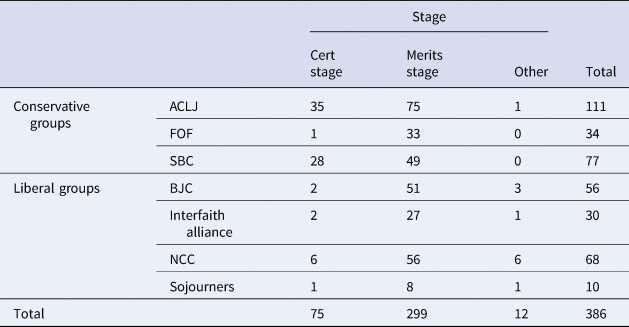
We begin with a count of the number of brief signatures from each group in our study, displayed in Table 1. In this table, we separately count signatures at both the certiorari and merits stages, in order to show the overall distribution of briefs. A few briefs have been classified as “other” because they fell in a different category, such as being filed in support of a stay, or because the brief content was unavailable. As we are interested in overall participation levels, the following analysis discusses briefs filed at all stages.
Brief signatures by group at each stage

The frequencies displayed in Table 1 demonstrate that the ACLJ is the most active group in this study, which is unsurprising as the group was formed to engage in legal advocacy on behalf of the Christian right. Among the liberal groups, the NCC was the most active. There is a relatively high level of participation from all the groups in the study, except for Sojourners.
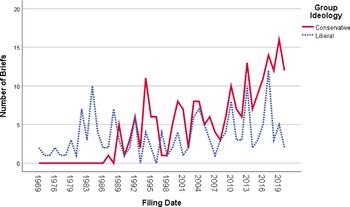
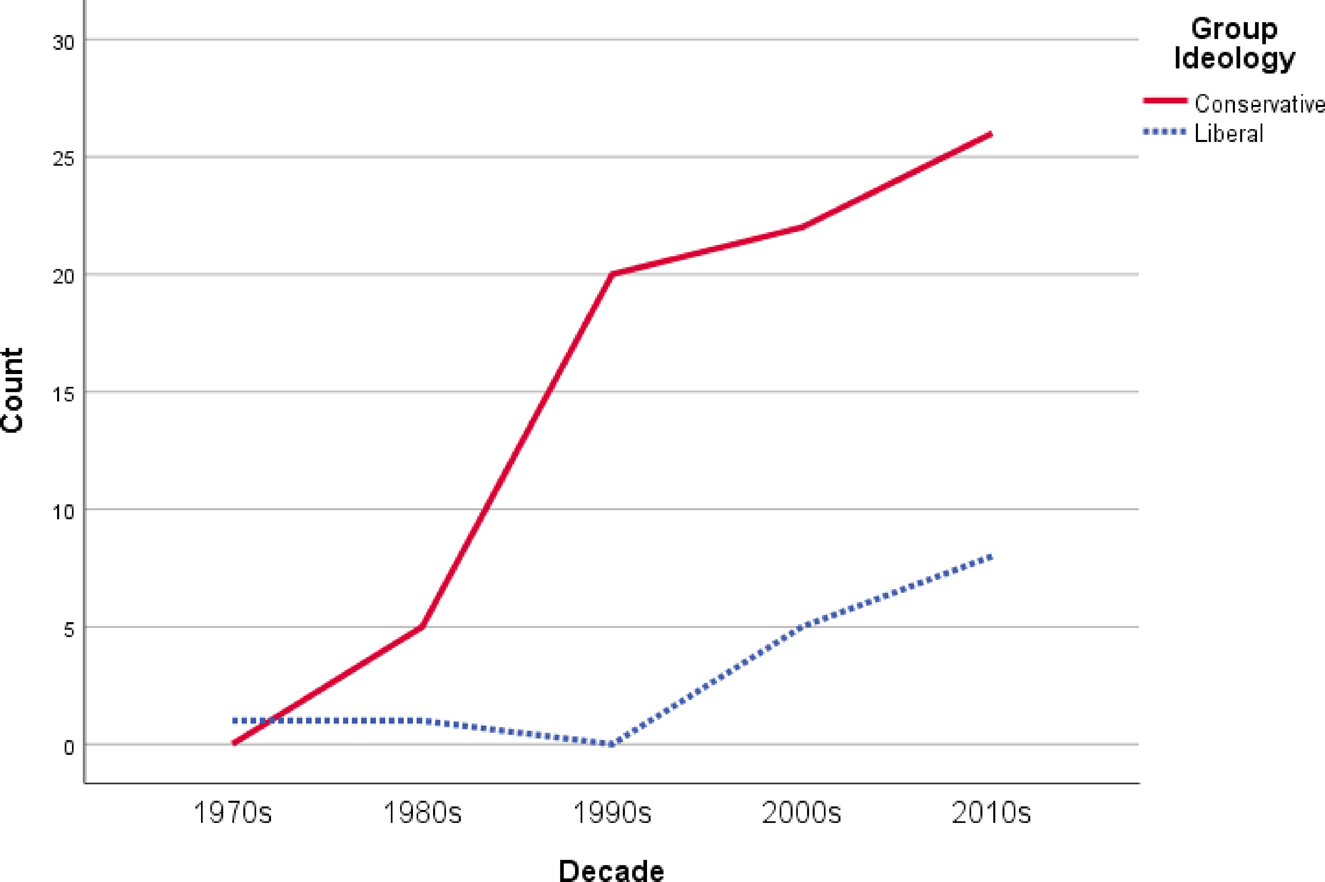
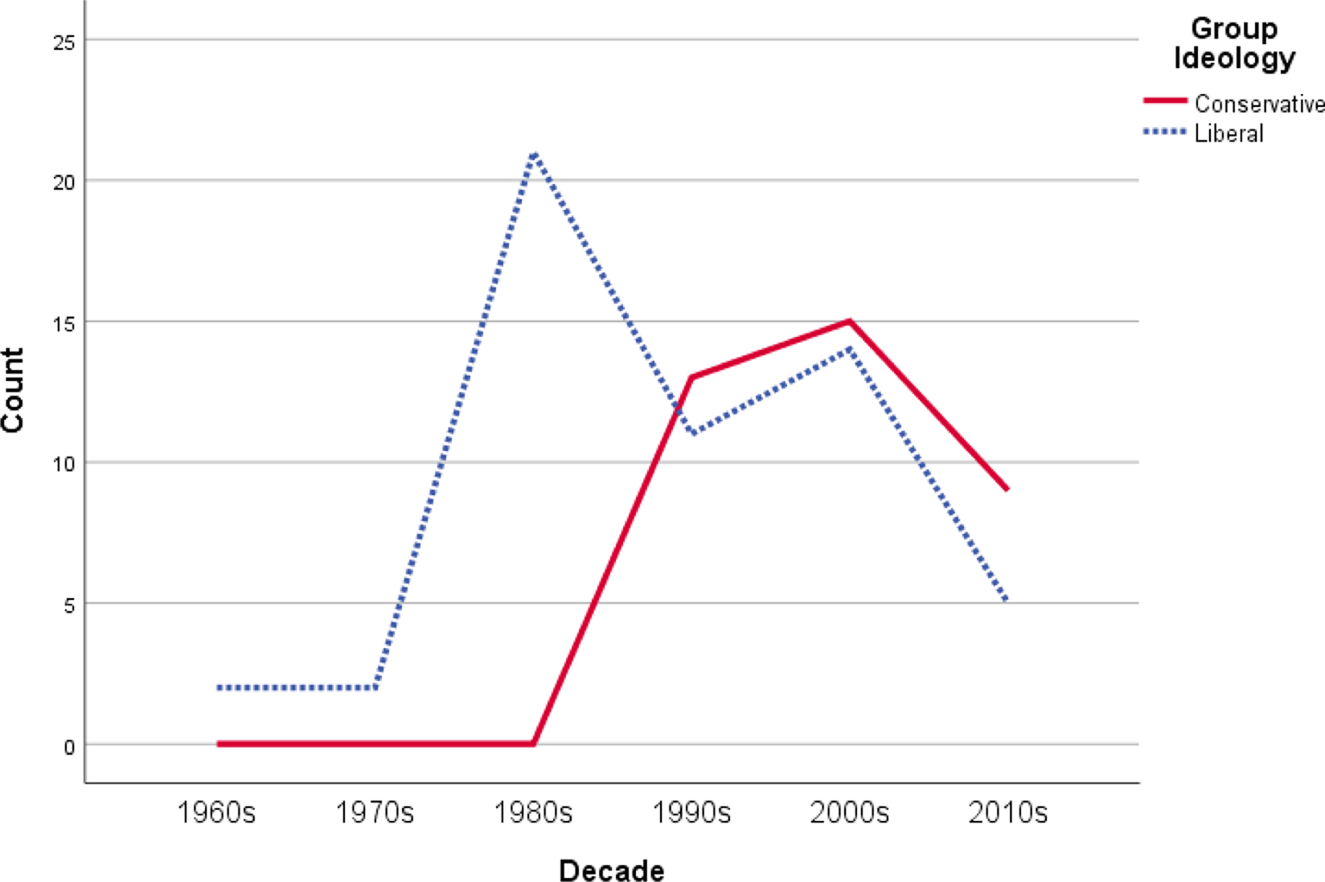
The frequencies in Table 1 represent only the total number of brief signatures by each party over a five-decade period, without regard for filing date. We include date information in the figures below to demonstrate changing levels of participation over time, the subject of our initial hypothesis. Figure 1 shows the count of brief signatures per year from 1969 to 2020, grouped by the ideology of the organization joining the brief.
Amicus brief signatures by group ideology 1969–2020.

The data in Figure 1 largely support our first expectation, that the level of amicus participation has increased over time, but the increase is not linear. This reflects the variation, within each Supreme Court term, in the number of cases that are deemed significant by religious groups. In some years the Court may grant cert in several cases that interest these groups, and in others years there may be no such cases. Similarly, with regard to cert stage briefs, the number of petitions that these groups wish to support will vary each term.
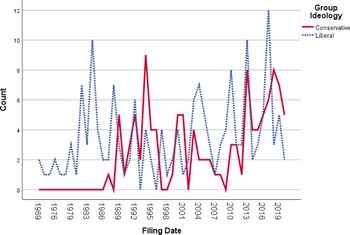
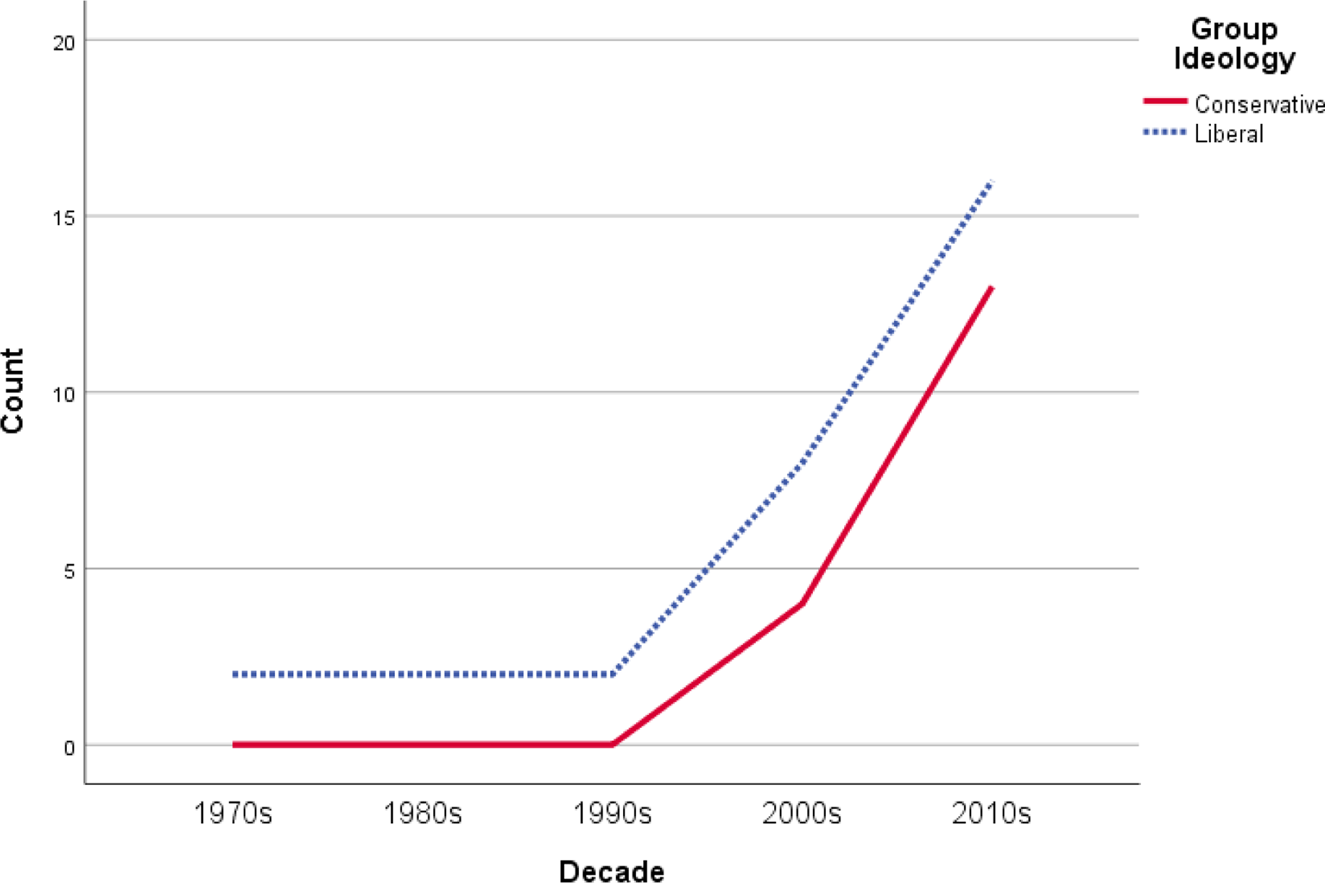
The data in Figure 1 show that liberal groups initially participated in amicus briefs more frequently than conservative groups, but that began to change in the 1990s, which saw a sharp upturn in conservative amicus activity. From the 1990s to the present, conservative groups have generally signed on to more briefs than liberal ones in any given year, although the rate of signing varies from year to year for all groups. To a considerable degree, this difference can be explained by the fact that the ACLJ, the most active group in our study, was founded in the 1990s. With the ACLJ excluded, Figure 2 shows that conservative amicus participation exceeded liberal participation in the periods from 1992 to 1995, and 1998 to 2001. In all other periods, liberal participation exceeded that of the conservative groups. This is a testament to the active role the ACLJ plays in pressing the Christian right's legal agenda; it also confirms the 1990s as the decade when the Religious Right's political engagement burgeoned. Additionally, we observe an upturn in both progressive and conservative filings beginning around 2010. This is consistent with the overall trend in amicus brief filings in the last decade, in which amici curiae of all types have filed an unprecedented number of briefs in the Supreme Court (Franze and Anderson Reference Franze and Anderson2020).
Amicus brief signatures over time by group ideology, excluding ACLJ 1969–2020.

Convergence of issue areas in filings
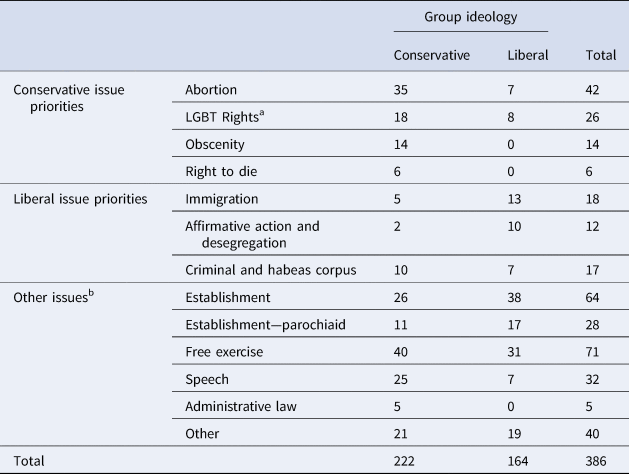
We turn next to our expectations regarding the groups' issue agendas, and how they will react to participation by their ideological adversaries. We predicted above that a group's ideology would determine which issues compose its agenda, but also that groups on each side would tend to move, over time, into issue areas that were once primarily the concern of the other side. We first display the frequencies of amicus participation by issue area in Table 2 below. In coding issue areas, we relied upon the issue coding used by the Supreme Court Database (“SCDB”) (Spaeth et al. Reference Spaeth, Epstein, Martin, Segal, Ruger and Benesh2020), with some modifications appropriate to our analysis, which are detailed in the Appendix.
Brief signatures by issue area and group ideology, sorted by issue priorities

a Note that we expect conservative participation in LGBT rights to be in opposition to those rights.
b The “Other Issue Categories” includes issues which we would expect both sides to prioritize, such as Free Exercise and Establishment, and issues about which we would not necessarily expect one side to be more concerned than the other.
Unsurprisingly, Table 2 shows high rates of participation by both conservative and liberal groups in Establishment Clause and Free Exercise cases. Because the Supreme Court database uses a separate category, “Parochiaid,” for Establishment cases involving aid to religious schools, we have done the same. The “Establishment” category contains all non-Parochiaid Establishment Clause cases.
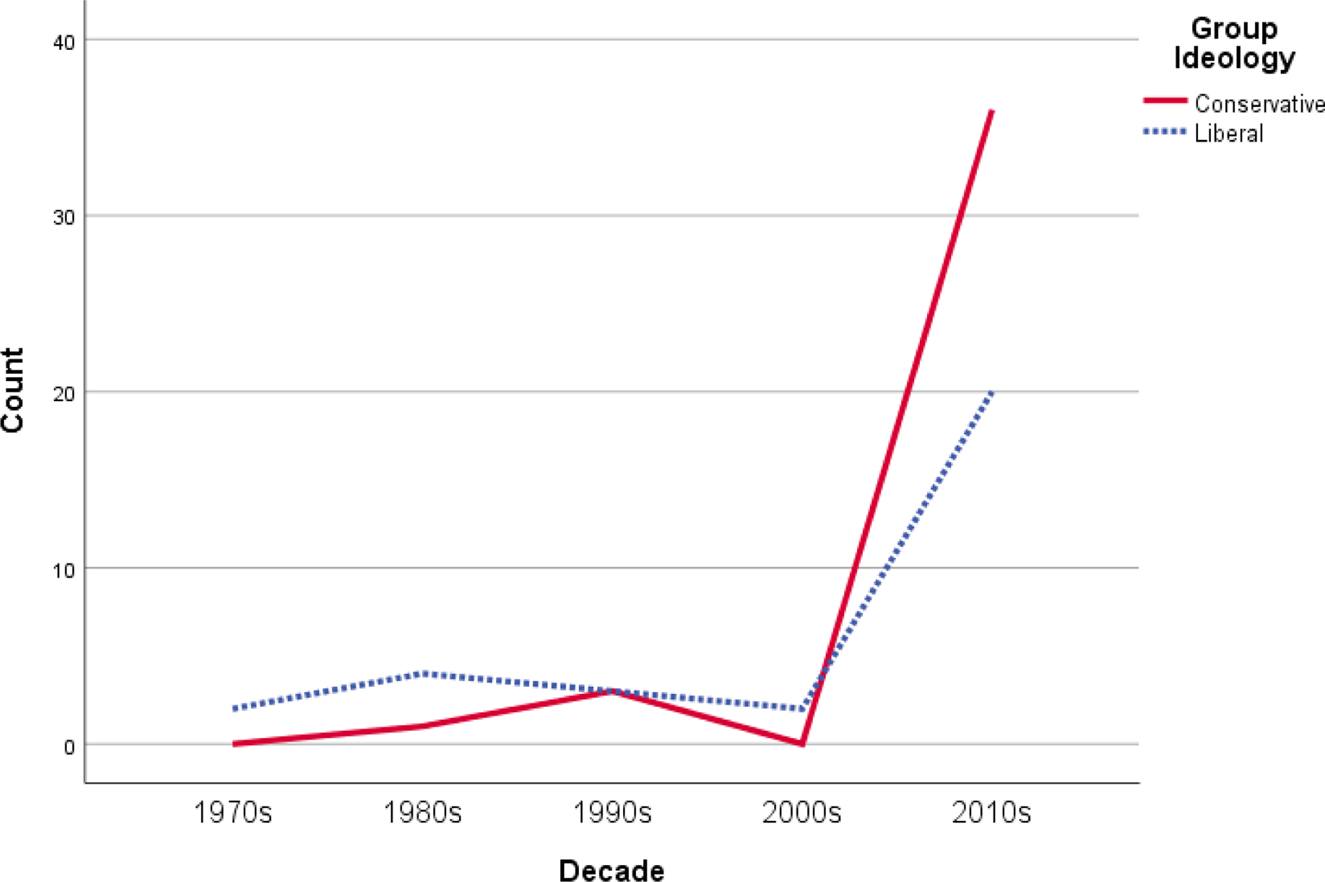
The top four rows of Table 2 concern issues that we expect to be conservative priorities, as they reflect the conservative focus on issues related to sexual morality, the family, and the protection of life: Abortion, (opposing) LGBT Rights, Obscenity, and Right to Die. The next two rows display results for issues that we expect to be liberal priorities, primarily because they reflect the liberal focus on social justice: Immigration, Affirmative Action and Desegregation (combined into one category), and Criminal Procedure and Habeas Corpus (combined into one category). The following rows display results for all other issues, including some, such as the religion clause cases, that we expect to be priorities for groups on both sides. As expected, we see more conservative brief signatures in cases involving conservative issue priorities, and more liberal brief signatures in cases involving the liberal issue priorities, with the exception of the Criminal and Habeas category—here conservatives have actually been more active overall. But, as Figures 3 and 4 demonstrate, we also see the groups on each side moving into the others' territory over time.
Brief signatures over time in conservative issue priority cases.

Brief signatures over time in liberal issue priority cases.

As Figure 3 demonstrates, liberal groups only began to become active in cases involving conservative issue priorities in the 1990s, with their activity steadily increasing since. However, conservatives are still much more active in these areas overall, in part because the liberal groups have not filed briefs in Right to Die or Obscenity cases. Still, liberal groups have begun to weigh in more in LGBT Rights and Abortion cases.
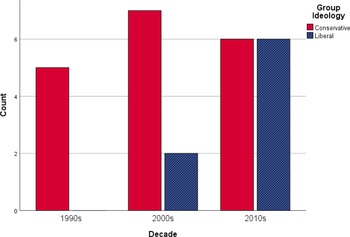
Similarly, Figure 4 demonstrates that conservatives have become increasingly active in cases involving liberal issue priorities. Liberal participation began to increase in the 1990s, at the same time that the conservative groups began to “catch up” by participating in cases focused on these issue areas. While liberal participation remained higher over time, the nearly parallel increase in conservative activity is noteworthy. As conservative groups staked out their own agenda, they also increased their participation in cases involving liberal issue priorities.
While the next section analyzes the filings in religion clause cases, abortion, LGBT Rights, Abortion, Immigration, and Affirmative Action, we should also briefly discuss the other issues in which the groups filed briefs. Conservative groups were active in Obscenity and Right to Die cases, in which liberal groups did not participate at all. This is consistent with the Christian Right's moral views on matters of ethics and sexuality. Christian left groups, on the other hand, appear not to prioritize these issues. Because of the Christian left's social justice concerns, we expected them to be more active in criminal and habeas corpus cases, but conservative groups were somewhat more active. The majority of Christian right involvement in criminal cases came from the ACLJ, whose positions seem to favor conservative ideology more than any particular religious view. They argued against habeas corpus rights for Guantanamo detainees, against the use of a chemical weapons treaty in a criminal prosecution, and in favor of Virginia Governor Bob McDonnell in a case involving political corruption. Similarly, only conservative groups filed briefs in administrative law cases, which reflects conservative concern with the growth of the federal government and the administrative state. Finally, conservatives filed over three times the number of briefs in free speech cases. While we did not expect the difference to be this large, this reflects the growing rights consciousness among conservatives noted by Lewis (Reference Lewis2017), which includes a connection between freedom of expression and freedom of religion.
Focused attention on briefs by subject matter
To provide a deeper dive into the motivations behind the brief filings, we now give three categories of cases focused attention: those involving the First Amendment's religion clauses, then subject areas that are classically associated with Religious Right and Religious Left groups, respectively. In presenting these more focused analyses, we will examine aggregate trends in brief filings over time as well as present selective arguments that are made in the briefs themselves. To represent Religious Right issue areas, we focus on Abortion and LGBT Rights, and for Religious Left issues, we examine cases involving Immigration and Affirmative Action/Desegregation.
Religion clauses
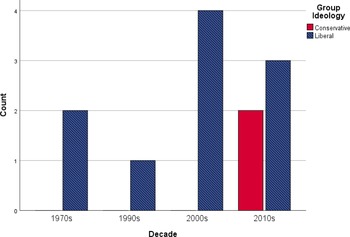
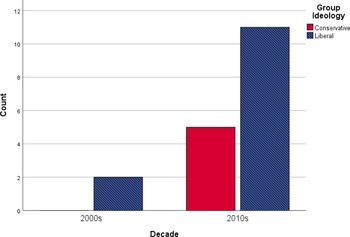
Trends in brief filings. We begin by examining amicus participation in religion clause cases. The most readily apparent trend is the overall decline in participation in Establishment Clause cases and the relatively recent and sharp rise in participation in Free Exercise cases. Figures 5 and 6 display the overall trends. Liberal groups were heavily involved in Establishment Clause cases in the 1980s, but their participation dipped slightly in the 1990s, when conservative groups first started to become involved. In this century, both groups have been less active in Establishment clause cases, while becoming much more active in Free Exercise cases. This represents not just a shift of emphasis among the groups, but a shift in the Supreme Court's agenda. While our goal in this article is not to analyze the Supreme Court decisions, it is worth noting that a jurisprudential shift in favor of the conservative construction of religious liberty that began in the 1990s appears to be driving both the changing patterns indicated in Figures 5 and 6 and also the arguments that we find in briefs across all subject areas, as the First Amendment was often the subtextual lynchpin of religious groups' amicus arguments. The 21st century trends in Free Exercise participation appear to provide an example of one side leading the other. The Christian Right, taking advantage of both new rights consciousness and favorable legal developments, became more active in Free Exercise cases, and the Christian left appears to have thought it necessary to catch up to the right in this area with their own filings, even if they never reached the same level.
Brief signatures in establishment and parochiaid cases by decade and group ideology.

Brief signatures in free exercise cases by decade and group ideology.

Arguments presented in briefs. By the time Lee v. Weisman, 505 U.S. 577 (1992), a case involving prayer at graduation ceremonies, came before the Court, the separationist interpretation of the Establishment Clause was both mostly settled law yet also highly contested by conservatives. Briefs filed in this and other cases reveal profound differences in liberal and conservative groups' conceptions of religious freedom. Representing the liberal perspective, an amicus brief filed by 10 groups, including both the BJC and NCC, argued that “religion and religious liberty have benefited” from the Court's then-existing approach to the Establishment Clause and that adopting a different interpretation would eliminate its protections.Footnote 8 The brief further argued that “Government-sponsored religious observances hurt believers as well as nonbelievers…by imposing government's preferred form of religion on public occasions.”Footnote 9 Each of these claims was consistent with the existing logic of the Court's jurisprudence, and a substantial portion of the brief was dedicated to summarizing the multifarious ways religion had proven to be divisive and even destructive when introduced in public school settings, especially those with religiously diverse student bodies.
Conservatives demonstrated less solicitude for separationism, and it is worth spending some time discussing not only their briefs in this case, but their tactics in First Amendment litigation during the 1990s as a whole, as the Court apparently came to accept its underlying assumptions. As discussed above, religious conservatives regard secularism with deep hostility, and many evangelical leaders such as James Dobson, who founded Focus on the Family, even see it as a conscious strategy to destroy America (Martin Reference Martin1996, 344). Their arguments by the early 1990s held that the secularist requirements of the Court's First Amendment jurisprudence had led to a public square hostile to religion (McConnell Reference McConnell, Stone, Epstein and Sunstein1992; Carter Reference Carter1993).
These sentiments found expression in two briefs filed in support of the school district in Lee v. Weisman, one by Focus on the Family, and one by the SBC. These filings capture the groups' sense of beleaguerment and frustration with separationist doctrine. Focus on the Family argued that separationism “leads to government hostility toward religion” and advocated instead that the Court should “interpret the Establishment Clause in tandem with the Free Exercise Clause to promote the common purpose for which they were both enacted.”Footnote 10 Employing the arguments of minority religious groups, whose mantle they now assumed, the brief declared that “we feel that we have been discriminated against” and that “religiously inclined students and families confront the clear message that they are outsiders.”Footnote 11
The brief filed by the SBC amplified these themes, claiming “relentless secularism also violates the Establishment Clause” and that failing to accommodate religious viewpoints in the classroom “amounts to a denial of equal protection of the law.”Footnote 12 It explicitly called for a rejection of the Lemon test and invoked the scholarship of Michael McConnell, who developed a powerful argument for conceptually integrating the Establishment and Free Exercise clauses.Footnote 13
McConnell's approach essentially blends anti-statism with solicitude for religion, which he finds to be marginalized and discriminated against whenever the Lemon test is faithfully applied. The solution is for the state to get out of the way and let Americans practice their religions (McConnell 1992). His scholarship blended Justice Stewart's observation that such cooperation had a long and widespread history in America with the claim that failing to accommodate it amounted to treating religion with disfavor in comparison with nonreligious practices. As lead counsel in Rosenberger v. Rector and Visitors of the University of Virginia, 515 U.S. 819 (1995), he was able to persuade a majority of Justices that the constitutionality of a state university using tax dollars to fund a student group's religious publication was best seen not through the lens of the Establishment Clause, but the Free Speech Clause, in conjunction with the Free Exercise Clause. This case built on Widmar v. Vincent 454 U.S. 263 (1981), in which the Supreme Court ruled in favor of a religious group at a public university that had been denied the right to use campus facilities for prayer and religious teaching. In Rosenberger, the use of the Free Exercise Clause to adjudicate subjects that had traditionally been decided as Establishment Clause cases, an approach long advocated by religious conservatives (Lewis Reference Lewis2017, 61–63, 78–85), thus became formally integrated into constitutional law.
This jurisprudential shift manifests in contemporary brief filings, as religious groups have adapted their arguments to fit the changed legal milieu. The most recent Establishment Clause case in the dataset, American Legion v. American Humanist Association, 139 S. Ct. 2067 (2019), is sometimes referred to as the “Peace Cross” case because it centers on a World War I monument in Maryland that, while initially built with private funds, is now publicly maintained. Liberal groups from our dataset participated in two separate briefs for this case. The brief signed by Interfaith Alliance, along with other civil rights and religious groups, argued that the government was impermissibly favoring one religion by maintaining a monument in the shape of a Christian symbol and admonished that, “Regardless of the counties’ intent, the Bladensburg Cross sends the divisive and hurtful message that non-Christians are second-class citizens whose sacrifices for our Nation do not count.”Footnote 14 The brief signed by the Baptist Joint Committee offered a similar argument, stating that “Using the cross to honor our nation's war dead reflects either the erroneous assumption that our military is comprised entirely of Christians, or the equally erroneous assumption that the most sacred symbol of Christianity somehow honors non-Christians as well.”Footnote 15
Conservatives, meanwhile, offered a Free Exercise frame, with the SBC brief arguing that the Establishment Clause does not require the state to refrain from sponsoring a monument that reflects a particular religious tradition. Among other arguments, they claimed that such an understanding of the Establishment Clause is harmful to religious liberty.Footnote 16 The SBC's position in the “Peace Cross” case reflects the Religious Right's opposition to defining government neutrality toward religion by reference to secular outcomes. In Trinity Lutheran Church v. Comer, 137 S. Ct. 2012 (2017), in which a church challenged the Missouri Department of Natural Resources' policy of denying grants to applicants controlled by religious institutions, the strategy was to replace the Establishment Clause's mandate against state funding of religion with an appeal to the Free Exercise Clause. In separate briefs, the ACLJ and the SBC thus insisted that a neutral state aid program was required to accommodate religious organizations by allowing them to apply for grants.Footnote 17
In separate briefs, the Interfaith Alliance and the BJC took the opposite view, arguing that, while states can choose to allow religious entities to participate in such a funding program, there is nothing in the Free Exercise or Establishment clause that requires them to do so. They also held that restrictions such as Missouri's actually protect religious liberty by prohibiting state funding of religious institutions.Footnote 18 This reflects the consistent view among religious liberals that separationism protects religious liberty.
The opposing positions taken by groups on the left and right in these religion clause cases present competing visions of the relationship between religion and the state. Progressive groups emphasize the importance of government neutrality in preserving religious freedom. Conservative groups, however, advocate for a view of religious freedom in which accommodating religion can require government to offer benefits to religious groups. The divergent interpretations of the First Amendment that we find expressed in these briefs reflect a deeper disagreement over who needs protecting from whom. Religious liberals are likely to see minority faiths as needing protection from a political culture that tends to reflect Christian values, while religious conservatives see themselves as an embattled minority in need of protection from an overbearing state. This fundamental difference in turn colors how each side engages other issue areas.
Abortion and LGBT rights
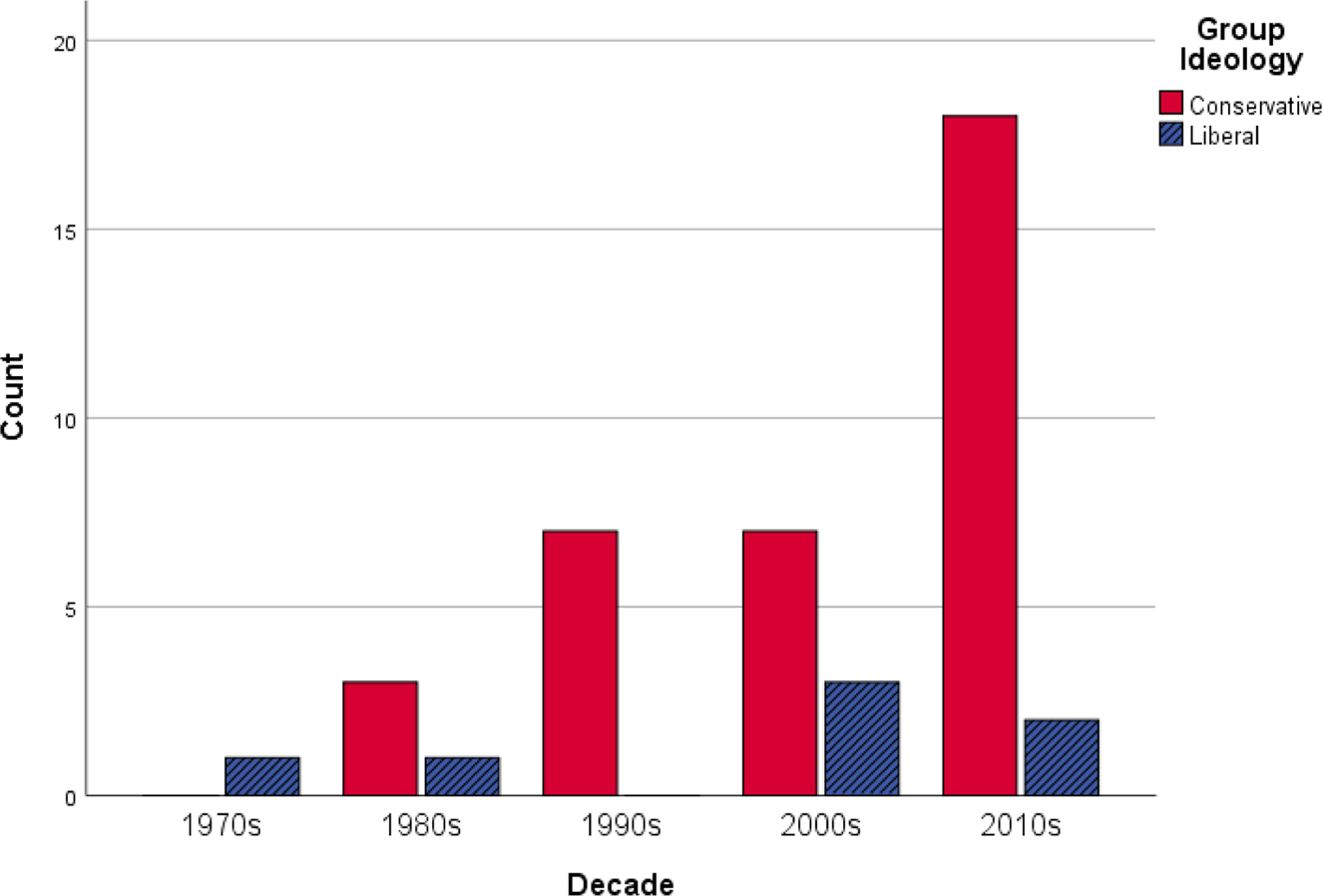
Trends in brief filings. Turning to our “conservative” issues, we begin by examining abortion and LGBT Rights cases. Figure 7 shows the number of brief signatures by liberal and conservative groups in cases involving abortion, including contraception; Figure 8 does the same for LGBT rights. We would expect conservatives to be more involved initially in these kinds of cases, but liberals to eventually become active, in order to differentiate themselves from their Christian Right counterparts. We also anticipate both groups to become steadily more active in both issue areas, with variation expected due to changes in the Court's docket, as noted above.
Brief signatures in abortion cases by decade and group ideology.

Brief signatures in LGBT rights cases by decade and group ideology.

Our expectations about amicus participation in LGBT Rights cases were confirmed, as liberal groups began filing briefs with greater frequency over time, eventually equaling the involvement of their conservative counterparts. Here, conservative groups have consistently participated since the 1990s, whereas none of the liberal groups in our study filed any amicus briefs until the 2000s. By the 2010s, however, the participation of Religious Left groups rose to the same level as Religious Right groups. The picture for amicus filings in abortion cases is more mixed. The liberal groups in our study began filing briefs in abortion cases earlier than any of the conservative groups, but infrequently. Beginning in the 1980s, however—even before the ACLJ was formed—conservative amicus participation in abortion cases began to increase, and has been significant ever since, easily outpacing that of the Religious Left. In these cases, the gap between conservative and liberal group participation remains wide as conservatives continue to engage this policy realm with greater commitment than their liberal counterparts.
Arguments presented in briefs. To illustrate the divergent moral visions espoused by religious conservatives and liberals in these cases, we now examine the briefs filed in the Hobby Lobby case, which concerned the contraception mandate in the Affordable Care Act (ACA). We also survey some additional observations from the Masterpiece Cakeshop case, which concerned a CO ordinance forbidding discrimination, in this case against a gay couple for whom Masterpiece Cakeshop refused to create a wedding cake. In both cases, religious conservatives and liberals alike grounded their arguments in the need to defend religious liberty and pluralism.
Among the groups in our analysis, the conservative religious position in Sebelius v. Hobby Lobby Stores, 573 U.S. 682 (2014), was presented in an amicus curiae brief filed by the SBC in conjunction with nine other religious organizations. The argument presented in the brief straightforwardly addressed whether the protections of the Religious Freedom Restoration Act (RFRA) extended to for-profit corporations.Footnote 19 Noting that the language of RFRA applied its protections to “all” persons without exception, and noting as well that the owners of Hobby Lobby objected for religious reasons to the ACA's requirement that the company provide access through employee insurance to forms of contraception they regarded as abortifacients, the brief argued that the religious liberty rights of the corporation were thereby violated. Noting that the intention to include all “persons” in RFRA's protections (including corporate persons) was universally held in both the House and Senate, the brief concluded by noting that “The Free Exercise Clause must be understood at least to address historically familiar means of religious persecution,” such as imposing onerous burdens on businesses for honoring their religious beliefs. In this way, and by relying on the religious liberty frame overall, the brief aligned Hobby Lobby with religious minorities being persecuted by their government.Footnote 20
Of the liberal groups included in our study, the Interfaith Alliance signed a brief filed in conjunction with 27 other religious groups, including several Jewish organizations, Hindu groups, and other Christian groups. (Some co-signers of the brief were specifically concerned that an unfavorable precedent would allow businesses to employ a religious liberty defense to limit LGBT rights; the Masterpiece Cakeshop decision validated that concern not long afterwards.) The argument in the brief, like the SBC's, was couched as supporting a robust application of RFRA. It arrived at a diametrically opposed conclusion of how RFRA applied to the facts, however, arguing that granting religious freedom protections to Hobby Lobby “would undermine—not promote—religious liberty, by allowing employers to impose their owners’ religious beliefs on employees, many of whom will hold different moral and religious views on the use of contraception.”Footnote 21 The brief further argued that since the employees would be the ones actually purchasing any contraceptives, and that they would be doing so through a doctor's prescription, paid for by an insurance company, Hobby Lobby would not even be involved in the procurement of contraceptives to a degree that constituted a burden on its religious practices.Footnote 22 The emphasis in the brief rested on the diversity of religious beliefs in the United States, including the diversity within any given workplace.
Uniting the claims on each side of this case was a sense of having one's religious liberty undermined by an adverse ruling. For SBC, not allowing Hobby Lobby an exemption from a federal policy that required it to provide (however indirectly) contraception to its employees amounted to religious persecution of the corporation and its owners. For Interfaith Alliance, providing that same exemption amounted to religious persecution of the employees. It was a case, as it were, of competing persecutions, with no meaningful way to satisfy both sides.
Such was the case in Masterpiece Cakeshop v. Colorado Civil Rights Commission, 138 S.Ct. 1719 (2018), as well. That case drew four briefs involving our groups. The two from religious conservatives stressed the baker's religious freedom, which was rooted in the long tradition of identifying one's labor with doing God's work, while two from religious liberals stressed the religious diversity in the United States and the harm that comes from allowing one's religion to be used to undermine the equal rights of others, particularly other religious individuals and groups. The only additional observation we share from that case comes from a section in the SBC brief, which characterized the increasing social and legal opprobrium against condemning or marginalizing homosexuality as “assaults on religious freedom.”Footnote 23 This passage expresses the Religious Right's fundamental opposition to homosexuality in zero-sum terms: if they cannot persecute homosexuals, then they themselves are thereby being persecuted. Properly applied, in other words, the First Amendment extends to them the religious freedom to punish and condemn homosexuality.
Affirmative action and immigration
Trends in brief filings. As for the subjects that we associate with religious liberals, when looking at the number of briefs filed, liberal groups take the lead, and conservatives only belatedly begin to enter these issue areas. Figure 9 shows participation in Affirmative Action and Desegregation cases (two related issue areas that we consolidated), and Figure 10 shows the groups' amicus participation in immigration cases. In both issue areas, the conservative groups in our study only began amicus participation in the 2010s. Liberal groups have been episodically engaged in affirmative action and desegregation cases since the 1970s and began becoming involved in immigration cases in the 2000s (a time frame that most likely reflects increasing political salience of immigration). While there is not the full convergence of brief filings that we observed in LGBT cases, we did identify unmistakable movement in that direction for both categories.
Brief signatures in affirmative action/desegregation cases by decade and group ideology.

Brief signatures in immigration cases by decade and group ideology.

Arguments presented in briefs. To provide a flavor of the arguments and moral stances that the groups present in their briefs in these issue areas, we again look briefly at briefs filed in two prominent recent cases. Fisher v. University of Texas at Austin, 570 U.S. 297, was a major affirmative action case from 2013, which was ultimately remanded to a lower court, taken up again by the Supreme Court, and finally decided in 2016. Trump v. Hawaii, 138 S. Ct. 2392 (2018), involved the so-called “Muslim ban” on immigration from certain countries. The two cases featured a total of 10 brief signatures by our groups.
Looking first at Trump v. Hawaii, the NCC and the Interfaith Alliance jointly filed a brief in conjunction with 39 additional groups. The ACLJ, filing alone, did the same on the conservative side, in two distinct rounds of filings. The briefs filed by the liberal groups argued that the proposed policy, by intentionally discriminating against Muslims, evoked some of the more sordid chapters of the country's history of imposing immigration quotas on the basis of race, ethnicity, and religion. They argued that singling out Muslims for disfavored treatment violated the Establishment Clause and explained that doing so “harms members of all faiths as beneficiaries of this Nation's commitment to religious free exercise.”Footnote 24 The brief also provided several examples of President Donald J. Trump's anti-Muslim rhetoric (mostly from campaign speeches), from which it drew a broader lesson. “Were this Court to sustain the Proclamation's validity despite such clear evidence of animus and harm to Muslims, it would send a message that religious-based discrimination is tolerable so long as it is framed in a way that appears superficially neutral” (i.e., as an anti-terrorism policy).Footnote 25 This argument was broadly consistent with religious liberals' traditions of empathizing with disfavored groups, relying on the Establishment Clause to justify a secular (i.e., in their view, neutral) policy framework to attain religious liberty, and identifying religious liberty with a climate of ecumenical pluralism.
The ACLJ rejected this analysis in its entirety. It primarily grounded its defense of the policy on its context (foreign policy), which both mandated judicial deference to the national security judgment of the political branches and rendered the Establishment Clause inapplicable. The brief further rejected the notion that the policy discriminated against Muslims, both because it identified entire nations, which, though Muslim-majority, contained non-Muslim citizens who were also excluded from traveling to the United States and also because it did not exclude other Muslim-majority nations. The administration's claim that the policy was tailored to combat terrorism should thus be accorded judicial deference, and the President's comments as a candidate should be ignored. The state's secular policy purpose of antiterrorism also shielded it from scrutiny under the Lemon test, thus eliminating the Establishment Clause complaint outlined in the brief filed by liberal religious groups.Footnote 26
In this highly visible immigration case, then, the ACLJ did not include a religious or moral dimension in its argument at all but sought instead to simply counter the claims of those who objected to the policy on Establishment Clause grounds, specifically separationism. For religious liberals, by contrast, those grounds were central to their understanding of how moral and religious values are realized in a democratic society. A similar dynamic was evident in the briefs filed for Fisher v. University of Texas at Austin. The liberal perspective was represented by the NCC and Sojourners, who joined with 13 other religious organizations to file one brief in each of the two stages of the case history. The core argument that they put forward held that a pluralistic society required a diverse student body in colleges—especially flagship universities, where leaders are cultivated. They wrote, “amici seek to promote a society that recognizes the worth and dignity of every human being. …At the same time, amici focus on outreach to and engagement with wider communities—teaching and fostering respect for those of different faiths, opinions, and beliefs.”Footnote 27
Once again, we find a brief filed by Religious Left organizations presenting a vision of a just moral order that is characterized by pluralism safeguarded by protection for the marginalized. The briefs filed by the ACLJ presented a line of argument featuring a similar solicitude for the dispossessed in order to arrive at the opposite conclusion. Its central theme was the invidiousness of racial categorizations imposed by the state, which the ACLJ linked to the Rwandan Genocide, the Holocaust, and slavery and segregation in the United States.Footnote 28 Two basic differences separated the ACLJ's and the NCC/Sojourner positions. The first was that the ACLJ attributed racism to state policy whereas the NCC and Sojourners identified social bases of racism that required state intervention to remedy. Secondly, while both sides agreed that racism was heinous, the liberals' brief valued pluralism as a good in itself, while the ACLJ emphasized racial unity, even arguing that racial differences had no objective basis.
Discussion
Beginning in the 1960s, religious politics in the United States became polarized in new ways while also coming to be implicated in an ever-broadening range of issues. Inevitably, these policy disputes—over matters of sexuality and the family, civil rights and the rights of the poor—became legal battles. Before long, religious freedom became implicated in almost every major policy initiative in America as the culture war moved to the center of American politics. Yet, although this history is familiar, the way scholars have chosen to study it has resulted in most attention being given to one side of this religiously based judicial rivalry: religious conservatives. In this article, we have seen that religious progressives not only have been at least as active as their conservative opponents, but that each side engages topics and frames arguments with an eye cast warily on the other. Neither religious liberals nor conservatives can be understood in isolation from their opponents—and make no mistake, they see themselves, in part, in opposition to each other. This makes the relative inattention given to religious progressives surprising.
When engaging the judicial realm, however, religious arguments require a constitutional architecture, and over time both sides have shown sophistication in their legal tactics, with the Religious Right enjoying a decided advantage at this juncture. Their success validates a decades-long program of developing a legal arsenal including law schools Like Regents and Ave Maria, advocacy groups such as the Becket Fund and the Alliance Defending Freedom, and networking activity with the broader conservative movement that is far more robust than that built by their progressive counterparts. Still, informal meetings by the broadly ecumenical Religious Liberty Committee predate these organizational developments, and the Christian Left has also made some efforts in this area in recent years, as with the Law, Rights, and Religion Project. In general, areas of the legal practice dealing directly or indirectly with religious liberty, including legal materials, law school courses, and specialized attorneys, have exploded in growth in recent decades.Footnote 29 At the same time, in presenting their moral convictions on subjects ranging from immigration to gay rights as raising the specter of religious freedom or persecution, religious liberals and conservatives have both deepened their respective niches (as legal victories increasingly mean exemption from otherwise applicable laws) while also inviting a legalistic and possibly litigious posture on an expanding array of matters of moral import. Religious groups are far more active in court cases today than they were 50 years ago, and they increasingly seem to find reason to file amicus briefs in cases dealing with subjects that fall outside their traditional areas of concern. These trends show no sign of abating.
If bringing attention to the involvement of religious progressives in judicial politics has advanced our understanding of these issues, then still more could be learned if the net were cast more widely. As noted above, numerous different Catholic, Jewish, and Black Protestant groups have been active in this arena, to say nothing of other religious progressive and religious conservative organizations, “special-interest” religious groups (e.g., those focusing on abortion), and organizations representing minority faiths such as Muslims, Native Americans, or Hindus. Indeed, representatives from each of these groups participated in the amicus filings that we examined. Also, because our purpose in this project was to analyze how the Religious Left and Religious Right engaged the judicial process by reference to the culture war, we did not assess how influential either side was in actually shaping the Supreme Court's jurisprudence. We did not study, in other words, who won—although we could not help but detect mounting success on the side of religious conservatives across a range of issues once their Free Exercise frame gained ascendance. Finally, we did not examine religious group involvement in cases at the state or lower federal levels. Clearly, more research needs to be done in this area. What we can conclude, however, is that the involvement of religious groups in judicial politics seems certain to continue into the foreseeable future, with consequences we are just beginning to appreciate.
Conflict of Interest
None.
Jonathan B. Hensley is, as of Academic Year 2022–2023, Assistant Professor of Political Science at Towson University. He studies the intersection of law, politics, and religion, the U.S. Supreme Court, and the role of interest groups in the American judicial system.
Paul T. McCartney is Professor of Political Science at Towson University. He is the author of Power and Progress: American National identity, the War of 1898, and the Rise of American Imperialism and several articles on a variety of topics, including American nationalism, religion and politics, and U.S. foreign policy.