Background
A large number of studies report that non-psychotic first-degree relatives of patients with schizophrenia show neurocognitive dysfunctions similar (but to a milder degree) to those displayed by patients with the illness (e.g. Snitz et al. Reference Snitz, Macdonald and Carter2006). However, these studies describe heterogeneous patterns of neurocognitive dysfunctions, involving different domains such as memory, attention and executive functions (Conklin et al. Reference Conklin, Curtis, Calkins and Iacono2005; Gur et al. Reference Gur, Nimgaonkar, Almasy, Calkins, Ragland, Pogue-Geile, Kanes, Blangero and Gur2007; Skelley et al. Reference Skelley, Goldberg, Egan, Weinberger and Gold2008). In contrast, some studies did not find any difference in neuropsychological functioning between first-degree relatives of patients with schizophrenia and control subjects (Faraone et al. Reference Faraone, Seidman, Kremen, Toomey, Lyons and Tsuang1996; Barrantes-Vidal et al. Reference Barrantes-Vidal, Aguilera, Campanera, Fatjó-Vilas, Guitart, Miret, Valero and Fañanás2007; Erol et al. Reference Erol, Bayram, Kosger and Mete2012). Moreover, in any sample of relatives of people with schizophrenia, only a subgroup of relatives is likely to be neuropsychologically impaired (Faraone et al. Reference Faraone, Seidman, Kremen, Pepple, Lyons and Tsuang1995). In a previous study of first-degree relatives of patients with schizophrenia, we found an impairment of executive functions as compared with controls (Scala et al. Reference Scala, Lasalvia, Cristofalo, Bonetto and Ruggeri2012). It is possible that the impairment affects only a sub-group of relatives, while the remaining part of the sample might show essentially normal performance. It is also possible that the variability of neuropsychological functioning in relatives could be a reflection of the heterogeneity within patients, perhaps corresponding to pathophysiological features.
Furthermore, a recent systematic review (Dominguez et al. Reference Dominguez, Viechtbauer, Simons, van Os and Krabbendam2009) suggests that different underlying pathophysiological processes associated with different intermediary phenotypes may substantially account for psychopathological heterogeneity in non-affective psychosis. This study specifically found that negative symptoms were moderately associated with impairment in neurocognitive functions, such as verbal fluency and Wisconsin card sorting test (WCST) measures.
Schizophrenia is well known to be a heterogeneous disorder (Lin et al. Reference Lin, Nelson and Yung2012). Over the years, a number of psychopathological categorizations have been proposed (e.g. Andreasen & Olsen, Reference Andreasen and Olsen1982; Crow, Reference Crow1985) to describe clinical profiles that may reflect its underlying pathophysiology. Among these categorizations, the deficit v. non-deficit syndrome has gained increasing attention, since it proved to be a promising model from both a heuristic and clinical perspective (Carpenter et al. Reference Carpenter, Heirrichs and Wagner1988; Kirkpatrick et al. Reference Kirkpatrick, Buchanan, McKenney, Alphs and Carpenter1989). The ‘Deficit’ form is characterized by a more frequent familial history of schizophrenia, insidious onset, intellectual deterioration, prominent negative symptoms, poor response to antipsychotic medication and structural brain abnormalities (i.e. enlarged ventricles) (Kirkpatrick & Galderisi, Reference Kirkpatrick and Galderisi2008). On the other hand, the ‘non-deficit’ form typically presents acute onset, prominent positive symptoms, relatively normal intellectual functions, less significant brain abnormalities and a better clinical outcome (Carpenter & Kirkpatrick, Reference Carpenter and Kirkpatrick1988; Fenton & McGlashan, Reference Fenton and McGlashan1994; Strauss et al. Reference Strauss, Harrow, Grossman and Rosen2010). Underlying neuropathological abnormalities are likely to be more linked to the prominent negative symptoms of the deficit syndrome (Tamminga et al. Reference Tamminga, Thaker, Buchanan, Kirkpatrick, Alphs, Chase and Carpenter1992; Turetsky et al. Reference Turetsky, Cowell, Gur, Grossman, Shtasel and Gur1995; Lahti et al. Reference Lahti, Holcomb, Medoff, Weiler, Tamminga and Carpenter2001; Cascella et al. Reference Cascella, Fieldstone, Rao, Pearlson, Sawa and Schretlen2010). Multidisciplinary studies confirmed that the deficit syndrome as a stable form of schizophrenia is typically more associated with structural brain abnormalities, than the non-deficit form (Buchanan et al. Reference Buchanan, Kirkpatrick, Heinrichs and Carpenter1990, Reference Buchanan, Strauss, Kirkpatrick, Holstein, Breier and Carpenter1994; Heckers et al. Reference Heckers, Goff, Schacter, Savage, Fischman, Alpert and Rauch1999; Amador et al. Reference Amador, Kirkpatrick, Buchanan, Carpenter, Marcinko and Yale1999; Tek et al. Reference Tek, Kirkpatrick and Buchanan2001).
Moreover, deficit schizophrenia has been found to be associated with a more severe cognitive impairment than the non-deficit syndrome (Pogue-Geile & Harrow, Reference Pogue-Geile and Harrow1985; Cohen et al. Reference Cohen, Saperstein, Gold, Kirkpatrick, Carpenter and Buchanan2007; Réthelyi et al. Reference Réthelyi, Czobor, Polgár, Mersich, Bálint, Jekkel, Magyar, Mészáros, Fábián and Bitter2012). Recent converging evidence support the notion that executive functions are typically impaired in deficit schizophrenia (Bryson et al. Reference Bryson, Whelahan and Bell2001; Wang et al. Reference Wang, Yao, Kirkpatrick, Shi and Yi2008; Polgár et al. Reference Polgár, Réthelyi, Bálint, Komlósi, Czobor and Bitter2010). Dysfunction of the prefrontal cortex has been suggested as a presumed neural substrate associated with deficit schizophrenia (Delamillieure et al. Reference Delamillieure, Fernandez, Constans, Brazo, Benali, Abadie, Vasse, Thibaut, Courtheoux, Petit and Dollfus2000, Reference Delamillieure, Constans, Fernandez, Brazo and Dollfus2004; Gonul et al. Reference Gonul, Kula, Esel, Tutus and Sofuoglu2003). In particular, dysfunction of prefrontal cortex is associated with both negative symptoms and executive dysfunctions within this subtype of patients (Buchanan et al. Reference Buchanan, Strauss, Breier, Kirkpatrick and Carpenter1997; Stolar et al. Reference Stolar, Berenbaum, Banich and Barch1994). Although the conclusions drawn from this literature are still controversial (Goghari, Reference Goghari2011; Benoit et al. Reference Benoit, Bodnar, Malla, Joober and Lepage2012), most studies report that dorsal prefrontal cortex functioning is associated with the negative dimensions of apathy and poor ‘volition’ (Taylor et al. Reference Taylor, Welsh, Wager, Phan, Fitzgerald and Gehring2004; Kimhy et al. Reference Kimhy, Yale, Goetz, Marcinko McFarr and Malaspina2006; Barch & Dowd, Reference Barch and Dowd2010). Moreover, high familial load may play an important role in deficit schizophrenia, since some studies showed that biological relatives of patients affected by the deficit syndrome show a higher risk of developing psychosis than relatives of non-deficit patients (Castle et al. Reference Castle, Sham, Wessely and Murray1994; Dollfus et al. Reference Dollfus, Ribeyre and Petit1996).
Within this framework, the present paper aims to test the hypothesis that first-degree relatives of patients with deficit schizophrenia are more severely impaired in both clinical and neuropsychological measures than relatives of patients with a non-deficit syndrome. Based on the existing literature, it is expected that first-degree relatives of patients with deficit syndrome would display more severe impairment in executive functions. Moreover, it is hypothesized that executive impairment shown by relatives of deficit patients is associated with negative symptoms, such as apathy and lack of interest. As a pilot study, this work might provide a good opportunity to assess the feasibility of future large full-scale studies, enhancing its likelihood of success and potentially avoiding unnecessary expensive research (Thabane et al. Reference Thabane, Ma, Chu, Cheng, Ismaila, Rios, Robson, Thabane, Giangregorio and Goldsmith2010).
Methods
Subjects
This is a cross-sectional study conducted on a convenience sample of 55 adult non-psychotic first-degree relatives (age 18–60 years) of patients with diagnosis of schizophrenia receiving care in the South-Verona Community Mental Health Service. Diagnosis was established by using the local Psychiatric Case Register (PCR) (Tansella et al. Reference Tansella, Amaddeo, Burti, Lasalvia and Ruggeri2006) and was made by senior professionals using ICD-10 criteria. The reliability of this diagnostic procedure is known to be satisfactory (Amaddeo et al. Reference Amaddeo, Beecham, Bonizzato, Fenyo, Knapp and Tansella1997). The sampling and ascertainment procedures were described previously (Scala et al. Reference Scala, Lasalvia, Cristofalo, Bonetto and Ruggeri2012). Families of people affected by other major psychoses were excluded. Only parents, children and siblings without a current or lifetime history of psychotic disorder were included in the study. Other exclusion criteria included: (a) current substance or alcohol abuse (time frame: past 6 months); (b) history of head injury with loss of consciousness (>5 min.); (c) evidence of neurological diseases or electroshock history; (d) any major medical illness that could affect neurocognitive function. For each person participating in the study, direct interviews were conducted using the M.I.N.I. (Sheehan et al. Reference Sheehan, Lecrubier, Sheehan, Amorim, Janavs, Weiller, Hergueta, Baker and Dunbar1998) to ascertain the absence of DSM-IV Axis I psychiatric diagnosis, including non-psychotic bipolar and major depressive disorders. Relatives were also assessed for schizotypal personality disorder with the Structured Clinical Interview for Personality Disorders (SCID-II; Spitzer et al. Reference Spitzer, Williams, Gibbon and First1990).
The first-degree relatives of patients with schizophrenia were compared with a demographically matched (age, gender and educational level) community control (CC) group of individuals recruited from both hospital staff and the general population selected with the same exclusion criteria as those for relatives, with the addition of any family history of schizophrenia. At the time of recruitment, none of the participants were taking medications that could potentially affect cognitive functions; in particular, none took psychotropic medicines. No information on smoking was collected. However, neither relatives nor controls asked to take any smoke breaks during the assessment. The Ethics Committee of the Verona University Hospital approved the study procedures. Each participant was individually briefed about the nature of the study and provided written informed consent prior to participation.
Deficit v. non-deficit categorization
Participants were dichotomized into deficit v. non-deficit schizophrenia relatives based on assessment of their respective relatives with schizophrenia. Patients were assigned to deficit or non-deficit schizophrenia by using a chart review of ‘deficit syndrome criteria’ (Carpenter et al. Reference Carpenter, Heirrichs and Wagner1988; Kirkpatrick et al. Reference Kirkpatrick, Buchanan, McKenney, Alphs and Carpenter1989), consisting of: (a) occurrence of primary enduring negative symptoms that are not secondary to anxiety, depression, drug or psychotropic effect or environmental deprivation and which persist during chronic period states (observation period: at least 1 year); (b) the concurrent presence of a minimum of two negative symptoms, including any of the following: restricted affect, diminished emotional range, poverty of speech with curbing of interest and decrease in curiosity, diminished sense of purpose, diminished social drive; and (c) at least moderate severity of the negative symptoms, as rated in the middle range between normality and severe occurrence.
Assignment of patients to the deficit v. non-deficit category was performed by two of the authors (S.S and A.L.) on the basis of all available clinical information (e.g. case records) pertaining to the patients (including an electronic search of the South-Verona PCR) and after having interviewed their respective treating psychiatrists. Where both authors agreed on the assignment, this was taken as consensus. Where there was disagreement (only for 1 patient), a consensus decision was made following the suggestion of the psychiatrist who treated the patient for a longer period. Information collected was: diagnosis (specific ICD-10 subtype of schizophrenia), life events (number and type), age of onset, gender, length of illness, number and type of hospitalizations, symptoms (positive, negative and total positive and negative syndrome scale (PANSS) score), global assessment of functioning score (GAF score) [PANSS and GAF scores were averaged at different assessment times during the course of the illness].
Neuropsychological testing
Trained neuropsychologists individually assessed relatives with two of the most commonly employed tests to explore executive functioning in SCZ-RELs (Szoke et al. Reference Szoke, Schurhoff, Mathieu, Meary, Ionescu and Leboyer2005): (i) WCST (Heaton, Reference Heaton1981) evaluating concept formation, abstraction and set shifting [outcome variables were the number of categories achieved (CA) and perseverative errors (PE)] and the (ii) Verbal phonemic fluency test (VPF test; Milner, Reference Milner1975), which assesses switching, lexical retrieval and generative verbal ability based on phonemic category [the number of appropriate words generated was the outcome variable]. Vocabulary and Block design subtests (WAIS-R) were also employed for the intelligence quotient (IQ) estimate (Brooker & Cyr, Reference Brooker and Cyr1986). Neuropsychological assessment was carried out by one of the authors (S. S.) blind to clinical ratings and patients' classification. Subjects were allowed to take breaks as needed. Standard instructions and scoring methods were used.
Clinical assessments
Relatives were assessed with the Scale for the Assessment of Negative Symptoms (SANS; Andreasen, Reference Andreasen1983) blind to the patient's subdiagnosis. For some analyses individual subscales were combined into two factors, ‘Diminished Emotional Expression’ and ‘Apathy-Lack of Interest’, to separately identify ‘negative affect’ and ‘negative volition’, respectively. Self-perceived psychopathology was rated by the Symptom Checklist 90-Revised (SCL-90-R; Derogatis, Reference Derogatis1993) which is composed of the following subscales: somatization, obsessive-compulsive, interpersonal sensitivity, depression, anxiety, hostility, phobic anxiety, paranoid ideation, sleep disorders and the global severity index. Participants were also assessed using a set of other clinical measures, such as the Disability Assessment Schedule (DAS) – Section of Social Roles (WHO, 1988), and the GAF scale (APA, 1994).
Statistical Analyses
Owing to non-normality of scores, comparisons among groups were tested by non-parametric procedures. Specifically, the Mann–Whitney U test (2 groups) and the Kruskal–Wallis test (>2 groups) were used for continuous variables and the Chi-square test or the Fisher's exact test (if cell frequencies <5) for categorical variables. All tests were bilateral at p < 0.05. Effect sizes were calculated with Cohen's d (Cohen, Reference Cohen1988). After the application of the Kruskal–Wallis test, post-hoc comparisons were made by the Mann–Whitney U test with an adjustment of the a priori alpha level to p < 0.017 (0.05/3) only when a significant main effect had been found. Spearman's rho was used to explore the correlations between continuous variables (cognition and psychopathology and executive functions and IQ). Analysis of covariance (ANCOVA) models were used to test differences in executive functioning after controlling for each of the following variables considered one at a time: all the SANS subscales (including ‘Diminished Emotional Affect’ and ‘Apathy-Lack of Interest’), SCL-90 paranoid ideation and estimated IQ. All analyses were performed with SPSS 17.0 for Windows.
Results
Socio-demographic and clinical characteristics of patients
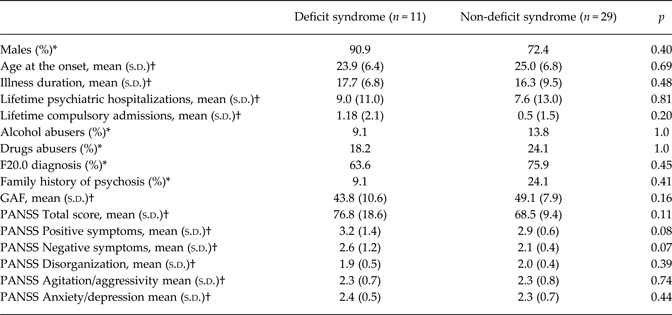
Of patients included in the study, 27.5% (n = 11) were classified as having deficit syndrome schizophrenia, and 72.5% (n = 29) as non-deficit. As shown in Table 1, deficit and non-deficit patients did not differ in terms of socio-demographic and clinical characteristics. It should however be noted that the P-value for the negative symptoms score showed a trend to statistical significance (p = 0.07), with deficit patients showing higher negative symptom scores than non-deficit patients. The lack of significance could be possibly accounted for the relatively small sample size, as the effect size was in the medium–large range (d = 0.71).
Demographics and clinical characteristics of patients classified as deficit v. non-deficit schizophrenia (n = 40)

*Exact Fisher test was used for categorical variables.
†Mann–Whitney test was used for continuous variables.
PANSS (positive and negative syndrome scale; Kay et al. Reference Kay, Fiszbein and Opler1987).
Socio-demographic characteristics of relatives
The DS relatives group consisted of 14 siblings (93.3%) and 1 offspring (6.7%), while the non-DS relatives group consisted of 28 siblings (70%), 5 offspring (12.5%) and 7 parents (17.5%). The DSRELs group comprises one (46.7%) or two (53.3%) relatives for each patient; non-DSRELs comprises one (55%), two (15%) or three (5%) relatives for each patient.
DSRELs (n = 15) were compared with non-DSRELs (n = 40) and CCs (n = 55) with regard to demographic variables. No significant differences in gender, age or education were found (see Table 2).
Demographics of the first-degree relatives of patients with DSRELs and non-DSRELs schizophrenia and CCs
*X 2 test was used for categorical variables.
†Mann–Whitney test was used for continuous variables.
Executive functioning in relatives
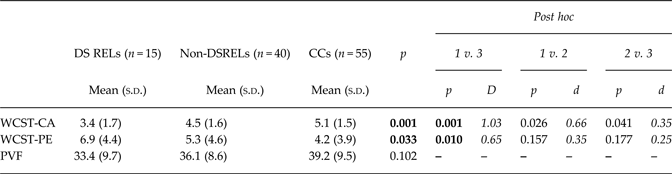
Both WCST-CA and WCST-PE significantly differed among groups (Table 3 and Fig. 1).
Executive functioning as measured by the Wisconsin Card Sorting Test (WCST) in relatives of deficit patients (DSRELs; n = 15), non-deficit patients (non-DSRELs; n = 40) and CC (n = 55), pairwise post-hoc comparisons: Mann–Whitney at p < 0.017); (a). Categories achieved. (b). Perseverative errors.
Executive functioning in first-degree relatives of patients with DSRELs and non-DSRELs schizophrenia and CCs
WCST-CA, Wisconsin Card Sorting Test Categories Achieved; WCST-PE, Wisconsin Card Sorting Test Perseverative Errors; PVF, phonemic verbal fluency.
p values based on Kruskal–Wallis test (p < 0.05).
Post-hoc statistics: Mann–Whitney (p < 0.017).
d = effect size (Cohen, Reference Cohen1988).
Bolded p values: significant results.
DSRELs performed more poorly than non-DSRELs and control subjects on executive functioning as measured by WCST-CA and WCST-PE. Pairwise post-hoc comparisons revealed significant differences between DSRELs and controls on both WCST measures, while no significant differences were detected by comparing with non-DSRELs. No significant effects among the groups were observed on the phonemic verbal fluency (PVF) measure.
Estimated IQ was weakly correlated with both WCST measures, but this association did not reach statistical significance (WCST-CA, rho = 0.24, p = 0.39; WCST-PE, rho = −0.12, p = 0.67).
Clinical measures in relatives
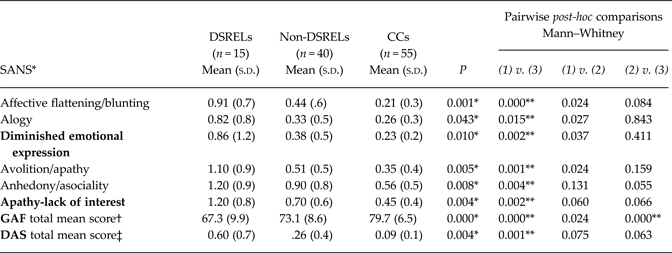
DSRELs were compared with non-DSRELs and CCs on negative symptoms, global functioning and social disability (see Table 4).
Comparison of clinical measures in first-degree relatives of patients with DSRELs and non-DSRELs schizophrenia and CCs
*Scale for the Assessment of Negative Symptoms (SANS); possible scores: ‘0’ = No symptoms, ‘1’ = Questionable, ‘2’ = Mild, ‘3’ = Moderate; 4 = ‘Marked’, 5 = ‘Severe’.
Diminished emotional expression dimension: Affective flattening/blunting + Alogy.
Apathy-lack of interest dimension: Avolition/Apathy + Anhedony/asociality.
†Disability Assessment Schedule (DAS); possible scores: ‘0’ = No disability; ‘1’ = , minimum; ‘2’ = manifest; ‘3’ = , severe; ‘4’ = very severe; ‘5’ = maximum.
‡Global assessment of functioning (GAF) scale; scores range from ‘1’ = extremely compromised functioning to ‘100’ = superior functioning.
Kruskal–Wallis tests *p < 0.05.
Pairwise post-hoc comparisons: Mann–Whitney (**p < 0.017).
Significant differences among groups were found on the SANS subscales, GAF and DAS (p < 0.05). Pairwise post-hoc comparisons suggested that the scores on the SANS items, GAF and DAS followed a ‘dose-response’ trend among the three groups, with the highest dysfunction in DSRELs and the lowest in the control group. All groups were also compared with self-rated psychopathology for all the SCL-90-R subscales, but no significant differences were found; only ‘paranoid ideation’ approximated to a non-significant trend to statistical significance (p = 0.09), with DSREL (0.83 ± 0.5) showing higher symptoms than both non-DSRELs (0.52 ± 0.4) and CCs (0.56 ± 0.5).
Relationship between cognition and clinical psychopathology
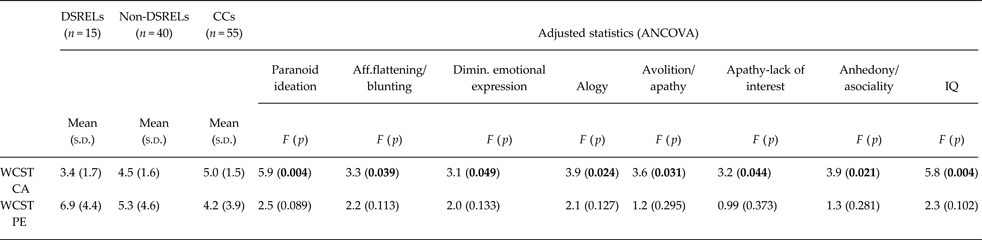
ANCOVA was performed to rule out the effect of negative symptoms, self-rated paranoid ideation and estimated IQ (each considered in a separate model) on executive functions among groups.
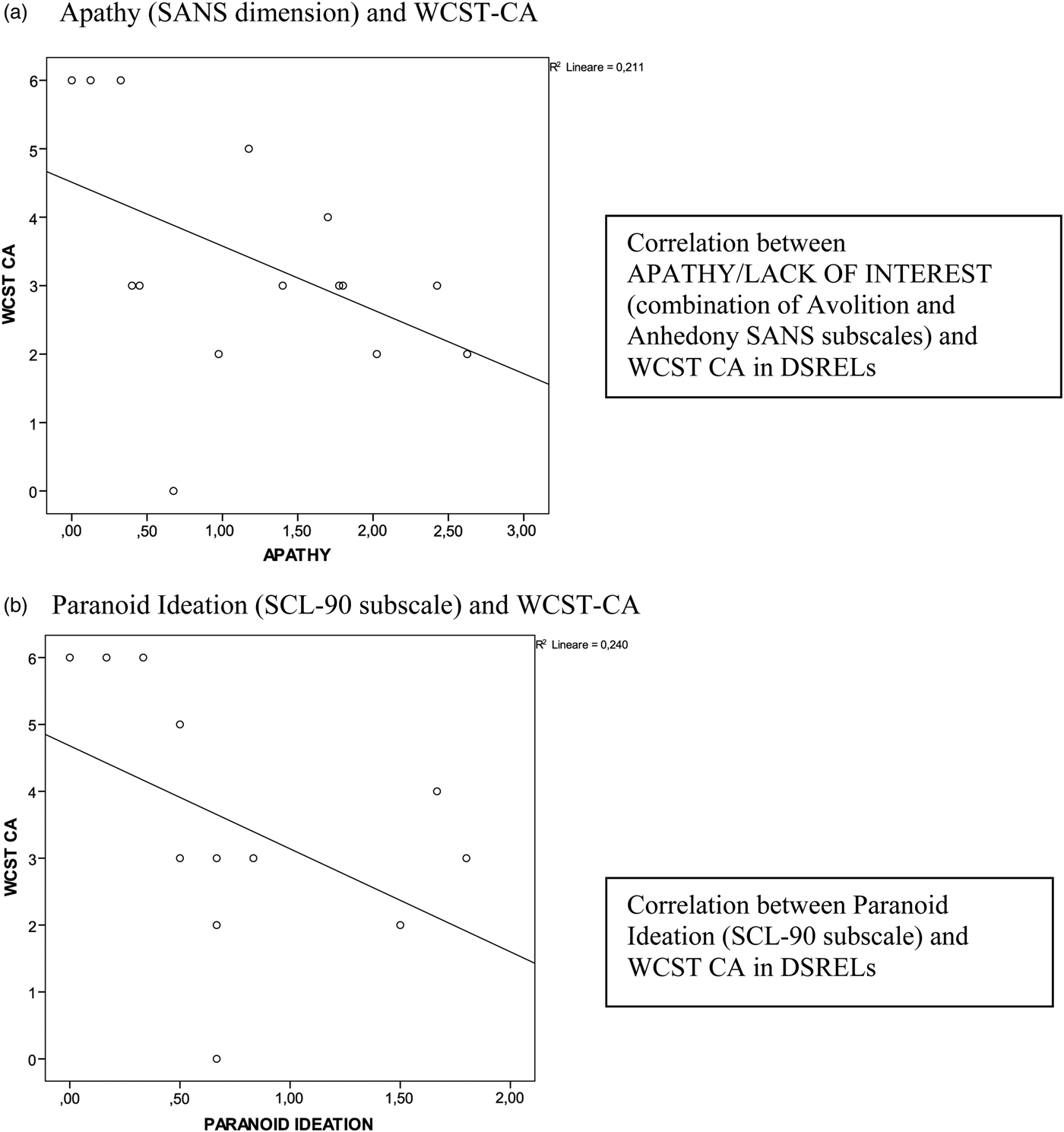
Table 5 shows that differences on WCST-CA were not explained by the clinical measures, since differences in the ‘categories achieved’ still survived after having taken into account all the covariates. On the other hand, differences on WCST-PE lost significance after controlling for the clinical measures. As shown in Fig. 2a, a significant negative correlation between ‘Apathy/lack of interest’ and WCST-CA was found only in the DSRELs group (rho = −0.54, p = 0.03).
Correlations for WCST-CA in the DSREL group (n = 15). (a) Apathy (SANS dimension) and WCST-CA. (b) Paranoid ideation (SCL-90 subscale) and WCST-CA.
Executive functioning measures adjusted for SCL-90-R paranoid ideation subscale, SANS subscales and estimated IQ in first-degree relatives of patients with DSRELs and non-DSRELs schizophrenia and CCs
WCST-CA, Wisconsin Card Sorting Test, Categories Achieved; WCST-PE, Wisconsin Card Sorting Test, Perseverative Errors.
p-values on ANCOVA.
Bolded p values: significant result.
No significant correlations were found in non-DSRELs group between ‘Apathy/lack of interest’ and WCST-CA (rho = −0.29, p = 0.07), nor between WCST-PE and ‘paranoid ideation’ and ‘apathy/lack of interest’ in either DSRELs or non-DSRELs group. No significant correlations were found between WCST-CA and the ‘Diminished Emotional Expression’ in both DSREL and non-DSREL groups.
WCST-CA was significantly correlated with paranoid ideation in DSRELs (rho = −0.53; p = 0.04) (see Fig. 2b), rather than in non-DSREL group (rho = −0.04; p = 0.80). Significant negative associations between the ‘apathy/lack of interest’ and the paranoid ideation were observed in the DSREL group (rho = −0.68; p = 0.006).
Discussion
We investigated whether clinical heterogeneity in patients with schizophrenia may be reflected in both clinical and executive functioning of their non-psychotic first-degree relatives. The originality of our study consists of examining clinical and cognitive function of unaffected biological families of patients with schizophrenia, using the model of deficit v. non-deficit schizophrenia syndrome to identify possible sources of heterogeneity in the sample of relatives. In fact, previous investigations on the first-degree relatives of patients with DS/non-DS schizophrenia were mainly focused on the heightened risk of psychosis (Dollfus et al. Reference Dollfus, Ribeyre and Petit1996, Reference Dollfus, Germain-Robin, Chabot, Brazo, Delamillieure, Langlois, van der Eist, Campion and Petit1998) or on mild-deficit like features (Kirkpatrick et al. Reference Kirkpatrick, Ross, Walsh, Karkowski and Kendler2000), and not on sub-groups. The size of our subgroup of patients that were classified as having deficit schizophrenia was consistent with the 25–30% rate previously reported in studies on chronic patients (e.g. Wang et al. Reference Wang, Yao, Kirkpatrick, Shi and Yi2008).
Consistent with Cohen et al. (Reference Cohen, Brown and Minor2010), our sample of patients with deficit schizophrenia was similar to the non-deficit schizophrenia in several clinical aspects, thus, supporting the idea that the deficit syndrome categorization may be able to detect a separate but not a globally more severe disorder (Ross et al., Reference Ross, Kirkpatrick, Karkowski, Straub, MacLean, O'Neill, Compton, Murphy, Walsh and Kendler2000). Furthermore, we did not find a different level of familial psychiatric load or substance/alcohol abuse in the patients meeting the DS schizophrenia criteria v. the non-DS criteria. This finding is consistent with the original concept of the deficit syndrome, according to which the presence or absence of prominent negative symptoms is thought to be independent from the presence of psychotic symptoms (Kirkpatrick et al. Reference Kirkpatrick, Buchanan, McKenney, Alphs and Carpenter1989).
Based on such dichotomization of patients, we identified two subsamples of first-degree relatives hypothesized to reflect different psychopathological constructs. Overall, our data suggest that DSRELs display a more impaired profile than both non-DSRELs and CCs.
Executive functioning performance
The pattern of executive impairment, including the PVF and the WCST tasks, is consistent with the idea of an increasing severity in the DS familial vulnerability profile: both relative groups performed worse than controls, with DSRELs performing worse than non-DSRELs. Although the profile of severity of the WCST and the PVF differences was not entirely supported by a significant statistical difference, both measures follow a similar linear trend. It is important to highlight that the PVF is also considered as a measure of speed of processing, involving more simple cognitive components such as motor and perceptual functioning (Nuechterlein et al. Reference Nuechterlein, Barch, Gold, Goldberg, Green and Heaton2004), that may be less affected in the DSRELs than the conceptual component (Bellani et al. Reference Bellani, Perlini and Brambilla2009).
Regarding the WCST, we decided to evaluate PE and CA to be consistent with the most recent meta-analytic literature review on executive tests of first-degree relatives of probands, which reports that those are the two WCST outcomes most often used to assess the executive functioning (Szoke et al. Reference Szoke, Schurhoff, Mathieu, Meary, Ionescu and Leboyer2005). These measures assess conceptual and executive control aspects of problem-solving such as efficient cognitive adjustment and output monitoring, which may be most essential to the deficit syndrome.
The poor WCST performance of DSRELs seems to confirm the hypothesis of a greater vulnerability load for distinct schizophrenia subtypes. Since correlations between the WCST and IQ were not significant, our finding suggests that the executive deficit is independent of generalized intellectual deficit (Byrne et al. Reference Byrne, Hodges, Grant, Owens and Johnstone1999).
Negative symptoms and executive functions
Relatives of patients with DS showed higher levels of negative symptoms than both non-DSRELs and controls, even though only the DSRELS v. CC reached significance. A complex relationship between symptoms and executive functions emerged. In particular, DSRELs show higher levels of both executive dysfunction and negative symptoms than relatives of non-DS patients.
DS and non-DS relatives performed worse on WCST-CA than controls, thus revealing a dimensional distribution of impairment in performing accurately after error feedback. The difference was not significant after the clinical adjustment.
On the other hand, the WCST-CA difference among groups persists after taking into account the effect of symptoms, suggesting that differences in complex cognitive processing, such as generating rules, maintaining an internal goal and updating a previously held rule, are at least partially independent of the level of symptoms.
Moreover, DS-RELs reported a correlation between impairment in WCST-CA and the ‘volition’ negative factor supporting the hypothesis that apathy and diminished emotional expression reflect distinct underlying processes associated with the illness. This is consistent with the hypothesis that the WCST perseverative factor (involving both CA and PE) may be related to negative schizophrenia (Cuesta et al. Reference Cuesta, Peralta, Caro and de Leon1995; Cannon et al. Reference Cannon, Glahn, Kim, Van Erp, Karlsgodt, Cohen, Nuechterlein, Bava and Shirinyan2005). Furthermore, the association between WCST-CA and apathy negative factor found in our study may suggest a more symptomatic profile of vulnerability for deficit schizophrenia. This is also consistent with data regarding patients, showing that impaired monitoring performance is associated with negative symptoms in schizophrenia (Bates & Malhotra, Reference Bates and Malhotra2002). Associations between high levels of social anhedonia and WCST-CA impairment were also found in individuals characterized by a measure of schizophrenia proneness (Tallent & Gooding, Reference Tallent and Gooding1999). In particular, the ‘apathy/lack of interest’ dimension is reported to be related to the DLPFC (Nakaya & Ohmori Reference Nakaya and Ohmori2008), whereas a ‘limited, subjective emotional experience’ is thought to be related to the inferior parietal cortex (Ross et al. Reference Ross, Orbelo, Cartwright, Hansel, Burgard, Testa and Buck2001).
An association between lower prefrontal brain activity and a decrease of emotional-volition may be hypothesized (Compton et al. Reference Compton, Banich, Mohanty, Milham, Herrington, Miller, Scalf, Webb and Heller2003; Milham et al. Reference Milham, Banich and Barad2003; Ochsner & Gross, Reference Ochsner and Gross2005). This is consistent with the recent finding (Kravariti et al. Reference Kravariti, Russo, Vassos, Morgan, Fearon, Zanelli, Demjaha, Lappin, Tsakanikos, Dazzan, Morgan, Doody, Harrison, Jones, Murray and Reichenberg2012) of a non-linear association between negative symptoms and cognition in patients, supporting the idea that this symptom dimension is not a unitary concept and that different underlying mechanisms may be involved in this relationship. Since we have not directly tested the integrity of prefrontal functioning in this study, we can only relate these results to previous work indicating that relatives show functional (Seidman et al. Reference Seidman, Thermenos, Poldrack, Peace, Koch, Faraone and Tsuang2006) and structural alterations of prefrontal cortex (Rosso et al. Reference Rosso, Makris, Thermenos, Hodge, Brown, Kennedy, Caviness, Faraone, Tsuang and Seidman2010).
Moreover, the negative correlation between paranoid ideation and the WCST-CA by DSRELs suggests that mental flexibility is to some extent associated with a sub-clinical, psychotic-like ideation. The knowledge store in DSRELs may be partially inaccessible, which would prevent information retrieval during paranoid ideas processing (Vollema & Postma, Reference Vollema and Postma2002). Furthermore, the associations between the ‘apathy-volitional’ dimension and paranoid ideation, both related to the impaired categories achieving, would suggest a more impaired vulnerability profile of the DSRELs.
This suggests that inflexible behavioural patterns can be related to an average familial liability for schizophrenia, while difficulties in category-learning may be more typical of the DS subtype of psychosis vulnerability.
Limitations
The main limitation of the current study is the small sample size of the DS subgroup of patients, which has several consequences. The first one is that demographic and psychopathological differences between DS and non-DS patients do not reach statistical significance although some of these variables showed a trend that could result in significance in a larger sample of patients. Another consequence is the small sample size of the DSRELs, which may influence the statistical power increasing the possibility of a type II error. A further consequence of the small number of test subjects, regarding the fact that we did not apply a multilevel approach to data analysis that would have been the appropriate method with a larger sample size.
An additional study limitation is that diagnosis of DS was not made according to the gold standard, such as the scale for the deficit syndrome (SDS; Kirkpatrick et al. Reference Kirkpatrick, Buchanan, McKenney, Alphs and Carpenter1989). However, the literature suggests (Kirkpatrick et al. Reference Kirkpatrick, Buchanan, Breier and Carpenter1993; Goetz et al. Reference Goetz, Corcoran, Yale, Stanford, Kimhy, Amador and Malaspina2007) that other proxy tools may be used as adequate alternatives to the SDS, when the clinical assessment may not be feasible. In our case, since the assignment of patients to deficit or non-deficit category was made retrospectively on the basis of all available clinical information and of case description provided by treating clinicians, the adoption of a proxy measure for identifying the DS was the only possible option.
Conclusion
Our study indicates a possible strategy to reduce the heterogeneity of schizophrenia by identifying subgroups of first-degree relatives of patients with a more impaired profile of neurocognitive vulnerability. The ‘deficit syndrome’ categorization, whose validity has been supported by independent studies (e.g. Heckers et al. Reference Heckers, Goff, Schacter, Savage, Fischman, Alpert and Rauch1999), allowed us to control for the effect of potential sources of heterogeneity in patients with schizophrenia and, in turn, in their unaffected first-degree relatives. Our findings provide evidence that DSRELs exhibit more negative symptoms and more executive dysfunctions than relatives of non-DS patients. Although these impaired dimensions follow a continuous distribution among the subgroups of relatives, associations between executive functions and negative symptoms were found only in the deficit subtype of relatives.
Overall, our finding points to both a dimensional and a categorical distribution of the familial load for the illness, across different subtypes of schizophrenia. Our investigation seems therefore support the adoption of DS as an indicator of a more severely impaired subgroup of relatives with higher vulnerability to schizophrenia.
Acknowledgements
The authors are grateful to patients attending the South-Verona Community Mental Health Service and their relatives for participation in the study.
Financial Support
This research received no specific grant from any funding agency, commercial or not-for-profit sectors.
Conflict of Interest
None.
Ethical Standards
The authors assert that all procedures contributing to this work comply with the ethical standards of the relevant national and institutional committees on human experimentation and with the Helsinki Declaration of 1975, as revised in 2008. The authors assert that all procedures contributing to this work comply with the ethical standards of the relevant national and institutional guides on the care and use of laboratory animals.