1. Introduction
Low-pressure, high-temperature (LP/HT) meta-morphic belts reflect some of the highest thermal perturbations of the upper crust, with average gradients generally between 35 °C and 75 °C km−1 at P < 5 kbar (Treloar & O'Brien, Reference Treloar, O'Brien, Treloar and O'Brien1998). Such belts are generally interpreted to result from a transient, enhanced crustal heat flux, possibly derived from advection of heat associated with magma emplacement (e.g. Treloar & O'Brien, Reference Treloar, O'Brien, Treloar and O'Brien1998). For the average gradients listed above, an assumed Moho temperature of 650 °C requires that crustal thickness should be only 10–20 km during LP/HT metamorphism, which implies crustal thinning.
One of the aims of metamorphic petrology is to gain information about the pressure and temperature histories of metamorphic areas through the use of mineral equilibrium. Chemical analyses of minerals assumed to be in equilibrium have been used in conjunction with geobarometers and geothermometers to estimate the pressure (P) and temperature (T) conditions attained at or near the peak of metamorphism (e.g. Richards & Collins, Reference Richards and Collins2002; Ricardo & Martínez Catalán, Reference Ricardo and Martínez Catalán2003). Recognition and characterization of superimposed metamorphic episodes, either during a continuous polyphase metamorphic P–T path (e.g. subduction–collision–exhumation; e.g. Otaa, Terabayashi & Katayama, Reference Otaa, Terabayashi and Katayama2004) or during repeated cycles of polymetamorphism (e.g. ‘Caledonian’–Hercynian/Variscan–Alpine evolution of the Eastern Alps) is critical for the understanding of the tectonic evolution of a metamorphic basement.
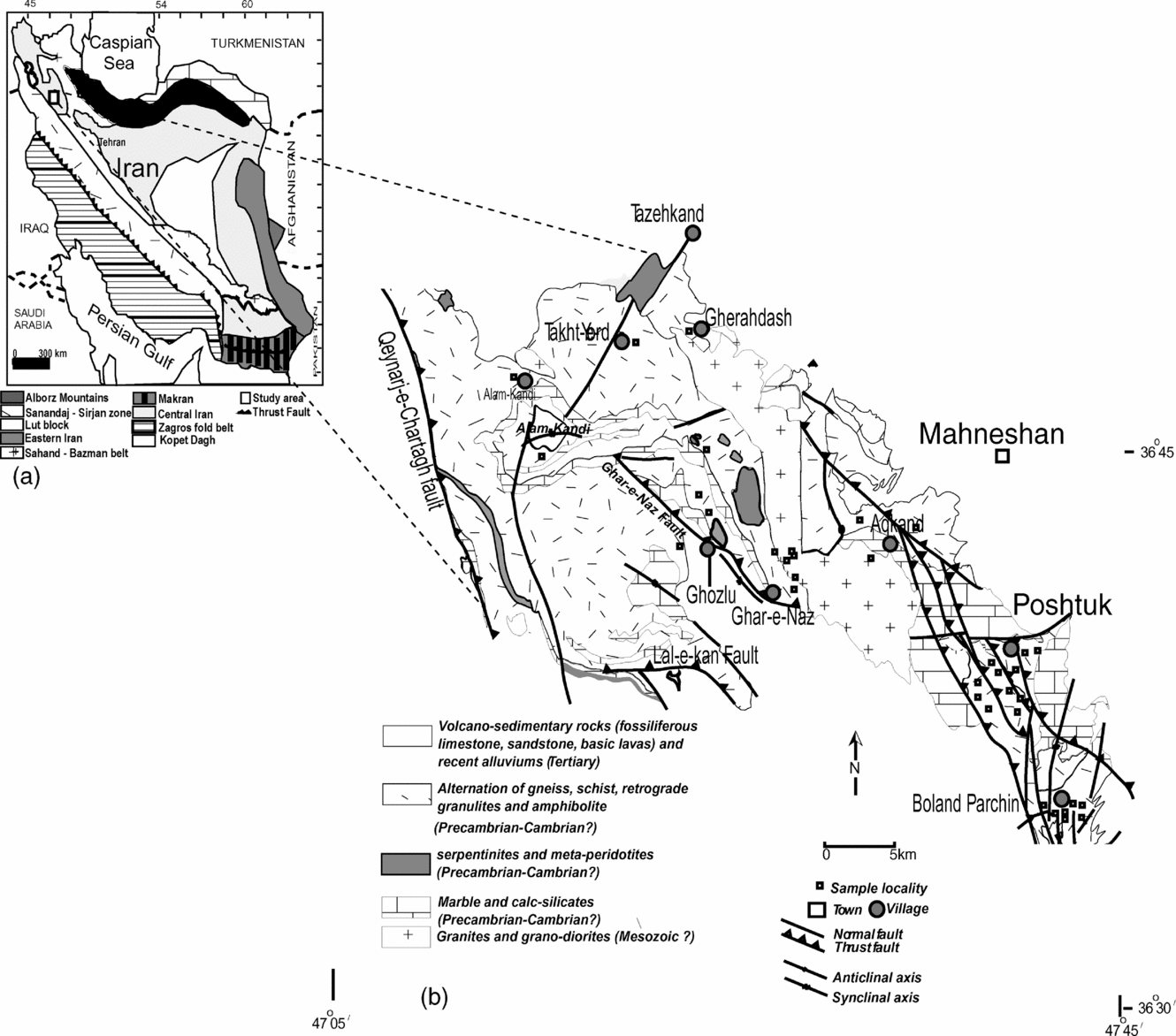
The Poshtuk area in the northwest of Iran (Fig. 1a) experienced polyphase metamorphism and magmatism from Palaeoproterozoic to Tertiary times. Tertiary metamorphism and magmatism occurred during the subduction of the Neo-Tethys (Mohajjel, Fergusson & Sahandi, Reference Mohajjel, Fergusson and Sahandi2003).
(a) Simplified structural subdivision map of Iran and the locality of the study area (modified from Stocklin & Setudenia, Reference Stocklin and Setudenia1972). (b) Geological map of the Mahneshan Complex and Poshtuk sub-area and sample locations.

The timing of the closure of the Neo-Tethys and the collision between the Arabian plate and the Iranian microcontinent is debated. Berberian & King (Reference Berberian and King1981) and Alavi (Reference Alavi1994) favour a Late Cretaceous age for the collision along the Zagros suture. Others envision a Cenozoic age for the continental collision (e.g. Agard et al. Reference Agard, Omrani, Jolivet and Mouthereau2005). Based on palinspastic and plate tectonic reconstructions, McQuarrie et al. (Reference Mcquarrie, Stock, Verdel and Wernicke2003) suggested that the collision between the Arabian plate and the Iranian microcontinent occurred before 20 Ma at most, in relation to the subduction of the Neo-Tethys. Recent studies by Verdel et al. (Reference Verdel, Wernicke, Ramezani, Hassanzadeh, Renne and Spell2007) support the Neogene collision between the Arabian plate and the Iranian microcontinent. Allen & Armstrong (Reference Allen and Armstrong2008) showed that the Arabia–Eurasia collision and the closure of the Tethys oceanic gateway began in the Late Eocene at ~35 Ma, up to 25 million years earlier than in many reconstructions.
There is no published study on the nature of the metamorphism of the pelitic rocks and their deformation in the Poshtuk area so far. This investigation aims to study the type of metamorphism and the deformational phases as well as the relations between these two using the textural relations and mineral chemistry of the metapelitic rocks of the area. This will provide a basis for further studies on the metamorphic and geodynamic evolution of this part of the Iranian crust.
2. Regional geological setting
The Iranian plateau consists of several continental fragments welded together along the palaeo-oceanic suture zones (Neoproterozoic). These fragments are bordered by major faults. Each fragment shows different sedimentary, stratigraphic, magmatic and metamorphic features. One of these fragments is the continental crust of the Central Iran Zone, which was metamorphosed and intruded by granites and faulted during the Late Precambrian Pan-African Orogeny (Ramezani & Tucker, Reference Ramezani and Tucker2003; Saki, Reference Saki2010). The Sanandaj–Sirjan zone is a metamorphic belt associated with the Central Iran Zone. This belt extends across Iran in a NW–SE direction (Fig. 1a). Subduction of the Neo-Tethys between the Afro-Arabian plate and the Iranian microplate and subsequent continental collision (during Cretaceous to Early Tertiary times) caused metamorphism and associated magmatism in the Sanandaj–Sirjan Zone (Mohajjel, Fergusson & Sahandi, Reference Mohajjel, Fergusson and Sahandi2003; Moazzen et al. Reference Moazzen, Moayyed, Modjarrad and Darvishi2004).
The study area is located in the south of the town of Mahneshan, western Zanjan (Fig. 1b). The area is limited to geographical latitude 47° 07′ to 47° 45′ E and longitude 36° 30′ to 37° 00′ N (Fig. 1b).
In the context of the structural subdivisions of Iran, the Poshtuk area has been assigned to various tectonic zones by different workers. It is included in the Central Iran Zone by Nabavi (Reference Nabavi1976), the Soltanieye–Misho Zone by Eftekhar Nejad (Reference Eftekhar Nejad1980) and at the junction of the Central Iran, Alborz–Azerbaijan and Sanandaj–Sirjan zones by Babakhani & Ghalamghash (Reference Babakhani and Ghalamghash1990). Recently Alavi (Reference Alavi2004) and Gilg et al. (Reference Gilg, Boni, Balassone, Allen, Banks and Moore2006) have included the study area in the Sanandaj–Sirjan Zone. In the geological map of the area, issued by the Geological Survey of Iran (Babakhani & Ghalamghash, Reference Babakhani and Ghalamghash1990), it is included between the Alborz–Azerbaijan, Central Iran and Sanandaj–Sirjan zones. Similarities in stratigraphy, lithology and age data (relative and isotopic ages) of the protoliths of the Mahneshan and Poshtuk complex and equivalent units from the Central Iran Zone suggest that the Mahneshan Complex has a Neoproterozoic–Early Cambrian age and has experienced the Pan-African Orogeny (e.g. Hajialioghli et al. Reference Hajialioghli, Moazzen, Droop, Oberhänsli, Bousquet, Jahangiri and Ziemann2007; Moazzen et al. Reference Moazzen, Oberhänsli, Hajialioghli, Möller, Bousquet, Droop and Jahangiri2009). The strips of ultramafic rocks in the Takab Complex can be interpreted as lithospheric remnants of the Proto-Tethyan, which closed during the Pan-African Orogeny (Hajialioghli et al. Reference Hajialioghli, Moazzen, Droop, Oberhänsli, Bousquet, Jahangiri and Ziemann2007; Saki, Reference Saki2011). Therefore, it is included in the Central Iran Zone. K–Ar dating of carbonaceous schists in the Zarshuran area (Mehrabi, Yardley & Cann, Reference Mehrabi, Yardley and Cann1999), apatite U–Th/He data from the Mahneshan area (Stockli et al. Reference Stockli, Hassanzadeh, Stockli, Axen, Walker and Dewane2004) and 40Ar–39Ar dating of muscovite schists (Gilg et al. Reference Gilg, Boni, Balassone, Allen, Banks and Moore2006), constrain the timing of rapid exhumation of the basement rocks to Early Miocene time (20 Ma). On the geological map of the Mahneshan area, the age of I-type granitoids is attributed to Mesozoic time (late Cimmerian orogenic phase). Recently, Jamshidibadr et al. (Reference Jamshidibadr, Collins, Masoudi, Cox and Mohajjel2011) found two distinct types of granitoids in the Soursat area, to the south of Poshtuk: a type I granitoid, ~ 540 Ma and a type II granitoid, 59.0 ± 2.7 Ma.
The main regional trend of the rocks is NW–SE, and these rocks were exposed by a young reverse fault (Chartagh Fault). The fault has placed the metamorphic rocks adjacent to the Miocene sediments. The plutonic rocks are intruded into the regional metamorphic rocks.
The Poshtuk metamorphic rocks in northwestern Iran were affected by regional and contact metamorphism. A variety of igneous and metamorphic rocks can be seen in the studied area (Fig. 1b). The metamorphic rocks in the Poshtuk area include garnet-staurolite micaschists, chloritoid-staurolite micaschists, meta-limestone, augen-gneisses and amphibolites. The igneous rocks of the area are composed of two types (Saki, Reference Saki2011): (1) S-type granitoids (anatectic alkali granite) and (2) white to light grey I-type igneous rocks. Samples for this study were collected from the mountains northwest of Poshtuk village. Figure 1b illustrates the sample localities and rock types.
3. Petrography
Petrographic features and mineral assemblages of the metapelitic rocks are described in the following sections. Detailed petrographic studies of thin-sections were carried out on all specimens (40). Table 1 shows mineral assemblages of the Poshtuk metapelitic rocks. Mineral abbreviations are after Kretz (Reference Kretz1983). Sample locations are shown in Figure 1b.
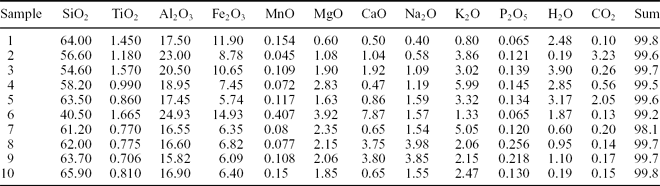
Representative major (wt%) compositions of metapelitic rocks from the Poshtuk area (bulk rock analyses)

The representative mineral assemblages in the studied metapelites of Poshtuk are:
 \begin{equation}
\begin{array}{*{20}l}
{{\rm Grt} + {\rm Ms} + {\rm Chl} + {\rm Qtz}} \\
{{\rm Grt} + {\rm Ms} + {\rm Ctd} + {\rm Chl} + {\rm Qtz}} \\
{{\rm Grt} + {\rm St} + {\rm Ms} + {\rm Ctd} + {\rm Chl} + {\rm Qtz}} \\
{{\rm Grt} + {\rm St} + {\rm Ms} + {\rm Chl} + {\rm Qtz}} \\
\end{array}
\end{equation}
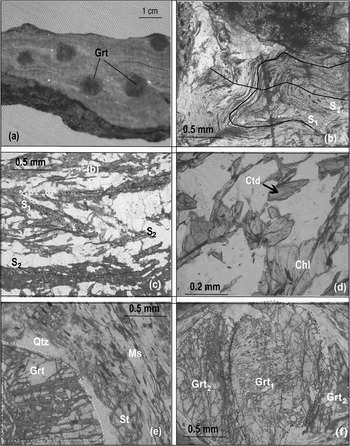
A polyphase deformation can be considered based on two foliations, S1 and S2, and inclusions in the porphyroblasts. Fabrics of D1 (the first deformational phase) are clearly deformed by D2 (second and the main deformational phase). D2 is the most obvious and pervasive deformation in the area. The mylonitic foliation enveloping garnet porphyroblasts, S2, (formed during the deformation phase D2) is best seen in samples from the Poshtuk schist (Fig. 2a, b) where it is defined by the parallel alignment of biotite and muscovite (Fig. 2b). S1 foliation can be seen in crenulation cleavage (Fig. 2c). S2 is parallel to the axial planes of the micro-folds of intercalated quartz-feldspar-rich and phyllosilicate-rich layers. This foliation represents the main regional foliation and can be recognized throughout all metamorphic zones.
(a) Garnet porphyroblasts (Grt) with 5 to 15 mm diameter are formed in chloritoid schists; hand specimen. (b) D1 and D2 deformational phases picked up by S1 and S2 schistosities. (c) A schistosity (S1) is defined by a preferred orientation of muscovite; chloritoid and chlorite is affected by a crenulation schistosity. (d) Chlorite and chloritoid are formed in equilibrium. (e) Staurolite and muscovite nucleated at the margin of garnet. (f) Syntectonic helcitic garnet porphyroblasts (Grt1) formed during M2 metamorphism; garnet (Grt2) is formed during contact metamorphic phase.

Porphyroblasts that formed during the regional metamorphic phase are usually overprinted (superimposed) by mineral growth associated with contact metamorphism.
4. Regional and contact metamorphism
The mineral assemblage of regional metamorphism, garnet–chlorite (in addition to plagioclase, muscovite, quartz and ilmenite), is inferred from mineral inclusions. Subsequently, the prograde metamorphic phase (contact metamorphism) is characterized by development of new porphyroblasts, including garnet (Grt1; Fig. 2b), staurolite, chloritoid and chlorite (in addition to plagioclase, muscovite, quartz and ilmenite). This phase is the major contact metamorphic phase in the studied area. This metamorphism overprinted the regional metamorphic assemblages.
4.a. Chlorite and muscovite
Regionally, metamorphic chlorite and muscovite are crystallized in the Poshtuk metapelitic rocks (Fig. 2d). The rock is composed of fine-grained muscovite, chlorite, quartz and porphyroblasts of helicitic garnet and staurolite. A second generation of chlorite and muscovite up to 0.3 mm in size also formed parallel to the S2 foliation.
4.b. Garnet
The garnet zone consists of medium- and coarse-grained schists (Fig. 2a). Garnet forms euhedral to subhedral, sometimes quartz inclusion-rich porphyroblasts and shows textural zoning (Fig. 2f). Most garnets show two stages of growth: first, garnet with spiral-shaped inclusion fabrics, which developed during syntectonic (S2) growth (Grt1 or regional metamorphic garnet); and second, garnet, free of inclusions, which developed during contact metamorphism (Grt2) (Fig. 2f). Rotated garnet porphyroblasts up to 13 mm in diameter are developed in the Poshtuk schists.
4.c. Staurolite
Staurolite forms porphyroblasts with sizes up to several millimetres in the chloritoid schists. Staurolite commonly nucleated at the margin of garnet or in phyllosilicate-rich layers (Fig. 2e). In Figure 2e, garnet is replaced by staurolite, which in turn is pseudomorphed by muscovite.
4.d. Chloritoid
Chloritoid occurs in the fine-grained rock matrix as lath-shaped crystals, and under the microscope (plain-polarized light) has a blue colour (Fig. 2d). The sample consists of garnet, chloritoid, staurolite (up to 0.5 mm), chlorite and muscovite. Therefore, the main paragenesis in these rocks is: Ctd + Grt + St + Ms + Chl + Qtz.
5. Bulk rock chemistry
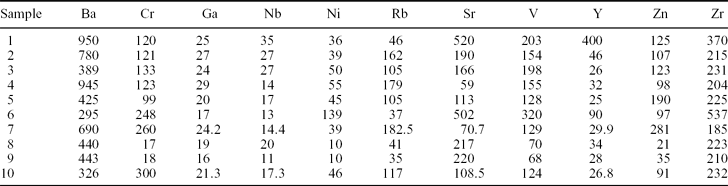
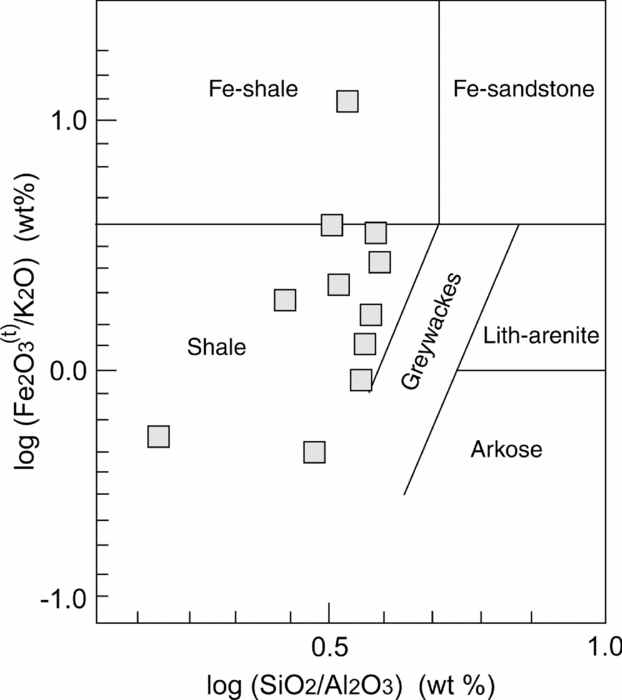
Major and trace elements of ten metapelitic rocks of the Poshtuk area were analysed by standard X-ray fluorescence (XRF) methodology using a Philips PW 1480 XRF spectrometer. The analyses are listed in Tables 1 and 2. In the discrimination diagram log(Fe2O3 t/K2O) v. log(SiO2/Al2O3) after Herron (Reference Herron1988) most of the Mahneshan metapelites plot in the shale field; only two samples plot in the fields of Fe-shale (Fig. 3). Similar results were obtained by using the empirical discrimination ratio 100TiO2/Zr (wt %/ppm) to distinguish between psammitic and pelitic sediments (Garcia, Coelho & Perrin, Reference Garcia, Coelho and Perrin1991; Häussinger, Okrusch & Scheepers, Reference Häussinger, Okrusch and Scheepers1993). Almost all samples have values above 0.4 and, accordingly, were derived from pelitic sediments, whereas, the remaining samples have a psammitic precursor.
Representative trace (ppm) element compositions of metapelitic rocks from the Poshtuk area (bulk rock analyses)

Discrimination diagram log (Fe2O3 t/K2O) v. log (SiO2/Al2O3) from Herron (Reference Herron1988), showing a predominant shale composition for the Poshtuk metapelites.

6. Mineral chemistry
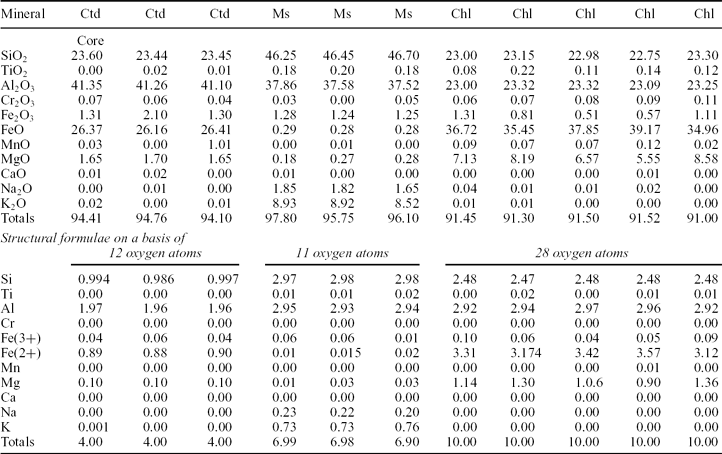
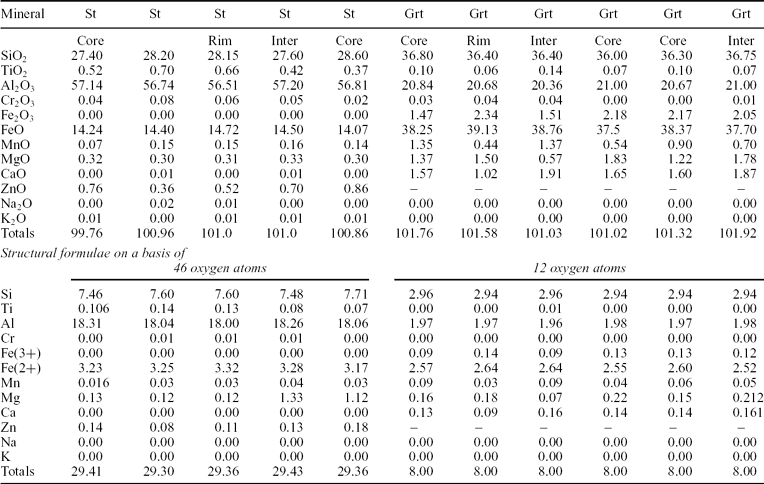
Major element compositions of chloritoid, muscovite, biotite, garnet, staurolite and plagioclase in selected metapelites were determined by wavelength-dispersive spectrometry using a Cameca SX100 microprobe at the GeoForschungsZentrum (GFZ), Potsdam, Germany. The operational conditions were 15 kV, 10–20 nA specimen current. The analytical spot diameter was set between 3 and 5 μm, keeping the same current conditions. Natural and synthetic standards were used for calibration (Tables 3 and 4). Ferric iron contents in ferromagnesian minerals were calculated using stoichiometric criteria (Droop, Reference Droop1987).
Representative chloritoid, muscovite and chlorite analyses and structural formulae

Representative staurolite and garnet analyses and structural formulae

6.a. Chlorite
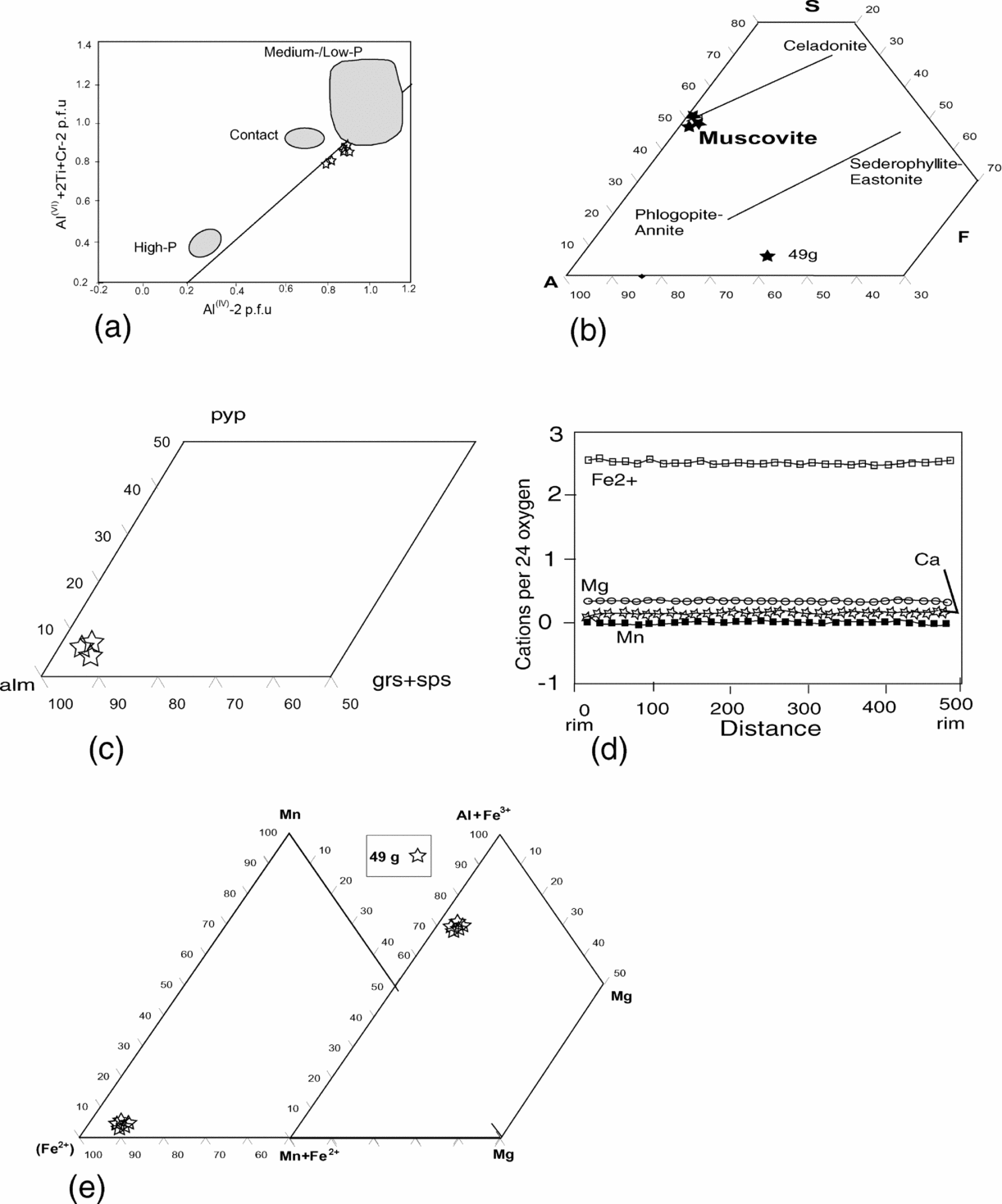
Representative analyses of chlorite are shown in Table 3. The oxide totals are between 91.00 and 91.52. The amount of Ti is between 0.01 and 0.04 atoms per formula unit (apfu). The chlorites are Mn-free. Na varies from 0.00 to 0.02 apfu, and K from 0.00 to 0.03 apfu. Substitution of Al3+ for Si4+ is calculated using the stoichiometric approach after Saad, Bouseil & Kalil (Reference Saad, Bouseil and Kalil1996). Chlorites are of daphnite type and Fe-rich nature. According to Laird (Reference Laird and Bailey1988) (Fig. 4a), prograde chlorite compositions plot close to the medium-/low-P field.
(a) Chlorite composition of the Poshtuk metapelites on a formula proportion diagram (Al(VI)+2Ti+Cr-2 versus Al(IV)-2). Compositional variation along the 1:1 line represents the Tschermak substitution. After Larid (Reference Laird and Bailey1988). (b) Analysed white micas plotted on SAF (SiO2, Al2O3, FeO) diagram. In all samples they are muscovite in composition. After Lambert (Reference Lambert1959). (c) Composition of the studied garnets plotted on the Ca+Mn, Fe2+ and Mg triangular diagrams. Garnets are Fe-garnet. (d) Garnet zoning profiles from chloritoid schists of Poshtuk. Profile extends from rim to rim through the core of the garnets, which shows a flat profile. (e) Composition of the studied chloritoids plotted on the Mn, Fe2+, Mg and Mn+Fe2+, Al+Fe3+, Mg triangular diagrams. Chloritoids are Fe-chloritoid.

6.b. Muscovite
Muscovite analyses are listed in Table 3. According to Figure 4b after Lambert (Reference Lambert1959), muscovites are rich in the muscovite end-member, and paragonite is the second most important component. The mole fractions of other components are negligible. Reduction in the phengite component of muscovite with metamorphic grade has been described by several authors (e.g. Mather, Reference Mather1970; Wang, Banno & Takeuchi, Reference Wang, Banno and Takeuchi1986; Dempster & Tanner, Reference Dempster and Tanner1997) in different low-to-medium pressure metamorphic terranes.
6.c. Garnet
Garnet compositions are listed in Table 4. Garnets are Fe-rich with almandine contents varying between 80 and 90%. Ti is not present or occurs in very low amounts. Figure 4c shows the chemical composition of the analysed garnets in the almandine (Alm), pyrope (Pyp) and grossular+spessartine (Grs+Sps) triangular diagram. Stoichiometry and the Fe3+ content of garnet were calculated based on 8 cations and 12 oxygen atoms. The zoning profile shown in Figure 4d is from rim to rim and cuts through the core of the garnet. There is no significant zoning in the garnet.
6.d. Staurolite
Staurolite analyses are listed in Table 4. The number of cations is calculated based on 28 oxygen atoms. Staurolite in some samples has distinctly less MgO (≈ 0.35%) and ZnO (≈ 0.30%). The staurolite does not show any significant zoning. Compositional ranges of staurolite in the Fe, Mg and (Mn+Zn) triangular diagrams indicate Fe-staurolite compositions. MnO and ZnO contents are very low. Staurolite shows lower XFe-values than coexisting garnet.
6.e. Chloritoid
Representative mineral compositions of chloritoids in the studied samples are given in Table 3. The chloritoid formula (Fe,Mn,Mg)2Al4Si2O10(OH)4 was calculated on the basis of 12 oxygen atoms. It is Fe-rich, and the Fe/Mg ratio is much higher than in the coexisting chlorite. Figure 4e illustrates the composition of chloritoids in Al+Fe3+, Fe2++Mn and Mg, and Fe2+, Mn and Mg triangular diagrams. According to Figure 4e, Fe2+ occupies the cubic site (i.e. chloritoids are Fe-chloritoid). The XMg values of chloritoid from these samples range from 0.09 to 0.1.
7. Mineral reactions and phase relations
For this purpose, AFM compatibility diagrams were constructed based on the actual mineral chemistry. Some samples contain the assemblage garnet, staurolite, chlorite, muscovite, chloritoid and quartz. Staurolite does not coexist with biotite as it does in the classical Barrovian staurolite zone. This suggests that the bulk composition is richer in Al than common pelitic rocks. Petrographic study of the samples also shows obvious reaction rims around the garnet crystals.
7.a. The garnet-in isograd
Chloritoid is formed in the Poshtuk schists by the reaction: Fe-Chl + haematite = Ctd + magnetite + Qtz + H2O.
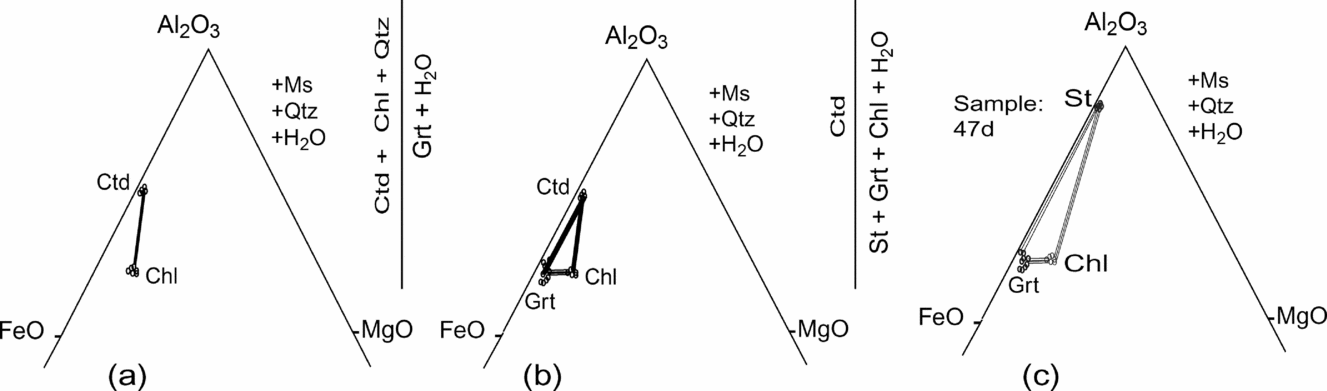
In these rocks chloritoid can also act as a possible reactant for garnet formation, as can be deduced from the AFM-phase compatibilities (Fig. 5a–c) Fe-Ctd + Chl + Qtz = Grt + H2O (Thomson & Norton, Reference Thomson, Norton, E-am, White, Hadley and Thompson1968).
(a–c) Al2O3–FeO–MgO (AFM) projection from quartz, muscovite and H2O of coexisting minerals in the Poshtuk schists.

7.b. The staurolite-in isograd
In the chloritoid schists, textures show that the formation of staurolite has occurred at the expense of garnet (Fig. 2e), suggesting the following reaction: Grt + Chl = St + Bt + H2O
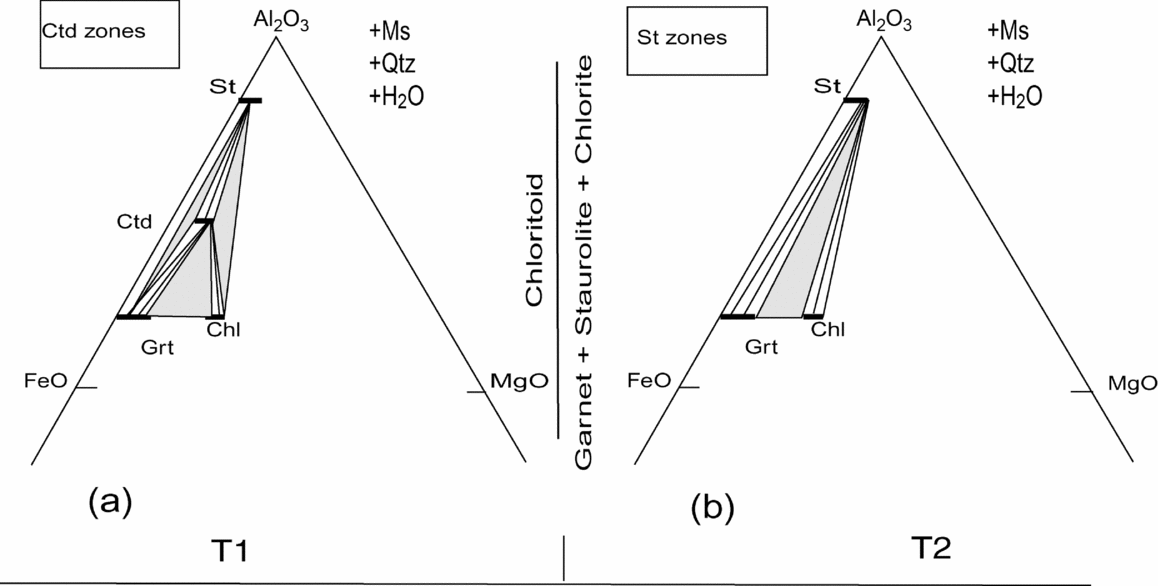
Figure 6a, b shows that garnet in the garnet zone samples occurs as an extra phase, stabilized by Mn. In the AFM system, the garnet zone samples (T1) are characterized by coexisting chlorite and chloritoid. At higher metamorphic temperatures (T2), the reaction: Ctd = Grt + St + Chl + H2O results in the disappearance of chloritoid in the higher-grade rocks and the appearance of staurolite associated with continued garnet growth.
(a, b) AFM plots showing the mineral sub-assemblages for the garnet zone and staurolite zone samples (temperature T1 < temperature T2).

8. Geothermobarometry
The pressure and temperature of peak metamorphism is estimated using conventional thermobarometry methods such as cation exchange reaction thermometry and multiple mineral equilibria calculations. Since the chlorite–chloritoid assemblage is stable within the range of metamorphic temperatures typical for the greenschist- to blueschist facies (300–550 °C), the Fe-Mg exchange reaction between both of these minerals has good potential as a geothermometer.
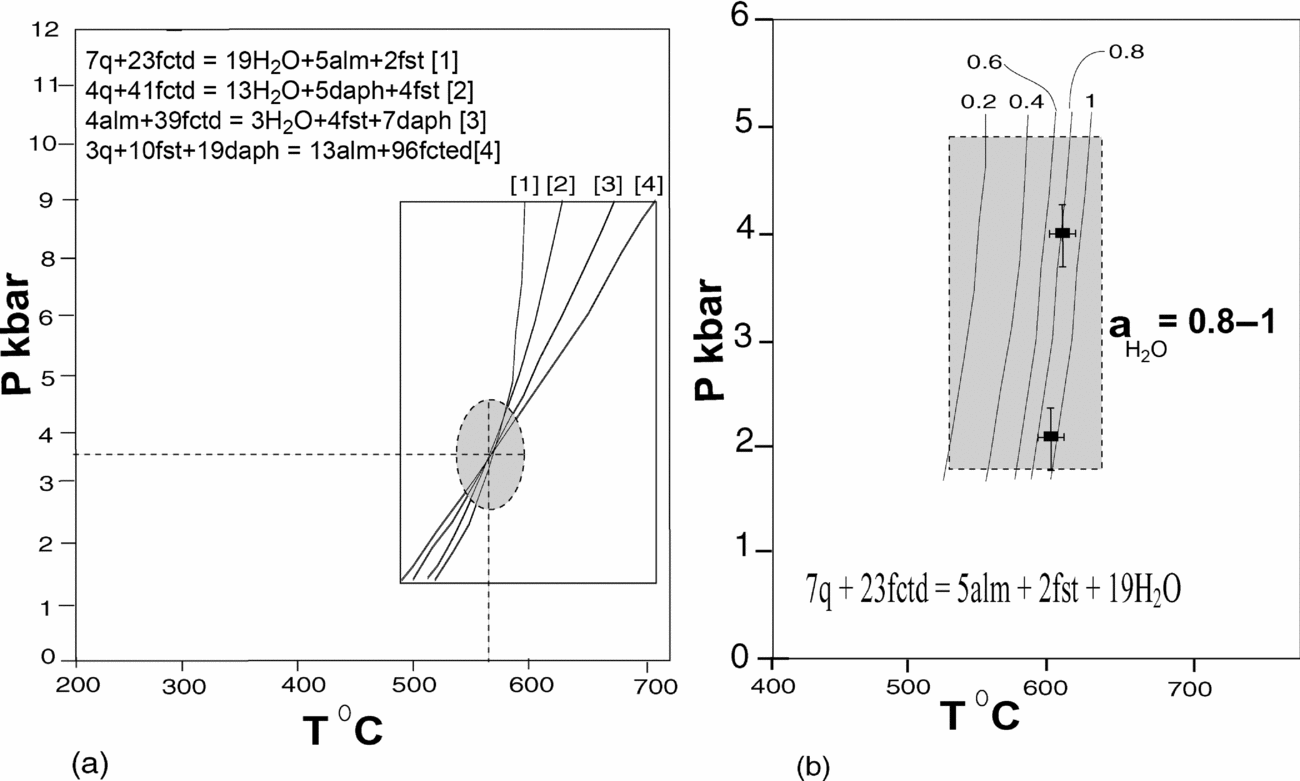
For the Poshtuk chloritoid schists, the calculated temperature using the garnet-chlorite Fe-Mg exchange thermometer (Grambling, Reference Grambling1990) is 598–635 °C. Temperatures from Fe-Mg exchange between chloritoid and chlorite (Vidal et al. Reference Vidal, Goffe, Bousquet and Parra1999) are 533–607 °C. Furthermore, using multiple-equilibrium calculations and the THERMOCALC program, version 3.2 (Holland & Powell, Reference Holland and Powell1998), temperatures and pressure were calculated using specific equilibria (Fig. 7a). Intersection of curves 1, 2, 3 and 4 in this P–T diagram indicate a pressure of c. 3.5 kbar and a temperature of 570 °C. These reactions are in agreement with the observed mineral parageneses and the AFM diagrams.
(a) Representative results of multiple-equilibrium calculation using the THERMOCALC (3.2) program. A pressure of ~ 3.5 kbar and temperature of ~ 570 °C can be considered for metamorphism of the Poshtuk metapelites. (b) The above P–T results and fluid-bearing reaction allowed us to estimate the H2O content (0.8–1) of the fluid phase in the Poshtuk metapelite rocks.

9. Discussion
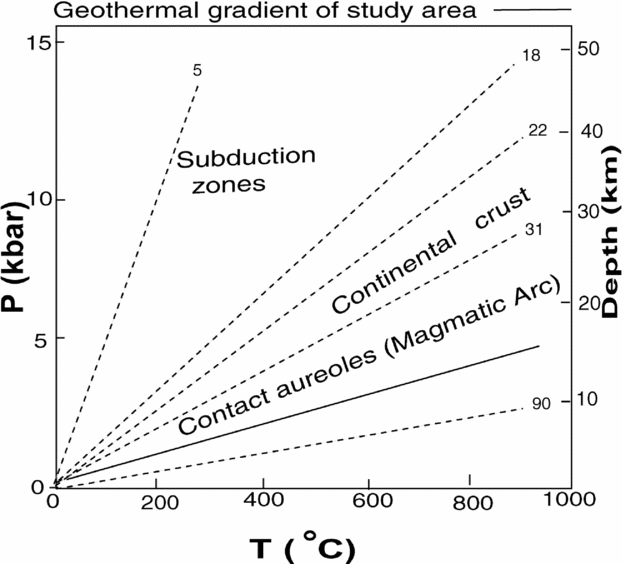
Microstructural and petrographical features and field relations indicate that the formation of the Poshtuk metamorphic rocks is polymetamorphic. With respect to the flat chemical zoning profile (Fig. 4d) and the existence of textural physical zoning in the Poshtuk garnet, different reactions among minerals and diffusion may produce apparent zonings without the existence of real chemical zoning. Contact metamorphism overprints regional metamorphism, which shows evidence for at least two deformational phases (D1 and D2) (Saki et al. Reference Saki, Moazzen, Modjtahedi and Oberähnsli2008a ,Reference Saki, Moazzen, Modjtahedi and Oberähnsli b ). Crustal shorting and thickening is therefore accompanied by two stages of deformation (D1 and D2), which produced a slaty cleavage S1 and a crenulation cleavage S2 associated with thrusting (Saki et al. Reference Saki, Moazzen, Modjtahedi and Oberähnsli2008b ). The peak metamorphic assemblages (garnet, staurolite, chloritoid, chlorite, muscovite and quartz) grew mainly during contact metamorphism and are not typical Barrovian types. P–T conditions (peak metamorphic) for chloritoid schists give temperatures of 550–600 °C and pressures of 3.2–4 kbar. These P–T results allowed a calculation of the H2O contents (0.8–1) of the fluid phase as shown in Figure 7b. The bulk chemistry of the metapelites indicates that their protoliths were deposited at an active continental margin. On the basis of these data, the studied rocks were at a depth of 10–12 km when they experienced the peak metamorphic temperature. This reflects a mean geothermal gradient of about 50 °C, which is typical of contact aureoles (Fig. 8). Therefore, peak metamorphism has occurred under high-temperature and low-pressure conditions (LP/HT metamorphism) and reflects the high heat flow in this part of the crust. This suggests a genetic link between granite ascent from the deep crust and the high-temperature/low-pressure (contact metamorphism) type of metamorphism in the studied area.
Simple linear temperature–depth trends for subduction, continental crust, and magmatic arc and contact aureole environments. The geothermal gradient of Poshtuk plots in the contact aureole environment.

In the Poshtuk area, our conclusions indicate that low-P metamorphism (contact metamorphism) may have developed during granite emplacement that occurred during the extensive Eocene metamorphic and magmatic activities associated with the early Alpine Orogeny, which resulted in this area from the convergence between the Arabian and Eurasian plates, and the Cenozoic closure of the Tethys oceanic tract(s).
10. Conclusions
The most important results of our investigations on the metapelitic schists of the Poshtuk area, NW Iran, are:
-
(1) The prograde mineral assemblage garnet–staurolite–chloritoid–chlorite–muscovite is replaced by the assemblage garnet–staurolite–chlorite–muscovite close to peak metamorphism.
-
(2) The peak metamorphism occurred at a temperature of 580 °C and pressures of 3–4 kbar; this reflects a mean geothermal gradient of about 50 °C km−1, which is typical of contact aureoles. Therefore, peak metamorphism occurred under high-temperature and low-pressure conditions (LP/HT metamorphism) and reflects the high heat flow in this part of the crust. This suggests a genetic link between granite ascent from the deep crust and the high-temperature/low-pressure (contact metamorphism) type of metamorphism in the upper crust.
-
(3) This metamorphism is mainly controlled by advective heat input through magmatic intrusions in the studied area. The extensive Eocene magmatic activities resulted from the convergence between the Arabian and Eurasian plates and the Cenozoic closure of the Tethys oceanic tract(s).
Acknowledgements
We thank Dr D. Rhede and Mrs O. Appelt from GFZ Potsdam, Germany for their generous help with electron microprobe analysis. Thoughtful review and invaluable comments by Dr J. Schumacher improved the paper. We appreciate editorial handling and guidance by Dr M. Allen. This work is supported by the University of Tabriz and Shahid Chamran University of Ahvaz.