Introduction
Giddens (Reference Giddens2001) claimed that the turn of the century coincided with a global Third Way debate about the modernisation of social democracy. There is much that he can legitimately point to in order to support this claim, including numerous high-level seminars in which centre-left political leaders from around the world met to forge a new ‘progressive governance’ agenda and an outpouring of academic work too. While documenting Third Way reform processes across the globe has itself proved a useful task – and a number of excellent studies have focused on recording this moment in the history of social democratic politics (for example, Bonoli and Powell, Reference Bonoli and Powell2004; Lewis and Surrender, Reference Lewis and Surrender2004) – the cross-national examination of ostensibly common Third Way reform agendas also offers us a rare opportunity for exploring the interplay between common cross-national policy ideas and varying national policy contexts. The policy analysis literature has shown an increasing concern with the role of ideas in explaining policy change, but Béland (Reference Béland2005: 14) notes that studies in the sphere have been hampered by the fact that ‘“smoking guns” are uncommon in ideational analysis’. Comparative analysis of shared Third Way reform agendas has the potential to offer us such a weapon.
It would be wrong to suggest there has been unqualified agreement as to what the Third Way means or, even, whether it should fall under a ‘Third Way’ label, and much of the academic debate has focused on uncovering cross-national variations in the broad principles underpinning the ‘Third Way’ (for example, Bonoli and Powell, Reference Bonoli and Powell2002, Reference Bonoli and Powell2004). However, Schröter (Reference Schröter2004: 2) argues that the movement produced an ostensibly unprecedented degree of unity among social democratic parties. Moreover, Giddens (Reference Giddens2001: 1) has urged us not to lose our way in a semantic debate, arguing that the often-abstract terminological debate has distracted from cross-national commonalities at the programmatic level. In part to test Giddens’ assertion, we wish to move beyond the examination of broad ideas here and instead explore the policy detail of actual welfare state reform. In so doing, of course, we expect to find differences between nations because, as is commonly argued, ‘there is unlikely to be a uniform Third Way given . . . different histories, polities, and economies’ (Bonoli and Powell, Reference Bonoli and Powell2002: 62; cf. Green-Pedersen et al., Reference Green-Pedersen, van Kersbergen and Hemerijck2001: 308). Yet those comparing Third Way governments have mainly looked to identify commonalities between reform processes (for example, Green-Pedersen and van Kersbergen, Reference Green-Pedersen and van Kersbergen2002; Green-Pedersen et al., Reference Green-Pedersen, van Kersbergen and Hemerijck2001) or to trace the transfer of specific policy ideas between nations (for example, Larsen, Reference Larsen2002; Peck and Theodore, Reference Peck and Theodore2001) rather than demonstrating how differing cultural, political and historical forces push Third Way reform trajectories apart in practice.
Here we examine welfare state reform trajectories in two institutionally contrasting countries that were not only among the first to elect Third Way governments but were also among the smaller band of nations to re-elect them beyond a first term in office: the United Kingdom (UK), where Blair's New Labour took office in 1997 (and won two subsequent general elections in 2001 and 2005, with Blair departing as leader in 2007) and Germany, where Schröder's Social Democratic Party (SPD) came to power in 1998 in coalition with Alliance 90/The Greens and won re-election in 2002 (on origins see Bonoli and Powell, Reference Bonoli and Powell2002; Merkel, Reference Merkel2000). In so doing, we look to offer a contribution to the debate about the competing roles played by institutional and ideational forces in shaping policy change. Our article will proceed as follows. After briefly reviewing key theoretical arguments about the role of ideas and institutions in shaping policy change, we outline competing hypotheses concerning the likely direction of policy change. We then move on to consider policy reform processes in three sectors of the welfare state – pensions, employment and health – in each country and, through consideration of actual policy change, try to ascertain the varying influences of ideas and institutions on these reform processes. Finally, we offer some thoughts on how theory in this field might be bolstered by viewing ideational and institutional perspectives as complementary rather than competing perspectives. We also suggest that they might be fruitfully combined with explanations rooted in interest group-based analyses of policy change.
Ideational analysis: the Third Way/Neue Mitte narrative
In comparing Germany and the UK we hope largely to sidestep the thorny issue of how to define the Third Way because Blair and Schröder issued a jointly authored manifesto on the Third Way/Neue Mitte that we will use for this purpose (Blair and Schröder, Reference Blair and Schröder1999). While they argued in their statement that ‘we are presenting our ideas as an outline, not a finalised programme’, at around 5,000 words in length and with principles, broad policy aims and specific flagship initiatives contained within it, the statement gives us plenty to work from. Indeed, the document is an excellent statement of their aspirations for an international Third Way movement that was written when the recent revival of European social democratic parties was at its peak.
How we might best analyse this statement of intent is open to debate. The recent ‘ideational turn’ in policy analysis has been marked by a distinct lack of consensus over the tools, techniques and concepts that ought to underpin an ideational approach (see Hay, Reference Hay2002; Finlayson, Reference Finlayson2004; Taylor-Gooby, Reference Taylor-Gooby2005). For the most part, theorists have built on Hall's (Reference Hall1993) notion of ‘social learning’ or Kingdon's (Reference Kingdon1995) work on agendas and alternatives (see Greener, Reference Greener2002 and Béland, Reference Béland2005, respectively). However, the most radical entry into the debate is arguably that of Bevir and Rhodes (Reference Bevir and Rhodes2003, Reference Bevir and Rhodes2004a, Reference Bevir and Rhodes2004b), whose ‘interpretive approach’ challenges many of the core assumptions of existing policy analysis frameworks. At its heart is the claim that ‘to recover the beliefs that inform actions is to provide a causal explanation of those actions’ (Bevir and Rhodes, Reference Bevir and Rhodes2004b: 159). Indeed, they reject structural explanations of political action, arguing it is impossible to predict the desires, actions or beliefs of people from information about their social or institutional location. Instead, they focus on ‘unpacking [actors’] constituent ideas and locating them in traditions and dilemmas’ (ibid.).
Methodologically, this demands we ‘read practices, actions, texts, interviews and speeches to recover other people's stories’ (Bevir and Rhodes, Reference Bevir and Rhodes2004b: 159) and, because these narratives need to be grounded in a consideration of deep-rooted beliefs in order for us to understand them, it demands ‘a historical form of inquiry: we have to locate their stories within their wider webs of belief, and these webs of belief against the background of traditions they modify in response to specific dilemmas’ (Bevir and Rhodes, Reference Bevir and Rhodes2004a: 135). In other words, action emanates from ideas and change occurs when established traditions are modified in light of new dilemmas that challenge the validity of these traditions. At the core of their approach, therefore, is not only an emphasis on ideas as the driving force for political action, but also a privileging of actors’ own accounts rather than those of academics or ‘expert’ commentators.
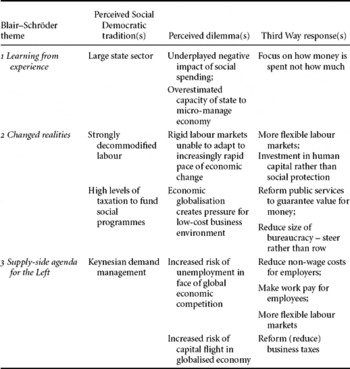
Though by no means without its critics (see Finlayson, Reference Finlayson2004), Bevir and Rhodes’ approach offers a useful basis from which to analyse the impact of the Third Way agenda, for Blair and Schröder (Reference Blair and Schröder1999) themselves claimed that the Third Way is a ‘modernisation’ of traditional social democratic values in response to ‘conditions that have objectively changed’, particularly the emergence of a more globalised, knowledge-based and technologically driven economy. As such, Blair and Schröder offer us an easy route to unpacking their narrative in terms of the core elements of the Bevir and Rhodes approach: tradition, dilemma and response. The key elements of their narrative can be summarised under three headings (see Table 1 for an overview). Firstly, there is – as Blair and Schröder put it – the process of ‘learning from experience’, by which they mean the need for the Third Way to depart from traditional social democracy in areas where the latter was deemed to have failed in the past. The chief issues here surround the perceived negative impacts of a large state sector and the key policy lesson they draw seems to be that ‘social conscience cannot be measured by the level of public expenditure [. . .what matters] is how effectively this expenditure is used’. Secondly, they see a need to adapt social democratic values to accommodate the ‘changed realities’ of the ‘newly emerging world’. Here they stress the need for flexibility ‘in a world of ever more rapid globalisation and scientific changes’ and the need ‘to invest in human capital: to make the individual and businesses fit for the knowledge-based economy of the future’. Finally, there is the need to develop a new ‘supply side agenda for the left’ in order to meet key social and economic policy challenges. Here the message is clear: traditional Keynesianism is no longer an option so ‘economies must be adaptable: flexible markets are a modern social democratic aim’.
Unpacking the Blair–Schröder Narrative

Bevir and Rhodes believe one of the main strengths of their approach is that it ‘does not read off actions from allegedly objective social facts about institutions or people’ offering, instead, ‘an analysis of change rooted in the beliefs and preferences of individual actors’ (2003: 195–9). This is a significant claim for most typologies of welfare state institutions place Germany and the UK in different camps, sometimes as polar opposites. If the common Third Way narrative can convincingly explain change without reference to these differing contexts that will be some feat, given what are widely perceived to be quite different social policy legacies in the two nations.
Differing national contexts: institutionalised policy legacies
Despite their acknowledged imperfections, welfare typologies usefully tease out some of the historically dominant features of our two nations’ institutionalised policy legacies. From a historical institutionalist perspective, these long-run historical policy legacies ought to be largely self-reinforcing; as Pierson argues, ‘social actors make commitments based on existing institutions and policies [and] as they do so, the cost of reversing course generally rises dramatically’ (2004: 35). Ultimately, therefore, institutions ‘induce self-reinforcing processes that make reversals increasingly unattractive over time’ (ibid.). In short, institutionalists would expect policy change to be ‘path dependent’, reflecting the differing institutional legacies in our two countries.
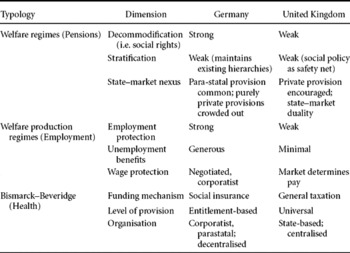
The dominant categorisation of national welfare ‘paths’ is undoubtedly Esping-Andersen's (Reference Esping-Andersen1990) three-way classification of welfare regimes. According to his classic typology, the UK is part of the liberal world of welfare in which means-tested benefits predominate, social interventions are designed primarily to act as a safety net and private provision is encouraged. Germany is the ideal type of the conservative/corporatist regime in which social rights are strong but attached to status, so earnings-related social insurance benefits predominate. These regimes, according to Esping-Andersen, are the outcome of a long process of development and represent distinct paths. Though widely accepted as a useful typology, one of the weaknesses of Esping-Andersen's approach is that it is built on data relating only to pensions, unemployment insurance and sickness insurance. While the description of policy regimes fits well with the UK and Germany's pensions systems, it is of little use in helping us to understand changes in the other policy sectors we want to examine here – health and employment – so we need to look to alternative typologies for these sectors.
In terms of employment policy, the growing debate about cross-national differences in economic institutions offers us a useful alternative. Hall and Soskice (Reference Hall, Soskice, Hall and Soskice2001) have argued that the UK and Germany are examples of different ‘varieties of capitalism’, the UK having a ‘liberal market economy’ (LME) where economic co-ordination takes place primarily through market mechanisms, while Germany has a ‘co-ordinated market economy’ (CME) in which non-market modes of co-ordination are prominent. They argue that complementary national institutions – including supportive social policies – underpin these differing forms of economic co-ordination. More specifically, Estevez-Abe et al. (Reference Estevez-Abe, Iversen, Soskice, Hall and Soskice2001) argue that different welfare production regimes, featuring contrasting levels of employment, unemployment and wage protection, map on to each: in LMEs these protection policies are weak (with free labour markets being favoured) when compared to CMEs (where co-ordinated intervention in labour markets is more readily tolerated). Health has always been something of an exception in the UK model (as Esping-Andersen concedes), acting as a social democratic oasis in a largely liberal welfare regime. The classic distinction between Beveridgian and Bismarckian welfare models – the former being characterised by (universal) flat-rate social protection funded through general taxation and the latter by earnings-related social protection funded through individual (and employer) contributions to social insurance funds – offers a useful way forward in this sector (Pierson, Reference Pierson1998: 778). As the progenitors of these labels, the British and German cases are contrasting ideal types and the two nations’ health care systems fit neatly into these categorisations.
Historical institutionalists suggest that these differing policy paths are amplified over time due to policy feedback that makes it easier and more fruitful to continue down the existing policy path rather than switch to an alternative (see Table 2 for a summary of these paths). They also claim that these differing policy arrangements fundamentally impact on the nature of key political debates about future policy change because they heavily influence actors’ interests. Given this, the institutionally grounded policy legacies thesis provides a strong counter to the ideational hypothesis that expects the common Third Way agenda to produce a similar set of policy outcomes in our two countries. Instead, the institutionalist perspective suggests that long-run path dependencies ought to manifest themselves in the nations’ policy agendas: in pensions, employment and health policy we ought to see the differing liberal/conservative, LME/CME and Beveridge/Bismarck legacies (respectively) remain intact. Significantly, Bevir and Rhodes see the institutionalist approach not just as a counter-thesis but, rather, as the antithesis of the interpretive approach, which, they argue, ‘replaces unhelpful phrases such as path-dependency with an analysis of change rooted in the beliefs and preferences of individual actors’ (2003: 199). We will now offer a brief overview of the detail of Blair and Schröders’ reforms in employment, pensions and health care, first sketching the broad trajectories of their reform processes in these sectors and then moving on to an examination of the interplay between institutional and ideational ‘forces’ in shaping these trajectories.
Institutionalised policy legacies

The Third Way in action? Examining policy reform trajectories
Given the emphasis on pursuing a new supply-side agenda in the Blair–Schröder communiqué, it is unsurprising that new employment policies were at the heart of welfare reforms in both countries. In the UK, the Blair government outlined a ‘new contract for welfare’ in its first year in office, the key principle of which was ‘work for those who can and security for those who cannot’ (Blair, Reference Blair1998: iii). A series of ‘New Deals’ was introduced for key target groups, each designed to assist job search activities, provide relevant training and, for the young or long-term unemployed, subsidise employers providing jobs for programme participants (see HM Treasury/Department of Work and Pensions, 2003). After a relatively modest approach in his first term of office, Schröder, as part of his ‘Agenda 2010’ programme, implemented a radical set of employment policy reforms in his second term. For the most part, these built on the report of the Hartz Commission (Hartz, Reference Hartz2002), whose proposals Schröder committed himself to fully implementing (Schröder, Reference Schröder2003). The most controversial component of these acts was the merger of unemployment assistance and social assistance together with stricter rules of acceptability for suitable jobs offered by placement officers.
In short, there are strong commonalities between the two countries in terms of placing active labour market policies (ALMPs) at the heart of their unemployment benefits systems. There are, however, some important differences to be found too. In the UK, on top of the refocusing of unemployment benefits, there has also been a concerted effort to ‘make work pay’ (see HM Treasury/Department of Work and Pensions, 2003) through a range of ‘tax credits’ designed to boost the income of those in low-paid jobs or whose circumstances might lead to them being worse off in work than on benefits. These targeted income top-ups were a central plank of the Blair government's social policies and had no genuine parallel in the German programme. They represent a considerable increase in public expenditure in this sphere and can be contrasted with the Schröder government's attempt to restrict expenditure by merging unemployment insurance and social assistance. Further still, it is worth noting that in Germany there was a (modest) loosening of other employment protection policies that made it easier for businesses to dismiss employees, while in the UK there have been some important – though again modest – improvements in employment rights, including the introduction of a national minimum wage in April 1999 and endorsement of the European Social Chapter, which the preceding Major government had opted out of.
Central to the common agenda outlined by Blair and Schröder was an emphasis on keeping taxation and spending within tight limits and reducing non-wage costs to businesses. As the largest single public spending commitments faced by both countries it is unsurprising that pensions have provided a focal point for reform. Indeed, in his exploration of the global Third Way debate, Giddens asserted that ‘in at least some of its aspects, and in some countries, the welfare state has become unsustainable . . . the pension commitments of some countries, such as Germany . . . are completely unrealizable’ (2001: 103), while Blair and Schröder's joint statement argued ‘social security systems need to adapt to changes in life expectancy’.
Pension reforms in the UK and Germany showed a remarkable commonality of purpose. In the UK, the Blair government stated its intentions early in its first term of office to increase the proportion of pensioner income coming from private pensions from 40 per cent to 60 per cent by 2050, reversing the existing situation (Department of Social Security, 1998). In order to achieve this, a complex mix of provision has been put in place (see Hills, Reference Hills2004). While the state has long encouraged the uptake of private pensions by offering generous tax relief on contributions, a number of measures have been introduced to stimulate further take-up, including the creation of a new ‘stakeholder pension’ targeted at those on modest incomes, tougher regulation of funds and greater protection in instances where funds collapse. While the universal, flat-rate basic state pension is to be protected, its value will diminish as earnings rise, although a tentative reform proposal outlined in 2006 may restore the link with earnings in exchange for raising the age at which it is paid (Department of Work and Pensions, 2006). In order to protect those with no or little private provision, a new means-tested ‘minimum income guarantee’ was introduced in 1999, replaced by a more generous ‘pension credit’ in 2003. In Germany, meanwhile, the pension reforms of 2001 fixed the state's contributions to standard pension insurance at an upper limit of 20 per cent alongside the introduction of a new formula for calculating payments that will have the net effect of reducing replacement rates from these schemes (see Hinrichs, Reference Hinrichs2003; Schmidt, Reference Schmidt, Egle, Ostheim and Zohlnhöfer2003). In addition, the reforms also introduced a new voluntary private pensions savings scheme with tax-subsidised contributions and a new means-tested basic security scheme for low-income pensioners. In both countries, the core goals are clear: to limit the percentage of each individual's pension costs for which the state is responsible, to increase the role of private provision and increasingly to focus additional state support on the poorest pensioners via a means-tested safety net.
While less explicit in their comments on health care per se, Blair and Schröder's joint statement certainly spoke to a number of major themes of great importance to policy in this sphere. As the most expensive public service (as opposed to cash transfer) in each country, the leaders’ claims that ‘public expenditure as a proportion of national income has more or less reached the limits of acceptability’ and that ‘constraints on “tax and spend” force radical modernisation of the public reform of public services to achieve better value for money’ were clearly of direct relevance to this sector. So too were their arguments that ‘public sector bureaucracy at all levels must be reduced, performance targets and objectives formulated, the quality of public services rigorously monitored, and bad performance rooted out’ and that ‘the state should not row, but steer’.
In Germany, there was a very clear attempt to contain the costs of health care spending. The first draft for the Reform Act of Social Health Insurance released in 1999 included the ambitious plan to introduce tightly controlled global budgets by assigning an upper limit for total health care expenditure. While these initial proposals were abandoned due to vehement resistance (Hartmann, Reference Hartmann, Egle, Ostheim and Zohlnhöfer2003), the red–green coalition eventually succeeded in shifting costs to patients via increased charges, including an ‘entry fee’ for visits to a doctor's surgery in the 2004 Health Care Reform. This shifting of costs to patients marked a significant u-turn for the Schröder government: in 1998 it had reversed charges introduced by the Kohl administration. By way of contrast, however, in the UK there was a considerable injection of additional funding into the National Health Service (NHS) during Blair's tenure, and a particularly marked growth after 2002 when he pledged to take UK spending on health care as a proportion of Gross Domestic Product (GDP) above the European Union (EU) average after decades lagging behind it. So, with respect to health care spending plans, there is a strongly divergent pattern of policy change.
There was more common ground between the countries in terms of reforms designed to boost the efficiency of health care services, but again the overall picture differs in terms of the organisational structures introduced to this end. Less than a year into office, Blair's government ‘proposed major changes in the structure, organization and funding of the NHS’ (Glendinning, Reference Glendinning, Ellison and Pierson2003: 199; see Department of Health, 1997). On the face of it – and certainly this is the view presented in government rhetoric – the reform involved a considerable devolution of power from the centre to the front line. Further devolution of control was created by controversial reforms that introduced ‘foundation hospitals’, elite institutions allowed to ‘opt out’ of the traditional NHS structure and become independent not-for-profit organisations with greater autonomy. Alongside all this devolution, however, there has also been an increase in the monitoring of activity and a frenzied setting of strategic objectives by the centre, with new institutions formed to ensure targets are being monitored and met and to specify best-value treatments and procedures. By way of contrast, the structural reforms of the Schröder governments appear to be rather modest (see Hartmann, Reference Hartmann, Egle, Ostheim and Zohlnhöfer2003). Their 2000 reform introduced stricter monitoring of hospital activity and greater specification of acceptable activity. Among the changes were binding evidence-based guidelines on preferred treatments, guidelines on technology assessment and the nationwide implementation of payment based on diagnostic-related groups (DRGs). Nevertheless, the overall institutional structure of the system remained intact. To summarise, while there was a clear shared goal of increasing the efficiency of health care services, widely differing strategies were adopted. Though both governments increased monitoring of medical activity, clear divergence can be seen with respect to structural reforms, the UK devolving power and Germany avoiding deep structural reforms of this type.
A Third Way in action? Assessing the interpretive approach
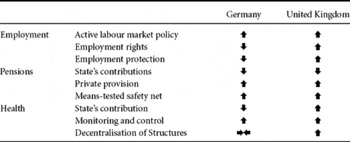
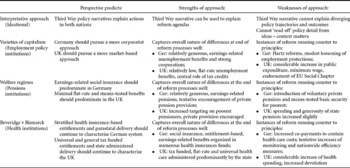
Whether these tales of reform endorse the interpretive or the institutional thesis depends to a large degree on whether they describe a tale of policy convergence or policy divergence respectively (see Table 3 for a summary). Determining which of these terms best describes the process of change is, however, far from straightforward. As we note above, in pensions policy the reform agenda shared a great deal in terms of its broad detail. Similarly, the core employment policies centred on introducing ALMP and much of the story in the health care field was one of scrutinising (and micro-managing) more intensely than before the effectiveness of spending. At the same time, however, there are areas in which there seemed to be different reform pathways: in employment policy, the UK strengthened employment rights while Germany weakened them and the UK's tax credits had no real parallel in Germany. In health care policy, meanwhile, the differences were more notable still: the UK sanctioning huge increases in health care spending and experimenting with some potentially radical new organisational forms while in Germany the picture was largely one of institutional stasis and cost reduction. In short, there seems to be something of a mixed picture on the convergence/divergence question.
Policy reform trajectories

 =Increase
 = Decrease ➡
 = No Change
The Theoretical perspectives compared

Yet we might reasonably ask whether convergence is best understood as a process of common means or common ends. For instance, in terms of employment rights, while the Blair governments looked to strengthen them and Schröder's weaken them, in both cases we observe modest changes and, ultimately, these rights remain much stronger in Germany than in the UK. However, these seemingly divergent reform trajectories pushed the two countries a little closer together in this policy sphere. (Between 1998 and 2003, Germany and the UK moved closer together in the Organisation for Economic Cooperation and Development's (OECD) Employment Policy Legislation strictness index, but with Germany remaining above, and the UK some way below, the OECD average – see OECD, 2006.) Similarly, the diverging trends with respect to health care spending will have much the same effect: Germany has long spent more than the EU average on health care and Blair's aim to take public spending on health to 8.2 per cent of GDP by 2008 will place it at a level remarkably similar to the rate in Germany when Blair came to power in 1997. Likewise, while Blair's plans to create foundation hospitals hold the potential to alter radically the structure of the NHS, in boosting the role of semi-independent (para-statal) organisations, they mimic one of the key features of the German model. In other words, it might well be argued that divergent means have had the effect of producing converging ends in these particular areas of policy: that a process of ‘condivergence’ has occurred.
All this, perhaps, offers considerable ammunition for the ideational thesis, but only if the agenda can be understood in terms of the Third Way narrative and the traditions and dilemmas in which it is rooted. Significantly, it is easy to explain much of the agenda in this way. Of the common policy elements, boosting the flexibility of labour markets to account for global economic change, the stronger focus on the way money is spent in health care services in order to reflect a concern with value for money and the desire to limit the growth of public expenditure in the field of pensions in order to keep overall taxation rates down – all fit neatly into the broad thrust of the Third Way narrative. Likewise, many of the ‘condivergent’ elements can be accounted for in a similar fashion. While, taken at face value, the two nations’ employment protection policies are heading in different directions, both are clearly framed by a Third Way compromise between a desire to protect social rights while also promoting flexible labour markets. Blair's approach was generally modest in intent – signalled, above all, by his refusal to fully sign up to the EU's directive limiting working hours – while Schröder's entailed incremental removal of some of the longstanding rigidities in the German labour market while protecting many of its key features, including the EU directive on working hours. Similarly, Schröder's attempts to constrain the cost of health care clearly chime with the Third Way belief that public sector spending has more or less reached its limits and the absence of deeper reforms to the structure of the service might be argued as irrelevant in the context. By contrast, while Blair's huge injection of additional cash into the sector seemed to go somewhat against the grain of the Third Way narrative, his desire to reconcile this spending growth with the Third Way narrative might well explain why he insisted on pushing through largely unpopular reforms aimed at boosting competition and, indeed, reducing the size of public bureaucracy to accompany this.
There is, then, much to commend the interpretive approach: not only is there a large degree of commonality in the policy agenda being pursued in the two countries, its direction is largely consistent with the Third Way narrative and, furthermore, discordant policy paths can be explained in a manner largely consistent with the narrative. Yet while the focus on ideas and beliefs that Bevir and Rhodes advocate can usefully help us interpret the ideational roots of change, it is much less useful in helping us understand what form change might take; the shared ideational agenda we see here manifests itself in often diverse forms. Indeed, while Bevir and Rhodes forcefully assert that we cannot ‘read off actions’ from institutions, it seems equally true that policy ideas cannot be read straight from beliefs without some understanding of the mediating variables that can lead to strong variations of the same theme as in our cases. Might the varying institutionalised policy legacies be the key?
Path-dependent or path-breaking Third Ways? Assessing the institutional approach
The (historical) institutionalist perspective encourages us to take a step back from the immediate point of decision and consider the long durée for the simple reason that a ‘focus on path-dependent processes suggests the need to develop analyses that may incorporate substantial stretches of time’ (Pierson, Reference Pierson2004: 45). What matters most from this perspective, it might be argued, is not so much whether common ideas can be identified across nations but, rather, whether national reform programmes display strong continuity with preceding policy frameworks. In short, what matters is whether change is path breaking or path confirming.
However, as with distinguishing between convergent and divergent policy change, determining whether a reform agenda is path breaking or confirming is a far from straightforward task and one that has been muddied by crude conceptions of path dependency as the claim that policy does not change or is ‘frozen’ (including Rhodes, Reference Rhodes2004). Given this, Pierson carefully stresses that ‘path dependence refers to dynamic processes involving positive feedback, which generates multiple possible outcomes depending on the particular sequence in which events unfold’ and, consequently, it refers to ‘social processes that exhibit positive feedback and thus generate branching patterns of historical development’ (2004: 20–21). What this means in practical terms for the task in hand is that even after common Third Way reform agendas have been implemented, the distinct institutional patterns identified in the two countries – the different ‘branches’ of development – ought to remain intact: the UK ought to remain a recognisable instance of a liberal regime with Beveridgian institutions and Germany a conservative regime with Bismarckian institutions. As Pierson puts it: ‘Change continues, but it is bounded change’ (2001: 415).
Once again, it is not difficult to construct a case that supports the perspective's claims. In terms of employment policy, while both have introduced active labour market policies, the two nations’ unemployment protection systems still differ radically along key dimensions: for instance, the German system still retains the core features of the conservative/corporatist regime identified by Esping-Andersen. While the perceived harshness of the Hartz reforms has produced considerable political controversy, even at the end of the process the German system remains resolutely different from that in the UK: the insurance principle remains at the core of the system and the unemployed receive relatively generous earnings-related benefits for a full 12 months (18 months for those over 55) before they move on to the less generous social assistance rate. In the UK benefit levels are low and there is little (in many cases no) difference between rates for unemployment benefit and social assistance. Similarly, in terms of employment protection and wage protection, the German system, despite Schröder's reforms, remains resolutely typical of a CME-based welfare production regime, given the strong role corporatist mechanisms such as works councils continue to play in the labour market. By contrast, the UK's LME approach is typified by its use of tax credits – as opposed to collectively negotiated wage agreements – to supplement low-level market wages and refusal to fully endorse EU limits on working hours.
In terms of pensions’ policy, while the Blair governments increased public expenditure on the poorest pensioners quite significantly, the overall picture of provision remains one in which state provision acts primarily as a safety net, while private provision is encouraged for the majority. Indeed, it might well be argued that reforms have solidified this picture given that increased public resources have been primarily distributed through means-tested benefits, while much policy attention has focused on extending private coverage through stakeholder pensions and moves to shore up the security of private funds. The German pension reforms, meanwhile, might well be seen in the same light as its employment reforms: radical in terms of some of the principles they embrace, but ultimately a tinkering at the margins. The introduction of a subsidised private pension scheme is potentially radical and while take-up has risen since 2005 in particular, its impact so far has been limited, not least because it is an addition to the existing social insurance-based provision rather than a replacement of it. Indeed, the core features of the conservative model – social insurance-based, earnings-related pensions – remain at the heart of the German system. Much the same can be argued with respect to health care reforms in the two countries where, for all the hullabaloo surrounding Blair's reforms, the core principles of the NHS remain firmly intact and where Schröder has operated entirely within the institutional structures he inherited.
In short, a more detached analysis that looks at where these reforms leave the two countries, rather than the more immediate politics of the moment, suggests that, for all the commonality in the ideas of Blair and Schröder, policy outcomes have shown very strong signs of path dependency. It should be added, though, that this is not to say that some reforms do not have the potential for greater impact in the future and it may be that some mark the beginning of path-breaking change processes rather than a completed reform agenda. Indeed, Pierson notes that ‘policies that start small may, if conditions are right for self-reinforcement or if unintended consequences are large, end up being extremely significant’ (2004: 166), and Streeck and Thelen argue that, in the long run, a series of seemingly small institutional changes may result in ‘gradual transformation’ (2005: 9). Herein lies one of the difficulties of applying the institutionalist analysis to contemporary cases: in order to fully assess whether change is path breaking we need to look forward as well as back, but this is impossible when analysing contemporary events. Indeed, while we have suggested here that change has been largely path confirming, it is worth noting that others have drawn different conclusions. For instance, Schmidt described the German pension reforms as marking a ‘great path-deviation’ (2003: 247), while Seeleib-Kaiser and Fleckenstein (Reference Seeleib-Kaiser and Fleckstein2006) believe German labour market policy has switched path to a liberal model heavily influenced by the UK's approach. This need for foresight in order to draw firm conclusions is evidently a problem for the perspective, but it should not be overplayed; if it means in practice that conclusions must remain provisional, then the situation differs little from that we find in branches of the social science with more clearly predictive aspirations. Here, our conclusions do indeed remain provisional and, as changes play out, those calling the changes path breaking may – or may not – prove to be more accurate in their judgement.
What we can say with greater certainty, however, is that a focus on institutionalised policy legacies can help us to understand why the common Third Way agenda has manifested itself in such different forms. For instance, the huge political controversy surrounding the creation of foundation hospitals in the UK would be difficult to understand from a German perspective, where the initial extension of state involvement in health care did not manifest itself as a nationalisation of health care provision and so, consequently, (state) ownership of hospitals has never been a major political issue. Likewise, the enormous trade union-driven demonstrations against the merger of social assistance and unemployment insurance in Germany – a reform whose controversy exceeded that of foundation hospitals in the UK – are difficult to understand from a British perspective, where the differences in payment rates between the two benefit categories have at most been minimal and, further, the trade unions have not seen unemployment insurance as part of the employment package it is their role to protect. In both instances, ostensibly common values cannot be easily translated into common policies, or common policy ends, because the political debates in the two nations are fundamentally shaped by past policies: institutionalised legacies clearly generated policy feedback that reverberated through the two nations’ Third Way narratives.
Between ideas and institutions
In short, the evidence presented here suggests that there are identifiable and common Third Way elements in the Blair and Schröder welfare state reforms; as such, we find support for Bevir and Rhodes’ insistence that a focus on narratives and traditions can help us to understand the nature of policy change. Many commentators remain sceptical of the very notion of a Third Way, but there is a ring of truth to Bevir and Rhodes’ claim that ‘what matters . . . are the subjective, or more usually, inter-subjective understandings of political actors, not our academic accounts of real pressures in the world’ (2003: 36). However, the interpretative approach only takes us so far. Despite the commonalities, we found much difference in policy detail, both in terms of policy direction and destination. While ideas and beliefs – the responses to dilemmas that threaten traditions if you like – are evidently a force for change, ideas are fuzzy. The two nations’ different starting points – their institutionalised policy legacies – fundamentally shaped the way in which beliefs about changed circumstances were interpreted into actual policy measures. In short, just as ideas hold the potential to reshape institutions, so too ideas are influenced by institutions.
Significantly, a careful reading of the literature shows that the two approaches share many core arguments and, in truth, would benefit from a fusion of their ideas rather than being presented as oppositional tendencies. In their keenness to mark new intellectual territory with their interpretative approach, Bevir and Rhodes have thrown the baby out with the bathwater. Indeed, it might well be argued that their attack on historical institutionalism is somewhat odd: while it is fair to say that the influence of ideas on policy change has not been systematically teased out by institutionalists keen to emphasise the stability of policy and politics (see Béland, Reference Béland2005), the approach has always been receptive to ideationally based arguments (for example, Hall, Reference Hall, Steinmo, Thelen and Longstreth1992). Moreover, institutionalists are aware that their perspective faces some difficulty in explaining change, and greater analysis of the role of ideas in propelling change is commonly advocated (see Streeck and Thelen, Reference Streeck and Thelen2005). The interpretative approach's focus on established traditions, dilemmas and narratives might well help here.
Indeed, in focusing on traditions on the one hand and path dependency on the other, the two perspectives share a fundamental view that history matters a great deal. Bevir and Rhodes’ notion of ‘tradition’ overlaps strongly with that of positive feedback: both, in essence, encapsulate the claim that past approaches heavily frame present thinking. Pierson says as much when he argues that ‘actors who operate in a social context of high complexity and opacity are heavily biased in the way they feed the information into existing “mental maps”. Confirming information tends to be incorporated, while disconfirming information is filtered out’ (2004: 35). As he puts it, this means that ‘social interpretations of complex environments like politics are often subject to positive feedback . . . the need to employ mental maps induces positive feedback’ (ibid.). It is only a small leap from this view to Bevir and Rhodes’ claim that actors respond to pressures for change – dilemmas – from within long-held traditions. Likewise, Bevir and Rhodes’ focus on the role of dilemmas in forcing the augmentation of traditions does not sit uneasily with the institutionalists’ view of path dependency as a scenario where ‘change continues, but it is bounded change – until something erodes or swamps the mechanisms of reproduction that generated continuity’ (Pierson, Reference Pierson2004: 52). While the language used in the two schools of thought differs slightly – crisis and dilemma, equilibrium and tradition – the overall thrust of the argument is, in truth, broadly similar.
In short, when Bevir and Rhodes argue ‘the point at issue is whether we can read off the beliefs, desires and actions of individuals from their institutional locations’ (2003: 63), they are undoubtedly correct in their claims about the complexities of human motivation, but are wrong in their belief that this is the key issue – their claim here rests on a mistaken interpretation of the institutionalist position. Far from occupying separate intellectual spaces, we suggest that combining elements of the interpretive approach with those of historical institutionalism offers a fruitful line of analysis in understanding a more subtle question: that of how the interaction between ideas and institutions impacts on policy outcomes.
From cross-national to cross-sector: policy networks and power dependency
So far, analysis has proceeded on the basis that two cases have been presented – Germany and the UK – when in fact we have six: three policy sectors in the two different countries. One of the weaknesses in much of the theoretical comparative welfare states literature is that it presents broad typologies that underplay national cross-sectoral variations, and certainly this is an issue here: while we have argued that strong path-dependent tendencies are at play, the ‘institutionalised legacies’ we presented were applied to each sector rather than the welfare state as a whole. In many ways, this runs counter to the ambitions of those who developed the typologies: certainly, Esping-Andersen's regimes are supposed to be applicable to the whole of a nation's welfare regime. Yet Levi-Faur has vehemently argued that ‘Nations and sectors are an important source of political variations and some marked advantages accrue from studying them together in the same research design’ (Reference Levi-Faur2006: 368, emphasis added). Ironically, much of Rhodes’ earlier work on policy networks forcefully argued the need to focus on the sectoral-level dynamics of the policy process (for example, Marsh and Rhodes, Reference Marsh and Rhodes1992a; Rhodes, Reference Rhodes1997). Indeed, the key insight of this earlier work was that sectoral-level policy networks matter because national governments must negotiate reform programmes with policy networks of varying degrees of power and autonomy: in short, the varying resources of networks affect the state's dependency on others and so its own power in each policy sector.
However, Rhodes’ shift to an interpretive approach leaves something of a question mark over the status of his earlier work on policy networks. On the one hand, Bevir and Rhodes insist that ‘policy networks are a long-standing feature of British government . . . the defining characteristic of governance’ (2003: 55). Consequently, they urge us to ‘decentre’ our analysis for ‘any straightforward comparison of national traditions runs the danger of ignoring significant complexity and diversity’ (ibid: 98). On the other hand, they suggest dominant conceptions of policy networks (including Rhodes’ earlier work) are ‘positivistic’ in outlook because of their focus on power dependence and measuring the size and independence of networks. They argue that, from an interpretive perspective, ‘a decentred account of governance would not stress their allegedly objective characteristics. Rather it would focus on the social construction of policy networks through the ability of individuals to create meaning’ (ibid: 62). In advocating such an absolute rejection of a structurally rooted analysis, Rhodes performs a considerable u-turn, for he had earlier looked to associate the policy network approach with institutional analysis, arguing ‘policy network theories adopt a “state-centric” approach to public policy making, studying “behaviour within institutional contexts”' and that, consequently, ‘policy networks is an institutionalist approach’ (1995: 53).
Yet if we examine the cases presented here at the sectoral rather than national level, Rhodes’ earlier arguments continue to carry much force. What is particularly notable is that the most radical reforms – and those that are most clearly ‘Third Way’ – are found in the employment policy sector, where the policy networks are at their weakest. This is particularly so in the UK, where the absence of any powerful organisation to represent the interests of benefit claimants made the passage of ALMP a relatively straightforward task for the Blair government. In Germany, the corporatist institutions and wider reach of benefits made change more difficult, but, ultimately, delaying the pace of reform rather than vetoing it. By way of contrast, in health care – the classic example of a well-organised and resourced policy community – change in Germany was minimal and reform in the UK has been accompanied by a huge injection of funding to placate the policy community. Moreover, it is in this sector that it is hardest to identify a common Third Way approach across the two countries, with widely diverging reform strategies being adopted. That a governing ‘ideology’ should have greatest and clearest impact where networks are weakest (and vice versa) is unsurprising: Rhodes’ earlier review of the progress of Thatcherite reforms in the UK drew broadly similar conclusions (Marsh and Rhodes, Reference Marsh and Rhodes1992b).
Significantly, the analytic power of the policy network approach in these cases stems precisely from its focus on sectoral-level power–dependency relationships. The contrast between relatively weak and relatively strong policy networks offers us a convincing explanation for the varying progress of Third Way reforms across policy sectors and, while an analysis of the traditions and narratives at play in these sectors would, no doubt, deepen our understanding of the dynamics of policy change in these sectors, such a claim does not need to undermine the value of the power–dependency approach. Indeed, it might well be argued that significant elements of sectoral-level traditions can be understood by reference to institutionalised policy legacies at this level. While the health care sector displays the most autonomy in both countries, the significance of specific policy issues in the two nations is, as we have shown, fundamentally influenced by the shape and form of existing policies and institutions, and, consequently, there are some major differences in the policy outcomes members of the network have advocated.
Once again, it might well be argued that Bevir and Rhodes have constructed something of a straw person in their (re-)conceptualisation of the policy network approach. Far from being rooted in a ‘positivist’ mindset that emphasises measurement of the ‘objective characteristics’ of networks, most of the literature is rooted in a qualitative, discursive, case-study-based tradition (Hudson and Lowe, Reference Hudson and Lowe2004) and recent work by Marsh and Smith (Reference Marsh and Smith2000), for instance, could hardly be described as ‘positivist’, given its emphasis on the complex, continuous and unpredictable interaction between network structures, agents and context. Constructing such a figure allows them to place much clearer water between their interpretive approach and the dominant claims made by policy networks theorists than is warranted; indeed, much is to be gained from fusing their focus on ideas and narratives with both the institutionalist emphasis on path dependency and the policy network approach's emphasis on power dependency.
Conclusion
Bevir and Rhodes’ assertion that policy analysts need to pay greater attention to the ideas propounded by policy actors themselves rather than looking to privilege academic accounts of change carries much truth. While commentators have legitimately challenged the intellectual coherence of the Third Way, what ultimately matters here is whether – as a narrative conceived in response to the dilemmas facing social democratic traditions – it can help to explain the nature and form of actual social policy reforms. To a large degree it can, for the narrative outlined by Blair and Schröder in the early days of their administrations chimes well with much of their actual welfare state reform agendas. Indeed, we believe that ‘Third Way thinking’ has had an important impact on social policy in the two countries.
However, Bevir and Rhodes are wrong to claim that a focus on narratives can explain everything. In examining two nations with an ostensibly common reform agenda, we have shown not only that the precise nature of the Third Way agenda has differed considerably in some key areas, but that institutionalised policy legacies help explain differences in the agenda between the countries and that varying policy networks help us to understand differences between sectors within countries. While Bevir and Rhodes rightly challenge a tendency among policy analysts to dismiss (and simplify) policy actors’ views in favour of academic accounts of change, it is ironic that, in seeking to articulate a clear and distinct interpretive approach to political science, they have often been guilty of similarly dismissing and simplifying the views of other policy analysts. Rather than looking to stress the difference by adopting an extreme position or by picking fights with historical institutionalists and policy network theorists, Bevir and Rhodes would do more to advance serious discussion of the impact of ideas on policy change by looking for potential synergies between their work and these perspectives – they are better viewed as complementary perspectives rather than competing ones.
While comparative exploration of common Third Way agendas can demonstrate the value of examining ideas as an explanation for change, it also demonstrates the weaknesses of an approach based on ideas alone. It has often been argued that the nature of the Third Way is best determined by examination of policy detail rather than through statements of broad intent. This seems to make sense, but only if we overlook two basic facts. The first is that in looking to assess the impact of a common idea in two countries, different starting points – policy legacies – make it difficult to determine analytically what might constitute divergent or convergent policy agendas: indeed, difference is inevitable, for path-dependent tendencies will exert their influence on national debates. The second is that policy, as a decentred approach implies, is not made in a vacuum; it is shaped by outside interests too. Deviation from a core set of ideas held by central actors again appears inevitable, therefore, and strong variations are likely to exist across sectors. In other words, ideas can only ever give us part of the picture. As Richardson argues, in practice ‘ideas, institutions and interests become entwined’ (Reference Richardson2000: 1019). There is much merit, therefore, in adopting a multi-theoretic approach that encourages analysis of all three together. In practice, of course, many other factors – particularly macro-level forces such as demographic and economic change – heavily influence policy change, not least through their impact on policy ideas or narratives: space precludes a discussion here of the interaction between macro- and meso-level forces (see Hudson and Lowe, Reference Hudson and Lowe2004). Our suggestion here is merely that, as a meso-level approach, ideational analysis has considerable value, but only if it is paired with a consideration of the institutions and policy networks that frame ideas in each specific policy arena.
Skocpol and Amenta famously argued that ‘not only does politics create social policies; social policies also create politics’ (Reference Skocpol and Amenta1986: 149). We might also add that not only do ideas create social policies, but social policies also create ideas. Indeed, in the cases we have examined here it seems that, if anything, such is the level of policy feedback that social policy has often had the upper hand in this relationship. This, of course, creates very difficult analytic problems for those exploring Third Way agendas, for it means policy convergence – even at the national level – is unlikely to be particularly deep other than at the rhetorical level. And if divergence of policy trajectories is all but inevitable given the fundamental role of institutional legacies and policy networks in shaping policy outcomes, then how are we to tell if Giddens’ ‘Global Third Way’ was a movement of real substance or nothing more than empty rhetoric? The answer is that in order to be fair to the Third Way, rather than simply dismissing it as irrelevant dressing, we need to examine not just the ideas held by policy actors but also their interaction with these other factors. The search for the essence of a Third Way in practice will otherwise be fruitless, for it lies between ideas, institutions and interests.
Acknowledgements
Earlier versions of this article were presented to the Australian Political Studies Association Conference at the University of Adelaide and to a Research Seminar at the School of Social and Policy Sciences, University of New South Wales: many thanks to those who offered feedback and suggestions at those events and also to the two anonymous referees of this article whose comments proved very helpful. Parts of this work were completed when John Hudson was a Visiting Fellow at the Social Policy Research Centre at the University of New South Wales; colleagues there offered invaluable support and helpful comments.