Past models of reading consider vocabulary knowledge to be an important source of variation in reading comprehension for both monolingual English speakers (Beck, Perfetti, & McKeown, Reference Beck, Perfetti and McKeown1982; Freebody & Anderson, Reference Freebody and Anderson1983; Hemphill & Tivnan, Reference Hemphill and Tivnan2008) and bilinguals (August, Carlo, Dressler, & Snow, Reference August, Carlo, Dressler and Snow2005; Snow, Burns, & Griffin, Reference Snow, Burns and Griffin1998). Oral vocabulary has been shown to be the most significant predictor of reading comprehension, even after controlling for early word recognition, phoneme awareness, and letter knowledge (Muter, Hulme, Snowling, & Stevenson, Reference Muter, Hulme, Snowling and Stevenson2004), and intervention studies have repeatedly shown the importance of vocabulary knowledge for reading comprehension (e.g., see Beck, McKeown, & Kucan, Reference Beck, McKeown and Kucan2002; Biemiller & Boote, Reference Biemiller and Boote2006). Comprehension is disrupted when the proportion of unknown words is too high (Carver, Reference Carver1994). This is particularly true for English language learners (ELLs) who have limited English vocabulary. They are less able to comprehend text at grade level than their monolingual counterparts and are at higher risk of being diagnosed as learning disabled (Limbos & Geva, Reference Limbos and Geva2001; Moll & Diaz, Reference Moll, Diaz, Garcia and Padilla1985). Moreover, young bilinguals are, on average, already behind their middle-class English-speaking peers, who know about 10,000 English words at school entry (Anglin, Reference Anglin1993).
In order for young ELLs to be successful, then, a key question is what predicts vocabulary, particularly English vocabulary. Although research on vocabulary development in monolingual English-speaking children spans several decades, how vocabulary develops in ELLs has been understudied. This study aims to identify what developmental processes ELLs display in their lexical acquisition and what factors predict individual differences in their rate of acquisition, which has implications for home and educational practices in early childhood.
MONOLINGUAL ENGLISH VOCABULARY DEVELOPMENT
It is well established that socioeconomic status (SES) is related to vocabulary development and that, as a group, children from families with low SES have lower vocabularies (Hart & Risley, Reference Hart and Risley1995) and slower rates of vocabulary development (Dollaghan et al., Reference Dollaghan, Campbell, Paradise, Feldman, Janosky and Pitcairn1999) than children from families with middle and high SES. Neuman and Cleano (Reference Neuman and Cleano2001) found inequity in the access to print and the quality of literacy materials, with middle-SES children having a large variety of resources to choose from and low-SES children having to rely on public institutions with fewer choices and a lower quality of literacy materials.
Shared book reading in preschool (Reese & Cox, Reference Reese and Cox1999; Sénéchal, Thomas, & Monker, Reference Sénéchal, Thomas and Monker1995; Wasik, Bond, & Hindman, Reference Wasik, Bond and Hindman2006), kindergarten (Eller, Pappas, & Brown, Reference Eller, Pappas and Brown1988; Robbins & Ehri, Reference Robbins and Ehri1994), and with children as old as third grade (De Temple & Snow, Reference De Temple, Snow, van Kleeck and Stahl2003; Penno, Wilkinson, & Moore, Reference Penno, Wilkinson and Moore2002) has been linked to robust vocabulary acquisition in monolinguals. In their meta-analysis examining the effect of interactive book-reading sessions on vocabulary development in day care centers, preschools, kindergartens, and first-grade classrooms, Mol, Bus, and de Jong (Reference Mol, Bus and de Jong2009) found that interactive reading had a moderate effect on vocabulary, explaining 6% of the variance.
Frequency of shared book reading in the home has also been associated with monolingual children's vocabulary development, even when controlling for variables such as parents’ education and children's nonverbal intelligence (Raikes et al., Reference Raikes, Pan, Luze, Tamis-LeMonde, Brooks-Gunn and Tarullo2006; Sénéchal & LeFevre, Reference Sénéchal and LeFevre2002). Children learn new words and expressions through hearing their parents use them in routine book-reading situations (Snow & Goldfield, Reference Snow and Goldfield1983). Books are a source of rich language input (e.g., De Temple & Snow, Reference De Temple, Snow, van Kleeck and Stahl2003; Dickinson, McCabe, & Anastapoulis, Reference Dickinson, McCabe, Anastapoulis, van Kleeck, Stahl and Bauer2003; Hoff-Ginsberg, Reference Hoff-Ginsberg1991), which is strongly associated with vocabulary growth in young children (Beals, Reference Beals1997; Beals & Tabors, Reference Beals and Tabors1995; Dickinson, Cote, & Smith, Reference Dickinson, McCabe, Anastapoulis, van Kleeck, Stahl and Bauer1993; Hart & Risley, Reference Hart and Risley1995; Huttenlocher, Haight, Bryk, Seltzer, & Lyons, Reference Huttenlocher, Haight, Bryk, Seltzer and Lyons1991; Weizman & Snow, Reference Weizman and Snow2001). Moreover, there is a Matthew effect (Stanovich, Reference Stanovich1986) by which those who initially know more words make greater gains than those who initially know fewer, making it difficult to close the gap even for monolingual English speakers (Reese & Cox, Reference Reese and Cox1999; Robbins & Ehri, Reference Robbins and Ehri1994).
ELL VOCABULARY DEVELOPMENT
Research on vocabulary development in monolingual English-speaking children spans several decades, but only recently has there been a focus on vocabulary research with ELL children and much less is known about their vocabulary development (Snow & Kim, Reference Snow, Kim, Wagner, Muse and Tannenbaum2007). Several studies report that ELLs have lower levels of vocabulary than monolinguals of the same age in both the child's first language (L1) and second language (L2; Hammer, Lawrence, & Miccio, Reference Hammer, Lawrence and Miccio2008; Oller & Eilers, Reference Oller and Eilers2002; Paez, Tabors, & Lopez, Reference Paez, Tabors and Lopez2007; Uchikoshi, Reference Uchikoshi2006). The Bilingual Study Group directed by Oller and Pearson (Reference Oller and Eilers2002) examined receptive and productive vocabulary size in Spanish–English ELL school-aged children in Miami from various SES groups attending bilingual or English-only programs and found that vocabulary development in ELLs was slow in terms of reaching monolingual norms; even in fifth grade, the children had lower vocabulary levels than their monolingual peers (Cobo-Lewis, Pearson, Eilers, & Umbel, Reference Cobo-Lewis, Pearson, Eilers, Umbel, Oller and Eilers2002). In addition, when comparing children who heard both Spanish and English prior to kindergarten with those who only heard Spanish, the Bilingual Study Group found that the dual-language group initially scored higher on English vocabulary tests but, by fifth grade, the groups’ abilities did not differ as a function of their home language (Cobo-Lewis et al., Reference Cobo-Lewis, Pearson, Eilers, Umbel, Oller and Eilers2002). With regard to Spanish abilities, children from homes that spoke Spanish only prior to kindergarten entry outperformed children from English bilingual homes at all ages from kindergarten through fifth grade. However, the authors note that children preferred to talk in English early in their kindergarten year. Thus it was likely that the children were experiencing linguistic assimilation to English even prior to school entry (Cobo-Lewis, Pearson, Eilers, & Umbel, Reference Cobo-Lewis, Pearson, Eilers, Umbel, Oller and Eilers2002).
Uchikoshi (Reference Uchikoshi2006) also found lower levels of both English and Spanish vocabulary with Spanish-speaking ELLs in kindergarten when compared to monolingual norms. On English receptive vocabulary, the Spanish-speaking ELLs scored at the level of a monolingual English child aged 3years, 2 months in October; by May/June they had acquired enough English vocabulary to achieve the level of a monolingual English child aged 4 years, 5 months. Although they did not reach monolingual norms, the ELLs, on average, had faster growth rates in vocabulary than monolinguals; in a period of 7 months, the ELLs had a vocabulary spurt that was roughly equivalent to a monolingual English child's vocabulary growth in 15 months. The large standard deviations in the scores were consistent with previous research showing a wide range of variability in vocabulary size among young children, especially in a L2 (Patterson, Reference Patterson2002). Similar results were seen for the ELLs’ English expressive vocabulary scores.
This gap in vocabulary knowledge between bilinguals and monolinguals was seen even at age 3 (Hammer et al., Reference Hammer, Lawrence and Miccio2008) and age 4 (Paez et al., Reference Paez, Tabors and Lopez2007). Like Cobo-Lewis et al. (Reference Cobo-Lewis, Pearson, Eilers, Umbel, Oller and Eilers2002), Hammer et al. (Reference Hammer, Lawrence and Miccio2008) report that children with dual-language exposure in the home prior to Head Start had significantly higher English receptive vocabularies than children who were not expected to communicate in English until attendance in Head Start at age 3. The opposite was true for their Spanish abilities; children who were only exposed to Spanish in the home had significantly higher Spanish receptive vocabularies at the beginning of Head Start. During the 2 years at Head Start, the gap between the two groups increased for Spanish vocabulary, whereas it narrowed, but did not disappear, for English vocabulary.
As with the monolinguals, limited research shows that SES (Cobo-Lewis et al., Reference Cobo-Lewis, Pearson, Eilers, Umbel, Oller and Eilers2002) and language exposure both at school and at home (Cobo-Lewis et al., Reference Cobo-Lewis, Pearson, Eilers, Umbel, Oller and Eilers2002), including years in the United States (Uchikoshi, Reference Uchikoshi2006), predict English vocabulary levels. Cobo-Lewis et al. (Reference Cobo-Lewis, Pearson, Eilers, Umbel, Oller and Eilers2002) show that high-SES children tended to have larger English vocabulary than those with lower SES. Length of stay in the United States tended to be associated with English vocabulary knowledge; children born in the United States scored higher than children who had recently arrived (Uchikoshi Reference Uchikoshi2006). On average, children exposed to both Spanish and English at home had larger English vocabularies than their counterparts who spoke only Spanish at home (Cobo-Lewis et al., Reference Cobo-Lewis, Pearson, Eilers, Umbel, Oller and Eilers2002; Hammer et al., Reference Hammer, Lawrence and Miccio2008; Paez et al., Reference Paez, Tabors and Lopez2007). In addition, by fifth grade, children attending English-only programs performed closer to English monolinguals when compared to children attending bilingual programs (Cobo-Lewis et al., Reference Cobo-Lewis, Pearson, Eilers, Umbel, Oller and Eilers2002).
Moreover, research with ELLs, mainly Spanish-speaking ELLs, shows that, as with monolinguals, books play a significant role in predicting English vocabulary levels (Biemiller & Boote, Reference Biemiller and Boote2006; Duursma et al., Reference Duursma, Romero-Sontreras, Szuber, Proctor, Snow and August2007; Uchikoshi, Reference Uchikoshi2006). Uchikoshi (Reference Uchikoshi2006) found that the number of books at home, whether in L1 or L2, was associated with vocabulary development in English for low-SES Spanish-speaking ELL kindergarteners. Biemiller and Boote (Reference Biemiller and Boote2006) found that both repeated readings and explanations of target vocabulary from the books were effective in increasing vocabulary for children in kindergarten through second grade. Duursma et al. (Reference Duursma, Romero-Sontreras, Szuber, Proctor, Snow and August2007) found that fifth-grade Spanish-speaking ELL children whose parents read or looked at English books with their children, told stories to them in English, and helped with their homework in English had higher English vocabulary scores than those whose parents did not.
Although books and shared book experiences with parents have been linked with increased vocabulary for Spanish-speaking ELLs, past research has not examined the relationship between concepts about print and vocabulary. Although concepts about print were frequently examined and reported in the literature 20 years ago (e.g., Clay, Reference Clay1989; Lomax & McGee, Reference Lomax and McGee1987), relatively little research in this area has been reported in recent years. When children enter kindergarten, they are expected to have acquired some understanding of concepts about print, that is, the conventions of reading (Clay, Reference Clay1972), such as what the title of the book is and where to start reading. In order to complete the expected task, children must know the rules that govern the act of reading in English, such as knowing that one reads from left to right and from top to bottom and that punctuation marks serve a purpose. As exposure to books and shared book-reading experiences have been associated with increases in vocabulary, it would be expected that concepts about print would have a role in ELLs’ vocabulary development. More research is necessary to better understand the influence of concepts about print on vocabulary development for ELLs, especially as testing for concepts about print can be an alternate method of collecting data on book reading.
Moreover, although several of the past studies have been large scale, allowing the researchers to make important generalizations about ELLs’ vocabulary development, many of the designs have been cross-sectional. Longitudinal data is crucial to provide additional insights into this process. In addition, all of the studies were conducted with Spanish-speaking ELL children. Although the majority of ELLs in the United States are Spanish speakers, Chinese is the next most frequently spoken home language among non-English-speaking families in the United States (Shin & Bruno, Reference Shin and Bruno2003). There has been some recent research done with young bilinguals who speak Chinese and English, but most of it has focused on Chinese children living in Hong Kong or China and on reading development rather than vocabulary development. Given the paucity of studies on Chinese-speaking ELL children living in English-speaking countries, we lack a clear picture of what constitutes typical vocabulary development in L1 and L2 as these ELL children enroll in elementary school.
The main goal of this study was therefore to identify the development processes that low-SES Spanish-speaking and Cantonese-speaking ELLs attending American public schools display in their L1 and L2 lexical development and to examine the effects of concepts about print and language exposure on these children's rates of vocabulary acquisition. The data were collected from children attending both bilingual programs and mainstream classrooms. It is hypothesized that the growth-modeling trajectories of vocabulary may differ between children attending bilingual programs, who receive literacy instruction in both L1 and L2, and children attending mainstream programs, who receive literacy instruction only in L2 English. Kindergarten was chosen as the starting point, as leading researchers have argued that the timing of school entry is a key variable in studying bilingual children's language development (Butler & Hakuta, Reference Butler and Hakuta2004; Genesee, Reference Genesee2004; Oller & Eilers, Reference Oller and Eilers2002). Both L1 and L2 data were collected to examine possible language loss for immigrant children in the United States, as relatively few studies have examined this topic. Children were followed for 3 years, ending in the spring of second grade.
When children come to school with L1 knowledge, or have received some L1 instruction, and then transition to L2 instruction, positive transfer is expected, as has been documented with Spanish-speaking ELLs (August, Calderón, & Carlo, Reference August, Calderón and Carlo2001; Nagy, Garcia, Durgunoglu, & Hancin-Bhatt, Reference Nagy, Garcia, Durgunoglu and Hancin-Bhatt1993). This study, however, aims to establish predictors of Spanish and English vocabulary development for a population of Spanish-speaking and Cantonese-speaking ELLs in the context of US schooling and will not focus on vocabulary transfer from L1 to L2.
PRESENT STUDY
This study addresses the limitations of previous research by focusing on the vocabulary development of ELL children whose L1 is either Cantonese or Spanish. In particular, the following questions are addressed:
1. What are the impacts of concepts about print and language exposure on native-language and English vocabulary growth from kindergarten to second grade?
2. Do the vocabulary-growth patterns for Cantonese-speaking and Spanish-speaking ELL children differ?
Language exposure was measured by whether children attend transitional bilingual programs or mainstream programs and at what age they were exposed to English. The transitional bilingual approach provides ELLs with academic content area instruction in their home language (L1) as they acquire facility in English (L2). A student's home language is used as the language of instruction in gradually decreasing increments whereas instruction in the target language is increased. This approach does not aim to create bilingual children. Instead, it uses the home language to ensure grade-level mastery of academic content, but only until the children can make a full transition to English-only instruction. The goal of these transitional bilingual programs is to have children ready for mainstream classrooms by fourth grade. Mainstream classrooms are conducted only in English.
Concepts about print were measured with the Book Task Test, developed by Tabors and Paez (Reference Tabors and Páez2002). It tests children's familiarity with books by asking questions about the rules that govern the act of reading in English, as well as questions pertaining to the content of the book.
Furthermore, this study employs individual growth modeling (IGM; Singer & Willett, Reference Singer and Willett2003; Willett, Reference Willett, Husen and Postlethwaite1994) to analyze the children's vocabulary development. Because IGM makes use of repeated waves of data and conceptualizes change as a continuous process of development (Willett, Reference Willett, Husen and Postlethwaite1994), it yields a more accurate picture of change over time than traditional techniques, such as ordinary regression methods.
METHOD
Participants
The data were collected from six schools in two major urban school districts in northern California. Schools with a high percentage of both Cantonese-speaking and Spanish-speaking children were selected, and participants were recruited through the kindergarten classrooms. Three of the six schools had early-exit transitional bilingual classrooms and mainstream classrooms in each grade from kindergarten through third grade. Children were enrolled in bilingual or mainstream programs based on parent preference, in consultation with the school administration and kindergarten teachers.
All kindergarten children whose native language was identified as being Cantonese or Spanish by the school home-language survey or by their homeroom teachers were given parental consent forms to take home. Additional native Cantonese-speaking and Spanish-speaking ELL children were recruited in first grade. The return rate of the consent forms averaged 73%, but ranged from 60% to 98%, depending on the classroom. According to the teachers, there appeared to be no pattern to the lack of return of the consent forms. District demographics and school data indicated that 75% or more of the participating students qualified for free or reduced lunch. All classrooms used the same state-adopted reading textbook and addressed the state standards in their instruction. Teachers in each grade level at each school met weekly to discuss curriculum and other issues to make sure similar content was being taught in all classrooms.
This study is part of a larger study examining the language and literacy development of Cantonese-speaking and Spanish-speaking ELL children. Only measures relevant to this study will be discussed. The sample consisted of 158 students (86 Cantonese speaking, 72 Spanish speaking) followed over 3 years from kindergarten through second grade. At kindergarten entry, the average age was 5 years, 3 months, although there were children as young as 4 years, 8 months and as old as 6 years, 8 months. The data were collected at three time points: fall of kindergarten, winter of first grade, and early spring of second grade. Out of the 158 students, 108 had data at all three time points and 50 at two time points.
The majority of the children were American born, but the majority of the Cantonese-speaking parents had been born in the Cantonese-speaking area of China and the majority of the Spanish-speaking parents had been born in Mexico. Eighty-nine of the 145 kindergarteners in the sample, 78 of the 158 first graders, and 74 of the 154 second graders, were enrolled in bilingual classrooms. The bilingual classrooms were early-exit transitional bilingual programs in which, by second grade, approximately 90% of class time was in English. Sixteen children exited out of the bilingual program at the end of kindergarten and were in mainstream classrooms in first grade. An additional child exited out of the bilingual program at the end of first grade and was mainstreamed in second grade. The exit criterions were teacher evaluations and the child's score on the California English Language Development Test.
MEASURES
All children were individually tested, on two separate days, in both their home (L1) and school (English) languages by trained research assistants who were native speakers of English, Cantonese, or Spanish. The research assistants received a full day of training on how to conduct the assessments. They then practiced giving the assessments and were observed on their first day of giving assessments to the subjects in this study. Weekly meetings were held during the data collection period to ensure fidelity and consistency. The majority of the children were assessed between October and December of kindergarten, January and March of first grade, and January and March of second grade. Each testing session lasted approximately 30 min.
Standardized measures were used for vocabulary; scores were collected each year. Although these instruments were standardized on monolingual populations, they were chosen for several reasons. First, no vocabulary tests standardized on bilingual children were available at the time of the study. Second, there were Spanish and Chinese versions of the English vocabulary test. Third, the tests demonstrate high reliability and are well-accepted measures. The reliability and validity of the standardized tests used for data collection meet basic technical requirements (Dunn & Dunn, Reference Dunn and Dunn1997; Dunn, Padilla, Lugo, & Dunn, Reference Dunn, Padilla, Lugo and Dunn1986; Lu & Liu, Reference Lu and Liu1998; Woodcock, Reference Woodcock1991). Moreover, as the measures have been standardized on a norming population of monolingual English, Spanish, or Chinese speakers, this allowed us to analyze these descriptive statistics from a comparative perspective. When interpreting the results of these standardized tests with this bilingual population, it is important to note that we are comparing bilingual children to norms that have been developed for monolingual children. A recent review of the literature by National Institutes of Health and the US Department of Education noted that “a comparison group of English-speaking monolinguals is not always the optimal comparison group for bilingual individuals; however, for purposes of studying ELLs, students in the US education system including such comparisons can be important” (McCardle, Mele-McCarthy, & Leos, Reference McCardle, Mele-McCarthy and Leos2005, p. 70).
An experimental measure developed and used by Tabors and Paez (Reference Tabors and Páez2002) was used to measure concepts about print. Data on concepts about print was only collected in kindergarten. The reliability of the instruments was estimated by the internal consistency of the items (Cronbach alpha).
English vocabulary
English receptive vocabulary was measured with the Peabody Picture Vocabulary Test (PPVT; Dunn & Dunn, Reference Dunn and Dunn1997). The child was asked to select the picture from an array of four that best matched the spoken word presented by the assessor. Reported reliability from the norms for children at age 6 is .94 (Dunn & Dunn, Reference Dunn and Dunn1997).
English productive vocabulary was measured with the picture vocabulary subtest of the Woodcock Language Proficiency Battery—Revised (Woodcock, Reference Woodcock1991). This measure required the child to name both familiar and unfamiliar pictures, ordered by increasing difficulty, with each response scored as correct or incorrect by the assessor. The reported reliability from the norms for children at age 6 is 0.77 (Woodcock, Reference Woodcock1991).
Home-language vocabulary
The Spanish version of the PPVT, the Test de Vocabulario Imágenes—Peabody (Dunn et al., Reference Dunn, Padilla, Lugo and Dunn1986) was used to measure Spanish receptive vocabulary. The Chinese version of the PPVT-R (Lu & Liu, Reference Lu and Liu1998) was used to measure Cantonese receptive vocabulary.
The Book Task Test
The Book Task Test (Tabors & Paez, Reference Tabors and Páez2002) consisted of 16 questions that the researcher asked the child while reading a book to him or her. The researcher read The Carrot Seed (Krauss, 1945/Reference Krauss2004) for the English version, the Spanish translation La semilla de zanahoria (Krauss, Reference Krauss and Palacios1996) for the Spanish version, and the Chinese translation 胡 蘿 蔔 種 子 (Krauss, Reference Krauss and Guo2001) for the Chinese version. The book is a picture book with a picture on every page and short text on each page. The questions required either a verbal answer or an action from the child. For example, on the English test, the first question was “Where's the front of the book?” Question 8 was “This says ‘A little boy planted a carrot seed.’ Show me where those words are on this page.” Question 14 asked, “What does the boy have in his wheelbarrow?” Children were shown the book and asked questions in English and in L1 on two separate days. The Cronbach alpha for this sample was estimated to be 0.73.
PARENT QUESTIONNAIRE
To investigate the children's home literacy environment and background, a parental questionnaire was sent home in both English and the native language in the spring of kindergarten. The response rate was 98% for children in bilingual classrooms and 81% for children in mainstream classrooms. Parents were asked at what age their child had first been exposed to English, at what age their child had started kindergarten, how many children's books they had at home, both in L1 and English, and what level of education the mother had reached.
STATISTICAL ANALYSIS
A descriptive analysis was first conducted on all vocabulary and concepts about print measures and questionnaire responses. Raw scores for the PPVT are reported for later use in growth-modeling analysis. W scores are reported for the Woodcock Language Proficiency Battery test because W scores are on an equal-interval scale and are mathematical transformations of the Rasch model of data analysis, which is based on item response theory (Woodcock, Reference Woodcock1991).
Correlation analyses were also conducted to investigate the relationships between the variables. Then, to examine the differences in the level and rate of change in vocabulary among individuals, a series of individual growth models using the PROC MIXED procedure available in the SAS statistical package were fitted to the data (Littel, Milliken, Stroup, & Wolfinger, 199; Singer Reference Singer1998).
DESCRIPTIVE RESULTS
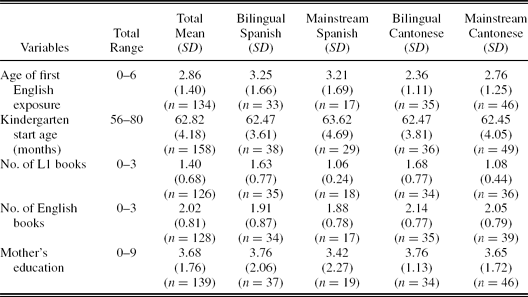
Responses to the parental questionnaires are summarized in Table 1. There were no significant differences among the four groups on the mother's education; on average, mothers had attended some high school. A two-way analysis of variance (ANOVA) for language (Spanish and Cantonese) and program (bilingual and mainstream) on age of first exposure to English revealed a significant main effect of language, F (1, 127) = 5.87, p = .0168, with Spanish children first exposed to English later than Cantonese children. The main effect of program was not significant. The interaction between program and language on age of first exposure to English was also not significant. A two-way ANOVA for language and program on age of kindergarten entry revealed no significant main effects of language and program.
Descriptive statistics for background variables

Note: Bilingual or mainstream was based on second grade classrooms. Number of books ranged from 0 to 3, where 1 = 1–10 books, 2 = 11–25 books, and 3 = >25 books. Mother's education ranged from 0 to 9, where 0 = none, 1 = some primary education, 2 = primary education, 3 = some high school, 4 = graduated from high school, 5 = some college/trade school, 6 = associate's degree or trade certification, 7 = bachelor's degree, 8 = some graduate study, and 9 = graduate degree. L1, first language.
For number of L1 books in the house, a two-way ANOVA for language (Spanish and Cantonese) and program (bilingual and mainstream) revealed a significant main effect of program, F (1, 119) = 25.29, p < .0001; children in bilingual programs had more L1 books than their counterparts in mainstream classrooms had. There was neither any effect of language nor interaction between language and program. A two-way ANOVA for language and program on number of English books in the house revealed no main effects of language and program. A two-way ANOVA for language and program on mother's education also revealed no significant main effects of language and program.
To sum, overall the background characteristics of the four groups were similar, suggesting that the children came from similar backgrounds. The only main difference was the difference in the number of L1 books in the home, with children in bilingual programs having more L1 books than the children in mainstream classrooms, suggesting that children in the bilingual classrooms have more exposure to L1 at home than children in mainstream classrooms.
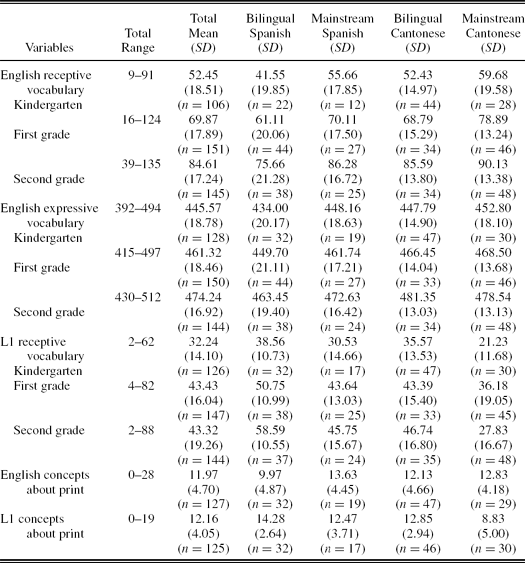
Table 2 shows the means and standard deviations for all vocabulary and concepts about print outcomes for all children as well as by language (Spanish or Cantonese) and by program (bilingual or mainstream). The average scores for both English vocabulary measures increased from kindergarten to second grade. The average score for L1 vocabulary increased from kindergarten to first grade, but remained the same or decreased from first to second grade. Individual variation for English vocabulary was high for all measures at all time points for the Spanish children, but was lower for Cantonese children. Individual variation for L1 vocabulary was low in kindergarten for the Cantonese children in mainstream classrooms and in all years for the Spanish children in bilingual classrooms.
Descriptive statistics for achievement data for all students
Note: L1, first language.
A two-way ANOVA for language (Spanish and Cantonese) and program (bilingual and mainstream) on kindergarten English receptive vocabulary revealed a significant main effect of language, F (1,102) = 5.64, p = .0194, a significant main effect of program, F (1,102) = 7.05, p = .0092, but no significant interaction. On average, Cantonese-speaking children scored higher on English receptive vocabulary at the beginning of kindergarten than the Spanish-speaking children. At the same time, on average, children in mainstream classrooms scored higher on English receptive vocabulary at the beginning of kindergarten than the Spanish-speaking children. The same results were seen for first- and second-grade English receptive vocabulary.
The two-way ANOVA results for English expressive vocabulary were similar to the results for English receptive vocabulary. A two-way ANOVA for language and program on English expressive vocabulary in kindergarten revealed a significant main effect of language, F (1, 124) = 10.80, p = .0013, a significant main effect of program, F (1, 124) = 7.22, p = .0082, and no significant interaction. The same results were seen for first-grade English expressive vocabulary. For second-grade English expressive vocabulary, a two-way ANOVA for language and program revealed a significant main effect of language, F (1, 140) = 23.58, p < .0001, where the Cantonese-speaking children scored significantly higher than the Spanish-speaking children. There was no main effect of program. The interaction between language and program on English expressive vocabulary was significant in second grade, F (1, 140) = 5.03, p < .0265; Cantonese-speaking children in mainstream classrooms scored significantly higher than those in bilingual programs yet there was no such effect for the Spanish-speaking children.
For L1 receptive vocabulary in kindergarten, a two-way ANOVA for language and program revealed a main effect of language, F (1, 122) = 6.32, p = .0133; the Spanish-speaking children scored higher than the Cantonese-speaking children. There was also a significant main effect of program, F (1, 122) = 26.49, p < .0001; the children in bilingual programs scored significantly higher than their counterparts in mainstream classrooms. There was no significant interaction. The same results were seen for first- and second-grade L1 receptive vocabulary.
For English concepts about print, a two-way ANOVA for language and program revealed a significant main effect of program, F (1, 123) = 5.05, p = .0120; the children in bilingual programs scored significantly lower than the children in the mainstream classrooms. However, the main effect of language and the interaction between language and program was not significant. For L1 concepts about print, a two-way ANOVA for language and program also revealed a significant main effect of program, F (1, 121) = 23.09, p < .0001; the bilingual program group scored significantly higher than the mainstream group. There was also a significant effect of language, F (1, 121) = 13.29, p = .0004; the Spanish group scored significantly higher than the Cantonese group. However, the interaction between language and program was not significant.
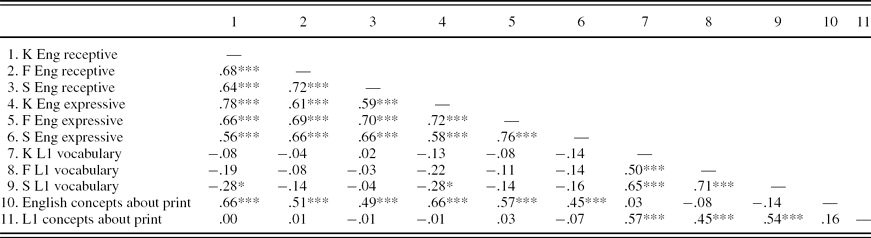
Table 3 shows the correlations among all vocabulary and concepts about print scores. All English vocabulary scores were strongly correlated with each other (rs = .56–.78); all L1 variables were also strongly correlated with each other (rs = .50–.71). An interesting pattern emerged between English vocabulary and L1 vocabulary scores where the relationship between the two languages became marginally significant over time. Although English and L1 vocabulary scores were not significantly correlated at each time point, the previous year's English vocabulary was negatively, although slightly and not significantly, correlated with L1 vocabulary. In addition, English vocabulary in kindergarten was significantly and negatively, albeit marginally, correlated with L1 vocabulary in second grade. Concepts about print and vocabulary were also moderately correlated within language but not cross-language.
Correlation matrix for vocabulary and concepts about print (n = 158)
Note: K, kindergarten; F, first grade; S, second grade; L1, first language.
*p < .05. ***p < .0001.
IGM
IGM was used to examine differences in the level and rate of change in vocabulary among individuals. IGM was the appropriate analysis tool for this data set for several reasons. First, it is designed for exploring longitudinal data on individuals over time (Littell et al., Reference Littell, Milliken, Stroup and Wolfinger1996; Singer, Reference Singer1998; Singer & Willett, Reference Singer and Willett2003). Second, it allows for the spacing of waves of data to vary across individuals (Littell et al., Reference Littell, Milliken, Stroup and Wolfinger1996; Singer & Willett, Reference Singer and Willett2003). In this data set, the time between assessments was 16 months for some children and closer to 12 months for others. Third, IGM can analyze data sets with varying numbers of waves of data (Littell et al., Reference Littell, Milliken, Stroup and Wolfinger1996; Singer & Willett, Reference Singer and Willett2003). That is, unlike other approaches, IGM includes all subjects in the estimation, regardless of missing data.
To arrive at a final model that best predicted English vocabulary development, a taxonomy of theoretically motivated individual growth models for English receptive vocabulary, English expressive vocabulary, and L1 vocabulary were built (see Table 4, Table 5, and Table 6). Time was denoted in number of months rather than assessment occasions, because assessments were carried out with some variation among individuals in exact timing. As all subjects had either two or three data points, a linear model was used (Singer & Willett, Reference Singer and Willett2003; Willett, Singer, & Martin, Reference Willet, Singer and Martin1998). Exploratory analysis was conducted to check the variables for linearity and normality.
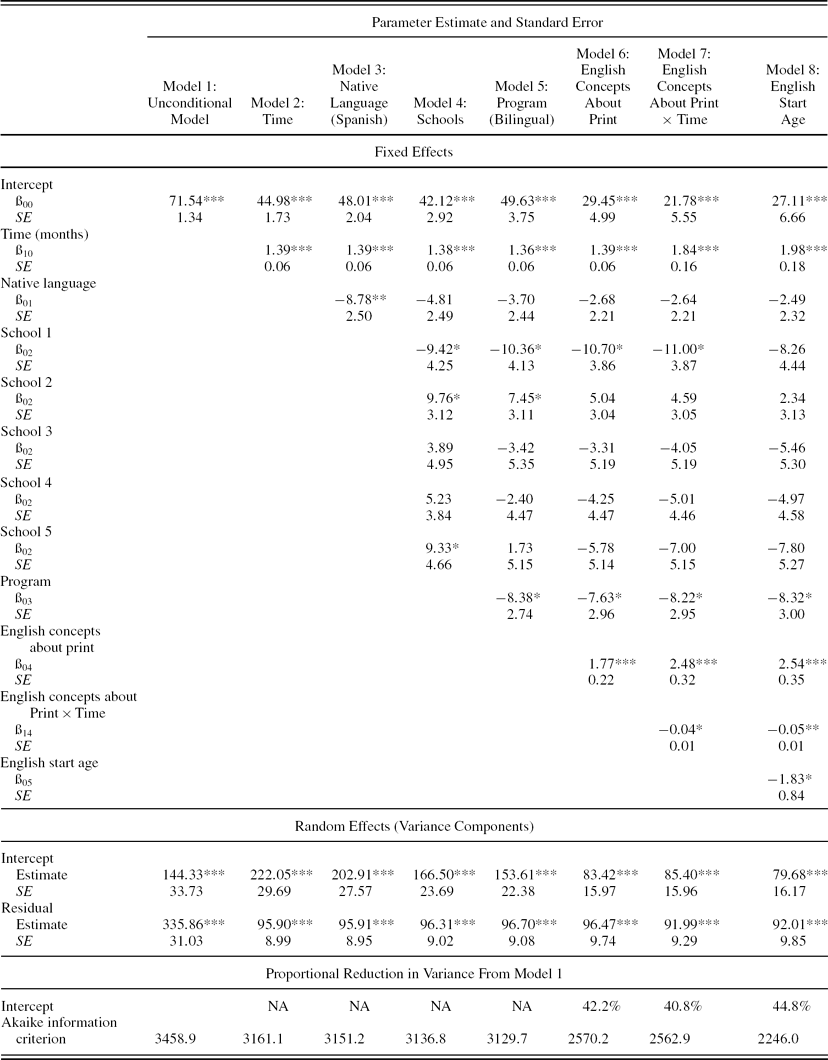
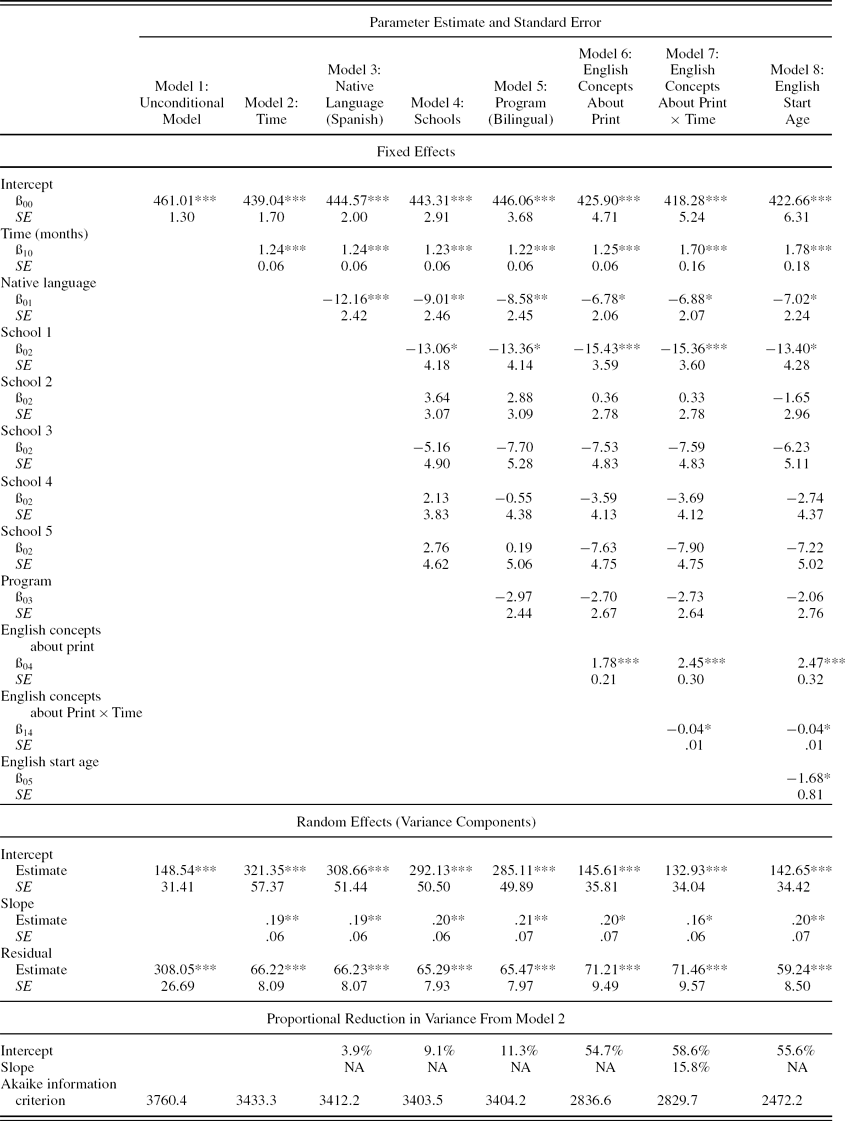
Estimates of fixed and random effects from a series of fitted individual growth models in which English concepts about print, native language, and English starting age predict the average English receptive vocabulary at the start of kindergarten and rate of change in English receptive vocabulary, after controlling for language of instruction and school during the period between kindergarten and second grade for all children (n = 158)
Note: Model 8 is the final model.
*p < .05. **p < .001. ***p < .0001.
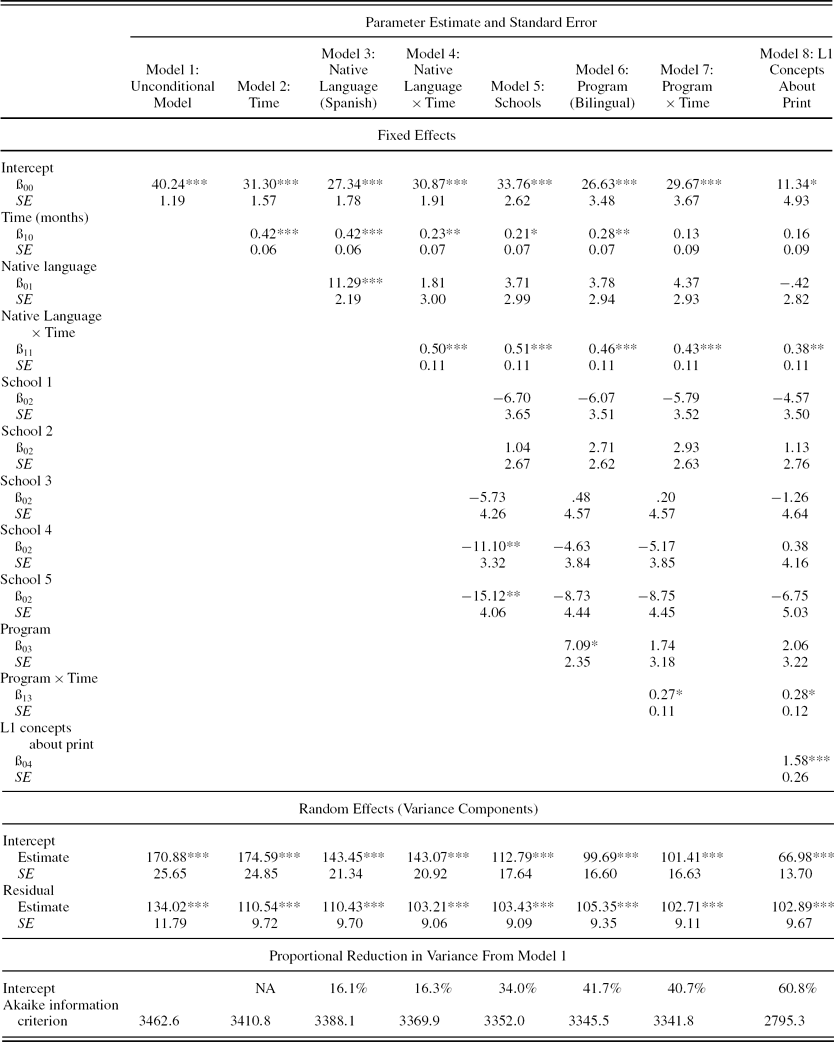
Estimates of fixed and random effects from a series of fitted individual growth models in which English concepts about print, native language, and English starting age predict the average English expressive vocabulary at the start of kindergarten and rate of change in English expressive vocabulary, after controlling for school and language of instruction during the period between kindergarten and second grade for all children (n = 158)
Note: Model 8 is the final model.
*p < .05. **p < .001. ***p<.0001.
Estimates of fixed and random effects from a series of fitted individual growth models in which English concepts about print, native language, and language of instruction predict the average native-language receptive vocabulary at the start of kindergarten and rate of change in native-language receptive vocabulary, after controlling for school, during the period between kindergarten and second grade for all children (n = 158)
Note: Model 8 is the final model. L1, first language.
*p < .05. **p < .001. ***p < .0001.
In the first stage, an unconditional means model, which included no predictors, was fitted. This model described variation in the outcomes (Singer & Willett, Reference Singer and Willett2003). Then a growth model was fitted, where within-person change was examined by fitting growth trajectories for each child over time. The growth trajectories of each individual child varied. Some children showed steady growth and others showed no growth. In light of the variation across children, it is important to understand the general growth patterns in ELL children's vocabulary. Hence, between-person variation was examined and predictors were added to investigate whether they affected individual changes in vocabulary. Concepts about print was added to investigate whether individual changes in vocabulary were related to concepts about print.
Combining the within-person and between-person models yielded the following model:
 \begin{equation}
\begin{array}{@{}lll}
{\rm outcome}_{ti} &=& [{\rm {\ss}}_{00} + {\rm {\ss}}_{01} \,{\rm concepts\, about\, print}_i + {\rm {\ss}}_{10} \,{\rm time}_{ti} \\
&& +\, {\rm {\ss}}_{11} \,{\rm concepts\, about\, print}_i \,{\rm time}_{ti} ]
+ [u_{0i} + u_{1i}\,{\rm time}_{ti} + r_{ti}]. \\
\end{array}\end{equation}
The parameters in the above model represent the effect of concepts about print on the initial level of outcome (ß01) and the effect of concepts about print on the rate of change in outcome (ß11). Full maximum likelihood estimates were used because models that differ in their fixed effects, but not in their variance components, were compared (see Singer, Reference Singer1998)
As a general modeling strategy, the above full-model equation was evaluated for significance, after including native language (Spanish or Cantonese) and program (bilingual classroom or mainstream classroom). Native language and program were kept in the model, even if they were not significant, to control for language background and program differences. Program was included as a time-varying predictor as some children exited the bilingual program during the 3 years. A school variable for each school was also included to control for school differences. Subsequent analyses investigated whether other variables, such as parents’ educational history, age of first English exposure, age of kindergarten entry, and number of children's books in the home were significant predictors. The predictors that were not statistically significant were kept out of the model.
English receptive vocabulary
Table 4 shows the results for English receptive vocabulary. The variance components in Model 1 (unconditional means model) indicate that the average child's English receptive vocabulary varied over time and that the children differed from each other. Using the results of this model, the intraclass correlation coefficient was calculated to be 0.30, which indicated that approximately one-third of the total variation in English receptive vocabulary is attributable to differences among children. A comparison between the variance components in Model 2 (unconditional growth model) and those in Model 1 shows that 71.4% of the within-person variation in English receptive vocabulary was systematically associated with linear time. Furthermore, as there was nonzero variability in true initial status (p < .0001), Model 2 suggested adding more predictors into the model to explain heterogeneity in initial status. When more predictors were added to the model, the standard error of the random effect of slope became larger than the parameter estimate for the random effect of slope. To resolve the situation, the model was simplified by removing the random component of the growth rate in all further models. This strategy assumes that all students have the same underlying value for the growth rate, rather than estimating the variance in growth rates across individuals. In this approach, the growth rate is regarded as fixed and average group differences can be tested for children with different characteristics. After fitting more models and checking for normality assumptions of the final model with quantile–quantile plots, Model 8 in Table 4 was chosen as the final model for English receptive vocabulary and will be interpreted in the following sections.
Effect of English concepts about print
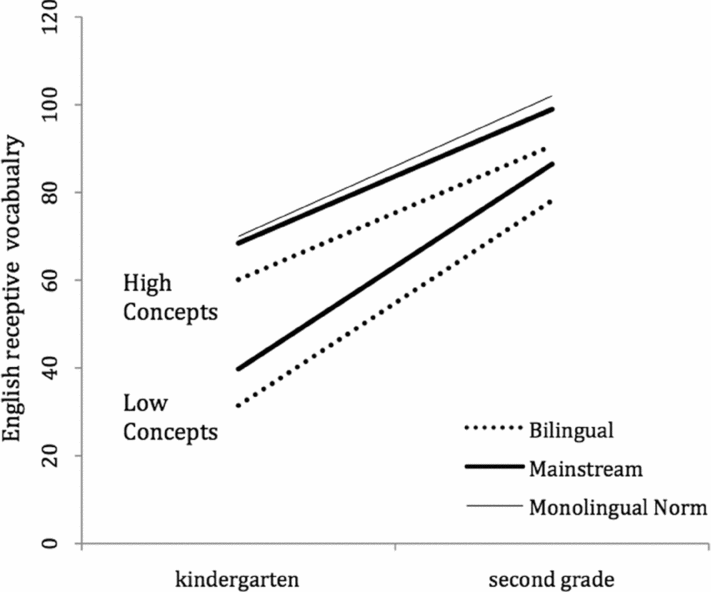
As Model 8 in Table 4 shows, the estimated coefficient for concepts about print was statistically significant. Moreover, the estimated coefficient for the concepts about Print × Time interaction was negative and significant after controlling for the other variables in the model. These two findings indicate, as shown in Figure 1, that children with a higher concepts about print score had more English receptive vocabulary at the beginning of kindergarten, yet their growth was slightly slower than those who had a lower concepts about print score at the beginning of kindergarten. The standard deviation for English receptive vocabulary pooled across all occasions was 21.98 points. Thus the coefficient of 2.54 for English concepts about print corresponds to an effect size of slightly over 0.1 SD per month or 1 SD for the entire school year. Concepts about print in L1 was not significant.
Average fitted trajectories, after controlling for schools and native language, that describe the effect of language of instruction and English concepts about print on the change in raw scores on English receptive vocabulary for English language learner children with an average age of first English exposure at age 2.86. High is defined as scoring at the 90th percentile, and low is defined as scoring at the 10th percentile. Included in the figure is a reference line for the published age-matched monolingual English mean (n = 158).
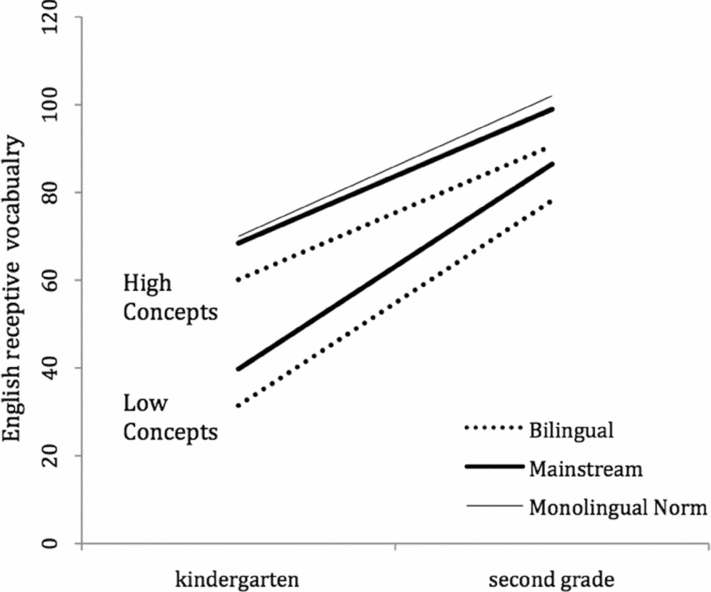
Children whose English concepts about print was at the 90th percentile in kindergarten and who had been exposed to English because the average age of 2.86 had English receptive vocabulary scores at similar levels to those of their age-matched monolingual English-speaking peers from kindergarten through second grade, regardless of their native language (see Figure 1).
Program
After controlling for the other variables in the model, whether the child was in a bilingual or mainstream program had an effect on the estimated average initial level of English receptive vocabulary. The interaction between bilingual program and time was not significant. Children in bilingual programs began with a 8.32-point (effect size > 0.33 SD) disadvantage on English receptive vocabulary at the start of kindergarten and this difference remained throughout the 3 years (see Figure 1).
English start age
After controlling for the other variables in the model, the age of first exposure to English had an effect on the estimated average initial level of English receptive vocabulary. However, the interaction between age of first English exposure and time was not significant. Every 1-year advantage in English exposure was associated with a 1.83-point (effect size = slightly < 0.1 SD) advantage in English receptive vocabulary at the start of kindergarten and this difference remained throughout the 3 years.
Native language
Native language was kept in the model to control for native language differences. Model 8 indicated that native language was not significant and there were no differences between Spanish-speaking and Cantonese-speaking ELLs in their English receptive vocabulary development.
English expressive vocabulary
Table 5 shows the results for English expressive vocabulary. The variance components in Model 1 (unconditional means model) indicate that the average child's English expressive vocabulary varied over time and that the children differed from each other. Using the results of this model, the intraclass correlation coefficient was calculated to be .33, which indicated that one-third of the total variation in English expressive vocabulary is attributable to differences among children. A comparison between the variance components in Model 2 (unconditional growth model) and those in Model 1 shows that 78.5% of the within-person variation in English expressive vocabulary was systematically associated with linear time. Furthermore, as there was nonzero variability in true initial status (p < .0001) and true rate of change (p < .001), Model 2 suggested adding more predictors into the model to explain heterogeneity in each parameter. After fitting more models and checking for normality assumptions of the final model with quantile–quantile plots, Model 8 in Table 5 was chosen as the final model for English expressive vocabulary and will be interpreted in the following sections.
Effect of English concepts about print
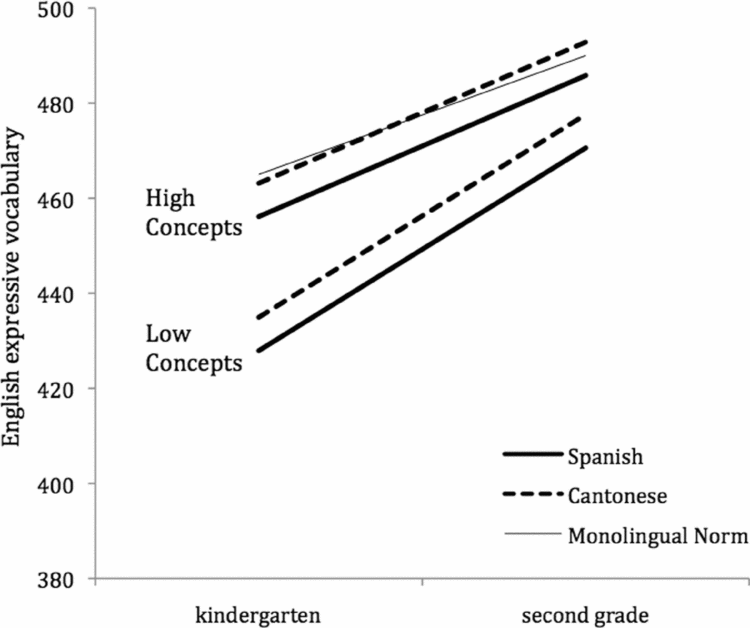
As Model 8 in Table 5 shows, the estimated coefficient for concepts about print was statistically significant. Moreover, the estimated coefficient for the concepts about Print × Time interaction was negative and significant after controlling for the other variables in the model. These two findings indicate, as shown in Figure 2, that children with a higher concepts about print score had higher English expressive vocabulary at the beginning of kindergarten, yet their growth was slightly slower than those who had a lower concepts about print score. The standard deviation for English expressive vocabulary pooled across all occasions was 21.39 points. Thus, the coefficient of 2.47 for English concepts about print corresponds to an effect size of slightly over 0.1 SD per month or 1 SD for the entire school year. Concepts about print in L1 was not significant.
Average fitted trajectories, after controlling for schools and language of instruction, that describe the effect of native language and English concepts about print on the change in W scores on English expressive vocabulary for English language learner children with an average age of first English exposure at age 2.86. High is defined as scoring at the 90th percentile, and low is defined as scoring at the 10th percentile. Included in the figure is a reference line for the published age-matched monolingual English mean (n = 158).
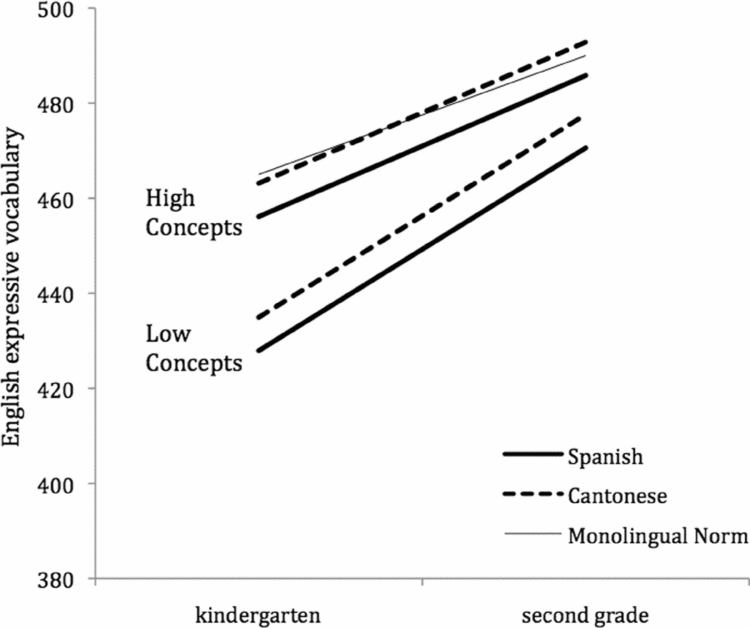
Cantonese children whose English concepts about print was at the 90th percentile in kindergarten and who had been exposed to English because the average age of 2.86 had English receptive vocabulary scores at similar levels to those of their age-matched monolingual English-speaking peers from kindergarten through second grade (see Figure 2).
Native language
After controlling for the other variables in the model, whether the child's native language was Spanish or Cantonese had an effect on the estimated average initial level of English expressive vocabulary. The interaction between native language and time was not significant. At the start of kindergarten, the Spanish-speaking children began with a 7.02-point (effect size = 0.33 SD) disadvantage in English expressive vocabulary when compared to the Cantonese-speaking children, and this difference remained throughout the 3 years.
English start age
After controlling for the other variables in the model, the age at which the child was first exposed to English had an effect on the estimated average initial level of English receptive vocabulary. However, the interaction between age of first English exposure and time was not significant. Every 1-year advantage in English exposure was associated with a 1.68-point (effect size = slightly < 0.1 SD) advantage in English receptive vocabulary at the start of kindergarten and this difference remained throughout the 3 years.
Program
Whether the child was in a bilingual program or a mainstream program was kept in the model to control for program differences. Model 8 indicates that language of instruction was not significant. On average, the English expressive vocabulary development of children in bilingual programs was similar to that of their counterparts in mainstream programs.
L1 receptive vocabulary
Table 6 shows the results for native-language receptive vocabulary. The variance components in Model 1 (unconditional means model) indicate that the average child's L1 receptive vocabulary varied over time and that the children differed from each other. Using the results of this model, the intraclass correlation coefficient was calculated to be 0.56, which indicated that slightly more than half of the total variation in L1 receptive vocabulary is attributable to differences among children. A comparison between the variance components in Model 2 (unconditional growth model) and those in Model 1 shows that 17.5% of the within-person variation in L1 receptive vocabulary was systematically associated with linear time. Furthermore, as there was nonzero variability in true initial status (p < .0001), Model 2 suggested adding more predictors into the model to explain heterogeneity in initial status. When more predictors were added to the model, the fixed and random effects could not be estimated in the model because the error-covariance matrix was not positive definite, which may happen when a data set is severely unbalanced or if many participants do not have enough waves of data (Caswell, Reference Caswell2002; Singer & Willet, Reference Singer and Willett2003). To resolve the situation, the model was simplified by removing the random component of the growth rate in all further models. This strategy assumes that all students have the same underlying value for the growth rate, rather than estimating the variance in growth rates across individuals. In this approach, the growth rate is regarded as fixed and average group differences can be tested for children with different characteristics. After fitting more models and checking for normality assumptions of the final model with quantile–quantile plots, Model 8 in Table 6 was chosen as the final model for L1 receptive vocabulary and will be interpreted in the following sections.
Effect of L1 concepts about print
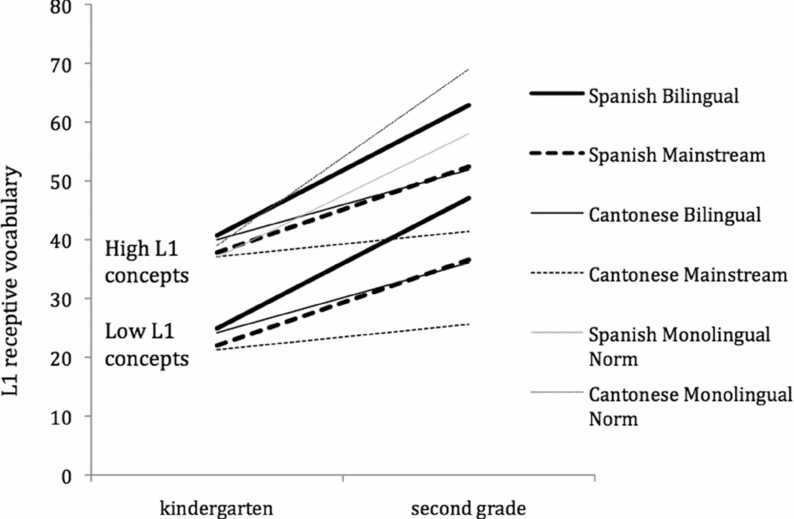
As Model 8 in Table 6 shows, the estimated coefficient for L1 concepts about print was statistically significant after controlling for the other variables in the model. This indicates, as shown in Figure 3, that at the beginning of kindergarten, children with a higher L1 concepts about print score had higher L1 receptive vocabularies than those with a lower L1 concepts about print score and that this gap continued for 3 years. The standard deviation for L1 receptive vocabulary pooled across all occasions was 17.43 points. Thus the coefficient of 1.58 for L1 concepts about print corresponds to an effect size of slightly under 0.1 SD per month or nearly 1 SD for the entire school year. Concepts about print in English were not significant.
Average fitted trajectories, after controlling for schools, that describe the effect of native language, language of instruction, and first language (L1) concepts about print on the change in raw scores on L1 receptive vocabulary for English language learner children. High is defined as scoring at the 90th percentile, and low is defined as scoring at the 10th percentile. Included in the figure are reference lines for the published age-matched monolingual Spanish and Chinese means (n = 158).
Spanish children who attended bilingual programs and whose Spanish concepts about print was at the 90th percentile in kindergarten had Spanish receptive vocabulary scores at similar levels to or even higher than those of their age-matched monolingual Spanish-speaking peers from kindergarten through second grade (see Figure 3).
Native language
After controlling for the other variables in the model, native language (Spanish or Cantonese) was not significant on the estimated average initial level of L1 receptive vocabulary. However, the interaction between native language and time was significant. Spanish-speaking children had a steeper growth rate in L1 receptive vocabulary than their Cantonese-speaking peers, as shown in Figure 3.
Program
Whether the child was in a bilingual or a mainstream program was kept in the model to control for program differences. Model 8 indicated that program was not significant on the estimated average initial level of L1 receptive vocabulary. However the interaction between program and time was significant, indicating that the children in the bilingual program had a steeper growth rate in L1 receptive vocabulary than their peers in mainstream classrooms, as shown in Figure 3.
Discussion
Results from this 3-year longitudinal study replicate and extend findings from previous research conducted with monolingual children (De Temple & Snow, Reference De Temple, Snow, van Kleeck and Stahl2003; Dickinson et al., Reference Dickinson, Cote, Smith, Damon and Daiute1993; Penno et al., Reference Snow, Burns and Griffin2002) and Spanish-speaking ELL children (Biemiller & Boote, Reference Biemiller and Boote2006; Cobo-Lewis et al., Reference Cobo-Lewis, Pearson, Eilers, Umbel, Oller and Eilers2002). First, book exposure, measured with concepts about print, had an effect on vocabulary after controlling for native language, language of instruction, and age of first exposure to English. This was a within-language relationship, not a cross-language relationship. English concepts about print measured in kindergarten predicted English vocabulary at the start of kindergarten and rate of growth in English vocabulary, whereas L1 concepts about print measured in kindergarten predicted L1 vocabulary at the beginning of kindergarten. The more familiar the child was with the conventions of reading in a particular language, the more vocabulary the child tended to have in that language. The correlation between concepts about print and the number of children's books in the home was not significant. Although the two variables may both be indicators of home literacy and book exposure, this suggests that the concepts about print measure may give us more insights into the child's book-reading experience and knowledge than a simple count of books in the home. More research examining how ELL parents read to their children and how this may impact ELL children's concepts about print is needed.
Second, there was an effect of language exposure on vocabulary. For both expressive and receptive vocabulary, children who were exposed to English from a younger age had higher vocabulary scores than children who were exposed to English later. This supports the findings of past research that children exposed to more words and language opportunities have larger vocabularies (Hart & Risley, Reference Hart and Risley1995; Patterson, Reference Patterson2002). This earlier exposure to English had no effect on children's native-language vocabulary scores. That is, there were no differences in L1 vocabulary between children who were exposed to English from a younger age and those exposed from an older age.
Third, there was an effect of program on vocabulary. Children who were enrolled in bilingual programs started kindergarten with lower English receptive vocabulary scores than children enrolled in mainstream programs and the gap remained throughout the 3 years. Children's English proficiency at school entry may be confounded with parental selection or teacher recommendation of bilingual instruction for their children. Parents and teachers may have chosen bilingual programs over mainstream programs for these children because they had lower English vocabulary at the beginning of kindergarten. This was only seen in English receptive vocabulary; growth modeling results show no significant differences in English expressive vocabulary between the two groups at the beginning of kindergarten and in their growth. For native-language vocabulary, growth trajectories show no significant differences between children in bilingual programs and those in mainstream programs at the start of kindergarten. However, there was a significant difference in rate of L1 vocabulary growth; children in bilingual programs showed steeper growth than children in mainstream programs. Because research suggests that young ELLs’ early development of native oral vocabulary may be particularly important for improving English reading comprehension in upper elementary grades when texts become more decontextualized (Proctor, August, Carlo, & Snow, Reference Proctor, Carlo, August and Snow2006), ELL children who start school in bilingual programs may be at an advantage and may do better on reading comprehension in upper elementary grades.
The combination of high book exposure and high language exposure predicted that ELL children could achieve monolingual-like norms. Children who scored at the 90th percentile on English concepts about print, who were first exposed to English at age 2.86, and who attended mainstream classrooms were projected to have similar English receptive vocabulary trajectories as their age-matched monolingual English peers. At the same time, Cantonese-speaking children who scored at the 90th percentile on English concepts about print and who were first exposed to English at age 2.86 were projected to have similar English expressive vocabulary trajectories as their age-matched monolingual English peers. In addition, Spanish-speaking children who scored at the 90th percentile on Spanish concepts about print and who had attended bilingual programs were projected to have similar Spanish receptive vocabulary trajectories as their age-matched monolingual Spanish peers in Mexico.
Some similarities and differences were seen based on native language. Both Spanish-speaking and Cantonese-speaking groups had similar English receptive vocabulary scores at the beginning of kindergarten, and there was no difference in growth based on native language. However, there was a significant difference in English expressive vocabulary at the beginning of kindergarten; Cantonese-speaking children had higher English expressive vocabulary scores than Spanish-speaking children, and this difference remained for the 3 years. In contrast, although there were no significant differences in L1 vocabulary at the start of kindergarten, Spanish-speaking children had steeper growth rates in L1 vocabulary than Cantonese-speaking children, after controlling for language of instruction and L1 concepts about print. Both Spanish-speaking and Cantonese-speaking families lived in communities with high percentages of Spanish speakers and Cantonese speakers, respectively, so access to opportunities for oral language use in L1 was the same. Yet it appears that Spanish-speaking families were maintaining and increasing their children's L1 oral vocabulary more than the Cantonese-speaking families. At the same time, Cantonese-speaking children came to kindergarten with larger English expressive vocabularies than Spanish-speaking children. This may be because, on average, Cantonese-speaking children were first exposed to English at an earlier age than Spanish-speaking children. More research is necessary to examine this relationship. Future research should also examine parental expectations and children's language use in the home to understand differences in vocabulary development between Spanish-speaking and Cantonese-speaking ELL children.
This study also shows that, although relatively little research has been conducted with concepts about print in recent years, this measure appears to have an important role in an ELL's vocabulary development in both L1 and English. Future research should further examine this variable in conjunction with observational data.
LIMITATIONS
In this study, vocabulary was only measured with two standardized assessments. Although they are widely used measures, there are problems with assessing bilinguals with monolingual-normed assessments (Abedi, Lord, Hostetter, & Baker, Reference Abedi, Lord, Hostetter and Baker2000) and results may change with other assessments. In addition, this study examined only achievement data and questionnaire data. A more detailed examination of interactions between adults and children during book reading, as well as interview and observational data on home literacy practices and parental expectations, will give us more insights into ELL children's language and literacy environments. Cultural expectations may also play a role in differences between Spanish-speaking and Cantonese-speaking ELLs. The comparison between mainstream and bilingual programs may be confounded because children with a larger English receptive vocabulary at the beginning of kindergarten may have been advised to enroll in a mainstream program and children with a smaller English receptive vocabulary to a bilingual program. Future research might consider matching the English abilities of children entering into mainstream classrooms and bilingual classrooms and following their growth.
CONCLUSION
Understanding the factors that contribute to vocabulary development for L1 and English for both Spanish-speaking and Cantonese-speaking ELL children might shed light on circumstances and practices that can lead to balanced bilingualism and high language and literacy skills. The results from this study suggest that for ELL children, just as for monolingual English-speaking children (e.g., Hart & Risley, Reference Hart and Risley1995; Raikes et al., Reference Raikes, Pan, Luze, Tamis-LeMonde, Brooks-Gunn and Tarullo2006; Sénéchal & LeFevre, Reference Sénéchal and LeFevre2002; Snow & Goldfield, Reference Snow and Goldfield1983), the combination of book-reading experiences and language exposure assists lexical development. Children who had rich literacy exposures prior to kindergarten started kindergarten with more vocabulary than those who were not familiar with book reading. This was true in both English and native languages. Although the gap decreased in English receptive and expressive vocabulary by the time the children were in second grade, the children who entered kindergarten with higher concepts about print still maintained a lead with higher vocabulary scores at the end of second grade. For L1 receptive vocabulary, controlling for language of instruction and native language, the gap did not decrease between children who began kindergarten with higher concepts about print and those who began it with lower concepts about print.
These findings highlight the importance of book exposure prior to school entry. Parents should be encouraged to read books in a way that will expand their children's lexical knowledge and book knowledge. Reading can occur in either L1 or English; both contribute to vocabulary development. Parents should be informed that L1 book reading and L1 exposure would not disadvantage children in their English development. At the same time, early L2 exposure would not interfere with L1 vocabulary development. Parents should be encouraged to expose their ELL children to English by enrolling their children in English-speaking preschools and Head Start. Early and rich exposure to both L1 and L2 may lead to balanced bilingualism.
The present results are only a first step in investigating English vocabulary development in Spanish-speaking and Cantonese-speaking ELL children. More detailed data on home literacy practices and home book-reading sessions would provide additional insight. Continuing to investigate ELL children's progress in lexical development is imperative for designing effective interventions for them.
ACKNOWLEDGMENTS
The research reported in this paper was funded by the Foundation for Child Development.