


Introduction
The lichen genus Pseudopyrenula was established by Müller Argoviensis in 1883 for the species of Pyrenula Ach. with dispersed unilocular ascomata and colourless ascospores. Harris (Reference Harris, Glenn, Harris, Dirig and Cole1998) revised the genus Pseudopyrenula and recognized four species and one variety, reducing 18 names to synonymy with P. diluta (Fée) Müll. Arg. Harris (Reference Harris, Glenn, Harris, Dirig and Cole1998) further proposed 13 recombinations for 70 names formerly assigned to Pseudopyrenula. The genus Pseudopyrenula can be differentiated from the similar genera Bogoriella, Constrictolumina, Dictyomeridium, Novomicrothelia and Polymeridium by its unique combination of an ecorticate or indistinct thallus with hyaline, transversely septate, astrothelioid ascospores that have diamond-shaped lumina. Many species within the genus contain yellow oil in the ascospore lumina and/or the hamathecium (Aptroot & Lücking Reference Aptroot and Lücking2016). According to molecular phylogenetic analyses, the genus Pseudopyrenula belongs to the family Trypetheliaceae (Del Prado et al. Reference Del Prado, Schmitt, Kautz, Palice, Lücking and Lumbsch2006; Nelsen et al. Reference Nelsen, Lücking, Grube, Mbatchou, Muggia, Rivas Plata and Lumbsch2009, Reference Nelsen, Lücking, Mbatchou, Andrew, Spielmann and Lumbsch2011, Reference Nelsen, Lücking, Aptroot, Andrew, Cáceres, Rivas Plata, Gueidan, da Silva Canêz, Knight and Ludwig2014; Sweetwood et al. Reference Sweetwood, Lücking, Nelsen and Aptroot2012; Lücking et al. Reference Lücking, Nelsen, Aptroot, Benatti, Binh, Gueidan, Gutiérrez, Jungbluth, Lumbsch and Marcelli2016a, Reference Lücking, Nelsen, Aptroot, de Klee R, Bawingan, Benatti, Bungartz, Cáceres, Canêz and Chavesb). The genus is distributed in all tropical regions of the world and is currently represented by 24 species (Aptroot & Lücking Reference Aptroot and Lücking2016; Aptroot et al. Reference Aptroot, Sipman, Barreto, Nunes and Cáceres2019; Aptroot Reference Aptroot2021). Six species of Pseudopyrenula have been reported from India: P. diluta (Fée) Müll. Arg., P. media Aptroot & Diederich, P. pupula (Ach.) Müll. Arg., P. subgregaria Müll. Arg., P. subnudata Müll. Arg. and P. subvelata (Nyl.) Müll. Arg. (Awasthi Reference Awasthi1991; Jagadeesh Ram et al. Reference Jagadeesh Ram, Aptroot, Sinha and Singh2005; Singh & Sinha Reference Singh and Sinha2010; Aptroot & Lücking Reference Aptroot and Lücking2016; Jagadeesh Ram 2022). Of these, Pseudopyrenula pupula was transferred to Astrothelium as A. pupula (Ach.) Aptroot & Lücking, while P. subvelata was transferred to Arthopyrenia as A. subvelata (Aptroot & Lücking Reference Aptroot and Lücking2016). The aim of the present study is to update the status of the genus Pseudopyrenula in India. In the process, two new species are described and a key to all Pseudopyrenula species known so far from India is provided.
Materials and Methods
The present study is based on specimens preserved in the herbarium LWG and the consultation of protologues. A Leica S8APO stereozoom microscope was used to study the external morphology of the specimens, while anatomical characters of ascomata were observed under a Leica DM500 compound microscope. Thin, hand-cut sections of the ascomata were initially mounted in water to record the colour and measurements of various structures. The sections were then observed after applying aqueous KOH and Lugol's solution (CDH, New Delhi) was used for iodine reactions. Colour tests were performed using routine reagents; aqueous KOH (10%; K), calcium hypochlorite (C) and para-phenylene-diamine (Pd). TLC was performed in solvent system C following Orange et al. (Reference Orange, James and White2001).
Taxonomy
Pseudopyrenula diluta (Fée) Müll. Arg.
Flora, Regensburg 66(16), 249 (1883).
The following description is based on observations made by Aptroot & Lücking (Reference Aptroot and Lücking2016). The original specimen has not been examined.
Thallus ecorticate, white, smooth to uneven lacking chemical substances.
Ascomata solitary, 0.3–0.5 mm, prominent, hemispherical, exposed and black with apical ostioles; hamathecium inspersed with hyaline oil droplets; asci 8-spored; ascospores hyaline often partly with yellow oil in the lumina, 3-septate, fusiform-ellipsoid, IKI−, not ornamented, 24–32 × 7–10 μm.
Chemistry
Thallus UV−, K−. TLC: no secondary substances detected.
Distribution
The species is reported from Arunachal Pradesh, Uttarakhand and the West Bengal plains (Singh & Sinha Reference Singh and Sinha2010).
Discussion
Pseudopyrenula diluta shows a close resemblance to P. subnudata in its exposed, black ascomata and inspersed hamathecium but differs in having longer ascospores. Harris (Reference Harris, Glenn, Harris, Dirig and Cole1998) previously treated P. diluta and P. subnudata as varieties but subsequently both taxa were accepted as distinct species by Aptroot & Lücking (Reference Aptroot and Lücking2016).
Pseudopyrenula himalayana Ingle, Nayaka & Upreti sp. nov.
MycoBank No.: MB 850274
Differs from Pseudopyrenula staphyleae by a lichenized thallus, immersed perithecia, eccentric ostiole and narrower ascospores measuring 40–53 × 9–11 μm.
Type: India, Himachal Pradesh, Hamirpur district, Jean nala, 500 m, on bark of Phoenix sylvestris, 6 April 2003, D. K. Upreti et al. 03-001471 (LWG—holotype).
Pseudopyrenula himalayana (holotype) A, thallus. B, transverse section of perithecium. C, transverse section of thallus. D, detail of perithecium. E & F, ascospores. Note: C, D, E & F treated with lactophenol cotton blue. Scales: A = 5 mm; B = 0.2 mm; C = 200 μm; D = 100 μm; E & F = 25 μm. In colour online.

Thallus corticolous, crustose, greyish white, smooth, ecorticate, up to 5 cm, UV−; photobiont Trentepohlia.
Ascomata perithecia, immersed, solitary, conical, 0.2–0.5 mm diam. Ostiole eccentric, immersed. Involucrellum entire, carbonized, 30–52 μm thick. Hamathecium hyaline, not inspersed with oil droplets, pseudoparaphyses branched and anastomosing. Asci clavate, 8-spored, mostly uniseriate, 135–220 × 18–23 μm. Ascospores transversely 3-septate, colourless, fusiform, with angular, diamond-shaped lumina, 40–53 × 9–11 μm.
Chemistry
Thallus UV−, K−. TLC: no secondary substances detected.
Etymology
The species epithet refers to the type locality within the Himalayan region.
Distribution and ecology
Currently the new species is known only from its type locality, Himachal Pradesh in the foothills of Western Himalaya. It was found on the bark of Phoenix sylvestris in deciduous forest with a subtropical climate at an elevation of 500 m.
Notes
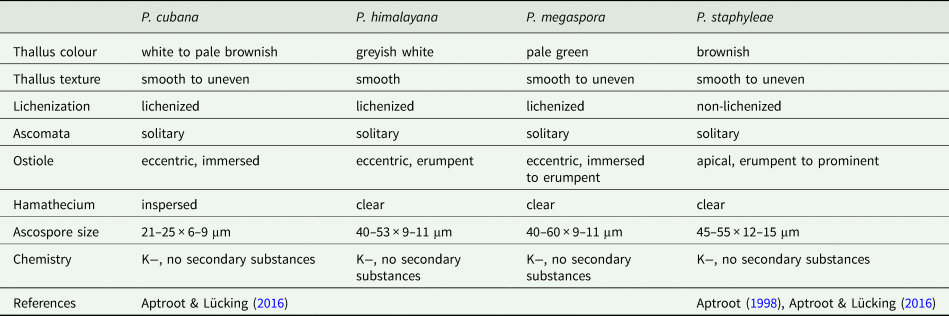
The new taxon is characterized by its greyish white, smooth, ecorticate thallus, immersed ascomata with eccentric ostioles, a clear hamathecium and large ascospores (40–53 × 9–11 μm). The thallus is mostly smooth, but occasionally forms granular patches. Pseudopyrenula himalayana closely resembles P. staphyleae (Petr.) Aptroot in having a clear hamathecium and similar ascospore length but P. staphyleae has a non-lichenized thallus, apical ostioles and wider ascospores (12–15 μm) (Table 1). Pseudopyrenula himalayana is also close to the other new species, P. megaspora Ingle, Nayaka & Upreti, in having eccentric ostioles and a clear hamathecium but P. megaspora has a non-carbonized involucrellum and longer ascospores (40–60 μm).
Comparison of two new species of Pseudopyrenula with similar species.
Pseudopyrenula media Aptroot & Diederich
Herzogia 30(1), 213 (2017).
The following description is based on observations made by Jagadeesh Ram (2022). The original specimen has not been examined.
Thallus ecorticate, white, suborbicular to irregular, smooth, with an anthraquinone as a chemical substance.
Ascomata solitary, sometimes confluent, subglobose to hemispherical, black with apical ostioles; hamathecium inspersed with yellow oil droplets; asci 8-spored; ascospores 3-septate, oblong-fusiform, IKI−, not ornamented, 25–30 × 7.5–10 μm.
Chemistry
Thallus UV−, K−, hamathecium K+ deep yellow to reddish. TLC: anthraquinone.
Distribution
In India, P. media is reported only from the Andaman Islands (Jagadeesh Ram 2022).
Discussion
Pseudopyrenula media is similar to P. subgregaria in its yellow hamathecium inspersion. However, the latter differs in having smaller ascospores (18–22 × 5–7 μm) (Jagadeesh Ram 2022).
Pseudopyrenula megaspora Ingle, Nayaka & Upreti sp. nov.
MycoBank No.: MB 850275
Differs from Pseudopyrenula staphyleae by a lichenized thallus, eccentric ostiole and longer and narrower ascospores, measuring 40–60 × 9–11 μm.
Type: India, Uttar Pradesh, Sonbhadra district, Hathinala, 284 m, on bark of tree, 23 June 2008, Santosh Joshi 08-015764/B (LWG—holotype).
Pseudopyrenula megaspora. (holotype) A, thallus. B, perithecium. C, transverse section of thallus. D, transverse section of perithecium. E, ascus. F–H, ascospores. Note: C, D, E & G treated with lactophenol cotton blue. Scales: A = 1 mm; B = 0.5 mm; C = 200 μm; D = 100 μm; E & H = 50 μm; F & G = 25 μm. In colour online.
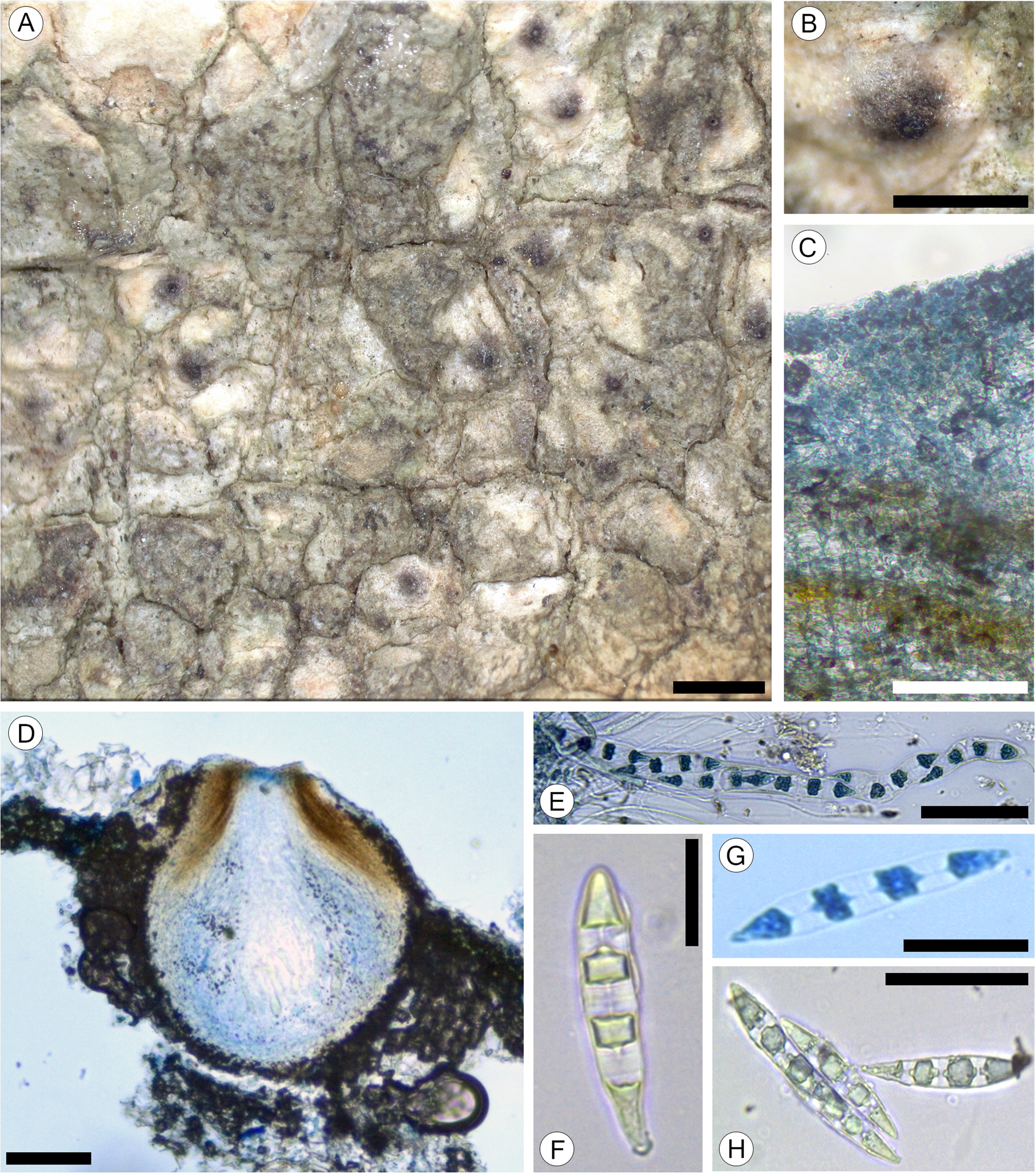
Thallus corticolous, crustose, smooth to uneven, visible as pale green discoloration of the bark, up to 7 cm, ecorticate, UV−. Photobiont Trentepohlia, sparse.
Ascomata perithecia, immersed, solitary, subglobose, 0.2–0.6 mm diam. Ostiole eccentric, immersed to erumpent. Involucrellum entire, not carbonized. Hamathecium hyaline, not inspersed with oil droplets, pseudoparaphyses branched and anastomosing. Asci cylindrical, 8-spored, mostly uniseriate, 170–235 × 16–18 μm. Ascospores transversely 3-septate, colourless, fusiform, with angular, diamond-shaped lumina, 40–60 × 9–11 μm.
Chemistry
Thallus UV−, K−. TLC: no secondary substances detected.
Etymology
The epithet refers to the large ascospores of the species.
Distribution and ecology
The new species is currently known only from the type locality in the Gangetic plains of Uttar Pradesh. It was growing on the bark of a tree in deciduous forest at an elevation of 284 m.
Notes
Pseudopyrenula megaspora is characterized by its ecorticate, pale greenish thallus, eccentric, ascomata with immersed to erumpent ostioles, clear hamathecium and large ascospores (40–60 × 9–11 μm). The species has the largest ascospores of all Pseudopyrenula species. Another species, P. staphyleae, shows a close resemblance to the new species in having a similar thallus coloration and a clear hamathecium, but it differs in having a non-lichenized thallus, apical ostioles and wider ascospores (45–55 × 12–15 μm). The other two species of Pseudopyrenula with eccentric ostioles are P. himalayana and P. cubana (Müll. Arg.) Aptroot & Lücking (Table 1). However, P. himalayana differs in having a carbonized involucrellum and slightly shorter ascospores (40–53 μm), and P. cubana differs in having erumpent ostioles, an inspersed hamathecium and smaller ascospores (21–25 × 6–9 μm).
Pseudopyrenula subgregaria Müll. Arg.
Bot. Jb. 6, 408 (1885).
The following description is based on observations made by Jagadeesh Ram (2022). The original specimen has not been examined.
Thallus ecorticate, white, smooth to uneven, with an anthraquinone as a chemical substance.
Ascomata solitary, 0.3–0.4 mm diam., prominent, hemispherical, exposed and black, with apical ostioles; hamathecium inspersed, with yellow oil droplets; asci 8-spored; ascospores hyaline, 3-septate, fusiform-ellipsoid, IKI−, not ornamented, 18–22 × 5–7 μm.
Chemistry
Thallus UV−, K−, hamathecium K+ deep yellow to reddish. TLC: anthraquinone.
Distribution
This species is reported from West Bengal and the Andaman Islands (Jagadeesh Ram 2022).
Discussion
The species shows a close resemblance to Pseudopyrenula subnudata in having an ecorticate thallus and ascospores of a similar size, but P. subnudata differs in having an inspersed hamathecium with hyaline oil droplets (Aptroot & Lucking Reference Aptroot and Lücking2016).
Pseudopyrenula subnudata Müll. Arg.
Flora, Regensburg 66(16), 249, 272 (1883).
The following description is based on observations made by Jagadeesh Ram et al. (Reference Jagadeesh Ram, Aptroot, Sinha and Singh2005). The original specimen has not been examined.
Thallus ecorticate, white, smooth to uneven, with no chemical substance.
Ascomata solitary, 0.2–0.4 mm diam., prominent, hemispherical, exposed and black with apical ostioles; hamathecium hyaline, inspersed with hyaline oil droplets; asci 8-spored; ascospores hyaline, sometimes yellow oil in the lumina, 3-septate, fusiform-ellipsoid, IKI−, not ornamented, 21–25 × 6–9 μm.
Chemistry
Thallus UV−, K−. TLC: no secondary substances detected.
Distribution
This species is reported from Arunachal Pradesh, West Bengal and Odisha (Singh & Sinha Reference Singh and Sinha2010; Singh et al. Reference Singh, Singh and Bhatt2015; Nayak et al. Reference Nayak, Bajpai, Upreti and Satapathy2016).
Discussion
Pseudopyrenula diluta and P. subgregaria resemble P. subnudata morphologically and anatomically, but P. diluta differs in having longer ascospores (24–32 μm), and P. subgregaria contains anthraquinones and has a yellow hamathecium inspersion.
Key to the species of Pseudopyrenula in India
1 Ostiole eccentric………2
Ostiole apical………3
2(1) Involucrellum carbonized, ascospores 40–53 × 9–11 μm………P. himalayana
Involucrellum non-carbonized, ascospores 40–60 × 9–11 μm………P. megaspora
3(1) Hamathecium inspersed with hyaline oil droplets………4
Hamathecium inspersed with yellow oil droplets………5
4(3) Ascospores 21–25 × 6–9 μm………P. subnudata
Ascospores 24–32 × 7–10 μm………P. diluta
5(3) Ascospores 25–30 × 7.5–10 μm………P. media
Ascospores 18–22 × 5–7 μm………P. subgregaria
Acknowledgements
We are grateful to the Director, CSIR-National Botanical Research Institute, Lucknow for providing essential laboratory facilities and financial assistance under in-house project OLP-0101. The authors also thank researchers for submitting their samples to the LWG Herbarium of CSIR-National Botanical Research Institute, Lucknow (CSIR-NBRI manuscript number – CSIR-NBRI_MS/2023/04/13).
Author ORCIDs
Komal K. Ingle, 0000-0002-0659-6031; Sanjeeva Nayaka, 0000-0001-6541-2362; Dalip K. Upreti, 0000-0002-5513-1759.
Competing Interests
All authors have expressed their willingness to be an author of this article and have declared no conflict of interest.



