1. INTRODUCTION
Land vehicle navigation is currently dominated by the Global Positioning System (GPS). However, stand-alone GPS suffers from a number of limitations in terms of absolute accuracy, shadowing and multipath effects, so significant efforts have been made to improve stand-alone GPS performance by integrating additional sensors.
Inertial sensors are the first choice because of their autonomous and environment-independent nature. However, the high and medium quality inertial navigation systems (INS) are limited by their significant size and high cost, which is not suitable for general land navigation application. The advent of MEMS inertial sensors provides a promising solution to this problem. Advances in MEMS technology have made it possible to produce single chip inertial sensors that are small, cheap and reliable.
Although MEMS technology has greatly reduced the size and cost of an INS, even smaller and lower cost systems are required in some land navigation applications. According to the analysis of the features in land vehicle navigation, it is found that some of the inertial sensors in INS provide very little information for land vehicle navigation, so these inertial sensors could be considered unnecessary and omitted from the INS. This kind of INS, which is not configured with a standard inertial measurement unit (IMU), namely three orthogonal accelerometers and three orthogonal gyros, is called the reduced INS.
The direct method (Brandt and Gardner, Reference Brandt and Gardner1998; Phuyal, Reference Phuyal2004) to implement the integration of GPS and the reduced INS is to develop a specific algorithm for the reduced suite of inertial sensors and correspondently develop a new Kalman filtering mechanization for GPS and the reduced INS integration. Niu et al. (Reference Niu, Nasser, Goodall and El-Sheimy2007) proposed a universal pseudo signals approach for GPS and the reduced INS integration. In their method, each omitted sensor is artificially given a constant output. Then these assumed outputs, together with the real outputs of the remaining sensors, are input to the standard INS algorithm to calculate navigation solutions. The Kalman filter for GPS and reduced INS integration also remained the same as the standard integration algorithm.
However, the positioning accuracy of stand-alone GPS is low, generally at the level of several or ten metres. So it will lead to large errors when the stand-alone GPS positioning results are integrated with INS, especially with the reduced INS. Both theoretical analysis (as shown in Section 2.2) and experimental results (as shown in Figures 2 and 3) have demonstrated that it will lead to divergence of height solution and large velocity errors when using only the position solutions from a stand-alone GPS receiver to aid reduced INS.
Graas and Soloviev (Reference Graas and Soloviev2004) proposed a method to estimate precise velocity from carrier phase measurements without integer ambiguity resolution using a stand-alone GPS receiver, and that the accuracy of velocity estimation could reach mm/s level. Using this precise velocity to aid the reduced INS will be a promising method for the integration of GPS and the reduced INS to improve the system performance.
In this paper a two-accelerometer and one-gyro (2A1G) mechanization is developed for the reduced INS. A novel integration scheme, in which the GPS precise velocity mentioned above together with the single point positioning result that is used to aid the reduced INS, is proposed for the integration of GPS and the reduced INS. In the 2A1G system, the vertical accelerometer and two horizontal gyros are omitted from the standard INS configuration after the analysis of the field test data, and the outputs of the omitted sensors are replaced by constant outputs. The residual noises of the assumed constant outputs are modelled as white noise in this paper, and a method is presented to estimate the corresponding noise parameters from field test data. Such parameters are then used in the system integration filter.
In the remainder of this paper, the general integration method of GPS and reduced INS will be discussed and the corresponding error characteristics will be analyzed. Then the proposed novel integration method for GPS and the reduced INS will be presented, and the corresponding reduced INS configuration will be discussed in detail. Field test results of this novel integration scheme will be given and compared with another two different integration schemes. Finally, the conclusions will be presented.
2. GENERAL INTEGRATION OF GPS AND REDUCED INS
2.1. General Integration Scheme
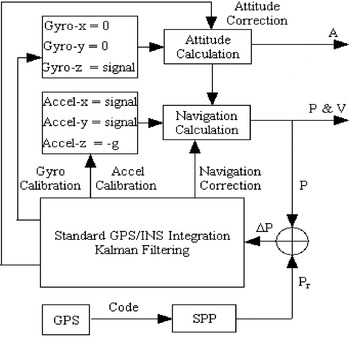
The general integration scheme of GPS and reduced INS is shown in Figure 1. In this scheme, GPS single point positioning (SPP) results are used to aid the reduced INS. The vertical accelerometer and two horizontal gyros are omitted from the full INS to form the reduced INS subsystem, and the corresponding pseudo-signals, namely zero plus white noise for gyros and minus standard gravity (-g) plus white noise for vertical accelerometer, are input to the system to perform inertial calculation (N.B. The sign here is dependent on the selection of inertial navigation frame. For NED frame, -g should be used).
General integration scheme for GPS and the reduced INS.

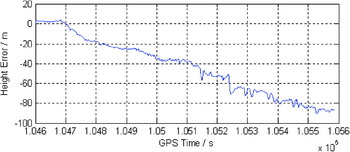
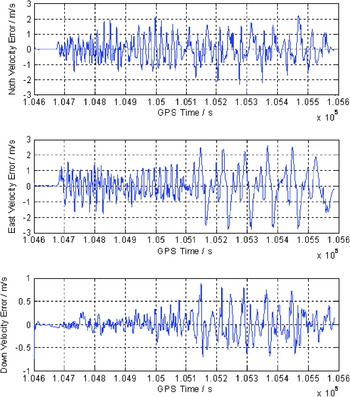
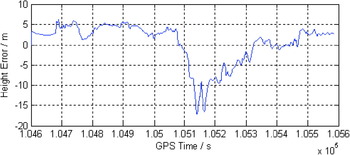
Theoretically, the integration scheme shown in Figure 1 could provide the full navigation solutions, namely, position, velocity and attitude, but experimental results show that the height solution is divergent and there are large errors existing in the velocity solution. The complete experimental results for this general integration of GPS and reduced INS will be given in Section 4, while the height error and velocity errors are presented in Figures 2 and 3 to show these problems.
Height error of general integration of GPS and the reduced INS.

North, East and Down velocity errors of general integration of GPS and the reduced INS.

The integrated height error is presented in Figure 2, which is calculated by comparing the integrated height with the DGPS height solution. The integrated velocities errors, which are presented in Figure 3, are calculated by comparing the integrated velocities with the DGPS velocities.
2.2. Error Analysis for General Integration Scheme
The divergent height error and large velocity errors stem from the reduction of INS, namely by omitting two horizontal gyros and the vertical accelerometer. Given the real and measured acceleration vector in navigation frame are  and
 respectively, they will be calculated and compared in the following.
Supposing the real yaw, pitch and roll of a vehicle are ψ, θ and γ respectively, the transformation matrix (Savage, Reference Savage2000) from the navigation frame (local level NED frame) to body frame C nb could be expressed as:

The standard gravity vector in the navigation frame could be expressed as:

Using  to represent the measured acceleration in the body frame, it could be formulated as follows:
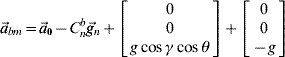
where  is motive acceleration vector in body frame; the second term is the equivalent acceleration measurement in body frame of gravity; the third and forth terms are used to adjust the vertical component to be −g, which is a basic assumption of reduced INS (refer to Figure 1).
Using to represent the measured acceleration in the navigation frame, it could be expressed as follows:

where C bn is the transformation matrix from the navigation frame to the body frame and equal to (C nb)T.
The real acceleration in the navigation frame could be formulated as:
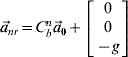
From (4) and (5), the measurement error of acceleration in the navigation frame could be obtained:

To simplify the analysis and also because the yaw angle will not affect the analysis result, which could be found in the following analysis, the yaw angle ψ will be set to be zero. So C bn could be calculated as:

So the measurement error of acceleration could be expressed as:
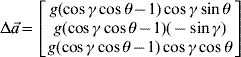
And the corresponding velocity errors in the navigation frame are:

where ΔT=T 2−T 1 is the sampling period of inertial sensors. Because of the high sampling rate of inertial sensors, the velocity errors could be rewritten as:



The corresponding position errors are:



where t c is current time when the position error is evaluated.
It could be found, from (10), that non-zero pitch and roll angles will increase the velocity error in three axes, which is shown in Figure 3. During the motion of a land vehicle, the pitch and roll angles are stochastic for both positive and negative values, so the integrals in (11a) and (11b) are approaching to zero for a long integral period, while the integral in (11c) will continuously decrease with integral time regardless of positive or negative values for pitch and roll. This is why the height is divergent in Figure 2. So if velocity aiding could be provided to this integrated system, the divergence of height solution could potentially be solved. At the same time, the overall velocity accuracy of this integrated system should also be improved.
As mentioned in Section 1, Graas and Soloviev (Reference Graas and Soloviev2004) proposed a method to estimate precise velocity from carrier phase measurements without integer ambiguity resolution using a stand-alone GPS receiver, and the velocity accuracy could reach mm/s level. In the following section, a novel integration scheme for GPS and the reduced INS is developed, where the precise velocity is incorporated into the system to overcome the height divergence and to improve the system performance.
3. NOVEL INTEGRATION OF GPS AND REDUCED INS
3.1. Novel Integration Scheme
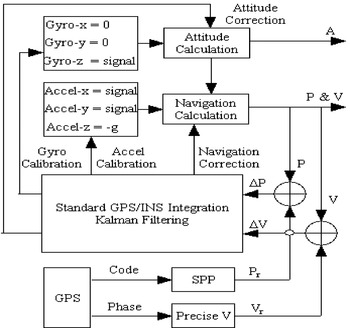
The system schematic of the novel integration scheme of GPS and the reduced INS for land vehicle navigation is shown in Figure 4. In the reduced INS sub-system, the outputs of vertical accelerometer and two horizontal gyros are replaced by pseudo signals, namely zeros plus white noise for horizontal gyros and gravity plus white noise for the vertical accelerometer. Then the outputs of the triad of one real signal and two pseudo signals of gyros are fed into the attitude algorithm to update the attitude solutions. Similarly, the triad of two real signals and one pseudo signal of accelerometers are fed to the velocity and position algorithm to update the velocity and position solutions. So the complete navigation solutions could be obtained from this reduced INS sub-system, although the gyros and accelerometers configuration is partial.
In the GPS sub-system, the pseudo ranges (code) are used to compute the single point positioning (SPP) solution. The SPP solution is too erroneous to aid the reduced INS, so the precise velocity derived from the carrier phase measurements is also used to provide additional aiding for the reduced INS.
Finally, the GPS signals and the reduced INS signals are integrated using the standard GPS/INS integration method (Han and Wang, Reference Han and Wang2008). The Kalman filter for integration will estimate the position, velocity and attitude errors, as well as the gyro errors, accelerometer errors and lever arm errors. The lever arm is used to measure the relative position between GPS antenna phase centre and INS. All these estimated errors are fed back into the reduced INS to correct the navigation solutions and calibrate the inertial sensor errors. There are two key parameters for the Kalman filter, the process noise covariance matrix Q and the measurement noise covariance matrix R. The determination of matrix Q will be discussed in the next subsection. Matrix R reflects the aiding measurement noise level and is dependent on GPS position and velocity solution accuracy. In the case of single point positioning, the accuracy of position solutions is at the level of metres. The accuracy for precise velocity is at the level of millimetres per second. So matrix R could be determined according to the accuracy of GPS single point positioning and the accuracy of GPS precise velocity.
Novel integration scheme of GPS and Reduced INS.

3.2. Reduced INS Configuration
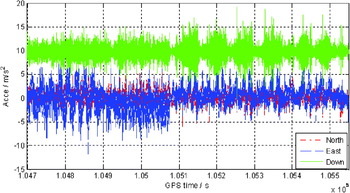
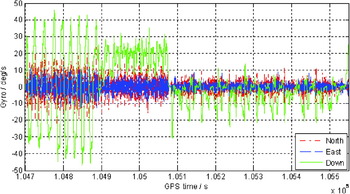
In land navigation applications, the vehicle always remains on the Earth's surface, so the vehicle positions have no large changes in the vertical direction. In addition, the pitch and roll angles of the vehicle's body relative to the Earth's surface are small. These could also be verified by the accelerometer measurements in Figure 5 and the gyro measurements in Figure 6.
MEMS accelerometer measurements.

MEMS gyro measurements.

Figures 5 and 6 plot the original measurements of MEMS accelerometers and MEMS gyros in three orthogonal directions respectively. Figure 5 indicates the down accelerometer's measurements fluctuate around g (gravity) and could be approximated as g plus a white noise process, which is in accordance with the first movement constraint mentioned above. Figure 6 shows the north and east gyros' measurements just fluctuate around zero and could be approximated as two white noise processes, which is in accordance with the second movement constraint mentioned above. According to this analysis, in land navigation applications, the vertical accelerometer and the two horizontal gyros could be omitted from the complete INS, because these three sensors provide very little navigation information. Because in this newly defined inertial navigation system, there are two accelerometers and one gyro, this reduced INS system could be named as the 2A1G system.
Under the two constraints mentioned at the beginning of this section, a specific inertial navigation algorithm could be developed for the 2A1G system. In this case, the algorithm for the integration of GPS and the reduced INS also needs to be redeveloped. This is a complicated task. If pseudo signals are used to substitute the outputs of the omitted sensors, the general inertial navigation algorithm could remain unchanged. According to the analysis from Figures 5 and 6, the pseudo signal for the vertical accelerometer could be set to be gravity g plus white noise, and the pseudo signals for the two horizontal gyros could be set to be zero plus white noise. The assumption of pseudo signals will obviously lead to large errors, unless the residual noises are accounted for carefully.
To reduce the errors introduced by the residual noises of the omitted sensors, the relevant elements of matrix Q should be determined carefully. According to the definition of Q matrix (Brown et al., Reference Brown and Hwang1997):

where u is the process noise vector, and δ(t) is the Dirac delta function. According to the requirement of the Kalman filter (Brown et al., Reference Brown and Hwang1997), u should be a white noise vector. According to the property of the white noise process (Brown and Hwang, Reference Brown and Hwang1997), the main diagonal elements of Q are the power spectral density (PSD) functions of the relevant white noise processes. The non-diagonal elements of Q are set to be zeros, which means that the white noise processes are independent of each other. Generally, the PSD relies on the noise level of the sensors used, but for the reduced INS, the PSDs of the residual noises coming from omitted sensors should be determined according to the field test data. The autocorrelation function and PSD have the following relationship (Yates and Goodman, Reference Yates and Goodman1998):
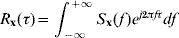
where R x(τ) is the autocorrelation function of stochastic process x and Sx(f) is the corresponding PSD. When τ=0, R x(0) is the variance of stochastic process x, and the following relationship could be obtained:
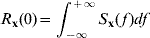
For the white noise process, the PSD is a constant, so the variance is infinite. But for narrow band white noise, which can be fulfilled by the noise process u in our integrated system, the following relationship could be derived from Equation (14):

where Var is the variance of noise process u, and S is the constant PSD, and Δw is the system bandwidth. So the PSD, which is needed in determining Q could be derived as follows:

So the PSDs of the residual noises of the pseudo signals inputting to the reduced INS could be calculated according to the following procedure. Because in our system, the sample rate of the inertial sensors is 100Hz, according to Nyquist sampling theorem, the system bandwidth should be less than half of 100Hz. Here the system bandwidth Δw is chosen to be 40Hz. For the pseudo signal of the vertical accelerometer, the variance could be calculated using the data plotted in Figure 5, Var Acc=1·29 (m/s 2)2, so the PSD could be calculated as:

For the two pseudo signals of horizontal gyros, the variance could be calculated using the data plotted in Figure 6, Var Gyro=11·3 (deg/s)2, so the PSD could be calculated as:

It should be noted that in real applications these parameters should be adjusted to get the best performance because of the disturbance of other noise sources.
4. FIELD TEST AND ANALYSIS OF THE RESULTS
To test the performance of the proposed novel integration scheme for GPS and reduced INS integration, a vehicle field test was carried out. The test was conducted in Sydney in December 2008 by the research team at SNAP lab of UNSW. The test equipment included a C-MIGITS II full INS used to collect inertial data, a dual-frequency Leica 1200 GPS receiver used to collect kinematic GPS pseudo range and carrier phase observations, and a Leica MC500 GPS receiver located at UNSW GPS base station to collect GPS base station data. The data from the Leica rover receiver and base receiver were used to compute DGPS positions. The DGPS positions were used as the position reference, and the velocity reference was obtained from the differential DGPS position.
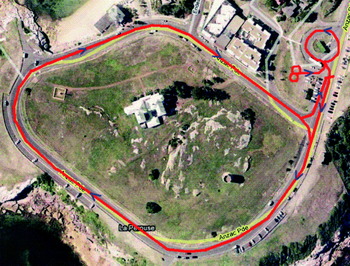
The trajectory of the field test is shown in Figure 7. At first, the test vehicle was operated to run along a small “eight-like” trajectory and a small circular trajectory. This kind of movement can produce big turn angles, which is necessary for INS initial alignment. During INS initial alignment, big turn angles can excite inertial sensors' errors and accelerate the initial alignment procedure. At the same time, big turn angles could be used to test the performance of the algorithm for precise velocity estimation. The test vehicle then ran along the big circular trajectory with acceleration up to 1·5g. This was used to test system performance in different dynamics.
Trajectory of the field test.

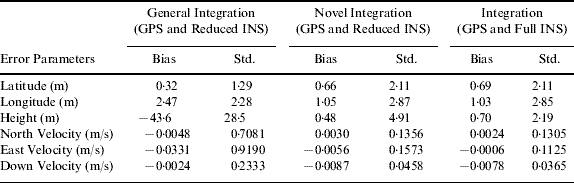
In the remaining part of this section, the navigation performance of this novel integration scheme of GPS and reduced INS will be compared with that of the traditional integration scheme. Figures 8 and 9 plot the integrated height error and velocity errors, respectively, of the novel integration. Table 1 gives a quantified description of the navigation errors of this novel integration scheme and the traditional integration scheme for GPS and reduced INS, as well as the navigation errors of GPS and full INS integration. It should be noted that the units of latitude and longitude errors have been transformed to metres.
Height error of the novel integration with precise velocity aiding.

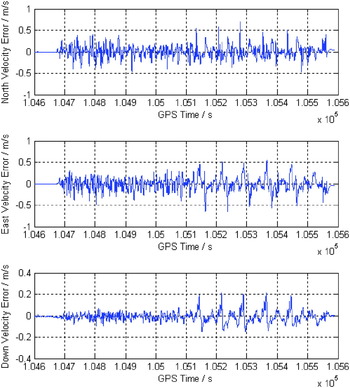
North, East and Down velocity errors of the novel integration with precise velocity aiding.

Summaries of Integration Errors.
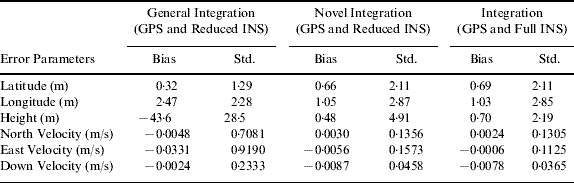
From Figure 8, it was found that, during low dynamics (before GPS time 105100), the height error was bounded to no more than 5 metres; with the increasing of dynamics, the height error arrived at its peak value about 17 metres, and then with the adding of the precise velocity, the height error converged back to around 5 metres. Comparing these results with Figure 2, which shows the plot of the height error of the traditional integration, the aiding of the precise velocity does greatly improve the height solution. Table 1 indicates that the mean value of height error reduces from -43·6 to 0·48 metres and the standard deviation reduces from 28·5 to 4·91 metres.
Figure 9 shows that in the low dynamic situation the horizontal velocity error (both the north velocity error and east velocity error) is no more than 0·5 m/s, and the vertical velocity error is no more than 0·1 m/s; and during high dynamics, the peak value of horizontal velocity error is around 0·6 m/s, and the peak value of vertical velocity error is about 0·2 m/s. The traditional integration results plotted in Figure 3 show that in the low dynamic situation the horizontal velocity error is near 2 m/s, and the peak value of vertical velocity error is about 0·5 m/s; and during high dynamics, the peak value of horizontal velocity error is around 3 m/s, and the peak value of vertical velocity error is about 0·8 m/s. Table 1 indicates, numerically, that the velocity errors of the traditional integration are several times larger than those of the novel integration.
5. CONCLUDING REMARKS
Through theoretical analysis and numerical experiments, this paper has shown that the existing method for integrating stand-alone GPS and reduced INS may have a severe divergence problem for the height component. The paper then proposed a new integration scheme for stand-alone GPS and the reduced INS, which can be effectively used for land navigation applications. In this integration scheme, precise velocity derived from GPS carrier phase measurements, together with a GPS single point positioning solution, is used to aid the reduced INS.
Using the analysis of the field test data, the 2A1G INS configuration scheme was presented for the reduced INS, and a method was proposed to estimate the process noise covariance matrix Q of the Kalman filter, which accounts for the residual noise of the omitted inertial sensors.
The integrated results of the proposed integration scheme were compared with the integration results of GPS and reduced INS without precise velocity aiding, as well as with the integrated results of GPS and full INS. Such comparisons have shown that:
• the aiding from GPS precise velocity overcomes the divergence problem of the integrated height solution and improves velocity accuracy of the integrated system;
• the proposed novel integration scheme could achieve comparable navigation accuracy with that from the GPS and full INS integrated system.
The proposed new integration methods can also be used in the integration of reduced INS with any other velocity measurements, e.g., from other satellite navigation systems, pseudolites and vision systems.
ACKNOWLEDGMENTS
The author is sponsored by the Chinese Scholarship Council for his studies in Australia. The authors would like to thank Mr Nathan Knight and Mr Shaocheng Zhang for their help with the experiments.