Introduction
Mutiny is an example of an exceptionally high-risk form of collective action: in the Royal Navy anyone convicted of it faced a statutory death penalty. Nevertheless, in 1797 a mass mutiny occurred at the Nore, an anchorage in the estuary of the Thames. The mutineers seized their ships, elected representatives, called for institutional reforms, and imposed an embargo on Thames shipping. The mutiny triggered a political crisis, intensifying fears of internal radicalism in a country embroiled in a war with revolutionary France (Rodger Reference Rodger2004: 441). Decades later, Edward Brenton (Reference Brenton1837: 276), who had been a lieutenant on one of the ships, marveled at the “flame of discord which had suddenly burst forth in the British fleet,” calling it the event that had “most endangered the safety of the British empire.”
Scholars of eighteenth-century radicalism have been impressed by the insurgency at the Nore, the seamen's rapid mobilization, and their stirring professions of solidarity (Coats Reference Coats, Coats and MacDougall2011; Thompson Reference Thompson1980; Wells Reference Wells1983). However, despite the success that seamen had in mobilizing the mutiny, their solidarity was soon compromised and their bargaining position repeatedly undermined by the defection of some ships’ crews. As Brenton (Reference Brenton1837: 289) observed, defection “had very important consequences; it spread distrust among [seamen], and led them to doubt the firmness of each other; and every one sought, by indirect means, to make his peace and secure his own safety.”
In short, the defections created a classic social dilemma. Previous mutinies had demonstrated that the best way for all seamen to avoid punishment and achieve their goals was to maintain a united front against the government. When the Nore mutiny collapsed, no concessions had been won and hundreds of seamen were referred to courts-martial. As the trials progressed, scores were punished with severe flogging and imprisonment and more than two dozen “ringleaders” were hanged. How can we explain the dynamics like those at the Nore? Why, despite extensive mobilization that brought thousands of seamen into a defiant rebellion, was insurgent solidarity so fragile that the cause swiftly suffered from defections that hastened its collapse—without the government even having to fire a shot?
The Nore mutiny was more than simply a collection of individual mutinies in the mode of the famous Bounty. Combined into a single movement, the nearly three-dozen ships comprised an armed insurgency that posed a radical challenge to the British government. The study of high-risk collective action seeks to identify the general processes that underlie involvement in dangerous and uncertain political causes, such as armed insurgencies. For obvious reasons, much of the literature on high-risk collective action stresses the initial hurdle facing such movements: recruitment and mobilization (Diani and McAdam Reference Diani and McAdam2003; Gates Reference Gates2002; Gould Reference Gould1995; Loveman Reference Loveman1998; Viterna Reference Viterna2006; Wood Reference Wood2003). Far less attention has been paid to the reasons why insurgents continue to support a rebellion when dangers grow and the prospects for its success dim. This is a vital issue because the most important determinant of an insurgency's effectiveness may not reside in initial mobilization, but rather in its capacity to sustain group solidarity and contain defection in the face of growing adversity (Berman Reference Berman2009; Kalyvas Reference Kalyvas2006; Kalyvas and Kocher Reference Kalyvas and Kocher2007; Weinstein Reference Weinstein2007).
We find that, throughout the rebellion, the mutiny's leaders struggled to maintain control over the ships of the fleet by monitoring the activities of the loyalists (and suspected loyalists) and punishing their opposition. Yet, above all, the seamen relied on the mutiny leadership to negotiate a victorious settlement, including an amnesty, in what they portrayed as an all-or-nothing dispute. But this bargain was conditional on information about alternative settlements to the conflict. Because the Admiralty offered amnesty to the sailors on ships defecting from the mutiny, the key weapon in the hands of mutiny leaders was the control over this information. Thus the mutiny should have been maintained longest on those ships in which the rank-and-file seamen had the least access to information about the Admiralty's offer.
The problem of defection makes the Nore an excellent case for the investigation of insurgent solidarity because defection is the mirror image of solidarity. Anyone can profess solidarity to a cause but what matters is whether or not one sticks with it, even when the outlook darkens. Our case-study design (Gerring Reference Gerring2007) combines rich qualitative and unique quantitative data drawn from the Admiralty archives in order to explore why solidarity was maintained or else collapsed in a ship's company. First, we employ process tracing (Bennet Reference Bennett, Brady and Collier2010; Brady and Collier Reference Brady and Collier2010) in an examination of the daily entries made into ships’ logbooks and of 16 verbatim trial transcripts of all of the 106 defendants tried by courts-martial before remaining indictments were dismissed. Second, because the logs and muster books are complete for the 33 ships involved at the Nore, we were able to code a host of important variables about ships, their crews, and their experiences in the mutiny. These systematic data permit an event-history analysis that models defection.
Our study highlights the importance of information control for sustaining insurgent solidarity. We find that, although benefiting from large-scale, apparently enthusiastic mobilization, the mutineers soon found themselves facing a lengthy standoff with the government. Neither ideological commitments nor community ties among seamen were adequate to maintain solidarity. As pressure mounted, their leaders were compelled to monitor and sanction seamen in order to gain compliance and deter defection. They exploited informational asymmetries to persuade seamen to stand by the insurgency, even as its prospects for success faded. Our analysis shows that the more insurgent leaders were able to limit access to information concerning alternative settlements, the greater a ship's commitment to the mutiny.
The Problem of Solidarity in High-Risk Insurgency
Compliance at the Nore was predicated on an oath. Seaman promised to obey their leaders and persevere until their collective goals were attained. The mutineers believed that they had to maintain a united front to prevail in the conflict and avoid punishment. Yet as Hobbes (Reference Hobbes1996: 111) famously observed, “covenants without the sword are but words, and of no strength to secure a man at all.” Why then did seamen honor their oaths in the absence of third-party enforcement and, on many ships, do so up to the very last moment, long after prospects for success had receded?
Most explanations of solidarity at the Nore have emphasized the roles of ideology and community. Sociologically, to the degree that individuals share a common ideology, they internalize a set of norms that are sufficient to sustain solidarity in the absence of material incentives or social rewards (Fantasia Reference Fantasia1988; Wood Reference Wood2003). The historiography has traditionally attributed insurgent commitment at the Nore to the ideology spread by the French Revolution and radical groups such as the London Corresponding Society (Gill Reference Gill1913: 4; Rodger Reference Rodger, Bartlett, Dickson, Keogh and Whelan2003; Thompson Reference Thompson1980: 168; Wells Reference Wells1983). Rediker (Reference Rediker1987: 155) and Frykman (Reference Frykman2009: 92) describe a radicalized Atlantic proletariat in the 1790s, with naval authorities regarding the “Irish and Foreigners” as the most ideologically contaminated. If ideology is largely responsible for insurgent solidarity, then widespread radicalism among ships’ companies should have substantially deterred defection.
A second explanation is that solidarity is fostered by the sense of community arising within close-knit social networks. Oath takers at the Nore may have been constrained by social ties and reputational incentives to honor their commitments (Chong Reference Chong1991; Cook et al. Reference Cook, Hardin and Levi2005). A good deal of sociological research supports this explanation. Labor militancy may be greatest in communities of geographically or socially isolated groups of workers who are highly interdependent (Kerr and Siegal Reference Kerr, Siegal, Kornhauser, Dugan and Ross1954). Strikers in colonial India who belonged to caste and ethnically based mutual-aid societies had high strike solidarity because community ties generated selective incentives that were independent of strike outcomes (Wolcott Reference Wolcott2008). Militiamen in the Paris Commune had higher solidarity in the face of the enemy when their units were recruited through neighborhood ties (Gould Reference Gould1995). And Union Army units recruited from small towns had lower desertion rates than those recruited from cities in the American Civil War (Costa and Kahn Reference Costa and Kahn2008).
By all accounts, sailors had a strong sense of occupational identity and belief in the “due rights and privileges” of seamen. Aboard ship, seamen “became an effective, efficient collectivity, bound together in skill, purpose, courage, and community” (Rediker Reference Rediker1987: 134–35, 154). This is a finding common to very different historians (Earle Reference Earle1998; Neale Reference Neale1985; Rodger Reference Rodger1986). The general implication for the seaman is that “[r]eneging on an explicit commitment to support his seagoing companions could damage this individual's reputation among the only people he could rely on in a difficult life at sea” (Leeson Reference Leeson2010: 302). If social ties were primarily responsible for the duration of mutiny, then those ships bound by tight communities would have been least likely to defect from the mutiny.
We go beyond these existing theories to show why commitment to the mutiny relied on techniques used by the leadership to increase dependence and control over rank-and-file seamen (Hechter Reference Hechter1987). In the back-and-forth struggle that often characterizes insurgent conflicts (Kalyvas Reference Kalyvas2006; Weinstein Reference Weinstein2007), the loyalists and mutineers on each ship struggled to attain the support of the bystanders, whose tilt to one side or the other would determine whether the ship would maintain solidarity with the fleetwide mutiny or defect from it. Throughout the rebellion, the mutiny's leaders sought to maintain control over the ships of the fleet. In so doing, they monitored the activities of the loyalists (and suspected loyalists) and credibly threatened to sanction those who sought to return a ship to government hands.
Seamen relied on the mutiny leadership to negotiate a victorious settlement, including an amnesty, in what was understood as an all-or-nothing dispute. The government threatened mutineers with force and mobilized troops on land hoping to persuade seamen to abandon their leaders. However, at least early in the standoff, these threats appear to have increased seamen's dependence on the mutiny leadership by convincing them that only by prevailing over the government could they secure their safety. Dynamics like these are not peculiar to the Nore; for example, Wood (Reference Wood2003: 116) describes how guerrillas secured peasant support by making them dependent on the movement for protection from government repression. Kalyvas (Reference Kalyvas2006: 157) argues that general threats of retaliation “allow insurgents to solve collective action problems by turning the protection of civilian populations into a selective incentive” and notes that “the force inherent in control solves collective action problems” (ibid.: 124).
Yet the belief that the leadership was most able to protect the lives and well-being of seamen was conditional on knowledge about alternative settlements to the conflict. In this regard, the key instrument in the hands of mutiny leaders was control over information. To enhance the seamen's perception that their best option was to stand by the mutiny, the leadership denied them access to information that capitulation was the safer course. If dependence and control explain the duration of the mutiny, then the ships whose crews were unaware of government amnesty for defectors would have remained longest with the mutiny.
The Making of the Nore Mutiny
In 1797 Britain and her allies had been at war with France since 1793, suffering numerous defeats at the hands of revolutionary armies. At sea, the kingdom fared much better, however, defeating a French fleet in 1794, thwarting an invasion of Ireland in 1796, and drubbing the Spanish in early 1797. Yet threats remained. In April, Austria, Britain's last ally, began to sue for peace, and intelligence revealed French plans to combine with the Spanish and Dutch fleets behind an invasion of the British Isles (Doyle Reference Doyle1990; Dull Reference Dull2009: 123–50; Rodger Reference Rodger2004: 429). At home, a network of republican activists had formed, inspired, in large part, by Thomas Paine's publication of The Rights of Man in 1791 (Goodwin Reference Goodwin1979). The conservative Pitt government countered with a campaign of repression (McLynn Reference McLynn1989: 336–38).
In the midst of this turmoil, government expenditure rose to a third of total economic activity and consumer prices rose dramatically (Oliver Reference Oliver1941: 544–51; Twigger Reference Twigger1999). Economic pressures brought an upsurge of strikes and industrial disturbances—about a third of all eighteenth-century English strikes occurred during the 1790s (McLynn Reference McLynn1989: 332). Inflation especially threatened naval seamen, whose wages were frequently delayed or in arrears, and whose general rates of pay had not been raised since 1652 (Lavery Reference Lavery2010: 213; Rodger Reference Rodger2004: 446). Anxious about desertion and insurrectionism, in 1792 and again in 1797, the government improved compensation for the soldiery but excluded seamen (Fortescu Reference Fortescu1902; Wells Reference Wells1983).
Meanwhile, discontent was mounting in the Royal Navy. Impressments had long been relied upon to meet manpower requirements, but the government passed Quota Acts in 1795 and 1796 that placed naval levies on counties and ports flooding the navy with some 30,000 conscripts, mostly rated as unskilled landsmen (Lavery Reference Lavery2010: 211; Rodger Reference Rodger2004: 444). Many Irishmen—distrusted colonial subjects (Colley Reference Colley2003; Hechter Reference Hechter1998)—were recruited and pressed in large numbers, some as a result of the Insurrection Act (Rodger Reference Rodger2004: 444). In this context, naval authorities feared that seamen were becoming restive. Mutiny and other forms of collective defiance were well known in the seagoing trades (Coats Reference Coats, Coats and MacDougall2011; Earle Reference Earle1998; Rediker Reference Rediker1987). Over the course of the eighteenth century, if mutineers refrained from violence against officers, negotiated with the authorities, and remained united, naval authorities gave in to “reasonable” demands on particular ships and agreed not to prosecute any seaman for involvement in the mutiny (Gilbert Reference Gilbert and Masterson1983; Neale Reference Neale1985; Rodger Reference Rodger1986). Shared knowledge of these episodes clearly informed the strategy of the Nore mutineers.
Rather than acknowledge the pressing weight of seamen's grievances, the authorities became convinced that radicalism was gaining a foothold in the navy (Coats and MacDougall Reference Coats and MacDougall2011; Wells Reference Wells1983). Distrust and animosity between seamen and officers appeared to be growing (Neale Reference Neale1985). In the early months of 1797, seamen discussed grievances and distributed “round robin” letters stating their demands (Earle Reference Earle1998: 177; Leeson Reference Leeson2010). One of the few surviving documents from Spithead indicates that seamen were expected to take an oath that pledged unity and obedience to their leaders (Hattendorf et al. Reference Hattendorf, Knight, Pearsall, Rodger and Till1993: 543–45). These clandestine activities resulted in petitions to various commanders and ultimately to the Admiralty, all without response. By March 30, Lord Bridport had received petitions from 11 of the ships in the fleet. After informing the Admiralty that mutiny was afoot, Bridport was told to put to sea on April 15. The following day 16 line-of-battle ships at the Spithead moorage disobeyed the order.
As is well known, for the next month the Spithead mutiny held together despite the government's maneuvers to weaken the fleet's solidarity (Coats and MacDougall Reference Coats and MacDougall2011; Gill Reference Gill1913; Manwaring and Dobrée Reference Manwaring and Dobrée1987). The seamen's leaders negotiated with the government and engaged in adroit public relations, insisting on parliamentary action to improve wages and victuals, as well as the king's pardon to ensure that none would hang. Despite tensions and frustrating negotiations, no ship's crew defected from the cause. By May 15, the Spithead mutineers had won their demands and received amnesty (Coats and MacDougall Reference Coats and MacDougall2011: 32).
News of the Spithead mutiny spread throughout home waters, attracting emissaries from the Nore. On May 6, a committee formed on the Sandwich, Admiral Buckner's flagship. The committee called on other ships to organize themselves and elect delegates for a fleetwide mutiny. They produced a standard oath that was distributed across the Nore (Dugan Reference Dugan1965: 179–80). On May 12 “At half past 9 (AM) the people cheered and came aft and demanded the keys of the magazine and the store rooms. Pointed the forecastle guns aft and gave charge to the Master.”Footnote 1 After seizing the ship, the mutineers raised a red flag and gave three cheers. Immediately, mutinies followed on several nearby ships and in the following weeks spread across the eastern coast.
A mutiny committee governed each ship, electing two delegates who assembled aboard the Sandwich. The Council of Delegates derived a set of articles specifying “unanimity,” “strict discipline,” and “all unsuitable Officers to go ashore” (Gill Reference Gill1913: 110). On each ship, ringleaders administered an oath of solidarity to all:
‘I, A. B. do voluntary make oath and swear that I will be true in the cause we are embarked in, and I will to the laying down of my life be true to the Delegates at present assembled, whilst they continue to support the present cause. . .’ the man going on to swear that he would discover and report any activity subversive of ‘our present plan,’ or likely to fray the texture of ‘our present system.’ (Manwaring and Dobrée Reference Manwaring and Dobrée1987: 131–32)
The council elected Richard Parker as its president, probably due to his education and experience (Dugan Reference Dugan1965: 199). Parker and his comrades exercised their authority at meetings of the council, in frequent visits to other ships, and by leading rallies of mutineers at the homeport of Sheerness. The Sandwich was the headquarters of the council and her guns were its chief enforcer. The mutiny comprised a confederation of ships but the Nore was a large area and vessels that joined it were a varied lot originating from several ports. On a half dozen ships, the leading mutineers were so weak that they required the threat of the Sandwich’s guns to persuade reluctant seamen.Footnote 2
The mutiny progressed through four phases. The first was the outbreak on May 12 on the Sandwich followed by its spread to other ships. The government reacted slowly because it saw the mutiny as a mere continuation of the Spithead affair and expected it to falter once the seamen realized that they would gain the same concessions as the Channel Fleet. However, in the following weeks, as the delegates stated enlarged demands and the mutiny spread to the Yarmouth squadron, the government realized a new rebellion was afoot (Wells Reference Wells1983).
On May 20 the mutineers addressed the enlarged demands to Admiral Buckner, hoping to negotiate a favorable settlement. The delegates expected “every indulgence granted to the Fleet at Portsmouth” and, in addition, opportunities for shore leave, limits on the holding of pay in arrears, the right to request the replacement of abusive or incompetent officers, pay advances for pressed men, clemency for deserters, trial by jury in courts-martial, more equitable distribution of prize money, and the immediate payment of bounties to volunteers.Footnote 3 These demands went substantially beyond those that had been presented at Spithead and the government was determined to resist giving in to new pressure after that settlement.
Following the rejection of their demands, Brenton (Reference Brenton1837: 287) noted that “[t]he mutiny from this moment assumed the character of rebellion, and as such the government and the nation, justly incensed, determined to treat it.” Indeed, beginning on May 21, the government began to tighten the noose. Unauthorized communication with the mutinous fleet was forbidden by parliamentary act and press censorship was imposed (MacDougall Reference MacDougall, Coats and MacDougall2011).
The government could not simply crush the mutiny. It had no trustworthy naval force in home waters and the army could do little save reinforce the coast. Moreover, the ships held by the mutineers had enormous value and contained many officers who effectively were hostages. Finally, armed action threatened public disapproval and might well have drawn naval attacks by France and her allies. Instead, the government gradually cut the mutineers off from supporters and blocked all letters going in and out, save for those that exhorted friends and loved ones to submit (ibid.). For their part, mutiny leaders responded by limiting shore access to active and trusted mutineers, distributing messages of support, and suppressing correspondence that might inform seamen about the pardon and the prior wage concessions (Wells Reference Wells1983: 88–90).
In retrospect, the mutineers’ policy of allowing most of the officers to remain on board was mistaken. On board ships, it left in place a core around which loyalist factions took shape that invariably worked to undermine the mutiny. Although mutineers forced some officers and loyalists ashore, this was not widely done partially because the delegates wanted to signal that the ships remained in readiness in case of a foreign attack, and partially because officers were effectively hostages and thus potential bargaining chips. A seesaw struggle transpired as both pro- and antimutiny factions battled for the support of less committed seamen, many of whom played little active role in the mutiny. In some instances, loyalist plotting to retake the ship and exit the rebellion commenced almost immediately. But on most ships, the frustrated negotiations between the fleet's delegates and the government and the defection of others from the mutiny—beginning with the Clyde on May 29—encouraged loyalists to act. The defections brought the mutiny into a state of crisis from which it never entirely recovered.
Facing government intransigence, loyalist plotting, and defections, the mutineers became increasingly militant, maintaining unity by threat, imposing a blockade of the Thames, and firing on ships that sought to exit the mutiny. The blockade, imposed at the end of May, detained more than a hundred merchant vessels. Brenton (Reference Brenton1837: 268) recalled, “The extent and value of the trade detained at the Nore was immense, and the consternation in London and throughout the empire proportionately great.” The government's position hardened and the seamen now found it difficult to harmonize their claims with the patriotic loyalty that the public expected (Land Reference Land2009). As the Admiralty tightened its noose around the fleet, movement became restricted and provisions began to run short. The delegates countered by seizing and distributing provisions from merchant ships. However, the seizures were limited and shortages heightened tensions (Gill Reference Gill1913: 220–21).
The third phase commenced with the mutiny of the greater part of Admiral Duncan's squadron at Yarmouth and its arrival at the Nore. Morale was poor; Duncan had warned the Admiralty and called for improvements of the seaman's lot (Dugan Reference Dugan1965: 123–29). Toward the end of May, committees formed on some of his ships. Duncan responded by having his officers assemble their crews and read the details of the Spithead settlement. Nevertheless, on May 30 as the squadron departed on patrol, many crews rebelled. Duncan quashed an incipient uprising on his flagship but a dozen vessels made their way to the Nore. Though their arrival was a boost to morale, upon arrival the Yarmouth men proved to be highly factionalized (Brenton Reference Brenton1837: 287–90; Rodger Reference Rodger2004: 448–49).
The final phase began after June 6 when the delegates presented a revised list of demands to the Admiralty, warning that if they were not met, “such steps will be taken by the Fleet as will astonish their countrymen.”Footnote 4 Meanwhile, the blockade had entrenched the government's position and turned public opinion firmly against the mutineers. The government sent troops to occupy seaports, passed an act that made it a capital crime to assist the mutiny, and stopped the provisioning of the fleet. On June 7, the Admiralty positioned batteries on nearby shores and ordered the removal of buoys and channel markers, making escape by sea more difficult. In the fleet, the situation became increasingly dire, as factional struggles divided crewmen on many ships, the supplies began to run short, and more ships defected. The blockade was abandoned and, with no apparent way out, the council submitted on June 15. In the following days, authority was restored. Officers identified the activists on each ship, leading to the arrest of hundreds of men and their referral to courts-martial. Trials progressed for months but on October 11, Duncan's North Sea fleet annihilated the Dutch fleet off Camperdown. Grateful for a momentous victory, the Crown pardoned the remaining indicted mutineers.
Oaths and Collective Action at the Nore
Because the officers always comprise a minority of the ship's company, if a large proportion of seamen refuse to accept their authority they can gain control of the ship. Given the severe, widely shared grievances that incensed the men of the Royal Navy in the 1790s, their capacity for self-organization, and the prior example of Spithead, the problem facing the mutiny's leadership was not initial mobilization but rather sustaining the commitment of seamen to the cause. Manwaring and Dobrée (Reference Manwaring and Dobrée1987: 131–32) observe that the ringleaders considered the oath to be the “firmest shackle” binding seamen to the mutiny. But why did the leadership believe that oaths would have been so binding?
Oaths activate mechanisms that overcome social dilemmas across distinct stages of collective action. During mobilization, coordination may be the greatest obstacle (Heckathorn Reference Heckathorn1996). However, in the second, more extensive stage of collective action, overcoming defection (and free riding) is the great problem facing insurgent groups. In the case of the Nore, we know that the activist core of mutineers had taken secret oaths prior to the seizure of ships. As seamen Matthew Barker explained, “There warn't so many led into the secret of the mutiny as was first imagined; but then they were chiefly petty officers and able seamen, who possess a strong influence on all hands, fore and aft” (Glasco Reference Glasco2004: 47). Outside of the core group of conspiratorial ringleaders and their supporters, mere oath taking could not be taken as a reliable signal of allegiance (Gambetta Reference Gambetta, Hedstrom and Bearman2011). Why then did the leadership demand that all seamen take the oath?
In the second stage of the mutiny the oath was intended as a “doomsday” pact (Rasmusen Reference Rasmusen2007: 123) that subjects signatories to the risk of death regardless of their subsequent behavior. Evidence indicates that the leaders appreciated the difference between the conspiratorial oaths they had sworn to one another and those they administered to an entire ship's company. For example, the conspirators aboard the Leopard used the oath to establish that they could take the ship, assessing loyalties one by one. Once they gained the ship, the leadership swore the rest of the seamen. One mutineer explained “that when they had got about 150 or 160 then they thought they were the strongest party and they were not afraid and they called them in three or four together afterwards. . . getting all the ship's company sworn.”Footnote 5 By taking an oath in the presence of witnesses the activists clearly sought to bind all seamen into the “sin” of rebellion.
Of course, loyalists took the oath under duress with no subjective compunction against defection (or subsequently informing on mutineers). But even they would have been constrained, at least to some extent, as this strategy presumed that after the fact the authorities would believe that they had taken the oath insincerely. Moreover, by “roving the ropes” (making a gallows on a yardarm) the mutiny's leaders made it clear to potential defectors that betrayal risked deadly reprisal from the mutineers as well. Thus even if some seamen discounted the odds that the government would punish all oath takers, uncertainty put all at risk. As such, they had an incentive to stick with the mutiny in the hope that it would prevail and win a general amnesty (as, in fact, had occurred a few weeks earlier at Spithead).
What made the doomsday scenario credible was hanging as the statutory punishment for mutiny and the government's hostile posture. The promise of general retaliation bolsters insurgency by changing the logic of collective action such that “participation in rebellion entails no collective action problem, but nonparticipation does” (Kalyvas Reference Kalyvas2006: 157). In such situations defection does not pay off. So long as uncertainty prevailed concerning the outcome of the rebellion, attempted defection could be catastrophic, with seamen risking being hanged either by the ringleaders or by the government for having taken the treasonous oath in the first place. Under these conditions, individuals will remain with an insurgency until changes in available information strongly suggest that one of the two outcomes is less likely.
Why Did Mutineers Stand by Their Oaths? The Qualitative Evidence
From the inception of the mutiny on the Sandwich on May 12, the Council of Delegates insisted on “unanimity” and “strict discipline.” It threatened to punish severely any oath taker who betrayed the cause and signaled this by roving the ropes when it took control of a ship. Court-martial testimony makes clear that the fleet delegates and committee men on each ship were the eyes and ears of the council. They donned red cockades to symbolize their power, carried cutlasses and pistols, and posted armed sentries. Confrontations with loyalists left several seamen dead. Parker explicitly used the threat of the noose and, when he visited other ships to exhort his supporters or quell dissent, he had a rope roved.Footnote 6
On each ship, governing committees enforced both shipboard order and punished political offenses. In practice, the control of a ship was most secure where a sizable cadre of committed mutineers could be relied upon, if necessary, to back up the council's decisions by force. For instance, on May 26, two seamen were flogged for defiance on the Sandwich; one of them was not only given two dozen lashes but was also ducked overboard.Footnote 7 On other ships with sizable activist cadres, mutiny leaders publically flogged and humiliated loyalists whom they saw as posing threats, as occurred on the Ardent, the Standard, and the Monmouth. On the Monmouth, six loyalists were severely flogged and, so that no one missed the point, the offenders had their heads shaved and were forced to wear a halter around their necks to show that they had passed “within a few inches of the rope.” Their degradation concluded with their being sent ashore in a launch that paraded through the fleet.Footnote 8 Inflicting political punishments like these required the active participation of committed mutineers. By contrast, on ships in which the committees were weakly supported, there was tentative enforcement of the delegates’ instructions and loyalists acted with less fear of reprisal.
Parker and the delegates visited a number of ships they perceived as wavering. Several ships with suspected loyalist majorities, including the Iris, Tisiphone, and San Fiorenzo were ordered to moor within range of the Sandwich’s guns. When loyalists did gain control of ships and attempted to make their escape from the Nore, insurgent ships opened fire on them. Although the casualties were light, probably because the mutineers aimed at sails and riggings in an effort to stop or slow the ships, those attacks deterred other defections (Wells Reference Wells1983: 88–89).
These examples should not be taken to imply that the leaders of the mutiny ruled by means of terror or that they managed to coerce thousands of seamen into supporting the mutiny. The testimony of William Gregory, hanged as a ringleader, summarizes the matter nicely:
Could it be reasonably supposed that twelve men armed, whom they armed themselves, should command that band of people?. . . There were six times the number of Officers in the King's ship than there were of the Committee and if those Officers were not able to exert their authority how could the Committee do it?Footnote 9
In fact, at least initially, the mutiny spread so widely and so quickly because seamen were aggrieved and the demand for redress enjoyed substantial support. However, the leadership buttressed its control through the threat of force, particularly against suspected loyalists.Footnote 10 Although they hanged no defectors—in spite of the roving of the ropes—prominent loyalists were flogged, beaten, dunked overboard, or ceremonially drummed off of ships, particularly on vessels in which ringleaders were emboldened by a large mutinous cadre. Violent struggles erupted on some vessels, killing or wounding several seamen.Footnote 11
Beyond coercive discipline, mutiny leaders increased seamen's dependence through tactics of information control. To enhance the seamen's perception that their best option was to stand by the mutiny, the leadership selectively denied them access to information suggesting that capitulation was the safer course. As the committee on the Sandwich had dispatched a fact-finding mission to Spithead, it knew about the settlement, which included a general increase in wages and a pardon for mutineers that defected. For the leadership, this knowledge was “private information” withheld to maintain support behind a united bargaining position (Cramton and Tracy Reference Cramton, Tracy, Addison and Schnabel2003). Conversely, from the perspective of loyalists, the spread of information about the settlement and pardon could undercut seamen's dependence on the delegates. The facts surrounding the Spithead settlement and pardon “were concealed from the Crews” and, on ships where they were known, the leadership insinuated that the settlement was fraudulent (Wells Reference Wells1983: 102). Delegates suspected of permitting the disclosure of this information were expelled from the council (ibid.: 103). On the other side, loyalists endeavored to reduce seamen's dependence by spreading this information, usually by arranging to have officers publically read the pardon (Gill Reference Gill1913: 100). Taken together, the credible threat of retaliation from the mutineers for breaking it, combined with uncertainty regarding possible naval sanctions, bolstered the commitments sealed by the oath.
Whereas the qualitative evidence provides strong support for our proposition that dependence and information control are essential to insurgent solidarity, it provides scant warrant for explanations premised on ideology or seamen's political dispositions. The Council stated radical goals that went beyond wage issues, including enhanced rights and status of seamen. Court-martial testimony indicates that republican statements were openly made by some of the delegates. For instance, William Gregory declared, “Is there not many among you here as fit to be our Sovereign as George Rex? He has power and we have the force of gunpowder.”Footnote 12 According to Lt. Forbes of the Sandwich, red cockades—radical symbols even then—distinguished the prominent members of the mutineers’ party: “Only those that appeared to me to be the most active and the leading men in the mutiny. . . I apprehend between forty and fifty of the ship's company might have worn them at different times.”Footnote 13 Other witnesses claimed that as the mutiny dragged on, radicals said that if the government would not budge then ships should variously be scuttled, defect to France, find refuge in Ireland, and so on, though none of these ideas enjoyed support.
On the other hand, although courts-martial were eager to find members of the radical underground, they identified none at all. This was also the finding of a simultaneous investigation undertaken by the Home Office (Goodwin Reference Goodwin1979: 408). Despite their radical reputation, the delegates did not endorse revolution. They saluted the king's birthday, played patriotic songs, and forbade “communication with Jacobins or Traitors.”Footnote 14 Moreover, although there were Irishmen and other “foreigners” among the hundreds of active mutineers, these categories of seamen do not appear to have asserted any particular ideological rationale for the mutiny. Nor is there evidence that specifically Irish grievances or nationalism were factors persuading seamen to stand by their oaths (Brown Reference Brown2006; Kennedy Reference Kennedy1990; Rodger Reference Rodger2004).
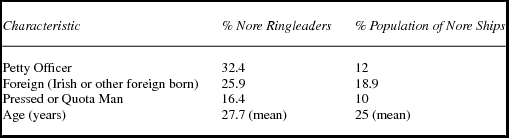
Indeed, whereas “foreigners” were a disproportionate share of the activists (see table 1), the most striking disproportion lies with the highly experienced petty officers. Although activists were also more likely to have been compelled to serve, this may have been more a source of private grievance than indicative of radicalism—evidenced by the fact that the mutineers did not demand the abolition of the impress. Leading seamen and Irishmen may well have helped to compose the critical mass around which the mutiny mobilized, but there is little in the backgrounds or actions of the activists, much less the bulk of mutineers, suggesting that they were the vanguard of a radicalized proletariat (Frykman Reference Frykman2009; Glasco Reference Glasco2004). Rather, as Captain Parr of the battleship Standard attested, “I am very sorry to say that the active mutineers that are here were amongst the best of the ship's company.”Footnote 15 Beyond the activist core, there is no evidence that radical ideology promoted solidarity; indeed it appears to have been divisive among seamen.
Comparison of indicted ringleaders (N = 336) with the population of seamen at the Nore

Source: Court-martial documents and ships’ muster books in TNA: PRO ADM.
Community bolsters a solidarity pact in the face of mounting adversity if the expected costs of defection exceed its benefits (Hovi Reference Hovi1998). In eighteenth-century Britain, secret societies were often recruited from villages, artisanal occupations, and sects (Calhoun Reference Calhoun1982). Thompson's (Reference Thompson1980) Luddites who stuck by their oaths even after being arrested were bound to particular villages and rural districts. In a more religious age, fear of otherworldly sanctions may have restrained oath takers, yet seamen were notoriously impious (Rediker Reference Rediker1987). While the fear of hellfire may be powerful, social ostracism is probably more so. The social costs that traitors to the Luddite cause faced were little short of ruinous. The Parisian Communards felt intense social pressure to fight and feared the disapproval of their homogeneous, densely-knit “urban villages.” As one explained when invited to defect, “I can't leave; what would my comrades from the quartier say?” (Gould Reference Gould1995: 181).
By contrast, the eighteenth-century maritime world was socially fluid. The Atlantic world had more than 150,000 English-speaking seamen (Frykman Reference Frykman2009). Seamen who gave testimony were assigned to other ships. Once the war ended, sailors could expect to find employment outside the Royal Navy in the merchant ships of several ocean-going countries. Feelings of community may have been largely provisional, as there was substantial turnover in many ships’ companies and crews were discharged at the end of a voyage. Moreover, bonds of community would have been hard to extend across the fleet, whereas strong community bonds aboard particular ships introduced social cross-pressures that worked against fleetwide solidarity.
A powerful illustration of these cross-cutting commitments is provided by the early defectors from the mutiny, the crews of the frigates Clyde and San Fiorenzo. On May 29, under fire, the Clyde became the first ship to defect. This occurred after “Captain Cunningham harangued the ship's company and read to them the King's most gracious pardon on the condition that they would return to their duty—they gladly accepted and expressed their grateful thanks by three cheers.”Footnote 16 San Fiorenzo quickly followed suit. The evidence shows that these seamen had strong bonds of local community, which included emotional attachments to their commanding officers that persisted even after being enveloped in the mutiny. The mutinous faction aboard the San Fiorenzo was initially so weak that it had required the armed assistance of other vessels before it could seize the ship.Footnote 17 Unusually, the captains of these ships were not confined to quarters, and it is worth noting that both crews appear to have been relatively satisfied with shipboard conditions. Both had long-serving commanders, tiny rates of desertion (Clyde 1.4 percent; San Fiorenzo 0.9 percent; average of Nore ships 7.1 percent), and modest flogging rates in the year prior to the mutiny (per capita rate of 1.0 for Clyde; .33 for San Fiorenzo; Nore 1.9). The sense of local community appears to have been stronger on these ships than the categorical definition of community associated with seamen across the mutiny.
As these instances of early defection make clear, the Nore's leaders, unlike those of many insurgent groups, could not readily select only some seamen to be mutineers, thereby excluding those whom they regarded as lacking ideological conviction. Nor could they provide special incentives to reward compliance, take loved ones as hostages, or make a credible threat to avenge disloyalty on a traitor's family, all tactics that have been successfully employed by insurgent groups (Berman Reference Berman2009; Kalyvas and Kocher Reference Kalyvas and Kocher2007; Weinstein Reference Weinstein2007). The varied ships that comprised the Nore mutiny were not uniformly small-scale communities in which seamen knew each other intimately and had life-long connections. In such a heterogeneous movement, commitments were harder to sustain. In sum, the weight of the evidence backs Calhoun's (Reference Calhoun1982: 156) observation that “[c]ommunity, as pattern of social organization and as culturally defined way of life, depends on a fairly high degree of stability.” Accordingly, “Where people are only loosely connected to each other, they may choose, for example, to prolong a conflict or abandon the community which proposes a solution they do not like—unless prevented by material power” (emphasis added).
Explanations for the Nore mutiny that emphasize radical ideology or the bonds that knit the seafaring community are impossible to dismiss entirely. Although, outside of a handful of “ringleaders,” there is little evidence of radicalism in the archival data we examined, and it is hard to find evidence that a sense of community bound seamen across many ships; this does not mean that internalized norms that cannot be documented were absent. Even though the great bulk of seamen were not radicals, they probably shared norms that claimed that, under particular circumstances, mutiny was justified (Rodger Reference Rodger1986). And seamen, like members of other occupational groups characterized by interdependencies, apparently had informal norms that vaunted solidarity (Rediker Reference Rediker1987). The problem with all informal norms, however, resides in attaining general compliance across the members of a group. In this, what made sustaining solidarity difficult at the Nore was not simply the problem of enforcement but also that radicalism was not widely diffused among seamen and bonds of community operating at different levels created social cross-pressures that undercut commitment.
Event-History Analysis: Data and Estimation
The qualitative evidence suggests the importance of dependence and control for attaining solidarity. Yet how confident can we be that the factors we have identified can be generalized across the ships at the Nore? Because muster books and logbooks are complete, we were able to code both cross-sectional and time-varying variables for every ship. For each of the 33 ships we modeled social structural and situational factors that may have influenced the duration of mutiny aboard that ship. Cox proportional hazards models are ideal for estimating time to an event when there is no theoretical reason to specify the underlying distribution of the baseline hazard rate (Allison Reference Allison1984; Box-Steffensmeier and Jones Reference Box-Steffensmeier and Jones2004). Logbooks allow us to make daily observations of every ship that was part of the mutiny, whereas muster books allow us to code features of the demographic and social structure of the crew at the time of that ship's joining the mutiny.
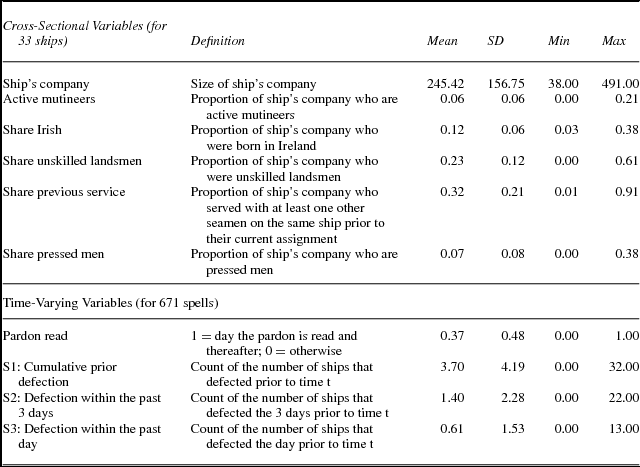
To test our explanation, we coded the share of active mutineers that faced indictment for their avid participation as a share of a ship's company and the date aboard a ship that details of the royal pardon were communicated to seamen. To assess the relative strength of the mutinous faction on Nore ships, we took the number of men indicted for active or leading roles on board a ship (Manwaring and Dobrée Reference Manwaring and Dobrée1987) divided by the size of the ship's company. It could be argued that this measure is simply gauging popular support for the mutiny aboard a given ship. But several facts speak against this interpretation. First, there is no evidence that militant seamen were more likely to be assigned to some ships than to others. Second, on no ship were these cadres large enough to constitute a majority (on average only 6 percent of the crew and on no ship more than a fifth of the crew). Third, the logbooks show that ships with large activist cadres had more episodes of punishment and violence against loyalists. If the size of the cadre were indicative of popular support, there should have been less conflict aboard those ships. On ships with small cadres, activists seem to have been reluctant to confront loyalist factions for the sake of their own safety. Large cadres appear to have reinforced control by suppressing loyalist agitation, thereby postponing defection.
It could also be argued that indicted activists are a poor proxy because of potential biases in prosecution. The number of activists might have been underreported, as the authorities could have had an incentive to minimize the prosecution of the valuable, highly trained sailors. Blaming a few troublemakers would also imply that grievances did not run very deep (Gilbert Reference Gilbert and Masterson1983; Rodger Reference Rodger1986). However, the manner in which seamen were indicted and their characteristics suggest otherwise. For one thing, commanding officers provided the list from each ship. Given clear incentives to rid themselves of militants, this list would tend to provide a reliable estimate of core mutineers. Secondly, more than two-thirds of the indicted men came from the ranks of the highly skilled and qualified petty officers and able seamen. While naval authorities might have preferred to put fewer of the most valuable personnel in legal jeopardy, the decision to indict was made by officers on the scene.
The date on which the pardon was read is a time-varying variable. To measure it, we used logs to identify if and on what date the settlement at Spithead and the terms of the royal pardon were read to a ship's crew. There is no pattern in the evidence that suggests that this variable is endogenous to our dependent variable. On some ships, such as those of Duncan's squadron, the details were read at the first show of unrest, and on others they were read at later points during the confrontation with the authorities. Ships have a value of 0 up until the day in which the pardon was read (if it was read). From that day it receives a value of 1 for the rest of the duration of the ship's mutiny. Ships that never had the pardon read receive a value of 0 for their entire mutiny duration.
To explore factors besides dependence and control, we use three proxy measures: the share of the ship's company rated as landsmen, the share of a ship's company that was Irish, and the share of the ship's crew that had previous service with at least one other seaman on the same ship prior to assignment to their vessel.Footnote 18 Men rated as “landsmen” were inexperienced and unskilled recruits to the fleet, newcomers unintegrated into the seafaring community, and threatening to the cohesion of crews (Lavery Reference Lavery2010: 211). By convention, after a year's continuous service at sea, they would be rerated as “ordinary seamen” (Rodger Reference Rodger1986: 26). To calculate the share of landsmen, we divided the reported number in the muster books by the size of the ship's company.
Coethnicity may be a robust basis for solidarity (Gates Reference Gates2002; Habyarimana et al. Reference Habyarimana, Humphreys, Posner and Weinstein2009) and research on the coherence of military units has found that ethnic differences can undermine solidarity (Costa and Kahn Reference Costa and Kahn2008; Janowitz and Shils Reference Janowitz and Shils1948). The Irish, the largest group of “foreigners,” comprised about 12 percent of the men at the Nore (Gill Reference Gill1913: 330). Although muster books provide no way of differentiating Catholics and Protestants (the latter may have been regarded as fellow Britons), the great majority of those marked as Irish were probably Catholics, as was at least 80 percent of Ireland in 1800. To calculate the variable, we took the number of men identified as Irish in muster books and divided it by the size of the ship's company.
Whereas some ships’ companies had been assembled from diverse recruitment sources so that few of the men had served with one another before, on other ships many of the sailors had served with their shipmates before, often giving them many years of acquaintance. We calculated this variable by taking the number of seaman who served with other seaman on the same ship prior to their current assignment and divided it by the size of the ship's company.
Finally, to assess possible differences in achieving and maintaining solidarity in groups of different sizes, we measure the size of the ship's company, which is reported in each ship's muster book at the last date of a muster prior to the ship joining the mutiny. Much of the historical literature emphasizes the grievances of pressed and quota men in the mutiny. To assess the share of such men in a ship's company, we examined each ship's muster book, which indicates the conditions of a man's recruitment. If the entry read “see former books,” we matched the members of our mustered company to the last preceding book that noted recruitment. The resulting number is divided by the size of the ship's company.
As we do not expect decisions by ships’ companies to be taken independently, we also include the spread of defection in the mutiny as a diffusion variable that measures the influence of previous defections by other ships. A dichotomous variable D jτ is coded 1 if a defection occurred in ship j in time τ, and 0 if it did not occur. The first diffusion variable is merely a cumulative count of the number of ships that defected prior to time t:
 $$\begin{equation*}
{S_{1{\hbox{\it it}}}} = \ \mathop \sum \limits_{{\rm{\tau }} = 1}^{t - 1} \mathop \sum \limits_{j = 1}^J {D_{j{\rm{\tau }}}}
\end{equation*}$$
Because the defection of other ships might have the largest influence in the days immediately following their defection, the second diffusion variable counts the number of ships that defected in the three days prior to time t:
 $$\begin{equation*}
{S_{2{\hbox{\it it}}}} = \ \mathop \sum \limits_{{\rm{\tau }} = {\rm{t}} - 3}^{t - 1} \mathop \sum \limits_{j = 1}^J {D_{j{\rm{\tau }}}}
\end{equation*}$$
The third diffusion variable counts the number of ships that defected the day prior to time t:
 $$\begin{equation*}
{S_{3{\hbox{\it it}}}} = \mathop \sum \limits_{j = 1}^J {D_{j{\rm{\tau }} - 1}}
\end{equation*}$$
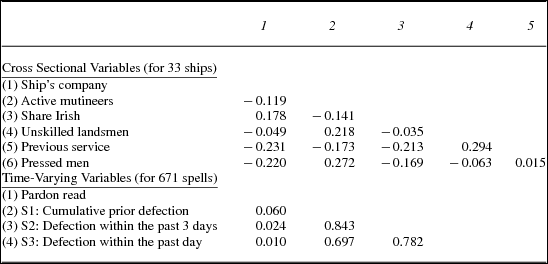
Table 2 provides descriptive statistics for these variables and their Pearson's correlation coefficients are reported in table 3.
Descriptive Statistics/Correlation Matrix for Variables

Correlation matrix for variables

Method
Duration is measured in days from when a ship entered the mutiny until its defection. The average duration is 22.33 days. There are 33 ships, all of which have mutiny entrance and defection dates. Thus, there is no left or right censoring. This results in a case-day file with a total of 671 observations. We model the rate of defection or the hazard rate as a function of a set of covariates. The hazard rate can be expressed as
 $$\begin{equation*}
h(t) = {\lim _{\Delta t \to 0}}\frac{{\Pr (t \le T\ \le t + \ \Delta t|T \ge t)}}{{\Delta t}}
\end{equation*}$$
and be interpreted as the rate of failure per time unit during the interval t and t + ∆t, conditional on a ship surviving at or beyond time t. We do not hypothesize time dependence (i.e., that the hazard rate varies across the duration of a ship's mutiny) and therefore we avoid specifying the baseline hazard rate by using the Cox semiparametric proportional hazards model (Cox Reference Cox1972).Footnote 19 This model can be expressed as
 $$\begin{equation*}
\log \left\{ {\frac{{h\left( t \right)}}{{{h_{0\ }}\left( t \right)}}} \right\} = B^\prime X,
\end{equation*}$$
where h(t) is the hazard rate, h 0(t) is the baseline hazard function, which is left unspecified, and B'X are the covariates and regression parameters.
Results
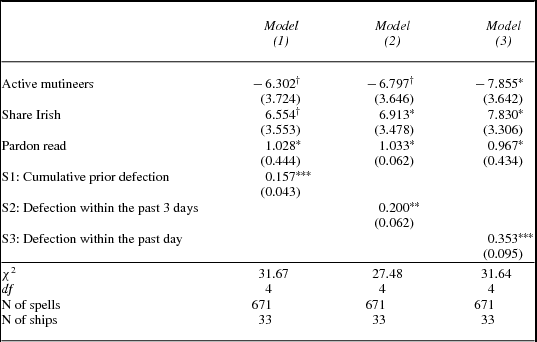
Table 4 presents the hazard models of the rate of defection from the mutiny with active mutineers, share Irish, pardon read, and the diffusion variables as the predictors. Alternative bivariate and multivariate hazard models were also estimated for size of the ship's company, share unskilled landsmen, share previous service, and share pressed men (results not shown). However, despite their potential theoretical importance, none of these variables is significantly correlated with the duration that a ship's company remained with the mutiny. Because of concerns about colinearity, because of a modest N of ships, and because the coefficients of these models never reached statistical significance, these variables were excluded from the final models presented here.
Hazard models of the rate of defecting the mutiny.

Note: Standard errors in parentheses.
Two-tailed significance tests: †p < .10; * p < .05; ** p < .01; *** p < .001.
In table 4 across all the models, the coefficient for the variable share Irish is positive and significant, indicating that the larger the proportion of Irish on a ship, the higher a ship's hazard rate of defection from the mutiny. The share of Irish seamen in a ship's company appears to have diminished solidarity, probably due to rising nationalist tensions and anti-Irish feelings among the English sailors. The strength of anti-Irish sentiment among Britons in the 1790s has been well documented (Colley Reference Colley2003: 8; Hechter Reference Hechter1998; Lavery Reference Lavery2010: 233–34). Certainly, the finding does not support the often-made claim that Irish militancy explains solidarity at the Nore. Although there was Irish nationalism among seamen in the 1790s and there were various Irish conspiracies detected in Royal Navy ships, particularly in the wake of the Irish Rebellion of 1798, it appears to have played no substantial role at the Nore.
The share of active mutineers on a ship has a significant and negative effect on the hazard rate in each model. As the proportion of active mutineers on a ship increases, the hazard of defecting decreases, which supports the qualitative evidence. The coefficient for pardon read is positive and significant in all three models. For example, in model 1 the risk of defecting is 2.8 times greater for ships in which the pardon was read compared to ships in which it was not read (e1.028 = 2.80).
All three diffusion variables have a positive and significant effect on the hazard rate. The hazard of defecting increases as the number of ships that defected increases, whether measured as all defections prior to time t (model 1), defections three days prior (model 2), or defections one day prior (model 3). The finding that prior defections increase the hazards of defection corresponds to the historical evidence. Defections were an obvious signal of the mutiny's diminishing chances of success that was out of leadership control and accessible to all seamen.
The fact that the pardon variable retains significance net of diffusion is powerful support for our argument. In ships in which information about the pardon was unavailable, seamen appear to have stuck with the leadership until the general capitulation partly because they believed that they might be severely punished—and perhaps hanged—even if they defected. On ships with large mutinous cadres, the threat of retaliation by one's own shipmates was highly credible and prevailing incentives deterred defection.
Conclusions and Implications
The problem of solidarity in insurgent collective action obtains not only in mobilizing members of aggrieved social categories but also in a group's capacity to compel them to follow through with their commitments, in spite of costs and uncertainties. Sometimes ideology or the bonds of community can attain the requisite compliance, but not at the Nore. In their struggle to cement an often shaky confederation of ships, mutiny leaders used information control, surveillance, and credible threats to compel seamen to stand by their cause. Emphasizing an “all or nothing” scenario, mutiny leaders sought to raise the probability that seamen who were party to the pact would hold fast. Our finding that monitoring and sanctioning helped determine steadfastness to the mutiny is in accord with research pointing to the pervasiveness of such mechanisms in conflicts occurring in a wide range of societies. Conflict groups with high levels of solidarity are socially organized in ways that enable them to monitor and sanction members so as to deter free-riding and defection (Guala Reference Guala2012; Mathew and Boyd Reference Mathew and Boyd2011).
Our analysis of the armed insurgency at the Nore also finds that solidarity across ships was most robust where leaders employed mechanisms—principally an illegal oath—that increased seamen's dependence on the mutiny as a collective endeavor. Where mutiny leaders were able to exploit informational asymmetries, they persuaded seamen to stand by the insurgency, even as its prospects for success faded. Specifically, we find that the longer the leadership was able to limit access to information concerning the Spithead amnesty, the longer the ship's commitment to the mutiny.
Illicit oaths like the one that seamen took at the Nore can have a fundamentally strategic character. Our analysis suggests why they may be effective in attaining solidarity. They are employed by insurgent leaders to increase the dependence of group members and thereby reduce their propensity to defect. This may be why oaths are signature features of insurgency across times and places. In Asia, for example, oaths “facilitated cooperation and organization on a remarkable scale” making it possible to launch major rebellions (Ownby and Heidhues Reference Ownby and Heidhues1993: 4). Oaths were a signature feature of Irish nationalist uprisings and in Kenya the Mau Mau employed oaths as means by which to divide the native population from the colonial authorities (Alam Reference Alam2007). While conventional accounts of the binding power of oaths stress tradition, supernaturalism, and rituals (Luongo Reference Luongo2011; MacKenzie Reference MacKenzie1967), such accounts do little to explain oaths’ variable success in binding members of insurgent groups to their cause. Many who take oaths later violate them in spite of the norms adhering to ideologies and communities. While our study provides evidence for dependence and control, more research in different times and places needs to be done on the mechanisms underlying the commitments expressed in oaths.
Future research should also explore the selective use of information in various manifestations of high-risk collective action. Our findings suggest that, particularly in instances in which groups have to engage in standoffs against their opponents, as in many large-scale strikes, rebellions, and civil conflicts, the control over information is vital to insurgent solidarity. For example, in strikes labor leaders often try to avert defection by withholding information about the employer's position and the terms being offered until a collective settlement has been reached (Martin Reference Martin1980). In many armed rebellions and civil conflicts, government propaganda is ubiquitous but “dissident entrepreneurs try to set up a ‘smoke screen’ for their rank-and-file followers” (Lichbach Reference Lichbach1998: 89–91) as well. More generally, the ability of leaders to exploit information asymmetries may be a key feature of social activism (Ahlquist and Levi Reference Ahlquist and Levi2013).
One of the implications of our study of the Nore is that poorly informed militants fearing reprisals may be the most committed to strikes, uprisings, and armed insurgencies. In such situations, authority's most effective counterinsurgency strategy may be to isolate the rebels while offering an amnesty that makes individual defection less costly. The more credible the amnesty, and the better the odds that defectors will be protected from retaliation, the more likely that it will erode solidarity by decreasing mean dependence on the rebellious group. If that is achieved, one of the conditions necessary for a cascade of defections will have been set in place. This dynamic may help explain the frequently observed paradox that large-scale, radical, and seemingly determined strikes and rebellions rapidly collapse in a reverse cascade of collective action.