Background
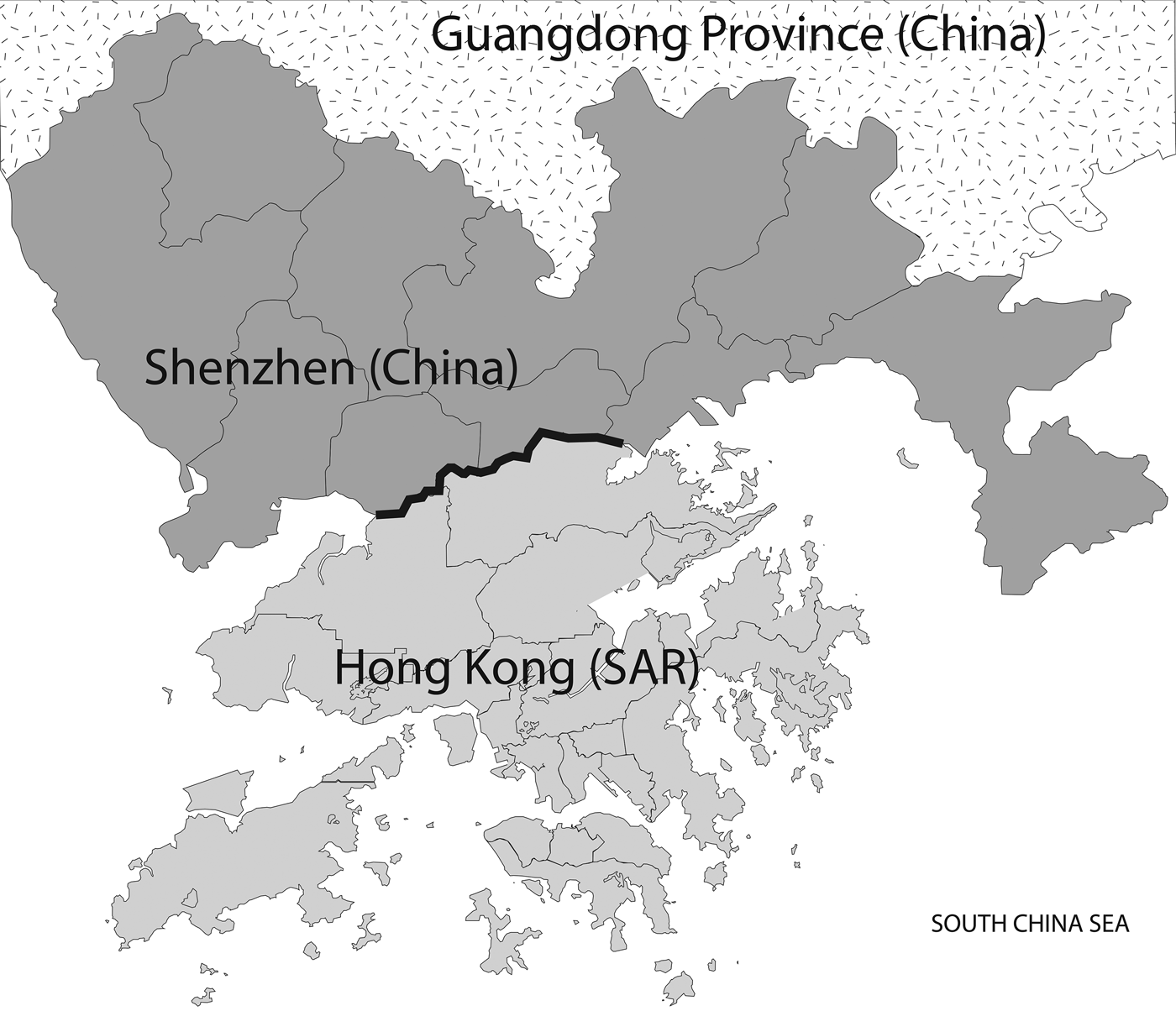
The border between mainland China and Hong Kong has become one of the world's most fascinating linguistic divides. On one side lies the mainland Chinese city of Shenzhen, stretching the entire length of the border – an extraordinary urban development which in many ways epitomises the recent urbanisation of modern China. On the other side lies the Special Administrative Region (SAR) of Hong Kong (see Figure 1). It is not possible to cross from Hong Kong to mainland China by land without passing through one of the Shenzhen checkpoints.
Location map of Shenzhen and Hong Kong

The population of Shenzhen (over ten million) outnumbers that of Hong Kong (just over seven million). The territory which Shenzhen now occupies formerly contained both Cantonese- and Hakka-speaking communities. However, most of the population of Shenzhen has migrated from other parts of China and speak other Chinese languages/dialects as their first language. For this reason, spoken Mandarin, known as Putonghua, has become the day-to-day lingua franca of most of Shenzhen's citizens. Although Putonghua has been promoted for many years by the Beijing government as the ‘national language’, and is the usual medium of education in mainland China, Cantonese is still widely used in Guangdong province, outside the new factory towns populated by migrant workers.
The influx of migrant workers, together with the use of Putonghua as the medium of instruction in mainland schools, has led to a rapid language shift in the former homeland of Cantonese in mainland China. Hong Kong, meanwhile, has emerged as the main cultural and political centre for the Cantonese language. Cantonese, along with English, is the main medium of education at all levels in Hong Kong; and is used in government and law.
These linguistic differences reflect the way the two territories have remained distinct in respect of culture, economy and language even after 1997, when Hong Kong ceased to be a British colony and reverted to Chinese sovereignty. The People's Republic of China (PRC) refers to this arrangement as ‘one country, two systems’. A part of the handover agreement was an undertaking by China to allow a different legal system (known as ‘Basic Law’) to operate in Hong Kong for at least 50 years after handover. However, only 15 years later, many Hong Kong citizens feel that they are now being absorbed into the PRC with increasing speed. Linguistic issues loom high in what is seen by many in Hong Kong as a struggle to maintain the city's cultural identity. Especially sensitive is the perception that Putonghua is playing an increasingly important role in Hong Kong and that the place of Cantonese is weakening.
In this complex and rapidly changing political, economic and linguistic context, English is acquiring new roles and meanings on both sides of the border. This article briefly summarises how some of these issues can be read in the language landscapes of the region.
English in Shenzhen
In Shenzhen, and other cities of Guangdong, such as Guangzhou, English is learnt and taught primarily as a foreign language, but its use in public spaces is becoming more prominent. This not only reflects the increasing number of international visitors and expatriate workers, but also the desire to project an identity as an ‘international city’. Learning English in Shenzhen, as elsewhere in China, is not only a necessity in order to pass high-stakes exams, such as the gaokao (university entrance exam), but offers a route to overseas study, or at least to better employment opportunities at home.
Shenzhen both cooperates with and competes with Hong Kong in economic activity. Since the use of English as an official language is one of Hong Kong's distinctive characteristics, it may be that the employment of English in Shenzhen indicates as much an orientation to ‘Hong Kong’ style as its aspiration to become a world city.
When Shenzhen hosted the Universiade games in 2011, the city introduced a ‘Shenzhen speaks English’ campaign, modelled on a similar campaign in Beijing ahead of the 2008 Olympics, in order to promote the learning and use of English by its citizens. According to the Shenzhen Standard, a local English-language newspaper:
a good English speaking environment can bring the city and its foreign guests closer by facilitating international communication. … Workers in public sectors such as restaurants, hotel, taxi and bus drivers will be receiving English language training, and more than 200 English speaking promotions have been in circulation since January. (Shenzhen Standard, 2010)
English in Hong Kong
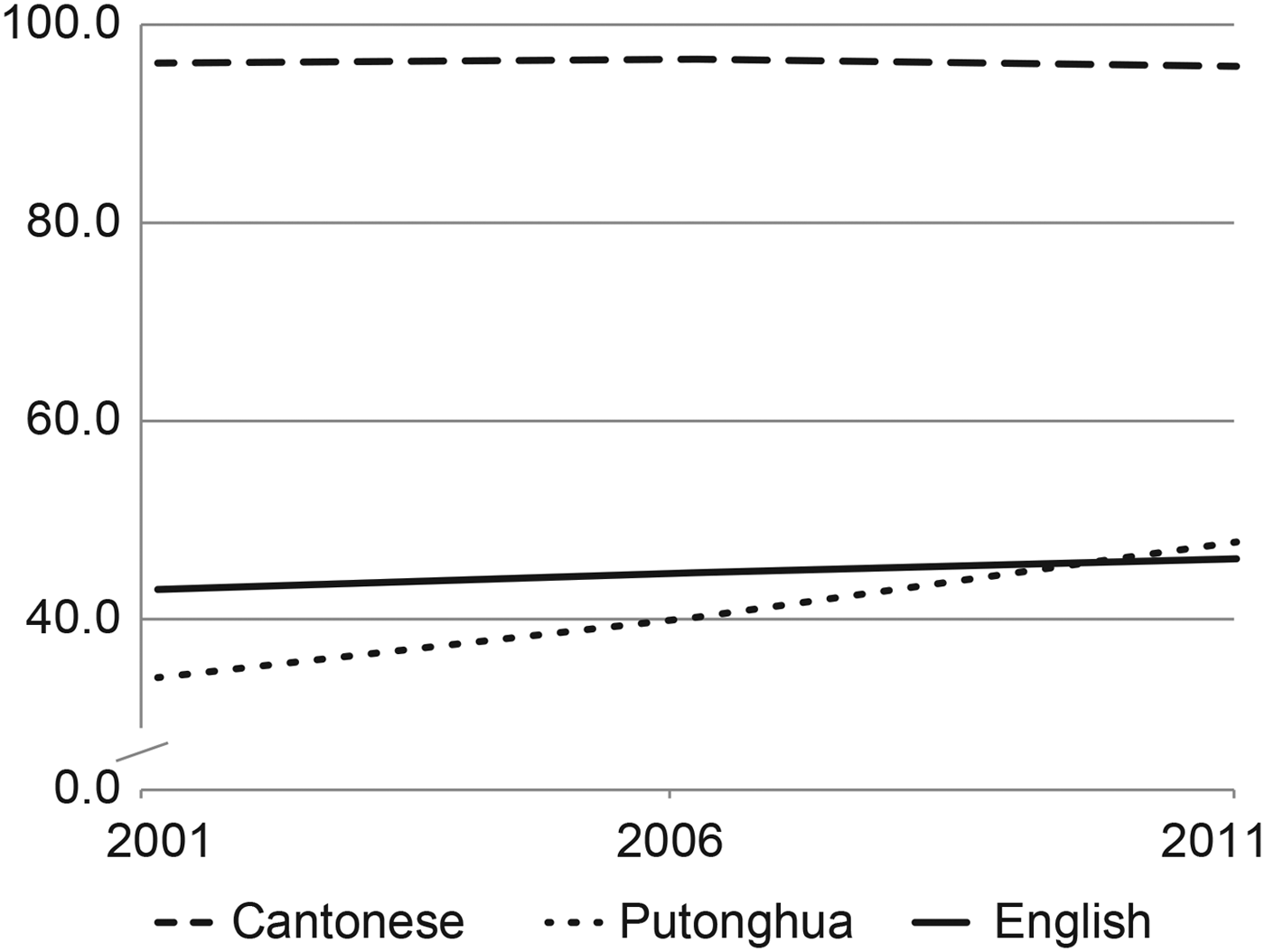
Hong Kong is officially ‘biliterate and trilingual’. The term ‘trilingual’ refers to the fact that although ‘Chinese’ (or rather a Hong Kong variety of Cantonese) and English have been co-official spoken languages in Hong Kong, Putonghua, the official spoken language of the mainland, has increasing currency in Hong Kong (see Figure 2). The term ‘biliterate’, in the context of Hong Kong, is, however, not easy to understand. Ostensibly it refers to English (and hence a roman writing system) on the one hand, and written Chinese (using ideograph-based characters), on the other. Yet, there are several differences between the written Chinese as used in mainland China and that in Hong Kong, the most prominent of which is use of ‘simplified characters’ in the former, in contrast to the ‘traditional characters’ used in the latter. These differences, which have become culturally very sensitive in present-day Hong Kong, appear to be elided in Hong Kong's policy statement, though the Hong Kong government itself provides three versions of its websites as ‘language’ options: English, ‘traditional’ and ‘simplified’ (see Figure 3).
The changing proportions of Hong Kong's adult population who can speak Cantonese, Putonghua and English
The Hong Kong government now provides its web pages in three ‘languages’: English, Traditional and Simplified Chinese
Schools in Hong Kong can choose between English and Chinese as the medium of instruction. Although the situation is complex and fluid, English remains the medium of greatest prestige and is used by most international schools in the SAR. English is also extensively used for teaching in the city's universities.
Language landscapes in Shenzhen and Hong Kong
The study of language landscapes (often abbreviated to LL) has become a popular research approach in recent years. English Today has published several articles on signs in various cities of the world (e.g. McArthur, Reference McArthur2000; MacGregor, Reference MacGregor2003; Schlick, Reference Schlick2003; Stewart & Fawcett, Reference Stewart and Fawcett2004; Ong et al., Reference Ong, Ghesquière and Serwe2013). Hong Kong has already proved to be a rich research site for LL, featuring in a number of edited collections and books (e.g. Shohamy & Gorter, Reference Shohamy and Gorter2008; Jaworski & Thurlow, Reference Jaworski and Thurlow2010; Shohamy et al., Reference Shohamy, Ben Rafael and Barni2010; Graddol, Reference Graddol2013). Our own interest is in what an LL approach can contribute to our understanding of the rapid social and economic change currently taking place in the border zone and how it is creating a new social geography in the Shenzhen and Hong Kong region.
In Hong Kong all official signs are bilingual. Street signs show the English name first, with Chinese, in traditional characters, below the English version (see Figure 4). In other places, such as the MTR, official signs usually show Chinese first, with English underneath (as in Figure 5). This difference reflects an ongoing shift in the priority of English in the Hong Kong landscape.
A typical street sign in Hong Kong
A station sign on the Hong Kong MTR
By contrast, until a few years ago, there was little English to be found in the landscape of Shenzhen (see Figure 6). Shenzhen, however, like other major cities in China, has recently adopted a policy of including English on signs in public places (below the simplified Chinese text), partly to help visitors and partly to enhance the municipality's claim to be an international city (see Figure 7). In 2013, the city released regulations regarding the use of English on signs. Recently, the municipal authorities in Shenzhen have become concerned about the lack of standardisation in public signs and the high number of English errors.
Bilingual public signs now must be made available in locations including parks, public squares, cultural and sports facilities, and resorts. The city's main roads, train stations, airport and Metro stations also have to provide bilingual public signs, according to the regulations. ‘In order to eliminate incorrect English signs at the source, we will examine all new bilingual signs before they appear in public’, said Tang Lixia, head of the foreign affairs office (Shenzhen Daily, 2013).
Chinese-only signs are still easily found in Shenzhen
A bilingual street sign in Shenzhen
The increased use of English in public spaces in Shenzhen makes it possible to compare its English landscapes with those of Hong Kong, and to explore ways in which the identities of the two cities are changing or merging with respect to English usage. One approach, which we employ here, is to explore the different varieties of English found on signs in the region.
Exonormative varieties
Broadly, English spelling and usage in mainland China tends to be American-based, whereas in Hong Kong, a former British colony, it is British(see Figures 8 and 9). This distinction is seen most clearly in institutional usage. For example, mainland English-language newspapers such as the China Daily conform to an American copy-editing style, whereas the main English language newspaper in Hong Kong – the South China Morning Post – uses a British style. This difference extends to government publications and to many official signs and notices in the two territories.
In extended texts, differences between American and British styles are apparent in three main areas: spelling, vocabulary and grammar. On signs, which typically use short, abbreviated texts, differences in grammar are less apparent. Both spelling and vocabulary differences, however, are easily found. Furthermore, there are a few words, such as ‘center’ as opposed to ‘centre’, or ‘elevator’ rather than ‘lift’, which appear on notices with high frequency and which help give Shenzhen a more ‘American’ look than Hong Kong.
A sign in a Shenzhen Metro station
A similar sign in the MTR station on the Hong Kong side of the border
Occasional examples of what appear to be hypercorrections towards a British norm can be found in Hong Kong (see Figure 10).
An example of hypercorrection of British ‘meter’ to ‘metre’ in Hong Kong
Local varieties of English
In Shenzhen, there is no recognised local variety of English, though it is common to see English notices which reflect features of the Chinese language. The situation in Hong Kong, as a former British colony, is different. Linguists have argued over whether there exists a fully institutionalised ‘Hong Kong’ English, in the way that Indian English or Singapore English is recognised. Our view, like that of Finzel (Reference Finzel2012), is that Hong Kong English ‘holds an intermediate position between a norm-developing and a norm-dependent variety’. However, as we have seen, official signs attempt to follow an external norm. Local features are more likely to be found in informal and ephemeral notices.
An exception to this general rule is provided by a small number of words that appear on formal signs in Hong Kong and which have their origins in eighteenth century Indian English. These words are still to be found in other former British colonies, such as India and Singapore, and so are not limited to Hong Kong. One such word is ‘shroff’, meaning, in Hong Kong, a car park cashier. Another is ‘nullah’, referring to a channelled stream. A third is the word ‘chop’ denoting a Chinese seal or stamp. All three words are also used in spoken English in Hong Kong. Figures 11–13 give examples of those words that appear on public signs.
‘Shroff’ is an old Anglo-Indian word
‘Nullah’ is an old Anglo-Indian word
‘Chop’ is an old Anglo-Indian word
The impact of Chinese on the English of signs
The increasing use of English signage extends beyond the confines of organisations that might be expected to have both a language policy and the means to enforce it. Indeed, many informal signs can be found which might be said to contain ‘Chinese English’. Leaving aside, for the moment, the controversial issue of whether such signs represent ‘errors’ or some emergent new English variety, we can note characteristics of the English even on formal signs which reflect Chinese linguistic features in both Shenzhen and Hong Kong.
Number
Chinese does not make a distinction between singular and plural noun forms. Where necessary, a qualifier such as a number is used to disambiguate. This probably explains why problems with number are commonly found in Chinese English. There exists variation in singular and plural on identical or contextually similar signs (see Figures 14–17).
An incorrect plural on a business sign in Hong Kong
Incorrect singular and plural, accompanied by a prepositional problem (on a Hong Kong ferry)
‘Please mind your steps’ is frequently found on signs both in Hong Kong and Shenzhen (this one is from the ifc mall, Hong Kong)
‘Offender will be prosecuted’
Use of prepositions
English phrasal verbs are known to be a challenge for English learners and the use of prepositions seems especially problematic for Chinese speakers since the meanings of Chinese prepositions do not simply map on to English ones. The character在 (zài) for example, can mean ‘in’, but also ‘at’, or ‘outside of’, depending on the context. This may explain the over-use of prepositions, e.g. on MTR signs in Hong Kong (Figures 18–19).
‘Exit from’ – an unnecessary preposition (in an MTR station in Hong Kong)
‘Touching to’: an unnecessary preposition (in an MTR station in Hong Kong)
Use of articles
Since there are no articles in Chinese, it is not surprising that some signs use articles in non-native ways even in Hong Kong (Figure 20).
The definite article is sometimes overused
Past participles and past tense
Chinese does not mark tense in the way English does. This probably explains the variety of past participle forms (e.g. allowed, as in Figure 21).
The struggle with past participles
Use of conjunctions
On the prohibition signs, which are so common in both mainland China and Hong Kong, the conjunction ‘and’ is often used where ‘or’ is logically expected (e.g. ‘no puking and urinating’). Figure 22 illustrates both this and the lack of the preposition ‘down’ to complete the phrasal verb.
The conjunction issue on prohibition signs
English and romanised Chinese
In Hong Kong, many generic place name elements such as ‘road’ or ‘lane’ are given in English. However, less generic parts of place names – the proper name elements – are often rendered as romanised Chinese. Hence the ‘English’ part of bilingual place name signs is often a mix of English and romanised Chinese.
In Shenzhen, the practice regarding generic place name elements is mixed. Sometimes, such elements as Lu (road) or Bei/Nan (north/south) may be given in pinyin; sometimes they are translated into English (see Figures 23–24). The policy intention is to standardise on fully translated English on signs (as in Figure 25), but this will take time to be realised, partly because of the number of different government departments responsible for street signs, and partly because most departments lack procedures which ensure proper proof-checking by a proficient English speaker. In the meantime, place name elements such as ‘Lu’ can probably be regarded as loanwords in an emergent local variety of English.
The street is referred to here as ‘Ren Min Nan Lu’
Lower on the same sign, it is referred to as ‘Renmin Nan Road’
Here, the street is referred to as Renmin S Rd
In Hong Kong, pinyin is rarely used for romanisation. Instead, a variety of older forms of romanisation are employed. Although there is an official romanisation standard used by the Hong Kong government – known as Cantonese pinyin – which students are required to use in school exams, it is rarely found on signs.
For example, Figure 4 showed a Hong Kong street name as ‘Peking Road’, whereas the pinyin rendering of China's capital city is ‘Beijing’ (the first element ‘bei’ meaning ‘north’). Of course, an interesting feature of romanisation is that, unlike most Chinese characters, it reflects pronunciation. Hence romanised place names in Hong Kong reflect the local spoken language – Cantonese – rather than Putonghua. So Chinese romanisation in Hong Kong differs from that used in Shenzhen in two ways: the correspondence rules which relate sound to spelling are different, as are the pronunciations represented.
These two factors imply that there are differences in the way roman forms and Chinese characters relate to each other on signs in Hong Kong and Shenzhen. For example, in Hong Kong a frequent place name element is ‘Tai’ which represents the Chinese character for ‘big’ (大), as depicted in Figure 26. We can see in Figure 7, however, that the character associated with ‘Tai’ in the Shenzhen street name ‘Taizi Road’ is a different character (太, meaning ‘prince’).
‘Tai’ is a frequent place name element in Hong Kong but means something different from ‘Tai’ in Shenzhen place names
Since English is almost always accompanied by Chinese on signs in both territories, differences in co-occurrence of this kind may play a role in defining a different ‘look’ and meaning of English in each landscape.
Emergent varieties
The merger of American and British varieties
In both Shenzhen and Hong Kong, many examples of mixing American and British English (AmE and BrE, respectively) features in single notices or recorded announcements can be found. Station signs might refer interchangeably to a ‘return ticket’ and a ‘round trip ticket’, for instance. The phrase ‘bulky luggage’ and the word ‘elevator’ might appear together on the same notice. The terms ‘rubbish bin’ and ‘garbage can’ might be heard in announcements on a single ferry trip.
What can be observed on signs (and also in announcements and audio messages, e.g. on the underground trains, ferries, escalators) is a blurring of distinction between these two native varieties of English. Perhaps this signals that both Hong Kong and Shenzhen have joined other global cities in which some form of lingua franca English can be observed emerging in the landscape, one that blends elements of AmE and BrE. For example, in the lobby of a hotel in Shenzhen there is a room designated as ‘Business Center’ and ‘Business Centre’ in adjacent notices. A notice on the campus of Hong Kong University of Science and Technology mixes AmE spellings (such as ‘Center’) alongside BrE vocabulary, such as ‘Car park’ or ‘Lift’ (see Figure 27).
The Hong Kong University of Science and Technology uses AmE spellings such as ‘Center’ alongside BrE vocabulary such as ‘Car park’ and ‘Lift’
Development of local varieties
In Shenzhen Metro station, a notice on the platform doors asks passengers to ‘Mind the gaps’ (see Figure 28). Is this an example of the number problem mentioned earlier? Nothing is actually wrong with such a sign, but the well-known equivalent on the London Underground ‘Mind the gap’ (used also on the MTR in Hong Kong) makes it seem unidiomatic in this context. However, similar ‘Mind the gaps’ signs are to be found elsewhere in China, including the Beijing subway. When such signs appear consistently, they must eventually be regarded as new local forms. In fact, language landscapes may be an important means whereby features of a local English variety become institutionalised.
In Shenzhen Metro station, passengers are asked to ‘Mind the gaps’
A more difficult case is presented by the earlier examples of English which appear to be influenced by the grammar of Chinese. Should these be regarded as indicative of an emergent local variety, or as errors?
Changing features on signs
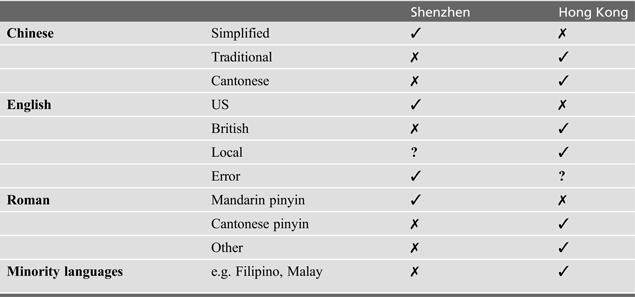
The matrix depicted in Table 1 indicates the main linguistic resources which we have described as being available in the Shenzhen–Hong Kong region for the construction of signs and notices. The selections noted for each side of the border are indicative of the traditional unmarked choices in each area. Deviations from this are likely to be either an indication of on-going change or regarded as marked usages. For example, notices do sometimes appear in Hong Kong in simplified Chinese, but they can generate hostility from local residents and be seen as directed to mainland visitors. On the other hand, Hong Kongers appear less sensitive to an increasing use of American spelling and vocabulary in English, which seems not to be regarded as a sign of ‘mainlandisation’.
A matrix of the linguistic features appearing on signs in Shenzhen and Hong Kong
What such a matrix does not adequately capture is the typical combination of elements found on bilingual, or multilingual signage. These combinations also change over time and contribute to a changing identity of the language landscape.
Conclusion
It is clear that the English in the language landscapes of both Shenzhen and Hong Kong is diverse and undergoing change. We have distinguished between external norms, local norms, potentially emergent norms reflecting Chinese linguistic features, and errors. None of these are clearly defined categories, but there appear to be on-going shifts, especially in Hong Kong, from BrE to AmE, and from AmE to local norms.
As might be expected in a major Asian city, many languages besides English and Chinese can be found in the landscape of Hong Kong. This paper has focused only on English and its relationship with Chinese.
The study of language landscapes offers an opportunity to monitor sociolinguistic change in English, especially that occurring in border regions undergoing political, economic and other transformations. From this perspective, language landscapes serve as an indicator of change, not only in linguistic terms. Some signage (e.g. advertising, announcements on public transport) can change fast; others retain a memory of former times (e.g. older forms of romanisation, right-to-left writing).
Generally speaking, there appears to be a slowly decreasing use of English in public life in Hong Kong, whilst it is increasing on the mainland. The priority of English in Hong Kong (such as placing English first on signs) is more and more looking like a colonial legacy: Chinese seems to have become the first, or more prominent language on bilingual signs and notices, as well as in spoken announcements.
At the same time, the regular use of English in public signage in Hong Kong, together with traditional written Chinese characters and spoken Cantonese in public announcements, serve an important role in demarcating Hong Kongers' identity from that of mainlanders.
ANNA DANIELEWICZ-BETZ is an Associate Professor in the Centre for Language Research, University of Aizu, Japan. Her research interests include Pragmatics, Critical Discourse Analysis and Interdisciplinary Studies (e.g. Geosemiotics, Forensic Linguistics, Corporate Discourse). She is also an experienced business consultant and trainer offering customised in-house business English courses and coaching services for multinational companies. Email: anna.danielewicz.betz@gmail.com
DAVID GRADDOL is Director of the English Company (UK) Ltd and its partner in Hong Kong, The English Company (Hong Kong) Ltd. He is a former Co-Editor of English Today and the author of several books which document the rise of global English, including The Future of English? (1997) and English Next (2006). His recent book for Cambridge English (Profiling English: The Pearl River Delta, 2013) combines his interest in Language Landscapes and in the role of English in economic development. Email: david@english.co.uk