I. INTRODUCTION
Standing the first on the list of light structure metallic materials, magnesium (Mg) alloys have attracted great attention and used widely in the field of 3C products, automobile, aerospace applications, and military products where weight reduction is of importance. Reference Chen, Lin, Zeng and Chen1–Reference Luo, Zhang, Tang and Zhao4 While most Mg parts are die-casted and only can be used in nonload bearing areas where high mechanical properties are not that necessary, thus the application of Mg alloys is limited greatly. Nowadays, wrought Mg alloys that exhibit excellent comprehensive mechanical properties are drawn much more attention. Reference Xu, Han, Liu and Xu5,Reference Bae, Lee, Kim, Kim and Kim6
Mg–Zn wrought alloys can be strengthened by adding rare earth elements, and among them Y is mostly used because of the largest solid solubility in Mg matrix (12.5% in wt% at most). Reference Su, Li, An and Lu7–Reference Farzadfar, Sanjari, Jung, Essadiqi and Yue9 Three kinds of ternary phases can be formed in Mg–Zn–Y alloys: I-phase (Mg3Zn6Y), W-phase (Mg3Zn3Y2), and X-phase (Mg12ZnY). Reference Hono, Mendis, Sasaki and Oh-ishi10–Reference Geng, Teng, Zhou, Zhao and Leng13 The I-phase is icosahedral quasicrystal structure which is symmetrical through 2, 3, 5 times rotation. Mg–Zn–Y alloys can be strengthened by I-phase with spheroidized structure caused by hot-extrusion because of the high hardness, high strength, and low surface energy; W-phase is cubic structure whose a = 0.683 nm; X-phase is long-period stacking ordered (LPSO) structure, so X-phase is also called LPSO phase. Reference Wan, Yang, Zhu, Xu and Zhuo11–Reference Chen, Lin, Shu, Hu, Zhao, Kang, Huang and Yuan15 All the three ternary phases can be formed through ordinary solidification but whether it can be formed all depends on the ratio of Zn/Y (wt%). According to the research studies, Reference Itoi, Inazawa, Yamasaki, Kawamura and Hirohashi16–Reference Lee, Kim, Lim and Kim18 only W-phase is formed when the ratio is smaller than 2; both I-phase and W-phase are formed if the ratio is between 2 and 5; I-phase is formed only if the ratio is 5–7. While only when the ratio is smaller than 1 LPSO phase can be formed.
The structure of Mg is hexagonal close-packed (HCP) and there exist three dislocation slip systems and two twinborn systems, thus it is more difficult for Mg alloys to be plastically deformed than Al alloys which is face-centered cubic structure. Reference Wang, Liu, Dong and Yang19,Reference Yan, Dong, Ma, Chen, Zhang and Ling20 So plastic deformation is more effective to increase the mechanical properties of Mg alloys.
Among the methods of deformation, hot-extrusion is used most widely. The coarse dendrite crystals can be broken, foundry defects can be eliminated, and dynamic recrystallization can be promoted, then the alloys are strengthened by grain-refining caused by crystals smashed and dynamic recrystallization, defects elimination, and work hardening. Reference Ma, Dong, Yan, Chen, Li, Zhang, Ling and Fan21–Reference Yan, Chen and Han23 The measures of extrusion consist of single pass extrusion, multi-pass extrusion, equal channel angular pressing (ECAP), and reciprocating extrusion and so on and the common of the research studies is that the extrusion ratio is relatively small which are normally between 5 and 25. Reference Yamasaki, Hashimoto, Hagihara and Kamamura17,Reference Singh, Nakamura, Watanabe, Kato and Tsai24 In this article, the alloys are extruded through the method of single pass with larger extrusion ratio on the foundation of adjusting the content of Y.
II. EXPERIMENT PROCEDURE
Mg–4Zn–xY alloys used in this experiment were smelted by ourselves and pure Mg [ω(Mg) = 99.9%], pure Zn [ω(Zn) = 99.9%], and Mg–Y master alloy [ω(Y) = 25%] were used. The melt was protected by continuous mixed gas including SF6 and N2. The cast ingot which was Φ130 mm × 100 mm was homogenized under the condition of 400 °C × 10 h to make constituent better distributed and avoid composition segregation, so that supersaturated solid solution was prepared to make plastic deformation easier.
The extrusion ratio (ratio of cross-sectional areas of casted and extruded samples) was 42.25, extrusion temperature was 450 °C, extrusion velocity was 1.5 mm/s and then extrusion bar which was Φ20 mm was prepared.
The specimens were sanded, polished, and corroded by picric acid. The microstructure was observed by Hitachi S-3400N scanning electron microscopy (Tokyo, Japan) and JEM-2100 transmission electron microscopy (TEM; Tokyo, Japan). The phases were analyzed by x-ray diffraction (XRD) and energy dispersive spectrum (EDS). The mechanical properties were tested by WDW-100 electronic universal testing machine (Jinan, China).
III. EXPERIMENT RESULTS AND ANALYSIS
A. The effect of hot-extrusion on the microstructure
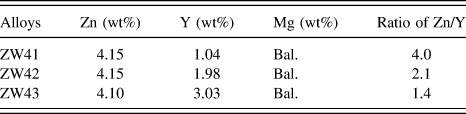
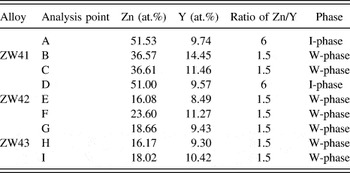
According to the ratio of Zn/Y (wt%) for forming I-phase and W-phase, Mg–4Zn–1Y (wt%) alloy is designed and the other two alloys are designed on the basis of decreasing the ratio of Zn/Y which are 4, 2, and 1.3, respectively, which are written as ZW41, ZW42, and ZW43 for short. The chemical compositions of the prepared samples of Mg–4Zn–xY alloys are shown in Table I.
Chemical compositions of the prepared samples of Mg–4Zn–xY alloys.

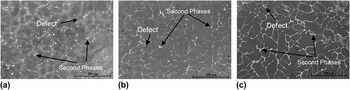
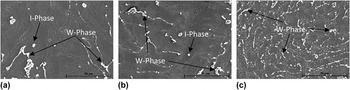
The microstructures of the as-cast alloys are shown in Fig. 1. The grain boundaries are more obvious and microstructures are more refined as the ratio of Zn/Y is decreased as the crystallization is changed from planar growth to cystiform-dendritic growth caused by the increase of constitutional supercooling degree through Y segregating on the solid liquid interface. There are some foundry defects which are distributed at random in the microstructures. There are a lot of second phases which are spheroidal, short rod-like, strip, and net structure in the matrix and along the grain boundaries in ZW41 alloy [Fig. 1(a)]. The amount of spheroidal phases is decreased but the number of net structure phases is increased in ZW42 alloy [Fig. 1(b)]. As the ratio of Zn/Y is decreased, there exist only net structure second phases in ZW43 alloy [Fig. 1(c)].
Microstructures of the as-cast Mg–4Zn–xY alloys: (a) ZW41, (b) ZW42, (c) ZW43.

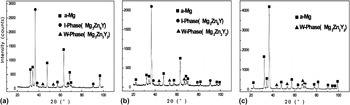
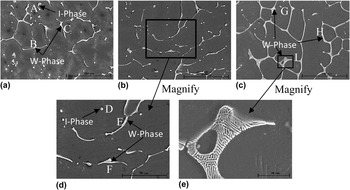
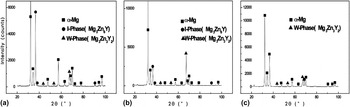
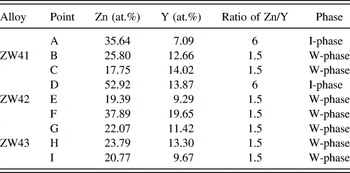
The results of XRD analysis are shown in Fig. 2. It indicates that they are composed of α-Mg, I-phase, and W-phase when the ratios of Zn to Y are 4 and 2. While when the ratio is decreased to 1.3, I-phase is vanished. The content of one phase is proportional to the diffracted intensity. Reference Singh, Somekawa and Mukai25 It can be semiquantitatively estimated that although ZW41 and ZW42 are both composed of I-phase and W-phase, the amount of I-phase in ZW42 is decreased obviously even though the content of Y is increased. As the ratio of Zn/Y is decreased, the amount of W-phase (Mg3Zn3Y2) is increased which is needed four times Y atoms as much as I-phase (Mg3Zn6Y) and it causes the decrease in the amount of I-phase in ZW42 alloy. While when the ratio is decreased to 1.3, only W-phase is formed. Therefore, the amount of I-phase is decreased until vanished, while the amount of W-phase is increased as the ratio is decreased. The results of EDS analysis are shown in Fig. 3 and Table II. The composition of the points and areas can be analyzed through the comprehensive analysis of XRD and EDS. The spherical phases are I-phase and the banding structure and contiguous net structure phases are W-phases which are much larger in volume than that of I-phases. W-phases which are typical herringbone structure are shown in Figs. 3(d) and 3(e).
Results of XRD analysis of the as-cast alloys: (a) ZW41, (b) ZW42, (c) ZW43.

Results of EDS analysis of the as-cast alloys: (a) ZW41; (b, d) ZW42; (c, e) ZW43.

Results of EDS analysis of the as-cast alloys.

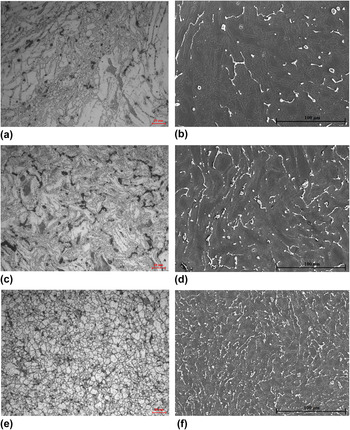
The microstructures of cross section (CS) of extruded alloys are shown in Fig. 4. All the microstructures are refined greatly and obviously through extrusion. The extruded ZW41 and ZW42 alloys are made of nondynamic recrystallization crystals which are bulky deformed and dynamic recrystallization crystals whose average sizes are 4–5 and 2–3 μm, respectively. The original coarse dendrite crystals are almost disappeared. The crystals are warped, transformed, and entangled because of the large plastic deformation [Figs. 4(a) and 4(c)]. While the extent of dynamic recrystallization of ZW42 is larger than that of ZW41 through horizontal comparison of microstructures. The grain size is smaller and the number of nondynamic recrystallization crystals is much less than that of ZW41. As to ZW43 alloy which is totally different from ZW41 and ZW42, the coarse dendrite crystals are changed into isometric crystals which are much more uniform through total dynamic recrystallization, even though the average grain size is 8–10 μm which is a little larger than that of ZW41 and ZW42 alloys. There are a lot of second phases which are spherical, short rod-like, and strip structure distributed in the microstructures. The second phases are warped, transformed, and even smashed along the direction which is perpendicular to the extruding direction under the action of extrusion forces. The phases are then redistributed under the action of stress more dispersively in the matrix of α-Mg. Compared with the microstructures, the number of second phases is increased as the ratio of Zn/Y is decreased [Figs. 4(b), 4(d), and 4(f)].
Microstructures of CS of the extruded alloys: (a, b) ZW41; (c, d) ZW42; (e, f) ZW43.

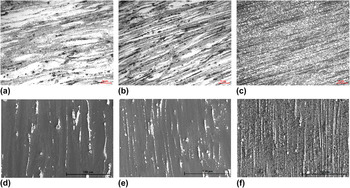
The microstructures of vertical section (VS) of extruded alloys are shown in Fig. 5. There are a lot of shear strips which are parallel to each other along the extruding direction, and the nondynamic recrystallization crystals which are surrounded by a large number of tiny and compact crystals and elongated under the action of stress. Thus, dynamic recrystallization occurred during extrusion, and the paralleled streamlines are a kind of representation of deformed microstructures which are in the dynamic recrystallization structures that is consistent to the research studies. Reference Yang and Guo26,Reference Wang, Song, Gao, Wei and Pan27 At the same time, the second phases are redistributed along the extruding direction under the action of stress.
Microstructures of VS of the extruded alloys: (a, d) ZW41; (b, e) ZW42; (c, f) ZW43.

First, there are only three slip systems in Mg alloy because of the HCP structure. The dislocation density which is necessary for dynamic recrystallization is much faster to be reached as it is much easier to be piled up for dislocations. Reference Singh, Watanabe, Kato and Tsai28 Second, it is hard to slip or climb for dislocations because the extended dislocations are hard to be bundled caused by the low stacking fault energy. Thus, the speed of dynamic recovery is decelerated which contributes to the dynamic recrystallization. Third, the diffusion of grain boundaries is fast and the dislocation energy that is stored in subgrain boundaries is absorbed. Combined with the high temperature of extrusion, intense dynamic recrystallization occurred. According to Zheng et al., Reference Zheng, Qiao, Xu and Gan29 a lot of crystal nuclei are produced through dynamic recrystallization and microstructure is refined greatly in the form of increasing the number of nucleation cores. Therefore, they are the stress of extrusion which broke the coarse dendrite crystals and dynamic recrystallization that refine the microstructures of the three alloys.
The analysis results of XRD of extruded alloys are shown in Fig. 6. The results indicate that the kinds of phases are not changed by extrusion but the morphology, distribution, and amount changed. The intensity shows that the amounts of second phases are all increased, while the extent of increase of I-phase is relatively smaller than that of W-phase in ZW42 alloy. Since all the ingots are homogenized before extrusion under the condition of 400 °C × 10 h, and the supersaturated solid solutions are obtained and the obstruction of second phases on the slip of dislocations is decreased. Thus, the increase in the amount of second phases is caused by dynamic precipitation during the cooling process of extrusion.
Results of XRD analysis of the extruded alloys: (a) ZW41, (b) ZW42, (c) ZW43.

The results of EDS are shown in Fig. 7 and Table III. The composition of the analysis points are shown through combining the results of XRD and EDS. The W-phases which are strip and net structure are deformed, warped, and smashed, while I-phases are spheroidized. There are two parts in the process of the formation of I-phase. Initially, the core which is pentagonal dodecahedron structure is formed in the melt, and then it grows along the preferred orientation of the directions of fivefold symmetry on the basis of the core. Finally, the I-phase which is icosahedral quasicrystal is formed. Reference Luo, Tang, Pan, Song and Wang30 There exists separation action between icosahedral structure and the matrix and it is decreased greatly through spheroidization of I-phase. Thus, the alloy can be strengthened effectively by I-phase.
Results of EDS analysis of the extruded alloys: (a) ZW41, (b) ZW42, (c) ZW43.

The results of EDS analysis of extruded alloys.

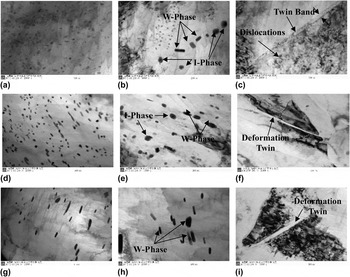
The TEM micrographs of extruded alloys are shown in Fig. 8. The amount of second phases is increased greatly. On one hand, the second phases of the as-cast alloy are broken; on the other hand, a lot of second phases are dynamically precipitated during the cooling process of extrusion after being homogenization treated. The typical two second phases: I-phase and W-phase in ZW41 alloy are shown in Fig. 8(b). The polygonal and spherical phases are I-phases whose average size is 80–90 nm according to the pentagonal dodecahedron structure of I-phase. Reference Zhang, Zeng, Liu, Lu, Zhou, Li and Zhu31 The short-rod-like phases are W-phases. There is also twin band whose width is 100–120 nm [Fig. 8(c)]. The alloy is greatly strengthened by the dramatic dislocations entanglement and the obstruction of slip of dislocations and grain boundary caused by twin band and second phases.
TEM micrographs of the extruded alloys: (a, b, c) ZW41; (d, e, f) ZW42; (g, h, i) ZW43.

The ability of plastic deformation of Mg alloy is much poor than that of Al alloy because of the only three slip systems decided by HCP structure. Two slip systems are activated at room temperature: main slip system {0001}
 $\left\langle {110} \right\rangle$
which is also called basal plane slip system and the second slip system {100}
 $\left\langle {110} \right\rangle$
which is also called cylinder slip system. While only at elevated temperature, the third slip system {101}
 $\left\langle {110} \right\rangle$
which is also called conical surface slip system can be activated. Besides twinning is one of the deformation mechanisms which occurs on the occasions that orientation factor is really tiny or the deformation cannot be achieved only by basal plane slip.
Reference Yoshimoto, Yamasaki and Kawamura32
When compressive stress is applied on Mg alloy, the slip plane tends to be parallel to the direction of stress, then the slip is stopped. While the twinning occurred because of the continuous stress, and the orientation is changed in twin crystals which is not parallel to the stress direction and the slip is reactivated until the end of deformation.
Reference Yamasaki, Hashimoto, Hagihara and Kamamura17
The extrusion ratio is 42.25 which is much larger than that of other research studies.
Reference Wang, Song, Gao, Wei and Pan27,Reference Zhang, Zeng, Liu, Lu, Zhou, Li and Zhu31
Twin crystals are helpful to achieve the deformation and to increase the plasticity. Apart from those, the slip of dislocations is hindered by twin band which can further increase the mechanical properties [Fig. 8(c)].
The TEM micrographs of the extruded ZW42 and ZW43 alloys are shown in Figs. 8(d)–8(i). Compared with ZW41 alloy, the number of spherical I-phase is decreased while the number of W-phase is increased in ZW42 alloy and there exists only W-phase in ZW43 alloy [Figs. 8(d), 8(e), 8(g), and 8(h)]. There are also deformation twins in ZW42 and ZW43 alloys which are through the crystals that is different from ZW41 alloy [Figs. 8(f) and 8(i)]. Apart from the obstruction of twins, the crystals are divided into more parts by deformation twins which is equal to refining. Therefore, the mechanical properties are increased greatly.
The mechanical properties of the alloys are shown in Table IV. The tensile strength values of the as-cast alloys are ∼125.2, ∼133.6, and ∼140.3 MPa, respectively and those of the extruded alloys are ∼254.9, ∼254.8, and ∼255.6 MPa, respectively. The elongations are ∼8.2, ∼8.9, and ∼12.3% for the as-cast alloys and ∼17.9, ∼21.0, and ∼24.8% for the extruded alloys.
Mechanical properties of the as-cast and extruded alloys (YS, MPa; UTS, MPa; EL, %; X Δ = X extruded − X as-cast, X is the value of mechanical properties).

The yield strength is closely associated with the microstructure. According to the formula of Hall–Petch: σy = σi + kd−1/2, the more refined microstructure is the higher the yield strength is. Reference Mima and Tanaka33 The microstructure is refined obviously through the coarse dendrite crystals being broken and dynamic recrystallization caused by extrusion. Meanwhile, the microstructure is much denser and the casting defects are decreased or eliminated. Besides, W-phases are deformed and warped and I-phases are spheroidized. The second phases are distributed more dispersively. The effect of the second phases on hindering the slip of dislocations is more obvious. Thus, the mechanical properties are increased to a large extent through extrusion combined with the three factors.
IV. CONCLUSIONS
-
(1) Microstructures are refined obviously through both breaking the sparse dendrite crystals caused by extrusion and dynamic recrystallization occurred during extrusion and equiaxed crystals are formed in ZW43 alloy. There are obvious shear strips which are parallel to each other along the extrusion direction in the VS. Twin band is formed to achieve the deformation and hinder the slip of dislocations to improve the tensile strength, in addition, the deformation twin band has an effect of crystal-refining.
-
(2) The phase composition of the three alloys are not changed before and after extrusion. But the composition is changed by the increase of Y content from α-Mg + I-phase + W-phase (ZW41 and ZW42) to α-Mg + W-phase (ZW43). Many second phases are dynamically precipitated and W-phase is transformed, warped, and broken, while I-phase is spheroidized through extrusion and distribution of the second phases is more dispersive.
-
(3) The tensile properties in strength and elongations are all improved greatly compared with the as-cast alloys but there is barely any change among the extruded alloys. Therefore, work hardening plays the greatest role in strengthening the alloys.
ACKNOWLEDGMENT
Thanks for Liaoning Province Science and Technology Plan (No. 2013201018) for funding supporting the research.