Human attachment is conceptualized as a robust survival mechanism that maintains proximity between a vulnerable infant and protective caregiver, and ensures the development of critical regulatory capacities required for learning and independent social functioning (Bowlby Reference Bowlby1969/1982). For some infants, however, adverse caregiving environments disrupt or fail to support the development of relational mechanisms (Cicchetti, Reference Cicchetti, Cicchetti and Cohen2006; Cicchetti & Carlson, Reference Cicchetti and Carlson1989; De Bellis, Reference De Bellis2005). According to data gathered between 2006 and 2010 (Child Welfare Information Gateway, 2012), over 500,000 children in the United States experience emotional or physical neglect with detrimental effects on a broad range of developmental outcomes. Institutional rearing, characterized by regimented care, high child to caregiver ratios, and frequent caregiver changes, further deprives children of stable, reciprocal caregiver interactions (an “average expectable environment”) required for normal development. The study of children adopted internationally from institutions provides an opportunity to address important questions regarding the effects of chronic early neglect on development and the possibility of recovery following social deprivation. In the current study, the formation of attachment is examined in postinstitutionalized (PI) toddlers and their adoptive parents following early social deprivation.
Attachment Development
Although infants enter the world with a biologically based propensity for social interaction, initiating behaviors that promote infant–caregiver proximity reflexively and without intention (e.g., crying, orienting, and clinging; Ainsworth, Bell & Stayton, Reference Ainsworth, Bell, Stayton and Richards1974), the initial repertoire of infant attachment behavior does not provide for the capacity to adapt or survive alone (Bowlby, Reference Bowlby1969/1982). The emergence of the attachment system requires reasonable access to adult caregiving co-adapted to infant behaviors in an organized and organizing caregiving environment (Bowlby, Reference Bowlby1969/1982; Waters, Kondo-Ikemura, Posada, & Richters, Reference Waters, Kondo-Ikemura, Posada, Richters, Gunnar and Sroufe1991).
During the first year, typically, infants increasingly organize communications and behaviors to serve the formation of attachment and exploration in the course of caregiver-orchestrated interaction and routine care (Sroufe & Waters, Reference Sroufe and Waters1977). When caregiving structure and supportive signals are absent or markedly discrepant from a species-typical environment, attachment and related systems may be disrupted, or not properly organized, and may require more time and environmental organization than in nondeprived infants (Bowlby, Reference Bowlby1969/1982; Waters et al., Reference Waters, Kondo-Ikemura, Posada, Richters, Gunnar and Sroufe1991). Social attachments in animals that do not receive the normal or expected environmental input show fundamental deviations in social interaction across the life span (Harlow & Suomi, Reference Harlow and Suomi1970; Insel, Reference Insel1997).
Three primary dimensions have been considered and assessed to investigate the development of attachment in humans. Attachment formation concerns the extent to which the child differentiates familiar adults from others, and shows preference for and orients toward a particular caregiver (Zeanah, Smyke, Koga, Carlson, & the BEIP Group, Reference Zeanah, Smyke, Koga and Carlson2005). This dimension is a prerequisite to establishing a close bond with a caregiver and has been studied with respect to atypical populations such as children living in institutional settings, for example, by using the Attachment Formation Rating (Carlson, Reference Carlson2002/2011; Zeanah et al., Reference Zeanah, Smyke, Koga and Carlson2005). The extremes of the dimension are a lack of differentiation between familiar and unfamiliar adults at the low end and a discriminate attachment at the ideal end of the spectrum. Attachment organization is the second dimension examined by developmental studies focusing on this process. Attachment organization denotes a coherent pattern of child behaviors and strategies that maintain proximity to the caregiver, particularly when confronted with distressing or fear-inducing events (Carlson, Reference Carlson1998). Attachment is considered “disorganized” when children exhibit inexplicably disoriented or conflicted behaviors toward their caregivers (e.g., contradictory approach/avoidance or unusual behaviors such as freezing) that are considered to be a result of frightening or frightened parental behavior (Main & Hesse, Reference Main, Hesse, Greenberg, Cicchetti and Cummings1990). These behaviors have been assessed using laboratory procedures such as the Strange Situation, which monitors reactions to separations from and reunions with the caregiver (Ainsworth, Blehar, Waters, & Wall, Reference Ainsworth, Blehar, Waters and Wall1978; Main & Solomon, Reference Main, Solomon, Greenberg, Cicchetti and Cummings1990). Attachment security is the third dimension of attachment, investigated when infants are deemed to have already formed an attachment relationship that is both discriminate and organized. Attachment security, linked to sensitive and responsive care, is reflected in infant use of the caregiver as both a source of comfort when distressed and a base for exploration, whereas insecure patterns, resulting from insensitive caregiving, consist of withdrawal from the caregiver (insecure avoidant) or excessive crying and clinging (insecure resistant; Ainsworth et al., Reference Ainsworth, Blehar, Waters and Wall1978). Secure/insecure classifications can be deduced using the Strange Situation procedure or other methods, such as the Attachment Q-Sort (Waters & Deane, Reference Waters and Deane1985). These dimensions are examined in the current study. Below we briefly review studies on the development of attachment in children who have experienced early deprivation, referring to the dimensions and their operationalizations.
A global survey of the prior literature reveals that even following aberrant and abusive conditions of care, such as neglectful institutional care, the majority of human infants are likely to form attachments to new caregivers. Moreover, children who experience sensitive, responsive care and form secure relationships with adoptive parents exhibit more positive social development in middle childhood and adolescence (Jaffari-Bimmel, Juffer, van IJzendoorn, Bakermans-Kranenburg, & Mooijaart, Reference Jaffari-Bimmel, Juffer, van IJzendoorn, Bakermans-Kranenburg and Mooijaart2006; Stams, Juffer, & van IJzendoorn, Reference Stams, Juffer and van IJzendoorn2002). Despite the apparent resilience and flexibility of the attachment system, for some infants, specific socioemotional difficulties may linger years after placement in an adequate caregiving environment (e.g., MacLean, Reference MacLean2003; O'Connor, Marvin, Rutter, Olrick, & Britner, Reference O'Connor, Marvin, Rutter, Olrick and Britner2003; Rutter & the ERA Study Team, Reference Rutter1998). Developmental challenges may include difficulties in understanding social boundaries in interactions with strangers (Chisholm, Carter, Ames, & Morison, Reference Chisholm, Carter, Ames and Morison1995; Rutter et al., Reference Rutter, Colvert, Kreppner, Beckett, Castle and Groothues2007; Zeanah, Smyke, & Dumitrescu, Reference Zeanah, Smyke and Dumitrescu2002), inhibitory control (Bruce, Tarullo, & Gunnar, Reference Bruce, Tarullo and Gunnar2009), emotion understanding (Wismer Fries & Pollak, Reference Wismer Fries and Pollak2004), interactions and relationships with peers (Vorria, Rutter, Pickles, Wolkind, & Hobsbaum, Reference Vorria, Rutter, Pickles, Wolkind and Hobsbaum1998), and under- or overreactions to environmental stimuli (e.g., Ames, Reference Ames1997; Beckett et al., Reference Beckett, Bredenkamp, Castle, Groothues, O'Connor and Rutter2002; Zeanah et al., Reference Zeanah, Smyke and Dumitrescu2002).
Attachment Among Institutionalized Children
Early descriptive studies of attachment and institutionalized care reported that children were unable to form attachments to new caregivers following a period of early deprivation (e.g., Goldfarb, Reference Goldfarb1945). However, this research was often based on small samples and included children with histories of multiple foster care placements prior to assessment. Consistent with attachment theory, recent studies of institutionalized children highlight the need for caregiving stability for the formation of attachment of any quality. For example, whereas children living in typical Romanian institutions characterized by high staff turnover and high child to caregiver ratios (10–20:1) were not likely to demonstrate a preferred caregiver, lower ratios (4 children per caregiver) and consistency favored the emergence of a preferred caregiver for 90% of children, compared to 59% in standard institutional care (Zeanah et al., Reference Zeanah, Smyke and Dumitrescu2002). Nevertheless, having a preferred caregiver cannot be equated with secure or even organized attachment quality. Across studies addressing the effects of institutional care on attachment, using the Strange Situation procedure (Ainsworth et al., Reference Ainsworth, Blehar, Waters and Wall1978) or a modification, institutionalized children showed high rates of insecure attachment and especially high rates of disorganized attachment (Dobrova-Krol, Bakermans-Kranenburg, van IJzendoorn, & Juffer, Reference Dobrova-Krol, Bakermans-Kranenburg, van IJzendoorn and Juffer2010; Steele, Steele, Jin, Archer, & Herreros, Reference Steele, Steele, Jin, Archer and Herreros2009; St. Petersburg–USA Orphanage Research Team, 2008; Vorria et al., Reference Vorria, Papaligoura, Dunn, van IJzendoorn, Steele and Kontopoulou2003; Zeanah et al., Reference Zeanah, Smyke, Koga and Carlson2005).
These studies highlight the conceptual and methodological challenges of studying attachment development in institutionalized children with assessments (e.g., the Strange Situation procedure or the Attachment Q-Sort) created for and validated with normative samples of children with histories of stable reciprocal caregiving experiences. Developed to address these issues, the Attachment Formation Rating (Carlson, Reference Carlson2002/2011; Zeanah et al., Reference Zeanah, Smyke, Koga and Carlson2005) captures the evolution of secure base behavior in caregiving relationships based on ethological and naturalistic observations (Ainsworth, Reference Ainsworth1967; Tinbergen, Reference Tinbergen1951/1974). When the rating was applied in an institutional setting in the Bucharest Early Intervention Project, over 65% of children were assigned ratings corresponding to rudimentary and fragmented displays of attachment behavior rather than fully formed or traditional attachment patterns (Zeanah et al., Reference Zeanah, Smyke, Koga and Carlson2005).
Studies of PI adopted children have faced the same challenge of attempting to measure and interpret atypical attachment patterns in the absence of specifically designed measures. Early research incorporating parent reports found 80% of caregivers reporting their children attached to them within a year of adoption from London nurseries (Hodges & Tizard, Reference Hodges and Tizard1989; Tizard & Hodges, Reference Tizard and Hodges1978; Tizard & Rees, Reference Tizard and Rees1974, Reference Tizard and Rees1975). Based on more systematic parent questionnaires (using Attachment Q-Sort items; Waters & Deane, Reference Waters and Deane1985), PI children scored significantly lower on attachment security compared to nonadopted (NA) controls approximately 11 months postadoption (Chisholm et al., Reference Chisholm, Carter, Ames and Morison1995), with no significant group differences 3 years later (Chisholm, Reference Chisholm1998).
Using observational measures, such as the Attachment Q-Sort (Waters & Deane, Reference Waters and Deane1985) and the Strange Situation standard procedure or modified procedure with the MacArthur Preschool Coding System (Cassidy & Marvin, with the MacArthur Working Group, Reference Cassidy and Marvin1992), a meta-analysis of 17 studies (N = 772) found a significant risk of insecure attachment for children adopted after their first birthday (van den Dries, Juffer, van IJzendoorn, & Bakermans-Kranenburg, Reference van den Dries, Juffer, van IJzendoorn and Bakermans-Kranenburg2009). Risk of insecure disorganized attachment was found regardless of age of adoption.
The Bucharest Early Intervention Project examined attachment outcomes of institutionalized children randomly assigned to foster care or usual (initially institutional) care (Smyke, Zeanah, Fox, Nelson, & Guthrie, Reference Smyke, Zeanah, Fox, Nelson and Guthrie2010). Using Strange Situation assessments and preschool coding methods, 49.2% of children placed in foster homes displayed secure attachment patterns 11–36 months after placement (Smyke et al., Reference Smyke, Zeanah, Fox, Nelson and Guthrie2010). Because of the delay in measurement, it is difficult to know how quickly these attachments formed.
In an examination of attachment formation in foster care children born and raised in the United States, attachment behaviors were recorded daily by foster parents using the Parent Attachment Diary for 2 months after placement (Stovall & Dozier, Reference Stovall and Dozier2000; Stovall-McClough & Dozier, Reference Stovall-McClough and Dozier2004). In this study, it appeared that the majority of infants had formed consistent attachment patterns within 2 months, with infants who were younger than 12 months at placement or who had foster parents with secure attachment representations having a higher likelihood of forming secure attachments earlier and displaying higher levels of security overall (Stovall-McClough & Dozier, Reference Stovall-McClough and Dozier2004). Given this pattern of relatively rapid attachment formation, it would be useful to examine this question in a sample of PI children.
Research on attachment formation within the first year of postinstitutional experience is rare. However, one study found children adopted at 13 months significantly less likely to be securely attached compared to normative distributions (48% and 42% at 2 and 6 months postadoption, respectively) with significantly more disorganization (31% and 40%, respectively; van den Dries, Juffer, van IJzendoorn, Bakermans-Kranenburg, & Alink, Reference van den Dries, Juffer, van IJzendoorn, Bakermans-Kranenburg and Alink2012). The generalizability of these results is limited owing to restricted ethnic diversity and younger age of adoption.
In summary, research on attachment formation following severe deprivation suggests that most children form attachments following early institutional care, and for children adopted early (before 12 months of age), attachment security with adoptive caregivers is comparable to that of NA peers (van den Dries et al., Reference van den Dries, Juffer, van IJzendoorn and Bakermans-Kranenburg2009). However, children adopted after their first birthday are more likely to show increased insecurity as well as disorganized or atypical relationship patterns with new caregivers. What is not known is the course of the formation of these new relationships, especially for older children, and the influence of the quality of preadoptive experience on attachment development.
The current study addresses these questions by examining the development of attachment in toddlers with adoptive parents following social deprivation. The study examines (a) the formation of attachment in the first months post adoption (i.e., at 1–3 months and 7–9 months); (b) the relations between attachment formation and indices of attachment security during the period when attachment relationships are forming; and (c) the association of a cumulative measure of preadoption adversity with attachment formation and attachment quality (i.e., attachment security and organization/disorganization) following adoption. Attachment measures include an assessment of attachment formation, the Q-Sort attachment measure sensitive to behavior beyond infancy, and the standard laboratory attachment assessment, the Strange Situation, sensitive to both organized and disorganized patterns.
Methods
Participants
Demographics
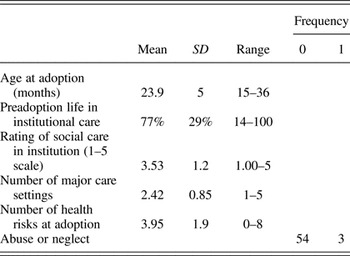
Participants were 65 PI children selected based on international adoption between 15 and 36 months (M = 23.9 months, SD = 5.0 months) and 52 NA children raised in their birth families in the United States. PI children had experienced institutional care in an orphanage or baby home overseas for 4–34 months (M = 18.1, SD = 7.6; 14%–100% of preadoptive life, median = 94.3%). They were recruited from the Minnesota International Adoption Clinic, located at the University of Minnesota Hospital, and from the Minnesota International Adoption Project Registry, which draws from a diverse sampling of adoption agencies throughout Minnesota. The International Adoption Clinic provides services such as the initial medical visit after adoption, recommended for all families to establish the child's baseline physical health. All internationally adopted children who did not meet exclusion criteria (described in more detail below), were recently adopted into Minnesota during the course of data collection, were in the target age range, and were interested in participating in this research were recruited. The PI and NA groups were matched as closely as possible by age and sex, with no differences in age, t (115) = 1.35, ns, or sex distribution, χ2 (1) = .50, ns (percentages female were 58.5% and 51.9% for PI and NA, respectively). Thus, we did not control for age or sex in analyses of group differences. The PI children were adopted from 15 countries (21.5% Russia/Eastern Europe, 38.5% Asia, 30.8% Africa, and 9.2% Latin America). The NA group was selected to roughly match the typically high socioeconomic status of internationally adoptive parents. The median household annual income was $100,000–$125,000 for the PI group and $75,000–$100,000 for the NA group. Approximately 84.6% and 92% of primary caregivers had completed a college degree in the PI and NA groups, respectively.
Exclusion criteria
Recruitment exclusion criteria included congenital or neurological disorders (including seizure disorders, endocrine disorders, and heart defects); information regarding these diagnoses was collected from parents during phone recruitment, in questionnaires at the time of assessment, and through contact with the pediatric clinic in the United States where the child was first seen. In addition, in order to focus on the effect of deprivation during the first postnatal years, PI participants were excluded from analyses if they exhibited facial signs of prenatal alcohol exposure (n = 6) or extremely low IQ (n = 1). Facial signs of fetal alcohol exposure were coded from digital photographs obtained at the second assessment described below and at each of three subsequent sessions approximately 6–7 months apart. After being trained by a licensed clinician on obtaining precise and scorable photos, researchers collected three standardized facial photographs at each session: a frontal view, a three-quarter view, and a lateral view. The Astley FAS Facial Photographic Analysis Software was then used by trained coders to provide each child with a Facial 4-Digit Code Rank. Coders attained 0.84 average reliability (using 14% of randomly selected photos) with a licensed clinician using percentage agreement on whether the photo was scored to have absent to low concern (code = 1 or 2) or moderate to high FAS concern (code = 3 or 4). Children with high FAS concern (codes = 3 or 4) were excluded from the present analysis, and parents were informed of the results of this screening if they elected to be notified during the consent process. Two NA participants were excluded from analyses due to parent-reported Autism diagnosis (n = 1) and child abuse (n = 1) in order to maintain a nonabused, typically developing comparison group.
Missing data
Missing attachment data were minimal. For Time 1, one PI videotaped assessment was not available because of technical problems. For Time 2, data were missing for six individuals because of problems in scheduling and withdrawal from the study (PI: n = 4, NA: n = 2). Participants who withdrew were more likely to be coded as insecurely attached at Time 1 (66.7% insecure, comprising 3 PI and 1 NA) compared to rates in the entire sample. Given that missing data were under 5% for the main study variables, multiple imputation methods were not used as estimates and were not likely to change with replacement.
Procedure
Each parent–child dyad participated in 1.5-hr laboratory sessions at two time points (1–3 and 7–9 months postadoption). The sessions were videotaped and consisted of 10 segments: a 10-min Disinhibited Social Approach procedure, in which the parent was discouraged from interacting with the child and the experimenter was present, being neutral initially but increasingly friendly; a modified Strange Situation procedure, including one separation/reunion at Time 1 (6 min) and two standard separation/reunions at Time 2 (15 min); two parent–child free- and structured-play interactions, lasting 10 min each; a 2-min book-reading episode; and four Laboratory Temperament Assessment Battery vignettes (two eliciting fear and two for positive affect). It must be noted that all these segments were viewed to derive the Q-Sort attachment security scores, but these episodes were not otherwise utilized in the current study. The primary caregiver was invited to participate with the designated toddler. The same caregiver was asked to participate at Times 1 and 2 (PI: 94.1% mothers, NA: 98.1% mothers).
Measures
Attachment formation rating
Attachment formation ratings were derived from a modified Strange Situation procedure (one separation/reunion) at Time 1 and the standard procedure (two separations/reunions) at Time 2 (Ainsworth et al., Reference Ainsworth, Blehar, Waters and Wall1978). The standardized laboratory procedure consists of eight brief episodes designed to activate infant attachment behavior through an increasingly stressful series of infant–mother separations and reunions. Assessments were coded from videotape by expert raters unaware of child group status. The attachment formation 5-point rating (Carlson, Reference Carlson2002/2011; Zeanah et al., Reference Zeanah, Smyke, Koga and Carlson2005) documented the degree to which children had developed a preferred relationship with the primary caregiver. Rating development was based on natural observations of infant attachment development with a primary caregiver (Ainsworth, Reference Ainsworth1967). Ratings of “5” indicated attachment behavioral organization consistent with traditional attachment classifications (secure, insecure avoidant, insecure resistant, and disorganized/disoriented; Ainsworth et al., Reference Ainsworth, Blehar, Waters and Wall1978; Main & Solomon, Reference Main, Solomon, Greenberg, Cicchetti and Cummings1990). Ratings of “4” indicated evidence of attachment figure preference in the context of distress, but incomplete patterning of attachment behavior. Ratings of “3,” “2,” and “1” were assigned for behavioral displays of fragmented attachment behavioral sequences differentially directed toward or in response to the caregiver, isolated attachment signals and responses, and no evidence of attachment behavior, respectively. Attachment formation ratings have been significantly related to caregiving behavior as well as indices of attachment disturbance in an institutionalized sample (Zeanah et al., Reference Zeanah, Smyke, Koga and Carlson2005). Interrater reliability (intraclass correlation coefficient) was 0.96 for an institutionalized sample (n = 45; Zeanah et al., Reference Zeanah, Smyke, Koga and Carlson2005) and 0.77 for the current sample (n = 10).
Attachment Q-Sort
A continuous rating of attachment security was derived from videotaped assessments of the entire laboratory session using the Attachment Q-Sort (Waters & Deane, Reference Waters and Deane1985). The Attachment Q-Sort is appropriate for use with children between 12 and 48 months, and based on meta-analyses, the measure has been found to be reliably associated with Strange Situation classification security, when used by trained coders rather than parents, and significantly related to parental sensitivity (van IJzendoorn, Vereijken, Bakersmans-Kranenburg, & Riksen-Walraven, Reference van IJzendoorn, Vereijken, Bakermans-Kranenburg and Riksen-Walraven2004). The Q-Sort method minimizes response bias through a process of item sort into a fixed distribution based on the salience of child behaviors (Waters & Deane, Reference Waters and Deane1985). In addition, the instrument is compatible with a diversity of child–parent interactions such as those included in the 1-hr laboratory session. Of the 90 Q-Sort items, 13 home-based items were determined to be nonapplicable to the experimental situation and were treated as missing data for all participants. In addition, 10 items were reworded without changing the description of the child behavior captured by the item (e.g., when new adults “are present” instead of “visit the home”). Flexibility in the Q-Sort methodology allowed a change from the classic sorting procedure (10 equal piles of 9 items) to a symmetric quasinormal distribution of 77 items (8 items in Piles 1, 2, 8, and 9, and 9 items in the remaining piles). The Q-Sort adaptation was developed with German Posada (Purdue University).
Videotaped assessments were coded by two master coders and eight trained coders blind to child status. Master coders were trained to reliability by German Posada, attaining good reliability on the three standard Attachment Q-Sort training videotapes. Average reliabilities with the certified trainer for the two master coders were Pearson r = .68 and .62 based on the 90-item Q-set, and .55 and .57 based on a sample of two tapes from the current study (not included in current analyses) using the selected 77 items (note: these reliabilities can be considered very high, considering that the minimum acceptable interrater reliability for two Q-Sort distributions derived from independent observations is r = .30 according to Gjerde, Reference Gjerde1986; Wampler, Halverson, Moore, & Walters, Reference Wampler, Halverson, Moore and Walters1989). For videotapes from the present study, internal interrater reliabilities among pairs of trained coders averaged r = .60.
The security score for each child was calculated as the value of the Pearson correlation between the child's Q-profile and the Criterion Security Q-Sort (a composite of attachment expert ratings). Even though there is no natural cutoff score for the Q-Sort, the developer of the instrument has suggested that a cutoff score of .30 can sometimes be used for dichotomizing the security variable (secure ≥ .30; insecure < .30) if it yields comparable percentages of secure and insecure children observed in other samples (Park & Waters, Reference Park and Waters1989). At Time 1, a cutoff of .30 resulted in 69.2% secure children in the NA, typically developing group, which does not differ from the average estimated distribution across US samples of 67% secure and 33% insecure (van IJzendoorn & Sagi-Schwartz, Reference van IJzendoorn, Sagi-Schwartz, Shaver and Cassidy2008). Because Q-Sort scores increase with age (Clark & Symons, Reference Clark and Symons2000; Symons, Clark, Isaksen, & Marshall, Reference Symons, Clark, Isaksen and Marshall1998) and because the instrument measures social behaviors that typically improve with age (e.g., responding readily to mother's suggestions, waiting patiently for mother to do what the child asks), we used a cutoff of .43 at Time 2 to preserve the same distribution in the NA group (70% secure, 30% insecure). Using different cutoffs at each age for dichotomizing longitudinal assessments in the same children is customary in the literature to account for these improvements with age (e.g., Symons et al., Reference Symons, Clark, Isaksen and Marshall1998).
Attachment classification
Traditional attachment classifications were derived from the modified Strange Situation procedure (one separation/reunion) at Time 1 and the standard procedure (two separations/reunions) at Time 2 (Ainsworth et al., Reference Ainsworth, Blehar, Waters and Wall1978; see description under Attachment Formation Rating). We used a modified (single separation) procedure at Time 1 instead of the standard recommended two separations to prevent undue stress on the families and children who were, in many cases, undergoing a challenging family transition 1–3 months after adoption. Individual differences in attachment relationships were coded with respect to the child's gaining comfort in the mother's presence when stressed and using the mother as a secure base from which to explore. Based on the patterning of the child's behavior across eight episodes, mother–child dyads were assigned to one of four major classifications: secure, insecure avoidant, insecure resistant, or disorganized/disoriented (Ainsworth et al., Reference Ainsworth, Blehar, Waters and Wall1978; Main & Solomon, Reference Main, Solomon, Greenberg, Cicchetti and Cummings1990). In addition, continuous scores for the proximity seeking, contact maintenance, resistance, avoidance, and disorganization subscales of this coding system based on the first reunion (Time 1 and Time 2) or the second reunion (only at Time 2) were compared to gain further insight into the development of attachment. Strange Situation secure versus insecure (avoidant or resistant) classification was 72% concordant with the secure/insecure category based on continuous Q-Sort security when excluding children with disorganized scores, because the attachment Q-Sort does not differentiate organized from disorganized patterns. Behavioral ratings and classifications were assigned from video recordings by independent expert coders (E. Carlson and A. Sroufe, University of Minnesota) blind to child status and remaining data.
Index of preadoption adversity
A preadoption index of adversity was created from information gathered through a phone interview with caregivers within the first year after adoption. Interviews were conducted by a retired international adoption social worker. Parents were instructed to have materials provided by the adoption agency available during the interview. Using information supplied by agencies and gathered when parents traveled to the birth country to pick up the child, the interview yielded the following measures used in the current study: age at adoption, duration of institutional care, number of care settings experienced, and reports of severe neglect or abuse prior to institutional placement. Based on caregiver observations of institutions (n = 49), the interviewer also rated the extent to which the child's needs for social contact with adults were met in the institution on a 5-point scale from poorly to well met. To provide a measure of reliability, 10 interview scenarios were constructed describing institutional care of various qualities. The interviewer and a former international adoption social worker read the scenarios and independently used the information to rate institutional quality. On all the scales, κ > 0.80.
In addition, child health at adoption was assessed from medical records obtained from the child's physician as an objective index of preadoption adversity. A health composite variable (i.e., number of health risks at adoption) was created. A score of 1 was assigned for the presence of each health-related risk or problem, including low birth weight, growth delay greater than two standard deviations from the mean, evidence of malnutrition, motor delay, psychological/ occupational therapy or speech referrals, chronic disability, and each medical referral obtained. Nonincidences and missing data on risk factors were scored as 0. These values were summed to create a possible range of 0–30 for the composite (i.e., index of neglect). In this study, scores ranged from 0 to 8 (M = 3.95, SD = 1.9).
The cumulative adversity score was created using variables expected to impact attachment. In the present study, children were 15 months or older at the time they entered full-time adoptive care. However, based on evidence that adoption at 2 years or older may make formation of a secure/nondisordered attachment more difficult for PI children (Smyke et al., Reference Smyke, Zeanah, Fox, Nelson and Guthrie2010; van den Dries et al., Reference van den Dries, Juffer, van IJzendoorn, Bakermans-Kranenburg and Alink2012), being 2 years or older was assigned 1 point in the adversity index. Reports of severe neglect or abuse yielded 1 point. One point each was assigned for extended institutionalization (over half of toddler's life), quality of social care in the institution (bottom half of the distribution), and number of transitions or major care settings (top half of the distribution, or three or more settings) prior to adoption. Finally, 1 point was assigned for three or more health problems (top half of the distribution) at adoption. To be scored, children required three of the six measures to be available. The resulting index ranged from 0 to 6, with a median of 2. See Table 1 for descriptive statistics of preadoption adversity indices.
Descriptive statistics for preadoption adversity indices

Results
Attachment formation
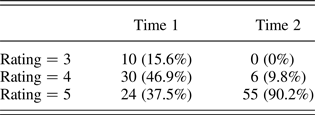
At Time 1, all but one of the NA children were classified as having a fully formed attachment relationship (i.e., a score of “5”), and all NA children received a score of “5” at Time 2. As shown in Table 2, at Time 1 over half of PI children did not exhibit a fully formed attachment relationship, a significant difference from the NA group. By Time 2, nearly all had formed attachment relationships, and significant differences from the NA group were no longer apparent.
Attachment formation scores for postinstitutionalized children

Note: χ2 (2) = 8.12, p = .017. Time 1, 1–3 months postadoption; Time 2, 7–9 months postadoption.
There was a significant relation between Time 1 and 2 attachment formation scores among the PI children, χ2 (2) = 8.12, p = .017, such that all children scoring “5” at Time 1 also scored a “5” at Time 2, and all of the six children scoring a “4” at Time 2 had scored a “3” or a “4” at Time 1. At neither time point did PI children score below “3.”
Although children were assessed within 3 months of their arrival in the United States, some families needed to stay with their children in the birth country for a time before bringing the child home. As a result, the range of postinstitutional time with the adoptive family ranged from 2 to 18.5 weeks. Children scoring “5” (attached) on the attachment formation rating at Time 1 tended to have been with their families longer than children scoring 3 or 4, t (62) = 1.96, p = .055, partial η2 = 0.06 at the first assessment.
Attachment security: Attachment Q-Sort
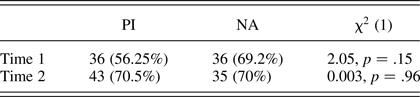
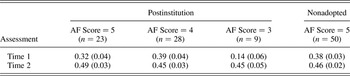
As shown in Table 3, Q-Sort attachment security did not differ by group at either Time 1 or Time 2 assessment (Time 1: M PI = 0.31, SD = 0.23, M NA = 0.38, SD = 0.18; Time 2: M PI = 0.46, SD = 0.15, M NA = .46, SD = 0.16). A repeated measures analysis of the continuous attachment scores also revealed no significant group difference, F (1, 108) = 0.74, p = .39, except a main effect of time, F (1, 108) = 28.76, p < .001, partial η2 = 0.21. The time interaction was not significant, F (1, 108) = 2.27, p = .135, partial η2 = 0.02.
Postinstitutionalized (PI) and nonadopted (NA) securely attached toddlers based on attachment Q-Sort

Note: Frequencies are presented with percentages in parentheses.
Attachment security and organization/disorganization: Strange Situation
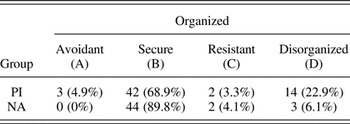
The distribution of attachment classifications was examined at Time 2 when the majority of the PI group had formed attachments, yielding meaningful categorical data (see Table 4). At 9 months postadoption, the PI and NA groups differed significantly in attachment classification distribution, χ2 (4) = 10.17, p = .038, primarily owing to significant differences in rates of disorganized versus organized attachment, χ2 (1) = 5.89, p = .015. One NA child was unclassifiable using this scheme (not included in Table 4). Aside from the differences in organization/disorganization, there was no overall difference in secure versus insecure classification. Thus, the difference between groups was restricted to attachment disorganization.
Frequency distribution of attachment categories at Time 2 (7–9 months postadoption)

Note: PI, Postinstitutionalized toddlers; NA, nonadopted toddlers. Four-way comparison: χ2 (4) = 10.17, p = .038; organized/disorganized comparison: χ2 (1) = 5.89, p = .015.
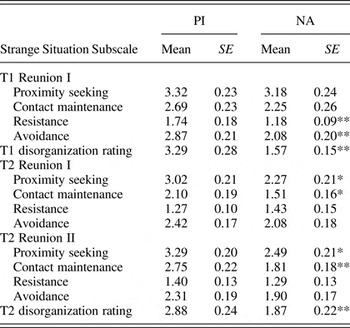
The continuous Strange Situation rating scales (proximity seeking, contact maintenance, avoidance, resistance, and disorganization) for the two reunion episodes at Time 2 were also examined for the two groups. In these analyses, PI children exhibited significantly more proximity seeking and contact maintenance during the first, t (107) = 2.45, p = .016; t (106.8) = 2.30, p = .023, and second reunion episodes, t (96) = 2.58, p = .01; t (94.8) = 3.05, p = .003, compared to NA children, and the PIs displayed significantly more signs of disorganization, t (104) = 3.0, p = .003, consistent with the classification results (see Table 5 for means and standard errors). The elevation in proximity seeking and contact maintenance may be understood in the context of developmental trends from Time 1 to Time 2, such that PI and NA children tended to exhibit less contact maintenance, PI: t (57) = 2.32, p = .02; NA: t (47) = 3.2, p = .003, and NAs also showed significantly less proximity seeking, NA: t (47) = 2.37, p = .02, with their parent during the first reunion of the session as they got older (comparisons could not be made for the second reunion episode given that only the Time 2 assessment included two separations). Furthermore, t tests revealed that PI children showed significantly more signs of avoidance and resistance than did NAs during the first reunion at Time 1 but did not differ from NA children on these dimensions at Time 2 (Table 5).
Means and standard errors of Strange Situation scales by group, time of assessment, and reunion episode

Note: PI, post institutionalized; NA, nonadopted; T1, Time 1; T2, Time 2.
*p < .05. **p < .01.
Attachment formation and attachment quality
Although the Q-Sort measures of security did not differ by group, we examined whether they differed by Time 1 attachment formation rating. The goal was to establish the predictive value of the Time 1 attachment formation ratings for security and organization/disorganization. PI children were grouped according to their attachment rating at Time 1, yielding 4 groups (PI: 3 versus 4 versus 5 and NAs). Using a repeated measures analysis of the Q-Sort measure at Times 1 and 2, a significant interaction of group and time was found, F (3, 106) = 4.31, p = .007, partial η2 = 0.11. At both Time 1 and Time 2, children scoring 4 or 5 on the attachment formation scale did not differ in Q-Sort measures of attachment security from the NA children. At Time 1, PI children scoring below 4 on attachment formation scored lower on Q-Sort security than did NA children (see Table 6 for means). PI children who were classified as organized versus disorganized at Time 2 did not differ in their Q-Sort security scores at Time 1, t (58) = 1.06, p = .29, or Time 2, t (59) = 1.08, p = .28. In the PI group, attachment formation at Time 1 was marginally positively correlated with being classified as secure (versus insecure) according to the Strange Situation procedure at Time 2: ρ (58) = 0.24, p = .068, but Time 1 formation was not significantly associated with being classified as disorganized (versus organized): ρ (58) = –0.18, p = .21.
Attachment Q-Sort security mean scores as a function of attachment formation (AF) at Time 1 (3 months postadoption)

Note: Values are mean (standard error). Main effect of time: F (1, 106) = 43.4, p < .001, partial η2 = 0.29; Group × Time interaction: F (3, 106) = 4.31, p < .007, partial η2 = 0.11.
Preadoption factors and attachment
Prior to examining whether preadoption adversity affected attachment formation or quality, we examined the effect of birth region in these analyses. Preadoption adversity was found to vary by birth region, F (3, 61) = 2.83, p = .046, with post hoc tests indicating that children adopted from Africa (n = 20, M = 1.7, SD = 0.98) scored significantly lower (p = .002), having experienced less adversity, than did children from Russia/Eastern Europe (n = 14, M = 2.7, SD = 1.14), with the children from Asia (n = 25, M = 2.24, SD = 0.93) and Latin America (n = 6, M = 2.17, SD = 1.17) scoring in between and not differing significantly from each other or from the other regions. Birth region was rank ordered by adversity score and entered as a control variable in subsequent analyses.
To address whether preadoption adversity predicted length of time required to achieve a preferential attachment to the adoptive parent, Time 1 and Time 2 attachment formation scores were recoded and combined. A score of “1” indicated attachment formation (score = “5”) at Time 1; a score of “2” indicated attachment formation at Time 2, and “3” indicated that even at Time 2 the child was scoring below “5.” The distribution on this measure was as follows: “1” = 41%, “2” = 49%, and “3” = 10%. After controlling for birth region, F (1, 60) = 10.48, p = .002, the main effect for time to form attachment was significant, F (2, 60) = 5.8, p = .005, η2 = 0.17. The preadoption adversity scores for the three groups were formed by Time 1 (n = 25, M = 1.96, SD = 1.02), formed by Time 2 (n = 30, M = 2.13, SD = 0.97), and not formed by Time 2 (n = 6, M = 3.17, SD = 0.98), with the third group having significantly higher levels of adversity compared to the first (p = .001) and the second (p = .002).
The associations between adversity and attachment security (Q-Sort), and attachment organization/disorganization (Strange Situation) were examined controlling for birth region. The partial correlation between adversity and Q-Sort security was significant, such that higher adversity was associated with lower security (r = –.31, df = 57, p = .015), but while in the same direction, the association was not significant at Time 2 (r = –.17, df = 58, p = .20). An analysis of covariance was computed to examine preadoption adversity in relation to the measure of disorganized attachment at the Time 2 attachment assessment (i.e., Strange Situation). The main effect of disorganized attachment was not significant, F (1, 58) = 0.12, p = .73.
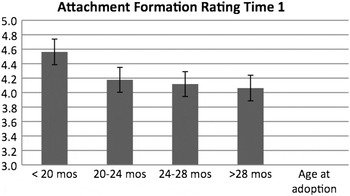
Finally, we examined age at adoption as a separate predictive factor given extensive prior work linking age to socioemotional outcomes in this population (Smyke et al., Reference Smyke, Zeanah, Fox, Nelson and Guthrie2010; van den Dries et al., Reference van den Dries, Juffer, van IJzendoorn, Bakermans-Kranenburg and Alink2012). Age at adoption was significantly inversely correlated with attachment formation at Time 1 (ρ = –0.45, p = .04), but associations with attachment formation at Time 2 (ρ = –0.21, p = .08) and Q-Sort Attachment security at either Time 1 or Time 2 were not statistically significant, r (69) = .11, p = .37 and r (66) = –.12, p = .32. For a graphical illustration of the gradient in Time 1 attachment formation scores by age at adoption, Figure 1 displays these scores by age quartiles.
Attachment formation rating at Time 1 by age at adoption quartiles (months).

Discussion
The present report provides critical information regarding the development of attachment relationships in toddlers adopted from institutional care. The results indicate that attachment formation and attachment security in PI children are differentiable constructs with different precursors. Specifically, attachment formation appears to be based largely on exposure. It was encouraging to find that even for children who had lived their early lives in institutions with multiple caregivers and few, if any, opportunities to form attachment relationships, the attachment relationship to an adoptive parent formed relatively quickly, within 9 months. At Time 1, not all children had fully formed an attachment pattern, but stability of care predicted formation. At Time 1, those who had been with the parent for fewer days or weeks were less likely to have already formed an attachment than those who had been with the parent for a longer period. Adverse preadoption experience also appeared to slow the attachment-formation process.
Assessment of attachment quality (security and organization/disorganization) provided a different picture. PI children did not differ from NA children in attachment security (secure base behavior) although the pattern was more likely to be “disorganized.” Length of time with the adoptive parent did not predict attachment security. However, adversity experienced prior to placement was related to lower Q-Sort security score, especially at the initial assessment 1–3 months postadoption.
Attachment formation and quality
The results provided evidence of relatively rapid attachment formation following institutional care for the majority of children. Nearly 40% had formed an attachment within 3 months of placement in a family, with nearly all having done so by 9 months after placement. Regarding attachment quality, based on laboratory observations, the Attachment Q-Sort revealed similar rates of security in the PI and NA samples at 9 months postadoption in contrast to a low incidence of security in previous parent Q-Sort reports at 11 months postadoption (e.g., Chisholm et al., Reference Chisholm, Carter, Ames and Morison1995). However, the Q-Sort does not distinguish between organized and disorganized attachment patterns. Laboratory Strange Situation assessments revealed elevated rates of disorganized attachment in the PI compared to the NA groups, consistent with previous findings based on categorical attachment coding from standard and modified laboratory assessments with infant and preschool coding methods (e.g., Chisholm, Reference Chisholm1998; Marcovitch et al., Reference Marcovitch, Goldberg, Gold, Washington, Wasson and Krekewich1997; O'Connor et al., Reference O'Connor, Marvin, Rutter, Olrick and Britner2003; Smyke et al., Reference Smyke, Zeanah, Fox, Nelson and Guthrie2010; van den Dries et al., Reference van den Dries, Juffer, van IJzendoorn, Bakermans-Kranenburg and Alink2012). Whereas the Attachment Q-Sort approach measures the range of secure base behavior (i.e., child proximity and contact-seeking behavior when distressed; exploration beyond the caregiver when not distressed) generally related to caregiver sensitivity, the assessment may not readily capture disruptions in the coordination or regulation of behavior, attention, and affect (e.g., sequential or simultaneous contradictory behaviors or lapses in behavioral sequences) reflected in attachment disorganization and typically associated with caregiving that exceeds insensitivity (e.g., separation or maltreatment). Qualitative scales derived from the Strange Situation procedure also revealed no differences between PI and NA children in levels of resistance or avoidance at Time 2; however, PI children tended to show higher levels of proximity seeking and contact maintenance during Strange Situation reunion episodes at Time 2 compared to NAs, with PI levels being comparable to those seen in NAs at Time 1. The findings suggest that PIs may require more physical proximity and contact to resolve distress in contrast to more age-typical strategy incorporating distance interaction and language.
The level of disorganization reflected in this PI sample was slightly lower (25%) than average levels reported in previous studies (e.g., 31%; van den Dries et al., Reference van den Dries, Juffer, van IJzendoorn and Bakermans-Kranenburg2009). Higher rates of attachment security in the current sample may be due to several reasons. First, the sample of parents was very low risk, characterized by high socioeconomic status and access to numerous resources throughout the adoption and postadoption process. Second, attrition of some families exhibiting insecure attachment patterns may affect estimates, although there was no direct evidence of differential impact. Third, differences may reflect a historical trend toward improved outcomes in internationally adopted children, attributed to improvements in orphanage conditions (changes from global deprivation to adequate physical care but lack of relational experience; Juffer et al., Reference Juffer, Palacios, LeMare, Sonuga-Barke, Tieman and Bakermans-Kranenburg2011). In particular, early research on attachment in PI children focused on children adopted in the early 1990s from Eastern European (especially Romanian) orphanages. At the time, these institutions represented extreme deprivation, as indicated by both direct observations and published studies of children adopted from Romania versus other regions (for a discussion, see Hawk & McCall, Reference Hawk and McCall2010). Slightly better outcomes might be expected from more recent and diverse samples. The current study included a high percentage of children adopted from Asia (38.5%) and Africa (30.8%) with lower average adversity scores in contrast to a lower percentage of children adopted from Eastern Europe/Russia (21.5%), the area with the worst adversity scores.
Early adversity and attachment
It is important that, in the current study, attachment quality in the first few months was predicted by preadoptive conditions. An index of early adversity (i.e., child age of 2 years or older, experiencing abuse or neglect, duration of institutionalization, quality of social care in the institution, number of transitions in care prior to adoption, and health problems at adoption) was related to lower continuous Q-Sort ratings of attachment security. Prior adversity was not related to disorganization in secure base behavior at the Time 2 attachment assessment (9 months postplacement). Thus, while stability in care following early deprivation is critical to relationship formation with adoptive attachment figures, early adverse biological and environmental conditions were central to the quality of newly formed relationships.
Summary and limitations
Based on the findings in the current study, the attachment system seems to be robust and capable of formation following deprivation and beyond infancy in the majority of children, especially if they have not experienced many changes in care settings or a prolonged period of institutionalization. Stability and quality of care are critical to attachment formation and individual differences in attachment quality. What remains unknown is how preadoptive and adoptive influences interact to influence developing child–parent relationship patterns and the function and trajectories of atypical social behaviors (e.g., attachment disorganization, indiscriminate social behavior, and impulsivity).
As noted in previous studies, the application of the disorganized classification to institutionalized and PI samples requires further review (Bakermans-Kranenburg et al., Reference Bakermans-Kranenburg, Steele, Zeanah, Muhamedrahimov, Vorria and Dobrova-Krol2011). Whereas the conceptual origin of the disorganized pattern relates to “fear without solution” (i.e., caregiver as a source of both comfort and threat) in children with already developed relational capacities, disorganization in the context of deprivation may represent progress (with possible wariness) associated with organizing behavioral, emotional, and attentional strategies in social relationships for the first time. The specific antecedents and consequences of disorganization as a phase of attachment development versus a conflicted regulatory strategy are unknown. Longitudinal research (e.g., preschool or school-related behavioral outcomes) is needed to determine if early disturbances resembling disorganization represent initial pathways to pathology versus adjustment indices. Moreover, an understanding of the trajectories of these and related institutional effects is critical to developing targeted intervention strategies.
The limitations of the current study, including typical gaps in information about preadoptive experiences, hinder attempts to isolate specific pathways to current behavior or precursors for disorganized patterns of attachment. For example, we and others have acknowledged that orphanage records are not standardized, are often incomplete or ambiguous (e.g., missing information does not always equate to the nonoccurrence of a risk factor), and there is also great variability in the ways that information is treated by adoption agencies and passed on to parents. Thus, results using these variables must be interpreted with caution. In addition, in the current study, baseline assessments immediately upon arrival were not available because most families (understandably) were not able to commit to research within the first 2 weeks of adoption, with a small number of families postponing their visit by up to 3 months after adoption. Moreover, adoptive caregiving quality was not considered in the current study. Finally, the comparison group was a high-socioeconomic status, low-risk sample with high rates of attachment security and low rates of disorganization, which may limit generalizability to other populations. However, these families were matched in demographics to those of internationally adopted children, and as such, they provided an adequate measure of the rates of security and disorganization expected in low-risk social contexts. Despite these limitations, the study demonstrates the robust nature of the attachment system. Children in the study showed a remarkable capacity for recovery during months following adoption from institutional care, and the largely positive outcomes resonate with Bowlby's (Reference Bowlby1988) conceptualization of the flexible nature of attachment in early childhood.