Introduction
Anthelmintic resistance in cattle, although not widespread compared to that of small ruminants, has started emerging in Chhattisgarh (Sanyal et al., Reference Sanyal, Rawte, Kerketta, Pal, Baghel and Bisen2015). As benzimidazoles (BZ) are cheap and widely used anthelmintics, it would be of considerable significance if the development of benzimidazole resistance could be delayed by improving the efficacy of the drug. Studies on the pharmacokinetic behaviour of BZ anthelmintics have indicated that their efficacy and spectrum of activity could be improved by using procedures that extend and maintain plasma and tissue concentrations beyond those normally achieved by a single-dose drenching (Prichard et al., 1978; Hennessy, Reference Hennessy1994). Efforts are being made to increase the activity of existing BZ by manipulating their pharmacokinetics (Hennessy, Reference Hennessy1997). Orally administered BZ adsorbs to particulate digesta in the rumen of ruminants and slowly dissociates to the liquid phase of digesta (Hennessy 1994) resulting in increased systemic availability of the drug and its metabolites compared to non-benzimidazole anthelmintics.
The present investigation was designed to study, through different experiments, the effect of dry matter intake during summer and the rainy season (diet quality) and of pre-treatment fasting (diet quantity) on the disposition of albendazole (ABZ) metabolites in plasma of cattle. This was designed to ascertain the likely influence of such feeding resources on the efficacy of anthelmintic treatment in ruminants in India.
Materials and methods
Experimental design
Ten Sahiwal heifers aged 1–2 years, weighing 85–116 kg and maintained in the Bull Mother Experimental Farm, College of Veterinary Science & Animal Husbandry, Anjora, Durg, were used for the study, without disturbing normal husbandry practices. In the month of May, 2014, when the ambient temperature was around 39.1°C, the average monthly rainfall was 25.8 mm and the animals were fed on dry fodder (paddy straw), all heifers were treated with levamisole (Ventrimisole, Venky's India Ltd, Pune, India) at 7.5 mg/kg body weight per head by the oral route. Their freedom from nematode parasites was confirmed by repeated faecal examination. After a washout period of 15 days, they were divided into two groups of five heifers each. Group 1 and Group 2 heifers were administered albendazole (ABZ) at 7.5 mg/kg body weight (Albacril 2.5% w/v, Cattle Remedies India Ltd., India) by oral and intra-ruminal route, respectively. The same heifers were subjected to the same protocol in the month of August, when the ambient temperature was around 31°C, the monthly average rainfall was 486.7 mm and they were fed on green grasses and lucern green fodder.
In a separate experiment, ten Sahiwal heifers of about the same age and body weight as in the previous experiment were maintained indoor on grasses fed by cut-and-carry method and water ad libitum. They were treated with levamisole (Ventrimisole, Venky's India Ltd) at 7.5 mg/kg body weight per head by the oral route. Their freedom from nematode parasites was confirmed by repeated faecal examination. After a washout period of 15 days, they were divided into two groups, Group 1 (n= 5) had no pre-treatment fasting and Group 2 (n= 5) had a 24-h pre-treatment fast. Following the pre-treatment fast, all heifers were given ABZ at 7.5 mg/kg body weight by the intra-ruminal route.
Collection and analysis of blood samples
Whole blood was collected from all heifers by jugular venipuncture into heparinized vials (Vacutainer, Becton Dickinson Inc., California, USA) at 0, 4, 8, 12, 18, 24, 30, 36, 48, 72 and 96 h post-dosing. Plasma was separated immediately and stored at − 4°C until its analysis by high performance liquid chromatography (HPLC).
Pure external standards, albendazole sulphoxide (ABZ-SO) and albendazole sulphone (ABZ-SO2) were supplied by M/S Smith Kline Beecham India Ltd (Bangalore, India). The pure internal standard, ethyl oxfendazole (ETH-OFZ), was supplied by Dr D.R. Hennessy, CSIRO McMaster Laboratory, Sydney, Australia. Solid-phase extraction of plasma (Hennessy et al., Reference Hennessy, Lacey, Prichard and Steel1985) was done using a C18 Sep-pak cartridge (Waters Associates, Millford, Massachusetts, USA). Plasma (1 ml) was spiked with 0.5 μg ETH-OFZ internal standard and applied to a Sep-pak cartridge that had been preconditioned with 10 ml HPLC-grade methanol and 5 ml Sep-pak buffer. Following elution with 10 ml HPLC-grade water and 0.5 ml 40% methanol, the metabolites were collected in 2.5 ml methanol and evaporated under nitrogen gas to approximately 300 μl before HPLC analysis.
The reverse-phase HPLC (Flexar; PerkinElmer, Singapore; consisting of Flexar HPLC pump, UV-Vis detector set at 292 nm, Solvent Manager and a C18 column) was run in isocratic mode using 33% acetonitrile in 0.025 mol/l sodium acetate as the mobile phase (Sanyal, Reference Sanyal1997) with a flow rate of 2 ml/min. Identification of metabolites in plasma was done by comparison with the retention times of the reference standards. The absolute recovery rate was 97%, the precision of the extraction procedure and chromatography being evaluated by processing, as replicates on different days, pooled plasma aliquots containing known amounts of ABZ-SO and ABZ-SO2.
Stock solutions of ABZ-SO, ABZ-SO2 and ETH-OFZ were prepared in dimethyl sulphoxide (DMSO) at a concentration of 1000 μg/ml. Working solutions of 0.125, 0.25, 0.5 and 1.0 μg/5 ml (external standard) were prepared in DMSO from the stock solutions. Blank plasma (1 ml) spiked with the external standards at five different concentrations of 0, 0.125, 0.25, 0.5 and 1.0 μg/ml, and 0.5 μg of the internal standard ETH-OFZ, was added to each vial. The spiked plasma was extracted by solid-phase extraction and dried down to 300 μl under nitrogen gas. Then, 20 μl was injected into the column to enable calibration curves to be prepared for the two components. The concentration of each component in the plasma extracts was determined by comparing the detector response for each component with the corresponding peak in the standard mixture. Least squares regression analysis was used to determine the slope, intercept and correlation coefficient for each compound in the concentration range tested. The limit of detection was 0.02 μg/ml.
Data analysis
The maximum concentration (C max), time to C max (T max), area under concentration–time curve (AUC) and elimination half-life (t ½β) for ABZ-SO and ABZ-SO2 were determined using the non-linear modelling programme PHARMKIT, which fitted the concentrations versus time profiles to a first-order input and output, two compartment model (Sanyal, Reference Sanyal1994). Data were subjected to analysis of variance using GraphPad Prism 4 software (Version 4.02, 2004, GraphPad Software Inc., New York, USA).
Results
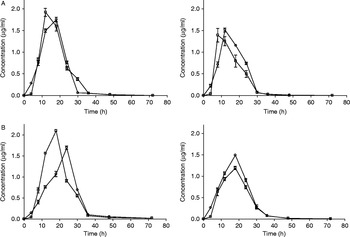
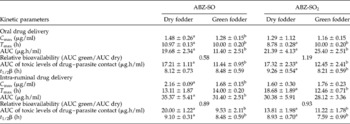
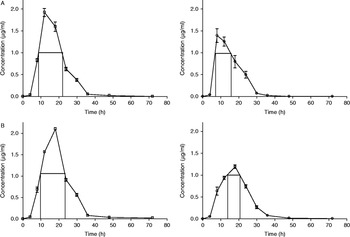
Using the described chromatographic conditions, ABZ-SO, ABZ-SO2 and ETH-OFZ were well resolved without interference from indigenous compounds, with retention times of 1.84 ± 0.09, 2.86 ± 0.08 and 3.98 ± 0.05 min, respectively. The anthelmintically active moiety ABZ-SO appeared early and was eliminated early in heifers offered green fodder (fig. 1), with decreased C max and AUC when the drug was administered both through oral and intra-ruminal routes (table 1). Further, t ½β revealed significantly increased values for ABZ-SO in heifers administered ABZ through the intra-ruminal route. Increased AUC and t ½β are reflective of increased bioavailability of ABZ in heifers offered dry fodder. Although T max and t ½β of ABZ-SO2 revealed increased values in heifers offered dry fodder and administered ABZ intra-ruminally, increased values for T max and AUC were observed in heifers offered green fodder and administered ABZ through the oral route. The relative bioavailabilities (AUC green fodder/AUC dry fodder) of ABZ-SO were 0.58 and 0.89 following oral and intra-ruminal routes of ABZ administration, respectively (table 1). Extrapolation of data of the active metabolite ABZ-SO levels in terms of drug–parasite contact revealed increased exposure to parasites in heifers fed on dry fodder irrespective of route of administration (fig. 2). This visual interpretation could be justified scientifically following calculation of AUC of toxic levels of drug–parasite contact for ABZ-SO, which was significantly higher (P < 0.05) in animals fed on dry fodder in both the routes of ABZ administration (table 1).
Plasma levels of albendazole sulphoxide (□) and albendazole sulphone (○) in cattle following (A) oral and (B) intra-ruminal administration of albendazole at 7.5 mg/kg body weight and offered dry (left side) and green (right side) fodder ad libitum.

Pharmacokinetic values (mean ± SD) of albendazole sulphoxide (ABZ-SO) and albendazole sulphone (ABZ-SO2) in cattle following a single intra-ruminal administration of albendazole at 7.5 mg/kg body weight and allowed to feed on dry or green fodder.

Values with different superscripts indicate significant differences at P < 0.05.
Estimated drug–parasite contact of albendazole sulphoxide in cattle following (A) oral and (B) intra-ruminal administration of albendazole at 7.5 mg/kg body weight and offered dry (□) and green (○) fodder ad libitum.

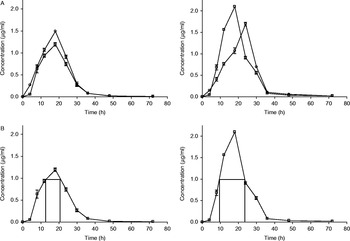
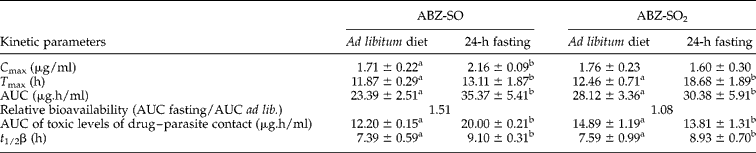
Increased plasma levels of ABZ-SO and ABZ-SO2 were observed in heifers with a 24-h pre-treatment fast (fig. 3). Analysis of data revealed increased values (P < 0.05) of C max, T max, AUC and t ½β for ABZ-SO in heifers with a 24-h pre-treatment fast (table 2). The relative bioavailabilities (AUC fasting/AUC ad lib.) of ABZ-SO and ABZ-SO2 were 1.51 and 1.08 (table 2). For ABZ-SO2, statistically increased values (P < 0.05) of T max and AUC were observed in heifers with a 24-h pre-treatment fast (table 2). Therefore, the bioavailability of ABZ was greater in heifers on the 24-h fast. The drug–parasite contact was around 7 h in animals offered the ad libitum diet, while it was increased to around 15 h in animals administered ABZ following a 24-h fast (fig. 3). This visual interpretation could be justified scientifically following calculation of the AUC of toxic levels of drug–parasite contact for ABZ-SO, which was significantly higher (P < 0.05) in animals on the 24-h fast (table 2). Therefore, the parasites are exposed to the lethal toxic levels of anthelmintically active metabolite for a longer duration following intra-ruminal administration of ABZ in cattle with 24-h pre-treatment fast.
Plasma levels of albendazole sulphoxide (□) and albendazole sulphone (○) in cattle following intra-ruminal administration of albendazole at 7.5 mg/kg body weight and offered (A) ad libitum (left side) and restricted diet (right side), and (B) the corresponding drug–parasite contact of albendazole sulphoxide.

Pharmacokinetic values (mean ± SD) of albendazole sulphoxide (ABZ-SO) and albendazole sulphone (ABZ-SO2) in cattle following a single intra-ruminal administration of albendazole at 7.5 mg/kg body weight and offered ad libitum or restricted diet.
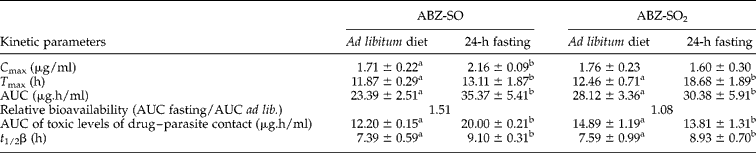
Values with different superscripts indicate significant differences at P < 0.05.
Discussion
The persistence of an oesophageal groove reflex even in adult ruminants is responsible for ruminal bypass of liquid BZs administered orally, causing hastened absorption and reduced total drug bioavailability in large and small ruminants (Sanyal et al., Reference Sanyal, Knox, Singh, Hennessy and Steel1995; Swarnkar et al., Reference Swarnkar, Sanyal, Singh, Khan and Bhagwan1998).
There was a substantial reduction in the systemic availability of both ABZ metabolites in heifers offered green fodder compared to those offered dry fodder. A similar trend in drug bioavailability with diet changes was observed in cattle and buffaloes by Sanyal et al. (Reference Sanyal, Knox, Singh, Hennessy and Steel1995). Alwash & Thomas (Reference Alwash and Thomas1971) reported that a diet's physical form may affect both digestibility and the rate of flow of digesta in the gastrointestinal tract (GIT). Though the flow rate of the digesta in the intestine was not measured in the present experiment, it is well established that, as diet quality improves and intake increases, the residence time of the digesta in the GIT decreases (Warner, Reference Warner1981). The reduced systemic availability of ABZ metabolites in cattle with access to green fodder in the rainy season observed in the present study accorded with the observations of Singh et al. (Reference Singh, Sanyal, Swarnkar, Khan and Bhagwan1999), who reported reduced bioavailability of ABZ and their metabolites in small ruminants grazing on pasture compared to those confined and offered hay and feed concentrate. This may be the result of increased digesta flow rates in animals consuming green grass, with the resultant decreased residence time of the drug in the GIT affecting absorption.
Lanusse et al. (Reference Lanusse, Sanchez, Alvarez and Lees1994) reported that starvation modifies the disposition kinetics of ABZ in the plasma of cattle. Decreased gastrointestinal absorption of oxfendazole in sheep with a higher feed intake has been related to a shorter gastrointestinal transit time and hence less time for drug desorption from particulate material in the rumen (Ali & Hennessy, Reference Ali and Hennessy1995). Fasting induces a decrease in the flow rate of the digesta through the GIT of ruminants. This slower rate of passage of the ruminal contents could prolong the duration of the desorption process, resulting in enhanced absorption of ABZ. The higher peak plasma concentration of both the metabolites and the significantly higher AUC observed in the present study when heifers were fasted for 24 h prior to treatment tend to confirm such increased absorption. The diet's physical form may affect the digestibility and rate of flow through the GIT, and the ability of dietary cellulose to bind with the drug (Bogan & Marriner, Reference Bogan, Marriner, Ooms, Degryse and Van Miert1987). Both these factors may contribute to the differences in the pharmacokinetic behaviour of ABZ metabolites and in the therapeutic efficacy of the drug (Arundel, Reference Arundel1983).
The influence of the type of diet has often been overlooked when determining anthelmintic efficacy. The present study suggests that studies should include this factor in assessing dose response to avoid underdosing and reduced anthelmintic efficacy. Restricting the intake of feed is another way to manipulate the host's physiology and improve absorption of BZ anthelmintics from the ruminant GIT, so enhancing the systemic availability and efficacy (Hennessy, Reference Hennessy1993). The significantly higher uptake of ABZ could be observed in heifers following intra-ruminal administration of the drug with a 24-h pre-treatment fast. The present study suggests that maintenance of heifers predominantly on dry fodder followed by a 24-h pre-treatment fast enhances absorption of ABZ.
Acknowledgements
Facilities provided by the Dean, College of Veterinary Science & AH, Anjora, Durg are thankfully acknowledged.
Financial support
This research is the result of the Department of Biotechnology sponsored project on ‘Management of benzimidazole resistance in livestock by use optimization of anthelmintics’.
Conflict of interest
None.
Ethical standards
The experimentation on cattle was approved by the Institutional Ethics Committee.