Introduction
BVDV infection of cattle has presented numerous challenges for veterinarians and research scientists since the first manifestation of clinical disease in the 1940s (reviewed in Goens, Reference Goens2002). Genetic variation among viral strains, the establishment of persistent infections, viral tropism for epithelial, hematopoietic and immune cells, and diverse manifestations of clinical disease have all complicated disease control strategies. Vaccines have been used as a disease control strategy for over 50 years (Coggins et al., Reference Coggins, Gillespie, Robson, Thompson, Phillips, Wagner and Baker1961) but there have been numerous concerns regarding vaccine safety and efficacy due to adverse effects associated with early vaccines (Bolin, Reference Bolin1995). In particular, the use of modified-live viral (MLV) versus killed viral (KV) vaccines has been extensively debated and numerous vaccines have been developed and tested to address specific issues related to safety and efficacy (Kelling, Reference Kelling2004). Furthermore, vaccination protocols have been developed to address the need to target specific populations while monitoring local disease prevalence (González et al., Reference González, Arnaiz, Yus, Eiras, Sanjuán and Diéguez2014). The current review addresses the limitations and advantages of KV versus MLV BVDV vaccines and based on recent information vaccination strategies that address all stages of the production cycle while minimizing the potential risk of adverse vaccine reactions are discussed.
BVDV and primary infections
BVDV has been divided into two major species, BVDV1 and BVDV2, but each species includes multiple genetically distinct viral isolates. Genome sequencing reveals significant genetic variation among clinical isolates and also within persistently infected animals over time (Neill et al., Reference Neill, Newcomer, Marley, Ridpath and Givens2011). Thus, one of the defining features of this RNA virus is rapid genetic change with the potential for new emerging species and strains with changing disease manifestations. This genetic variability poses a number of challenges for vaccine efficacy and safety. Viral species and isolates selected for use in vaccines must provide cross-protection against the diverse species and strains circulating within national herds. In response to this need the majority of vaccines now include both a BVDV1 and BVDV2 isolate and vaccine efficacy studies frequently include serology to evaluate neutralization of heterologous virus species and animal challenge studies with a heterologous strain (Xue et al., Reference Xue, Mattick, Smith, Umbaugh and Trigo2010; Wang et al., Reference Wang, Shi, Wu, Li, Ji, Meng, Zhang and Wu2014).
It is important to consider the structure of BVDV when evaluating potential vaccines and vaccine strategies. This relatively simple enveloped RNA virus encodes at least four structural and six non-structural proteins (reviewed in Neill, Reference Neill2013). Antibody responses capable of blocking viral entry into cells and preventing infection target E2, an envelope protein. In contrast, T-cell responses have been shown to target both E2 and non-structural proteins that are expressed in infected cells. T-cell responses include the activation of both CD4+ Thelper responses, essential for B-cell activation and differentiation into plasma cells, CD8+ cytotoxic T cells (CTLs), and γδTcR T cells (Endsley et al., Reference Endsley, Ridpath, Neill, Sandbulte and Roth2004). Both antibody and CTL responses contribute to the control and clearance of BVDV infection and are important for the prevention of clinical disease and fetal infection (reviewed in Ridpath, Reference Ridpath2013).
BVDV infection can occur by either the aerosol route or fecal–oral transmission and the primary target of infection is epithelial cells in the oral cavity, respiratory tract, or gastrointestinal tract. Once this mucosal barrier has been breached, however, virus spreads to mucosal-associated lymphoid tissue, such as Peyer's patches and draining lymph nodes (Liebler-Tenorio et al., Reference Liebler-Tenorio, Ridpath and Neill2004). A viremia also occurs resulting in a systemic infection targeting a wide variety of tissues. Of particular interest is the infection of hematopoietic and lymphoid tissues that can result in immune suppression and the occurrence of fetal infection. Fetal infection during the first half of pregnancy is of particular concern since this may result in the birth of persistently infected (PI) animals, a major source of virus transmission (Brownlie, Reference Brownlie1990). Thus, the primary objective of parenteral vaccination has been to prevent viremia and the systemic spread of virus as a means of preventing clinical disease, protecting the fetus, and preventing the birth of PI calves. There is, however, increasing interest in developing mucosal vaccination strategies that block the initial BVDV infection of epithelial cells at mucosal surfaces, especially in young animals.
Immunogenicity of killed versus live viral vaccines
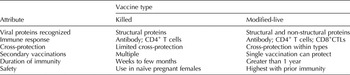
Adverse reactions associated with early MLV BVDV vaccines and recurrent problems associated with inadvertent BVDV contamination of modified-live vaccines raised concerns regarding the potential for vaccine-induced immunosuppression and PI calves (Bolin, Reference Bolin1995). KV vaccines provided an alternative approach to immunization that addressed these major safety concerns (Kelling, Reference Kelling2004) but this vaccine approach resulted in a number of compromises (summarized in Table 1). Specifically, killed vaccines induce immune responses limited primarily to antibody production targeting structural proteins, such as E2. Furthermore, the limited immunogenicity of killed vaccines required the use of adjuvants, multiple vaccinations to induce protective levels of virus neutralizing (VN) antibodies, and these antibody responses decline within weeks to a few months (Reber et al., Reference Reber, Tanner, Okinaga, Woolums, Williams, Ensley and Hurley2006; González et al., Reference González, Arnaiz, Yus, Eiras, Sanjuán and Diéguez2014). In contrast, BVDV MLV vaccines induce a range of immune responses similar to those observed following a natural viral infection, including both VN antibody and CTL responses. Furthermore, these immune responses are specific to both structural proteins, such as E2, and the non-structural proteins expressed during viral replication in infected cells. Because non-structural proteins play a key role in viral replication their structure is more highly conserved and consequently immune responses to these proteins are frequently conserved among strains and biotypes. Finally, it has been shown that a single vaccination with a MLV BVDV vaccine can induce long-term immune memory and disease protection that lasts at least 6–12 months (Reber et al., Reference Reber, Tanner, Okinaga, Woolums, Williams, Ensley and Hurley2006; Xue et al., Reference Xue, Mattick, Smith, Umbaugh and Trigo2010). Thus, it is necessary to consider both the target population and the objectives of a vaccination program when deciding whether to use a KV versus a MLV BVDV vaccine.
Comparison of killed versus modified-live BVDV vaccines

Strategic use of killed versus live viral vaccines
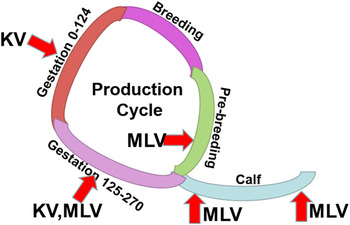
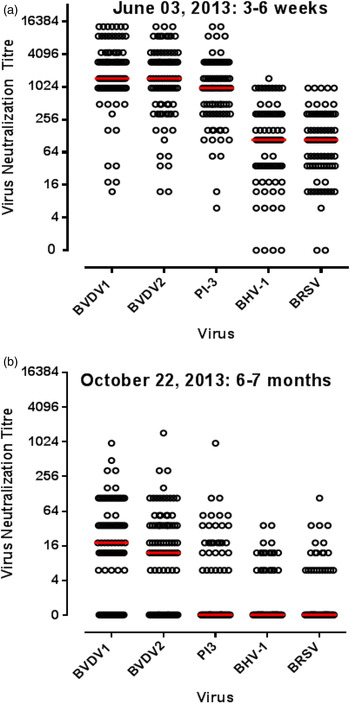
One of the major objectives of BVDV vaccination is fetal protection to achieve both increased reproductive efficiency and prevention of BVDV transmission by PI calves. These objectives can be achieved by ensuring adequate pre-breeding vaccination (Fig. 1) and several commercial MLV vaccines have been validated for fetal protection when heifers or cows are immunized prior to breeding (Rodning et al., Reference Rodning, Marley, Zhang, Eason, Nunley, Walz, Riddell, Galik, Brodersen and Givens2010; Leyh et al., Reference Leyh, Fulton, Stegner, Goodyear, Witte, Taylor, Johnson, Step, Ridpath and Holland2011; Xue et al., Reference Xue, Mattick, Smith, Umbaugh and Trigo2010; Givens et al., Reference Givens, Marley, Jones, Ensley, Galik, Zhang, Riddell, Joiner, Brodersen and Rodning2012; Meyer et al., Reference Meyer, Deplanche, Roux, Moulignie, Picard-Hagen, Lyazrhi, Raboisson, Mathevet and Schelcher2012). Barriers to achieving this objective include adequate vaccination of heifers prior to selection for breeding and the willingness of producers to vaccinate cows soon after parturition to ensure a 3–6-week interval between vaccination and breeding. Booster vaccinations with a multivalent, modified-live BVDV vaccine pre-breeding can induce high VN titers for both BVDV1 and BVDV2. Our recent investigations confirmed that these high antibody titers can persist throughout pregnancy and be transferred through colostrum to the newborn calf. Average VN titers over 1000 were observed in 3–6-week-old calves for both BVDV1 and BVDV 2 (Fig 2a). These titers exceed those recently reported for newborn Holstein calves receiving either fresh colostrum or a commercial colostrum product (Chamorro et al., Reference Chamorro, Walz, Haines, Passler, Earleywine, Palomares, Riddell, Galik, Zhang and Givens2014). Although all calves received maternal antibody, it is important to note that there was a 1000-fold variation in VN titers for both BVDV1 and BVDV2 at 3–6 weeks of age (Fig. 2a). Variance in the VN titers of young calves was reflected in a similar 1000-fold range in the VN titers when calves were 6–7 months old (Fig. 2b). These observations indicate that the age at which calves are no longer protected by maternal antibody may vary considerably. Thus, it is difficult to predict when individual calves become seronegative. The need to vaccinate calves in the face of maternal antibody (IFOMA) will be discussed in the next section.
The production cycle can be divided into five separate management phases. Following parturition, the pre-breeding phase may last at least 6–9 weeks and provides an opportunity for BVDV vaccination (red arrow) with no risk of fetal infection. A MLV BVDV vaccination at this time is associated with little risk of an adverse reaction. The breeding phase usually lasts another 6–9 weeks and is not a recommended time for vaccination. The first half of gestation may be a time when cows are checked to confirm pregnancy and this may also provide an opportunity for BVDV vaccination. With no prior history of vaccination, then a killed BVDV vaccine (KV) can provide a safe strategy for inducing VN antibody to protect the fetus. A second KV vaccination during the last half of pregnancy may be necessary to boost immunity and ensure both fetal protection and effective transfer of maternal antibody to the newborn calf. A MLV vaccination may also be safe in the second half of pregnancy if there is prior history of BVDV vaccination. Finally, the birth of a calf completes the production cycle and one or more BVDV vaccinations may be necessary to establish protective immunity, especially in heifer calves selected for breeding. Intranasal vaccination with a MLV vaccine during the neonatal period is one strategy to induce protective immunity in the face of maternal antibody.

Maternal antibody levels present in calves at 3–6 weeks of age (a) and 5–6 months of age (b). Data presented are values for individual calves (n = 90) and virus neutralization (VN) titers were determined for all five viral components (BVDV1, BVDV2, PI3, BHV-1, and BRSV) present in the multivalent, MLV vaccine used to vaccinate cows pre-breeding. Mean VN titers for each virus are presented as the solid horizontal bar.

The next opportunity to vaccinate cows during the production cycle is during the first half of gestation when many cows are checked to confirm pregnancy. The potential risk of fetal infection at this time, resulting in either abortion or the development of a PI, means that BVDV vaccine safety is of paramount importance. In cattle herds or individual animals with an unknown history of BVDV vaccination, the use of a KV vaccine provides the greatest safety margin (Fig. 1). Due to the limited immunogenicity of the KV vaccines, it may be necessary, however, to vaccinate a second time prior to parturition to maximize the number of cows with protective levels of VN antibody and to ensure effective transfer of maternal antibody. This second vaccination adds substantial cost in terms of vaccine, animal handling facilities, and human resources. Producers may also be reluctant to complete a second vaccination due to the perception that restraining pregnant cows in a chute system may in itself cause abortions.
It may also be safe to give a second MLV BVDV vaccination during the second half of gestation when the fetus has acquired immune competence and if the herd has a clear record of prior BVDV vaccination (Fig. 1). At a herd level, however, there may always be individual animals that respond poorly to prior vaccination and develop low or non-protective levels of VN antibody (Fig. 2a). Therefore, there is a risk of fetal infection by vaccine virus as was recently demonstrated by genome sequence analysis of BHV-1 isolates from aborted fetuses (Fulton et al., Reference Fulton, d'Offay, Eberle, Moeller, Campen, O'Toole, Chase, Miller, Sprowls and Nydam2015). Our recent analysis of the transfer of maternal antibody specific to BVDV1 and BVDV2 (Fig. 2) provides evidence that a booster vaccination with a MLV BVDV vaccine prior to breeding was sufficient to maintain elevated antibodies titers throughout pregnancy. These results support the conclusion that there was no need for a second vaccination during pregnancy which minimizes potential risk to the fetus and reduces animal health costs for the producer.
In conclusion, current BVDV vaccines provide several options to achieve effective fetal protection, prevention of fetal death, and the development of PI (Rodning et al., Reference Rodning, Marley, Zhang, Eason, Nunley, Walz, Riddell, Galik, Brodersen and Givens2010; Leyh et al., Reference Leyh, Fulton, Stegner, Goodyear, Witte, Taylor, Johnson, Step, Ridpath and Holland2011; Xue et al., Reference Xue, Mattick, Smith, Umbaugh and Trigo2010; Givens et al., Reference Givens, Marley, Jones, Ensley, Galik, Zhang, Riddell, Joiner, Brodersen and Rodning2012; Meyer et al., Reference Meyer, Deplanche, Roux, Moulignie, Picard-Hagen, Lyazrhi, Raboisson, Mathevet and Schelcher2012). Epidemiological data have been gathered in several countries to support the conclusion that vaccination programs are an effective strategy to reduce the prevalence of PI calves and disrupt the cycle of BVDV transmission (Moennig et al., Reference Moennig, Eicken, Flebbe, Frey, Grummer, Haas, Greiser-Wilke and Liess2005; Ploneczka-Janeczko et al., Reference Płoneczka-Janeczko, Bania, Wałecka, Bierowiec and Rozpedek2013). Challenges to instituting and maintaining effective vaccination programs in breeding females may arise more from herd management practices than the limitations of currently available vaccines. For example, in the beef industry animals are often extensively grazed. Vaccination is then performed when animals are gathered to perform other husbandry procedures, such as branding or weaning of calves or pregnancy testing of cows. The timing of each management procedure may then dictate whether a killed or MLV BVDV can be used and this will then influence the duration of protective immunity.
Vaccination in the face of maternal antibody
Naïve calves are very susceptible to BVDV infection but it is difficult to predict when calves are no longer protected by maternal antibody (Fig. 2b). Consequently, there has been considerable interest in developing vaccine strategies to induce active immunity prior to the complete disappearance of maternal antibody. Studies by Endsley et al. (Reference Endsley, Roth, Ridpath and Neill2003, Reference Endsley, Ridpath, Neill, Sandbulte and Roth2004) challenged the concept that maternal antibody interfered with the induction of immune responses by a MLV vaccine. These studies clearly demonstrated that even though maternal antibody blocked the induction of a detectable antibody response there was priming of BVDV-specific T-cell responses following vaccination and, more importantly, these responses protected calves following BVDV challenge (Endsley et al., Reference Endsley, Ridpath, Neill, Sandbulte and Roth2004). Vaccination IFOMA has, however, resulted in variable responses. For example, Woolums et al. (Reference Woolums, Berghaus, Berghaus, Ellis, Pence, Saliki, Hurley, Galland, Burdett, Nordstrom and Hurley2013) reported that neither parenteral or IN vaccination with a MLV vaccine at 2 or 70 days of age resulted in the induction of significant immune memory when calves received a second vaccination 6 months later (Woolums et al., Reference Woolums, Berghaus, Berghaus, Ellis, Pence, Saliki, Hurley, Galland, Burdett, Nordstrom and Hurley2013).
An alternative strategy to avoid maternal antibody interference emerged based on evidence that the mucosal immune system is functional in young calves. Xue et al. (Reference Xue, Mattick, Smith, Umbaugh and Trigo2010) demonstrated that in the absence of maternal antibodies, the intranasal (IN) delivery of a MLV BVDV vaccine in 6–8-week-old calves induced immune responses that protected against a heterologous BVDV challenge 6 months later. These investigations were then extended to 4–7-day-old calves by injecting a MLV BVDV vaccine IN and IFOMA (Hill et al., Reference Hill, Hunsaker, Townsend, van Drunen Littel-van den Hurk and Griebel2012). This investigation confirmed that maternal IgA was cleared from nasal secretions within 5–7 days after birth and significant endogenous BVDV1 and -2-specific IgA production was detected within 10 days after vaccination. A secondary IN vaccination after 5 weeks induced a strong anamnestic antibody response with sustained IgA levels in nasal secretions. Collectively these studies demonstrated both the competence of the mucosal immune system in newborn calves and the feasibility of IN vaccination as a strategy to avoid BVDV vaccine interference by maternal antibody. An important question that remains to be addressed, however, is how long mucosal immune memory persists following a single IN vaccination of neonatal calves (Woolums et al., Reference Woolums, Berghaus, Berghaus, Ellis, Pence, Saliki, Hurley, Galland, Burdett, Nordstrom and Hurley2013). Once this question is fully answered, it will then be possible to combine a vaccination program that induces high levels of VN antibodies in pregnant cows with IN vaccination of newborn calves to ensure active immunity as maternal antibody wanes. This vaccination strategy would eliminate the interval between waning of maternal antibody and first vaccination when calves are no longer protected from BVDV infection.
Future vaccine technologies
Research on BVDV vaccines continues to explore technologies that can provide the safety of KV vaccines with the range and duration of immune responses achieved with MLV vaccines. Further information on immune responses to BVDV infection and the pathogenesis of disease is needed to develop MLV vaccines that are highly immunogenic and provide protective immunity. Research continues to identify significant differences in both immune responses (Palomares et al., Reference Palomares, Hurley, Woolums, Parrish and Brock2014) and disease pathogenesis (Falkenberg et al., Reference Falkenberg, Johnson, Bauermann, McGill, Palmer, Sacco and Ridpath2014) following infection with low and high virulence BVDV isolates. Identifying specific viral proteins that play key roles in modulating innate or acquired immune responses or control viral replication in specific cell populations may provide rational targets for engineering attenuated vaccine strains. For example, deleting the entire N-terminal cysteine protease (Npro) region from the genome of NADL strain produced an Npro-null BVDV (BVDV-Npro) with significantly reduced replication and growth (Lai et al., Reference Lai, Zhong, Skelton, Ingravallo, Vassilev, Donis, Hong and Lau2000). Further studies are required to determine if this strategy not only reduces virulence but also provides attenuated vaccines that induce protective immune responses equal to the currently available MLV vaccines.
DNA vaccines have the potential to provide a vaccine technology with a high level of safety as well as the capacity to induce both strong antibody and CD8+ T-cell responses. BVDV DNA vaccines have been evaluated and shown to provide disease protection (van Drunen Littel-van den Hurk et al., Reference van Drunen Littel-van den Hurk, Lawman, Snider, Wilson, van den Hurk, Ellefsen and Hannaman2013). Effective delivery of DNA vaccines in cattle, however, remains a major challenge to the commercialization of DNA vaccines. Similarly, replicons expressing the E2 protein have also been evaluated as an alternative to BVDV MLV vaccines (Loy et al., Reference Loy, Gander, Mogler, Vander Veen, Ridpath, Harris and Kamrud2013) and recombinant BCG vaccines expressing antigenic epitopes of the E2 protein (Liu et al., Reference Liu, Lu, Shi, Su, Li and Du2014) have been proposed as vaccine alternatives. Each of these vaccine technologies has unique challenges for either vaccine production or licensing. A number of approaches are also being investigated for the production and delivery of recombinant BVDV proteins, which by themselves would have a high safety profile. Previous studies suggested that recombinant E2 protein vaccines provided limited protection against infection and disease (Bolin and Ridpath, Reference Bolin and Ridpath1996) but vaccine development continues in this area. For example, a plant-based vaccine approach has been considered for the production and delivery of recombinant E2 protein (Peréz Aguirreburualde et al., Reference Peréz Aguirreburualde, Gómez, Ostachuk, Wolman, Albanesi, Pecora, Odeon, Ardila, Escribano, Dus Santos and Wigdorovitz2013) and when recombinant E2 protein was conjugated with silica particles then both antibody and T-cell responses were observed in mice (Mody et al., Reference Mody, Mahony, Zhang, Cavallaro, Zhang, Popat, Mahony, Yu and Mitter2014).
Focusing vaccine development on a single viral protein may be a useful strategy for differentiating infected from vaccinated animals when combining vaccination with a BVDV eradication program (Moennig et al., Reference Moennig, Eicken, Flebbe, Frey, Grummer, Haas, Greiser-Wilke and Liess2005). This vaccine strategy may, however, result in reduced disease protection at the level of a national herd. The E2 protein is a major target for neutralizing antibodies but this protein can be highly variable (Ciulli et al., Reference Ciulli, Galletti, Battilani, Galligioni and Prosperi2009). Therefore, recombinant E2 vaccines would need to include E2 proteins from both BVDV1 and BVDV2 and possibly incorporate neutralizing epitopes from multiple isolates from each BVDV species. In conclusion, the search continues for the ideal BVDV vaccine that can provide cross-protection against the major BVDV species, induces both neutralizing antibody and T-cell-mediated immunity, and poses no risk of fetal infection and PI.
Acknowledgments
Research was supported by funding from ALMA, NSERC, Saskatchewan ADF, and Merck Animal Health. Dr Griebel holds a Tier I Canada Research Chair (CRC) funded by the Canadian Institutes of Health Research (CIHR).