1. Introduction
Understanding physician career satisfaction has potentially important implications for quality and access to care, as well as the supply of physician services. The dynamic nature of the physician’s practice environment implies that career satisfaction may wax and wane with institutional, regulatory and other changes, making it important to investigate the association of such changes with physician satisfaction. Thus, a number of studies have examined the association between managed care and physician satisfaction (Baker and Cantor, Reference Baker and Cantor1993; Hadley et al., Reference Hadley, Mitchell, Sulmasy and Bloche1999; Stoddard et al., Reference Stoddard, Hargraves, Reed and Vratil2001; Hadley and Mitchell, Reference Hadley and Mitchell2002; Williams et al., Reference Williams, Konrad, Linzer, McMurray, Pathman, Gerrity, Schwartz, Scheckler and Douglas2002; Landon et al., Reference Landon, Reschovsky and Blumenthal2003).
One important change has been in terms of the healthcare information sources available to patients. Patients now have access to a wide variety of healthcare information sources besides their physicians, including friends, relatives, TV, radio, books, magazines, the Internet, physician and hospital report cards and direct-to-consumer advertising of drugs. Increasingly, consumers are using such information to help them take a more proactive stance in their medical decision making (Mechanic, Reference Mechanic2003). And with generally increasing copays in recent years, consumers have an additional financial incentive to play a greater role in their medical treatment. These changes have placed greater pressure on physicians to explain their recommended treatments and pressures to provide treatments they may not prefer (Mechanic, Reference Mechanic2003).
Our paper seeks to contribute to the literature on physician career satisfaction in several respects. First, to our knowledge, this is the first study to quantify how information-oriented patients affect physician career satisfaction. Second, we apply ordered probit estimation to address the ordered and non-linear features of career satisfaction measures. Third, we find that the measure of information-oriented patients is endogenous and correct for this by using a control function method since our main estimation approach is ordered probit.
The results indicate that having more information-oriented patients is associated with significantly lower physician career satisfaction. Moreover, the magnitude of this effect is substantial: the probability of being very satisfied declines by 25 percentage points when a physician’s information-oriented patient caseload share increases from 0% to 18% (the mean value in our sample).
The remainder of this paper is organized as follows. Section 2 provides the conceptual framework, drawing upon previous work on physician career satisfaction, and discusses the potential link between information-oriented patients and physician career satisfaction. Section 3 describes the data and variables that we analyze and Section 4 provides our empirical estimation strategy. The results are presented in Section 5. Section 6 summarizes the results and their policy implications.
2. Conceptual framework
2.1 Physician career satisfaction
A number of studies have examined the role of managed care on physician career satisfaction (Baker and Cantor, Reference Baker and Cantor1993; Hadley et al., Reference Hadley, Mitchell, Sulmasy and Bloche1999; Hadley and Mitchell, Reference Hadley and Mitchell2002; Williams et al., Reference Williams, Konrad, Linzer, McMurray, Pathman, Gerrity, Schwartz, Scheckler and Douglas2002) with mixed results. Baker and Cantor (Reference Baker and Cantor1993), Sturm (Reference Sturm2002), Williams et al. (Reference Williams, Konrad, Linzer, McMurray, Pathman, Gerrity, Schwartz, Scheckler and Douglas2002) and Landon et al. (Reference Landon, Reschovsky and Blumenthal2003) conclude that managed care has had little effect on physician career satisfaction. In contrast, Hadley et al. (Reference Hadley, Mitchell, Sulmasy and Bloche1999), Linzer et al. (Reference Linzer, Konrad, Douglas, McMurray, Pathman, Williams, Schwartz, Gerrity, Scheckler, Bigby and Rhodes2000) and Hadley and Mitchell (Reference Hadley and Mitchell2002) find evidence that managed care has reduced physician career satisfaction. Of interest, Hadley and Mitchell (Reference Hadley and Mitchell2002) report that health maintenance organization growth was associated with lower satisfaction when differences in income and autonomy were not controlled for but vanished once these controls were included in their model. Stoddard et al. (Reference Stoddard, Hargraves, Reed and Vratil2001) find that managed care has a negative association with satisfaction in bivariate, but not in multivariate, analyses.
Leigh et al. (Reference Leigh, Kravitz, Schembri, Samuels and Mobley2002) studied physician career satisfaction across specialties, finding significant variations. They also report that age, income and region significantly affect career satisfaction and dissatisfaction. Stoddard et al. (Reference Stoddard, Hargraves, Reed and Vratil2001) report more modest, though still significant, differences in satisfaction by specialty, and they also find evidence that satisfaction varies by age and income. In contrast, in a study of primary care physicians, Williams et al. (Reference Williams, Konrad, Linzer, McMurray, Pathman, Gerrity, Schwartz, Scheckler and Douglas2002) do not find that age or income affects career satisfaction.
While results vary across studies, a number suggest that physician demographic characteristics – especially age and experience – specialty, physician autonomy and involvement in managed care have important effects on career satisfaction. In reviewing this literature, Landon (Reference Landon2004) notes that physician career satisfaction “appears to be a complex function of a number of variables” (p. 634). In our empirical analysis, we extend these investigations to examine the relationship between information-oriented patients and physician career satisfaction.
2.2 Information-oriented patients
Consumers are becoming more heavily involved in their medical care treatment decisions and the growth in available sources of healthcare information has hastened this development. Patients use a variety of alternative information sources, such as friends, relatives, TV, radio, books and magazines. In addition, use of the Internet as a source of healthcare information is now quite common. Survey evidence indicates that 53% of all Internet users visited online health information sites in 2001 and that 65% of users visited these sites in 2002 (Holstein and Lundberg, Reference Holstein and Lundberg2003). Information that rates and compares hospitals, physicians and nursing homes is now readily available.Footnote 1 Such involvement may provide consumers with better information, though some research raises important concerns about the reliability of report cards (Hofer et al., Reference Hofer, Hayward, Greenfield, Wagner, Kaplan and Manning1999; Robinson, Reference Robinson2004) and consumers’ ability to process and make sense of this information (Hibbard and Jewett, Reference Hibbard and Jewett1997).
These changes may have important effects on the agency relationship between physicians and their patients. What effects might one anticipate? The information gap between physicians and patients may be reduced, which could improve the agency relationship. On the other hand, physicians may view greater patient involvement as infringing on their autonomy and time, which could cause friction to arise. If information-oriented patients improve this relationship, one would expect it to have a positive association with physician career satisfaction and vice versa.
3. Data and variables
3.1 Data source
We use data from the Community Tracking Study (CTS) physician survey 2000–2001 maintained at the Center for Studying Health System Change. The CTS surveys achieve response rates above 60% (Strunk and Reschovsky, Reference Strunk and Reschovsky2002). A review of the CTS database concluded that “there was little evidence of a systematic under representation among demographic and practice characteristics available for all physicians from the American Medical Association Masterfile” (Center for Studying Health System Change, 2003: C19–C20). Thus, the CTS may be regarded as a nationally representative dataset in the United States.
The CTS is conducted by the Gallup Poll and the 2000–2001 physician survey includes 12,406 physicians who are engaged in direct patient care for at least 20 hours per week from 60 selected sites in the United States. The CTS physician survey includes a wealth of information on demographic characteristics, income and practice hours, involvement with managed care arrangements and financial incentives, physician specialty, relationship with patients and career satisfaction. We use the 2000–2001 CTS survey because this survey has data on information-oriented patients, the key explanatory variable in our analysis.
We confine our study to self-employed physicians. Such physicians have more discretion to adjust their practice behaviors and determine their satisfaction levels. Employee physicians are more likely to be restricted by their practice organizations. Their career satisfaction may be substantially affected by the particular structure of their employment arrangements, which are not captured well in the CTS database. Moreover, since the CTS is a survey of direct patient care physicians, the strong majority of the sample consists of private practice physicians. Excluding employee physicians reduces the sample size by 2049 observations, and missing values in some of the response items used in our multivariate models cause an additional 1063 observations to be lost. This leaves a sample of 9294 physicians for analysis.
3.2 Information-oriented patients
In the CTS physician 2000–2001 survey, physicians were asked the following questions about patients that they treat:
During the last month, what percentage of your patients talked about medical conditions, test, treatments, or drugs they have read or heard about from various sources other than you, such as the Internet, their friends or relatives, TV, radio, books, or magazines?
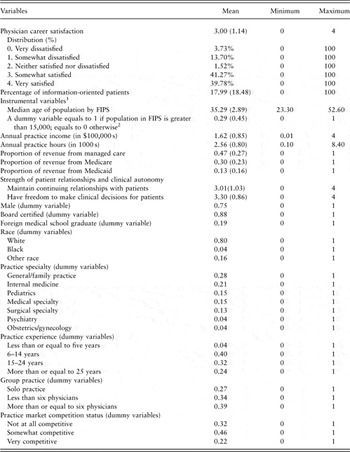
This variable measures the percentage of the physicians’ patients who use medical information from sources other than their provider. We term these patients as information-oriented patients. This term is intended only to describe the behavior of such patients (e.g. that they gather medical information), not to imply any positive or negative connotations. The percentage of information-oriented patients is a continuous variable ranging from 0 to 100 for each physician. Table 1 shows that on average, approximately 18% of patients treated by physicians are information-oriented.
Variable names and descriptive statistics, n = 9294

FIPS = Federal Information Processing Standards; CTS = Community Tracking Study; ARF = Area Resource File.
1Both instrumental variables are from ARF maintained at Bureau of Health Professions, US Department of Health and Human Services.
2The mean population by FIPS in the study sample is 15,032.
Data source: CTS physician survey 2000–2001.
Note: standard deviations are reported in parentheses.
3.3 Physician career satisfaction
The CTS physician survey also asks the following question about physician career satisfaction:
Thinking very generally about your satisfaction with your overall career in medicine, would you say that you are currently: very satisfied, somewhat satisfied, neither satisfied nor dissatisfied, somewhat dissatisfied, or very dissatisfied.
As Table 1 indicates, 40% of physicians reported being very satisfied, 41% somewhat satisfied, 1% neither satisfied nor dissatisfied, 14% somewhat dissatisfied, and only 4% very dissatisfied. We have coded this variable on a 5-point Likert scale from 0 (very dissatisfied) to 4 (very satisfied). The mean value of physician career satisfaction is 3. Physicians are generally happy with their medical careers, as very satisfied and somewhat satisfied physicians account for more than 80% of the sample. Evidence on satisfaction across professions is limited by differences in survey methodology and response categories (Mechanic, Reference Mechanic2003). However, available evidence does suggest that dentists, nurses and lawyers are no more satisfied and in fact may be less satisfied than are physicians (Hirsch, Reference Hirsch1993; Chambers, Reference Chambers2001; Spratley et al., Reference Spratley, Johnson, Sochalski, Fritz and Spencer2003).
One concern is that the ordered and categorical feature of the physician’s career satisfaction variable implies that it should be treated as non-linear. It is incorrect to assume that the difference between very dissatisfied and somewhat dissatisfied, for example, is the same as that between somewhat satisfied and very satisfied. In order to account for the non-linear feature of physician career satisfaction, previous studies of physician satisfaction have typically constructed binary outcomes, classifying ‘somewhat satisfied’ and ‘very satisfied’ into the satisfied group, and including all other physicians in the not satisfied cohort. While this approach accounts for the non-linear feature of physician satisfaction variable as a univariate probit model, important variation is omitted. For example, the high percentages of ‘very satisfied’ and ‘somewhat satisfied’ in our sample show that physicians can distinguish between these two measures. To deal with the non-linear nature of the physician satisfaction variable and include all available information on it in the multivariate analysis, we will estimate an ordered probit model.
3.4 Other explanatory variables
In addition to the measure of information-oriented patients, other potential determinants of physician career satisfaction include a variety of physician and medical practice characteristics and variables that may affect the physician agency relationship to his patients. Sociodemographic characteristics include physician gender, race, years of practice experience, whether the physician is a foreign medical school graduate and board certified status. Medical practice characteristics include annual practice income, annual practice hours, the revenue shares from managed care, Medicare and Medicaid, practice specialty, group practice status and competitive conditions in the physician’s market area.
Physician agency variables include the extent to which the physician agrees that he has the freedom to make clinical decisions for his patients in his practice and to maintain long-term relationships with his patients.Footnote 2 The former variable measures the extent to which the agency relationship is the traditional doctor-directed model. This also measures the degree of physician practice autonomy, which a number of previous studies have found to be an important determinant of career satisfaction (Stoddard et al., Reference Stoddard, Hargraves, Reed and Vratil2001; Landon et al., Reference Landon, Reschovsky and Blumenthal2003). The second variable helps capture the quality of the physician–patient relationship within the practice. Presumably, physicians who are better able to develop long-term relationships with their patients on average have better interactions with them. Descriptive statistics for the variables included in this study are provided in Table 1.
4. Estimation strategy
4.1 Multivariate estimation model
We write our multivariate estimation model as follows:

where S = physician career satisfaction, X = a vector of other explanatory variables, C = percentage of information-oriented patients, ε = a disturbance term; and β 0–β 2 = coefficients to be estimated.
The multivariate model estimates the effect of information-oriented patients on physician career satisfaction while controlling for other important factors. The coefficient on the percentage of information-oriented patients, β 2, is the key coefficient to be estimated. In equation (1), physician career satisfaction is ordered and categorical, so ordinary least squares (OLS) regression may not capture this non-linear feature efficiently. Instead, we apply the ordered probit model to analyze this effect. The ordered probit model accounts for both ordered and categorical features of the dependent variable. The disturbance term in equation (1) is still assumed to follow a normal distribution.
In order to compare our results with those in the previous literature, we also apply our data to OLS. The OLS model assumes that the physician career satisfaction variable is a cardinal measure, so that the difference between two categories has mathematical meaning. This alternative estimation using OLS serves as a robustness check.
4.2 The control function method
One concern about the above multivariate estimation model is the potential endogeneity of the percentage of information-oriented patients in equation (1). Endogeneity may reflect unobservable omitted variables, reverse causality (simultaneity) and/or measurement errors (Wooldridge, Reference Wooldridge2001). If the percentage of information-oriented patients variable is correlated with the disturbance term, the estimated coefficient β 2 will be biased. Information-oriented patients are not randomly assigned to physicians, and they may have characteristics and preferences (unobserved omitted factors) that differ from other patients. Likewise, the physician who is chosen by information-oriented patients has some specific characteristics that are preferred by these patients. The non-randomness of this matching process, as well as potentially different characteristics of information-oriented patients and their physicians, suggest that failure to correct for endogeneity may lead to biased estimates of the association between information-oriented patients and physician career satisfaction. For example, if information-oriented patients select physicians who are more tolerant of questioning and inquisitive patients, one might find that such patients do not negatively impact physician career satisfaction; indeed, one might even observe a positive relationship. But if information-oriented patients were randomly assigned to physicians, we might expect a less positive (or more negative) association between information-oriented patients and career satisfaction. Moreover, less satisfied physicians could significantly increase the percentage of patients who feel the need to mention information found elsewhere, in which case one could only identify a correlation between information-oriented patients and physician career satisfaction, not a causal relationship. Our measure of information-oriented patients is based on physician responses; hence, it is also subject to potential recall bias (measurement errors). For example, it may be that less satisfied physicians more readily recall patients seeking medical information from alternative sources.
Since the physician career satisfaction variable is ordered and categorical, using two-stage least squares estimation to correct for endogeneity may not be efficient. Instead, we apply the control function method (Wooldridge, Reference Wooldridge2001). We begin by estimating the share of the physician’s patients who are information-oriented:

where Z = instrumental variables, α 0−α 2 = coefficients to be estimated; and e = a disturbance term.
Since the measure of information-oriented patients is endogenous, C is correlated with the error term ε in equation (1), so that the covariance of ε and e will differ from 0. The control function is a two-stage method. The first stage is an OLS estimation of equation (2), because our patient information variable is continuous, allowing us to obtain the predicted residual ê. The second step is to replace the unobservable variables with the predicted residual and perform the ordered probit estimation of the following model:

The control function estimation will produce consistent estimates of the coefficients in equation (3). In addition, the statistical significance of the coefficient β 3 also serves as an exogeneity test (Hausman, Reference Hausman1983; Wooldridge, Reference Wooldridge2001). If the coefficient on the predicted residual included in equation (3) is statistically significant, the percentage of information-oriented patients is endogenous and the two disturbances in equations (1) and (3) are correlated. The covariance between ε and e is approximately equal to the coefficient of the included residual in equation (3) (Rivers and Vuong, Reference Rivers and Vuong1988). This approach is also known as the two-stage residual inclusion estimation (Terza et al., Reference Terza, Basu and Rathouz2008). Since we apply two-stage estimation, the standard errors in the second stage are underestimated. Non-parametric bootstrap techniques with 1000 replications have been applied in this paper to correct for the standard errors, and bias-corrected statistical significance levels are reported.
4.3 Instrumental variables
Our instrumental variables are median age of the population by Federal Information Processing Standards (FIPS)Footnote 3 area and a dummy variable equal to one if the population size in the FIPS area is greater than the mean population size (15,032) of all FIPS areas and equal to 0 otherwise. These instrumental variables are taken from the Area Resource File (ARF) maintained by the Bureau of Health Professions, US Department of Health and Human Services. Since our CTS data are from 2000 to 2001, our instrumental variables pertain to 2000 data in ARF. ARF obtained these two measures from the US Census 2000.
We anticipate that the percentage of information-oriented patients will be directly related to population size. Consumers in more populated market areas may have greater access to media generally, including better access to medical information. Age should also relate to information-oriented patients, though there are competing effects as to the direction of the relationship. Older subjects have greater demand for medical care and may be more likely to seek out sources of medical information, suggesting a direct relationship between age of the population and percentage of information-oriented patients. However, older subjects may be less willing and able to access non-traditional sources of medical information. These patients may be less computer-literate than their younger counterparts and less willing to confront physicians regarding treatment issues. The net effect is an empirical question.
There is little reason to expect that physician career satisfaction should relate directly to median age or population size. All of the sites included in the CTS are metropolitan areas, and it is difficult to believe that physician career satisfaction should differ systematically depending upon whether the physician practices in a very large market like New York City or a smaller metropolitan area such as Baltimore, Maryland. Similarly, we can think of no compelling story why physician career satisfaction should vary systematically with median age of the population in the market area. Finally, in preliminary analyses, we found no evidence of direct effects of either variable on physician career satisfaction.
5. Results
5.1 Physician career satisfaction and information-oriented patients
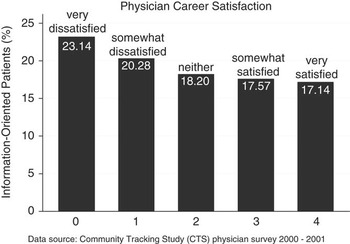
Before proceeding to our multivariate results, Figure 1 shows the simple relationship between physician career satisfaction and the percentage of information-oriented patients. Among physicians who are very dissatisfied with their careers, 23.14% of their patients are information-oriented. This percentage declines to 20.28% for somewhat dissatisfied physicians. The percentages of information-oriented patients decrease to about 18% or lower for the other three categories of physicians with higher career satisfaction.
Mean percentage of information-oriented patients by physician career satisfaction categories

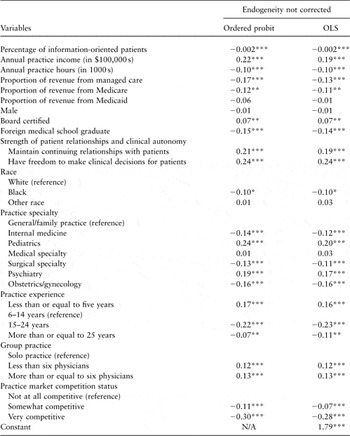
Assuming that the percentage of information-oriented patients is exogenous, a single equation model may be estimated. We apply the ordered probit model to equation (1) and the estimation results are reported in Table 2. We find that information-oriented patients negatively affect physician career satisfaction. Although the coefficient is statistically significant at the 1% level, the coefficient is rather small (−0.002). The alternative estimation by OLS produces very similar results to those using the ordered probit estimation in Table 2.
Multivariate estimates of career satisfaction, endogeneity not corrected

OLS = ordinary least squares; N/A = not applicable.
*Significant at the 10% level; **significant at the 5% level; ***significant at the 1% level.
Owing to potential endogeneity, we apply control function estimation to the ordered probit model. In the first stage of this model, we use median age of the population and a dummy variable indicating a more populated market area to instrument the percentage of information-oriented patients. The results of the first stage estimation are reported in Appendix. Both instrumental variables are positive and highly significant in the first stage OLS estimation (p-values <0.01). The coefficient on median age is 0.17, which means the percentage of information-oriented patients will increase by 0.17% if median age rises by one year. The dummy variable of more populated areas has a coefficient of 1.065, so the percentage of information-oriented patients will increase by 1.065% in more populated areas. The under-identification test using the Cragg–Wald Statistic for the instrumental variables in the first stage is 12.32 and significant at the 1% level. The F-statistic testing the weak instrumental variables in the first stage is 19.36 (Staiger and Stock, Reference Staiger and Stock1997). Based on these tests, these two variables are sound instruments.
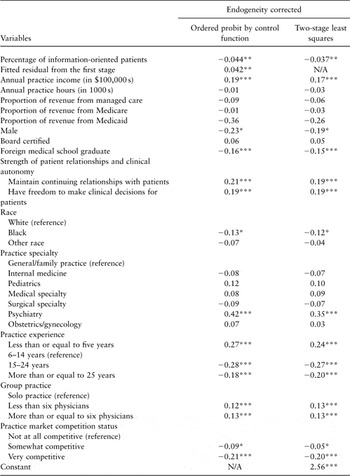
In the second stage of the control function estimation, the coefficient of information-oriented patients is still negative and statistically significant at the 5% level. Two pieces of evidence suggest that the percentage of information-oriented patients is endogenous. First, its coefficient changes from −0.002 to −0.044 after controlling for endogeneity. Second, the coefficient of the predicted residual included in the second stage is statistically significant at the 5% level, indicating that the disturbances in equations (1) and (3) are correlated so that the variable of information-oriented patients is endogenous (Hausman, Reference Hausman1983; Wooldridge, Reference Wooldridge2001). The single equation model thus appears to underestimate the effect of these patients on physician career satisfaction. The alternative estimation by the two-stage least squares also produces similar results as those estimated by the control function approach in Table 3.
Multivariate estimates of career satisfaction, endogeneity corrected

N/A = not applicable.
*Significant at the 10% level; **significant at the 5% level; ***significant at the 1% level.
5.2 Marginal effect of information-oriented patients on physician career satisfaction
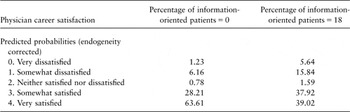
To gain a sense of the importance of information-oriented patients on physician satisfaction, we use the ordered probit results in Table 3 to compute marginal effects, which are summarized in Table 4. Table 4 indicates how physician career satisfaction levels change when the percentage of information-oriented patients increases from 0 to its sample mean value: 18%, holding other factors constant.
Marginal effects of information-oriented patients on physician career satisfaction

The mean of information-oriented patients in the study sample is 18%.
After correcting for endogeneity, the probability that the physician is very satisfied with his career declines from 63.61% to 39.02% when we change the percentage of information-oriented patients from 0 to its mean value. The ordered probit analysis furthermore delineates how satisfaction declines. In particular, while far fewer physicians are very satisfied, many more are now only somewhat satisfied, somewhat dissatisfied or very dissatisfied.
6. Conclusion
As Professor Arrow (Reference Arrow1963) observed many years ago, good agency relationships between physicians and their patients are fundamental to the proper performance of medical markets. However, the dynamic nature of these markets implies that this relationship is itself dynamic and may be altered by regulatory and other institutional changes. How such changes affect physician career satisfaction can provide useful insights into the likely effects on the physician agency relationship. A number of previous studies have examined the effects of managed care on physician satisfaction. The present analysis considers the association of information-oriented patients, a more recent development in medical markets, and physician career satisfaction.
We find that information-oriented patients are negatively associated with physician career satisfaction. Moreover, once we correct for endogeneity, the magnitude of this association becomes substantial. For example, if the physician’s share of information-oriented patients increases from 0 to the sample means of 18%, the proportion of physicians who are very satisfied with their career choice declines by about 25 percentage points. Getting more information is a substantive change in how patients relate to their medical care providers. Our results indicate that having a greater proportion of information-oriented patients has an important association with physician career satisfaction. From a policy perspective, we may hypothesize that, while information-oriented patients might be more cost-conscious and generally more knowledgeable, there is the risk that such patients may alienate their physician providers, who ultimately remain the arbiters of their care.
6.1 Limitations
Our study has some limitations that must be noted. Owing to data limitations, we are unable to separate out the types of patients who get information from friends and relatives, the Internet and other sources, etc. Conceivably, the association between information-oriented patients and physician career satisfaction could vary depending upon where their patients obtain medical information. In future work, it would be interesting to examine the individual effects of alternative sources of information when such data become available.
While we have attempted to control for all important confounders that may affect physician satisfaction, some relevant factors may have been omitted. For example, changes in physician income over time may affect satisfaction as well as the absolute level of income. However, we are unable to include income changes due to data limitations. The non-randomized nature of our data and other sources of endogeneity in our key explanatory variable required that we employ instrumental variables estimation to overcome these problems. While our instruments appear to perform well and pass a number of tests checking their reliability, these results should be viewed with caution. The information-oriented patient measure is only available in the CTS physician survey 2000–2001. Thus, while the CTS has an unbalanced longitudinal design, we are unable to take advantage of this longitudinal feature.
While the precise implications for cost, quality and access to care lie beyond the scope of this study, significant reductions in physician career satisfaction hardly bode well for these important outcomes. Declining career satisfaction may also raise physician job turnover (Pathman et al., Reference Pathman, Konrad, Williams, Scheckler, Linzer and Douglas2002), decreasing continuity of care. An important direction for further research is to understand the clinical, cost and labor market implications of these changes in physician career satisfaction.
Appendix. First stage (OLS) estimates instrumenting the percentage of information-oriented patients

1Both instrumental variables are from ARF maintained at Bureau of Health Professions, US Department of Health and Human Services.
2The mean population by FIPS in the study sample is 15,032.
**Significant at the 5% level; ***Significant at the 1% level.