


1. Introduction
The South China Craton, including the Yangtze Block to the northwest and the Cathaysia Block to the southeast (present coordinates), was presumably the central part of the Precambrian supercontinent Rodinia (Fig. 1a) (Li, Zhang & Powell, Reference Li, Zhang and Powell1995). Apart from the Kongling Complex, there have been three other major rock units previously reported from the Yangtze Block, including some volcanic and meta-volcanic rocks of late Palaeoproterozoic to Mesoproterozoic age. The c. 1.75–1.66 Ga Dahongshan Group (marked ‘2’ in Fig. 1a) consists of meta-volcaniclastic rocks, meta-basalts, meta-siliciclastic rocks and marble (e.g. Greentree & Li, Reference Greentree and Li2008; Zhao et al. Reference Zhao, Zhou, Li, Sun, Gao, Sun and Yang2010). The Tianli schists (marked ‘3’ in Fig. 1a) represent a clastic sedimentary succession, probably formed on the southern continental shelf of the Yangtze Block between c. 1530 Ma and 1042 Ma (Li et al. Reference Li, Wartho, Occhipinti, Zhang, Li, Wang and Bao2007). The Kunyang–Huili groups (marked ‘4’ in Fig. 1a) consist of a sequence of greenschist-facies meta-sedimentary and meta-volcanic rocks that probably developed between 1.8 Ga and 1.0 Ga (Greentree et al. Reference Greentree, Li, Li and Wu2006; Greentree & Li, Reference Greentree and Li2008; Zhao et al. Reference Zhao, Zhou, Li, Sun, Gao, Sun and Yang2010).
(a) Simplified tectonic map showing the study area in relation to South China's major tectonic units (Li et al. Reference Li, Wartho, Occhipinti, Zhang, Li, Wang and Bao2007). Numbers 1–4 indicate the Kongling Complex, the Dahongshan Group, the Tianli schists and the Kunyang–Dongchuan groups, respectively; (b) geological map of the late Palaeo- to Mesoproterozoic strata and Proterozoic intrusions in the Kangdian region, SW China (modified from Wu et al. Reference Wu, Duan, Song, Chen and Dan1990; Zhao & Zhou, Reference Zhao and Zhou2011).

The Yangtze Block played an important role in the reconstruction of the Rodinia supercontinent (e.g. Li, Zhang & Powell, Reference Li, Zhang and Powell1995; Li et al. Reference Li, Li, Zhou and Kinny2002, Reference Li, Bogdanova, Collins, Davidson, De waele, Ernst, Fitzsimons, Fuck, Gladkochub, Jacobs, Karlstrom, Lu, Natapovm, Pease, Pisarevsky, Thrane and Vernikovsky2008), but little is known as to whether or not it was also a component of the Palaeo- to Mesoproterozoic supercontinent called Nuna (Hoffman, Reference Hoffman1989, Reference Hoffman, Van der Pluijm and Marshak1997; Evans & Mitchell, Reference Evans and Mitchell2011; Zhang et al. Reference Zhang, Li, Evans, Wu and Li2012) or Columbia (Rogers & Santosh, Reference Rogers and Santosh2002; Zhao et al. Reference Zhao, Cawood, Wilde and Sun2002a ; Hou et al. Reference Hou, Santosh, Qian, Lister and Li2008b ; Meert, Reference Meert2012; we will use this name in the remainder of this paper for the late Palaeo- to Mesoproterozoic supercontinent). Nonetheless, 2.03–1.97 Ga granulites and 1.85 Ga A-type granites and mafic dykes have been identified in the northern part of the Yangtze Block (the Kongling Complex; ‘1’ in Fig. 1a) (Zhang et al. Reference Zhang, Zheng, Wu, Zhao, Gao and Wu2006a ; Sun et al. Reference Sun, Chen, Zhao, Wilde, Ye, Guo, Chen and Yuan2008; Wu et al. Reference Wu, Zheng, Gao, Jiao and Liu2008; Xiong et al. Reference Xiong, Zheng, Yu, Su, Tang and Zhang2009; Peng et al. Reference Peng, Wu, Wang, Jiao, Liu and Yang2009, Reference Peng, Wu, Gao, Zhang, Wang, Liu, Gong, Zhou, Hu, Liu and Yan2012), which coincide with the age of the Columbia supercontinent assembly (Hoffman, Reference Hoffman1989, Reference Hoffman, Van der Pluijm and Marshak1997), and may therefore be genetically linked to the evolution of the supercontinent. Yao, Shu & Santosh (Reference Yao, Shu and Santosh2011) presented evidence from detrital zircon U–Pb geochronology, Hf isotopes and geochemistry from the Cathaysia Block (Fig. 1a) with clear age peaks at 1930–1520 Ma, which they correlated with the Columbia supercontinent. In addition, a number of studies have documented the late Palaeoproterozoic to early Mesoproterozoic igneous rocks in the southwestern Yangtze Block in recent years. The presence of late Palaeoproterozoic to early Mesoproterozoic (1.7–1.5 Ga) mafic magmatism in the southwestern Yangtze Block is contemporaneous with the break-up of the Columbia supercontinent, and provides further evidence to support the idea that the Yangtze Block was likely a part of the Columbia supercontinent (Zhao et al. Reference Zhao, Zhou, Li, Sun, Gao, Sun and Yang2010, Reference Zhao, Zhou, Li and Qi2013; Fan et al. Reference Fan, Zhu, Li, Zhong, Bai, He, Chen and Chao2013). Meanwhile, the Yinmin Formation of the Lower Kunyang Group in the southwestern Yangtze Block contains zircons of ages dominantly from late Archaean to Palaeoproterozoic (2.8–2.7 Ga, 2.5–2.3 Ga and c. 1.85 Ga). The Heishantou Formation of the Upper Kunyang Group has two major age populations, i.e. 1.8–1.6 Ga and c. 1.0 Ga. The presence of abundant c. 1.85 Ga zircons also suggests that the Yangtze Block was probably a part of the Columbia supercontinent during Palaeoproterozoic time (Wang et al. Reference Wang, Yu, Griffin and O'Reilly2012).
In recent years, many intrusive igneous rocks in the southwestern Yangtze Block have been gradually identified in age as late Palaeoproterozoic to early Mesoproterozoic, although these intrusive igneous rocks in the Kangdian region are sparse and on a small scale. For example, a number of mafic intrusions and dykes intruded into the Dahongshan Group, Lower Kunyang Group (also called the Dongchuan Group; we will use the name Lower Kunyang Group in the remainder of the paper), Hekou Group and Huili Group in the Kangdian region (Zhao et al. Reference Zhao, Zhou, Li, Sun, Gao, Sun and Yang2010, Reference Zhao, Zhou, Li and Qi2013; Guan et al. Reference Guan, Zheng, Liu, Sun and Cheng2011; Zhao & Zhou, Reference Zhao and Zhou2011; Fan et al. Reference Fan, Zhu, Li, Zhong, Bai, He, Chen and Chao2013). A dolerite dyke cutting the Dahongshan Group has a laser ablation inductively couple plasma mass spectrometry (LA-ICP-MS) U–Pb zircon age of 1659±16 Ma (Zhao & Zhou, Reference Zhao and Zhou2011). The other dolerite dykes that cut the Yinmin Formation of the Lower Kunyang Group have LA-ICP-MS and a secondary ion mass spectroscopy (SIMS) U–Pb zircon ages of 1690±32 Ma (Zhao et al. Reference Zhao, Zhou, Li, Sun, Gao, Sun and Yang2010) and 1701±28 Ma (Zhao et al. Reference Zhao, Zhou, Li and Qi2013), respectively. In addition, the Zhuqing Fe–Ti–V oxide ore-bearing mafic intrusions that intruded into the Huili Group were dated at 1494±6 Ma (zircon U–Pb), 1486±3 Ma and 1490±4 Ma (baddeleyite U–Pb), respectively (Fan et al. Reference Fan, Zhu, Li, Zhong, Bai, He, Chen and Chao2013). However, owing to the lack of more systematic geochemical and isotopic data, the origin and tectonic implications of these mafic dykes and intrusions remain unclear. Thus, further studies on the timing and tectonic setting of these mafic dykes and intrusions are needed, which will play an important role in elucidating the late Palaeoproterozoic to early Mesoproterozoic tectonic evolution of the southwestern Yangtze Block.
There are numerous mafic intrusions that intruded the Hekou Group in the Hekou area, SW Huili County (D. F. He, unpub. Ph.D. thesis, Graduate School of the Chinese Academy of Sciences, 2009; Zhou et al. Reference Zhou, Zheng, Zhu, Chen, Shen, Li and Luo2009; Guan et al. Reference Guan, Zheng, Liu, Sun and Cheng2011; Chen & Zhou, Reference Chen and Zhou2012; Chen, Zhou & Zhao, Reference Chen, Zhou and Zhao2013). Recent studies have focused on the ages of these intrusions. The c. 1.7 Ga dolerite and gabbroic intrusions that intruded into the Hekou Group were recently identified in the Hekou area (Guan et al. Reference Guan, Zheng, Liu, Sun and Cheng2011; Chen, Zhou & Zhao, Reference Chen, Zhou and Zhao2013). However, Guan et al. (Reference Guan, Zheng, Liu, Sun and Cheng2011) reported a SHRIMP zircon age of 1710±8 Ma for a dolerite intrusion that intruded into the Hekou Group, which is very different from the whole-rock Sm–Nd isochron age of c. 850 Ma for some gabbroic and dolerite intrusions in this area (Zhou et al. Reference Zhou, Zheng, Zhu, Chen, Shen, Li and Luo2009). In addition, the petrogenesis of the mafic intrusions is not well understood in this area. Thus, systematic geochronological, elemental and Nd isotopic investigations on these rocks are further required to elucidate the origin and tectonic implications of these mafic intrusions.
In this paper, we report precise Cameca SIMS U–Pb zircon ages, and geochemical and Nd isotopic data for the biggest and most representative Hekou gabbroic intrusion in the Hekou area with the aim to (1) date the crystallization age for the gabbroic intrusion; (2) constrain the origin and petrogenesis of the intrusion; and (3) shed new light on the late Palaeoproterozoic tectonic evolution in the southwestern Yangtze Block. Our new results confirm that the gabbroic intrusion emplaced at c. 1.7 Ga in the Hekou area was derived from a slightly depleted mantle source and formed in an intracontinental rift, most likely related to the break-up of the Columbia supercontinent.
2. Geological background and petrography
The South China Craton consists of two major Precambrian blocks: the Yangtze Block and the Cathaysia Block (present coordinates) (Fig. 1a; Li et al. Reference Li, Wartho, Occhipinti, Zhang, Li, Wang and Bao2007). The oldest rocks exposed in the Yangtze Block are the Kongling complex (marked ‘1’ in Fig. 1a) containing magmatic and metamorphic rocks as old as 3.3 Ga (Zhang et al. Reference Zhang, Zheng, Wu, Zhao, Gao and Wu2006a ; Gao et al. Reference Gao, Yang, Zhou, Li, Hu, Guo, Yuan, Gong, Xiao and Wei2011). Zheng et al. (Reference Zheng, Griffin, O'Reilly, Zhang, Pearson and Pan2006) suggested a wide distribution of Archaean rocks in the unexposed basement of the Yangtze Block based on U–Pb and Hf isotopic data from zircon xenocrysts in Palaeozoic lamproites. Zhao et al. (Reference Zhao, Zhou, Li, Sun, Gao, Sun and Yang2010) and Wang et al. (Reference Wang, Yu, Griffin and O'Reilly2012) reached the same conclusion based on detrital zircon analyses of Palaeo- to Neoproterozoic sedimentary rocks in the southwestern Yangtze Block. These recent studies have proposed that the Archaean to Palaeoproterozoic basement is probably more widespread in the Yangtze Block than previously thought (Zheng et al. Reference Zheng, Griffin, O'Reilly, Zhang, Pearson and Pan2006; Zhang et al. Reference Zhang, Zheng, Wu, Zhao, Gao and Wu2006a ,Reference Zhang, Zheng, Wu, Zhao, Gao and Wu b ; Wang et al. Reference Wang, Griffin, Yu and O'Reilly2010, Reference Wang, Yu, Griffin and O'Reilly2012).
The Kangdian area (Fig. 1b) is located near the southwestern margin of the Yangtze Block (Fig. 1a). The oldest supracrustal rocks in this area are the late Palaeo- to Mesoproterozoic meta-volcanic and meta-sedimentary rocks, termed the Dahongshan Group (Greentree & Li, Reference Greentree and Li2008), the Lower Kunyang Group (Dongchuan Group; Zhao et al. Reference Zhao, Zhou, Li, Sun, Gao, Sun and Yang2010), the Hekou Group (Wu et al. Reference Wu, Duan, Song, Chen and Dan1990; D. F. He, unpub. Ph.D. thesis, Graduate School of the Chinese Academy of Sciences, 2009; Zhao & Zhou, Reference Zhao and Zhou2011), the Huili Group (Yin, Sun & Zhang, Reference Yin, Sun and Zhang2011) and the Kunyang Group (Yin, Sun & Zhang, Reference Yin, Sun and Zhang2011), which occur along the Luzhijiang fault and a series of related NNE-trending faults (Fig. 1b). They consist of meta-sedimentary rocks interbedded with felsic and mafic meta-volcanic rocks (Li et al. Reference Li, Li, Zhou and Kinny2002, Reference Li, Li, Sinclair, Li and Carter2006; Greentree et al. Reference Greentree, Li, Li and Wu2006; Greentree & Li, Reference Greentree and Li2008; Zhao et al. Reference Zhao, Zhou, Li, Sun, Gao, Sun and Yang2010). These late Palaeo- to Mesoproterozoic rocks are overlain by a thick sequence (maximum > 9 km) of Neoproterozoic (850–540 Ma) to Permian strata consisting of clastic, carbonate and volcanic rocks (Cong, Reference Cong1988; SBGMR, 1991).
The ages of the Precambrian units in the Kangdian region had been poorly constrained (see review by Wu et al. Reference Wu, Duan, Song, Chen and Dan1990) until the availability of precise U–Pb zircon ages in recent years. The Dahongshan Fe–Cu ore deposit is hosted in the Dahongshan Group (Zhao & Zhou, Reference Zhao and Zhou2011). Meta-volcanic units in the Dahongshan Group have been dated at 1675±8 Ma and 1681±13 Ma by SHRIMP U–Pb zircon (Greentree & Li, Reference Greentree and Li2008) and LA-ICP-MS U–Pb zircon (Zhao & Zhou, Reference Zhao and Zhou2011) methods, respectively.
The Kunyang Group in the southern part of the study region (Fig. 1b) was divided into the Upper and Lower Kunyang groups (e.g. Zhao et al. Reference Zhao, Zhou, Li, Sun, Gao, Sun and Yang2010; Zhao & Zhou, Reference Zhao and Zhou2011; Yin, Sun & Zhang, Reference Yin, Sun and Zhang2011). From the base upwards, the Lower Kunyang Group (Zhao et al. Reference Zhao, Zhou, Li, Sun, Gao, Sun and Yang2010; Zhao & Zhou, Reference Zhao and Zhou2011; Yin, Sun & Zhang, Reference Yin, Sun and Zhang2011) includes the Yinmin, Luoxue, E'touchang and Luzhijiang formations, whereas the Upper Kunyang Group consists of the Dayingpan, Heishantou, Dalongkou and Meidang formations. Several ‘Dongchuan-type’ Fe–Cu ore deposits are hosted in the Lower Kunyang Group (Zhao et al. Reference Zhao, Zhou, Li, Sun, Gao, Sun and Yang2010, Reference Zhao, Zhou, Li and Qi2013; Zhao & Zhou, Reference Zhao and Zhou2011). Detrital zircons from the Lower Kunyang Group yielded the youngest age of c. 1.78 Ga, and a tuff sample from the same group has a U–Pb zircon age of 1742±13 Ma (Zhao et al. Reference Zhao, Zhou, Li, Sun, Gao, Sun and Yang2010). Sun et al. (Reference Sun, Yin, Guan, Liu, Li, Geng and Wang2009) recently reported a SHRIMP zircon age of 1503±17 Ma for a tuff sample from the E'touchang Formation in the Lower Kunyang Group. Thus, the Lower Kunyang Group likely formed between c. 1.7 Ga and c. 1.5 Ga. Zhao et al. (Reference Zhao, Zhou, Li, Sun, Gao, Sun and Yang2010) hence interpreted the Lower Kunyang (Dongchuan) and Dahongshan groups as stratigraphically correlatable units (Fig. 1b). In addition, a carbonaceous shale sample of the Dayingpan Formation from the Upper Kunyang Group yielded a whole-rock Pb–Pb isochron age of 1258±70 Ma (Chang et al. Reference Chang, Zhu, Sun, Qiu and Zou1997). A tuff layer in the Heishantou Formation of the Upper Kunyang Group has been dated at 995±15 Ma and 1032±9 Ma by SHRIMP U–Pb zircon dating (Greentree et al. Reference Greentree, Li, Li and Wu2006; Zhang et al. Reference Zhang, Gao, Wu, Shi, Yan and Li2007). Meanwhile, detrital zircons from the Upper Kunyang Group also gave U–Pb ages as young as 960 Ma (Greentree et al. Reference Greentree, Li, Li and Wu2006).
The Huili Group in the northern part of the study region (Fig. 1b) is an over 10 km thick sequence of meta-clastic and meta-carbonate rocks interbedded with volcanic rocks (Wu et al. Reference Wu, Duan, Song, Chen and Dan1990). The group consists of the Yinmin, Luoxue, Heishan, Qinglongshan, Limahe, Fengshan and Tianbaoshan formations, from the base upwards (Wu et al. Reference Wu, Duan, Song, Chen and Dan1990). The meta-volcanic rocks in the Tianbaoshan Formation have TIMS U–Pb zircon and SHRIMP U–Pb zircon ages of 958±16 Ma (Mou, Lin & Yu, Reference Mou, Lin and Yu2003) and 1028±9 Ma (Geng et al. Reference Geng, Yang, Du, Wang, Ren and Zhou2007), respectively.
The Hekou Group in the northwestern part of the study region (Fig. 1b) is a sequence of meta-clastic and meta-carbonate rocks. This group is in fault contact with the Huili Group to the W and NE and is unconformably overlain by Sinian and Phanerozoic strata to the NW and E–SE (Fig. 2a). The Hekou Group comprises the Dayingshan, Luodang and Changchong formations from the base upwards (Fig. 2b), and has a total thickness of >1800 m (Fig. 2b; J. Y. Zhou, unpub. Ph.D. thesis, Chengdu Univ. Technology, 2005). The Lala Fe–Cu ore deposit is hosted in the Hekou Group (D. F. He, unpub. Ph.D. thesis, Graduate School of the Chinese Academy of Sciences, 2009; Chen & Zhou, Reference Chen and Zhou2012). The latter is generally considered to be the equivalent of the Dahongshan Group (Wu et al. Reference Wu, Duan, Song, Chen and Dan1990; Zhao et al. Reference Zhao, Zhou, Li, Sun, Gao, Sun and Yang2010), as confirmed by a recent SHRIMP U–Pb zircon age of 1695±20 Ma for the meta-volcanic rocks (D. F. He, unpub. Ph.D. thesis, Graduate School of the Chinese Academy of Sciences, 2009) (Figs 1, 2).
(a) A simplified geologic map of the Hekou area, Sichuan Province, SW China; (b) a simplified stratigraphic column of the Hekou Group. Modified from the Chinese Huili 1:200000 geological map (SBG, 1967).

A number of relatively well-preserved mafic and felsic intrusions are exposed in the vicinity of the Hekou Town and Lala Fe–Cu ore deposit in the Hekou area. The former intruded into the Dayingshan Formation and the latter into Luodang Formation of the Hekou Group, respectively (Fig. 2a, b; SBG, 1967; D. F. He, unpub. Ph.D. thesis, Graduate School of the Chinese Academy of Sciences, 2009; Zhou et al. Reference Zhou, Zheng, Zhu, Chen, Shen, Li and Luo2009; Guan et al. Reference Guan, Zheng, Liu, Sun and Cheng2011; Chen & Zhou, Reference Chen and Zhou2012). Rocks from these mafic intrusions are slightly to strongly altered to chlorite, actinolite, albite and magnetite, but their ophitic texture and minor primary clinopyroxene are still preserved (J. Y. Zhou, unpub. Ph.D. thesis, Chengdu Univ. Technology, 2005; Chen & Zhou, Reference Chen and Zhou2012).
The Hekou gabbroic intrusion investigated in this paper intruded into the Dayingshan Formation of the Hekou Group near Hekou Town, SW Huili County, Sichuan province (Fig. 1b). The intrusion strikes NE–NW and dips to the SE or SW with an angle of ~30–45°. The intrusion is the biggest mafic intrusion in the Hekou area and is up to 4–5 km long with a thickness between 1 and 2 km, covering an area of about 6 km2 (Fig. 2a). These rocks are dark-grey to black, fine to coarse grained, with massive and subhedral granular and ophitic textures. The coarse-grained gabbroic rocks are in the central zone (CZ) of the intrusion, and are moderately to strongly altered to chlorite, actinolite and albite. However, the medium- to fine-grained gabbroic rocks are usually observed in the outer zone (OZ) of the intrusion, and are relatively fresh to slightly altered. These rocks mainly consist of plagioclase (50–55 vol.% by volume) and clinopyroxene (40–45 vol.%), and minor subordinate orthopyroxene, Fe–Ti oxides and apatite. Clinopyroxenes in the gabbros from the OZ commonly exhibit a medium- to fine-grained texture. Electron microprobe analyses indicate clinopyroxenes from the gabbros are Wo38–49En34–46Fs11–22, mostly belonging to augite (online Supplementary Material available at http://journals.cambridge.org/geo).
3. Sampling and analytical methods
Nineteen samples were collected from the CZ (samples HK1101 to HK1103) and the OZ (samples HK1104 to HK1211) of the gabbroic intrusion in the Hekou area (Fig. 2a, b).
Zircons from samples HK1103 and HK1107 were separated using conventional heavy liquid and magnetic techniques, then by handpicking under binocular microscopes. They were mounted in an epoxy resin disc, and polished and coated with gold film. Zircons were documented with transmitted and reflected light micrographs as well as cathodoluminescence (CL) images to reveal their external and internal structures. U–Pb zircon dating was conducted using a Cameca IMS 1280 ion microprobe (SIMS) at the Institute of Geology and Geophysics, the Chinese Academy of Sciences (CAS) in Beijing. Details of the analytical procedures for U–Pb zircon dating can be found in Li et al. (Reference Li, Liu, Li, Guo and Chamberlain2009, Reference Li, Li, Wang, Li, Liu, Tang, Gao and Wu2010). Oxygen flooding that introduces oxygen into the sample chamber was used during the analyses, which not only enhances Pb+ ion yield by a factor of 2 and 7 for zircon and baddeleyite (Li et al. Reference Li, Liu, Li, Guo and Chamberlain2009), respectively, but also depresses the U–Pb orientation effect (Wingate & Compston, Reference Wingate and Compston2000) down to ~2% (Li et al. Reference Li, Li, Wang, Li, Liu, Tang, Gao and Wu2010). The uncertainties in ages are cited as 1σ, and the weighted mean ages are quoted at the 95% confidence interval (2σ). The SIMS U–Pb zircon ages are presented in Table 1.
Cameca SIMS U–Pb zircon isotopic analyses for the gabbroic rocks from the Hekou intrusion, SW China

Errors are 1σ; f 206 is the percentage of common 206Pb in total 206Pb; Common Pb corrected using the measured 204Pb.
Chemical compositions of clinopyroxenes from the gabbroic intrusion were determined by wavelength-dispersion X-ray emission spectrometry using an EPMA-1600 electron microprobe at the State Key Laboratory of Ore Deposit Geochemistry (SKLODG), Institute of Geochemistry, Chinese Academy of Sciences (IGCAS). Major-element compositions of whole rocks were determined using X–ray fluorescence spectrometers (XRF) at the State Key Laboratory of Isotope Geochemistry, Guangzhou Institute of Geochemistry of the CAS. The analytical precision was better than 5%. Trace elements in whole rocks were analysed using a Perkin-Elmer Sciex ELAN DRC–e ICP-MS at the SKLODG, IGCAS. The powdered samples (50 mg) were dissolved with HF + HNO3 mixture in high-pressure Teflon bombs at ~190°C for 48 hours (Qi, Hu & Gregoire, Reference Qi, Hu and Gregoire2000). Rh was used as an internal standard to monitor signal drift during measurement. The international standards GBPG-1, OU-6 and the Chinese National standards GSR-1 and GSR-3, were used for analytical quality control. The analytical precision is generally better than 10% for trace elements.
Samples for Nd isotopic analyses were dissolved in an acidic mixture of HF, HNO3 and HClO4 in Teflon bombs. Sm and Nd were separated by conventional cation-exchange techniques at the SKLODG. The Nd isotopic measurements were performed on a multicollector ICP-MS (MC-ICP-MS) at the Key Laboratory of Orogenic Belts and Crustal Evolution, School of Earth and Space Sciences, Peking University. The mass fractionation corrections for Nd isotopic ratios are based on 146Nd/144Nd = 0.7219. The 143Nd/144Nd ratios of the JNDI-1 Nd standard solution and the USGS standard rock BCR-2 were determined to be 0.512119±14 (2σ) and 0.512629±16 (2σ), respectively.
4. Results
4.a. U–Pb zircon geochronology
4.a.1. Sample HK1103 (26°16´12.7″N, 102°01´04.6″E)
Zircons extracted from sample HK1103 in the CZ are mostly clear and up to 50–100 μm in length with length to width ratios between 1:1 and 1.5:1. Most zircons are simple prismatic crystals without obvious zoning under CL (Fig. 3a). Fourteen analyses were conducted on 14 zircons. Uranium and thorium concentrations are variable, with U = 213–1263 ppm, Th = 83–2879 ppm and Th/U = 0.31–3.79 (Table 1). Most analyses yielded near concordant ages, while four grains are obviously discordant owing to the loss of radiogenic lead. All 14 analyses give consistent 207Pb/206Pb ratios within errors, yielding a weighted average 207Pb/206Pb age of 1736±5.0 Ma (95% confidence interval, MSWD = 1.5). In addition, all these analyses yield a discordia line with an upper intercept age of 1735±6.5 Ma (MSWD = 4.9) (Fig. 4a).
Representative CL images of zircons from (a) sample HK1003 from the CZ; and (b) sample HK1007 from the OZ of the gabbroic rocks from the Hekou intrusion.

SIMS U–Pb Concordia diagrams of (a) sample HK1003 from the CZ; and (b) sample HK1007 from the OZ of the gabbroic rocks from the Hekou intrusion.

4.a.2. Sample HK1107 (26°16´25.0″N, 102°00´26.6″E)
Zircons from sample HK1107 from the OZ are mostly clear, euhedral prismatic grains without obvious zoning on CL images, and are 50–200 μm long with a length to width ratio of between 1:1 and 2:1 (Fig. 3b). Seventeen Cameca SIMS analyses were completed on 17 zircons with U concentration between 302 and 1533 ppm, Th between 388 and 2527 ppm, and Th/U ratios between 0.96 and 1.75 (Table 1). Most analyses yielded near concordant ages, while three grains are obviously discordant owing to the loss of radiogenic lead. All 17 analyses give consistent 207Pb/206Pb ratios within errors, yielding a weighted average 207Pb/206Pb age of 1728±3.6 Ma (95% confidence interval, MSWD = 0.51). In addition, all these 17 analyses yield a discordia line with an upper intercept age of 1736±4.0 Ma (MSWD = 1.2) (Fig. 4b).
Combining the dating results above, the upper intercept ages for sample HK1103 and sample HK1107 are 1735±6.5 Ma and 1736±4.0 Ma, respectively. Therefore, the upper intercept ages of c. 1736 Ma for the samples HK1103 and HK1107 are considered as the best estimate of the crystallization age for the gabbroic intrusion.
4.b. Elemental geochemistry
4.b.1. Alteration effects on chemical compositions
All the samples analysed in this study were the freshest available based on outcrop appearances, but they were altered to varying degrees judging from thin-section examinations. Nineteen samples from the Hekou gabbroic intrusion have been selected for major- and trace-element analyses (Table 2). The loss of ignition (LOI) values for the gabbroic rocks range from 0.55 to 2.69%. Thus, the effects of alteration on the chemical compositions of these rocks need to be evaluated. Zirconium in mafic intrusive rocks is generally considered to be the most immobile during low- to medium-grade alteration (e.g. Wood, Joron & Treuil, Reference Wood, Joron and Treuil1979; Gibson et al. Reference Gibson, Kirkpatrick, Emmerman, Schmincke, Pritchard, Okay, Horpe and Marriner1982). Therefore, bivariate plots of Zr against selected trace elements have been used for evaluating the motilities of such elements during alteration (e.g. Polat, Hofmann & Rosing, Reference Polat, Hofmann and Rosing2002). A number of elements with different geochemical behaviours, including Y, Nb, Th, La, V, Sr, Rb, Rb and Ba in the gabbroic rocks, are plotted against Zr to evaluate their mobility during alteration. Except for Pb, Rb and Ba, the other elements overall correlated tightly with Zr, indicating that these elements are essentially immobile during alteration (Fig. 5). Therefore, only the immobile elements are used for geochemical classification and petrogenetic discussions in this study. Meanwhile, the sums of major-element oxides for all samples in this study are recalculated to 100% volatile free.
Major-element (in wt%) and trace-element (in ppm) data for the gabbroic rocks from the Hekou intrusion

Mg no. =100*molar MgO/(Mg+FeO), assuming FeOT = 0.9×Fe2O3. Total iron as FeOT. LOI = loss on ignition.
Diagrams of Y, Nb, Th, La, V, Sr, Pb, Rb and Ba v. Zr to evaluate the mobility of these elements in the gabbroic rocks from the Hekou intrusion during alteration. Solid round symbols – the central zone (CZ) of the gabbroic intrusion; Open round symbols – the outer zone (OZ) of the gabbroic intrusion.

4.b.2. Major- and trace-element geochemistry
The rocks in the CZ of the Hekou gabbroic intrusion show fairly homogeneous major- and trace-element compositions, with Mg no. from 61.5 to 62.3, SiO2 from 48.2 to 49.0%, TiO2 from 0.81 to 0.92%, MgO ~8.9%, Fe2O3 from 10.7 to 11.0%, CaO from 10.1 to 11.2%, Al2O3 from 15.9 to 16.7%, Zr from 34.7 to 38.5 ppm, Cr from 312 to 321 ppm, and Ni from 141 to 171 ppm (Table 2; Fig. 6). In contrast, the rocks from the OZ display slightly evolved compositions, with relatively lower Mg no. (54.3–59.3), MgO (6.9–8.4%), Al2O3 (14.1–16.4%), Cr (203–356 ppm) and Ni (74.6–113 ppm) contents, and higher SiO2 (48.7–50.3%), CaO (10.4–13.2%) and Zr (40.9–56.5 ppm) concentrations than those of the rocks from the CZ of the intrusion. Meanwhile, TiO2 (0.75–0.92%) and Fe2O3 (48.7–50.3%) contents of these rocks are similar to those of the rocks from the CZ (Table 2; Fig. 6). In the Fenner diagrams (Fig. 6), with decreasing MgO contents, Cr and Ni contents of the rocks from the OZ obviously decrease, and Fe2O3 contents slightly decrease, whereas SiO2, TiO2, CaO and Al2O3 contents slightly increase, and Zr contents obviously increase with decreasing MgO contents (Fig. 6). The Ti/Y ratios of the gabbroic rocks are 467–550 and 325–399 for the CZ and OZ, respectively. On the TAS rock classification diagram, all the gabbroic rocks from the intrusion are plotted in the subalkaline field (Fig. 7). Therefore, the gabbroic rocks from the Hekou intrusion were related to subalkaline basaltic affinities.
Fenner diagrams for the gabbroic rocks from the Hekou intrusion. Symbols as in Figure 5.

Rock classification plot of SiO2 v. (Na2O + K2O) (Cox, Bell & Pankhurst, Reference Cox, Bell and Pankhurst1979) for the gabbroic rocks from the Hekou intrusion. Symbols as in Figure 5.

The gabbroic rocks from the Hekou intrusion have low total REE contents (REE = 29.3–40.2 ppm) (Fig. 8a). These rocks in the CZ of the intrusion show slightly LREE-enriched and HREE-depleted patterns (LaN = 14–18, (La/Yb)N = 3.1–4.0, (La/Sm)N = 1.8–1.9, (Gd/Yb)N = 1.4–1.7; subscript N denotes chondrite normalized) (Boynton, Reference Boynton and Henderson1984), and slightly positive Eu anomalies (Eu/Eu* = 1.2–1.3) (Fig. 8a). Compared with the rocks from the CZ of the intrusion, the OZ rocks have relatively flatter LREE and HREE patterns, with LaN = 14–18, (La/Yb)N = 2.1–2.7, (La/Sm)N = 1.4–1.7, (Gd/Yb)N = 1.2–1.3, and insignificant to slightly positive Eu anomalies (Eu/Eu* = 1.1–1.3) (Fig. 8a).
(a) Chondrite-normalized REE patterns; and (b) primitive-mantle normalized incompatible trace-element multi-element plot for the gabbroic rocks from the Hekou intrusion. The normalization values of chondrite are from Boynton (Reference Boynton and Henderson1984). The normalization values of primitive mantle are from Sun & McDonough (Reference Sun, McDonough, Saunders and Norry1989). Symbols as in Figure 5. OIB – ocean island basalt; E-MORB – enriched mid-ocean ridge basalt; N-MORB – normal mid-ocean ridge basalt.
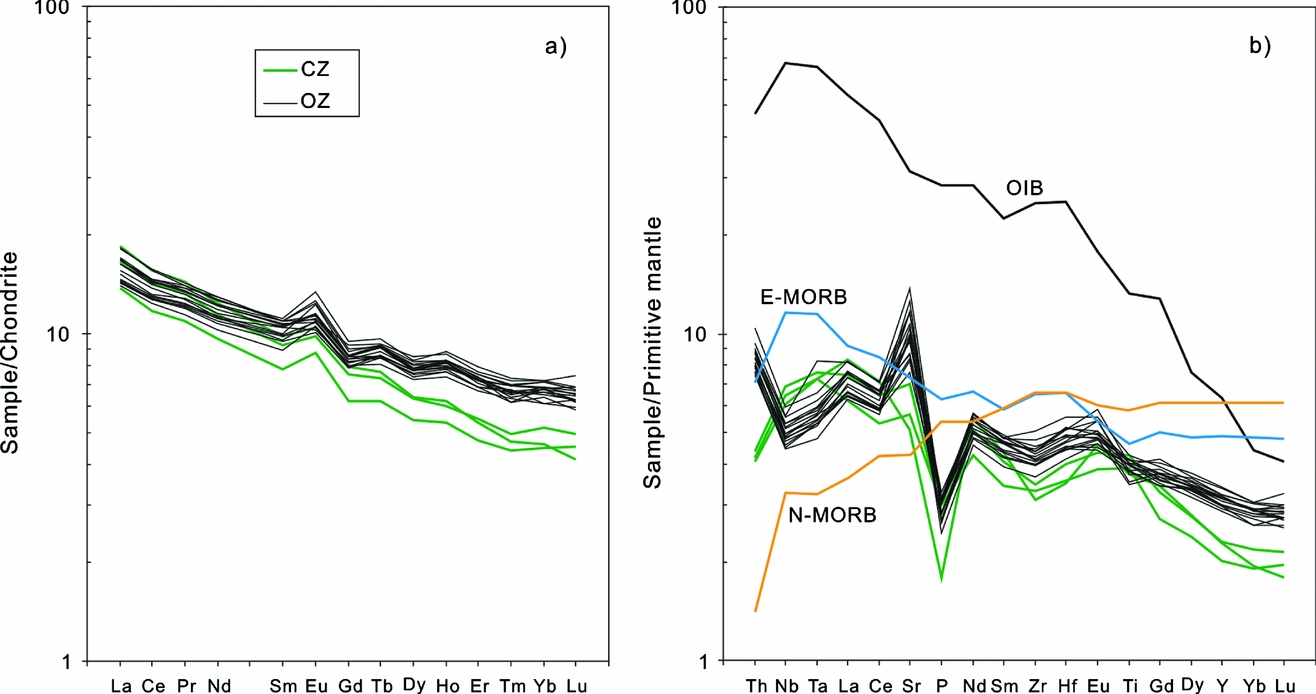
In the primitive-mantle normalized multi-element plot (Sun & McDonough, Reference Sun, McDonough, Saunders and Norry1989), the Hekou gabbroic rocks are characterized by the sub-parallel spiky pattern with slight enrichment in LREEs and large ion lithophile elements (LILEs), and slight depletion in HREEs and high field strength elements (HFSEs) (Fig. 8b). Notably, as shown in Figure 8b, these rocks from the CZ exhibit significant Th depletion ((Th/La)PM = 0.49–0.67; subscript PM denotes primitive-mantle normalized) and insignificant Nb and Ta depletion relative to La ((Nb/La)PM = 0.73–1.0, (Ta/La)PM = 0.87–1.2). Meanwhile, the features of the CZ rocks are similar to E-MORB-like basaltic rocks, continental flood basalt (CFB) and ocean island basalt (OIB) (Fig. 8b; Sun & McDonough, Reference Sun, McDonough, Saunders and Norry1989). In contrast, these OZ rocks are slightly enriched in Th ((Th/La)PM = 1.1–1.3) and depleted in Nb and Ta ((Nb/La)PM = 0.67–0.76, (Ta/La)PM = 0.75–1.0) (Fig. 8b).
4.c. Nd isotopes
Neodymium isotopic data are given in Table 3 for the Hekou gabbroic intrusion, of which the rocks from CZ and OZ have 147Sm/144Nd values of 0.1559–0.1590 and 0.1678–0.1772, and 143Nd/144Nd values of 0.512208–0.512327 and 0.512321–0.512400, corresponding to εNd(T) values of +0.70 to +2.3 and −0.30 to +0.24, respectively. The Nd isotopic compositions suggest that the parental magmas of the Hekou gabbroic intrusion were derived from a slightly depleted mantle source.
Sm–Nd isotopic compositions for the gabbroic rocks from the Hekou intrusion

Chondrite uniform reservoir (CHUR) values (147Sm/144Nd = 0.1967, 143Nd/144Nd = 0.512638) are used for the calculation. λSm = 6.54×10⁻¹² year−1 (Lugmair & Harti, Reference Lugmair and Harti1978). The (143Nd/144Nd)I and εNd(T) of these rocks were calculated using the age of 1736 Ma.
5. Discussion
5.a. The petrogenesis of the gabbroic intrusion
5.a.1. Fractional crystallization
The rocks from the CZ of the Hekou gabbroic intrusion show fairly homogeneous major oxides and Mg no. values. In contrast, the gabbroic rocks from the OZ of the intrusion exhibit slightly variable MgO concentrations and Mg no. values, suggesting that they had undergone small degrees of fractional crystallization (Fig. 6). A slight increase of TiO2 with decreasing MgO contents for these rocks from the OZ indicates that TiO2 was incompatible in the crystallizing phases and therefore titanomagnetite did not appear on the liquidus during crystallization of plagioclase and clinopyroxene in these systems. The slightly positive correlations of Fe2O3 versus MgO, and the obviously positive correlations of Cr and Ni versus MgO imply that they may undergo some degrees of fractionation of orthopyroxene.
The negative correlation of Al2O3 v. MgO in the rocks from the OZ suggests that they underwent insignificant plagioclase fractionation (Fig. 6; Pik et al. Reference Pik, Deniel, Coulon, Yirgu, Hofmann and Ayalew1998). The gabbroic rocks from the Hekou intrusion have relatively high CaO contents (10.1–13.2%) and low REE contents (29.3–40.2 ppm), which are consistent with the features of the mafic cumulate rocks. Moreover, all the rocks from the intrusion display a slightly negative correlation in the CaO v. MgO diagram (Fig. 6), implying clinopyroxene is a major fractionated phase for these rocks.
In summary, clinopyroxene and minor amounts of orthopyroxene are the important fractionation phases for the rocks from the OZ of the gabbroic intrusion.
5.a.2. Crustal contamination
The gabbroic rocks from the CZ of the intrusion display significant Th depletion and insignificant Nb and Ta depletion relative to La. In contrast, the gabbroic rocks in the OZ are slightly enriched in Th and depleted in Nb and Ta (Fig. 8b). As shown in the εNd(T)–Nb/La plot (Fig. 9a; Paces & Bell, Reference Paces and Bell1989) and the Nb/Th–Nb/La plot (Fig. 9b), the less-contaminated rocks from the CZ have relatively higher εNd(T) values and Nb–Ta contents, and lower Th contents than those of the more contaminated rocks from the OZ. In view of these geochemical and isotopic correlations, the crustal contaminants must mainly have caused low εNd(T) values, and Nb/La and Nb/Th ratios, indicating sialic crust components in the OZ rocks. Furthermore, the continental crust is typically depleted in Nb and Ta (Rudnick & Fountain, Reference Rudnick and Fountain1995), and the upper continental crust is enriched in La and Th while the lower continental crust is not usually enriched in Th (Barth, McDonough & Rudnick, Reference Barth, McDonough and Rudnick2000). As a result, the crustal contaminant, which is enriched in Th and La, and depleted in Nb and Ta, was potentially derived from the upper crust rather than from the lower crust (Fig. 9c; Ingle et al. Reference Ingle, Weis, Scoates and Frey2002). It is therefore suggested that the magmas parental to the gabbroic rocks assimilated the upper continental crust.
Plots of (a) εNd(T) v. Nb/La; (b) Nb/Th v. Nb/La; and (c) (Th/Ta)PM v. (La/Ta)PM (Ingle et al. Reference Ingle, Weis, Scoates and Frey2002) for the gabbroic rocks from the Hekou intrusion. Symbols as in Figure 5. UCC – upper continental crust; LCC – lower continental crust.

5.a.3. Nature of the parental magma and mantle source characteristics
Although the magmas parental to the Hekou gabbroic intrusion were subjected to variable degrees of crustal contamination, the rocks from the CZ exhibit obvious Th depletion and insignificant Nb, Ta and Ti depletions relative to La (Fig. 8b). However, the trace elemental features of the gabbroic rocks are different from those of typical E-MORB because: (1) all the gabbroic rocks are cumulate rocks and exhibit more obvious LREE-enriched and HREE-depleted patterns (Fig. 8a, b); (2) the magmas parental to the gabbroic rocks had been assimilated by sialic crust. This makes it unlikely that the gabbroic intrusion was formed in an oceanic setting where sialic crust is normally absent. In contrast, the trace elemental features of the less-contaminated gabbroic samples are very similar to the intraplate basaltic rocks in CFB and OIB provinces (Sun & McDonough, Reference Sun, McDonough, Saunders and Norry1989). For example, the less-contaminated rocks of the CZ have high Ti/Y (467–550) and low La/Nb (0.93–1.32) and La/Ta ratios (14.3–19.3), which are also similar to those of OIB (Ti/Y > 410, La/Nb < 1.5 and La/Ta < 22) (Table 2; Ormerod et al. Reference Ormerod, Hawkesworth, Rogers, Leeman and Menzies1988; Sun & McDonough, Reference Sun, McDonough, Saunders and Norry1989; Lightfoot et al. Reference Lightfoot, Hawkesworth, Hergt, Naldrett, Gorbachev, Fedorenko and Doherty1993; Garland, Turne & Hawkesworth, Reference Garland, Turne and Hawkesworth1996; Ewart et al. Reference Ewart, Milner, Armstrong and Duncan1998).
Based on the aforementioned results, the magmas parental to the gabbroic rocks display a subalkaline basaltic affinity. In combination with the Nd isotopic features (εNd(T) = +0.70 to +2.3) of the less-contaminated rocks from the CZ, the parental magmas for the Hekou gabbroic rocks were proposed to be generated dominantly by melting of a slightly depleted mantle source. The lack of Nb–Ta depletion and the high-Ti nature of the magma parental to the less-contaminated rocks suggest the sub-continental lithospheric mantle (SCLM) was not the geological reservoir that contributed the trace-element and Nd isotope inventory to the Hekou gabbroic intrusion. In general, low ratios of LREE/HREE in mafic rocks reflect a melting regime dominated by relatively large melting fractions and/or having spinel as the predominant residual phase, whereas high LREE/HREE ratios are indicative of smaller melting fractions and/or garnet control (Deniel, Reference Deniel1998; Xu et al. Reference Xu, Chung, Jahn and Wu2001). Therefore, the samples from the Hekou gabbroic intrusion, exhibiting a slightly LREE-enriched and HREE-depleted pattern, were potentially generated by relatively high degrees of partial melting of a slightly depleted asthenospheric mantle source. Their geochemical and isotopic variations are attributed to slight crystal fractionation with varying degrees of crustal contamination.
5.b. Tectonic implications
Numerous meta-volcanic- and meta-sedimentary-rock-hosted Fe–Cu ore deposits were developed in the late Palaeoproterozoic to early Mesoproterozoic basins in the Kangdian region in the southwestern Yangtze Block, for example, the Dahongshan, Hekou, and Dongchuan Fe–Cu ore deposits (D. F. He, unpub. Ph.D. thesis, Graduate School of the Chinese Academy of Sciences, 2009; Zhao et al. Reference Zhao, Zhou, Li, Sun, Gao, Sun and Yang2010, Reference Zhao, Zhou, Li and Qi2013; Zhao & Zhou, Reference Zhao and Zhou2011; Chen & Zhou, Reference Chen and Zhou2012). The ages of the meta-volcanic rocks and mafic intrusions from the upper Palaeoproterozoic to lower Mesoproterozoic strata in the Kangdian region had recently been well constrained by the availability of precise U–Pb zircon ages (Greentree & Li, Reference Greentree and Li2008; D. F. He, unpub. Ph.D. thesis, Graduate School of the Chinese Academy of Sciences, 2009; Zhao et al. Reference Zhao, Zhou, Li, Sun, Gao, Sun and Yang2010, Reference Zhao, Zhou, Li and Qi2013; Zhao & Zhou, Reference Zhao and Zhou2011; Chen, Zhou & Zhao, Reference Chen, Zhou and Zhao2013). However, such meta-volcanic rocks and mafic intrusions (Greentree & Li, Reference Greentree and Li2008; D. F. He, unpub. Ph.D. thesis, Graduate School of the Chinese Academy of Sciences, 2009; Zhao et al. Reference Zhao, Zhou, Li, Sun, Gao, Sun and Yang2010, Reference Zhao, Zhou, Li and Qi2013; Zhao & Zhou, Reference Zhao and Zhou2011; Chen, Zhou & Zhao, Reference Chen, Zhou and Zhao2013) were generally intensely altered and did not preserve their original chemical characteristics. Therefore, a major problem with better understanding these deposits is the lack of precise elemental and isotopic data for these meta-volcanic rocks and mafic intrusions, which hampers the understanding of the geodynamic setting of the ore mineralization.
The Hekou gabbroic intrusion has a SIMS U–Pb zircon age of c. 1736 Ma reported in this study, suggesting that the depositional ages of the Hekou Group were slightly older than the ages of the intrusion (Chen, Zhou & Zhao, Reference Chen, Zhou and Zhao2013). Moreover, the crystallization ages of the gabbroic intrusion are similar to that of the dolerite dykes that intruded into the Dahongshan Group in the Dahongshan Fe–Cu ore deposit (Zhao & Zhou, Reference Zhao and Zhou2011) and into the Lower Kunyang Group in the Yinmin Fe–Cu ore deposit (Zhao et al. Reference Zhao, Zhou, Li, Sun, Gao, Sun and Yang2010, Reference Zhao, Zhou, Li and Qi2013), indicating that significant mafic magmatism occurred at c. 1.7 Ga in the southwestern Yangtze Block. The meta-volcanic rocks from the Dahongshan Group and the Yinmin Formation in the Lower Kunyang Group were also formed slightly before or almost synchronously with the c. 1.7 Ga mafic dykes and intrusions (Greentree & Li, Reference Greentree and Li2008; D. F. He, unpub. Ph.D. thesis, Graduate School of the Chinese Academy of Sciences, 2009; Zhao & Zhou, Reference Zhao and Zhou2011; Zhao et al. Reference Zhao, Zhou, Li, Sun, Gao, Sun and Yang2010, Reference Zhao, Zhou, Li and Qi2013). Therefore, the late Palaeoproterozoic to Mesoproterozoic volcanic and sedimentary basins, termed the Dahongshan, Hekou and Lower Kunyang groups, were likely formed almost synchronously and slightly prior to c. 1.7 Ga.
As discussed above, the least-contaminated gabbroic rocks from the CZ exhibit characteristic patterns of incompatible trace elements similar to those of OIB and CFB (Fig. 8b). As shown in Figure 10, the clinopyroxene crystals from the Hekou intrusion show the characteristics of gabbroic cumulate rocks formed in a continental rift system. Magmatism associated with lithosphere rifting coupled with asthenosphere upwelling can explain why the intrusion has isotopic compositions similar to those of magmas derived from the asthenospheric mantle. Therefore, the gabbroic intrusion intruded into the Hekou Group is best interpreted as a product of a continental rift environment.
Discrimination diagram of AlZ (percentage of tetrahedral sites occupied by Al) v. TiO2 in clinopyroxenes (Loucks, Reference Loucks1990) for the gabbroic rocks from the Hekou intrusion. Symbols as in Figure 5.

In the Kangdian region, the Yinmin Formation of the Lower Kunyang Group with a U–Pb zircon age of 1742±13 Ma has been considered to have formed in a continental rift basin (Hua, Reference Hua1990; Wu et al. Reference Wu, Duan, Song, Chen and Dan1990; Zhao et al. Reference Zhao, Zhou, Li, Sun, Gao, Sun and Yang2010). Meanwhile, alkali basaltic tuff is present in the Yinmin Formation (Wu et al. Reference Wu, Duan, Song, Chen and Dan1990; Greentree et al. Reference Greentree, Li, Li and Wu2006). Moreover, the εHf(t) values of igneous zircons from the tuff and ~1.70 to 1.65 Ga dolerite dykes that intruded into the Yinmin Formation suggest they were derived from a depleted mantle source. These dolerite dykes show no anomalies of Nb and Ta on the primitive-mantle normalized multi-element plot, and fall into the field of within-plate basalt (Zhao et al. Reference Zhao, Zhou, Li, Sun, Gao, Sun and Yang2010, Reference Zhao, Zhou, Li and Qi2013; Zhao & Zhou, Reference Zhao and Zhou2011). These sedimentary records combined with the elemental and isotopic data from these igneous rocks support the interpretation that the Yinmin Formation of the Lower Kunyang Group was formed in a continental rift setting at ~1.7 Ga. It is therefore suggested that the c. 1.7 Ga Dahongshan, Hekou and Lower Kunyang groups were likely formed in similar continental rift basins in the southwestern Yangtze Block.
Collisional events at 2.1 to 1.8 Ga have been recorded in a number of Precambrian cratons and are thought to be related to the assembly of the Palaeoproterozoic supercontinent Columbia (Rogers & Santosh, Reference Rogers and Santosh2002; Zhao et al. Reference Zhao, Cawood, Wilde and Sun2002a ). More recently, it was suggested that even the 1.84–1.75 Ga mafic dyke swarms and 1.75–1.68 Ga anorthosite–mangerite–alkali granite and rapakivi granite suites (AMGRS) in the North China Craton (NCC) may have resulted from the fragmentation of the Columbia supercontinent (e.g. Zhao et al. Reference Zhao, Zhou, Zhai and Xia2002b ; Peng, Zhai & Guo, Reference Peng, Zhai, Guo, Hanski, Mertanen, Ramö and Vuollo2006; Peng et al. Reference Peng, Zhai, Guo, Kusky and Zhao2007, Reference Peng, Zhai, Ernst, Guo, Liu and Hu2008; Hou et al. Reference Hou, Li, Yang, Yao, Wang and Wang2008a ,Reference Hou, Santosh, Qian, Lister and Li b ). The late Palaeo- to Mesoproterozoic anorogenic magmatism associated with the break-up of the Columbia supercontinent generally took place during intraplate continental rifting, triggered mostly by mantle plumes (Rogers & Santosh, Reference Rogers and Santosh2002; Zhao et al. Reference Zhao, Cawood, Wilde and Sun2002a , Reference Zhao, Sun, Wilde and Li2004; Peng et al. Reference Peng, Zhai, Ernst, Guo, Liu and Hu2008; Hou et al. Reference Hou, Li, Yang, Yao, Wang and Wang2008a ,Reference Hou, Santosh, Qian, Lister and Li b ; Evans & Mitchell, Reference Evans and Mitchell2011).
In the traditional reconstruction models (Rogers & Santosh, Reference Rogers and Santosh2002; Zhao et al. Reference Zhao, Cawood, Wilde and Sun2002a ), the Yangtze Block was not included in the Columbia supercontinent owing to the lack of geological and geochronological data for that time. However, recent studies reveal that the Yangtze Block may have been involved in this global Palaeoproterozoic orogenic event (Zhang et al. Reference Zhang, Zheng, Wu, Zhao, Gao and Wu2006b ; Sun et al. Reference Sun, Chen, Zhao, Wilde, Ye, Guo, Chen and Yuan2008; Wu et al. Reference Wu, Zheng, Gao, Jiao and Liu2008; Peng et al. Reference Peng, Wu, Wang, Jiao, Liu and Yang2009, Reference Peng, Wu, Gao, Zhang, Wang, Liu, Gong, Zhou, Hu, Liu and Yan2012) and late Palaeo- to Mesoproterozoic anorogenic magmatism (Zhao et al. Reference Zhao, Zhou, Li, Sun, Gao, Sun and Yang2010, Reference Zhao, Zhou, Li and Qi2013; Chen, Zhou & Zhao, Reference Chen, Zhou and Zhao2013). In this study, the presence of the c. 1.7 Ga Hekou gabbroic intrusion in the southwestern Yangtze Block is contemporaneous with the break-up of the Columbia supercontinent, which provides further evidence to support the idea that the Yangtze Block was likely a part of the supercontinent.
It is difficult to tell the precise position of the Yangtze Block within the Columbia supercontinent without a large number of reliable palaeomagnetic poles. However, on the basis of similar age spectra of detrital zircons, the geochemical characteristics of the Palaeoproterozoic strata, comparisons of rift-related sediments and ~1.7 Ga within-plate mafic magmatism (such as the Hekou intrusion reported in this paper) among different blocks in the Columbia supercontinent, the Yangtze Block is considered to possibly link with the North Australian Craton during Palaeoproterozoic time (Wang et al. Reference Wang, Yu, Griffin and O'Reilly2012; Chen, Zhou & Zhao, Reference Chen, Zhou and Zhao2013; Chen et al. Reference Chen, Lin, Faure, Lepvrier, Chu and Wang2013; Chen, Zhang & Song, Reference Chen, Zhang and Song2013; Wang & Zhou, Reference Wang and Zhou2014), as reconstructed by Zhao et al. (Reference Zhao, Cawood, Wilde and Sun2002a , Reference Zhao, Sun, Wilde and Li2004). Moreover, the Yangtze Block, the NW India and the North Australian Craton were perhaps neighbours located in a spatial association within the Columbia supercontinent, based on the similar mineralization ages and styles of the Palaeoproterozoic Fe–Cu ore deposits on these cratons (Zhou et al. Reference Zhou, Zhao, Chen, Li, Wang, Yan and Qiu2014).
6. Conclusions
(1) The age of crystallization for the Hekou gabbroic intrusion is ~1.7 Ga, as demonstrated by the upper intercept ages of 1735±6.5 Ma and 1736±4.0 Ma for the rocks from the CZ and the OZ, respectively.
(2) The Hekou gabbroic intrusion experienced slight fractional crystallization from a parental magma, which was potentially generated by melting of a slightly depleted asthenospheric mantle source in a continental rift environment plus varying degrees of crustal contamination.
(3) The Yangtze Block was likely a fragment of the Palaeo- to Mesoproterozoic supercontinent Columbia, and the c. 1.7 Ga Hekou gabbroic intrusion from the southwestern Yangtze Block was likely formed in an anorogenic continental rift that contributed to the break-up of the Columbia supercontinent.
Acknowledgements
We appreciate Q. L. Li, Y. Liu, G. Q. Tang and H. Tao for their assistance with SIMS dating, Y. Liu for major-element analyses by XRF, J. Hu, G. P. Bao and Y. Huang for trace-element analyses by ICP-MS, B. L Wang for Nd isotope analyses by MC-ICP-MS, and G. F. Zhou, and W. Q. Zheng, for electron microprobe analysis. This paper has benefited from constructive comments of the editor and anonymous reviewers. This work was funded by the NSFC (Grants 41273049, 41572074 and 41073043) and the State Key Laboratory of Ore Deposit Geochemistry (12th Five-Year Plan: SKLOG-ZY125-06).
Supplementary material
To view supplementary material for this article, please visit http://dx.doi.org/10.1017/S0016756815001119.



