Sepsis is a fatal dysregulated immune reaction to infection, triggering organ failure(Reference Singer, Deutschman and Seymour1). Despite advances in critical care, sepsis-related mortality remains substantial, highlighting the need for adjunctive therapies to improve outcomes. Among these, intravenous amino acid administration has gained attention for its potential immunomodulatory and metabolic benefits in critically ill patients(Reference Hsu, Sun and Tsai2,Reference Doig, Simpson and Bellomo3) . However, the clinical efficacy of amino acid supplementation in sepsis remains uncertain, necessitating further investigation.
Amino acids play a fundamental role in protein synthesis, immune regulation and endothelial function, all of which are critical in the hypercatabolic state of sepsis(Reference Bonvini, Coqueiro and Tirapegui4,Reference Mattick, Kamisoglu and Ierapetritou5) . Metabolic profiling studies have identified significant disruptions in amino acid homeostasis, particularly deficiencies in key amino acids such as arginine and glutamine, which are essential for immune function and vascular integrity(Reference Morris, Hamilton-Reeves and Martindale6). Preclinical and clinical studies suggest that targeted amino acid supplementation may enhance protein synthesis, modulate inflammatory responses and improve microcirculatory function, potentially translating into better clinical outcomes(Reference Jaurila, Koivukangas and Koskela7,Reference Heming, Carlier and Prigent8) . Moreover, randomised controlled trials have reported that intravenous amino acid therapy may contribute to enhancing estimated glomerular filtration rate and urine volume in critical care settings(Reference Doig, Simpson and Bellomo3).
Multiple studies have revealed that serum amino acid concentrations correlate with sepsis-driven organ dysfunction and outcomes. For instance, branched-chain amino acids were significantly reduced in sepsis non-survivors and may serve as early biomarkers for mortality prediction(Reference Reisinger, Posch and Hackl9). Mechanistically, certain amino acids, such as citrulline and glutamine, have been hypothesised to exert protective effects preclinically(Reference Reizine, Gregoire and Lesouhaitier10,Reference Hou, Wu and Chen11) . However, despite these findings, clinical trials evaluating classical candidates like arginine or emerging targets such as citrulline have failed to conclusively demonstrate consistent benefits in heterogeneous sepsis populations(Reference Tadie, Locher and Maamar12,Reference Luiking, Poeze and Deutz13) . Therefore, the effect of amino acid application on the prognosis of sepsis and the optimal strategy of application are still uncertain.
To address these gaps, we conducted a translational investigation integrating pharmacoepidemiologic and genetic evidence (Figure 1). By combining a cohort analysis using propensity score matching (PSM), we first applied the Medical Information Mart for Intensive Care-IV (MIMIC-IV) database to evaluate the real-world effectiveness of intravenous amino acid therapy in a sepsis population. Furthermore, we employed Mendelian randomisation (MR) to identify specific amino acid types with causal protective effects against sepsis mortality. This study aims to use this dual-method approach to distinguish therapeutic benefits arising from intravenous amino acid supplementation from confounding due to illness severity, while simultaneously uncovering bioactive components within complex amino acid formulations.
Study flow chart.

Figure 1 Long description
A study flow chart illustrating the process of investigating the efficacy of amino acid supplementation in sepsis patients. The chart is divided into two main sections: Retrospective cohort study and Mendelian randomisation analysis. The Retrospective cohort study section starts with the MIMIC-IV database version 2:2 containing 315,460 entries. It narrows down to ICU stays with a sepsis diagnosis, resulting in 33,177 entries. Exclusions include pediatric patients, patients with non-first ICU admissions, ICU stays less than 24 hours, and incomplete records of mortality outcome data. This leads to a pre-PSM cohort of 22,633 entries. A 1:1 PSM cohort is then formed with 726 entries (363 pairs) based on intravenous amino acid supplementation or not. The association between amino acid use and 28-day mortality is assessed using logistic regression, Cox proportional hazards regression, and TMLE analysis. The Mendelian randomisation analysis section starts with the IEU OpenGWAS database. SNP for 20 amino acids are obtained, followed by obtaining outcome data for 28-day mortality in sepsis (ieu-b-5086). MR analysis includes IVW, Weighted median, MR-Egger, Weighted mode, and Simple mode. Sensitivity analysis includes MR-Egger intercept tests, Cochran's Q test, MR-PRESSO, Leave-one-out analyses, Scatter plots, Funnel plots, and Forest plots. The goal is to explore causal relationships between 20 amino acids and sepsis mortality.
Methods
Data sources
Data were drawn from the MIMIC-IV database, a publicly accessible and comprehensive resource containing detailed information on intensive care unit (ICU) patients. Data for the current analysis were retrieved from the MIMIC-IV (v 2.2) and provided granular clinical variables such as patient demographics, vital signs, as well as laboratory test results, medications and outcomes. Specific focus was given to identifying intravenous amino acid administration through prescription data and its association with clinical outcomes. Anonymised data were used in compliance with relevant privacy regulations, ensuring patient confidentiality.
Population and data collection
The cohort comprised sepsis patients aged ≥ 18 years, selected from MIMIC-IV by ICD-10-CM codes and Sepsis-3-aligned clinical assessments(Reference Singer, Deutschman and Seymour1). Septic shock at ICU admission was defined per Sepsis-3 as vasopressor requirement and serum lactate > 2 mmol/l within the first 24 h after ICU admission. For patients with multiple ICU stays, only the first stay meeting the inclusion criteria was selected for analysis. Patients were stratified into two separate groups based on intravenous amino acid supplementation (amino_use: ‘exposed’ v. ‘unexposed’). The recorded amino acid formulations in our cohort included the following 1000-ml bags: ‘Amino Acids 4·25 % w/ Dextrose 5 %, 1000 ml,’ ‘Amino Acids 4·25 %–Dextrose 10 %, 1000 ml,’ ‘Amino Acids 4·25 %–Dextrose 5 %, 1000 ml’ and ‘Amino Acids 5 %–Dextrose 15 %, 1000 ml’ (see online Supplementary Table S1 for formulation list and dose conversion). Patients were excluded if they had incomplete records of mortality outcome data or ICU stays < 24 h.
Clinical and laboratory data were extracted from the MIMIC-IV database through structured query language queries, including demographics, vital signs, laboratory parameters (leucocytes count, pH, partial pressure of arterial oxygen [PaO2], partial pressure of arterial carbon dioxide [PaCO2], lactate, etc.), disease severity scores (sequential organ failure assessment, Simplified Acute Physiology Score II, Acute Physiology Score III, Oxford Acute Severity of Illness Score, systemic inflammatory response syndrome) and intervention details (vasopressors and amino acid use).
To address potential confounding, missing data (< 20 % for key variables) were imputed using multiple imputation by chained equations(Reference Resche-Rigon and White14), while variables exceeding this threshold were excluded.
Outcomes
The primary outcome, 28-d mortality, was defined by death events occurring post-ICU admission, based on data obtained from the Social Security Death Index and hospital records. The secondary outcomes comprised ICU length of stay, occurrence of acute kidney injury within 7 d and acute kidney injury staging at day 7 following ICU admission.
Statistical analyses
To minimise confounding bias, a 1:1 nearest-neighbour PSM was performed with a caliper of 0·2 sd. Propensity scores were derived from a logistic regression model incorporating baseline covariates: admission age, gender, Acute Physiology Score III, systemic inflammatory response syndrome, Oxford Acute Severity of Illness Score, Simplified Acute Physiology Score II, sequential organ failure assessment scores, ICU-admission lactate and vasopressor exposure within the first 24 h after ICU admission. Vasopressor exposure was defined as norepinephrine ≥ 0·10 μg/kg/min or epinephrine ≥ 0·05 μg/kg/min averaged over 24 h, any vasopressin use or ≥ 2 distinct vasopressors within 24 h. Covariate balance between matched groups was confirmed via standardised differences (< 0·1) and diagnostic plots (e.g. Love plots). The matched cohort was used for outcome analysis.
Normally distributed data were summarised as mean (sd); non-normal variables were expressed as median (interquartile range). Categorical measures were reported with frequencies (%). Inter-group comparisons of continuous variables were analysed using Wilcoxon rank-sum test or Kruskal–Wallis test, whereas categorical variables were assessed with Pearson’s chi-square test, with Fisher’s exact test applied when expected frequencies were insufficient. Multiple comparisons were adjusted using false discovery rate (FDR), with adjusted P values reported as q-values after correction.
To evaluate the association between intravenous amino acid supplementation and 28-d mortality, logistic regression, Cox proportional hazards regression and targeted maximum likelihood estimation (TMLE) were employed. Each method included three models: an unadjusted model, a partially adjusted model (adjusting for demographic variables: age, sex, weight, height and ethnicity) and a fully adjusted model (further incorporating disease severity scores: sequential organ failure assessment, Simplified Acute Physiology Score II, Oxford Acute Severity of Illness Score, systemic inflammatory response syndrome and Acute Physiology Score III; laboratory markers: PaO2, partial pressure of arterial oxygen, WBC count, Ca levels and pH; and vital signs: heart rate, mean arterial pressure (MAP), respiratory rate and body temperature).
Logistic regression estimated OR and 95 % CI using the generalised linear model function in R with a binomial family. Cox proportional hazards regression was applied to estimate HR with 95 % CI using the coxph function from the survival package. TMLE, a doubly robust, semiparametric method integrating machine learning-based modelling, was used to estimate the average treatment effect with 95 % CI. All analyses were conducted using the PSM cohort to minimise confounding.
As sensitivity analyses to assess robustness, we additionally examined competing risks and potential survivor/immortal-time bias. We fitted Fine–Gray subdistribution hazard models for > 48-h (≤ 28-d) mortality, treating ≤ 48-h death as a competing event, in the matched cohort. Robustness to competing risk was assessed by the subdistribution hazard ratio. In a 48-h landmark sensitivity analysis, we excluded patients who died within 48 h after ICU admission and fitted a Cox model in the matched cohort. Robust standard errors were clustered by the matching subclass.
We performed a two-sample MR analysis using IEU OpenGWAS summary data to assess causal links between amino acids and sepsis 28-d mortality. Exposure instruments were mainly obtained from community-based metabolomics genome-wide association studies such as TwinsUK and KORA(Reference Shin, Fauman and Petersen15,Reference Kettunen, Demirkan and Würtz16) . Accordingly, our two-sample MR estimates reflect lifelong genetically proxied differences in amino acid levels in the general population rather than short-term pharmacologic effects during ICU care and are used as directional/etiologic evidence that triangulates with the observational analysis. Genome-wide significant single nucleotide polymorphisms (P < 1 × 10⁻⁶) associated with amino acid levels were designated as instrumental variables. However, for amino acids with fewer than four genome-wide significant SNP, including arginine, aspartate, cysteine, glutamate, methionine and threonine, we applied a more relaxed threshold of P < 1 × 10⁻⁵ to ensure an adequate number of instrumental variables while minimising weak instrument bias. To mitigate weak instrument bias, only SNP with an F-statistic greater than ten were retained for the final analysis. Candidate SNP associated with heritable confounders (BMI, type 2 diabetes, hypertension, dyslipidaemia and chronic kidney disease) were screened by OpenGWAS PheWAS and excluded from the primary instruments. Outcome data for 28-d mortality in sepsis were obtained from the same database (ieu-b-5086), and SNP harmonisation was performed to align effect alleles between the exposure and outcome datasets. The inverse variance-weighted method was the primary analysis for causal effect estimation. Supplementary MR approaches (MR-Egger, weighted median, simple/weighted mode and MR-robust adjusted profile score) were employed for robustness evaluation. Cochran’s Q statistic assessed instrumental variable heterogeneity, while MR-Egger intercept testing examined directional pleiotropy. To account for multiple comparisons across the twenty amino acids, we controlled the FDR using the Benjamini–Hochberg procedure. The F-statistic for each SNP was calculated to assess instrument strength, and variance explained was estimated for each SNP to determine its contribution to the exposure. Mendelian Randomisation Pleiotropy RESidual Sum and Outlier analysis was applied to identify and adjust for potential outlier SNP. Sensitivity analyses included a leave-one-out analysis to evaluate the influence of individual SNP and multiple graphical assessments, including scatter plots, funnel plots and forest plots, to visualise the stability and consistency of the MR estimates. The TwoSampleMR and MRPRESSO R packages supported all statistical workflows.
All statistical analyses were performed using R software (version 4.3.0), with statistical significance defined as P < 0·05.
Results
Study participants
A total of 363 sepsis patients who received intravenous amino acid supplementation were identified from the MIMIC-IV database. Before PSM, notable differences were observed between the amino acid group and those not receiving supplementation, particularly in key variables such as age, disease severity and baseline renal function. To address these imbalances, a 1:1 PSM was performed based on covariates including age, gender, disease severity, lactate and vasopressor exposure.
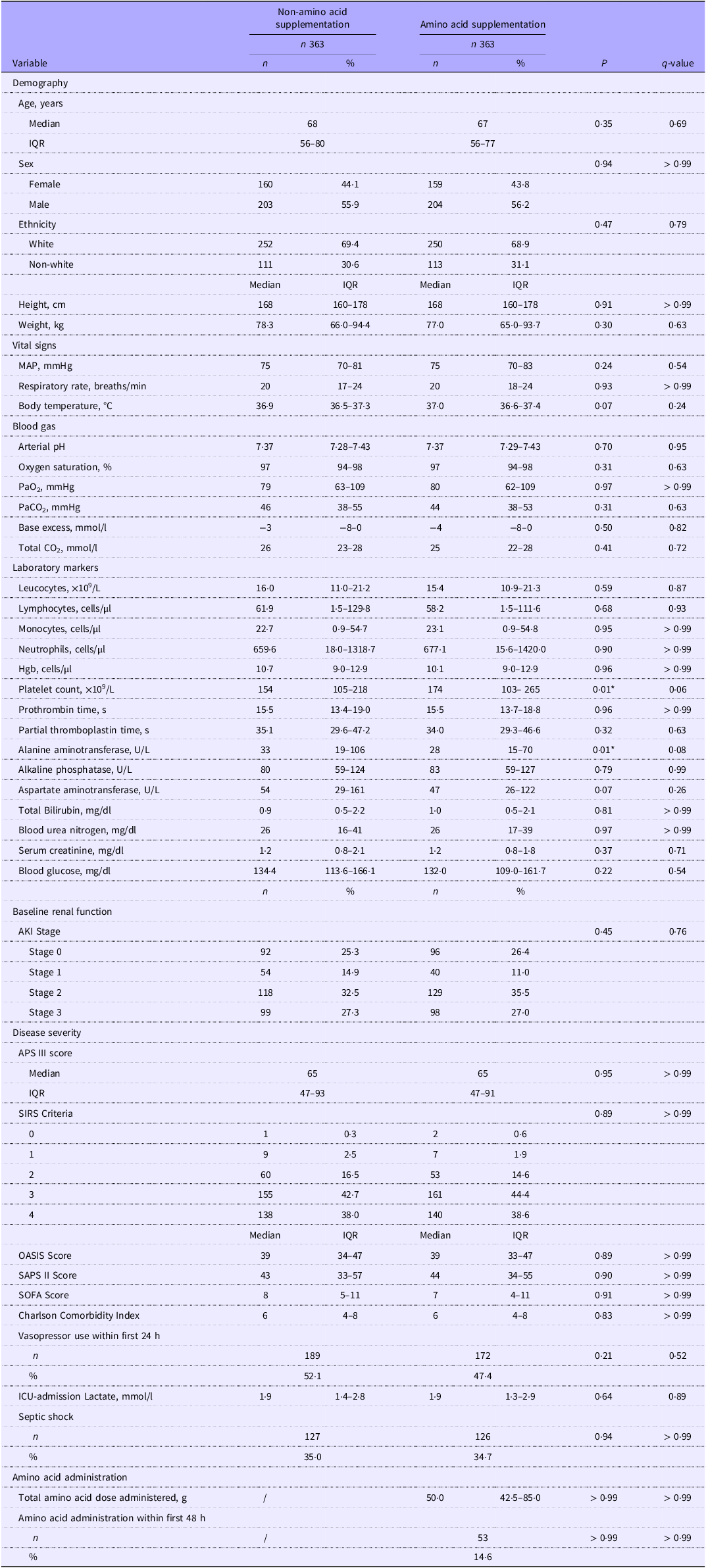
After matching, the two groups achieved balanced baseline characteristics with no statistically significant differences in demographic parameters, vital signs, laboratory markers, baseline renal function and disease severity scores or proportion of patients with septic shock (Table 1, online Supplementary Figure S1). Specifically, the median age remained comparable between groups (68 v. 67 years, P = 0·35), and gender distribution was nearly identical (approximately 56 % male in both groups, P = 0·94). Importantly, key disease severity indicators including septic shock within 24 h of ICU admission (approximately 35 % in both groups, P = 0·94), sequential organ failure assessment score (median 8 v. 7, P = 0·91) and Acute Physiology Score III score (median 65 v. 65, P = 0·95) were well balanced after matching.
Baseline characteristics and amino acid supplementation details in the PSM cohort of septic patients

Table 1 Long description
The table compares baseline characteristics and amino acid supplementation in septic patients. It has 36 rows and 12 columns. Column headers are Variable, Non-amino acid supplementation, and Amino acid supplementation. The table includes sub-columns for count, percent, median, and interquartile range (IQR) where applicable. Row labels include demographic details, vital signs, laboratory markers, baseline renal function, disease severity, and amino acid administration details. Each row provides specific values for both non-amino acid supplementation and amino acid supplementation groups. Notable trends include balanced demographic parameters, vital signs, laboratory markers, baseline renal function, and disease severity scores between the two groups.
PSM, propensity score matching; IQR, interquartile range; AKI, acute kidney injury; APS III, Acute Physiology Score III; ICU, intensive care unit; MAP, mean arterial pressure; OASIS, Oxford Acute Severity of Illness Score; PaCO2, partial pressure of arterial carbon dioxide; PaO2, partial pressure of arterial oxygen; SAPS II, Simplified Acute Physiology Score II; SIRS, systemic inflammatory response syndrome; SOFA, sequential organ failure assessment.
* P < 0·05, significant statistical difference.
Notably, although two laboratory parameters showed nominal P values below 0·05 – alanine aminotransferase (33 v. 28 U/L, P = 0·01) and platelet count (154 v. 174 × 109/L, P = 0·01), these differences did not retain statistical significance after FDR correction (q = 0·08 and 0·06, respectively). All other measured variables including inflammatory markers, coagulation parameters and organ function indices demonstrated robust balance between groups (all q > 0·05), confirming the effectiveness of the PSM procedure in minimising baseline confounding (Table 1). The amino acid group received substantial supplementation (median 50 g, IQR 42·5–85 g) during ICU hospitalisation, though only 14·6 % initiated therapy within the first 48 h of ICU admission (Table 1).
Outcomes comparison
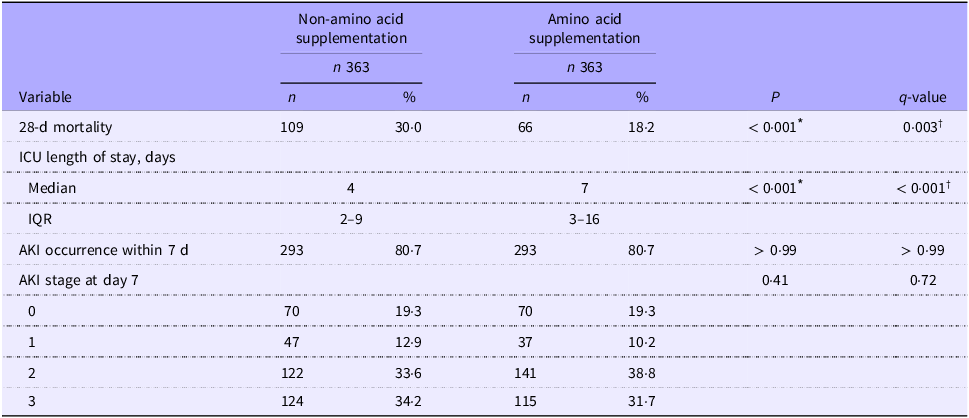
Following PSM, key clinical outcomes revealed significant differences between groups (Table 2). Patients receiving amino acid supplementation demonstrated markedly lower 28-d mortality (18·2 % v. 30·0 %, P < 0·001, q = 0·003), despite showing prolonged ICU stays (7 v. 4 d, P < 0·001, q < 0·001). However, there was no significant difference in the occurrence of acute kidney injury within 7 d (80·7 % v. 80·7 %, P > 0·99, q > 0·99) or in the distribution of acute kidney injury stages at day 7 (P = 0·41, q = 0·72).
Comparative clinical outcomes in the PSM cohort

Table 2 Long description
The table compares clinical outcomes between non-amino acid and amino acid supplementation groups. It has 8 rows and 8 columns. The columns are labeled as Variable, Non-amino acid supplementation n, Non-amino acid supplementation percent, Amino acid supplementation n, Amino acid supplementation percent, P, and q-value. The rows are labeled as 28-d mortality, ICU length of stay days Median, ICU length of stay days IQR, AKI occurrence within 7 d, AKI stage at day 7 0, AKI stage at day 7 1, AKI stage at day 7 2, and AKI stage at day 7 3. The values in the table are as follows: Row 1: 28-d mortality, 109, 30.0, 66, 18.2, < 0.001*, 0.003†. Row 2: ICU length of stay days Median, 4, 7, < 0.001*, < 0.001†. Row 3: ICU length of stay days IQR, 2-9, 3-16. Row 4: AKI occurrence within 7 d, 293, 80.7, 293, 80.7, > 0.99, > 0.99. Row 5: AKI stage at day 7 0, 70, 19.3, 70, 19.3. Row 6: AKI stage at day 7 1, 47, 12.9, 37, 10.2. Row 7: AKI stage at day 7 2, 122, 33.6, 141, 38.8. Row 8: AKI stage at day 7 3, 124, 34.2, 115, 31.7.
PSM, propensity score matching; ICU, intensive care unit; IQR, interquartile range; AKI, acute kidney injury.
* P < 0·05, significant statistical difference.
† q-value < 0·05, significant statistical difference.
Logistic regression analysis
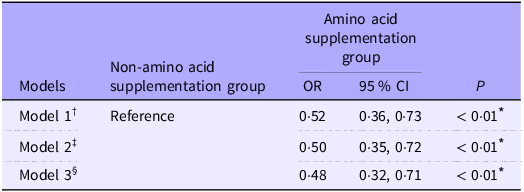
Logistic regression analyses demonstrated a significant association between intravenous amino acid supplementation and reduced 28-d mortality (Table 3). In the univariate model, amino acid use was associated with 48 % lower odds of mortality (OR = 0·52, 95 % CI: 0·36, 0·73, P < 0·01). After adjusting for demographic variables in the partially adjusted model, the association remained significant (adjusted OR = 0·50, 95 % CI: 0·35, 0·72, P < 0·01). Further adjustment for clinical severity and laboratory parameters in the fully adjusted model confirmed the independent association between amino acid supplementation and lower 28-d mortality (adjusted OR = 0·48, 95 % CI: 0·32, 0·71, P < 0·01). The observed associations indicate a probable mortality reduction through amino acid administration in critical sepsis cases, persisting after adjustment for major demographic and clinical confounders.
Association between amino acid supplementation and reduced 28-d mortality: logistic regression analysis in the PSM cohort

Table 3 Long description
A table comparing the association between amino acid supplementation and reduced 28-day mortality using logistic regression analysis. The table has three rows and four columns. The columns are labeled Models, Non-amino acid supplementation group, Amino acid supplementation group, and P. The rows are labeled Model 1, Model 2, and Model 3. Row 1: Model 1, Reference, OR: 0.52, 95% CI: 0.36, 0.73, P: < 0.01. Row 2: Model 2, Reference, OR: 0.50, 95% CI: 0.35, 0.72, P: < 0.01. Row 3: Model 3, Reference, OR: 0.48, 95% CI: 0.32, 0.71, P: < 0.01.
PSM, propensity score matching; SOFA, sequential organ failure assessment; SAPS II, Simplified Acute Physiology Score II; OASIS, Oxford Acute Severity of Illness Score; SIRS, systemic inflammatory response syndrome; APS III, Acute Physiology Score III.
* P < 0·05, significant statistical difference.
† Univariate model.
‡ Adjusted for age, gender, weight, height and ethnicity.
§ Adjusted for age, gender, weight, height, ethnicity, SOFA score, SAPS II score, OASIS score, SIRS, APS III score, pO2, pCO2, WBC, calcium, pH, heart rate, MAP, respiratory rate and body temperature.
Cox proportional hazards analysis
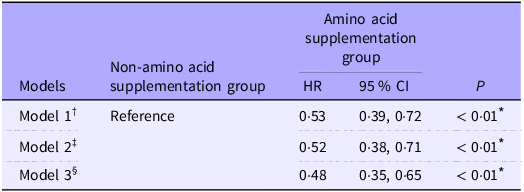
Time-to-event analysis via Cox regression in the PSM cohort corroborated these findings (Table 4). In the univariate model, amino acid supplementation reduced 28-d mortality risk by 47 % (HR = 0·53, 95 % CI 0·39, 0·72, P < 0·01). Adjustment for demographic confounders preserved significance (adjusted HR = 0·52, 95 % CI 0·38, 0·71, P < 0·01), and full adjustment model strengthened the association to 49 % risk reduction (adjusted HR = 0·48, 95 % CI 0·35, 0·65, P < 0·01). The concordant risk estimates across analytic approaches enhance causal inference validity.
Survival benefit of amino acids supplementation in sepsis: cox regression results in the PSM cohort

Table 4 Long description
A table comparing survival benefit of amino acid supplementation in sepsis using Cox regression results. The table has four rows and four columns. The columns are labeled 'Models', 'Non-amino acid supplementation group', 'Amino acid supplementation group', and 'P'. The 'Amino acid supplementation group' column is further divided into 'HR', '95 % CI', and 'P'. The rows are labeled 'Model 1', 'Model 2', and 'Model 3'. Row 1: Model 1, Reference, HR: 0.53, 95 % CI: 0.39, 0.72, P: < 0.01. Row 2: Model 2, Reference, HR: 0.52, 95 % CI: 0.38, 0.71, P: < 0.01. Row 3: Model 3, Reference, HR: 0.48, 95 % CI: 0.35, 0.65, P: < 0.01.
HR, hazard ratio; PSM, propensity score matching; SOFA, sequential organ failure assessment; SAPS II, Simplified Acute Physiology Score II; OASIS, Oxford Acute Severity of Illness Score; SIRS, systemic inflammatory response syndrome; APS III, Acute Physiology Score III.
* P < 0·05, significant statistical difference.
† Univariate model.
‡ Adjusted for age, gender, weight, height and ethnicity.
§ Adjusted for age, gender, weight, height, ethnicity, SOFA score, SAPS II score, OASIS score, SIRS, APS III score, pO2, pCO2, WBC, calcium, pH, heart rate, MAP and respiratory rate and body temperature.
Targeted maximum likelihood estimation analysis
The targeted maximum likelihood estimation analysis further supported these findings, demonstrating a marked decrease in 28-d mortality associated with amino acid supplementation (Table 5). We observed absolute mortality reductions of 11·9 % (average treatment effect = −0·119, 95 % CI: −0·181, −0·057, P < 0·01) in the crude model. Demographic adjustment marginally attenuated this effect to 11·7 % (average treatment effect = −0·117, 95 % CI: −0·177, −0·057, P < 0·01), while full clinical adjustment yielded 10·2 % absolute risk difference (average treatment effect = −0·102, 95 % CI: −0·159, −0·045, P < 0·01). The targeted maximum likelihood estimation results reinforce the robustness of the observed association, suggesting a potential causal effect of amino acid supplementation on improved survival outcomes in sepsis patients.
TMLE of amino acid supplementation effects: absolute risk reduction in 28-d mortality among septic patients

Table 5 Long description
A table comparing the effects of amino acid supplementation on 28-day mortality among septic patients using different models. The table has four rows and five columns. The columns are labeled Models, Non-amino acid supplementation group, Amino acid supplementation group ATE, Amino acid supplementation group 95 percent CI, and Amino acid supplementation group P. The rows are labeled Model 1, Model 2, and Model 3. Row 1: Model 1, Reference, -0.119, -0.181, -0.057, < 0.01. Row 2: Model 2, -0.117, -0.177, -0.057, < 0.01. Row 3: Model 3, -0.102, -0.159, -0.045, < 0.01.
ATE, average treatment effect; TMLE, targeted maximum likelihood estimation; SOFA, sequential organ failure assessment; SAPS II, Simplified Acute Physiology Score II; OASIS, Oxford Acute Severity of Illness Score; SIRS, systemic inflammatory response syndrome; APS III, Acute Physiology Score III.
* P < 0·05, significant statistical difference.
† Crude model.
‡ Adjusted for age, gender, weight, height and ethnicity.
§ Adjusted for age, gender, weight, height, ethnicity, SOFA score, SAPS II score, OASIS score, SIRS, APS III score, pO2, pCO2, WBC, calcium, pH, heart rate, MAP, respiratory rate and body temperature.
Sensitivity analysis
In the matched cohort (n 726), amino acid supplementation was associated with a lower subdistribution hazard of > 48-h (≤ 28-d) mortality (subdistribution hazard ratio 0·72, 95 % CI 0·52, 0·99, P = 0·044) when ≤ 48-h death was treated as a competing event. After excluding ≤ 48-h deaths (final n 696; 145 events thereafter), amino acid supplementation remained associated with lower 28-d mortality: HR 0·66 (95 % CI 0·48, 0·90; P = 0·009; robust Wald test), consistent with the primary analysis. E-values were 1·82 for the competing-risk model and 2·00 for the 48-h landmark model, supporting robustness to unmeasured confounding.
Mendelian randomisation analyses
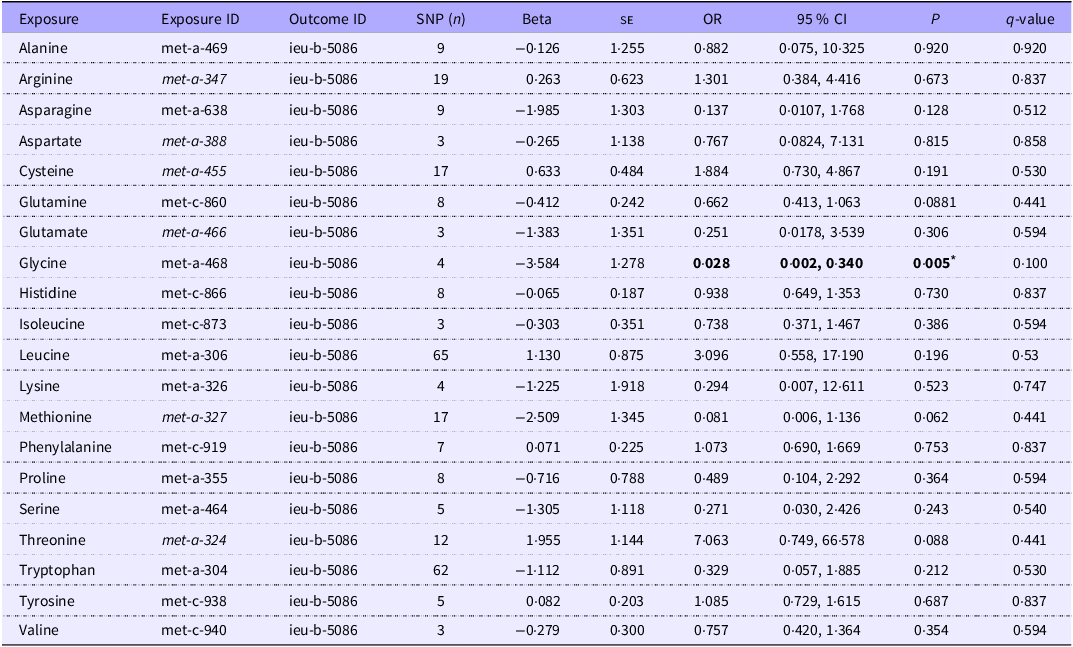
Across the twenty common amino acids, only glycine showed an inverse association with 28-d sepsis mortality at the nominal level: per sd higher genetically proxied glycine, the inverse variance-weighted estimate indicated a lower risk (OR = 0·028, 95 % CI 0·002, 0·340, P = 0·005); however, this signal did not survive FDR correction (q = 0·1). Findings for the remaining amino acids were non-significant (Table 6). In sensitivity checks focusing on glycine, estimates were directionally consistent across complementary estimators, with no evidence of directional pleiotropy (MR-Egger intercept P > 0·05) and no substantial heterogeneity (Cochran’s Q P > 0·05) (online Supplementary Table S2). Mendelian Randomisation Pleiotropy RESidual Sum and Outlier detected no outlier instruments and leave-one-out and forest plots showed that the association was not driven by any single SNP; funnel and scatter plots appeared symmetric and mutually consistent (online Supplementary Figure S2–S4). These sensitivity results are presented for completeness given the nominal association but should be interpreted cautiously because the glycine signal did not remain significant after FDR adjustment.
Causal effects of amino acids on sepsis survival: MR evidence for glycine and methionine as protective factors

Table 6 Long description
A table with twenty-one rows and eleven columns. The columns are labeled Exposure, Exposure ID, Outcome ID, SNP (n), Beta, SE, OR, 95 % CI, P, and q-value. The rows list different amino acids and their corresponding data values. Each row provides specific values for each column, detailing the causal effects of amino acids on sepsis survival. Notable values include Beta, SE, OR, 95 % CI, P, and q-value for each amino acid. The table highlights the inverse association of glycine with 28-d sepsis mortality, showing a lower risk with a significant P-value but not surviving FDR correction.
SNP, single nucleotide polymorphism; ID, identifier.
Note: The value in bold indicates a statistically significant odds ratio (P < 0·05).
* P < 0·05, significant statistical difference.
Discussion
Our integrated analysis demonstrates that intravenous compound amino acid supplementation is independently associated with a significantly reduced 28-d mortality in critically ill sepsis patients. This survival benefit was consistently observed across multiple analytic approaches in our cohort. However, MR analyses did not identify any individual amino acid with a causal effect on sepsis outcomes after correcting for multiple testing. An initial genetic signal for glycine (inversely associated with mortality) did not remain significant after FDR adjustment, and no single amino acid met the threshold for a robust association. This suggests that no single amino acid alone is likely responsible for the observed protective effect of the amino acid infusion.
Importantly, the absence of any clear single-agent effect in MR aligns with evidence from clinical trials of individual amino acid therapies in critical illness, which have largely yielded null results. For example, enteral citrulline supplementation in ICU patients failed to reduce organ failure or improve outcomes compared with placebo(Reference Tadie, Locher and Maamar12), and prolonged intravenous L-arginine infusion in septic shock did not improve microcirculatory perfusion or organ function(Reference Luiking, Poeze and Deutz13). Similarly, high-dose glutamine, another amino acid historically thought to be beneficial, did not improve survival in a large, randomised trial and was even associated with increased mortality(Reference Heyland, Muscedere and Wischmeyer17). A systematic review and meta-analysis of immunonutrition interventions found that diets enriched with arginine (with or without glutamine or other additives) offered no outcome advantage in critically ill ICU patients compared with standard nutrition(Reference Marik and Zaloga18). These converging lines of evidence underscore that supplementing any single amino acid has not yielded a clear clinical benefit in sepsis or critical illness. Our null MR results bolster this conclusion from a genetic perspective, reinforcing current guideline cautions against single-amino acid supplementation in sepsis.
The contrast between the failure of single amino acids in trials and the observed benefit of a combined amino acid formulation in our study points to the possibility of synergistic or complementary effects when multiple amino acids are provided together. Sepsis is characterised by profound metabolic and nutritional derangements, including widespread amino acid depletion and altered amino acid utilisation(Reference Mosevoll, Hansen and Gundersen19–Reference Druml, Heinzel and Kleinberger22). These metabolic alterations result in a dysregulated amino acid profile, where some amino acids, especially branched-chain amino acids, become depleted due to heightened energy demands and immune activation(Reference Reisinger, Posch and Hackl9,Reference Su, Li and Xie21,Reference Druml, Heinzel and Kleinberger22) . In this context, replenishing a broad spectrum of amino acids simultaneously may address multiple metabolic needs and pathophysiological pathways in a way that any single amino acid cannot(Reference García-de-Lorenzo, Ortíz-Leyba and Planas23). Accumulating evidence suggests that compound amino acid administration may confer clinical benefits in critically ill patients, particularly by improving metabolic stability and preserving organ function. Notably, randomised controlled trials have suggested that compound amino acid administration may enhance renal perfusion, improve nitrogen balance and modulate inflammatory responses, potentially contributing to better outcomes in patients with sepsis and critical illness(Reference Doig, Simpson and Bellomo3,Reference Landoni, Monaco and Ti24,Reference Zhu, Allingstrup and Perner25) . Consistent with these findings, our study further supports the notion that amino acid supplementation may be associated with improved survival outcomes in critically ill sepsis patients, even after adjusting for key confounding variables such as disease severity and baseline renal function, reinforcing its potential role in critical care nutrition strategies.
It is also important to consider the clinical and methodological context when interpreting our results. First, our study is retrospective, and despite rigorous adjustment (including PSM and multiple sensitivity analyses), unmeasured confounding may still be present. Another limitation is the lack of detailed data on the exact composition and dosing of the amino acid formulations used in our cohort. We treated the intervention as a class effect of compound amino acid supplementation but could not determine the contribution of each amino acid in the mixture. This uncertainty reinforces our caution against attributing the benefit to any single component, and it aligns with our conclusion that synergy is likely at play. Most importantly, the MR findings must be interpreted in context. Because instruments were derived from community-based genome-wide association study, our MR quantifies the etiologic effect of lifelong genetically proxied amino acid differences rather than the short-term pharmacologic effects of ICU supplementation. Accordingly, the large MR effect size observed for glycine (OR = 0·028) should be interpreted with caution. Such large estimates are not uncommon in MR analyses and do not imply that acute intravenous glycine administration in the ICU would yield a comparable effect size. The glycine signal showed consistent direction across estimators, supporting directional plausibility rather than dose equivalence. This distinction is critical: our null MR results do not contradict the observed cohort benefit but highlight that a lifelong trait for one amino acid may be insufficient to alter outcomes. The benefit seen in our cohort is likely due to the acute, combined effect of multiple amino acids – a scenario our MR analysis is not designed to detect, thus leaving the possibility of a true combination effect that requires confirmation in prospective trials.
Conclusion
By using multiple analytical approaches, this study demonstrates a strong association between intravenous amino acid supplementation and reduced 28-d mortality in critically ill sepsis patients. However, our MR analysis did not identify a robust causal link for any specific amino acid after statistical correction. These findings support the potential therapeutic benefit of compound amino acid supplementation as a class. Nevertheless, further randomised controlled trials are needed to definitively validate these observational results and to establish optimal formulations and dosing strategies for clinical application.
Supplementary material
For supplementary material/s referred to in this article, please visit https://doi.org/10.1017/S0007114526106461
Acknowledgements
We would like to thank the MIMIC-IV and the IEU OpenGWAS database for providing data support for this paper. Data for this paper obtained from the MIMIC-IV v2.2 database and the IEU OpenGWAS database.
Funding for this research was provided by the Outstanding Youth Project of Heilongjiang Natural Science Foundation (Grant No. JQ2024H004) and the Young Scholars Fostering Fund of the First Affiliated Hospital of Nanjing Medical University (Grant Nos. PY2023011 and PY2023035).
Q. W.: Conceptualisation, Data curation, Formal analysis, Funding acquisition, Investigation, Methodology, Writing – original draft. Y. M.: Data curation, Formal analysis, Software, Writing – original draft. Y. Z.: Formal analysis, Investigation, Methodology. J. W.: Formal analysis, Visualisation. Y. H.: Conceptualisation, Funding acquisition, Supervision, Writing – review & editing. H. H.: Conceptualisation, Funding acquisition, Project administration, Supervision, Validation and Writing – review & editing. All authors read and approved the final version of the manuscript.
The authors declare that they have no competing interests.
Ethical approval for the use of MIMIC-IV database was obtained from the Institutional Review Board (IRB) of Beth Israel Deaconess Medical Center. Access to the database was granted following completion of the Collaborative Institutional Training Initiative certification (Record IDs: 35951029 and 53211622), ensuring compliance with ethical and data privacy requirements.