Lianas (woody climbers) play a key role in the structure and function of forest ecosystems (Schnitzer & Bongers Reference SCHNITZER and BONGERS2002), representing 10–40% of woody stems in tropical forests (Gentry Reference GENTRY, Putz and Money1991). General patterns of liana distribution, abundance and species richness in the tropics have been documented (DeWalt et al. Reference DEWALT, SCHNITZER, CHAVE, BONGERS, BURNHAM, CAI, CHUYONG, CLARK, EWANGO, GERWING, GORTAIRE, HART, IBARRA-MANRIQUEZ, ICKES, KENFACK, MACIA, MAKANA, MARTINEZ-RAMOS, MASCARO, MOSES, MULLER-LANDAU, PARREN, PARTHASARATHY, PÉREZ-SALICRUP, PUTZ, ROMERO-SALTOS and THOMAS2010, Gallagher & Leishman Reference GALLAGHER and LEISHMAN2012, Schnitzer Reference SCHNITZER2005, van der Heijden & Phillips Reference VAN DER HEIJDEN and PHILLIPS2008). Precipitation and seasonality have been identified as major drivers of liana abundance in tropical regions, with lianas increasing with decreased annual rainfall and increased dry-season length (DeWalt et al. Reference DEWALT, SCHNITZER, CHAVE, BONGERS, BURNHAM, CAI, CHUYONG, CLARK, EWANGO, GERWING, GORTAIRE, HART, IBARRA-MANRIQUEZ, ICKES, KENFACK, MACIA, MAKANA, MARTINEZ-RAMOS, MASCARO, MOSES, MULLER-LANDAU, PARREN, PARTHASARATHY, PÉREZ-SALICRUP, PUTZ, ROMERO-SALTOS and THOMAS2010, Schnitzer Reference SCHNITZER2005). However, in a study across Neotropical forests, van der Heijden & Phillips (Reference VAN DER HEIJDEN and PHILLIPS2008) found no relationship between liana abundance and both mean annual rainfall and dry-season length, suggesting that this issue deserves further study.
The climbing habit has evolved many times during plant evolution (Gianoli Reference GIANOLI2004), and a variety of mechanisms are utilized by climbers to access the support structure (Isnard & Silk Reference ISNARD and SILK2009, Putz & Holbrook Reference PUTZ, HOLBROOK, Putz and Money1991). The relative frequency of climbing mechanisms varies with the availability of suitable supports and with light levels (Carrasco-Urra & Gianoli Reference CARRASCO-URRA and GIANOLI2009, Hegarty & Caballé Reference HEGARTY, CABALLÉ, Putz and Money1991, Putz Reference PUTZ1984). However, the distribution of climbing mechanisms at global scales has received little attention; the single study performed to date took into account the proportion of twiners relative to tendril-bearers only, and evaluated the relationship between this proportion and latitude (Gallagher & Leishman Reference GALLAGHER and LEISHMAN2012). The association between climbing mechanisms and the environmental factors that influence liana distribution has yet to be evaluated at a global scale.
Root climbers constitute a distinctive group within climbing plants. Whereas other guilds have constraints concerning the maximum support diameter they can use (e.g. tendril-bearers), root climbers are free from this limitation (Hegarty Reference HEGARTY, Putz and Money1991, Putz Reference PUTZ1984, Putz & Holbrook Reference PUTZ, HOLBROOK, Putz and Money1991). Lianas are often considered light-demanding plants (Hegarty & Caballé Reference HEGARTY, CABALLÉ, Putz and Money1991, Putz Reference PUTZ1984, Schnitzer & Bongers Reference SCHNITZER and BONGERS2002, but see Gianoli et al. Reference GIANOLI, SALDAÑA, JIMÉNEZ-CASTILLO and VALLADARES2010), while root climbers comprise mostly shade-tolerant species (Hegarty Reference HEGARTY, Putz and Money1991, Valladares et al. Reference VALLADARES, GIANOLI and SALDAÑA2011). At least at local scales, root climbers seem to be associated with high precipitation and low light availability (Hegarty Reference HEGARTY, Putz and Money1991, Orihuela Reference ORIHUELA2010, Teramura et al. Reference TERAMURA, GOLD, FORSETH, Putz and Money1991). In extratropical regions of South America, root climbers were only recorded in rain forests, being absent from seasonal forests (Durigon et al. unpubl. data). In seasonal forests, many tree species lose their leaves in the dry season, resulting in high light penetration in the understorey (Kalacska et al. Reference KALACSKA, SANCHEZ-AZOFEIFA, RIVARD, CALVO-ALVARADO and QUESADA2008). This may be an unfavourable condition for root climbers in view of their low potential for acclimation to high irradiance (Carter & Teramura Reference CARTER and TERAMURA1988, Teramura et al. Reference TERAMURA, GOLD, FORSETH, Putz and Money1991). In the present study, we tested whether root climbers mainly occur in areas with high precipitation and low seasonality across forests worldwide, a pattern which is contrary to general patterns of distribution and abundance of lianas in the tropics. We also included the effect of temperature on the occurrence of root climbers because there is evidence that temperature may influence distribution limits of lianas (Jiménez-Castillo et al. Reference JIMÉNEZ-CASTILLO, WISER and LUSK2007).
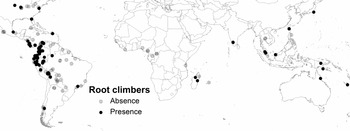
In order to test our hypothesis, we constructed a matrix of presence/absence data of root climbers in 174 sites distributed in tropical and temperate areas. These sites correspond to a subset of the Alwyn H. Gentry Forest Transect Data Set (Phillips & Miller Reference PHILLIPS and MILLER2002), which comprises forest plots of 0.1 ha distributed across the globe (Figure 1). Gentry quantified all trees, shrubs, lianas and hemiepiphytes with stems ≥2.5 cm diameter at breast height in 225 plots worldwide. Each plot consists of 10 transects of 2 × 50 m distributed across mature forest. We used only those plots that had lianas. Some sites had more than one plot, but they were considered independent sampling units as they had contrasting soil types. From this database, we selected the species identified by Gentry as lianas, and determined which of these species climb using adventitious roots by searching the literature and herbarium collections. Environmental data for each site, i.e. mean annual precipitation, length of the dry season, and mean annual temperature, were taken from the WorldClim dataset (www.worldclim.org). Dry-season length was defined as the number of consecutive months with average precipitation <100 mm (DeWalt et al. Reference DEWALT, SCHNITZER, CHAVE, BONGERS, BURNHAM, CAI, CHUYONG, CLARK, EWANGO, GERWING, GORTAIRE, HART, IBARRA-MANRIQUEZ, ICKES, KENFACK, MACIA, MAKANA, MARTINEZ-RAMOS, MASCARO, MOSES, MULLER-LANDAU, PARREN, PARTHASARATHY, PÉREZ-SALICRUP, PUTZ, ROMERO-SALTOS and THOMAS2010).
Spatial distribution of Gentry's forest plots used in the current study (n = 174). Presence/absence of root climbers is indicated.

We used logistic regression (R-software) to evaluate the effects of mean annual precipitation, dry-season length and mean annual temperature on the occurrence of root climbers (binary data: presence = 1, absence = 0). The analyses were performed using both the global dataset and tropical sites only.
A total of 174 plots in Gentry's dataset had liana species, with 151 plots located in the tropics and 23 plots in temperate ecosystems. We retrieved 116 liana species bearing adventitious roots as climbing mechanism. Root climbers occurred in 79 of the 174 plots considered in the study, being present in only seven plots from temperate forests (Figure 1). As expected, root climbers were positively associated with mean annual precipitation and negatively associated with dry-season length across forests worldwide; the same patterns were found for tropical forests only (Table 1). Higher temperatures reduced the probability of root-climber occurrence in tropical sites and had a marginally significant effect at the global level (Table 1). The inclusion of plots with no lianas (n = 5) did not alter the patterns found (data not shown).
Logistic regressions to evaluate the effects of mean annual precipitation (MAP), dry-season length (DSL) and temperature on the occurrence of root climbers across forests distributed worldwide and in tropical forests only. β denotes the standardized regression coefficients, and SE their standard error.

Whereas overall liana abundance across the tropics decreases with increasing precipitation and decreasing seasonality (DeWalt et al. Reference DEWALT, SCHNITZER, CHAVE, BONGERS, BURNHAM, CAI, CHUYONG, CLARK, EWANGO, GERWING, GORTAIRE, HART, IBARRA-MANRIQUEZ, ICKES, KENFACK, MACIA, MAKANA, MARTINEZ-RAMOS, MASCARO, MOSES, MULLER-LANDAU, PARREN, PARTHASARATHY, PÉREZ-SALICRUP, PUTZ, ROMERO-SALTOS and THOMAS2010, Schnitzer Reference SCHNITZER2005), we found that root climbers occurred more frequently in sites with greater precipitation and shorter seasonality. This pattern held both at the tropical and global scales. Gentry (Reference GENTRY1988, Reference GENTRY, Putz and Money1991) noted that in sites with higher precipitation the species richness and abundance of root climbers tend to increase. Besides utilizing data of a different type, Gentry included hemiepiphytes in his analysis, while in our quantitative analysis we took into account the presence/absence of root climbers only.
Open and dry habitats appear unsuitable for root climbers. This could be related to physiological adaptations to low light developed by many species from this group of climbers (Carter & Teramura Reference CARTER and TERAMURA1988, Teramura et al. Reference TERAMURA, GOLD, FORSETH, Putz and Money1991). Shade-tolerant lianas preferentially allocate resources to traits that enhance survival in light-limited understorey environments, sacrificing carbon gain and shoot growth, which are maximized by light-demanding species (Ichihashi et al. Reference ICHIHASHI, NAGASHIMA and TATENO2010, Valladares et al. Reference VALLADARES, GIANOLI and SALDAÑA2011). Susceptibility to desiccation of adventitious roots (Hegarty Reference HEGARTY1988, Wilder Reference WILDER1992) may explain the exclusion of root climbers from sites with high potential evapotranspiration and high temperatures.
The increased liana abundance in dry and seasonal forests has been attributed to a greater competitive advantage of lianas over trees, which allows the former to show higher growth rates during the dry season (Schnitzer Reference SCHNITZER2005). The higher light levels in the understorey throughout the year and the increase in light when deciduous trees shed their leaves in the dry season are likely to favour lianas (DeWalt et al. Reference DEWALT, SCHNITZER, CHAVE, BONGERS, BURNHAM, CAI, CHUYONG, CLARK, EWANGO, GERWING, GORTAIRE, HART, IBARRA-MANRIQUEZ, ICKES, KENFACK, MACIA, MAKANA, MARTINEZ-RAMOS, MASCARO, MOSES, MULLER-LANDAU, PARREN, PARTHASARATHY, PÉREZ-SALICRUP, PUTZ, ROMERO-SALTOS and THOMAS2010, Schnitzer Reference SCHNITZER2005). However, the physiological adaptability and light acclimation potential of lianas are likely to be associated with their particular climbing mechanism (Carter & Teramura Reference CARTER and TERAMURA1988, Teramura et al. Reference TERAMURA, GOLD, FORSETH, Putz and Money1991). Whereas tendril climbers show broad physiological plasticity in response to variation in light availability, most root climbers have low capacity of acclimation to high irradiance (Teramura et al. Reference TERAMURA, GOLD, FORSETH, Putz and Money1991). Stems of root climbers grow away from sources of strong light (Hegarty Reference HEGARTY, Putz and Money1991) and chances of survival are greater when they grow on the less-exposed side of a tree, thus avoiding desiccation (Hegarty Reference HEGARTY1988). Root climbers cope with deep shade by intercepting light efficiently and reducing gas-exchange rates (photosynthesis and dark respiration) (Gianoli & Saldaña Reference GIANOLI and SALDAÑA2013, Kusumoto et al. Reference KUSUMOTO, ENOKI and KUBOTA2013, Valladares et al. Reference VALLADARES, GIANOLI and SALDAÑA2011); the strategy of maximization of light capture and minimization of metabolic costs is typical of shade-tolerant plants (Valladares & Niinemets Reference VALLADARES and NIINEMETS2008).
Climbing by adventitious roots is a mechanism employed by relatively few climber taxa (Gallagher & Leishman Reference GALLAGHER and LEISHMAN2012, Hegarty Reference HEGARTY, Putz and Money1991). However, some species of root climbers can be locally very abundant, both in tropical and temperate rain forests (Durigon & Waechter Reference DURIGON and WAECHTER2011, Gianoli et al. Reference GIANOLI, SALDAÑA, JIMÉNEZ-CASTILLO and VALLADARES2010, Kusumoto et al. Reference KUSUMOTO, ENOKI and KUBOTA2013). We have shown that root climbers have distinctive environmental requirements and constraints, which make their pattern of association with precipitation and seasonality contrary to the one proposed for all lianas as a group. Consequently, whereas lianas are predicted to increase in abundance and biomass with increasing frequency or duration of seasonal droughts associated with climate change (Schnitzer & Bongers Reference SCHNITZER and BONGERS2011), we can expect that root climbers will decline if the rain forests where they occur become drier in the future.
ACKNOWLEDGEMENTS
We thank the Missouri Botanical Garden for making available the valuable dataset of Alwyn H. Gentry. JD thanks CAPES (PDSE 7138-12-1) for the scholarship during the “Sandwich” PhD Program at Universidad de la Serena, Chile. EG thanks funding by FONDECYT grant 1100585.