INTRODUCTION
Understanding the circulation of objects, especially in pre-Columbian Mesoamerica, has proven difficult (cf. Hodder Reference Hodder, Ericson and Earle1982; Renfrew Reference Renfrew, Sabloff and Lamberg-Karlovsky1975, Reference Renfrew, Ericson and Earle1977). Models based on strict dichotomies between commodities and gifts are insufficient, as objects are recognized as having long social lives and possibly moving back and forth between categories (i.e., Appadurai Reference Appadurai and Appadurai1986). To investigate the complex lives of many of these objects, archaeologists must look at their distribution across the landscape, how they were produced, circulated, and consumed, as well as the place of that object in a larger system of value and values (e.g., Graeber Reference Graeber2001). Jade can be especially confounding because it often had a long life-history and may have been reworked, and/or served as heirlooms that were displayed and curated sometimes over periods of hundreds of years (Joyce Reference Joyce, Joyce and Gillespie2000). Most scholars agree that jade was traded in dyadic relationships (Polanyi Reference Polanyi, Polanyi, Arensberg and Pearson1957) of reciprocal exchange between elites as gifts or tribute (see for example, Braswell and Glasscock Reference Braswell, Glascock and Glascock2002:34, 46; Kovacevich Reference Kovacevich2013; Lange and Bishop Reference Lange, Bishop and Lange1988; McAnany Reference McAnany2010:298–299). Kovacevich (Reference Kovacevich, Wells and Davis-Salazar2007, Reference Kovacevich, Hruby, Chinchilla and Braswell2011, Reference Kovacevich2013) has argued previously for gradations of value in the circulation of jade artifacts based on the work of Lesure (Reference Lesure and Robb1999; see also Masson and Freidel Reference Masson and Freidel2012), who suggests that some types of jades circulated in non-elite circles, while others were more restricted to the elite and gained value because of the circulation of the more common forms. Jade artifacts and jade production have been found in non-elite contexts throughout the Maya area during the Classic period (Garber Reference Garber and Lange1993:166–172; Guderjan Reference Guderjan2007:81–88; Kovacevich Reference Kovacevich, Wells and Davis-Salazar2007; Moholy-Nagy Reference Moholy-Nagy1994:88, Reference Moholy-Nagy1997:301; Palka Reference Palka1995:20; Rochette Reference Rochette2009; Rochette and Pellecer Alecio Reference Rochette, Alecio, Laporte, Arroyo and Mejia2008), and there have been arguments for beads (Freidel Reference Freidel and Lange1993; Freidel et al. Reference Freidel, Reese-Taylor, Mora-Marín, Masson and Freidel2002; Kovacevich Reference Kovacevich, Wells and Davis-Salazar2007) and greenstone axes (Freidel and Reilly Reference Freidel, Reilly, Staller and Carrasco2010) as possible mediums of exchange in pre-Contact period Mesoamerica.
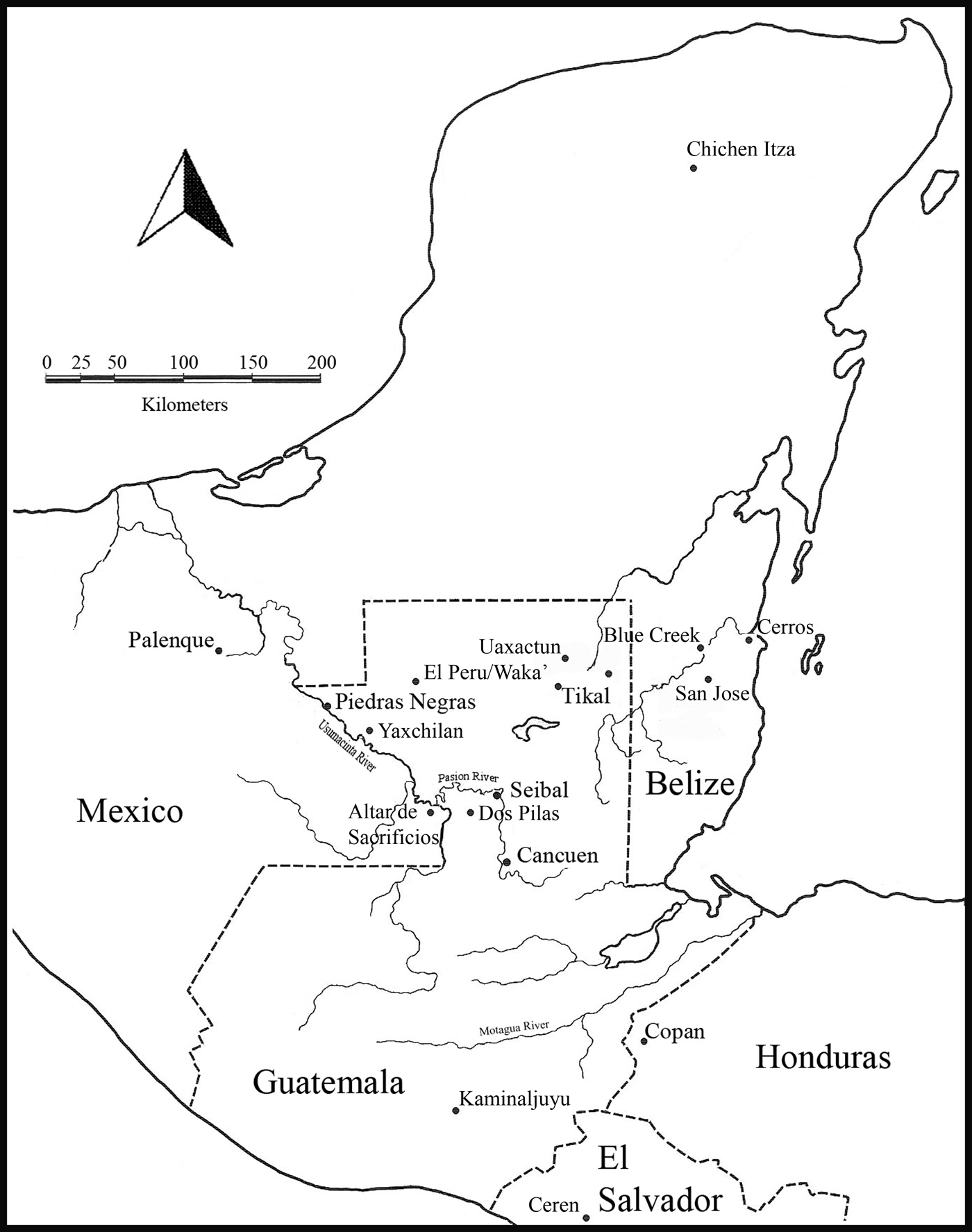
Kovacevich's (Reference Kovacevich, Wells and Davis-Salazar2007, Reference Kovacevich, Hruby, Chinchilla and Braswell2011, Reference Kovacevich2013, Reference Kovacevich, Guderjan and Matthews2017) research at Cancuen, Guatemala supported many of the above interpretations, especially that some jades functioned as inalienable possessions with gifting as a mechanism for circulation (Kovacevich Reference Kovacevich2013). This work has shown that certain forms (including badges of office) were restricted to elites, while others (including beads) circulated more widely, and that commoners participated in jade production (e.g., Kovacevich Reference Kovacevich, Wells and Davis-Salazar2007, Reference Kovacevich, Hruby, Chinchilla and Braswell2011, Reference Kovacevich2013; see also Rochette Reference Rochette2009). Recent work by others from Cancuen suggests a commoditized role for jades in early stages of production, which were purportedly exported en masse from this production site (see Figure 1) as blanks that were then worked by local elite crafters at destination sites:
[t]his model matches the data from Cancuen very well, with an exportation of beads and earflares blanks [sic] to consumer sites that carried out their own final work on each piece. Regarding the value of the exchange, it is important to note that exchanging preforms or blanks certainly did not have the same implications as the exchange of finely crafted finished objects. While these objects could have been exchanged through gifting obligations (Godelier Reference Godelier1996; Mauss Reference Mauss2007 [1924]), blanks, on the other hand, are more easily commoditized (Kopitoff Reference Kopytoff and Appadurai1986) [sic], especially since they are easily standardized and could have been exchanged in a more mundane way. The crafting of blanks probably conveyed less meaning than the carving of finished artifacts (Andrieu et al. Reference Andrieu, Rodas and Luin2014:160).
Map of the Maya region showing sites mentioned in the text. Map by Kovacevich.

Andrieu and colleagues' (Reference Andrieu, Rodas and Luin2014) findings are largely the same as those of Kovacevich (Reference Kovacevich2006, Reference Kovacevich, Wells and Davis-Salazar2007, Reference Kovacevich, Hruby, Chinchilla and Braswell2011, Reference Kovacevich2013, Reference Kovacevich, Guderjan and Matthews2017), but depart from her original conclusions in several ways. Most significant is the supposition that blanks were standardized and exchanged in mundane economic spheres as opposed to finished products that were unique and exchanged among elite actors in competitive gifting. This argument creates a false dichotomy in the distinction between commodity and gift (e.g., Kopytoff Reference Kopytoff and Appadurai1986; Wright Reference Wright, Abraham, Gullapalli, Raczek and Rizvi2013), and also involves a false evolutionary implication that assumes the Maya economy moved from less to more complex as commodity exchange emerged (Wright Reference Wright, Abraham, Gullapalli, Raczek and Rizvi2013), with Cancuen leading the way in commoditization (Demarest Reference Demarest2013). The reality is much more complex, with jades not strictly conforming to gift or commodity categories.
In this study, we argue that standardization was not a necessary feature of inchoate commodities. A more important feature was most likely the ability of an object to be counted and classified as generic. If this were the case, certain jade artifacts lend themselves more readily to these qualities, including beads and axes, as opposed to earflares and plaques (Freidel al. Reference Freidel, Masson and Rich2017:148). Although we argue that standardization was not a necessary feature of potential commodities, we examine if Maya jades were standardized to debunk the inference that jade blanks were commodities because they were easy to standardize. We argue that it is not standardization that may hint at the incipient commodification of jade in the Maya area, but artifact distributions of specific classes of objects, namely beads and axes.
MESOAMERICAN “JADE”
Jade is used in this context as a general term for greenstones including jadeite (a pyroxene mineral, NaAlSi2O6). Many of the artifacts discussed in the text have not been subjected to chemical compositional analysis to determine their mineralogical composition. Recent studies have shown that many artifacts that do contain jadeite are often polymineralic jadeitite with jadeite as a major component (including jade production refuse from Cancuen; see Kovacevich et al. Reference Kovacevich, Neff, Bishop, Speakman and Neff2005). Many artifacts also include combinations of jadeite and omphacite, a related mineral that often forms with jadeite (see Kovacevich et al. Reference Kovacevich, Crawford, Carl, Burgess, Young and Jones2018). It has also been noted that many non-jadeite greenstones were used in burial contexts and Hammond (Reference Hammond, Grove and Joyce1999) argues that the Maya could differentiate between these types of stones, calling the non-jadeite greenstones “social jades.” Hammond (Reference Hammond, Grove and Joyce1999) also notes that “social jades” were used in female burials at Cuello while jadeite was more often used in male burials. This evidence suggests that the Maya had the ability to differentiate between different types of greenstones and valued them differently. Given that chemical compositional analysis has not been carried out on most artifacts discussed here, they will be called jade unless their mineralogical composition is known (see Kovacevich Reference Kovacevich2013 and Andrieu et al. Reference Andrieu, Rodas and Luin2014 for a similar use of the term), with the understanding that many of them probably contain jadeite, but were probably not as mineralogically pure as modern gemological jadeite (i.e., ≥ 90 percent jadeite) as this does not seem to have been an important discriminator for the Maya.
MAYA JADES AS COMMODITIES AND GIFTS
In order to evaluate claims that Maya jades were commodities, it is important to define the nature and history behind the distinction of gifts versus commodities. The difference between commodities and gifts is a basic distinction in types of objects exchanged, originally made by Marx (Reference Marx, Mandel and Fowkes1990 [1876]) and then elaborated by Mauss (Reference Mauss, Douglas and Halls1990 [1925]) and others (e.g., Gregory Reference Gregory1982). Commodity exchange has been characterized by the exchange of material, alienable objects between social actors who are in a state of reciprocal independence (see Marx Reference Marx, Mandel and Fowkes1990 [1876]). Gift exchange has been considered exchange of inalienable objects between social actors who are in a state of reciprocal dependence (Lévi-Strauss Reference Lévi-Strauss, Coser and Rosenberg1949; Mauss Reference Mauss, Douglas and Halls1990 [1925]; Morgan Reference Morgan1877; see also Gregory Reference Gregory1982 and Weiner Reference Weiner1992). Mauss (Reference Mauss, Douglas and Halls1990 [1925]:63) emphasizes the inalienability of the gift, noting that, “the alliance that has been contracted is no momentary phenomenon, and the contracting parties are deemed to be in a perpetual dependence towards one another.” This dichotomy can often be exaggerated (Kopytoff Reference Kopytoff and Appadurai1986), especially with respect to nonindustrial economies (Wright Reference Wright, Abraham, Gullapalli, Raczek and Rizvi2013).
Many have argued against this strict dichotomy. Kopytoff (Reference Kopytoff and Appadurai1986) argued that there is a spectrum ranging from commodities to gifts and that commoditization is a process. Appadurai (Reference Appadurai and Appadurai1986:11) argued that there should be no such distinction, that anything that is intended for exchange is a commodity, and that we should look at the life history of objects to see that a commodity is not a certain type of thing, but a phase in the life of a thing (Appadurai Reference Appadurai and Appadurai1986:17). Graeber (Reference Graeber2001:33) has critiqued both Appadurai and Kopytoff, as they emphasize the social life of the thing in its importance to value but also define their terms in such a way that it becomes difficult to consider that an object's biography could itself contribute to its value (although cf. Appadurai Reference Appadurai and Pearce1994). This argument corresponds to many recent approaches that consider the materiality and material agency of objects (see Knappett and Malaflouris Reference Knappett and Malafouris2008; Meskell Reference Meskell2005), as well as objects as inalienable possessions (Kovacevich and Callaghan Reference Kovacevich and Callaghan2013; Mills Reference Mills2004). These approaches focus on heirlooms and other valuables, which themselves add to the social identity of either the giver or the recipient (or both). These objects can be considered to have agency themselves, along with the ability to constitute social identity, as well as the ability to retain some of the personhood of their possessor, making them indelibly linked to that person. Objects with long histories and material agency are less likely to be commodities because of their uniqueness and inability to be compared and extracted from their connections to individuals. This uniqueness can also be reflected in their distribution on the landscape, which is often restricted. They are not objects that are possessed by the masses.
Graeber (Reference Graeber2001) further argues that it may be more helpful to look at two types of reciprocal exchange relationships: instead of focusing on commodities or gifts, we should focus on whether the object is generic or specific. By doing this, we see that some objects become more than tokens of value, and actually embody or emote value themselves. Generic objects are more resistant to accumulating histories (like paper currency in modern society), whereas specific objects accumulate histories and accrue value through those historical links that are remembered and shared. These two types of valued objects can reflect two different types of power that are not mutually exclusive: the power of the visible and the hidden. Visible qualities of objects or adornments bring power to the individual and demonstrate the power of past actions and achievements (readily visible to all). In contrast, hidden power and/or value of objects not on display (often hoarded or secreted away like paper money hidden in a mattress), speaks to the potential for success of an individual's actions in the future. These types of power correspond to differently valued objects. Those that are displayed are often objects that gain value from their life histories, previous owners, and producers. In these objects, value and power emanate from the object itself, especially in things like heirlooms and inalienable possessions. Objects that represent hidden power are things like money, currency, tokens of value, or items that can be hoarded and are largely devoid of historical information or life histories. We argue that jades in general, but particularly jade beads, can traverse both of these types of power, which is why the Maya held jade in such high esteem, and also why jade may have circulated in multiple economic spheres. Beads are objects of personal adornment that are publicly displayed, and therefore become part of public displays of power. Beads, however, can also be parted from their displayed capacity and easily hidden, hoarded, or cached, while also remaining largely generic.
Finally, Graeber (Reference Graeber2001) argues that exchanges should be characterized not as generalized and balanced, which would traditionally characterize gift versus commodity exchange (cf. Sahlins Reference Sahlins1972:194), but as open or closed forms of exchange (i.e., those that welcome continued social ties and relationships and those that end social relationships after the exchange). This broader characterization corresponds to Graeber's concepts of different types of power in that specific objects would be exchanged in open systems, whereas generic objects would largely be exchanged in closed systems. Some objects may have been able to traverse both open and closed forms of exchange; in the case of the Maya, beads were the most likely candidates.
The use of alternative terms is significant because when we are applying ideas about commodities to a non-commoditized or non-capitalist economy we may be expecting those commodities to behave exactly as our own (i.e., to be standardized). These terms do not have the connections to capitalist economies and Western world view the way that terms like “commodity” may. Maya jades had complex social lives and some surely circulated in open exchanges, meaning they left existing social ties open between the giver and the receiver (i.e., either as gifts or tribute). Some jades may have also circulated in closed forms of exchange, including barter or market exchange, but what allowed them to do so may not be the same characteristics that we expect in capitalist economies, i.e., standardization.
To understand why objects may have circulated in different spheres, one must first understand the different regimes (Appadurai Reference Appadurai and Appadurai1986) or gradations of value (Lesure Reference Lesure and Robb1999), as those differences in value may give clues to restrictions placed on the objects by the society as to where the object may have circulated and by whom. Graeber argues that in order to understand the value of objects in a society, one must know something of its values. He contends that, “value is the way actions become meaningful to the actors by being placed in some larger social whole, real or imaginary” (Graeber Reference Graeber2001:254). In order to understand that larger social realm, Graeber (Reference Graeber2001:259) suggests looking at its most valued objects: namely, heirlooms, treasures, inalienable possessions, songs, ritual performances, titles, and associated ritual regalia:
[t]he critical thing is that whatever it [the valued object] is, it can on some level be said to contain everything. Such objects imply within their own structure all those principles of motion that shape the field in which they take on meaning—in much the same way as, say, a household contains all the elementary forms of relation at play within a larger kinship system, even if at times in strange inverted forms. In any case, they become the frozen images of those patterns of actions that in practice are called into being by the very fact that people value them: they are, as I said, mirrors of our own manipulated intentions.
To understand the system of value of a culture, we must understand what it valued most and why. In the case of the Maya, the most highly valued jades, like elite badges of office, adornments/ritual paraphernalia like earflares (see also Taube Reference Taube2005), and plaques incised with ritual and esoteric knowledge (sometimes even hieroglyphic histories of the objects themselves) can tell us something of Maya values and what the Maya valued. Especially important is looking at objects that could transcend different spheres of value. By doing this, we can understand exactly what can and what could, or what should or should not, be measured and compared in an economic system (Graeber Reference Graeber2001:223). This allows us to determine the object's ability to be used in an open versus a closed exchange.
The types of jade objects that circulated in open versus closed exchanges, or maybe even bridged them, must be carefully examined so as not to import our own Western economic ideals into the interpretation. This study evaluates plaques, earflares, beads, and axes in terms of their economic role in Maya society through distributional analysis. Earflares and plaques (even as blanks) may have had more power potential for display than beads, thus they had more potential for creating a history and more capacity for demonstrating past action of their owners. As finished objects, these jades were also important in creating and maintaining open social relationships between social actors. Earflares and plaques, even as blanks, were on their way to becoming specific, or objects that would serve to define the social identity of the giver and receiver; something that would be important to control and restrict. Jade in general declines in quantity at sites and becomes more restricted to the elite during the Late Classic period (see Marroquin Reference Marroquin2009:Table 3.1; Rathje Reference Rathje1970) and beads become the most common form of jade during this time; generic often in form, but not standardized in proportions (Marroquin Reference Marroquin2009:83). As Marroquin (Reference Marroquin2009:83) suggests this may be because beads were becoming an inchoate medium for exchange. But, even if beads circulated in more common spheres, they would have still increased the capacity for action of other, more valued, transcendent objects (Lesure Reference Lesure and Robb1999).
This is supported by distribution patterns of these objects: earflares and plaques were generally restricted to elite display and consumption, whereas beads and axes were much more widely distributed across statuses, as we discuss below (see also Guderjan Reference Guderjan2007; Kovacevich Reference Kovacevich, Wells and Davis-Salazar2007; Masson and Freidel Reference Masson and Freidel2012; Palka Reference Palka1995). Our research evaluates both distribution and standardization in an effort to better understand which jades were used in open versus closed exchanges and which may have traversed both spheres. Although standardization has been argued to be the defining factor for commodity exchange (Andrieu et al. Reference Andrieu, Rodas and Luin2014), our research and that of others suggests that Maya jades were not standardized. Instead, distribution patterns and context are the most useful tools for determining the type of exchange that transpired in the past and which objects were involved (e.g., Hirth Reference Hirth1998).
STANDARDIZATION, COMMENSURABILITY, AND FUNGIBILITY
Standardization, fungibility, and commensurability have been argued to be characteristics of commodities in capitalist societies and are sometimes applied to non-capitalist economies as well, but should be used with caution. Andrieu and colleagues (Reference Andrieu, Rodas and Luin2014) argue standardization as a marker of possible jade commodities, but their definition and correlates of standardization are not well defined. In this work, we define standardization as the relative degree of homogeneity or reduction of variability in characteristics of a particular object class (see also Blackman et al. Reference Blackman, Stein and Vandiver1993:61). In defining commodities in capitalist economies, it has been argued they are items that have equivalencies, or are fungible, which can be, “said of a thing when another of the same or of another class can be delivered in lieu of it” (Renfrew Reference Renfrew, Papadopoulos and Urton2012:253, based on Shorter Oxford English Dictionary [Trumble Reference Trumble2007]). This could be interpreted as commensurability (see also Renfrew Reference Renfrew, Papadopoulos and Urton2012) to facilitate equivalence of transaction as commodities. Renfrew (Reference Renfrew, Papadopoulos and Urton2012:250) argues that only recently have the barriers between spheres of exchange (i.e., sacred things, prestige goods, and commodities) been broken down so that fungibility is extended to things that may have previously circulated in non-commodity spheres. All barter involves the exchange of equivalencies to some degree (although see Graeber Reference Graeber2014:34 for arguments against the existence and importance of barter). It has been argued that barter exchanges are made on an ad hoc basis and are not formalized (Renfrew Reference Renfrew, Papadopoulos and Urton2012:252, see also McAnany Reference McAnany2010:258–259), whereas true fungibility is formalized, i.e., associated with standardization. These qualities together could collectively create the possibility of commodity candidacy for an object (see also Appadurai Reference Appadurai and Appadurai1986), meaning that with standardization and commensurability an object would be more likely to pass into the commodity sphere and/or be fungible. We can evaluate these proposed characteristics for Maya jades. Were Maya jades standardized? Is there evidence of commensurability during the Classic period? Did Maya jades have commodity candidacy, and if so, did this apply to all of them or just certain types of jades? We present evidence that no Maya jades were standardized. This characteristic of commodities in capitalist economies did not apply to the pre-Columbian Maya, who may have exchanged certain jades in closed exchanges, but did not need them to be standardized to fit into this category. If any class of jade artifacts were a likely candidate for commodification, that class is beads. We will discuss the commodity candidacy of jade beads, as well as jade axes, in the following sections.
COMMODITY CANDIDACY OF MAYA JADES
There are few direct historical records of pre-Contact Maya economic transactions, let alone what objects may have served as commodities. In these situations, traits such as standardization or other classic measures of commoditization in Western economies must be observed directly or indirectly in the objects themselves. Andrieu and colleagues (Reference Andrieu, Rodas and Luin2014) suggest that jade blanks could be observed to be more standardized and therefore reflect the commodity candidacy, or the ability to behave as a commodity, for those objects. Unfortunately, at the current time there is a dearth of jade blanks in the archaeological record of the Maya region and Andrieu and colleagues rely on negative evidence for the existence of blanks, let alone these blanks being standardized. Therefore, direct measures of standardization and commensurability of blanks are impossible. We can investigate standardization indirectly from finished products, however, which we would expect to be standardized in finished form if they were standardized as blanks (see below).
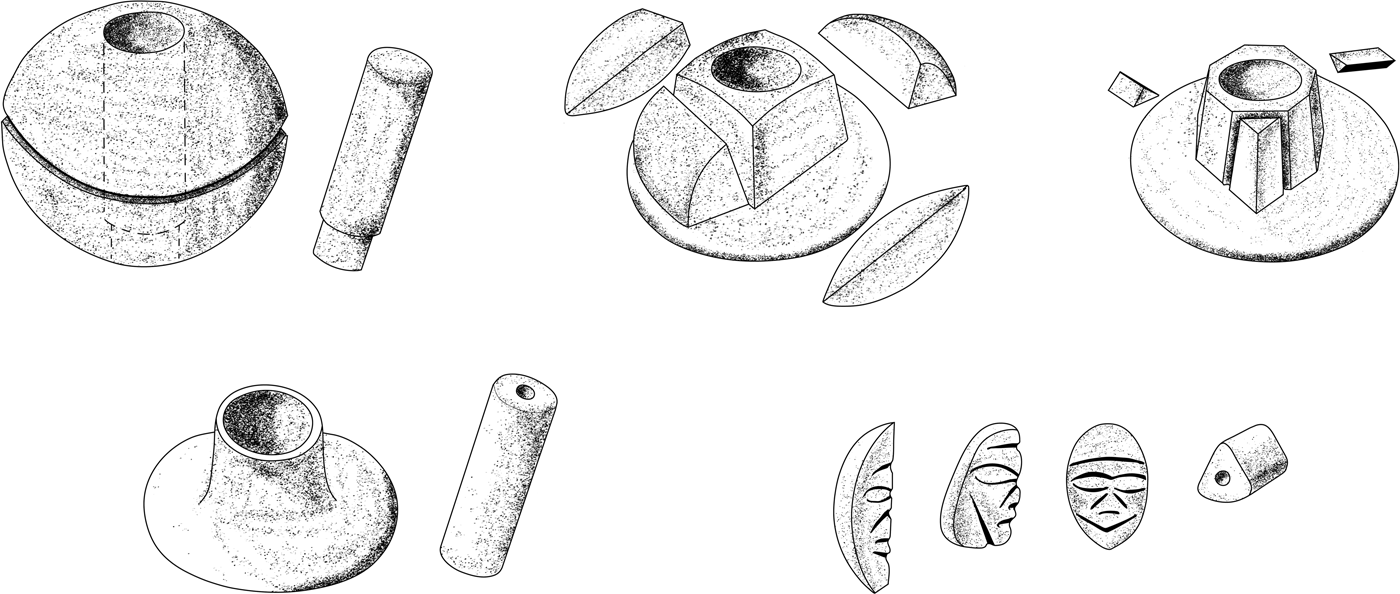
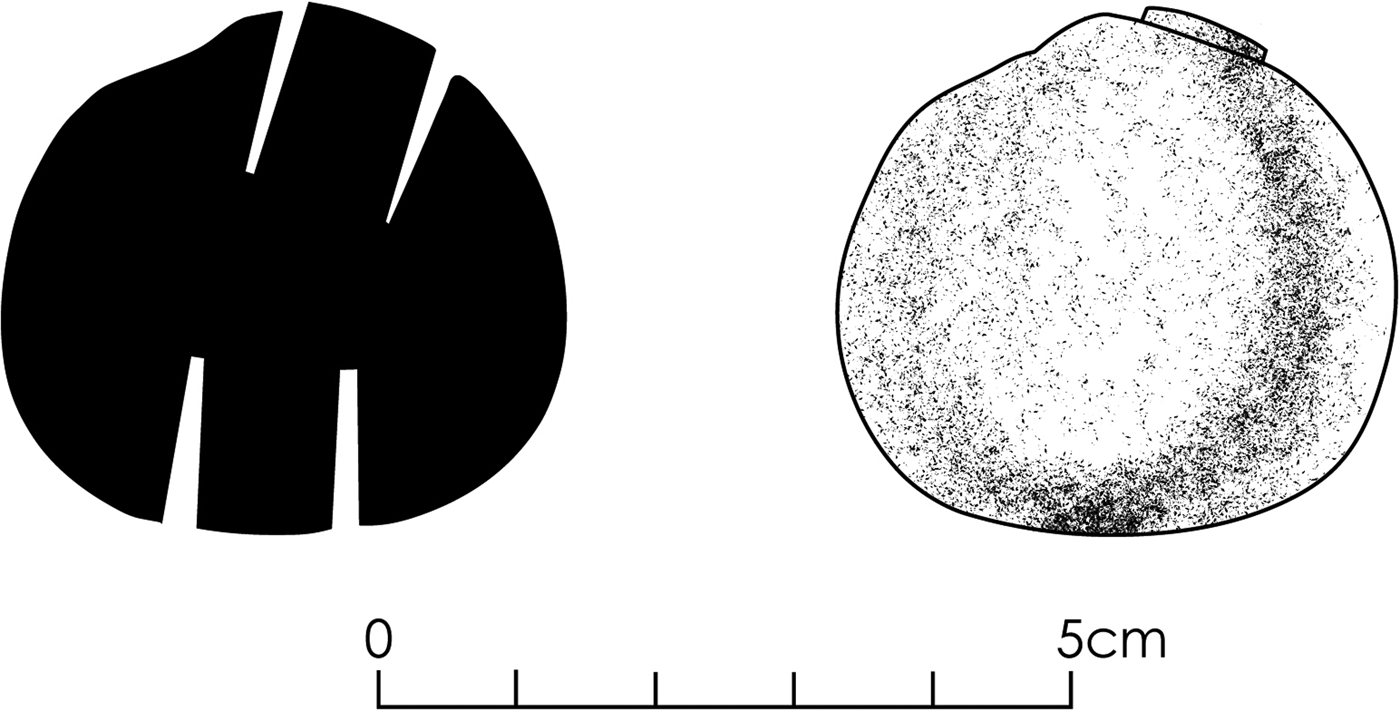
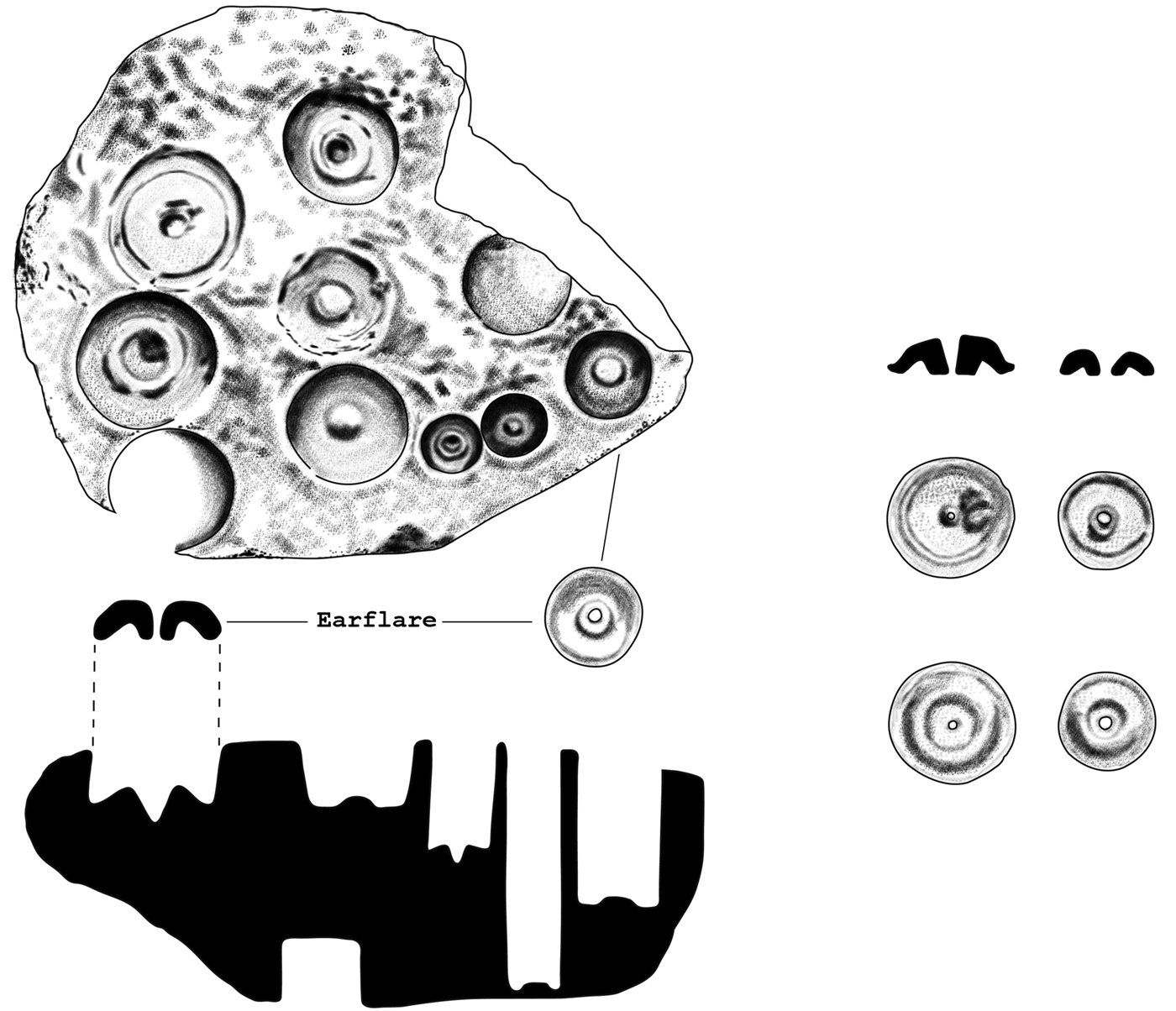
At Cancuen, a lowland Maya production locus for jade, there is only one example of an earflare blank, which is more accurately classified as an earflare abandoned in the early stages of production (see Figure 2 for stages of earflare production). As can be seen in Figure 3, the tubular drill holes in the preform that were boring in from each side were not going to meet to allow the central tubular portion to be removed, therefore the production of the object was abandoned in the early stage and deposited in a household midden of a jade production area. Blanks are defined in the present study as
a piece of lithic material that has been modified to an intended stage of a lithic reduction sequence in a specified assemblage. It must be demonstrable that it is not a finished implement and that it is intended for further modification. Furthermore it must have the morphological potential to be modified into more than one implement type within the assemblage. The method of its manufacture is not important to its initial identification (Bradley Reference Bradley and Swanson1975:5).
In the literature, earflare blanks have been mentioned for lowland sites like Copan (Fash Reference Fash1988; see also Taube Reference Taube2005:25). What is described in the literature of Copan, a roughly shaped earflare, might more readily be described as a preform, which has a very similar definition to the above, but would only have the morphological potential to be modified into a single type of implement (Taube Reference Taube2005:6), in this case, an earflare. One could make the argument, based on negative evidence, that the lack of jade blanks in the archaeological record could be attributed to the fact that they were all exported and then quite quickly carved into the desired form, or perhaps the relevant contexts have not yet been discovered. There may be contexts out there waiting to be discovered with caches or stores of blanks. The question remains, even though we do not have direct evidence of blanks, was standardization a marker of commoditization of these objects? Even in the absence of blanks there are some indirect measures that could help us to determine if blanks were standardized as a reflection of commodity candidacy. Measurements of finished products (i.e., plaques, earflares, and beads) can allow us to determine if blanks of these objects were standardized at any point, even in the absence of the blanks themselves. Our results, presented below, demonstrate that no jades were standardized, making standardization a poor marker for potential commodity candidacy. Instead, other markers like distribution may be more helpful for identifying which jades were circulated in closed exchanges.
Process of earflare production based on reconstruction by Digby (Reference Digby1964:Figure 5). Drawing by Whitney Goodwin and Alejandro Figueroa.

Abandoned jade earflare preform from jade workshop at Cancuen, Structure M10-7 (after Kovacevich Reference Kovacevich2006:Figure 5.20). Drawing by Whitney Goodwin and Alejandro Figueroa.

Plaques
In order to assess if plaque blanks were circulated as standardized commodities, it may be helpful to look at a certain type of plaque that was relatively homogeneous in form and iconography, such as the “Nebaj-type objects” studied by Proskouriakoff (Reference Proskouriakoff1974:175). These plaques were named for those first found at Nebaj in 1946 (Smith and Kidder Reference Smith and Kidder1951:Figures 59a and 59b) and are part of a larger category called “picture plaques” (McVicker and Palka Reference McVicker and Palka2001). Proskouriakoff (Reference Proskouriakoff1974) and Smith and Kidder (Reference Smith and Kidder1951) argue that these objects were carved on or near the lower Usumacinta drainage (possibly at a single workshop) due to the similarity in sculptural style to monumental art in the region. Other similarities in the objects also include the common presence of the jawless zoomorph headdress on many of the plaques (Schele and Miller Reference Schele and Miller1986:78, 89, Plate 6). Tozzer (Reference Tozzer1957:183) also speculated that the plaques came from the Usumacinta region, possibly somewhere between Palenque and Piedras Negras, based on a cache found at Tonina, although, apart from this finding, none of the plaques were found in the Usumacinta River region or even lowland Maya contexts. Regardless of the workshop location, the question that concerns this study is, did the artisans receive these plaques as commensurable, standardized blanks and were they fungible commodities? We chose this particular type of plaque because of their general homogeneity in form and depiction, as well as the suggestion that they came from the same workshop. These plaques could be good prospects for mass-imported blanks, if such a thing existed.
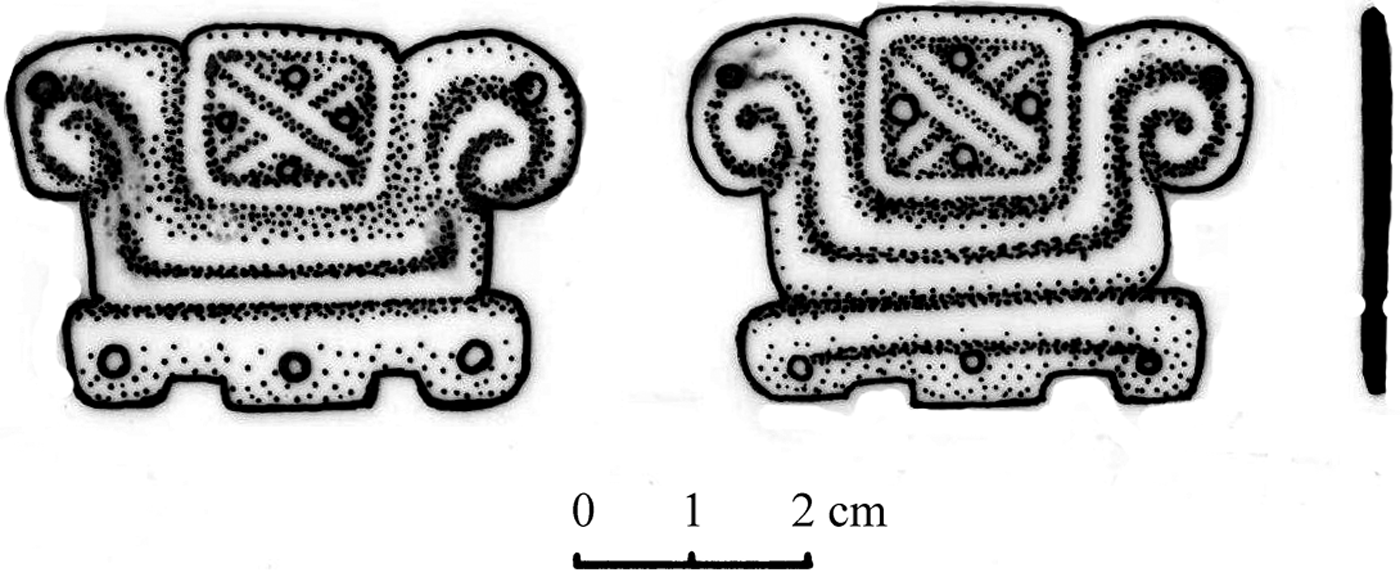
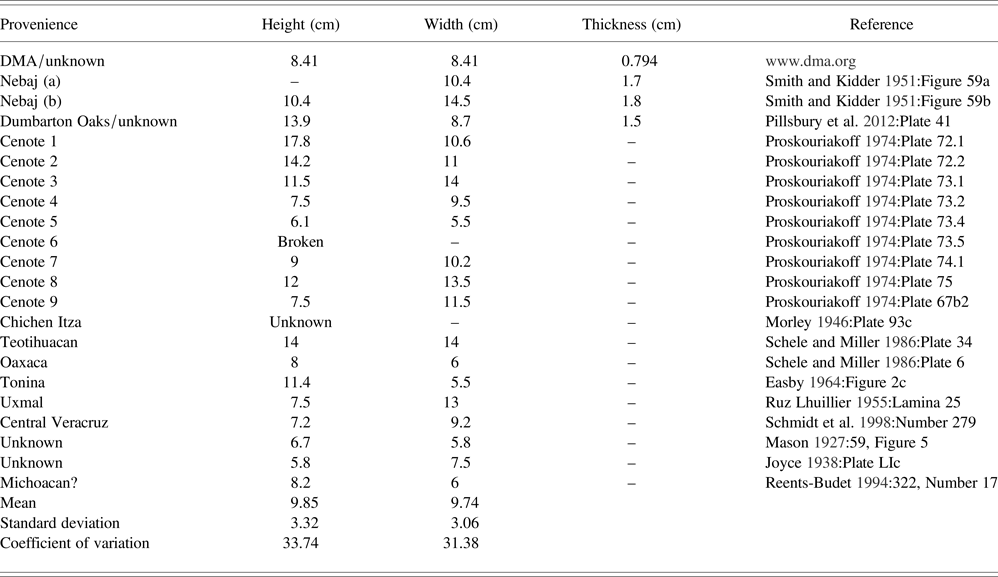
A quick survey of several examples shows that some are of the same approximate size, but are not exact (see Table 1). One could argue that this is due to the different size of the original nodule or possible reworking, but the Maya could certainly make objects nearly identical in size when they came in pairs if that was the intent (see for example the nearly identical pair of headdress ornaments from Cancuen in Figure 4). McVicker and Palka (Reference McVicker and Palka2001:186) found that no two plaques of the 20 that they surveyed were exactly the same size (see also Table 1).
Cancuen jade headdress ornaments from a cyst tomb in Structure K7-3. Drawing by Fernando Alvarez Andaverde.

Sizes of “Nebaj-type” jade plaques. Note that all following the first four are reported in McVicker and Palka Reference McVicker and Palka2001:Table 1.

A common measure of standardization used for ceramics is the coefficient of variation (CV; Blackman et al. Reference Blackman, Stein and Vandiver1993; Costin and Hagstrum Reference Costin and Hagstrum1995; Rice Reference Rice, Bishop and Lange1991), which is a standardized measure of dispersion as the ratio of the standard deviation to the mean. Here, it is presented as a percentage, or the standard deviation multiplied by 100 divided by the mean. Costin and Hagstrum (Reference Costin and Hagstrum1995:631) argue that a CV below 10 percent is used to characterize a low degree of standardization in a biological population (based on Thomas Reference Thomas1976). The CV for the height and width of the plaques is 33.74 percent and 31.38 percent respectively, which is within the range of what Costin and Hagstrum (Reference Costin and Hagstrum1995) argue to be a high level of variation.
These picture plaques, in their finished form, were almost certainly gifts between elites that served as a kind of calling card, given on royal visits, as a symbol of political alliance (McVicker and Palka Reference McVicker and Palka2001; see also Pillsbury et al. Reference Pillsbury, Doutriaux, Ishihara-Brito and Tokovinine2012:Plate 41; Schele and Miller Reference Schele and Miller1986). Most of these plaques show rulers seated on thrones, possibly indicating that these were a stand in for royal power, as a gift they would represent the personage of the king (see also Graeber Reference Graeber2014 for objects coming to represent humans as a substitute for human currency). Many of these examples were burned and those that show burning (in that they were broken and discolored white or brown) were probably deposited in the Sacred Cenote of Chichen Itza, and those that remain pristine often come from caches. McVicker and Palka (Reference McVicker and Palka2001:193) argue that if they were meant to establish and maintain peripheral relations this may be why few, if any, were found in the Usumacinta region where they were possibly carved. The fact that they were not included with interments may suggest that they were not seen as individual or personal inalienable possessions, but perhaps represented a community or larger ideal, as a lasting example of political alliances between communities (see also Kovacevich and Callaghan Reference Kovacevich and Callaghan2013; Mills Reference Mills2004). McVicker and Palka (Reference McVicker and Palka2001:194) argue that the mass deposition of these objects in the Sacred Cenote may represent the conscious termination of these alliances and the establishment of a “new world order” with Chichen Itza at the head, although it should be noted that the Sacred Cenote was used as an offering site before and after the apogee of Chichen Itza. Plaque blanks have not been recovered archaeologically, and the finished form of this particular type of plaque is found in ritual and political contexts that created open political and economic relationships with the living and the dead. In this case, we see that the finished items were highly prized inalienable possessions and heirlooms that were almost certainly gifted to create lasting political relationships and alliances.
Evidence for plaque blanks moving as standardized, mundane commodities prior to carving remains weak. Blanks may have been supplied as tribute to a site or number of sites where the carving took place, but this still does not involve commoditization and true fungibility. The variation in quality and size of the plaques would be better accounted for by tribute payments, as multiple sites at different times supplied the plaques, raw materials, or blanks as tribute (see also McAnany Reference McAnany2010). The lack of standardization in size and the restricted nature of their distribution (i.e., often cache, burial, and offering contexts) suggest that these plaques were not fungible commodities. Marroquin (Reference Marroquin2009:Table 3.28) found in a survey of 8 Maya sites (Tikal, Seibal, Altar de Sacrificios, Blue Creek, San Jose, Uaxactun, Piedras Negras, and Cerros) from the Preclassic to the Postclassic periods that “pendants”, which is the category that included plaques, were found at a ratio of 22:1 in elite contexts versus simple structures and dispersed occupations. They were also found in a ratio of 31:1 in site cores versus lesser centers, and 5:1 in nucleated versus dispersed settlements (Marroquin Reference Marroquin2009:Table 3.27). If plaques were commodities at some phase during their social lives, we might expect a more even distribution (e.g., Hirth Reference Hirth1998).
Plaques seem to be among those jade objects (seen in their distribution patterns and production choices) that were more restricted in circulation due to the ritual and esoteric knowledge they contained and their function as almost a type of political calling card. Their material of manufacture, including veins of imperial or apple shades of green, also points to the inherent value of the objects from the outset. The presence of these veins would also make it very difficult for highly valued objects to be standardized, as the veins themselves were often highly irregular. This evidence points to plaques being used as gifts and/or tribute rather than commodities. They were most probably used in open exchanges meant to create and maintain social connections and indebtedness. The finished products of jade plaques were not standardized, but this is not the sole reason that these objects were not likely circulated in closed exchanges. There is no evidence of plaque blanks and the finished plaques were not widely distributed across the landscape. If these objects were circulated in closed exchanges, we would expect to find them distributed more widely in both commoner and elite contexts and in major as well as minor sites. The political and ritual contexts for these objects suggest open exchanges between political actors and a transcendent value created by the difficulty in production, the esoteric knowledge represented on the plaques, and their connection to important political actors.
Earflares
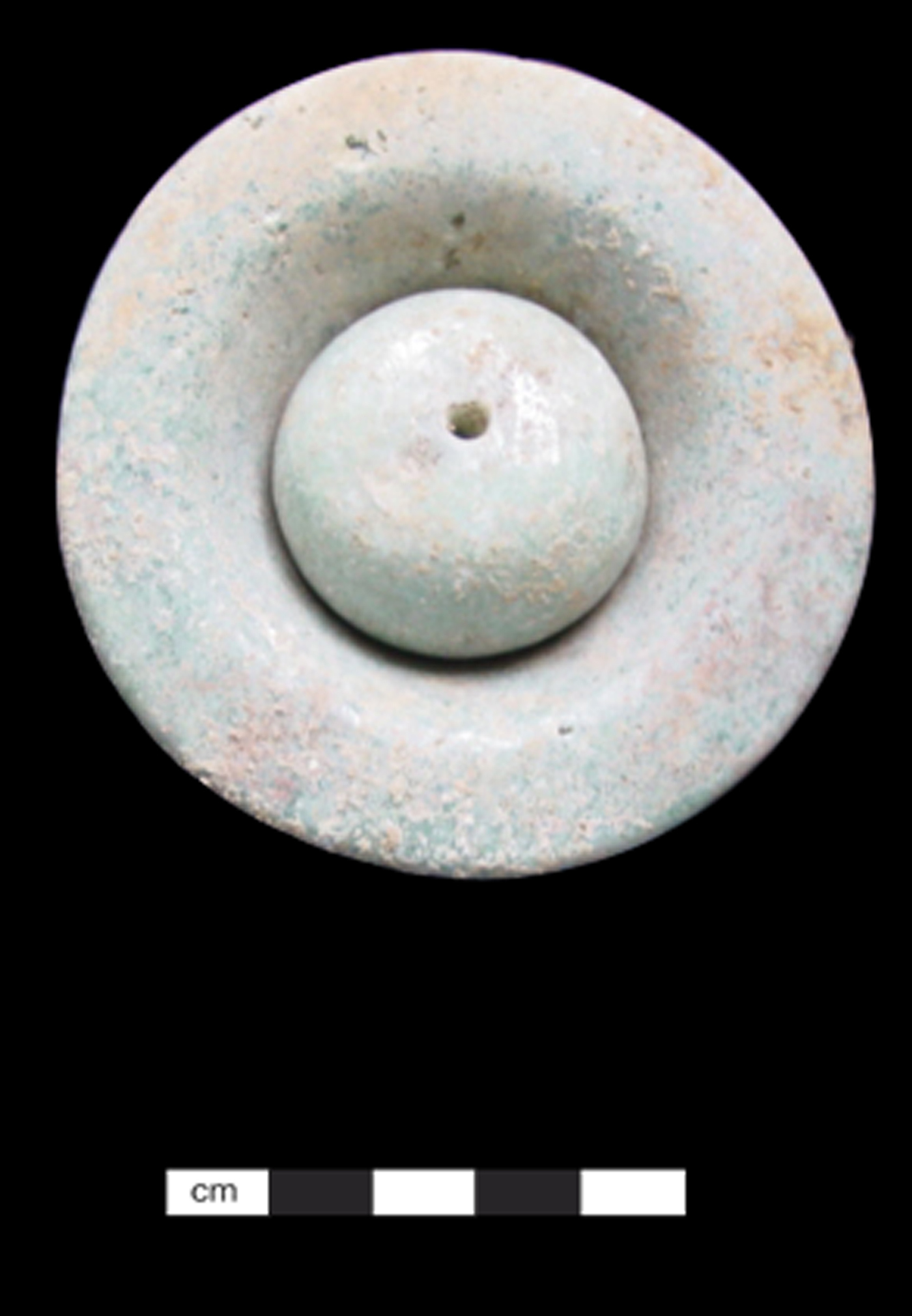
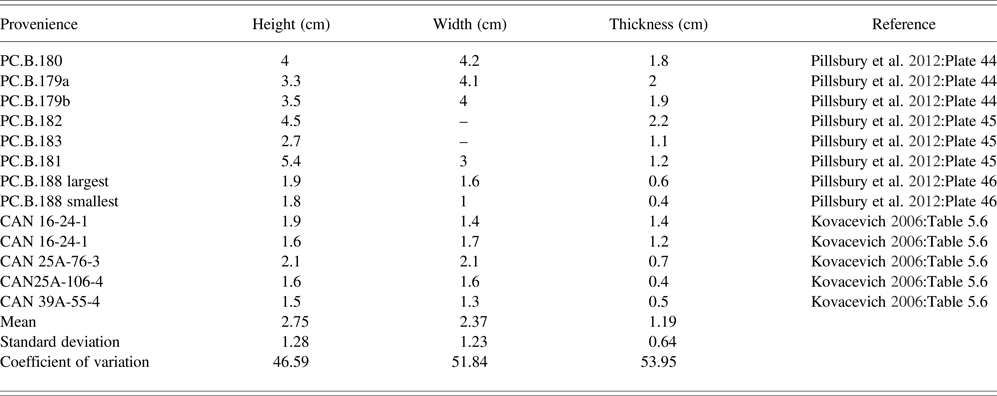
Andrieu and colleagues (Reference Andrieu, Rodas and Luin2014) also suggest that earflare blanks were standardized and circulated in mundane spheres of exchange. Proskouriakoff (Reference Proskouriakoff1974:29), in discussing the earflares recovered from the Sacred Cenote, notes that the collection is small and extremely varied with several varieties and sizes. A limited survey of earflares of relatively the same size (i.e., classified as small) from the Dumbarton Oaks collection (Pillsbury et al. Reference Pillsbury, Doutriaux, Ishihara-Brito and Tokovinine2012) and some small earflares and button flares from Cancuen show some similarity, although there is not an overall standard in terms of size (Table 2). The coefficient of variation for the earflares in this small sample is even higher than that of the plaques discussed above: 46.59 percent for height, 51.84 percent for width, and 53.95 percent for thickness. This sample does not include large earflares or hair ornaments that would skew results and were obviously singularities (see Figure 5 for an example of a large flare from a cache from Cancuen). This is far from a system of more exact quantification and commensurability (Renfrew Reference Renfrew, Papadopoulos and Urton2012:254). There is no standardization like we see in the emergent monetized economy of Europe and Western Asia (Renfrew Reference Renfrew and Kyriakidis2007:170).
Large ear or hair ornament from a cache beneath the Royal Throne Room at Cancuen. Photo by Kovacevich.

Sizes of sample earflares from Cancuen (CAN) and Dumbarton Oaks Collection (PC.B).

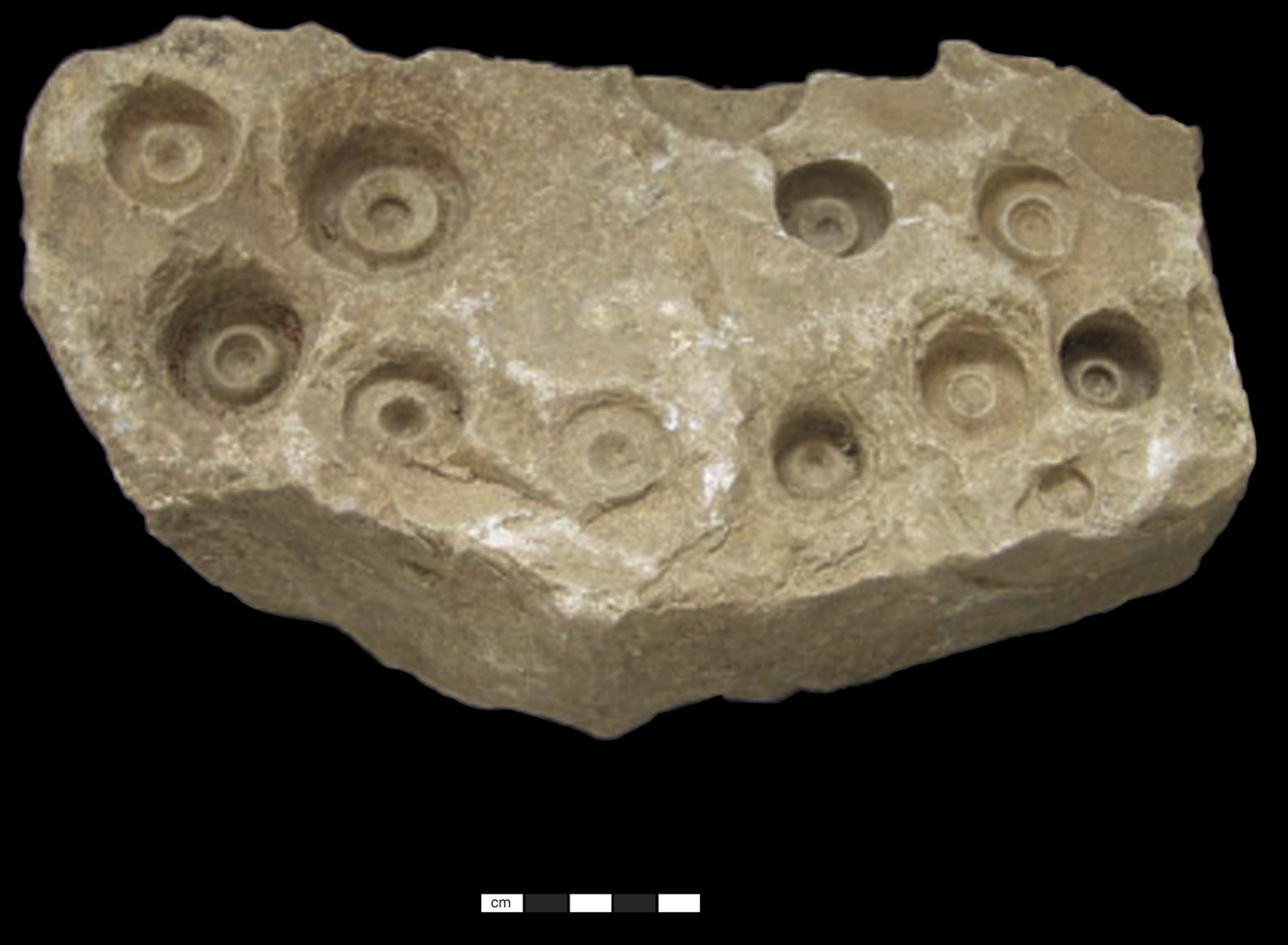
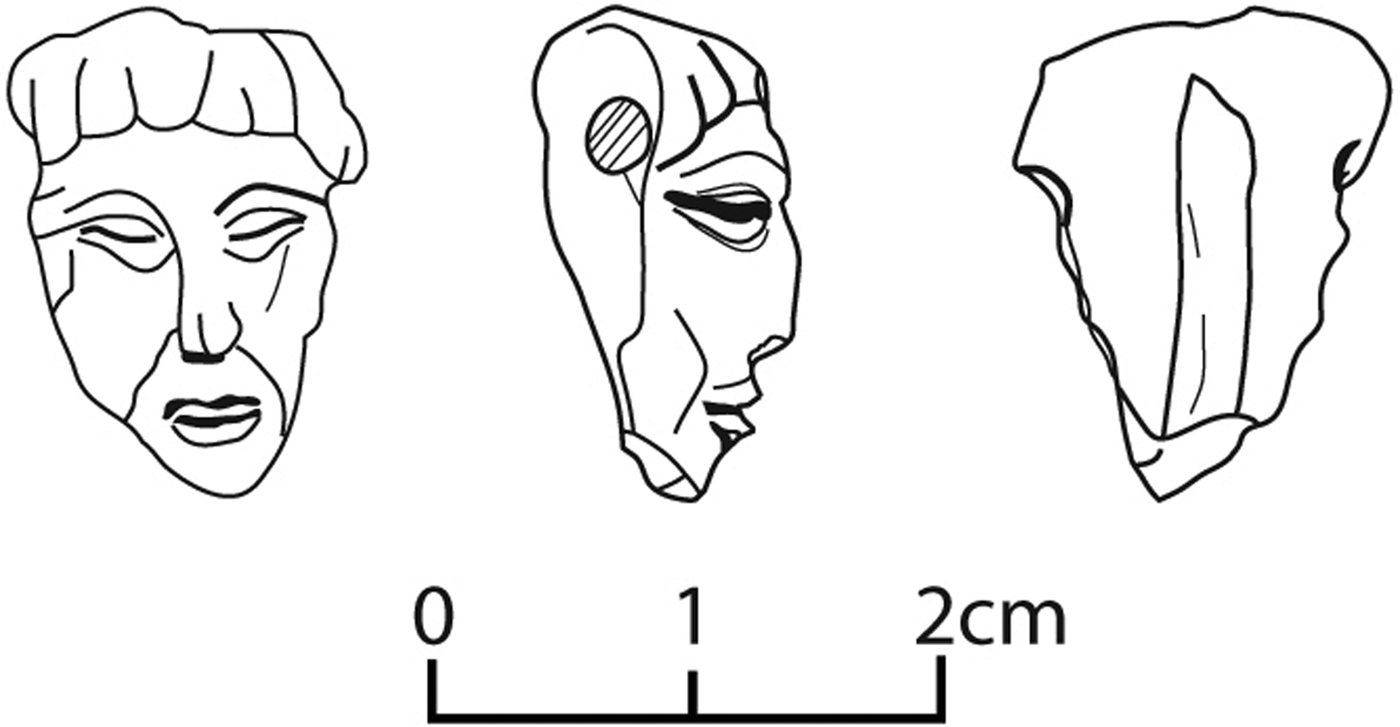
The many sizes of earflare and button flare imprints on the abrader/polishers from Cancuen demonstrate that there was not a standardized size within production locales at the site (Figures 6 and 7). According to Andrieu and colleagues (Reference Andrieu, Rodas and Luin2014) early stage earflare production was present, and, “middle stages” of earflare production are missing at Cancuen. The authors use this as negative evidence to argue that earflare blanks were being exported from the site and only the early stages were carried out at Cancuen. Middle stage debitage, however, was often worked into finished artifacts such as tubular beads and face pendants, as pointed out by Digby (Reference Digby1964:Figure 5) (see Figures 2 and 8 for an example of a reworked middle stage object from Cancuen). Therefore, it is understandable why the middle stages appear to be missing. Artifacts from these middle stages could have been used at Cancuen or been gifted or traded with other sites. Additionally, there is evidence of the final stage of earflare production at Cancuen in the form of earflare and button flare polishers/abraders that show earflares of various sizes (see also Landry Reference Landry2013 for a summary of these abrader/polishers found at other sites, often in elite contexts). Earflares and button flares are also among the artifacts recovered from burials, caches, and other contexts, suggesting at least some earflares were produced at the site (see Kovacevich Reference Kovacevich2006). Furthermore, there is the only example of an earflare “blank” that has been found at Cancuen, which is better classified as an earflare abandoned in the early stages of production (see discussion of commodity candidacy above). While it is possible that blanks may have circulated out from Cancuen, there is no standardization in size and shape of finished products, and there is no large-scale evidence of the presence of blanks at Cancuen or other sites.
Cancuen jade abrader/polisher from fill of Structure L7-9. Photo by Kovacevich.

Limestone earflare abrader/polisher recovered from Structure M9-1 shown with flares recovered from the M9 Group (after Kovacevich Reference Kovacevich2006:Figure 5.25). Drawing by Whitney Goodwin and Alejandro Figueroa.

Small jade face pendant from cache beneath the Royal Throne Room as possible reworked refuse from earlare production (after Kovacevich Reference Kovacevich2006:Figure 5.35). Drawing by Whitney Goodwin and Alejandro Figueroa.

Looking at the distribution of earflares at Maya sites, Marroquin (Reference Marroquin2009: Table 3.27) found that the ratio of earflares from site cores to lesser centers is 189:1 and this ratio in nucleated to dispersed settlements is 13.5:1. Earflares were found in elite versus simple or occupational contexts at a ratio of 15.2:1 (Marroquin Reference Marroquin2009:Table 3.28). The context of earflares reinforces this notion that these objects were probably not fungible commodities as blanks or finished products. They were also not widely available to all members of society and were not widely distributed across primary and secondary centers, suggesting that they did not circulate in market spheres (e.g., Hirth Reference Hirth1998) and were probably more restricted to elites. Taube (Reference Taube2005) has argued that earspools were not only adornments and markers of prestige, but also actual ritual tools used in the conjuring of deities and ancestors. These contexts also suggest that earflares were transcendent objects, with a specific history that may not only include multiple producers and previous owners, but also conjuring events and connections to “numinous beings” as discussed by Taube (Reference Taube2005:45). Earflares are best considered as very specific objects with important histories including the numerous people involved in their production, distribution, and maintenance. In this case, it is both the lack of standardization and the distribution of these objects that suggests that they were not used in closed exchanges.
Beads
Spherical beads vary greatly in size, quality, and shape. Although some certainly do appear to be of the same general size in burial assemblages, there was not one general standardized size throughout the Maya lowlands. Proskouriakoff (Reference Proskouriakoff1974:18) notes that “[j]ade beads do not seem to have been standardized in size, as we might expect if they were used as money, but, on the other hand, the fact that matched assemblages are very rare suggest that they were often bought and circulated singly and were not always manufactured for specific use.” We can see here that Proskouriakoff questions the idea of true fungibility of jade beads, but also does not support the idea that they were specific types of objects in Graeber's (Reference Graeber2001) terms, as earflares and plaques may have been. Kovacevich (Reference Kovacevich, Wells and Davis-Salazar2007) has argued elsewhere that spherical jade beads at Cancuen were different in size between elite and commoner contexts and that this relationship was statistically significant. This finding supports the argument for gradations of value, even within the same class of artifact. Some beads were made of higher quality stone, some were bigger, and evidence suggests that the elite more often possessed the larger and higher-quality beads.
Tubular beads were often part of earflare assemblages and headdresses, varied greatly in size, and were not produced in pairs or sets (Proskouriakoff Reference Proskouriakoff1974:24; see also Pillsbury et al. Reference Pillsbury, Doutriaux, Ishihara-Brito and Tokovinine2012:Plate 49). Tubular beads also provide another argument against standardized earflare blanks, as many tubular beads were the byproduct of earflare production (see Figure 2). If purported earflare blanks were of standardized size, we could expect to see an outstanding number of similarly sized tubular beads.
Pillsbury and colleagues (Reference Pillsbury, Doutriaux, Ishihara-Brito and Tokovinine2012:268) argue that the widespread documentation of beads in cache contexts demonstrates their symbolic significance. For example, a large spherical jade bead was found “lidded” or capped by flat, floral-shaped jade pieces near the right foot of Pakal at Palenque (Ruz Lhuillier Reference Ruz Lhuillier1973:195). Beads are also argued to have taken on the breath-soul of a person when they died, which is why beads were often placed in the mouth of the deceased (Houston et al. Reference Houston, Stuart and Taube2006:142–143; Taube Reference Taube2005). These examples also show that artifacts can be ensouled, as well as act as “stand-ins” for a person in certain social or even economic circumstances.
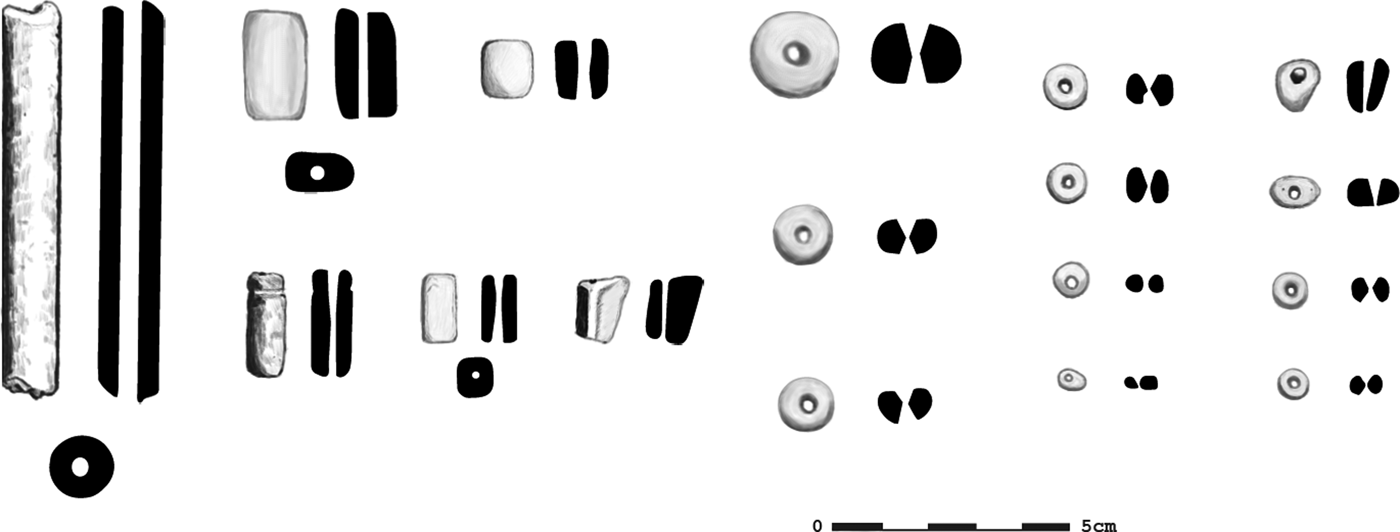
Despite the sacred contexts of many beads, spherical beads provide the best probability of being used in closed exchanges and possibly even currency during the Postclassic period (e.g., Tozzer Reference Tozzer1941:19, 95–96, 130). Postclassic beads may have been an inchoate form of a fungible commodity, although not formally established and standardized during the Classic period (see Figure 9 for the variability in size and shape of beads from Cancuen). The prevalence of beads during the Classic period suggests that they were a class of artifact that was widely available and not necessarily always associated with prestige and power of the elite. Beads provide the best evidence for jade objects that could have been used as a medium of exchange (see also Freidel et al. Reference Freidel, Reese-Taylor, Mora-Marín, Masson and Freidel2002; Marroquin Reference Marroquin2009), yet they were probably not standardized, at least not during the Classic period.
Variation of Cancuen bead shapes (after Andrieu et al. Reference Andrieu, Rodas and Luin2014:Figure 5). Drawing by Whitney Goodwin and Alejandro Figueroa.

Graeber (Reference Graeber2001:92) discusses why beads are so often the first medium of exchange (citing evidence of European traders carrying beads not only to the New World, but also to Africa and throughout the Indian Ocean). He argues for three properties of beads that facilitate this transition: namely, they can be commensurable, they are highly portable, and they do not decay. The most important aspect is the unique ability of beads to transcend both realms of power and action (i.e., displayed and hidden; Graeber Reference Graeber2001:106). In the shift from a non-monetized economy to a monetized economy, the potential candidates for currency may often be made of the most valued substances. These substances (like precious metals or jade) were fashioned into adornments and represent displayed forms of power in a more generic form of specific historic heirlooms (see also Lesure's [Reference Lesure and Robb1999] argument for gradations of value). Graeber (Reference Graeber2001:92) argues that the first mediums of exchange or “primitive money” (i.e., Dalton Reference Dalton1965) in many cultures were objects of adornment, including gold, silver, cowrie shells, Spondylus shell, and feathers.
In the case of beads, jade is a mediator of the two types of power afforded by objects (i.e., hidden and displayed, see Graeber Reference Graeber2001), and may be part of an emergent commoditized economy. Beads materialize the human desire for both types of power (Sutton Reference Sutton2004). Even in the Preclassic period we see jades moving between the two spheres of power from being hidden in caches (stored power representative of future actions and potential) to being displayed (symbolic of past action) in treasures and heirlooms worn by the elite. At well-preserved sites like Ceren, we see jade beads stored and hidden in roof beams for future use (Hendon Reference Hendon2000; Sheets Reference Sheets1998:85–86) and also the involvement of households in multiple economic spheres, including market exchange (Sheets Reference Sheets2000). In order to make the move to commodity status, the form of the jade had to be something that could be commensurable and generic. Whereas heirlooms gain object histories making each impossible to compare to each other, beads could be compared in size but also generically rendered, making it easy to remove the importance of the object history, making them more easily commensurable (even if they were not standardized). The ability to move back and forth between the displayed and the hidden forms of wealth and power is a step in the direction of focusing more on hidden forms of power and use in closed exchanges. Whereas beads could go back and forth between spheres, even as finished products, earflares and plaques were on a trajectory to become sacralized objects with distinct histories that would make them unique and specific to individuals and representations of individual histories. This path makes them less likely to become some of the first commoditized objects in an emergent mercantile economy, as they do not flow easily between the different spheres of power. Plaques and earflares were more highly valued and sacralized, and the primary way that we know this is that they were restricted in terms of distribution.
The implication of beads moving back and forth between displayed and hidden forms of action or power is that they were also possibly used in both open and closed forms of exchange. This means that beads could have been used for impersonal transactions between strangers that would likely not continue the social relationship after the economic exchange: for example, the famous supposed purchase of Manhattan from Native Americans for 24 dollars worth of beads and trinkets by the Dutch (Graeber Reference Graeber2001:106). Beads could also be used in open exchanges where the continuation of social relationships and connections would be the point of the exchange. For instance, beads placed in burials facilitated connections and reciprocity between the living and the dead.
While beads may not have been highly standardized during the Classic period, they were still largely generic, as opposed to plaques and earflares that gathered unique histories through specialized production and circulation. Standardization may not have been necessary for inchoate forms of commodities and/or currency in all cultures. Graeber (Reference Graeber2012:46) argues that some early mediums of exchange may have operated according to the “credit theory of money,” which finds that early currencies were often tokens of accounting. Graeber (Reference Graeber2012:48) gives the example of the currency established by Charlemagne (pounds, shillings, and pence). Some of these denominations never circulated, and the ones that did varied greatly in size, purity, weight, and value. This suggests that it was not the standardization of the currency that was important, but that there was a uniform system for measurement of credit and debt. This is interesting in light of Freidel and colleagues' (Reference Freidel, Masson and Rich2017) recent arguments for tokens of accounting during the Maya Classic period that included shells, beads, spindle whorls, cacao beans, sticks, and earflares (Masson and Freidel Reference Masson, Freidel, Hirth and Pillsbury2013:212). The lack of standardization of these objects would make sense given that they may not have originally been used as equivalencies, but as counting devices (standing for debt rather than representing it). Freidel and colleagues further argue that some of these accounting devices, especially beads, may have transcended into the realm of currency or virtual money, representing credit and debt (Freidel et al. Reference Freidel, Masson and Rich2017:40). Freidel and Reilly (Reference Freidel, Reilly, Staller and Carrasco2010) note in reference to greenstone axes that our notions of standardization may not have held up in the past, and that counting was particularly more important than weighing and hence standardization was not the important mechanism for comparison that it was in other parts of the ancient world (Freidel et al. Reference Freidel, Masson and Rich2017:48). The generic nature of beads as a marker of use in closed exchanges is also supported by their widespread distribution as opposed to other, more highly valued jade objects like plaques and earflares (see below discussion).
For the ancient Maya, jades were most likely first used for human debts (e.g., bridewealth and tribute) and then may have become exchangeable for other things through time, as is the case for many forms of displayable wealth that then could have become commodities or mediums of exchange. Transcendent objects and inalienable possessions are often used in contests of giving because they cannot be compared and therefore the debt can never truly be cancelled (Graeber Reference Graeber2014:159). But slowly, certain classes of artifacts within this category of wealth (especially those made of the same substance or class) that were more generic, may have been able to be compared, or at least counted as measures of debts. It is these objects that have possibility of use in closed exchanges. For the ancient Maya these jade objects were probably beads:
[t]hey [beads] can be bought in bulk, sewn together into elaborate beadwork or into other forms of adornment, and then whenever the need is felt, broken up into individual, mutually indistinguishable items once again. It makes them ideally suited to pass back and forth between radically different domains (Graeber Reference Graeber2001:106).
From a distributional perspective, Marroquin (Reference Marroquin2009:83) finds that during the Late Classic period there is a substantial increase in the presence of beads in the Maya lowlands, and they become the most common form of jade artifact. At some sites with excavation of both elite and commoner contexts, it has been found that they were also more widely distributed, suggesting more homogenous access to beads. Guderjan (Reference Guderjan2007:113) found that the majority of the jades at Blue Creek were in the form of beads, many falling in the lowest quality of craftsmanship and being relatively well-distributed throughout the site. High-quality beads were often found in tombs, however, including anthropomorphic and zoomorphic pendants, and bib-head pendants (see Proskouriakoff Reference Proskouriakoff1974). Earflares at Blue Creek were much more restricted to elite contexts and all date to the Early Classic period (see also Hirth Reference Hirth1998 for a discussion of artifact distribution patterns characteristic of market exchange). Marroquin (Reference Marroquin2009:Table 3.27) found that beads were found in nucleated versus dispersed settlements at Maya sites in a ratio of 3.1:1, suggesting that, in currently excavated contexts, beads were much more evenly distributed than other artifacts like earflares and plaques. While beads become the most common form in the Late Classic, Marroquin (Reference Marroquin2009:83) also finds that their sizes vary significantly. She argues that their widespread and generic nature would have made them likely for commodity candidacy (Marroquin Reference Marroquin2009:80). Marroquin (Reference Marroquin2009:82) notes Appadurai's (Reference Appadurai and Appadurai1986:26) argument that social, political, and economic turmoil can cause status objects to be diverted into commodities. The turmoil of the Terminal Classic period and the subsequent emphasis on mercantilism could certainly have stimulated the shift of certain jades to this status, but some were much more feasible in terms of their ability to be used in closed exchanges.
Axes
A class of artifacts not mentioned by Andrieu and colleagues (Reference Andrieu, Rodas and Luin2014) as candidates for commodities are greenstone axes. Masson and Freidel (Reference Masson and Freidel2012:476) report that at Tikal groundstone axes and chisels (87.3 percent of which were made of jade or other greenstone) were more common in smaller structures (40.8 percent) compared to civic-ceremonial structures (12.7) and range structures (14.1 percent). Similarly, they find that greenstone celts were found in a relatively even distribution between elite and commoner contexts at Mayapan (Masson and Freidel Reference Masson and Freidel2012:Figure 16). They use these distributions to argue that greenstone axes (as opposed to more singular jade objects) may have been acquired in market settings due to the evenness of their contexts (Hirth Reference Hirth1998). Kovacevich (Reference Kovacevich2006:174) found a similar pattern at Cancuen, where greenstone axes seemed to be more evenly distributed among various status levels as opposed to other more restricted forms like earflares, plaques, and pendants (see Kovacevich Reference Kovacevich2006:Table 5.6). This pattern was also evident at Ceren, as jade celts were one of the classes of artifacts found in all households (Sheets Reference Sheets2000). This even distribution reflects the gradations of value within jade and greenstone objects. Many of the axes or celts discussed here were not made of high-quality material and were certainly used for domestic purposes, making them less like historical, transcendent objects. The black and dark green celts (mostly chloromelanite) may have been produced in the Motagua valley and are particularly widespread in the lowlands, especially where chert is scarce (see Taube et al. Reference Taube, Hruby and Romero2006, Reference Taube, Hruby, Romero, Hruby, Chinchilla and Braswell2011). Axes were more widespread in distribution and generally made of lower-quality materials and less-valued, darker shades of green. They were often used for utilitarian purposes such as forest clearing and agriculture, although they still likely had deep symbolic meaning. Taube (Reference Taube, Clark and Pye2000) argues that jade axes in Mesoamerica may have been able to stand in for maize in certain economic transactions, as many cultures connected greenstone celts to maize, the axis mundi, four cardinal directions, and lightning. Taube's research shows that while generic, even greenstone axes were far from devoid of ideological meaning.
Freidel and Reilly (Reference Freidel, Reilly, Staller and Carrasco2010) argue that in addition to beads, greenstone axes may have formed an inchoate currency. Like beads, axes in general have a more generic form, although of course they could be elaborately decorated as we see with many Olmec examples (see Taube Reference Taube2004). Taube (Reference Taube2004:18), based on the work of Thompson (Reference Thompson1975), makes the point that celts or axes may have actually been blanks that were then reworked into other objects. Again, Freidel and colleagues (Reference Freidel, Masson and Rich2017:48) note that standardization within this artifact class is not high, but it may have been their generic nature that contributed to their possible use as commodities or virtual money. Taube (Reference Taube, Clark and Pye2000:301) also argues that Olmec celts varied greatly in terms of size, quality of material, and workmanship, and perhaps were better regarded as primitive valuables or ingots displaying color, flaws, and translucence (see also Taube Reference Taube2004:18).
As a cross-cultural comparison of lack of standardization for commodities, cattle used as a medium of exchange in Africa were not standardized (i.e., they came in many different sizes, colors, gender, and ages), but were used as a currency with differences forming negotiable attributes and different denominations. Having exact standards of comparison was not necessary (Comaroff and Comaroff Reference Comaroff and Comaroff2005:113). This is another example of the context of use, and deposition context of objects, being much more important than identifiers of Western commodities or currencies, like standardization. When we expect these objects to be divorced from their larger social meaning because of their commodity candidacy, it will likely end in us making misinterpretations about their past functions. It may be the generic nature of the finished product that facilitated their use in counting of debt. The even distribution of axes on the landscape further supports their possible circulation in closed exchanges. Standardization was not present and was not a marker of commoditization.
CONCLUSIONS
Understanding jade production, circulation, and consumption requires us to understand differential value and to look not only at traditional measures of commodities like standardization, but also at context and distribution. Even if we consider the argument based on negative evidence that jade blanks left Cancuen for other sites, there is little evidence of standardization by way of measurements of finished products. If blanks were standardized, we would expect finished products to have at least a minimal degree of standardization as well. The question then becomes, would objects that had a commodity phase necessarily need to have been standardized? Given cross-cultural evidence for commodities and early mediums of exchange, we find evidence that standardization may not have been the key feature that made these objects commensurable. In some cases, the generic rendering of objects, rather than a standardized appearance, may have been what gave them the ability to be counted as a token of debt or payment and allowed them to function in a closed exchange. We must be careful about our preconceived notions based on Western worldviews that may cloud how we imagine and interpret economic functions of the past.
Freidel and colleagues (Freidel and Reilly Reference Freidel, Reilly, Staller and Carrasco2010; Masson and Freidel Reference Masson and Freidel2012) have made arguments for jade axes as commodities, as they were widely distributed. Axes and beads hold the best promise for the identification of commodities and could be relatively generic when compared to other classes of jade artifacts. Axes were more widely distributed at Cancuen (Kovacevich Reference Kovacevich2006:Table 5.6) as well as other sites (Masson and Freidel Reference Masson and Freidel2012; Sheets Reference Sheets2000), and we believe that this avenue holds potential for future research.
The issue that precludes the possibility of other classes of jades from having a commodity phase is not the lack of standardization, per se, but their pathway to becoming transcendental, unique, and restricted objects. This is evidenced by their distribution and general restriction across the landscape. What is needed is an increased, continued, and sustained focus on excavating both commoner and elite contexts at Maya sites, so that the true nature of distribution patterns and the contexts of jades can be more thoroughly understood. At the present time, data from most sites is woefully incomplete. And as we discovered at Cancuen, excavations in commoner residences can reveal large-scale production of jade artifacts (Kovacevich Reference Kovacevich, Wells and Davis-Salazar2007). Commoners were involved in the production (e.g., Rochette Reference Rochette2009, Reference Rochette2014) and consumption (e.g., Guderjan Reference Guderjan2007) of jade and that relationship must be fully explored.
Still, jade may have been a mediator of two types of power (hidden and displayed, as argued by Graeber [Reference Graeber2001:104]) and may have been part of an emergent commoditized economy. Early in Maya history, we see jade in both hidden contexts (stored power representative of future actions) in caches and storage contexts (Hendon Reference Hendon2000) and display contexts (symbolic of past action) in treasures and heirlooms worn by the elite. While caching and/or burying an object and taking it out of circulation may seem like a loss of power (economic and/or social), the ability to take something out of circulation and create a memory of its deposition can bring even more power than display or circulation (see also Weiner Reference Weiner1992).
In order to make the move to commodity status the form of the jade had to be something that could be commensurable and generic. Whereas heirlooms gain object histories, making each nearly impossible to compare to another, beads could be easily counted and evaluated, but also generically rendered making it easy to remove the importance of the object history, making them fungible for other objects. Beads were also more likely to have a commodity phase because of their commodity context (they were more evenly distributed across the landscape and available in greater numbers). As Graeber (Reference Graeber1996) argues, beads are uniquely suited to move back and forth between these types of power. Items that could move back and forth between the display and the hidden forms of wealth may be the emergent objects that would become more established hidden forms of wealth. It was these objects that were probably used in closed exchanges, which may have developed more fully during the Postclassic period (Freidel et al. Reference Freidel, Masson and Rich2017:29).
The current data suggest that large-scale export of jade blanks from Cancuen to sites downriver was not likely. If blanks were circulated at all, they did not have the layers of inalienability that a finished plaque or earflare would have (see also Wright Reference Wright, Abraham, Gullapalli, Raczek and Rizvi2013), but they were not completely devoid of social meaning, history, or sacredness either. Certain jades had long life histories, sometimes deeply politically embedded, as evidenced by the circulation of picture plaques (McVicker and Palka Reference McVicker and Palka2001). Sites like Piedras Negras were also using imitations quite successfully when the real thing was not available, fabricating and manufacturing inalienability (see also Mills Reference Mills2004; Weiner Reference Weiner1985). The Maya could use jade to establish and maintain political and social relations between allies and rivals. The power and value of these transcendent objects, like plaques and earflares, resided in their capacity to act as gifts and tributes that created open social and political ties, rather than their ability to promote economic profit.
RESUMEN
Este estudio aborda las varias interpretaciones sobre la producción, circulación y consumo de jades en el área maya desde el período preclásico hasta el período posclásico (600 a.C.–1697 d.C.). Tradicionalmente, el intercambio de jades ha sido visto como una relación diádica entre las élites (regalos y tributos). Algunos especialistas han argumentado por gradaciones de valor en la circulación de jades, los cuales probablemente circulaban en esferas de la élite y de personas comunes. Un estudio reciente argumenta que porciones de jade fueron comoditizados porque podían ser estandarizados. En este artículo evaluamos este último argumento, y concluimos que no hay evidencia de la estandarización y comoditización de porciones de jade, y que por el contrarios, las porciones de jade son escasas en depósitos arqueológicos. Criticamos la expectativa de que las comodidades en algunas economías no industrializadas deben de ser estandarizadas, y damos sugerencias acerca de tipos de objetos de jade que si los hay, tienen el mayor potencial de convertirse en comodidades en el área maya.
ACKNOWLEDGMENTS
The initial research that forms the basis of this article was funded by the National Science Foundation (BCS-0137639), Sigma Xi Grants-in-Aid of Research, and Association of Women in Science. Some of the more recent ideas began to be developed as part of an SAA session in 2015 organized by Nicoletta Maestri and Rodrigo Liendo on the movement of objects along the Usumacinta River, and Kovacevich thanks the organizers and discussants, Patricia McAnany, and David Webster, for their feedback. Much was added and changed after that session and we also wish to thank John Walker for reading drafts of this work and four anonymous reviewers for their helpful comments. Thanks also to Alejandro Figueroa for translating the Spanish summary. Of course, all errors and omissions are our own.