It is undisputed that all scientific knowledge proceeds from sense perception. And the way in which sense perception is fostered by the graphic arts generally, and in particular by photography (stereoscopy included), likewise needs no further explanation here.
The power of sense perception, however, can be even more enhanced and its scope significantly expanded by the graphic arts. Whenever we have collected a large amount of physical empirical data, we have culled them from direct sense perception, and yet perception must remain bound to the particular. How great, in contrast, is the richness, the expansiveness, the concretion of perception when we represent the totality of the empirical data by a curve! And how much easier is it utilized intellectually! Recording apparatuses and recording methods are implemented in physics, in technology, in physiology, in meteorology, indeed, in nearly all natural sciences, and photography is used in multiple ways in this respect. The extent to which especially Marey has contributed to developing recording methods is generally well known.
Even in cases wherein immediate sense perception is entirely incapable of accomplishing anything, new territory can be opened up for it and for the graphic arts through commensurate means. The microscope and its achievements, which are based primarily on the principle of spatial expansion, are widely held to be marvels. More seldom does one also think of the importance of the opposite principle, that of spatial diminution. We would probably never arrive at a clear image of the division of land and sea on our earth using immediate sense perception, not on the most distant travels, simply because the object is too large for our field of vision and always permits a merely awkward mental aggregation of the parts into a whole. The map compresses the image of the entire earth into our field of vision. What is the geographic description of Libya by an eyewitness, by Herodotus, compared to the imagination of a school boy with a map of Africa in hand!
We fix the individual phases of a movement that proceeds too rapidly for our immediate perception with instantaneous photography and can then exhibit them to our perception in as slow a sequence as we like. The accomplishments of Anschütz, the analysis of bird flight by Marey, the instantaneous photographs of flying projectiles along with their induced air movements are fitting examples and they explicate the principle of temporal expansion that is applied in these cases.
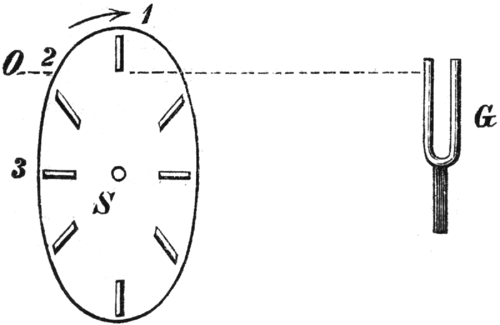
If one studies periodic movements, one may use the so-called stroboscopic method, which is likewise based on the principle of temporal expansion and of course allows for the utilization of photography. The movements of a tuning fork G (see fig. 1) oscillating, for example, at 100 beats per second cannot be directly observed because of the overly high speed. If we look at the fork through a rotating disk S which cycles at 100 slits per second before the eye, however, then we would always see the fork after one oscillation cycle, always in the same phase, thus seemingly at rest. If only 99 slits per second pass before the eye, then the fork completes one oscillation and almost 1/100 more (precisely 1/99) while 1 and 2 change places. When one looks through slit 3, the fork has advanced 2/99 of an oscillation etc. so that after 99 slits pass by (not counting the first one), and thus after one second, the tuning fork has completed one apparent oscillation while in reality having completed 100. For the observer time is expanded 100 times over. It is unnecessary to explain to the specialist how, according to the stroboscopic procedure, instantaneous images may be obtained in a stroboscopic drum that can be used to slowly reproduce a motion otherwise directly imperceptible because of its speed (cf. Mach, Optisch-akustische Versuche. Die spectrale und stroboskobische Untersuchung tönender Körper, Prag, Calve, 1873).
Oscillating tuning fork seen through a stroboscopic disc.

Should not the principle of temporal diminution be of value as well? In point of fact, we consider photographically fixing the growth stages of a plant, the stages of an embryo's development, the limbs of the Darwinian genealogical tree of the animal branch and exhibiting them in a quick series of successive “magic lantern pictures”! What an intellectually invigorating impression that would have to make, too! The images of a human being from the cradle onwards, thus depicted in his advancing development and then in deterioration into old age in but a few seconds, would necessarily elicit an aesthetically and ethically grandiose effect.
That we would gain new insight from this is likewise beyond doubt. Would we, then, have needed a Kepler to guess that the planets move in ellipses around the sun if this movement had been made available to perception, spatially and temporally diminished, in a model so to speak? Certainly this realization was more difficult to reassemble piecewise from individual empirical data.
Perhaps these remarks contribute toward strengthening the conviction that the questions dealt with here are not simply of interest to scientific practice and industry, but also to philosophy.