





Introduction
SARS-CoV-2 (COVID-19) causes severe respiratory failure in adults, while most children have mild acute upper respiratory symptoms. Reference Feldstein, Rose and Horwitz1 However, hyperinflammation in the weeks following COVID-19 exposure leads to multi-system inflammatory syndrome in children (MIS-C). It is postulated that postinfectious immunologic derangement causes a profound cytokine release contributing to multi-system inflammatory syndrome in children-related endothelial injury and subsequent organ damage, with at least four organ systems affected. Reference Feldstein, Rose and Horwitz1,Reference Consiglio, Cotugno and Sardh2
Multiple organ dysfunction syndrome (MODS) is the alteration of two or more organs and their function in the acutely ill patient caused by the release of damage-associated and pathogen-associated molecular patterns that amplify cytokine release, subsequently leading to one to four pathogenic pathways, including endothelial cell dysfunction and thrombotic microangiopathy. Reference Proulx, Fayon, Farrell, Lacroix and Gauthier3–Reference Carcillo, Podd and Aneja5 Thrombotic microangiopathy is hyperinflammation perpetuating the complement cascade down to terminal complement (C5b-9), causing endothelial injury and thus release of very long von Willebrand factors, resulting in thrombosis and haemolytic anaemia. Reference Diorio, McNerney and Lambert6,Reference Diorio, Henrickson and Vella7 Suspected involvement of thrombotic microangiopathy in MIS-C is related to endothelial cell dysfunction and cytokine release with subsequent damage causing pro-coagulation in microvasculature, endothelial dysfunction, and injury. Reference Feldstein, Rose and Horwitz1,Reference Diorio, McNerney and Lambert6–Reference Gavriilaki, Anyfanti, Gavriilaki, Lazaridis, Douma and Gkaliagkousi9
Copeptin, a pre-provasopressin peptide derivative released alongside vasopressin, is released in critical illness affecting especially the cardiovascular system, increasing its prognostic value in MIS-C patients. Reference Koch, Yagmur and Hoss10,Reference Morgenthaler11 As a biomarker, Copeptin is more stable than vasopressin and more reliable than cortisol with minimal variation in the healthy population. Reference Dobša and Cullen Edozien12 Copeptin levels have been correlated with disease severity, mortality, and other biomarkers of endothelial dysfunction and vascular tone in septic and cardiogenic shock and heart failure patients. Reference Koch, Yagmur and Hoss10,Reference Krychtiuk, Honeder and Lenz13 Greater than 50% of MIS-C patients have cardiovascular involvement, with half having hypotension requiring vasoactive support. Reference Feldstein, Rose and Horwitz1,Reference Krychtiuk, Honeder and Lenz13,Reference Nakra, Blumberg, Herrera-Guerra and Lakshminrusimha14 Hence, copeptin levels may be beneficial in correlating with endothelial dysfunction, cardiac dysfunction, and outcomes in critically ill patients.
An echocardiogram is a primary effective tool in the assessment of cardiac function, which plays a pivotal role in the initial diagnosis and ongoing management of these critically ill MIS-C patients.
We suspected that complement (C5b-9) and copeptin are predictive biomarkers of endothelial injury in MIS-C whose identification could lead to earlier recognition and guide treatment of thrombotic microangiopathy-related multi-organ dysfunction syndrome in the ICU with outcome improvement. We hypothesised that children admitted to the pediatric ICU with MIS-C-associated organ failure defined using MODS criteria have underlying endothelial dysfunction and thrombotic microangiopathy based on terminal C5b-9 complement levels, signs of consumptive hemolytic anemia, and cardiovascular dysfunction predicted by increased levels of copeptin.
Methods
Study design and patient population
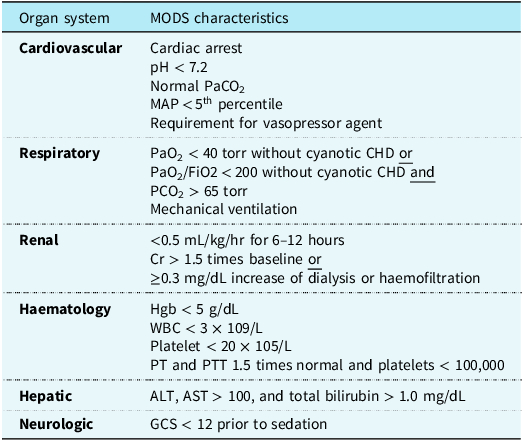
This was an institutional-review-board-approved, prospective cohort study at a pediatric tertiary care centre evaluating organ failure, morbidity, and mortality in patients with MIS-C in the pediatric ICU. As MIS-C is a low prevalence population, subjects were enrolled in a convenience sample. Patients were included in the multi-system inflammatory syndrome in children group if admitted to the pediatric ICU and if they met CDC criteria for MIS-C: less than 21 years old, greater than 24 hours of fever, laboratory evidence of inflammation, a positive COVID-19 polymerase chain reaction and/or antibodies or a recent COVID-19 exposure in the last four weeks, and dysfunction of ≥2 or more organ systems within a hospitalization. Reference Krychtiuk, Honeder and Lenz13 Organ system failure in MIS-C was as defined in Table 1 and adapted from Proulx et al., Doughty et al., and the Kidney Disease Improving Global Outcomes guidelines. Reference Proulx, Fayon, Farrell, Lacroix and Gauthier3,Reference Nakra, Blumberg, Herrera-Guerra and Lakshminrusimha14,Reference Stasiak, Kędziora, Kierzkowska, Niewiadomska-Jarosik, Perdas and Smolewska15 Thrombotic microangiopathy, and thus the presence of endothelial injury, was diagnosed based on meeting five out of seven criteria: thrombocytopenia (platelets ≤ 150 × 109/L), anemia for age, signs of hemolysis (high bilirubin, low haptoglobin, and high lactate dehydrogenase), proteinuria (defined as 1+, 30 mg/dL, or 2 mg/mg protein to creatinine ratio), hypertension during admission, low ADAMTS13 activity, and high C5b-9 (≥ 200 ng/mL
MODS criteria

Echocardiogram parameters included dimensions of the left ventricle, systolic, and diastolic function. For the dimensions, we used m-mode measurements, which were corrected to the body surface area (cm2) that included left ventricular diastolic diameter, septal wall thickness, and posterior wall thickness. For systolic function, a standard left ventricular ejection fraction described in percentage (%) by Simpson’s biplane method. Diastolic function was assessed by the E/A ratio of the mitral valve inflow (cm/sec) and E/E’ ratio, an average E/E’ ratio performed across the left ventricular medial wall and lateral wall. While the sample size in this study is small, electrocardiogram parameters were included to better understand and correlate the patterns of systolic and diastolic dysfunction in this subset of the population. This approach aims to assist in identifying and stratifying patients who may require inotropic support.
Data and sample collection
Consent was obtained for access to patient records and a whole blood sample of 1.5 mL. Blood work, imaging, symptoms, and interventions documented during the clinical course were gathered from the patient chart for their entire hospitalisation. The blood sample was obtained within 24 hours of starting immunomodulator therapy. One-third (0.5 mL) of the sample was collected in sodium citrate and sent to LabCorp Laboratories (Memphis, Tennessee, USA) to measure the ADAMTS13 activity by chromatography-tandem mass spectrometry. The rest of the sample was obtained in an Ethylenediaminetetracetic acid tube and then centrifuged at 5 C. The plasma was evaluated by enzyme-linked immunosorbent assay for copeptin and C5b-9 levels at the University of Tennessee Health Science Center Endocrinology/Lipoprotein Laboratory (Memphis, Tennessee, USA).
Whole blood samples for copeptin and C5b-9 and echocardiogram results were obtained from the healthy control groups after obtaining consent in the cardiology clinic. Controls were age matched to the MIS-C group. All data were entered in a HIPPA-compliant RedCAP® database.
The control group was selected from the pediatric cardiology clinic, consisting of healthy children referred for evaluation of innocent murmurs, chest pain, or palpitations, with non-cardiac causes for the symptoms. All participants in the control group had normal cardiac anatomy and physiology. This group was chosen to establish baseline comparisons for cardiac indices and copeptin levels. There are limited data available on the correlation between copeptin levels and cardiac function in the pediatric population, which motivated this inclusion.
Specific echocardiogram parameters were identified for initial screening and follow-up studies, as described in Table 6. Echocardiogram data were reviewed by VG, who screened and identified those parameters for standardized assessment of systolic and diastolic function.
Statistical analysis
Descriptive analysis was generated for all patient demographics. Spearman’s rank correlation coefficient was used to evaluate the relationship between copeptin and terminal complement levels with other biomarkers of end-organ dysfunction (i.e., troponin, B-type natriuretic peptide, creatinine, and blood urea nitrogen) and echocardiogram findings of both systolic and diastolic dysfunction. All analyses were conducted using SPSS (IBM®, Armonk, NY).
Results
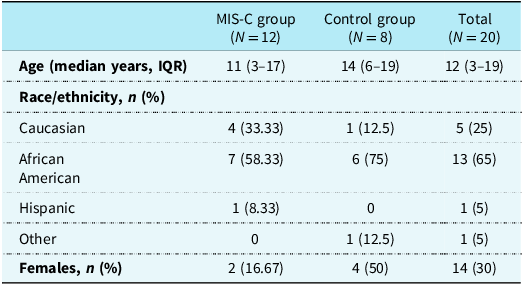
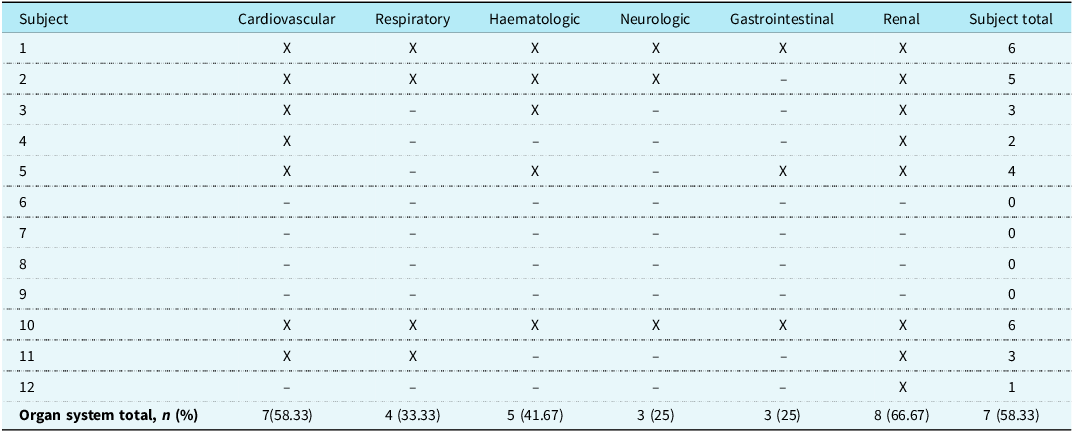
A total of 20 patients (12 MIS-C patients and 8 healthy control patients) were recruited. Table 2 displays the demographics of the two populations, with the majority being African American and/or male. Out of the 12 patients with MIS-C (included in the analysis), 7 (58.33%) of the patients met MODS criteria (Table 3). Two patients (16.67%) had all 6 organ systems with dysfunction, while 4 patients (33.33%) met none of the criteria. One patient who did not have MODS was the only one who met the criteria for Kawasaki disease. The two most common systems that were affected were renal (66.67%) and cardiovascular (58.33%).
Patient demographics

Organ dysfunction distribution among MIS-C patients

While evaluating interventions needed for organ system dysfunction, 2 patients were found to require continuous renal replacement, and two were placed on veno-arterial extracorporeal membrane oxygenation, one of whom was status-post cardiac arrest from ventricular tachycardia. Two patients had coronary ectasia found on electrocardiogram, and both of them had improvement at follow-up. Three patients required mechanical ventilation, one required noninvasive positive pressure ventilation, and one required inhaled nitric oxide. Five patients required transfusion of blood products. One patient met the criteria for disseminated intravascular coagulation, while two other patients were found to have provoked thromboses connected to central venous catheters (data not shown).
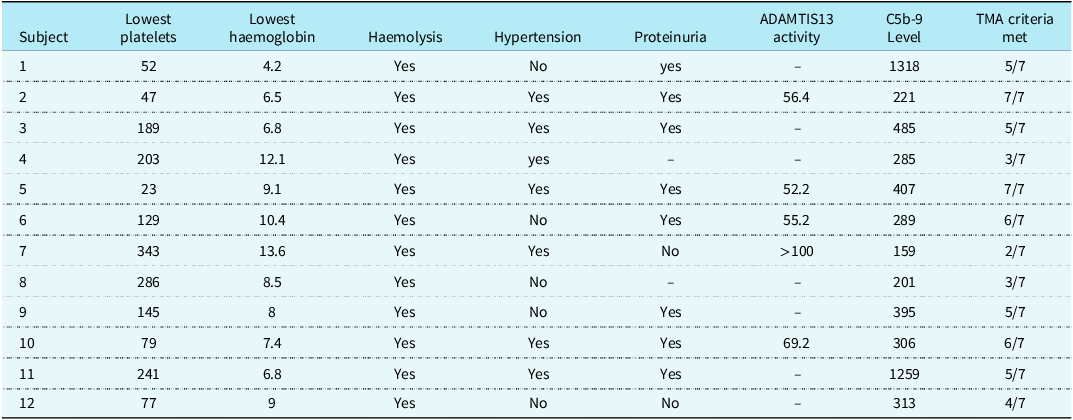
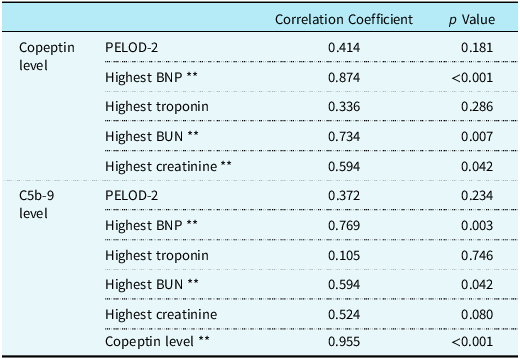
Among the 12 patients included in the analysis, 8 (66.67%) met the criteria for thrombotic microangiopathy, with 7 having overlapping multi-organ dysfunction syndrome (Table 4). Three subjects that did not meet thrombotic microangiopathy criteria had missing values, which could be skewing the results. C5b-9 levels were significantly higher (p = 0.014) in the MIS-C group (mean 470 ng/mL; range 159–1318 ng/mL) compared to the control group (mean 136 ng/mL; range 112–185 ng/mL). C5b-9 levels correlated with B-type natriuretic peptide (p = 0.003, see Table 5). Figure 1 demonstrates graphically the close correlation between copeptin and C5b-9.
TMA criteria

Copeptin and terminal complement correlation values

** Correlation is significant at the 0.01 level (2-tailed).
BNP = B-type natriuretic peptide; BUN = blood urea nitrogen.
Copeptin and complement relationship.

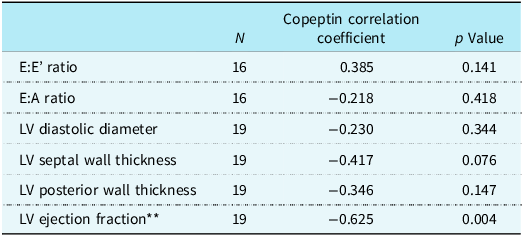
The copeptin levels for the MIS-C group ranged from 19.5 to 1026.3 pg/mL (mean 366.63 pg/mL), while the control group copeptin levels ranged from 10.7 to 25.8 pg/mL (mean 14.88 pg/mL. Copeptin levels correlated with B-type natriuretic peptide, blood urea nitrogen, and C5b-9 levels (p < 0.001, 0.007, and <0.001, respectively). Table 5 compares the relationships between copeptin, C5b-9, biomarkers of cardiac and renal function, and the pediatric logistic organ dysfunction score. Regarding echocardiogram values for diastolic and systolic function, only copeptin correlated negatively with left ventricular ejection fraction (p = 0.004). While the values were not significant, there was a negative trend with copeptin and left ventricle diastolic diameter, septal, and posterior wall thickness (Table 6).
Copeptin and ECHO correlations

** Correlation is significant at the 0.01 level (2-tailed).
Of note, there was one outlying MIS-C patient whose copeptin (19.5 pg/mL) and C5b-9 levels (159 ng/mL) were much lower than the others in the cohort. This patient did not meet the criteria for organ dysfunction in any system nor the criteria for thrombotic microangiopathy. They did not require any vasoactive support, had the lowest B-type natriuretic peptide levels, troponin levels, and blood urea nitrogen levels, and their pediatric logistic organ dysfunction-2 score (a score used to assess the severity of multi-organ dysfunction syndrome and risk of mortality over an admission) was 0. This patient was only in the pediatric ICU for 1 day and did not require any ICU-level interventions.
Discussion
Multi-system inflammatory syndrome in children-related vascular compromise in pediatric patients can lead to poor outcomes, thus the need for provider awareness. Utilization of biomarkers such as C5b-9 and copeptin, along with echocardiogram as initial screening strategies of such dysfunction in MIS-C patients presenting with MODS on ICU admission, would be beneficial for rapid management. This study demonstrated that MIS-C patients admitted to the pediatric ICU have approximately a 50% chance of developing MODS, which was determined by C5b-9 biomarker levels. C5b-9 levels were correlated with copeptin levels. Renal and cardiovascular systems were most impacted by this dysfunction, which manifested as hypotension requiring frequent fluid resuscitation, with > 50% patients requiring vasoactive support. The study results also support suspected endothelial dysfunction and injury related to the underlying thrombotic microangiopathy pathophysiology, which can contribute to the development of MODS. In our study, all MODS patients except one met ≥5 criteria for thrombotic microangiopathy. Three patients who did not meet thrombotic microangiopathy criteria had missing data. However, if data were consistent, patients whose data were affected by information bias would have been placed in the thrombotic microangiopathy group. The hypothesis that endothelial dysfunction is present in MIS-C patients is supported by the presence of thrombotic microangiopathy and elevated copeptin levels, which is known to correlate with markers of endothelial dysfunction. Reference Diorio, McNerney and Lambert6–Reference Diorio, Henrickson and Vella7,Reference Koch, Yagmur and Hoss10 Since these are both indirect markers of endothelial dysfunction, more focused studies on direct biomarkers are needed to evaluate further.
There is an overlap of symptoms between thrombotic microangiopathy and multi-organ dysfunction syndrome. Interestingly, 2 patients who met thrombotic microangiopathy criteria did not meet MODS criteria, while one patient met MODS criteria but not those for thrombotic microangiopathy. One patient with Kawasaki disease was diagnosed with MIS-C due to a positive COVID-19 antibody and other laboratory markers consistent with their MIS-C diagnosis. This patient did not have Kawasaki disease-related coronary dilation on echocardiography. Consistent with the described Kawasaki disease case, MIS-C has been compared to Kawasaki disease since first being described. Reference Feldstein, Rose and Horwitz1 This overlap of symptoms may be due to the underlying endothelial dysfunction in both diseases.
All MIS-C patients in this study, excluding the outlier, had elevated C5b-9. Elevated C5b-9, also known as terminal complement, is associated not only with inflammation but also microangiopathy and endothelial damage. Reference Diorio, Henrickson and Vella7,Reference Gavriilaki, Anyfanti, Gavriilaki, Lazaridis, Douma and Gkaliagkousi9,Reference Khwaja16 Our results are corroborated by Diorio et al., who also found signs of thrombotic microangiopathy in both MIS-C patients as well as patients with active COVID-19 infections. Reference Diorio, McNerney and Lambert6,Reference Diorio, Henrickson and Vella7 The possibility of thrombotic microangiopathy in MIS-C opens the possibility to the use of eculizumab, a monoclonal antibody that inhibits terminal complement and is used in severe cases of complement-associated thrombotic microangiopathy. There is one case report of a patient with multisystem inflammatory syndrome in adults (the adult equivalent of MIS-C) and thrombotic microangiopathy who was successfully treated with eculizumab. Reference Khwaja16 Aurora et al. also described improvement after eculizumab administration to three pediatric patients who met thrombotic microangiopathy criteria with either acute COVID-19 or MIS-C. Reference Doughty, Carcillo, Kaplan and Janosky17 Of note, these pediatric patients had either sickle cell disease or leukemia, predisposing them to endothelial injury, thrombosis, and complement activation prior to their infection. Further research is needed regarding the use of eculizumab as a treatment in MIS-C associated thrombotic microangiopathy. C5b-9 had a strong positive correlation with copeptin. The correlation could be due to their correlation with endotheliopathy in MIS-C which should be further studied before making that assumption.
The C5b-9 and copeptin correlation could also be due to the patients having an acute critical illness. Copeptin levels do not correlate with chronic diseases, but it has been shown to be elevated in acute critical illness and acute heart failure. If we exclude the outlier, the MIS-C population in this study had elevated copeptin levels compared to the healthy control group, which could be due to their acute critical illness. Copeptin levels have previously been documented to correlate with outcomes in critical illness. It did not, however, have a significant correlation with the pediatric logistic organ dysfunction-2 score in our MIS-C population. While most patients had MODS, the majority also had low pediatric logistic organ dysfunction-2 scores, and all recovered without complications. This lack of correlation may be due to copeptin being elevated in the early acute phase, while pediatric logistic organ dysfunction-2 evaluates over the entire admission. Copeptin levels had a significant negative correlation with ejection fraction, an echocardiogram marker of systolic dysfunction, but did not have a significant correlation with the markers of diastolic dysfunction. It is important to note that many of the MIS-C patients were on vasoactive support at the time of the echocardiograms as well as all the patients had normal or improving ejection fraction prior to discharge. Copeptin and C5b-9 levels both had a significant positive relationship with B-type natriuretic peptide. These two relationships have been noted in previous studies. Reference Diorio, Henrickson and Vella7,Reference Krychtiuk, Honeder and Lenz13 Copeptin did not have a significant correlation with troponin. With all these data, copeptin cannot be used as a marker for severity of MODS in patients with MIS-C, but it can be indicative of the presence of critical illness. One cannot connect copeptin with potential myocardial injury; however, copeptin may be used as a marker of depressed systolic function in MIS-C.
A key limitation of this study is the small sample size. MIS-C is an uncommon disease state. The study population was limited to MIS-C patients admitted to the pediatric ICU, limiting enrolment and sample size. This also limits true evaluation of the number of MIS-C patients with MODS admitted to other areas of the hospital. Biomarker levels were only obtained peri-admission and within 24 hours of administrating therapy, capturing a cross-section of biomarker level prevalence among MIS-C patients. The clinical utility of developing a biomarker panel for MIS-C-related thrombotic microangiopathy would allow earlier recognition of these patients and potentially guide therapies by measuring a change in levels. Another study limitation is the information bias related to missing data, allowing for underestimation or overestimation of effect size. Despite study limitations, this study is the first to evaluate thrombotic microangiopathy-related biomarker utility in MIS-C evolution into MODS. Although race and gender were disproportionate in this sample, we cannot make any statements related to generalizability due to the sample size. Further studies are needed to evaluate the utility of copeptin, the presence of MODS, and the potential for thrombotic microangiopathy in the MIS-C population.
Conclusion
Multi-system inflammatory syndrome in children patients who require a higher acuity of care in the pediatric ICU have the potential for MODS due to underlying complement-associated thrombotic microangiopathy. The most common organ systems likely affected are renal and cardiovascular. Copeptin and C5B-9 can be used as biomarkers for acute critical illness and systolic dysfunction in MIS-C patients. However, their utility as markers for myocardial injury, diastolic dysfunction, or the severity of MODS needs further evaluation.
Acknowledgements
We would like to thank Dr Frankie Stenz in the University of Tennessee Health Science Center Endocrinology/Lipoprotein Laboratory for copeptin sample analysis.
Financial support
Dr Ashlee Christmas received a UTHSC Le Bonheur Children’s Hospital Fellows Grant to conduct the study.


 Open access

