Introduction
The way political systems deal with deeply divisive issues has always figured as a central concern to social science. In today’s Europe, the organization that has played a major role in removing armed conflict on the old continent, the European Union, nevertheless also continues to spark opposition and controversy. Recent examples include the rejection of the Constitutional Treaty, the negative Irish referendum on the Lisbon Treaty, and a general tide of rising Euro-scepticism.
Political systems vary greatly in their ability to handle conflicts; they also vary greatly in their propensity to shirk away from particularly controversial issues. In other words, as part of their conflict handling repertoire, political systems possess a range of mechanisms that enable them to suppress or avoid conflicts. Consensual democracies shirk away from deeply charged ideological issues; elites in consociational systems handle contentious issues and, as such, keep them away from the general population; all political systems leave contentious and intractable issues to experts and technocrats; political systems frequently resort to non-decisions; and governments re-label or reframe issues to defuse their heat. For instance, a number of member state governments (Denmark, Sweden and the UK to cite some) adamantly refused to label the European Constitutional Treaty as a constitution, as part of a strategy of constitutional avoidance. A closer look across Europe would yield a varied tapestry of mechanisms for handling the thorny issue of European integration, with most governments and political systems relying on some version of conflict avoidance.
In this picture, one should expect that a country such as Norway that has rejected EU membership, in fact done so twice,1 and even has an active and vocal anti-membership organization, would stand out as the exception. In other words, as Norway is not a member of the EU, and polls consistently show a ‘no’ majority, one would expect not only that the EU issue would be off the political agenda, but also that there would be no need for the Norwegian government to take any measures to suppress this issue.
But reality is more complex. Since the early 1990s, when Norway entered into the EEA agreement with the EU, Norway’s relationship to the EU has changed dramatically. Today, Norway is almost as integrated in the EU as any actual member state.2 Given that Norway is a member of the Schengen Agreement and other such arrangements, Norway is in some respects more integrated in the EU than is for instance the UK. Clive Archer has noted that ‘Since 1994 Norway’s relationship with the process of European integration, as led by the EU, has been as close as possible without full membership’ (Ref. Reference Archer3, p. 188).
Norway’s current arrangement with the EU is perhaps best labelled as tight incorporation without formal membership. This arrangement has also frequently been equated with a sharecropper’s arrangement.Reference Claes4–6 It might even be construed as a kind of self-chosen ‘farming out’ of much of Norwegian democracy. This is ironic given that the main reason for rejecting EU membership was to protect Norwegian democracy and Norwegian sovereignty (Ref. Reference Bjørklund7, p. 189; Ref. Reference Oskarson, Ringdal, Jenssen, Personen and Giljam8, pp. 153–166). The popular anti-EU mobilization was, to a large extent, driven by people who claimed that Norway’s tradition of egalitarian democracy would be the most important casualty of Norwegian EU membership. But post-1994 the political establishment has apparently accepted Norway’s close incorporation into the EU. What is particularly notable is that this incorporation has unfolded amidst silence and a relative absence of organized popular protest.9
Why, given the democratic stakes and the strong popular mobilisation during each referendum, has there been such domestic silence and lack of organised political action post-1994, at a time when Norwegian democracy is becoming emasculated?
Analysts have focused on the pattern of Norwegian adaptation to the EU;Reference Sverdrup10, Reference Claes and Tranøy11 the complex configuration of cleavage patterns and party alignments that the EU issue has spawned;Reference Bjørklund7, Reference Bjørklund12–Reference Valen, Aardal, Narud and Berglund14 the dynamic character of the EEA agreement;Reference Sejersted5, Reference Onstad15 this agreement’s status of a national compromise;Reference Claes and Tranøy11, Reference Østerud16 and democratic implications for Norway.Reference Blichner17, Reference Eriksen18 Claes and Tranøy, in the most broadly based study to date, have noted that ‘Norway’s political and administrative elite push EU adaptation forward basically independent of what they might express in public and whatever party they might belong to’ (Ref. Reference Claes and Tranøy11, p. 282, author’s translation). There is nothing to suggest that this has changed since 1999. The upshot is that Norway’s active adaptation to the EU has taken place together with a virtual ban on discussion of EU membership amongst the political elite.
It is the character and the democratic implications of this type of issue avoidance that is the topic of this article. Norwegian governing coalitions have formulated a range of provisions for keeping the EU membership issue off the political agenda: so-called ‘suicide clauses’ (if a party in a coalition government launches a campaign for EU membership, the coalition unravels). This is based on a bi-partisan agreement to base Norway’s relation to the EU on the EEA agreement. Other provisions are particularly high partisan thresholds for instituting debate on EU membership. The agreements and arrangements not to raise the EU membership issue, I will show, have greatly facilitated an active process of adaptation or ‘close incorporation without formal membership’. In other words, the decisions to remove the EU membership issue from the political agenda must be considered in light of the many decisions that are taken to sustain a process of ‘active adaptation’ to the EU. To shed light on this we therefore need an analytical framework that can capture both the decision to remove the EU membership issue and the many decisions that form the process of active EU-adaptation. For this I have settled on Stephen Holmes’s notion of ‘gag rules’. These are (formal and informal) mechanisms that political actors apply when they seek to remove debate on a contentious item from the public agenda.Reference Holmes19 Gag rules are a particular type of issue avoidance; they speak of how actors seek to remove debate on a controversial issue that does not go away: it is a matter of stymieing debate on the issue but not by stopping to deal with the issue. The lid on debate on EU membership helps the political system to keep alive an active process of Norwegian adaptation to the EU.
No systematic research has thus far been conducted on these gag rules in Norway. Understanding these mechanisms will add to existing accounts of why Norway has entered into an arrangement with the EU that analysts label as a democratic sharecropper’s arrangement. This of course reflects back on Norway’s special relationship with the EU. But there is also a broader theme here, of relevance across Europe, namely the factors and political mechanisms that constrain politicization of EU issues. Studying the de-politicizing mechanisms that are operative in Norway should thus be understood as a part of a larger ‘call’ for case studies and comparisons that can furnish us with a better and more precise conception of the causes, consequences and modalities of non- or de-politicization. Is Norway’s handling of this contentious issue unique? In what sense or to what extent is this reflective of Norway’s special relationship to the EU? This is important also to the issue of democracy: insofar as the Norwegian gag rules have negative democratic effects, are these the same sorts of effects that other member states experience or are they unique to Norway?
Gag rules or the politics of omission outlinedReference Bellamy and Castiglione20
With gag rules, Holmes refers to rules – formal and informal – that remove issues from the political agenda or from political debate. Holmes lumps formal provisions, regulations, tacit understandings etc under this category. These can regulate public debate as well as formal decision-making. In other words, some gag rules are instituted to stymie or prevent debate; others to prevent taking a decision. Holmes notes that gag rules have generally been considered as alien to democracy. When considered from a deliberative democratic perspective they can readily be construed as results of strategic manipulation through withholding information, removing issues from public attention, diverting attention from salient and controversial issues, etc. But they can also serve democracy: precisely by removing the most controversial issues from the public agenda, they can preserve peace, foster agreement and consensus, and make democracy workable. Under this rubric we find consociational, federal, segmental and other arrangements that localize or diffuse conflict; we can also understand privatization of issues as a means for disencumbering the political agenda. Such provisions could stymie democracy but it is to overstate the case to argue that there is necessarily a democratic odium associated with such provisions: they can serve democracy.
Holmes develops a typology of gag rules, which is useful in the analysis of the Norwegian case. He distinguishes between formal and informal gag rules, where the distinction speaks to the degree to which gag rules are formalized in written rules, laws and constitutional orders versus tacit understandings and informal arrangements. This distinction can refer to the degree of binding, to the political salience, and to the public visibility that a given provision has. Another distinction Holmes makes is between autonomous and heteronomous gag rules, which refers to whether actors impose the rules on themselves or have the rules imposed on them. This is also of relevance to the understanding of the role of the political system, namely whether in removing highly controversial issues from the political agenda it merely reflects social forces or rather acts relatively autonomously from such. The final distinction Holmes makes is between majoritarian versus unitarian gag rules, which of course refers to whether they are accepted by a majority or by all. By considering the Norwegian gag rules in relation to these three distinctions we can say something more general about how the Norwegian political system has sought to grapple with the highly controversial EU membership issue.
Given the range of phenomena that might be included under the rubric of gag rule, how, methodologically speaking, may we ascertain that something is a gag rule? Gag rules, as noted, can manifest themselves in tacit understandings, in norms, conventions, rules, and even in institutional-constitutional orders. To identify a gag rule we could start by seeking out a highly contentious issue and thereafter examine whether there are formal or informal rules or provisions that are explicitly set up to prevent public debate, public attention, or public decision-making on the issue. These can be found in written or in oral statements. Or gag rules can be traced by trying to track issue removal: what controversial issues are not on the agenda, what issues are not addressed or dealt with? For such issue removal to be understood as the result of a gag rule, however, rather than a non-decision, we must be able to trace it back to some identifiable wilful act of issue removal, expressed in a statement, a rule or a provision.
Norway, the EU and EEA – The politics of omission?
What rules, provisions, or tacit understandings might qualify as Norwegian-made gag rules on the issue of Norway’s relation to and membership of the EU? This inquiry is confined to the post-1994 period because that was when Norway became most tightly linked to the EU. This has occurred, notably, but far from exclusively, through the European Economic Area (EEA) that regulates the relationship between the EU and most of the European Free Trade Association (EFTA).21 Further, it was only really after 1994 that we may talk about permanent organizations with an explicit self-interest in sustaining an ongoing debate on EU membership.22 Their acquiescence helps justify this article’s focus on the role that the political system played in maintaining silence on the controversial membership issue.
Two sets of Norwegian provisions/norm-sets are particularly relevant for discerning gag rules. The first is governmental declarations that spell out the newly elected government’s political program; and the second is partisan provisions on Norway’s relationship to the EU.
Norwegian government declarations
The first (minority) Bondevik government (1997–2000) was the first government formed after the EEA agreement had come into effect in 1994. It was made up of three parties, all of which were formally against Norwegian EU membership (Krf: Christian People’s Party; Venstre: Liberal Party; and Senterpartiet: Centre Party). Its inaugural declaration stated that ‘the EEA agreement forms the main basis for Norway’s relationship to the EU.’23
This stance was reiterated in the Sem Declaration, which was the second Bondevik right-of-centre government’s (Høyre: Conservatives; Krf: Christian People’s Party; Venstre: Liberal Party) agreed-upon political platform for the period 2001–2005.24 It was negotiated during the period 2–8 October 2001 by the three parties that formed this coalition. Note that in the second Bondevik government the EU-positive Conservative party had replaced the EU-negative Centre Party. Under the heading ‘An Active European policy’, the Sem Declaration stated that ‘Norway’s affiliation with the EU builds on the EEA agreement. The EEA agreement must be effectively exploited and be adapted in accordance with new needs’ (p. 10). The Declaration stressed the need for an active European policy. This would be undertaken within the framework of the EEA agreement; there would be no possibility of sending a new membership application during the period in question (2001–2005). This provision has often been referred to as the coalition government’s ‘suicide declaration’.25 It entailed that if one of the parties in the coalition were to bring up the EU membership issue, the government would dissolve.
Does the Sem ‘suicide declaration’ qualify as a gag rule? This question is particularly relevant for the Sem Declaration because the second Bondevik government – in contrast to the first Bondevik government – contained both proponents and opponents of Norwegian EU membership. It was (a) an explicitly stated provision, (b) aimed at self-bind, through (c) removing the issue of Norwegian EU membership from the government’s political agenda during its tenure in office; and (d) through basing Norway’s formal relation to the EU on the EEA agreement. The declaration thus formed a self-declared ban on launching a new EU application process, in the sense that all coalition parties had signed onto it. It also came with a strong sanction: a party that wanted to launch a new EU membership round would have to choose between pursuing EU membership or remaining in office.
The Bondevik coalition government was heavily criticized for dragging its feet on EU issues, and some have even accused it of having basically put a lid on public debate on the issue.26 Prime Minister Bondevik himself added to this by declaring that to start a new EU membership round, two popular referenda would be required: one to authorize the process of negotiations, the other to sanction the results of the negotiations.27 This can only be understood as an effort to raise the threshold for action on EU membership; hence it was entirely consistent with the presence of a self-imposed gag rule on EU membership but also extending to debate on EU issues as such. The important point to keep in mind, then, is that the Sem Declaration was but one of a number of more or less formal – more or less explicitly stated – efforts to keep this highly controversial and divisive (EU membership) issue off the coalition government’s agenda.
The Soria Moria Declaration,28 which was negotiated during 25 September and 13 October 2005, formed the basis for the Stoltenberg left-of-centre majority coalition government’s political platform during its anticipated tenure in office, 2005–2009 (composed of DNA: The Norwegian Labour Party; SV: the Socialist Left Party; and SP: the Centre Party). It stated that ‘The Government will not apply for Norwegian EU membership.’ (p. 10)29
The Soria Moria Declaration thus clearly qualifies as a gag rule on the issue of Norwegian EU membership. But the Declaration also stated that the Stoltenberg government would pursue a more active European policy (implicitly criticizing its predecessor for passivity). The Declaration likewise noted that the government should ensure open debate on EEA and EU issues, including greater parliamentary (Storting) involvement.
Both declarations contain statements to the effect that Norway should not apply for EU membership, and both were ‘suicide clauses’ in the sense that both coalition governments would unravel if one major coalition partner were to bring up the EU membership issue. In both cases the main target for the gag rule was formal Norwegian EU membership. Both declarations contained statements on the need for a proactive Norwegian role in relation to the EU; both shared the emphasis that such a proactive role should take place within the confines of the EEA-agreement, not through EU membership.
What is important to keep in mind is that neither the Sem nor the Soria Moria Declaration sought in any way to constrain Norway’s active incorporation in the EU. Quite the contrary: both referred to an active policy in relation to the EU. This naturally pertained to the dynamic EEA agreement. But both declarations also referred to an active Norwegian participation in a host of areas not covered by the EEA agreement, areas under the EU’s second and third pillars (security and defence policy and justice and home affairs, respectively).
What kind of gag rules?
What kind of gag rules are these, in relation to Stephen Holmes’s classification? First, both gag rules (not apply for EU membership and retain the EEA Agreement) are formal in the sense that they are clearly spelled out and given the status of binding written declarations.
Second, the provisions may, formally speaking, be said to be autonomous, along the lines that Holmes depicts as autonomous, namely as self-chosen by the governing constellation. They have not been directly imposed on the government by anyone outside of the government. But whether they are autonomous in the sense of being properly self-chosen is a more tricky issue. On the one hand, it is clear that they have been imposed on the main governing party in each constellation by its smaller coalition partners. In the case of the right-of-centre Bondevik government, it was imposed on the pro-EU party, the Conservatives (Høyre), the largest party in the government, by its smaller coalition partners, the Christian People’s Party (Kristelig Folkeparti) and the Liberals (Venstre), which were both opposed to EU membership. In the case of the Stoltenberg left-of-centre government, it was imposed on the main governing party, the pro-EU Labour (Arbeiderpartiet) by its smaller coalition partners, the Left Socialists (Sosialistisk Venstreparti) and the Centre Party (Senterpartiet), which were both opposed to EU membership. Thus, neither gag rule can be said to be wholly autonomous. Both are probably better understood as heteronomous: the smaller coalition partners (EU-opponents) force the largest governing party to comply with their provisions on self-bind and/or the large party is internally divided and finds this a way of handling internal disagreement. The two Declarations contain the same basic mechanism: the provision not to apply for EU membership entails that the main (EU-positive) coalition partner has to choose between, on the one hand, continuing in government or, on the other, launching a campaign for EU membership. If it opts for the former, the coalition stays together; if it opts for the latter, the coalition unravels and the government is out of office. The main party is thus faced with a clear choice between the influence it can wield through being the main partner in government but having to exercise this within the bounds set by the EEA agreement, versus dissolving the coalition in order to pursue Norwegian membership in the EU.
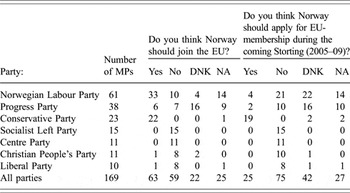
There is nevertheless a difference between the two main parties, Labour and the Conservatives, in terms of the degree of ‘voluntary’ party submission to the gag rule. The issue of EU membership is difficult to handle. After the 1972 referendum, Labour was split and saw a strong voter defection in the ensuing 1973 election. The EU membership issue cuts across the ideological left–right cleavage-line in Norwegian politics.30 Further, ‘(t)he issue of EU membership splits all parties except the Centre Party and the Conservatives, making the question of deciding who are one’s political friends and foes much more complicated than formerly’ (Ref. Reference Heidar31, p. 825). Three governments have stranded on the EU membership issue (1971, 1972 and 1990) (Ref. Reference Bjørklund7, p. 73). A recent survey of Norwegian MPs (Table 1, conducted by the main EU-opposition organization) confirms this. Among MPs who declared a position on EU membership, Labour was divided, whereas the Conservative party was not. Therefore, for Labour, putting a lid on the EU membership issue would amount to removing a deeply divisive issue.32 The Conservatives on the other hand, internally united on this issue, could benefit from keeping the issue on the agenda (as we see from Table 1).
Norwegian MPs’ attitudes to Norwegian Membership in the EU

Source: EU-standpunkt blant stortingsrepresentantene i 2005 (EU stances among the Storting representatives) No to the EU Factsheet. Available electronically at: http://www.neitileu.no/content/download/14952/99673/file/Faktaark.pdf (accessed 6.8.2008). Table compiled by Erik Ryen.
We also see from Table 1 that there was a clear majority among those declaring a position on EU membership against sending an application during 2005–209. This suggests that there was not much pressure in the Storting to keep the membership issue alive.
Third, Holmes distinguishes between unitarian and majoritarian gag rules. These two Norwegian provisions are clearly not unitarian, but on the face of it they do not appear to be entirely majoritarian either, as they are used by the weaker parties to bind the largest party in the coalition. How could they then be so effective? All plausible governing coalitions would likely contain at least one party opposed to raising the EU membership issue; the sanction; the generally lukewarm attitude in the Storting; and a further set of provisions and agreements that have been developed in the Norwegian political system. These operate at the level of political parties and to some extent even social movements.
Political parties’ acts of self-binding
The coalition governments have instituted gag rules on the issue of Norwegian EU membership; such rules are also found in most of the political parties. The most explicit case is the populist Progress Party (Fremskrittspartiet: FrP) with two elements of self-bind. The first, and unique to the Progress Party, is that the party has bound itself to follow popular opinion on membership; consequently it has declined to formulate an own official party stance on the question of Norwegian EU membership.33 Thus, the Party sees itself as a receiver, rather than a shaper, of popular opinion on this important issue. The Party’s stance on Norwegian EU membership, as stated in its Principle and Action Program during the period 2005–2009 (the party’s political platform: FrP 2005) is that the two previous popular referenda on EU membership operate as constraints on the procedures guiding Norwegian EU membership: (a) the decision to apply for EU membership should be preceded by a popular referendum; (b) Norway should not apply for EU membership unless there are significant changes in Norwegian public opinion; and (c) the negotiation result should be subjected to a second referendum.34 The second element of self-bind is thus the requirement to hold two referenda; notably that a referendum is needed before an application can be sent.
How significant these are as elements of self-bind hinges on the thresholds they throw up. The Progress Party’s Principle and Action Program 2005–9 (p. 50) lists certain conditions that must be satisfied if Norway is to seek EU membership: Norway ought not to be a member of a union that constrains Norway’s control of natural resources (oil and gas); Norway ought not to be a member of a Union that weakens Norway’s defence and military alliances; Norway ought not to be a member of a union that damages Norway’s relationship to the US or Russia; and Norway should not be a part of a union that weakens Norwegian suzerainty and the international legal provisions guiding Norwegian ocean areas. Nothing is said on how characteristic these features are for present-day EU. Nor is anything said about what might spark a new EU membership process. What is not made clear is whether a first referendum would be required to establish that there was a major change in public opinion or whether public opinion polling data to that effect would suffice. If a referendum is needed to establish whether there is a major change in public opinion, what does it take to initiate such a referendum? Precisely what constitutes a major change in public opinion, how the party will go about establishing this, and how this relates to the first referendum requirement, is not made clear. These provisions together form a strong protective bulwark against this issue entering the Party’s agenda.
In some contrast, both as to the clarity of the stance and of the procedure, the Conservative Party35 in its parliamentary party program for 2005–2009 explicitly states that Norway should become a member of the EU as soon as possible. It also notes that the issue of membership should be put to the people in a referendum. The party wants only one referendum, after the negotiations are completed. The Labour Party (DNA) holds the same position on membership and opts for the same application procedure.36
The Christian People’s Party, often portrayed as the main guarantor for the EEA agreement, states in its parliamentary program 2005–2009 that Norway at present is best served with the EEA agreement. But it also notes that if a parliamentary majority opts for EU membership, there should be only one referendum – after the negotiations have been completed.
The Liberal Party (Venstre) is also against Norwegian EU membership.37 It opts for two referenda but this is not a requirement. The party notes that its parliamentary representatives will respect the result of the membership referendum.
The Centre Party (SP) is against Norwegian EU membership and wants to replace the EEA agreement with a set of bilateral trade and cooperation arrangements with the EU.38 The Centre Party would obviously require a new referendum if the membership issue reappears. It states that the two referenda rejections should be respected and the party also commits itself to work against a new membership application. In contrast to most of the other political party programmes, the Centre Party’s programme is silent on the issue as to whether the party will respect a positive referendum result.39
The Socialist People’s Party40 adopts the same position as the Centre Party on Norwegian EU and EEA membership. The party notes that a popular referendum is required before the Storting ratifies a membership agreement. It states that it will respect a ‘yes’ majority in the referendum. The left-wing Red Party (Rødt) is against both the EU and the EEA; and explicitly states that it will not respect a ‘yes’ majority in a popular referendum.41
This brief overview of the party programmes reveals that the Progress Party stands out from the other political parties in that it has a unique self-imposed gag rule on Norway in relation to the EU: the party has declined to take a clear stance on Norwegian EU membership; has a two-referendum requirement; and requires a previous change in public opinion to set a new EU membership process in motion.
All the Norwegian political parties state that the issue of Norwegian EU membership must be put to the people in a popular referendum. Whether they will respect a (small) ‘yes’ majority in such a referendum is: confirmed by the Conservatives (Høyre), Labour (DNA), the Christian People’s Party (Krf), the Liberals (Venstre), the Socialist People’s Party (SV) and the Progress Party (Frp); is unclear with regard to the Centre Party (SP); and refuted by the left-wing Red Party (Rødt).
How can the gag rules help shed light on the present situation of tight incorporation without formal membership? Since the gag rules only form a part of the explanation, I will first list a set of relevant causal factors, and thereafter discuss the role of the gag rules.
Incorporation without formal membership
Many of the reasons for Norway’s present incorporation in the EU relate to the recognized need to manage the close interdependence that a small and open West European economy and society experiences in a rapidly integrating Europe. Most of Norway’s trade and business is with the EU; secure market access is thus a vital economic concern.42 Similarly, the decision to join Schengen must be seen in light of the need to retain the system of Nordic cooperation after Sweden and Finland joined the EU in 1994.
The present situation of close incorporation also relates to the character and structure of the EEA agreement. It is a dynamic agreement, in two important respects: the scope of the agreement expands in line with increases in the EU’s engagement in the areas that the agreement regulates, and the agreement expands to new member states as the EU expands – there is no need for re-negotiation (Norway’s financial contribution in practice excepted). The EU’s rapid integration and three rounds of enlargement post-1994 have produced important changes in Norway’s relation to the EU. The three sets of EU agreements since 1994 signify that the EEA agreement that Norway signed with the EU in 1994 is not the same agreement today, although the agreement’s basic structure is the same.Reference Sejersted5 Both the dynamic structure of the EEA agreement, and Norway’s incorporation in the EU in the other pillars (Nordic Union – Schengen), made it easier to de-link EU adaptation from EU membership. With such adaptations in place, the need to go through a painstaking process of altering Norway’s formal membership status was less pressing. This reasoning from convenience and conflict avoidance is well-entrenched in the political establishment.
Most of the political parties are also deeply divided over the EU membership issue; every plausible coalition will contain at least one party that opposes EU membership; governments have unravelled over this issue; proponents have seen their stances overturned by strong popular mobilisations during referendum campaigns; and the EEA agreement enjoys considerable popular support.43
The upshot is for politicians to see and cast themselves rather as receivers of already shaped popular opinion than as leaders who actively shape popular opinion. As noted above, the Progress Party is the party that has formalized this into an official stance, but the view is shared across the political spectrum.
Politicians operate as receivers, not shapers, of public opinion on EU membership. This stance is made democratically palatable by the fact that all political parties have provisions to put the issue of Norwegian membership in the EU to the people in a popular referendum. Symbolically speaking, a referendum signifies that ‘the people speaks’. Formally speaking, a referendum in Norway is only advisory. But on the EU membership question, the need for a popular referendum to settle the issue has developed into a constitutional convention.
However, whereas all parties commit themselves to deal with the issue of EU membership by means of direct democracy, not all parties are satisfied with a 50% plus ‘yes’ threshold; some want a higher ‘yes’ threshold and/or recourse to parliamentary override of the referendum result. The uncertainty surrounding how the referendum is operated (the size of the requisite majority and the partisan fidelity to the result) work in the same direction as the governmental gag rule on EU membership and on retention of the EEA Agreement, namely to keep the issue of EU membership off the parliamentary arena. By effectively removing the issue from the parliamentary arena, the political parties and the governing coalitions have curtailed the scope for public debate on Norway’s relationship to the EU in general. Given the present structure, such a debate will really only occur when and if the issue of EU membership is raised. The threshold for instituting such a debate is, if anything, raised, by a tacit agreement to the effect that the previous referendum results must be respected; the people spoke last on the membership issue in 1994, at that point the issue was laid to rest.44 Here, the cumulative effect of two consecutive referenda rejections should not be underestimated.
Precisely because some of the parties may take the issue with the Storting after a positive referendum result, there might not be a sufficient majority in the Storting to ensure that a positive referendum result will be respected. Constitutional safeguards raise the requisite parliamentary majority to  in the Storting (Article 93). The upshot is to ascribe to this particular result (1994 referendum) considerable binding force over time. The many high thresholds and the considerable uncertainty serve effectively to prevent the issue of EU membership from reappearing. They also help to shift the burden-of-proof to those that want to alter Norway’s formal relationship with the EU. The proponents need to come up with some form of compelling evidence to the effect that the situation has changed so much as to warrant a new EU membership round. There are, however, no clearly formulated or agreed-upon benchmarks that make clear when adaptation has proceeded so far as to require consideration of membership.
The gag rules operate to ban formal membership and to preserve the EEA Agreement, thus permitting Norway’s ongoing adaptation to the European integration process. If anything, the gag rules against formal membership and for retention of the EEA Agreement have facilitated the process of EU-adaptation because they have de-linked the process of adaptation from the issue of EU membership. Further, the government declarations (suicide clauses), EEA retention, and partisan provisions (on referenda) serve as mutually reinforcing elements of self-bind that work against re-introducing the membership issue, and as such contribute to give the referendum result a particular status and to put a brake on political engagement and mobilisation on EU issues. What this also implies is that there is a direct feedback mechanism from the referendum rejections to the government declarations. This referendum feedback mechanism helps to account for the legitimacy of the coalition governments’ gag rules against initiating a new EU membership application process.
Concluding reflections on Norwegian democracy
What does the foregoing tell us about the current state of Norwegian democracy? Here, I am interested in the practice of democracy as it is currently exercised in Norway under these kinds of gag rules. Holmes notes that gag rules can serve democracy. Do the Norwegian gag rules have positive democratic effects? The result of such an assessment is not independent of the democratic perspective or yardstick that is applied. If we consider the gag rules from a Schumpeterian or a communitarian conception of democracy, then the democratic verdict will not be very negative, because the gag rules help Norway to function despite the deep division over the EU membership issue. There are good grounds, however, for drawing on the far more demanding requirements of deliberative democracy, for two reasons. The first is that the main justification for not accepting EU membership was to protect Norwegian democracy, a notion of democracy that was clearly understood to be superior to that of the EU. Second, Holmes’ notion of gag rule is steeped in a deliberative mode.
The all-partisan agreement to subject the issue of Norwegian membership in the EU to a popular referendum, an instance of direct democracy, may be considered an important democratic achievement. The current referendum requirement is also quite understandable given that the issue has been broached in two previous referenda. This is in line with the democratic spirit: only a decision forged by the people can revoke a previous decision made by the people. The people can change their minds but to ensure that such a change has occurred, it is necessary to rely on the same, or another equally democratic, procedure.
Three aspects of Norway’s relationship to the EU render such a conclusion dubious. First is the importance attached to the referenda results: they lend legitimacy to the provisions on self-bind and the politics of omission on EU matters. Opponents recurrently and consistently refer to the referendum results as the authoritative statement on the membership issue, and most proponents of membership defer to this. Deliberative democracy in contrast posits that any norm or decision is always open to deliberative challenge.
Second is that, since several parties will take a positive referendum result back to the Storting, the referendum procedure as an instance of direct democracy is contingent on minoritarian parties’ willingness to respect the referendum result.
Third is that – notably so since Norway entered into the EEA agreement, the Schengen Agreement and cooperation in other areas of justice and home affairs, as well as security and defence – Norwegian democracy has become operationally bifurcated: the process of active adaptation to the European Union occurs through the traditional government–parliament interface, as an ordinary political routine process, with Norway as a mere taker of provisions decided at the EU-level, whereas the EU membership issue is singled out and to be dealt with through a popular referendum.
Formally speaking, Norwegian democracy is not threatened: Norway can opt out of the EEA Agreement and reserve itself against the EEA provisions taking effect in Norway. In practice, however, there are high costs associated with both options.
What is important from a democratic perspective is that the gag rules on EU membership, retention of the EEA Agreement, and the referendum provisions have helped to prevent the ongoing adaptation from becoming linked in with the issue of EU membership and the attendant formal reneging of Norwegian sovereignty. Few people are aware of the extent of Norway’s current incorporation in the EU,Reference Finstad45 and the lack of public debate has made it difficult for citizens to understand what is at stake, notably the extent to which the ongoing process of adaptation touches on constitutional-democratic essentials.
The referendum requirement cannot make up for this lack of ongoing public debate. The legitimacy of a referendum result is, to a large extent, a matter of the quality of the debate prior to the actual referendum. It is also quite logical that it be so from a deliberative democratic perspective: the comprehensive debate provides a major democratic opportunity to raise arguments in public and to ‘cleanse’ them through the critical scrutiny of others. The referendum result will then presumably be based on the best possible reasons that could be mustered at that particular point in time. The further implication is that if the situation changes, then there is a need to reconsider the reasons; hence a need for a new debate.
The problem today is that the reasons and justifications that motivated the two previous referenda are greatly changed as a result of the ongoing Norwegian process of adaptation to the EU, notably post-1994. There is thus today a clear discrepancy between what the referendum portends to cover on the one hand and the reality of Norway’s close incorporation in the EU on the other. The irony is that the question that nobody dares to raise is rapidly becoming emptied of substance through the process of ongoing adaptation or incorporation in the EU (without formal membership).
The Norwegian gag rules do not aid democracy; they weaken it. By helping to shut down debate on EU membership as well as on the ongoing process of adaptation to or incorporation in the EU, they render Norway more rather than less subservient to the EU. The lack of public knowledge and debate on the ongoing adaptation has direct decisional implications: analysts-cum-participants have shown that there is unexploited scope for Norway to make EU rules and provisions more suitable to Norwegian reality.Reference Sejersted5 Instituting referenda requirements as a de facto condition for debate (as some parties and politicians have done) is also counter-productive to democracy. The result is to impoverish the public sphere, in its several democratic functions: as a vehicle for educating the public; for improving the quality of decisions by including diverse voices, concerns and interests; and in its indispensable role in holding decision-makers and power-wielders properly to account.
Can the Norwegian experience be generalized to the EU’s member states? If so, we need to consider if the debate on the democratic deficit within the EU needs supplementing.
All governments and political systems might want to suppress debate. There is nothing unique in the proclivity to resort to such a measure. It is, however, likely that this will be a propensity that would be particularly present in consensus democracies because these systems generally operate through coalition governments. But there are nevertheless notable differences pertaining to ability. It would appear that Norway’s special relationship with the EU sets Norway apart in one important respect: given the Norwegian political system – parliamentarians, parties, and governments are not directly involved in the EU’s decision-making system – there is not the same degree of public transparency in Norway’s dealings with the EU as would be the case in a regular member country. This has direct public sphere ramifications, effects which are amplified by limited media interest in the EU. Therefore, there are features of Norway and its special relationship to the EU that will not occur in the same way or to the same degree in other countries. In this sense, the particular manifestation of gag rules that we see in Norway and their deleterious democratic effects will not show up in the same manner in other well-established EU member state democracies.
Acknowledgements
The author is grateful for comments and useful suggestions to previous drafts from Ben Crum, Daniel Gaus, Christer Gulbrandsen, Cathrine Holst, Chris Lord, Iver B. Neumann, Marianne Riddervold, Linda Sangolt, Ulf Sverdrup, Hans-Joerg Trenz, and Frode Veggeland.
John Erik Fossum is Professor of Political Science at ARENA, Centre for European Studies, University of Oslo, Norway. He is substitute coordinator of the European Commission funded five-year integrated sixth framework project RECON (Reconstituting Democracy in Europe) and vice president of the Nordic Association for Canadian Studies (NACS). He has written extensively on democracy and constitutional issues in Europe and Canada. Recent books include The European Union and the Public Sphere (co-edited with P. Schlesinger, Routledge, 2007) and The Ties that Bind (co-edited with J. Poirier and P. Magnette, Peter Lang, 2009).