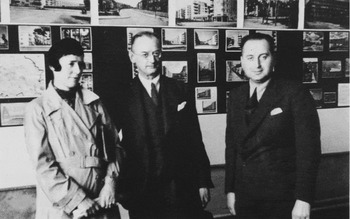
In a recently discovered photograph of German architect Bruno Taut's retrospective exhibition at the Istanbul Academy of Fine Arts, which opened on 4 June 1938, Taut in-exile stands with Erica Taut and his assistant Şinasi Lugal in front of a display (see Figure 1). What interests me in this image is not so much the frontal figures who posed for it as the documentary value of the exhibit in the background, the photographs inside the photograph. These images display Taut's Siedlungen (residential settlements/collective housing projects), designed and constructed as part of the Berlin Housing Program (1924–33) just before Taut was exiled from Germany due to the rise of National Socialism. After stays in Russia and Japan, Taut moved to Turkey, where he became head of the Architecture Department at the Istanbul Academy. Through a seminar and a studio he taught on Siedlung, he participated in a translation of the idea of collective housing that would shape the discursive space and practice of architecture in Turkey for decades to come. Most of the images in the exhibition were taken by the now-famous photographer Arthur Köster. The exhibit bears witness to the fact that Turkish architects were exposed not only to the influential Siedlungen of the Weimar period in Germany but also to their soon-to-be canonical photographs earlier than most of their colleagues around the world.
Opening day of Bruno Taut's retrospective exhibition at the Istanbul Academy of Fine Arts, 1938. Courtesy Manfred Speidel.

Archival research further reveals that the exhibition and Taut's introductory speech made an important impact on his colleagues. On the day of the opening, Taut noted in his diary that he had a conversation with Zeki Sayar, the editor-in-chief of the professional journal Arkitekt, who had previously written an editorial critical of the work of “foreign architects,” including Taut's Faculty of Language, History and Geography building in Ankara. On that day, however, a more appreciative Sayar thanked Taut for his contributions and voiced his interest in publishing images of the architect's projects. Taut playfully responded: enfin je suis auch turque (finally, I am also Turkish). Sayar then reprinted, in consecutive issues, chapters of Taut's Mimari Bilgisi, which was published in Turkish as a book the same year, and in which the author used some of Köster's photographs shown in this exhibit. A full German translation of the book with images would not appear until 2009. The photographs of Taut's newly built Siedlungen in Berlin, with their continuous and horizontal blocks, large windows, elaborately designed doors, white surfaces, flat roofs, bounteous balconies, and large green areas between blocks, would help convince Turkish professionals of the value of modernist architecture.
This photograph opens questions onto “translation” as a process of change that occurs with the transportation of people, ideas, objects, technology, information, and images. Translation takes place under any condition where there is a cultural flow from one place to another; it is the process of transformation during the act of transportation. I am proposing the notion of translation as a conceptual metaphor that helps us to acknowledge the world's intertwined histories by focusing on the global circulation of culture. The disciplines of art and architectural history tend to be divided according to 19th-century categories of Western and Islamic architecture as distinct entities, leaving little room for understanding how artifacts from these regions interacted on a variety of levels. There is enough evidence, however, to rewrite the past in a more intertwined way, by foregrounding cross-geographical conversations in a continuing hybridization process.Footnote 1 A theory of translation seeks to establish a terminology for understanding the global movements of culture through attention to the specific items, channels, places, agents, ideologies, and qualities of encounters involved in such movements.
In this case, the items of transportation were photographs moving between Germany and Turkey; the channel was an exhibition of an exiled architect. The process had many agents, some of which are likely indeterminable. An architect must have underslept for many nights to design a Siedlung in Berlin; a contractor must have taken investment risks to construct it; a photographer must have waited for hours for the right exposure to capture it on camera; a bureaucrat must have convinced the Turkish authorities to invite this architect; collaborating local architects must have opened themselves to foreign ideas; many students must have worked on the installation of the exhibit; and many viewers must have been inspired by it as these images and ideas traveled to take on new lives in another place. This process did not establish a neutral bridge between cultures, as is often assumed in conventional translation theories.Footnote 2 On the contrary, the conversation between Taut and Sayar exposes some of the tensions and psychological anxieties between “local” (Turkish) and “foreign” (German) architects, even as they were, in this case, relatively smoothed during the exhibition opening. The theory of translation that I am pursuing pays attention to the sociopolitical context and the perceived hierarchies between places, as well as the agency of all parties in any given cultural encounter, moving beyond indistinct concepts such as hybrid and transculturation and avoiding more passive metaphors such as import, transfer, or influence.
In Turkey, the translation of the idea of Siedlung—the word itself was either left untranslated or translated as mahalle, konut yerleşmesi, or, more recently, site—played a significant role in the history of Turkish residential modernism. The model was applied extensively in urban housing for middle- and upper-income residents, including state officials; in workers’ towns; and in residential villages for immigrants constructed after the exchange of populations with the Balkans in the 1920s. Taut indirectly influenced the shift from the garden-city style of houses built predominantly in residential settlements during the early republican era to the multifamily metropolitan housing projects constructed after World War II, which were composed of taller and bigger blocks in compounds of units standing on large open spaces. The 4th Levent housing in Istanbul (1956–60), designed by Taut's student Kemal Ahmet Aru, clearly illustrates this shift. He translated his professor's Weimar-era Siedlung ideals—such as mixed-income neighborhoods with different family sizes and residential types—into housing developments adapted to Turkey's circumstances in the postwar years. The blocks—with large and glazed surfaces, horizontal lines, flat roofs, and carved-in or jutting-out repetitive balconies—contributed to the making of a postwar international style in Turkey.
Processes of domesticating or estranging, assimilating or foreignizing, translations have been so ubiquitous during the modern era that one is no more able to think of a pure “local” architecture produced in a place completely closed to other locations than one is able to conceive of a pure “global” building produced in an abstract space outside the forces of any local condition. It is these diverse and ongoing episodes of translation that scholars need to come to terms with in any nuanced understanding of intertwined histories.