It is crucial to study environmental attitudes and behavior in populations of children, considering that the environment’s future will depend on the decisions of coming generations (Larson, Green, & Castleberry, Reference Larson, Green and Castleberry2011; van Petegem & Blieck, Reference van Petegem and Blieck2006). However, little is known about children’s environmental attitudes, how they develop, or the variables that influence them. The dearth of reliable instruments to measure such attitudes is, in part, why progress in this field has been so slow (Evans et al., Reference Evans, Brauchle, Haq, Stecker, Wong and Shapiro2007; Manoli, Johnson, & Dunlap, Reference Manoli, Johnson and Dunlap2007). This stands in contrast to the great many studies of environmental attitudes in adults. One of the most widely-used instruments measuring adults’ ecological beliefs is the New Environmental Paradigm (NEP) scale by Dunlap and van Liere (Reference Dunlap and van Liere1978). According to the New Environmental Paradigm, worldviews are shifting from anthropocentric to ecocentric, the latter of which considers human beings’ impact on nature and suggests limits be placed on growth. The NEP scale consists of 12 items and was created to measure people’s affinity for this ecocentric perspective. It was later revised to include a similar number of items in favor of and against the ecocentric view it aims to detect, to incorporate more up-to-date environmental problems, and to revise the terminology used in certain items (Dunlap, van Liere, Mertig, & Jones, Reference Dunlap, van Liere, Mertig and Jones2000), giving way to the New Ecological Paradigm: NEP revised. The revised scale is made up of 15 items whose content describes, in five parts, the human-nature relationship: 1) ecological limits, 2) anti-anthropocentrism, 3) balance of nature, 4) anti-exceptionalism, and 5) eco-crisis.
The NEP scale has been utilized, among other things, to link ecological beliefs to pro-environmental behavior. It has been established that the NEP scale is positively associated with human ecological behavior. For example, Vozmediano and San Juan (2005) found that the NEP scale’s ecocentrism dimension is positively correlated with the frequency with which people perform ecological behaviors (r = .12, p < .01) and positive outcomes from those behaviors (r = .28, p < .01). It is negatively correlated, meanwhile, with the effort involved in such behavior (r = −.20, p < .01). Similarly, Olli, Grendstad, and Wollebaek (Reference Olli, Grenstad and Wollebaek2001) showed, through multiple regression analysis, that the NEP, together with other variables like family income and environmental knowledge, is able to predict different types of ecological behavior, such as responsible consumption (b = 0.58, β = .09; p < .01) and conservation of resources (b = 0.64, β =.10; p < .01).
Hawcroft and Milfont (Reference Hawcroft and Milfont2010) conducted a meta-analysis of the NEP’s use in over 300 studies since 1970. The authors recommend using it as a standardized measure of environmental attitudes, and point out just one study where the NEP was adapted for use in a population of children, in this case 10 to 12 years-old (see Manoli, et al., Reference Manoli, Johnson and Dunlap2007). Those authors performed a series of exploratory and confirmatory factor analyses using structural equations, concluding that children’s ecological views hinge on three issues: the rights of nature, human exceptionalism, and ecological crisis. These results indicate that children’s ecological views vary in level of coherence and structure, with some children having more organized, coherent systems of beliefs than others (see Dunlap, Reference Dunlap2008).
Factors linked to children’s environmental attitudes
One factor that is positively correlated with environmental attitudes in children is having experiences of direct contact with nature (Kellert, Reference Kellert, Kahn and Kellert2002). A study by Larson et al. (Reference Larson, Green and Castleberry2011) revealed that children who spend more time in contact with nature are more ecologically-oriented. Likewise, Collado and Corraliza (Reference Collado and Corraliza2011) conducted a study that took into account where the children lived (rural and agricultural area, rural area in the mountains, or urban area) and found that participants residing in the rural, mountainous setting had more ingrained pro-environmental attitudes than those in rural, agricultural areas, suggesting it is not only important to spend time outdoors; the type of contact with nature matters. Similarly, Cheng and Monroe (Reference Cheng and Monroe2012) demonstrated that living close to nature promotes a positive emotional attitude toward nature in children; this implies they have greater interest in doing activities outdoors and exhibit more pro-environmental behavior. Several authors have suggested children’s ecological views depend, among other factors, on their contact with nature (Evans et al., Reference Evans, Brauchle, Haq, Stecker, Wong and Shapiro2007; van Petegem & Blieck, Reference van Petegem and Blieck2006) and participation in outdoor environmental education programs (Manoli et al., Reference Manoli, Johnson and Dunlap2007). Nevertheless, that hypothesis needs to be empirically corroborated in more specific contexts.
Another factor that seems to influence environmental attitudes is age. Kahn (Reference Kahn1999) argues that environmental concern in children increases when they reach 10 or 11 years-old. According to Kellert (Reference Kellert, Kahn and Kellert2002), small children tend to have a more utilitarian, anthropocentric view of nature, which shifts toward a more ecocentric perspective as they get older. Some studies indicate younger adults score higher on the NEP scale (Dunlap et al., Reference Dunlap, van Liere, Mertig and Jones2000). Nevertheless, there is no empirical evidence for possible differences in ecological beliefs as a function of age in child populations.
A third factor that can have an impact on adults’ ecological beliefs is gender; women tend to be more pro-ecological than men (Dunlap et al., Reference Dunlap, van Liere, Mertig and Jones2000; Müller, Kals, & Pansa, Reference Müller, Kals and Pansa2009). Therefore, in studies of children, gender has been considered a possible influence on ecological views (Evans et al., Reference Evans, Brauchle, Haq, Stecker, Wong and Shapiro2007; Manoli et al., Reference Manoli, Johnson and Dunlap2007), but differences between boys and girls have not yet been found.
Finally, van Petegem and Blieck (Reference van Petegem and Blieck2006) demonstrated that a child’s culture also influences his or her ecological viewpoint. Using an earlier version of the NEP Scale for Children (Manoli, Johnson, & Dunlap, 2005), they observed that children from Belgium and Zimbabwe share an ecological worldview. However, the Zimbabwean children also reported beliefs that human beings’ dominate over the rest of the natural world, and have the right to utilize nature when necessary. Their system of ecological beliefs, then, was more dualistic than Belgian participants’.
Given the need for access to reliable instruments that measure environmental attitudes in populations of Spanish-speaking children, and to deepen our understanding of how children develop such attitudes, the present study aims to adapt the NEP Scale for Children (from here forward known as the NEP_Ñ) to the Spanish population and examine its psychometric properties. We expect that the NEP scale will detect ecological beliefs in the population of Spanish children, as in prior studies that have employed it (Manoli et al., Reference Manoli, Johnson and Dunlap2007; Van Petegem & Blieck, 2006) (hypothesis 1). In addition, we mean to compare children’s ecological beliefs according to different socio-demographic variables. In this case, the children’s place of residence will be considered a measure of their access to nature, following the procedure used in past studies (Hinds & Sparks, Reference Hinds and Sparks2008; Müller et al., Reference Müller, Kals and Pansa2009). We predict children living in rural areas will exhibit more pro-ecological beliefs than children from urban areas (hypothesis 2). Another objective of this study is to evaluate whether or not participants’ gender and age influence their ecological beliefs. We anticipate that older children will exhibit more pro-ecological behavior (hypothesis 3) and given the findings of previous studies in child populations, we do not expect to find differences between boys and girls (hypothesis 4). Last, we predict a positive correlation between scores on the NEP_Ñ scale and the ecological behavior children exhibit, in this case, energy-saving behavior at home (hypothesis 5).
Method
Participants
The present study had a sample of 574 boys (47.2%) and girls ranging in age from 8 to 13 years-old. Their average age was 11.32 years (SD = 1.39) and they came from different locations, 8 rural (58.7% of children) and 6 urban (41.3%). Participants’ data was only used if they had completed all questionnaire items (we started off with a total of 592 participants). If a question was left unanswered, the questionnaire was not utilized for the purposes of this study. To collect data, we took advantage of a planned visit to a cultural center in Castilla La Mancha, in which all children from that autonomous community were going to take part. That procedure allowed us access to a highly varied sample of participants as far as gender, age, and place of residence, all relevant variables to this study.
Instruments
The NEP Scale for Children by Manoli et al. (Reference Manoli, Johnson and Dunlap2007): The scale was translated and adapted into Spanish using a back-translation method. That is, it was translated into Spanish, then that version was translated back into English by an English professor who is also a native speaker, in order to establish its similarity to the original scale. The final version of the scale (NEP_Ñ) we administered consisted of 11 items, including item 11 from the original questionnaire by Manoli et al. (Reference Manoli, Johnson and Dunlap2007) (“The so-called “environmental crisis” facing people has been blown out of proportion -exaggerated-”) even though those authors suggested eliminating it because, in their case, it caused comprehension difficulties. The test’s response format is a 5-point Likert-type scale. Following Dillman’s (Reference Dillman2007) recommendations, symbols that are familiar to children were included beside each score to make responses more visual, thereby increasing the accuracy of participants’ responses. Thus, answers ranged from 1 = strongly disagree (two thumbs down) to 5 = strongly agree (two thumbs up), the intermediate score being 3 = not sure (question mark). Total scores on the scale were calculated as the average of all the item scores. After analyzing the data, it was decided that the NEP_Ñ should include 9 of the 11 initial items (see Results section). The new 9-item version was utilized to assess the possible relationship between ecological attitudes and the other variables.
Pro-environmental behavior: Pro-environmental behavior was measured using a self-report item in which participants were asked to indicate to what extent they agree with the following statement: “At home, I conserve electricity to protect the environment: I turn off lights when I leave a room, I turn off the television, videogame console, and computer when I’m not using them, etc.” This behavior was chosen because earlier studies (Evans et al., Reference Evans, Brauchle, Haq, Stecker, Wong and Shapiro2007; Leeming, Dwyer, Porter, & Bracker, Reference Leeming, Dwyer, Porter and Bracker1995) have operationalized household energy savings as pro-ecological behavior in children. This question had the same response format as the NEP_Ñ (5-point Likert scale paired with visual symbols). Participants were also asked to indicate where they reside, their age, and their gender.
Procedure
A pilot study was conducted in 20 children to confirm the items could be easily comprehended. Next, we proceeded to collect data for this study. One of the authors read each item aloud twice to ease the children’s comprehension. Participants had ample time to answer and any questions they had were addressed.
Data analysis
First, exploratory factor analysis was applied to half the data. Following the recommendations of Abad, Olea, Ponsoda, and García (Reference Abad, Olea, Ponsoda and García2011), we utilized the method of generalized least squares with oblimin rotation. The scale’s internal consistency was evaluated with Cronbach’s alpha coefficient. Next we estimated a model through confirmatory factor analysis, adopting a second-order factor structure consisting of three first-order factors with three indicators each, and one second-order factor that explains the correlations between the first-order factors. The maximum likelihood method of estimation was employed. The following goodness of fit statistics (with their criteria) were assessed: chi-squared/df ( < 4), GFI (≥ 0.95), AGFI (≥ 0.90), CFI (≥ 0.90), and RMSEA (≤ 0.08). The confirmatory factor analysis model was estimated using 50% of the sample (not the 50% used to test the exploratory factor analysis model) so as to compute the model’s cross-validation indices. Next, we applied correlation analysis to determine the NEP’s relationship with pro-ecological behavior and age. Last, analysis of variance was conducted to address possible differences between groups of children according to sex and place of residence.
Results
The Kaiser-Meyer-Olkin measure of sampling adequacy was found to be .88 and Bartlett’s test of sphericity yielded significant results, from which we deduced that the data were adequate to conduct exploratory factor analysis. A one-dimensional factor solution comprised of 9 items was obtained: Items 1 and 2 did not load strongly enough on any factor (factor loadings under .30). This factor explained 39.57% of total variance and had an eigenvalue of 4.15. Table 1 displays the item matrix.
Matrix of Items on the NEP_Ñ Scale

The scale’s internal consistency index was found to be adequate (α = .84). Furthermore, internal consistency was calculated with items 1 and 2 included, and was found to be lower (α = .80) than when they were not, so it was proposed that those two items be eliminated.
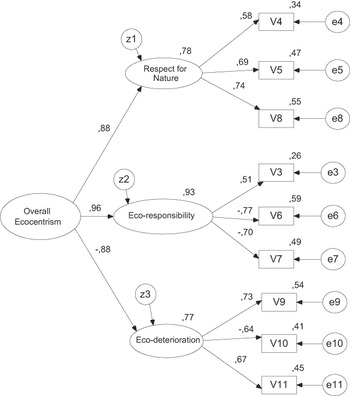
The confirmatory factor model revealed that all factor loadings were significant (p < .001) and should therefore be considered different from 0. Figure 1 presents the estimated model and includes standardized factor loadings. All loadings on first-order factors were high (> .5), their signs reflecting the direction of the question. The first order factors’ loadings on the overarching, second-order factor were very high, in all cases over 0.8 (in absolute value). The model’s fit to the data was good according to all indicators but RMSEA, whose value was close to the cut-off point: χ2 /df = 2.93; GFI = 0.95; AGFI = 0.91; CFI = 0.94; RMSEA = 0.083. In light of these results, the child population’s system of ecological beliefs can be defined as an overarching dimension called overall ecocentrism that encompasses three first-order dimensions. After analyzing the content of items in each of the first-order factors, they were defined as (1) respect for nature, (2) eco-responsibility, and (3) eco-deterioration.
One-dimensional Confirmatory Factor Analysis Model of the NEP_Ñ Scale.

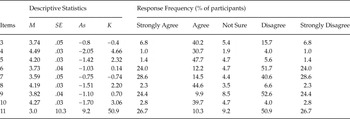
The distribution of response frequencies on each item in the scale appears in Table 2. Participants in this study were found to hold mostly ecocentric beliefs, scoring within the upper half of the instrument (M = 3.82, SD = 0.57). The children were found to be pro-ecological on all the scale’s items, whose minimum value is 1 and maximum is 5 (see Table 2).
Descriptive Statistics and Distribution of Response Frequency on the NEP Scale for Spanish Children. N = 574

Note:
SE = standard error of measurement; As = asymmetry and K = kurtosis.
Subsequently, the correlation between children’s NEP scores and the indicator of pro-ecological behavior was computed. The correlation was found to be r = .14, p < .01.
The relationship between NEP scores and certain socio-demographic and contextual variables was also analyzed. The results reveal a correlation between NEP scores and age of r = .22, p < .001, indicating that children become more pro-ecological with age.
Next, a 2x2 ANOVA was applied to ascertain whether or not participants’ gender and place of residence had an impact. The results indicate that participants’ NEP scores do not differ according to their gender, nor was there an interaction effect of gender and residence. Conversely, place of residence was found to have a significant effect, F(1, 570) = 4.85, p = .03, n2 p = .08. Children from rural areas scored higher on the NEP scale (M = 4.07, SD = 0.76) than children from urban areas (M = 3.93, SD = 3.93).
Discussion and conclusions
The present study conveys an adaptation of the NEP Scale for Children for a Spanish child population and evaluates Spanish children’s ecological points of view according to socio-demographic variables. This is the first time this scale has been administered to a sample of Spanish children.
As stated above, these participants exhibit ecocentric beliefs. Children in this sample follow a trend reported in earlier studies where a pattern of predominantly pro-ecological beliefs is observed. For example, in a study by Manoli et al. (Reference Manoli, Johnson and Dunlap2007), children obtained an average score of 3.58 on the NEP (SD = 0.47) even before participating in an environmental education program, and an average score of 3.74 (SD =0 .74) afterward. Considering the distribution of responses across the different categories, there is a trend toward response accumulation on the main, agree-disagree categories, about 40–50% of responses in most cases. It is important to mention that on items 3, 4, 5, 8, and 10, a high percent of responses was concentrated on the scale’s lower half, which might suggest a floor effect. However, the highest percent of responses did not fall in the lowest response category. They were distributed, though less so, across other response categories, indicating the items possess discriminant power.
The results obtained indicate the system of ecological beliefs of a population of Spanish children can be captured by the NEP_Ñ scale, confirming hypothesis 1. The proposed scale is made up of 9 items. These results coincide with those of previous studies in adults (Dunlap et al., Reference Dunlap, van Liere, Mertig and Jones2000) and children (Manoli et al., Reference Manoli, Johnson and Dunlap2007) alike in suggesting that the Spanish child population has a structured, coherent view of the relationship between mankind and the natural world, and moreover, one that is more ecocentric than anthropocentric. The portion of total variance explained by the scale was 39.57%, which, though not high, is similar to what previous studies have reported (Manoli et al., Reference Manoli, Johnson and Dunlap2007; Van Petegem & Blieck, 2006) in children and adults (Dunlap et al., Reference Dunlap, van Liere, Mertig and Jones2000). For example, Dunlap et al. (Reference Dunlap, van Liere, Mertig and Jones2000) reported that the one-dimensional NEP explained 31.3% of total variance. The scale’s internal consistency was also adequate.
On another note, the second-order confirmatory factor model showed reasonably good fit to the data. Keep in mind that this model’s main purpose was to confirm that there is a single, underlying dimension that all the first-order dimensions have in common. Hence, the confirmatory factor model supports the idea that a single dimension that all the participants’ answers share can be broken down into three first-order dimensions with greater descriptive ability.
As already stated at the start of this paper, it is difficult to predict pro-environmental behavior using scales that measure environmental attitudes. That being said, this study has confirmed that there is a positive link between energy-saving behavior at home and NEP scores, indicating that more ecocentric children tend to conserve energy more often. That correlation is low but significant and similar to what Vozmediano and San Juan (2005) reported in an adult sample. Future researches should more extensively study the descriptive and predictive power of the NEP_Ñ scale. They could use a test to gather information about different aspects of people’s environmental behavior (recycling, energy conservation, etc.) and assess the NEP_Ñ’s ability to predict scores on it, in conjunction with other variables that have been found to affect pro-environmental behavior in children, such as connection to nature (Cheng & Monroe, Reference Cheng and Monroe2012).
Also take into consideration that views of the human being-nature relationship may change over the course of a person’s life (Kahn, Reference Kahn1999). Manoli et al. (Reference Manoli, Johnson and Dunlap2007) and Evans et al. (Reference Evans, Brauchle, Haq, Stecker, Wong and Shapiro2007) were not evaluating the effect of age on children’s ecological beliefs, but their samples had very narrow age ranges (6 to 8, and 10 to 12, respectively). In that sense, another of this study’s contributions is that the scale was administered to children 8 to 13 years-old, which is a wide enough range to study the influence of age on children’s ecological beliefs. The current data show that older children tend to have a more ecocentric worldview than their younger counterparts. This finding upholds our third hypothesis and reinforces what Evans et al. (Reference Evans, Brauchle, Haq, Stecker, Wong and Shapiro2007) reported, that between 6-8 years-old and 11 years-old, children gradually shift from a more anthropocentric worldview to considering human beings’ impact on the environment. Even so, future research studies ought to further analyze this trend, because the correlation analysis conducted here does not establish causation.
Contact with nature, detected in this study by place of residence, influenced ecological beliefs in this population of children. This supports hypothesis 2 of the present study. Thus, children from rural areas are more pro-ecological than those from urban areas. These results should be interpreted with caution because the effect size was relatively small. That is likely due to the fact that in general, regardless of place of residence, participants report being pro-ecological, and the differences between groups of children were subtle. This study’s results reiterate the findings of studies conducted in adults (Hinds & Sparks, Reference Hinds and Sparks2008), adolescents (Müller et al., Reference Müller, Kals and Pansa2009), and children (Collado & Corraliza, Reference Collado and Corraliza2011) of people’s attitudes toward the natural environment. However, this is the first study to evaluate the influence of residence on children’ ecological worldviews. The growth of urbanization has produced, among other things, distance between people and nature settings. The trend is for populations of children to become increasingly distanced from direct contact with nature, especially in the cities, the main reasons being traffic, lack of time, safety, and greater use of technology (Clements, Reference Clements2004). These problems, which are prevalent in urban centers, are non-issues in rural areas where people have more contact with the natural world and more pro-environmental attitudes. Our findings have implications for the design of educational programs whose aim is to foment environmental attitudes. In view of these results, it would be preferable for such programs to take place outdoors, where children gain direct contact with nature. Meanwhile, contact with nature in cities can be facilitated by including natural elements in places frequented by children, like schoolyards, streets, and neighborhoods.
In summary, given the natural world’s mounting deterioration and the pressing need to find solutions, access to instruments that help us understand human beings’ perceptions of their relationship with nature is essential. This study presents a scale to measure ecological beliefs in Spanish-speaking populations of children 8-years-old and above. In addition, we have increased our understanding of how children develop an ecological perspective, highlighting the impact of contact with nature and age on pro-environmentalism in child populations. It is important to have an instrument of this kind because it allows one to study children’s worldviews and compare them with those of adults, and because it can be used in longitudinal studies. Children’s environmental attitudes very likely shape the way adolescents and adults think (Leeming et al., Reference Leeming, Dwyer, Porter and Bracker1995), so we recommend assessing environmental beliefs and behaviors at these early ages. The NEP_Ñ was very recently created, so as its authors note, it needs to be studied further in different cultures and with children of different socio-demographic backgrounds so that its results can be generalized.
Appendix: 1a.
NEP_Ñ Scale for Spanish Children (Spanish)
Por favor, rodea con un círculo si estás de acuerdo o no con las siguientes afirmaciones, y en qué grado.
Señala sólo una de las casillas (del 1 al 5) por cada una de las frases.

Appendix: 1b.
NEP_Ñ Scale for Spanish Children (English)
Please circle whether you agree or disagree with the following statements, and how much. Circle only one choice (from 1 to 5) for each statement.