In the heyday of political upheaval in the revolutionary Vienna of March 1848, journalists and dramatists alike turned to the theatre. They demanded that theatre have its finger on the pulse of their revolutionary times, that it mobilize its capacity to respond to political and societal change. In their view, theatre ought ideally to achieve the status of a political institution. For instance, on 28 March 1848 the influential Allgemeine Theaterzeitung wrote, ‘Theatre is the constitutional house of poetry, in which the poet speaks to the assembly of the people with the eloquence of the dramatic arts’.Footnote 2 Yet how could such a politically engaged theatre find its legitimate place in nineteenth-century German society? I will argue that this demand in 1848 that theatre be used as a political medium not only arose as a response to political upheaval, but also rather is connected to the emergence of a public sphere dating back to the late eighteenth century. Furthermore, this new public sphere was itself predicated on a process of media integration. During the critical phase of the public sphere in the early nineteenth century, a time marked by political repression, the power of the media shifted slightly, allowing different ‘players’ to compete for a voice in the public sphere. This was due not only to revolutionary change but also to long-term transformations related to the evolution of the media and to social reform. I am not, therefore, treating a theatrical case from one of the European revolutions of 1789, 1830 or 1848, but rather I am trying to highlight negotiations of the public sphere between those key moments.
The performance of von Maltitz's The Old Student (Der alte Student) on 4 January 1828 at the Königstädtische Theater in Berlin allows me to explore how theatre functioned as a potential player in an incipient public sphere and evidences how the desire to represent political topics onstage and to become a performative player in the public sphere was already under way in the 1820s, well before the revolutionary turbulence of 1848. Briefly, during the performance of von Maltitz's drama, it became clear that the playwright, who was also responsible for the mise en scène, had reinserted text previously deleted by the theatre censor. This mainly concerned pro-Polish comments referring to the unhappy fate of the Polish nation.Footnote 3 The dramatist and his actors ran considerable risks in ‘make things public’, risks evidenced by the hostile reactions of the Prussian authorities and von Maltitz's ultimate banishment from Berlin.
The powerful reaction of the Prussian authorities to the theatre's political participation in the public sphere was a symptom of the monarch's and his executives’ fear of losing control over what may and what may not be uttered publicly, over who had the power to speak. The authorities were fully aware of the political potential of public action: the public demonstrations during the French Revolution had proven that the vox populi indeed has the strength and the ability to promote and initiate political change. This begins to account for why von Maltitz and the Königstädtisches Theater met with such a severe act of silencing and, in von Maltitz's case, banishment. Later I explore these matters in more detail, but first I need to frame up some introductory remarks about the public sphere in relation to historical theatre research.
Discourses of the ‘public sphere’
It was not until 1989 that Jürgen Habermas's influential study The Structural Transformation of the Public Sphere (Strukturwandel der Öffentlichkeit, 1962) appeared in an English translation.Footnote 4 Although much delayed, its publication initiated a wave of new studies on political public spheres based on postmodern and post-structuralist political philosophy. In the work of Habermas and his critics,Footnote 5 however, theatre practice occupies only a marginal role and arguably, therefore, theatre studies need to reflect on this omission to better integrate the paradigm of the public sphere into historical theatre research.Footnote 6
Thus far, the potential this affords has been limited to research on theatre history of the French Revolution, examining links between bourgeois and popular theatre and the political agency of the people.Footnote 7 Here my argument is that an intermedial and historiographic perspective on theatre that takes account of the concept of the public sphere is potentially beneficial to periods of theatre history, such as the early nineteenth century, that to date have not been primarily or adequately assessed. For instance, the spectacular characteristics of early nineteenth-century melodrama have been widely studied in the sphere of cultural studies, but the political dimension of theatre in that period has not been fully researched, owing to the fact that, hitherto, censorship and repression were seen to have so dominated the political sphere that little explicit political action arising out of theatre seemed possible. In contrast to this view, I shall aim to show that there is in fact a considerable body of historical evidence for theatrical action in the public sphere in early nineteenth-century German theatre.Footnote 8
As historians now agree, the transformations of the public sphere are linked to modern political developments unfolding in the aftermath of the French Revolution. Both political culture and social life were profoundly affected by these events. The question that needs to be addressed, however, is how these transformations offered new horizons for the idea of a political theatre performing in the public sphere.
Around the year 1800 a certain historical awareness based on the paradigm of ‘progress’ and ‘modernity’ emerged in Europe, which provided the basis for subsequent political and social developments.Footnote 9 At the same time, due to innovative developments in the realm of the printing press and journalism (rotary press, telegraph, railway), flows of media communication accelerated and the rapid dissemination of information was in need of some kind of mapping or orientation. Fulfilling that need was the intellectual whose expertise was called upon in the interests of disseminating specialist information to the public at large. Fohrmann traces parallels between developments in media technology and the evolution of the public sphere: ‘The public sphere is generated by a process of circulation. And circulation is generated by the new and rapid forms of media’.Footnote 10 But to what extent can theatre be a rapid medium, a medium of circulation?
The philosophy of Georg Wilhelm Friedrich Hegel is essential for understanding intellectual history of the early nineteenth century as a framework for the emergence of modern theatre. By trying to transform the concept of freedom as postulated during the French Revolution into a stable governmental structure, Hegel captured the philosophical spirit of his time. Further, he observed the discrepancy between modern political thinking and the political reality in Germany and, in his concept of the ‘rationality of reality’, sought to argue a merging of the two by referring to the ‘zeitgeist’. In Hegel's thinking, to deny the zeitgeist was to adhere to a backward and irrational view of reality, thereby denying rationality altogether.
Horst Denkler explains how Hegel's maxim on ‘reality’ and ‘reason’ helped theatre directors and men of letters develop a telling argument for a political theatre and for what in German is known as Tendenzdrama, plays with an explicit and usually political slant:
With Hegel's maxim they interpreted the freedom gained throughout history as an achievement accomplished by the use of reason . . . On the other hand a state that denies any realization of freedom in a conservative and reactionary way is acting against reasonable achievements of history and therefore should be overwhelmed by new forces, because the reasonable has to win over reality . . . With this argument Hegel gave his students and followers an effective instrument for overthrowing the reality of their time.Footnote 11
In the framework of Hegel's influential political concept and state philosophy, and conceived as a public medium, theatre could play a key role in the shaping of political culture.Footnote 12 At the same time, theatre was a part of the public discourse based on liberal circulation and participated in the important remodelling processes the media were undergoing in Hegel's Berlin, positioning itself as a public medium with the capacity to have an impact on its audiences and, therefore, on the general public. It is important to remember that around 1800 the auditorium of a theatre in Prussia was the biggest meeting place after those serving military or religious purposes; this made it the ideal space for political education.
Given Prussian ‘reality’ at that time and the authorities’ sense of theatre's capacity to sway and monopolize public opinion, it is not surprising that the Prussian state reacted to the political tendencies of von Maltitz's play. But to express this in Hegelian terms, Prussia obviously acted in an irrational manner; it did not give way to the urgent and rational demands leading to a harmonious synthesis of rationality and a reformed reality in the interests of generating a ‘rational’ and ‘real’ Prussian state.
Making things public – theatre and the public sphere
Theatre practice and theoretical discourse on theatre between 1800 and 1850 bear visible traces of a struggle over the concept of theatre as a political medium. The media functions of theatre appear connected to the emergence of modern ideas of the public sphere during a time I would like to call an ‘experimental phase’ of the public. New medial configurations were being established, such as the development of mass press and the institutionalization of theatre, but these medial institutions and structures had not yet been consolidated; they remained vulnerable to political change and intellectual challenge. Historical research reveals persistent renegotiations between theatre, press and state authorities on questions of what can be pronounced publicly and what should have an impact on the public. Consequently, I do not subscribe to the definition of a singular model of the public sphere concerning theatre, but rather I would like to specify situations and configurations of the public sphere according to the case study in question. At this point it becomes clear that I will follow a somewhat ‘post-Habermasian’ path, one that looks to overcome hegemonic binaries and misleading simplifications,Footnote 13 by thinking the public sphere as a multilayered arena of concurrent public and media voices.
Analysis of the von Maltitz case police files of 1828 serves to demonstrate how an idea of the public was conceptualized, as well as the politics at stake in the public sphere. Arguably what this reveals is the struggle between an author seeking to speak freely in public, a theatre performing publicly as a political medium, and Prussian state authorities defending what they considered to be their monopoly of the public sphere. Prussia, like any absolutist power, had a keen interest in maintaining its system of secret politics, of concealing power and action.
Critical writing on early nineteenth-century German drama and theatre evidences a link between literary and theatrical public spheres. Moreover, it exhibits a relation between the emergence of private theatre entrepreneurship at the level of large urban playhouses and the general growth of bourgeois capital power.Footnote 14 Being a relatively unknown form of private administration, the new large-sized playhouses in the urban spaces of continental Europe challenged local and state authorities when it came to censorship and control. Warmly welcomed by the bourgeois population, these privately funded but publicly acting institutions were suspected of engaging in the proliferation of liberal thought. The state thus needed to redefine effective ways of controlling their discourse and their potential for making opinion.
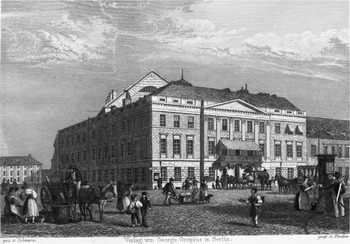
Since 1816, King Friedrich Wilhelm III and his court advisers had been discussing at length the foundation of a second large and privately owned playhouse in the royal residence. The urban metropoles of Paris and Vienna provided a model for Berlin: the king was striving to improve the cultural status of his residential city and wanted to copy their theatrical landscapes. In Paris and Vienna the court theatres were rivalled by large private playhouses, the latter adding comedies, vaudeville and comic opera to the literary repertoires of the former. Understandably, the king did not want Berlin to be left behind, and his idea of a secundair Theater rapidly became a matter of heated debate in the urban public sphere. Finally, the king provided a certain Friedrich Cerf with a theatre concession that required him, at his own cost, to build a large playhouse at the Alexanderplatz.Footnote 15 Lacking sufficient funds, Cerf transferred his concession to a shareholder association that undertook the construction and administration of the theatre. The king, while demanding complete independence from the court as a basis for this new theatre, supported the idea of a private theatre enterprise. However, he remained uncertain about how to control this new public medium. Soon after the opening of the Königstädtisches Theater (see Fig. 1), some court officials secretly tried to acquire a majority of theatre shares for the king, but this was prevented in 1825 by the minister of the royal house, von Wittgenstein, Friedrich Wilhelm III's closest adviser.Footnote 16 With the Theatre Shareholder Association going bankrupt in 1829, the theatre finally came under the court's control, with Cerf taking back the theatre concession and holding the first right of purchase as the court's stooge. This backdoor arrangement was kept secret,Footnote 17 and the public, notwithstanding some rumours circulating in the city, remained largely misinformed: officially the Königstädtisches Theater was understood to be a private bourgeois theatre run and ‘owned’ by Friedrich Cerf.
The Königstädtisches Theater in Berlin – a playground for bourgeois theatre with hidden links to the court. Engraving by Finden after Schwarz, c.1830. Courtesy of Deutsches Theatermuseum.

Controlling the discourse
When it comes to controlling the discourse of the Königstädtisches Theater we see an equally ambivalent approach on the part of the Prussian court. All the smaller private theatres that existed in Berlin before the opening of the Königstädtisches Theater in 1824 were controlled and censored by the residential Police Department.Footnote 18 The new theatre, however, got permission to have its own in-house censor, thus placing it on equal footing with the Royal Court Theatre. After a lengthy discussion between the Police Department and the secretary of interior affairs concerning the effectiveness and legitimation of such a proceeding, privy councillor Kunowski, in-house lawyer of the Theatre Shareholder Association (Theater-Actien Verein) and a member of the administrative board of the theatre, was appointed censor of the Königstädtisches Theater. This circumvented what would otherwise have been a time-consuming and costly process dealing with an inefficient censorship system involving the Police Department. Moreover, it also allowed the theatre a certain degree of freedom to act in the public sphere.
A full analysis of the von Maltitz case has to take account of the historical situation of the media operating in concurrent public spheres. What function did the theatrical model and the specific theatre institution fulfil in the public discourse? Which public spheres relied on theatrical performances? Which players took part in a public-event theatre? What kind of audiences participated and acted in this public forum? Which actors/agents dominated the public discourse on theatre and in the theatre? What kind of intermedial connections existed in the public sphere? And in what respect did they limit or enlarge the public representation of theatre and theatrical performances? Such questions frame my investigation of the von Maltitz case and help provide a fuller picture of the specific historical situation of the public sphere at that time. In sum, my interest lies not in seeking to define the public sphere at a particular time, but rather in tracing performances of the public sphere, elucidating the concrete practice of the public sphere in relation to theatre.
(Dis-)Claiming the monopoly over the public voice – theatre and the Prussian authorities
On 16 March 1820, Prussia issued a decree stating that henceforth all plays had to undergo censorship before being performed.Footnote 19 State censorship granted permission to print a text: the Imprimatur. However, it was the theatre censor, appointed by the local police and acting independently of the state censor, who granted permission to stage a play: the Admittitur. Granting the Admittitur could involve imposing some textual modifications.
In respect to The Old Student, von Maltitz had attained the Imprimatur from the high state censor and consequently Kunowski concluded from this permission that the play was politically harmless. He therefore issued the Admittitur, imposing only minor deletions. During the three rehearsals before the first public performance von Maltitz tried to reinsert these deletions. He introduced additional text, especially certain phrases celebrating the political figure of Napoleon I, and lines that were critical of Russian and Prussian politics with regard to the weakening of the Polish nation at the Congress of Vienna in 1815. For example, in the original text, von Maltitz's principal character, the Polish ex-student Zolky, begins to deliver a monologue in Polish only to stop after a few words, thereafter continuing in German with the line, ‘Speak German, Poland does not exist anymore for you!’Footnote 20 This wording was deleted by Kunowski because of its political overtones, although it could have been justified by the character's Polish origin (‘. . . for you!’). But von Maltitz reinstated the line with a heightened political resonance by omitting the preposition and pronoun: ‘Speak German, Poland does not exist anymore!’
What was deemed most scandalous about the performance of The Old Student was its potential to influence public opinion. In addition to theatre's capacity as a live medium to circumvent censorial control, here was Gotthilf August von Maltitz, a playwright and a journalist, determined on exploiting theatre as a public forum for his political views. Additionally, the play addressed the students of Berlin University,Footnote 21 a most politically engaged sector of society, who increasingly sought the freedom to speak out publicly for their rights.
Arriving at the theatre, Kunowski was alerted to what was taking place and was just in time to witness this at first hand as he caught the last scene of the play:
In the corridor of the theatre I met some friends who told me that the performance articulated a political tendency by pointing to some aspects of Russian history and fate that would probably displease the authorities. I responded that I could not understand their worries as I had taken care to delete all objectionable parts of the play; I could only explain these problems by an exaggerated and emphasized performance of all parts related to the biography of Zolky. I rushed to my theatre box to hear the end of the play . . . The last scene of the play . . . convinced me that there had been textual speculations and additions. The audience applauded with excitement after Biderstein's words ‘vivat Academia’ . . . because the spectators thought this was the end of the play. But after a pause, Zolky solemnly approached the audience, with his hands up high like a preacher, exclaiming passionately: ‘et Polonia!’Footnote 22
Immediately after the performance, Kunowski sensed the danger this posed both to himself and to the Königstädtisches Theater. He was in a difficult position: his administrative role for the theatre was in conflict with his duty as the theatre's censor. His solution was to demonstrate his loyalty to the Police Department by offering his full collaboration and, at the same time, he exonerated the theatre by shifting the blame onto the playwright. Kunowski's report reveals that it was first and foremost the performance, not the dramatic text, that created the scandal. Out in the corridor, excited spectators debated the play, and Kunowski himself experienced the impression made by the ending: the tumultuous applause and the ‘inappropriate impression on the audience’ that led him to take immediate action in the name of control and state authority. In his report to the Police Department Kunowski tried to exculpate his failing as a censor by emphasizing the radical potential of theatre in general:
A fair judge will understand that there is a big difference between the impression of reading a text and hearing a passionate performance of it, and many reinserted parts would not have been noticeable even during the representation of the play, if they hadn't been performed with a most passionate expression.Footnote 23
The police accused von Maltitz of politicizing the performance of the actors. Allegedly, he had rehearsed the actors on a one-to-one basis and prompted his main actor, Ludwig Meyer, to emotionally underscore the censored passages.
The risk of political agitation was considered to be even higher when a play staged an issue linked to recent events; hence the Prussian authorities needed to ban actual and current political matters from the stage. Von Maltitz was accused of using a love story as a vehicle for, or to conceal, his political ideas:
Von Maltitz chose to present in his play the Polish figure Zolky, thus treating a political issue concerning recent history and therefore completely inappropriate for staging. We cannot give permission to stage the recent history of Poland, to stage this country's misery depicted as a political injustice.Footnote 24
Von Maltitz was blamed here for ‘irresponsibility to the public’, because ‘each poet, especially the author of a drama he intends to stage in public, is obliged to act most carefully when he treats a subject that could create excitement’.Footnote 25 Theatre should never turn into a public tribunal, leading to a public discourse on political issues.
The political strategizing against von Maltitz – Kunowski's defence of the Königstädtisches Theater and the Police Department's investigation – conspired to undermine his personal integrity. In particular, von Maltitz's appearances in the public sphere were targeted: different witnesses reported that he had repeatedly made public speeches and was involved in political discourse in the public sphere. Theodor von Mundt, member of the theatre committee, remarked that he knew ‘from his own experience that Mr. von Maltitz is used to reciting the most interesting parts of his plays in cafes and that therefore any censor had a good reason to be very careful’.Footnote 26 A cafe was a space that offered a public forum for literary and political discourse. As von Maltitz took part in this kind of political culture, so he represented a political risk. Earlier, in 1824, he had already been accused of giving ‘reckless and highly inappropriate speeches and discourses on political matters and even on persons of high respect in public spaces’.Footnote 27 Hence the subsequent censorship scandal of The Old Student meant that in 1828 von Maltitz was unable to prevent his expulsion from Berlin.
Academic issues and student life were frequently a matter of public political debate: on the one hand, students were idealized as a model for free and self-determined citizenship, and on the other were demonized for their supposedly revolutionary radicalism. Von Maltitz used the image of the student to dramatize discourses of freedom and political activism. He said to his director, Louis Angely, that the success of his play would depend on the representation of the student, and insisted on casting leading actor Ludwig Meyer as his main character, Zolky.Footnote 28 In their final report, the police argued that the issue of the students was an artificial addition to the plot, and suspected von Maltitz of using it for political reasons:
The defendant has depicted Flachentropf and Zolky as students; at least he calls the latter ‘a student’ whereas both are ex-students in reality. He has done so on purpose, if not, this would be a strange idea because every other category of citizen would be more fitting for these two roles than that of an academic citizen.Footnote 29
Both statements prove that the inclusion of the student theme was indeed intended to politicize the play. Von Maltitz depicted student life as a democratic model of an equal and liberal society. His character Biderstein declares at the end of the play, ‘May the student's holy freedom always prevail – because it is only this freedom that can provide our state with real men’.Footnote 30
The deputy of police, Grano, was disgusted by the public expression of this opinion and reported,
Examined on the 28th of last month, von Maltitz confirms the opinion: freedom, not the rank of the student, provided the state with men. Very well then, freedom and equality staged on a theatre of the royal residence hosting a university within its walls; a residence whose citizens, even though they have a reputation for true respectability, could, however, potentially be encouraged to fight for freedom in their youth. And all this articulated by a live voice from the stage!Footnote 31
The main argument for von Maltitz's exile from the city of Berlin was the dangerous potential of a ‘live voice’ agitating publicly on stage, and thus possibly inciting students – always considered to be a danger to public order – to political action: ‘in a city with a university, such a playwright seems to be very dangerous when he possibly comes into close contact with academic citizens’.Footnote 32
At the same time, the police were anxious to avoid a legal case. In their final report they argued that von Maltitz wanted to arouse the people's ‘discontentment and dissatisfaction’ with the government and therefore ought to be tried for high treason according to §151, Part II, Title 20 (General State Law of Prussia). But, they went on, ‘it does not seem appropriate to give more public attention to this misdeed by a legal procedure’.Footnote 33 Even though court proceedings were not open to the public, a trial would be a public issue and the court's decision would have to appear in the official gazette, thereby potentially fuelling a public debate which was not at all what the Prussian authorities wanted to see happen.
In addition, the police feared that the court would not accept their examinations and would order new hearings from all their witnesses. Having shown little enthusiasm for accusing von Maltitz, it was likely that the performers would be even more recalcitrant in any repeat examinations. Indeed, as they had ‘openly demonstrated their intention to spare von Maltitz’ they might even have been able to ‘thwart the whole judicial proceedings’.Footnote 34
Consequently, the police demanded that von Maltitz be convicted according to the Censorship Law as administered by them. Indeed, von Maltitz had illegally added extra text to his play. Doing so, he had not violated the Imprimatur of state censorship, but he had exceeded the limits of the Admittitur, the permission to perform. This fact did not stop the police from applying the Censorship Law related to Imprimatur, in accordance with which von Maltitz should have received the maximum penalty: a fine of 100 taler and confiscation of his play. The problem was that under these regulations a penalty of more than 40 taler automatically allowed for an appeal to a legal court. Here again, to avoid judicial proceedings the police lowered the penalty: von Maltitz was ordered to pay exactly 40 taler and therefore had no ‘right of court hearing’.Footnote 35 Additionally, the police and the secretary of interior affairs obtained a royal order to ban him from the royal residence. Ultimately, the von Maltitz case never received a court hearing and the Prussian authorities were able to avoid a public debate on the case. The scandal of The Old Student did not enter the public sphere – for the time being at least.
Media agents and interventions
Analysis of the von Maltitz case attests to the power and danger of performance when it touches on political events and topical issues. Both sides (albeit in different ways and for different reasons) acknowledged the impact of theatre on the political agenda. Consequently, the Prussian authorities kept a keen eye on theatrical activities and tried to exercise full control of the theatre. Von Maltitz, on the other hand, wanted to transform theatre into an effective instrument in the political arena given its potential for reaching the masses. Interestingly, in the epoch of the von Maltitz case, theatre was judged to be more dangerous in political respects than the printed word, even though newspapers and broadsheets had a much larger distribution. This was due to the affective potential of the live performance: a live representation of political facts was perceived to be a far greater danger than the printed word. We have to remember that during the von Maltitz case the violation of censorship regarding the printed word was judged not to be as severe as the performative transgression. But Prussia would soon learn not to underestimate the power of the press: von Maltitz's banishment did not stop his published works from re-entering Prussia, and later, during the 1848 revolution in Berlin, printed pamphlets proved an effective means of political agitation.
The parties acting in the public sphere during the von Maltitz scandal can be grouped in three ways. First, we are dealing with the playwright and his peer group, the poets and intellectuals in Berlin. At the same time, von Maltitz was allied with the students of the University of Berlin, who were politically very active. Although the Prussian authorities were addressing von Maltitz as an individual, we can sense from the police files a general suspicion towards these two groups. Both literati and students desired to take an active role in the political public sphere and both had the potential to overthrow the old regime's ruling of the public sphere.
The second large group consists of the theatre actors. Surprisingly, their activity was not considered to be as dangerous as von Maltitz's action. Only the leading actor, Ludwig Meyer, was issued a stern warning because he adhered to von Maltitz's desire to politicize his stage role. The police appear to have assumed that the embodiment of political ideas by an actor had the status of a legal public appearance onstage, whereas the claims of a dramatic author and publicist in public were defined as political agitation and were, therefore, deemed suspect. Von Maltitz's role as a ‘free player’ in the public sphere made him a dangerous subject, whereas the public appearance of the actor was connected to the institutional framework of theatre. Meyer did not need to be banned from the city; a reprimand appeared to be sufficient.
Kunowski took up a position between the actors and the Prussian authorities. Earlier he had bravely defended the theatre's right of free action in the public sphere. His demand to censor the Königstädtisches Theater (28 September 1823) himself without interference from the authorities demonstrates a high level of self-confidence in light of the Prussian administrations involved. Kunowski stated that his Königstädtisches Theater – being a Volkstheater (a popular theatre) – had to be endowed with a certain degree of freedom by the Prussian authorities:
If such a stage is to prosper, this can only be achieved with a certain degree of liberty . . . The examples of Paris and Vienna prove the correctness of this view. Everywhere the Popular Theatres have more freedom to stage wittiness and satire than the large theatres and especially the court theatres. In addition, a kind of theatre like ours can only succeed and flourish if it takes advantage of quickly changing fashions and can act on the spur of the moment.Footnote 36
Kunowski emphasized here the theatre's position in comparison to the Royal Court Theatre and also gives us an idea of his efforts to stretch the ‘public playground’ for his theatre. But Kunowski was still ‘on probation’ as a censor, and ultimately he had little choice but to surrender to the Prussian authorities’ claim to control the public sphere.
The third group is represented by the Prussian authorities: the Police Department, the Ministry of Interior Affairs, and the royal court. The speech and actions of these officials demonstrate the Prussian claim to hold the monopoly on performing freely in the public sphere. Accordingly, the Prussian authorities had the right to determine what could or could not be uttered publicly. The control of public discourse had to remain in the hands of the court and its representatives. This was precisely what an ambitious renegade such as Gotthilf August von Maltitz was challenging. Gradually it became clear that the Prussian monopoly over the public sphere was being undermined from all sides.
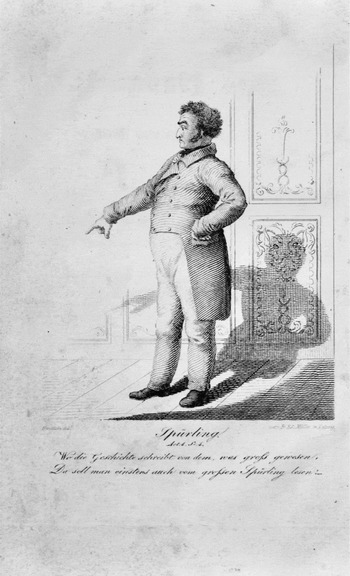
After his ban from Berlin, von Maltitz moved to Hamburg, where a more liberal atmosphere reigned. There he used what influence he had to rework his case through his literary and journalistic publications. Until his early death in 1837 his struggle with Prussia for a public voice and the contested right to control the public sphere remained the dominant topic of his work. His first concern in Hamburg was to see The Old Student in print and his play was duly published in July 1828. Here, too, von Maltitz used the publication as a public forum: in his foreword he recounted the facts of the police examinations and the political repression by Prussia, and demanded a hearing in the court of public opinion: ‘Would that the public consider and judge for themselves the crimes of the author's earning such a punishment. Public opinion should be the judge over his deeply hurt honor as a citizen of this state.’Footnote 37 A year later, von Maltitz wrote a second play for the Stadttheater in Hamburg: The Pasquill (1829). In this drama, von Maltitz pulled out all the stops and firmly articulated his public voice. He dramatized a society in which all the good and righteous people belong to the sphere of a transparent and accessible political culture, while licentious and greedy civil servants are involved in secret diplomacy and concealed power plays. Von Maltitz depicted the backwardness of this obscure system of politics through the figure of the secret police agent Spürling (‘Sleuthling’ – see Fig. 2).
‘Sleuthling’ (Spürling): ‘In the historical records of our time you surely will read of Spürling's deeds’. Engraving from Gotthilf A. von Maltitz, Das Pasquill (Hamburg: Hoffmann und Campe, 1829).

He caricatured Spürling's blind adherence to secret operations and his perverted idea of the public sphere ad absurdum. For instance, Spürling would like to win over the waiter Jakob to spy on his guests. Jakob refuses and threatens instead to publicize Spürling's dishonest demand. Spürling answers ironically that no one would believe Jakob because there was no witness present. On the spur of the moment, Jakob slaps Spürling in the face and exclaims that for this there was no witness. Outraged, Spürling addresses the audience:
The royal secret police got slapped, publicly slapped – this was a fully constituted, genuine, slap I received, received without witnesses! And I cannot prove it! – How? Cannot prove it! – Is there no man, no human being, not a mouse witnessing, witnessing, witnessing! (Suddenly staring wildly into the audience) Ah! – You have to testify, all of you must testify that I have received a slap.Footnote 38
From the relatively safe distance of Hamburg, von Maltitz was able to attack the Prussian authorities and they were not able to stop his publications from crossing the Prussian border.Footnote 39 Although forgotten today, The Pasquill, his masterpiece of public politics, became quite popular in German theatres of the time.
As this analysis of the von Maltitz case shows, all parties involved – the theatre, the playwright, the police and the state authorities – had a heightened awareness of and media competence in the public sphere of the early nineteenth century. Growing competition and concurrence of media marked this public sphere and the absolutist power of Prussia could no longer neutralize the theatre's claim to take part in public action. The state's powerful monopoly over the public voice was gradually undermined by public players of all kinds. Due to these demonopolizing tendencies theatre was able to join in the shaping of a modern public sphere, and thus provided a model for later ideas of the political function of theatre.
Approaching nineteenth-century German theatre in the way I have essayed here is a means of getting beyond the limitations of dramatic analysis in order to reveal how theatre was more deeply involved in the struggles for a political public sphere than previously thought. If the textual provocations of a play such as The Old Student appear rather modest by today's standards, we need to acknowledge these within the broader social, cultural and political picture, a canvas that reveals the gradual creation of a public space in which the theatre could become a modern medium relentlessly calling for the right to perform and engage in the social and political ‘here’ and ‘now’.