In our own time, the expression ‘body fascism’ is commonly used in the mainstream media and in popular cultural discourse, having become part of the modern English lexicon. It tends to denote an infatuation with the body beautiful at the expense of substance, a celebration of physical fitness, muscular self-control and slavishness to style to the detriment of intellect and spiritual self-awareness. Significantly, the expression most frequently appears on the fashion or lifestyle pages of leading newspapers or fashion magazines, and while largely satirical in its application and ultimately derogatory in its connotation, an aspirational undertone is also often discernable. To be a ‘body fascist’ is to be a man or a woman pre-occupied with outward appearance and aesthetic self-perfection, as ‘body’ becomes the far more meaningful element of the expression, and the evocation of the term ‘fascist’ is merely adjectival.Footnote 1 Thus in its current usage, the term ‘fascism’ tends to signify some form of fanaticism, accompanied by a lack of self-irony, with little more substantial political meaning attached. For example, a recent book by Brian Pronger on the technology of physical fitness is titled Body Fascism, and nowhere in the substantial introductory chapter is there any attempt to account for the use of ‘fascism’ as a master term as it has clearly breached its historically and politically identified moorings.Footnote 2 In the field of sociology, Marvin Prosono's development of the expression ‘fascism of the skin’ to describe the commodification of the body in consumptive capitalist society does a better job to justify the appropriation of the political term, even if its subject matter is Arnold Schwarzenegger, the Jerry Springer Show, and Abu Ghraib, concluding that ‘in a fairly perverse irony of history, that bodily aesthetic, which was heralded by the Fascists of the last century as signaling evidence of a superior race, was not a casualty amid the ruined landscape of the Second World War’.Footnote 3 Notwithstanding the current usage and the slippage of the term, an actual cult of body fascism existed in Britain in the 1930s, an embodied fascism to which adherents dedicated themselves body and soul. It is the intention here to return to the roots of the culture of body fascism, put some evidentiary meat on the by now distorted and deformed linguistic bones, and examine the politics of the British fascist body and the deployment of bodily metaphors in the language of the British Union of Fascists (BUF). The movement's gender constructions and body cult need to be seen in the context of their own time, and as significant, if politically marginal, responses to the gender disorder that accompanied political, economic and cultural crisis in the inter-war years.
This seemingly casual diagnosis of body fascism by cultural critics, scholars and journalists can be accounted for, of course, by the reconceptualisation and historicisation of the body in recent decades, a process that has followed closely on the heels of developments in women and gender history.Footnote 4 Scholarship of the body is vast, and constantly gaining weight, both in volume and in terms of its prominence as a theoretical and methodological framework. Indeed, analysis of the body has offered new insight into many subjects from the Enlightenment and the French Revolution to imperialism, the First World War and fascism.Footnote 5 According to Kathleen Canning there are two most prominent approaches to studying historical bodies, the first ‘as signifiers, metaphors or allegorical emblems’ and thereby offering new understandings of nation or social formation; the second, the body as ‘a site of intervention or inscriptive surface’, expanding ‘our grasp of the processes of social discipline or the reach of the interventionist welfare state, of medicalization, professionalization, rationalization of production and reproduction’.Footnote 6 For my purposes the body is being conceived in both ways, first as a site of intervention and a surface to be inscribed and sculpted. The meanings of the marking and self-marking of the body can be seen through an exploration of the BUF's distinctive sartorial codes, body politics, body language and body building. Second, these British fascist bodies are also signifiers, metaphors and allegorical emblems that can be located throughout British fascist self-representations, both discursive and visual. For the leaders and members of a marginal movement – a classical case study for ‘failed fascism’Footnote 7 – the allegorical resonances of the body, both male and female, shifted with the movement's fortunes, hopes and disappointments. Looking at the history of British fascism by gazing at the movement as a body and by embracing the meanings of its bodies is consistent with more recent developments in the study of political marginality in inter-war Britain, a field that has taken somewhat belated recognition of gender and cultural approaches as vital perspectives for contextualising and understanding the political failure of fascism in Britain.Footnote 8
While it is important to emphasise the positionality and the pariah status of the British fascist body vis-à-vis other political (mainstream parties who formed a legitimate part of the body politic) and politicised bodies (the Tory John Bull, the soldier hero, the English gentleman, or the matinée idol), it is also clear that the body fascism of the 1930s did not develop in a vacuum. Certainly Britain's marginal fascist movement was not alone in embracing physical culture and making a cult of physical fitness, nor was its take on the matter an isolated response to the generally recognised post-war predicament of male trauma, instability and alienation, a collective state of mind further exacerbated by especially working-class male demoralisation in the face of mass unemployment during the depression.Footnote 9 Nonetheless, as we will see, Britain's fascists did develop their own set of prescriptive ideals of masculinity to cope with the more general socio-political and psychological dislocation after the First World War, and the consequent restructuring of the gender order. It is widely understood that the aftermath of the mechanised slaughter of the First World War delivered a fatal blow to the ‘romantic language of heroic masculinity’, leading to ‘a reassertion of the domesticated and private categories of masculinity . . . the later Victorian “flight from domesticity” had become impaled on the barbed wire of the Somme, and even another call to arms – in 1939 – could not restore the “high homosociability” of an earlier, undomesticated, and more elemental age’.Footnote 10 Michael Roper has also helpfully traced the development of the historiography of the post-Great War construction of masculinity in Britain. Breaking ground in the mid-1980s, historians of masculinity stressed the shattering of male identity caused by the war experience, with shell-shock as a real psycho-medical condition as well as a metaphor for the disfigurement and necessary reconstruction of a universal masculinity. Later work acknowledged more continuity with the ‘Edwardian gender scripts into midcentury’, while others have shown how ‘the disillusionment stressed by the war poets did not lead to a rejection of manliness, but to its reconfiguration around themes of pain and sacrifice’. Roper himself shows that after the First World War and right through the Second World War ‘there emerged among the British middle class a means of reflexively assessing the codes of “manliness”’.Footnote 11 Indeed, an examination of Britain's Blackshirts provides substantiation for the case for greater continuity in ideals of manliness, exemplified by the movement's institutionalisation of physical fitness and the paramilitary organisation of the gang, as well as the rising anxiety, both ideologically and subjectively expressed, about the lack of opportunities to perform these gender roles under the circumstances of political and economic crisis. It is plain that ‘British servicemen who fought in the First World War used their experience to define themselves as men, both in relation to other men and to women’.Footnote 12 The tone in this regard of the Blackshirt was one of bereavement for those lost but observance nonetheless of pre-war ideals of masculinity. As one fascist adherent wrote:
. . . there are untold numbers of desperate men in England who have lost all hope and are ripe for revolution. They are mostly decent men of sterling British stock who have been brutally treated by those to whom money is everything and human life less than nothing . . . The ex-service men in this country, and their sons and daughters, should be behind you to a man.Footnote 13
The Blackshirts thus stand out as the forward guard of an unreconstructed masculinity, evoking the prescriptive codes of manly comportment and behaviour associated with a more confident imperial age in Britain's pre-war past.Footnote 14
In her rich study of the physical culture movement in Britain in the same period, Ina Zweiniger-Bargielowska has argued, rather dismissively, that ‘the attempt to build a “superman” was not confined to fascist dictatorships or Britain's small fascist parties’.Footnote 15 However, the BUF provides a potentially interesting case study, precisely because it was, first and foremost, a political movement and thus unique in ascribing so much philosophical meaning and revolutionary zeal to the body and to the bodies of its Blackshirts. Catering to the opposite sex, the very popular Women's League of Health and Beauty – more popular and with a much higher membership, at 170,000, than any political organisation for women – also participated in the creation of a body cult for women. However, its interest was not overtly political, even if we can identify close analogies between its activities and aesthetic displays and those of like but significantly not voluntary organisations in fascist Italy, such as the fasci femminili, or in Nazi Germany, the Bund Deutscher Mädel (League of German Girls).Footnote 16 Mary Bagot Stack founded first the Build-the-Body-Beautiful League in 1930, quickly to be renamed the Women's League of Health and Beauty, with the stated aim of ‘racial health’, which in 1936 was modified to ‘racial health leading to peace’. Stack's League was thus linked to pacifism, and the body beautiful was to be at the service of the peace movement. She wrote: ‘Health represents Peace and harmonious balance in the innermost tissues of mind and body. Beauty seems to me to represent this idea carried out by every individual, by humanity universally.’Footnote 17 Therefore, notwithstanding similarities in the activities and the penchant for displays of mass physical fitness, there was a significant difference between the physical culture movement and the BUF, and that difference was that the fascist body culture was the embodiment of its political culture.
More recently, Petra Rau has shown how the appreciation of body fascism – here used very specifically to mean the fascist and even more the Nazi construction and display of the body – was far more widespread and mainstream in British culture than it might be comfortable to acknowledge. Rau demonstrates the range and frequency of accounts written by British writers from across the political spectrum as they encountered expressions of the Nazi body cult while travelling abroad. An example of the vigorous marketing of Germany as a destination is the summer of 1936 Thomas Cook brochure showing a healthy and glowing young woman mountaineering, with the caption ‘Heil! Summer!’. She suggests that ‘in travel writing, the fascist body beautiful becomes the focus of a nostalgic desire for the British imperial past. In fiction, it also highlights a growing ambivalence about British imperialism by dramatizing English subjection in sadomasochistic scenarios in which the Anglo-Saxon body can enjoy relief from the white man's burden vis-à-vis German domination.’Footnote 18 Certainly it is intriguing and going against the accepted grain to recognise temperamental affinities and sympathies for Nazism among Britain's intelligentsia; nonetheless it is equally important to recognise that in the end their admiration and even envy of body fascism did not motivate political affiliation. In contrast, in the case of the BUF we can see how the fascist body cult encapsulated a fascist Britain.
As we see, then, both the historiography of sport and of that of masculinity have greatly expanded in recent years, and intersected with the turn to culture in fascist studies. Since the 1990s the scholarship has burgeoned, many studies taking a very helpful comparative perspective and not confining themselves to the unavoidable case studies of fascist Italy and Nazi German alone.Footnote 19 J. A. Mangan has noted that ‘sport was at the centre of the induction of the male body (and mind) into martial self-sacrifice. Sport was an important part of Fascist socialization.’ To be precise, ‘sport develops muscle and muscle is equated with power – literally and metaphorically’.Footnote 20 In relation to the British case, both Tony Collins and Michael Spurr have considered the importance of sport and constructions of sportsmanship in the organisation, the discourse and the symbolism of the BUF, while elsewhere I too have considered the construction of masculinity, patterns of male hegemony, and the imagery of masculinity supremacy that were inscribed in the movement's visual culture and rhetoric.Footnote 21 But there is still more to be said about the way the body was constructed, used and abused both in the physical experience of adherents, and in the British fascist imaginary.
Founded in October 1932 by Sir Oswald Mosley out of the ruins of the New Party (NP), the BUF (renamed the British Union of Fascists and National Socialists in 1936, thereafter the BU, and banned in 1940 under Defence Regulation 18B 1(a)) aspired to rise, phoenix-like, from the ashes of political and economic crisis, supported by a phalanx of svelte and well-tailored Blackshirts, the original intention being that these would be mostly of the male variety. This gender apartheid and the undeniable male-supremacist ethos that characterised the NP's youth wing earlier could not withstand the enthusiasm of women for the BUF, however, and it did not take long for the movement's leadership to recognise the value of women's zeal and organising abilities, with women Blackshirts becoming nearly as a familiar a sight as their male counterparts on the street-corners as newspaper sellers and as sizable contingents in fascist parades, marches and displays.Footnote 22 Of course, ‘masculinity's meanings can be understood only if we analyse them in relation to femininity, other masculinities, and the ambiguous category of effeminacy’.Footnote 23 Blackshirt bodies, male and female, joined together in acts of devotion and ritualised confrontation with political enemies, while lip-service at least was paid to the indictment against male aggression against women, the clear message being that violence must be a single-sex affair. For instance, during disorder at a meeting in Manchester there was a struggle to remove a protestor: ‘. . .during the struggle to remove him there were cries to Sir Oswald of “Stop it”, and women began to scream hysterically. Above the din Sir Oswald shouted: “Women will handle women, men handle men.”’Footnote 24
The movement met with some enthusiasm and a swell of support soon after its formation, with press baron Lord Rothermere launching a campaign in their favour in his Daily Mail and Sunday Dispatch with his now famous article, ‘Hurray for the Blackshirts’. While no definitive or absolutely reliable figures are available, it has been estimated that the BUF reached its peak with 50,000 members in 1934, steadily declining after the Olympia rally of June 1934 and Rothermere's withdrawal of support together with that of his newspapers, with slight increases in membership in response to its anti-war campaign later in the 1930s. However, one would struggle to trace this decline in the movement's self-image and publicity, the assertion of its rhetoric rising as it strength waned. Indeed, however, underlying the BUF's political project was a cultural project, and a vision for reforming and regenerating the British national and racial community. The BUF did not confine its dialogue to critiques of the political system and the stagnancy in party politics but also intruded into more general inter-war discourses on the decline of the nation's health, the drawn-out psychological impact of the Great War, the social impact of poverty and (male) mass unemployment, the failure of providing homes fit for heroes, the confusion caused by the first ‘sexual revolution’, and the instability in family life which accompanied the radical reordering of gender relations in the aftermath of female political emancipation. Other recurrent and related themes in the BUF's propaganda included food production, diet and nutrition, athleticism and sportsmanship, diagnoses of sexual indecency and its remedies, and youth worship, each theme transcending mere rhetoric, and institutionalised in BUF organisation and activities. Mosley wrote how: ‘It is time that we substitute a system of manhood for the interference of the universal grandmother.’ He was as concerned to regulate time spent in service of the state as that spent on conditioning the body, prescribing that: ‘In hours of leisure we shall rely for the maintenance of the health and morality of the nation not on legislation but on the spiritual rebirth of a national renaissance.’Footnote 25 These activities ranged from annual Blackshirt summer camps at Selsey (there were male, female and family sessions),Footnote 26 to fascist sports leagues, including a cycling club,Footnote 27 to exchange excursions between British and Italian fascist and German Nazi youth organisations.Footnote 28 At the fascist holiday camps members were seduced by the promise that ‘at the end of their holiday they will leave the camp not only tuned up to the highest pitch of physical health and fitness, but inspired to devote their whole energies to the cause during the year to come’. The summer of 1933 provided an excellent opportunity to merge political conviction with healthful recreation, and ‘the weather being glorious, the holiday makers spent their time out of doors, in bathing, doing physical exercises, and generally getting themselves fit’.Footnote 29 The volume Blackshirts-on-Sea: A Pictorial History of the Mosley Summer Camps 1933—1938 (2001), by Jeremy A. Booker, is a rich collection of otherwise private snapshots and some more official photo records taken by fascists of Blackshirted bodies in sporting action, striking poses as they swim in the sea, run, play team sports, and participate in exercise classes and displays, exemplifying the importance of body building and physical maintenance both as the basis of the movement's exclusive sociability – only those with fit and trim bodies need apply – and political inclusion – sport in the service of party cohesion.
From the early days of the NP politicised leisure or sporty politics was the order of the day: the NP's youth wing (the NUPA), the all-male military-style organisation set up in order to defend NP pitches, was organised around sport and self-defence training. There were boxing classes, NUPA cricket teams, fencing demonstrations and classes. Prominent in the movement were the so-called Biff Boys, and the NP also had some success recruiting sport celebrities such as England's rugby captain Peter Howard and the boxer Kid Lewis. Robert Skidelsky contends that one of the main weaknesses of the NP was the tension between high-brow and low-brow elements, and while Harold Nicolson, the diplomat, journalist and writer and Mosley's ally in the NP enterprise, went around recruiting young intellectuals to write for Action, ‘Kid Lewis was training the “active force” in fisticuffs, and Glyn Williams was busily introducing the whole Boy Scout paraphernalia of uniforms, badges, saluting, flags etc., into the youth movement.’Footnote 30 Mosley's no doubt jocular but clumsy solution to this goes some way to explaining the failure of the NP, and on 4 September 1931, he wrote to Nicolson: ‘I think Peter Howard is just the man to hold the right balance. He must see that Mr Kid Lewis is invariably accompanied on his tours by Mr Sacheverell Sitwell – in a Siamese connection they might well form the symbol of our Youth Movement.’Footnote 31 This experiment in organisation and the attempted reconciliation of might and mind was a total failure, as we know, and by the time Mosley formed the BUF it was clear that the focus would be on politicising, organising and embodying might.
What was the sexual charge of these elegant and athletic bodies coming together in homo-social spaces, exhibiting strength and stamina? Matt Houlbrook has examined the image and experience of the guardsmen in Britain in the mid-century, demonstrating the short distance between soldier–hero as epitome of masculinity and as object of homoerotic desire and actor in homosex, arguing that ‘the guardsman offers a key to both the cultural politics of masculinity and sexual difference and to the gendered sexual production of Britishness’.Footnote 32 The guardsman was embodied as the eroticised masculine ideal in this period when ‘muscular physicality was constructed as the defining aesthetic of male beauty’.Footnote 33 Thus the idea of the Blackshirt body's muscularity and sculpted physique was hardly exceptional, nor was this body's excitement of both and simultaneously hetero- and homosexual desire without parallel among other ideal types and national, patriotic emblems. Houlbrook notes the power and puissance of uniforms – acknowledging both their reference to heroic masculinity and their homoerotic charge: ‘in evoking masculine physicality, uniforms were thus imagined as a material sign of erotic status, treated with near-fetishistic reverence.’Footnote 34 While the BUF may have tried to downplay the sexualised male body, accompanied by a consistently hostile and increasingly violent reaction to ‘sexual inversion’ and the alleged decadence and perversity of sexual sub-cultures, this was not an altogether effective prophylactic. A. K. Chesterton recommended the merits of sublimation before explaining how ‘in an age of health sex and its mutual benefits are taken as a matter of course. Under Fascism, which holds introversion suspect, an atmosphere will be created favourable to health. The bladder of lunatic obsession with sex will be pricked.’Footnote 35 Nonetheless, the homoeroticism of Blackshirt bodies was not lost on homosexuals, and it was clear that part of the appeal of the NP for the homosexual Harold Nicolson was its virile exhibitionism, and Neil Francis-Hawkins, the Director of Blackshirt Organisation and Mosley's right-hand man, was widely alleged to be homosexual. Mosley's own view on homosexuality became far more measured over the years, and writing in 1968, and thus shortly after the passage of the Sexual Offences Act which decriminalised sexual acts between men when committed in private, he explained that ‘my attitude to homosexuality was then much less tolerant than now, because I have long taken the view on basic grounds of liberty that adults should be free to do what they wished in private, provided they do not interfere with others’.Footnote 36 The uniformed female body likewise emitted a two-pronged charge: the uniformed female was both an object of male and lesbian desire. In terms of the latter one need only look at the cases of Valerie Arkell-Smith, also known as ‘Colonel’ Victor Barker, who joined the National Fascisti as a man in the 1920s, and ‘Commandant’ Mary Allen, former suffragette and co-founder of the Women's Police Volunteers, the quintessential ‘mannish-woman’ whose long association with British fascism was formalised when she joined the BU in 1939.Footnote 37 But, again, what differentiated the Blackshirt from the guardsmen, the soldier hero, or the imperial adventurer was the self-inscribed political meaning of the black-shirted body, marking it out as distinct or at least supplementary to hegemonic masculinity and masculine idealism.
The story of the fictitious or composite figure of Blackshirt Bill gives a sense of day-to-day, and hour-to-hour activity of the average member:
Bill is a member of the Defence Force, so after a bite of food he goes over to the Defence Force Control. Here units assembled to be selected for the stewarding at the various meetings being held that night. Most branches supply their own stewards, but occasionally a tough spot necessitates assistance from NHQ [National Headquarters]. The unit to which Bill belongs is not required for duty this evening, so the members go down into the gymnasium where classes are in progress. Boxing, Fencing, Ju-Jitsu, and First Aid are among the subjects being taught by qualified instructors. After a strenuous couple of hours, the pupils adjourn to the canteen and club room, where games and conversation provide relaxation until 11 p.m. when the rooms close. Such is an evening in the weekly routine of Bill Jones, member of the British Union of Fascists.Footnote 38
Blackshirt Bill was engaged in physical fitness not only for its own sake but also in the name and cause of fascism.
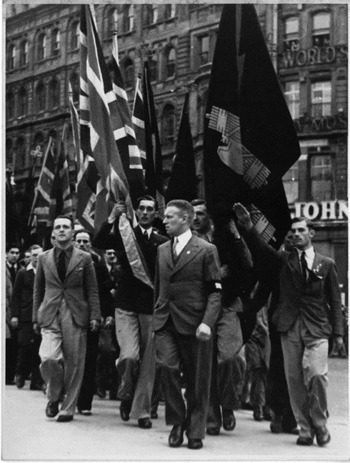
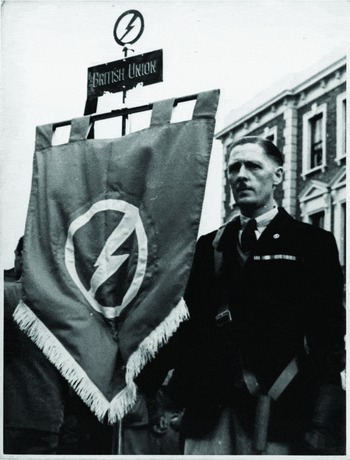
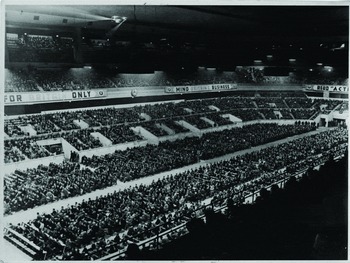
The Blackshirt's itinerary of physical activity and the development of a distinctive British fascist aesthetic was also constructed and well documented in images, photographs, films and graphic art produced both by the movement and by photojournalists and onlookers.Footnote 39 The fascist body took on an iconic status in these images: lean, angular, well-tailored young men moving their bodies in union, their gaze fixed at a distance or at ‘the Leader’ himself. Carefully posed images showed groups of Blackshirts giving their Nazi-style salute, the uniformity and unity of their bodies the embodiment of the symbolism of the fasces themselves. The Daily Mail was the purveyor of a whole library of such stylised images during the ‘Hurray for the Blackshirts’ campaign in 1933 and 1934, readers of one of Britain's best-selling papers being treated to photographs of men and women Blackshirts engaging in acts of controlled physical exertion, such as fencing, ju-jitsu, motorcycling and drilling; expressing satisfaction, pride, and ease in both facial expression and posture at being part of a group of uniformed bodies marching, dining and living together on the basis of shared political commitment; and displaying joy through their work for the movement either as telephone operators, recruitment agents, office workers or dispatch riders, taking pride and pleasure in their mastery of the latest of modern media and political technologies. Blackshirts were defined by themselves and by their critics for how their bodies appeared and how they moved, for how their uniform-adorned bodies acted and reacted. Figure 1 shows a group of British Union members on the march, proudly carrying flags of the union jack and the fasces, doing their best to emulate the Blackshirt uniform with dark suits and other emblems affixed to their clothing – after the passage of the Public Order Act on 1 January 1937, political uniforms were banned in public. As individuals they are anonymous and meaningless, while as a band they represent strength, might and order. Figure 2 shows a BU member in military-style uniform, his gaze stern and resolute, supporting a BU standard emblazoned with the flash in circle symbol that the movement adopted as it rebranded itself the British Union of Fascists and National Socialists in 1936. Figure 3 is a picture of the BU's Earl's Court Rally in July 1939, touted as the largest indoor meeting ever to take place in Britain. While the movement had by this point been divested of its uniforms and its public meetings curtailed and carefully regulated by the police and Home Office, they still managed to mount this last spectacular mass meeting, as carefully choreographed and as much attention paid to sound, lighting and leader-adulation as the movement's already infamous Albert Hall or Olympia meetings of 1934.
Group of BU members on the march [n.d].
British Union Collection, University of Sheffield Library.

BU member with Flash and Circle Standard [n.d.].
British Union Collection, University of Sheffield Library.

Earl's Court Rally.
British Union Collection, University of Sheffield Library.

Indeed, in the Blackshirt movement, credentials in physical education were seen as equally important to political experience, as exemplified by the case of ‘Buddy’, whose story the Communist Party's Daily Worker was only too happy to publicise. ‘Buddy’ had been a gymnasium instructor at Winchester, Mosley's alma mater, and in 1933 Mosley recruited him as a bodyguard. When it became clear to the new recruit that his role was not meant to be merely defensive but that those in the defence force were expected to ‘kick up rough’, he was revolted, was called before the Leader, and subsequently resigned, only to be set upon by ‘Mosley's extra special gang of thugs, with the result that he spent the best part of the next six months . . . in St. Mary Abbot's hospital . . . with a smashed hip’.Footnote 40 The fascists trained in physical fitness not for its own sake but as rehearsals for conflict, and anyone who did not properly understand this learnt it the hard way. Fascist bodies were being conditioned as offensive weapons.
The centrality of sport and the way the movement sought to prop itself up on the firm foundations of Britain's sporting culture and growing industry can be seen in its use of sporting space and venues. The BUF frequently appropriated space, the space of the sporting ground, to stage its meetings, symbolically resonant with its attempt to emulate the Spartan ideal of body over mind and to politicise and contemporise the gladiatorial contests of ancient Rome. This evocation of the classical past was a common thread in the British fascist imagination: ‘Fascism aims definitely at the creation of a new civilization which shall hold an equal balance between the ordered and static Roman ideal, and the intensely individualistic and progressive Greek spirit.’Footnote 41 This reverence for the classical past was also in evidence in the movement's literary output, illustrated well by ‘our short story’ published in the 21 February 1936 edition of Action, ‘The Winged Hats’, by Arthur Marsden. This Boy's Own-like tale was set in ancient Rome, and luxuriated in the ‘noise of fighting men’.Footnote 42 Especially in the early life of the movement when funds were more readily available and before the glamour had been decisively undermined by the unpredictability and the crudeness of Blackshirt hooliganism, BUF meetings provided an aesthetic feast of lime light and sophisticated sound equipment, military bands and an orchestra, colourful flags and banners (both the union jack and the fascist insignia), precisely choreographed columns of men and women in Blackshirt uniform, displays of fencing and boxing, and all punctuated by the grand entrance of the leader. For examples, at the BUF's White City rally of June 1934, ‘from 3pm until the leader speaks at 6pm the arena will be given over to physical training displays, inter-area athletics, boxing matches and fencing. There will sometimes be eight boxing matches taking place simultaneously.’Footnote 43
More memorably, the Olympia meeting of 7 June 1934 was also carefully arranged to tantalise and provoke the audience, this time with less overt but nonetheless clear evocation of the sporting contest or gladiatorial encounter. The Olympia meeting descended into the chaos and violence for which it is best remembered due to the organised opposition of communists, socialists and a wider array of spectators who, while not supporters of Mosley, attended for its spectacular and even entertainment value.Footnote 44
Inside the great hall it was seen that Sir Oswald Mosley had nothing of theatricalism to learn from either Hitler or Mussolini. There was a massed band of Blackshirts, there were flags, the union jack, and the black and yellow flag of the British Union of Fascists. There were arc-lamps with a theatrical greyish-blue tinge, and there was an aisle lined with Blackshirts extending from the entrance usually employed by the performing animals at the Royal Military Tournament to a specially contrived platform draped with drugget of a tinned-salmon pink. And Sir Oswald, in keeping with a nowadays out-of-date theatrical tradition, kept his audience waiting while the band played patriotic marches and other tunes devised for the British fascists. Exactly thirty-five minutes after the meeting was due to begin Sir Oswald made his appearance. The lights of the hall flickered, the band dropped into a Low German march of the seventies [1870s] or thereabouts, the arc-lamps swung round from the platform down the Blackshirted aisle, and there in the foggy distance Sir Oswald appeared – announced by a fanfare and preceded by six men carrying union jacks and the British Blackshirt flag. And so the march proceeded to the platform while some people – they did not seem to be many – raised their arms in a Fascist salute and others with less commitment, cheered. Yet above the cheers could be heard the unmistakable sound of booing.Footnote 45
The ostentatious display was followed by a scrimmage, with the arc lamps swinging round from the platform to the fighters, as this was very much part of the show and the gladiatorial-like contest between Mosley's men and their dehumanised opponents, a stylised and ritualised violence. ‘For close to two hours the meeting dragged on like that, interruption following interruption and ejection. Now and again a woman would shrill at the top of her voice, a crowd of Blackshirts would hustle round her and, knotting her arms behind her back, bundle her out.’Footnote 46 Indeed, the climax was yet to come, and the fighting reached fever pitch when anti-fascists began to display their banner by acrobatic feats, swinging from the girders. The Blackshirts’ Olympia rally, like others before it, was a carefully staged affair that sought to capitalise on Mosley's celebrity status and the hero worship of his followers; the theatrical and cinematic effect of columns of Blackshirts either in rising their arms in orderly salutes or, as effective for the purposes of stoking interest and frenzy, engaged in self-consciously choreographed violence; and all that the most current technologies offered for the display of political conviction and the flaunting of physical presence and implied strength in numbers. Ultimately these techniques backfired, famously so at the Olympia rally itself where the chaos, disorder and offensive aggression displayed by Mosley's minions marked the downturn in the BUF's possible ascendency.Footnote 47 But what is clear is the importance placed on choreographed bodies, each playing their part in illustrating the symbolic hierarchies of the movement: leader, follower, menacing opposition that will stop at nothing to make disorder of the Blackshirts’ symmetrical aesthetic.
The setback suffered by the BUF at Olympia was well illustrated by the fact that the next time the movement wished to stage a meeting at White City, their request was denied because of appeals from sporting interests and their concern that ‘the Fascist rally might do serious damage to the sward and the running tracks, which will be required the same week for the Empire Games’. As a consequence, the BUF changed the venue to Hyde Park where, according to the Office of Works, no permit was required for holding a demonstration unless bringing into the park wheeled vehicles or loud-speakers. For this occasion, significantly, the BUF claimed that would not be an issue as ‘the gathering is not a public meeting but a demonstration of Blackshirt “physical fitness”’.Footnote 48 Nor was the movement reluctant to blur the lines of demarcation between civilian and military spaces, using the Drill Hall of the 5th Devan Regiment at Plymouth as a venue for a meeting addressed by Mosley in October 1934.Footnote 49 Notwithstanding the increasing difficulty faced by the BUF in securing those venues they most desired for their meetings, they continued to use leisure and sporting spaces, and, as another example, in September 1935 a Blackshirt squad ‘marched on to one of the playing fields [at Battersea Park], followed by their “Black Maria” vans’.Footnote 50
There was also a sense that the meeting was a great event and a site of conspicuous consumption. The Daily Mail and the Sunday Dispatch offered 500 tickets to the Albert Hall meeting as prizes for those who sent in the most interesting reasons for why they liked the Blackshirts. Further, the Rothermere press attempted to heighten expectations by noting that ‘thousands of Blackshirts in all parts of the country have been saving money for weeks to attend the rally in the White City on August 5’.Footnote 51 The meeting was a product to be consumed, Blackshirts having to save their money and then spend it to buy tickets for the spectacle. However, after Rothermere withdrew his support, BUF leaders began to reassess the value of that support. While the BUF accepted the Daily Mail's support and expressed little reservation about the way the movement was being commodified and commercialised in order to cohere with the methods of a profit-making tabloid paper, they expressed reservations after the fact:
The propaganda of the ‘Daily Mail’ has probably done more harm than good. The only good is that of advertisement; the harm that it introduced a flood of paper members, and induced some of the old active members to rest on their oars, believing that the fight has been won.Footnote 52
These paper members were not worth the paper they were pictured on!
More than this, the ‘Daily Mail’ is so discredited with the general public. It remembers the Boxer rebellion, standard bread, Daily Mail roses, and the rest; so that the support of the Northcliffe Press on any terms is a doubtful asset. Unfortunately the public are not equally disillusioned about the other press combines, and from our point of view, Rothermere was the worst choice.Footnote 53
The end of the collaboration with Rothermere did not, in fact, lead to a change of tactic and the movement clearly learnt a great deal about publicity from the tabloid press. However, the end of the relationship did lead to less inhibition on the part of the BUF, especially in terms of its expression of antisemitism.
Perhaps many of these displays of Blackshirts’ playing politics would in the end be rather innocuous and ridiculous if it were not for their intensifying racist and sexist charge. These bodies engaged in stylised violence and sport display were also racialised and gendered, as images of healthy fascist bodies were constantly juxtaposed with their stereotyped antitheses, the most frequently represented being the physically weak and morally diseased urban Jew, and the corporeally unkempt and ideologically and psychologically unbalanced ‘red’ woman. Choosing to have it both ways, fascist propagandists acknowledged the forceful physical reaction mounted by British Jewry to fascist speakers, while simultaneously repeating the antisemitic images of the physically frail and slovenly Jew. Jews were the countertypes, and no logical consistency was required to justify fascist revulsion. In an article recounting the alleged attack by communists on Blackshirts after a fascist meeting in Manchester in March 1933, the writer speaks of ‘Communist beastliness’, a ‘ghetto mob’, the leader of which was ‘a boy of the bull-dog breed from the local ghetto’, guilty of ‘filthy cowardice’ for ganging up on a small group of Blackshirts after the meeting had finished.Footnote 54 Jewishness was, of course, also seen to be embodied either as a stereotyped Jewish physique or, mainly, as a Jewish nose. Jewish Chronicle reporters were abused when identified at fascist meetings, insulted for being ‘skinny’ or ‘dirty’. Even Stuermer commented on the ‘Jewish Problem’ in Britain, observing that ‘Judaism in Great Britain is beginning to work like a creeping poison, and he who has the courage to see will realize that the hour is coming when England will have to decide for or against All-Judah's desire for domination’. Number 3 (1937) of Stuermer contained this caricature of the Public Order Act, the legislation that effectively banned the wearing of political uniforms:
The BUF's most poisonously lyrical antisemite, A. K. Chesterton, raged against the Jewish presence in sites of sport and leisure:
To go to a swimming pool anywhere near London or the large cities is as efficacious as baptism in the Jordan. One becomes positively anointed with Semitic grease. To go to the sea, especially if it be a fashionable resort, is to find the Jews in possession of almost all hotels, swarming over the beaches, overcrowding the cafes, and always making themselves conspicuous, always drawing attention to themselves by loud clothes, loud cars and loud behaviour.Footnote 56
Chesterton's vehement objection to Jewish bodies and the display of Jewish bodies – represented as unkempt, grotesque, diseased, full of contagion and the object of parody when any attempts were made to develop physique in line with the Anglo-Saxon ideal of physical fitness and beauty – was linked to the fascist critique of Jewish incursions and alleged creeping domination of the sporting industry. E. G. Clark wrote how ‘night after night gangs of anti-fascist toughs led by foul and loathsome specimens of sub-humanity, surrounded the speakers and attempted by physical violence to break up our meetings and do bodily harm to our members’. Much was made of the fact that the British sports industry was, allegedly, under Jewish control, and Clark noted that ‘even sport, boxing, racing, football, are falling into the control of a race which has no conception of our principle of fair play and good sportsmanship’.Footnote 57 Chesterton took this further, accusing the Jew of ‘protesting against British sportsmen melting into the friendly rivalry of sportsmen of other nations, whom he hates and fears’, and claiming that the Jewish race was most out of its depth when Jews interfered in the ‘field of sport’.Footnote 58 These allegations that Jews were not team-spirited, that they were spoil sports and would not play according to the rules, cut to the heart of Edwardian constructions of British manliness and gentlemanliness in particular. The British middle class would have recognised the importance of playing by the rules as a test not only of physical ability but of citizenship, as ‘games were not only a means of improving physique, but of teaching team spirit, and of diverting young men from enervating self-abuse’.Footnote 59 Indeed, ideals of gentlemanliness and sportsmanship were claimed as core fascist ideals and integral to the national awakening that would come through fascist revolution: ‘Britain can only become great and virile once more if this movement is British to the core. It must bring all the finest qualities of British character back into their old place of honour.’ The writer acknowledged the reinvention of tradition that this entailed:
The phrase ‘a British Gentleman’ must win a new and higher meaning. At present it means little or nothing. A ‘sportsman’ should be a person who not only takes part in some sport himself and is physically fit, but who has a high conception of fair play and a feeling of duty towards actively helping to keep the nation bodily and morally healthy.Footnote 60
Britain's fascists built their new fascist bodies with the weights and irons of past aspirations for a national and nationalised manliness.
If notions of British fair play were assumed to be undermined by alien interference, feminine ideals of the ‘English rose’ were seen to be negated by the politicised woman of the left, and especially the feminist anti-fascist. Witnessing a procession of left-wing marchers ‘representing the heights and depths of Bloomsbury's uninhibited parlours’ on May Day 1936, Anne Cutmore described
. . . a fat woman with uncombed hair and thick tweed jacket . . . Here is a deplorable girl, whose out of condition body, over-fat body and legs, shorts which reach just below the knee, and personality exudes external and internal grime, [and] make one think of one's common humanity and regret it . . . These are the rejects of a ruthless civilization – and only in their increasing numbers are they any menace.Footnote 61
While the BUF did not hold exclusive rights to the technique of attacking political opponents by distorting their body imagery, by imputing that they were sexual deviants, and by imagining them to be ‘sub-human’ physical specimens, fascist poisoned-pen propagandists and photographers who took great license by cropping images for their nefarious purposes were far more provocative, rapid and violent than any of the democratic parties. What differentiated the British fascists from their opponents in this regard was the unqualified embrace of racial and eugenic typologies and hierarchies, many degrees more rabid than, for instance, the feminisation of male politicians by conservative propagandists or the mockery and criminalisation of the British fascists by their communist opposition.Footnote 62
Paradoxically, however, the BUF's suggested remedies to perceived social ills were not unilaterally reactionary, nor should their cultural vision be blandly categorised as anti-modern. Instead, Mosley spoke of his party as ‘the modern movement’; the movement's rhetoric was obsessed with the process of creation and the ‘new’; and every effort was made to launch a process of socio-cultural and racial regeneration, and to reconstruct the dismembered male body. The BUF's own affirmative body imagery was part of what Roger Griffin has termed generic fascism's essential vision of palingenesis (rebirth). Its body cult also dovetailed with the more specific British fascist malaise with the modern city and diagnosis of cultural decadence, as Thomas Linehan has convincingly shown in his studies of the BUF's engagement with culture.Footnote 63 The basic unit of this Mosleyite regeneration was the ‘new fascist man’, inspired by continental examples of masculine resurgence, while also tailored to respond to the perceived crisis in the British polity.
The male body, body imagery and body politics were inscribed at the very centre of Britain's fascist movement. In terms of organisation, and from its formation, the BUF was explicitly preoccupied with providing a distinctive sartorial code (the Blackshirt itself), an all-encompassing sporting culture (from boxing to football), and a paramilitary residence (the Blackhouse) as means to cultivate the New Fascist Man and to build his physical body. This ‘body fascism’ – in which the healthy, mighty, aesthetically pleasing and war-like male body was inextricably linked to the violent action that would bring forth a fascist Britain – was not confined to the organisation of the movement. A distinctive ideology and aesthetic of an Anglicised body fascism was also a leitmotif in the BUF's rhetorical flourishes, visual culture, and its self-representations in print, film, photography and in graphics. There is therefore little question that the British variant of fascism adhered to Walter Benjamin's interpretation of fascism as the ‘aestheticization of politics’.
A profound fear of emasculation provided the psychic point of departure for imagining the British new fascist man. One of Mosley's young adherents explained:
To-day, probably for the first time in history, ‘men’ are ashamed to be men. The full-blooded virility of the warrior is traced to the machinations of Satan. It is a blasphemy! . . . Man's place has been on the track and in the arena, fighting, struggling, proud of his virility in the unceasing battle against evil and disorder. Fascism believes in manhood, in courage, in determination, in selflessness, in the essence of life.Footnote 64
The construction of the British new fascist man reached its most coherent expression in the idiom and imagery developed by the Rothermere press from 1933 to 1934, when the techniques of the tabloid press were effortlessly merged with the physical assuredness of Blackshirt athleticism, with notions of imminent political triumph, and with a quintessentially masculine and martial aesthetic of corporeal toughness, hard lines and futurist obsession with speed, flight, new technology and mechanisation. A collage of Daily Mail and Sunday Dispatch images illustrates this well, as does a closer reading of the marketing scheme employed by Rothermere journalists to promote the fledgling movement. Rothermere's support for the Blackshirts grew out of his own specific brand of ultra-nationalism and his particular concerns about the need to build Britain's air power.
Each member of the BUF subscribed to this athletic ideal, and G. De Burgh Wilmot wrote to the Yorkshire Post: ‘Fascism is the very contrary of an “appeal to self interest and the lower instinct of human nature” . . . It seeks to uphold a belief in physical and mental fitness.’Footnote 65 De Burgh Wilmot also wrote to the Manchester Guardian, advocating the BUF's ‘belief in physical fitness’ as the ‘first step towards an ideal of a nation of young men “living like athletes”’.Footnote 66 It was the manufactured body image of Mosley himself that provided the model for the Blackshirt body fascism. Mosley was described as ‘a man who is not ashamed of physical fitness, of health and vitality. He is a man in the tradition of manhood.’ These tropes of Mosley's quintessentially British masculinity were often repeated:
He is appealing to the spirit of British manhood, to the spirit of men who conquered, as he has so brilliantly put it, of the Empire builders who conquered the tropical, fever infested forests, or who sailed the tempestuous seas . . . Yet, in spirit of their bitterness, these men have never entirely lost faith and hope – they have retained the spirit to struggle on in the days of peace as they struggled in the days of war; their manhood is unsullied and undefiled. Mosley comes to them as one of the great figures of British history with his clarion call, ‘To give all to dare all for Britain.’Footnote 67
Taking a leaf out of Mussolini's representational book, Mosley was clear about the BUF's Italian inspiration: ‘We salute, in Signor Mussolini, not only the inspirer of world Fascism, but also the highest and most superb manifestation of the European man.’Footnote 68 Further, Mosley made much of his own athletic achievements and his awareness of the political profitability of style and body image, and he took every opportunity to be represented in the BUF press and its pictorial records as a great sportsman, especially in solitary athletics such as swimming and fencing, the latter a sport at which he excelled, winning both the foil and saber public school titles, and as a member of the British épée team.
‘Body fascism’, in its inter-war British manifestation, should not only be understood as the glorification of health and fitness. On a metaphoric level, whatever the power, conviction or sterility of fascist ideas and policy, the BUF was distinctive on the British political landscape for its anthropomorphic imagery, for its physical gestures, and for its non-verbal expressiveness, for its performance. The utopian corporate state of the fascist future was explained in bodily terms:
. . . as its name indicates, it is a deliberate organization of the whole of the national community into a corporate entity on the analogy of the human body. The human body is an organism composed of many millions of cells all organized into various muscles and organs, so that they function in the interests of the body as a whole.Footnote 69
This anthropomorphic state, this embodied state, would also pay special care to its citizens’ bodies, and Alexander Raven Thomson prophesised that ‘every corporation will organize recreational facilities, Libraries, playing fields and social clubs . . . The BU will not be satisfied until every worker has facilities to enjoy his favourite sport and follow his own recreational hobby.’Footnote 70 The very notion of the BUF as a ‘movement’, rather than a party, evoked the unique kinetic and stylistic quality of British fascism.
This kinesthetic politics was reinforced by their watchword ‘action’, first used as the NP's slogan and then effortlessly transported into the BUF. ‘Talk is a tool, but if it does not lead to action, why talk at all?’ was the telling slogan on the poster hanging on the wall of the NUPA clubroom in Greenwich.Footnote 71 In Mosley's view, his fascist movement represented ‘all that is vital in the young manhood of the nation’, whereas the old gang parties and the communists in particular relied on ‘wind and words’.Footnote 72 The BUF's language was saturated with allusions to the physical deterioration of democratic institutions and ideas. A BUF recruitment flyer asserted: ‘Call a halt to the flabby surrender of British interests . . . Ever since the War we have talked. It is time to act again. Send for men of action.’Footnote 73 Similarly, the contrast between bold nationalism and cowardly internationalism was made in bodily terms:
The three old Parties all line up together for the flabby international. They all stand united for national surrender . . . In the old days, Conservatism at least had the merit of being a national creed. The doctrine of patriotism and self-help was the basis for Conservatism. Now Mr Neville Chamberlain joins Mr Baldwin and the other Conservative leaders who have surrendered to the weak-kneed international doctrine.Footnote 74
Wholeness and manliness were associated with a Britain conceived in imperial terms, while disintegration, national malady and decline were the physical analogies for internationalism.
Manliness was further manifested in the blackshirted body standing as the movement's trademark and its public image, and adherents were identified by how they clothed and adorned their bodies, taking pride in wearing the uniform and a range of accessories designed with the BUF's symbols. Their uniformed and mechanised fascist bodies in motion – dressed and accessorised as such to inspire fear in their opponents – became the weapons that delivered the blows to the democratic body politic, a national body that was figured as degenerate and decayed. This corporeal politics was also exemplified by the physical exertions that defined the movement's culture, in the form of choreographed marches, theatrical rallies and spectacular meetings, as well as the kinetic expression of allegiance in the form of the raised arm salute.
At its most essential, the BUF did not gain the notoriety it did for its ideas or the originality of its political philosophy but rather for its visual, stylistic and physical impact, and assault, on the British body politic. Thus I am using the concept ‘body fascism’ to explain more than the BUF's rather unsurprising fixations on health, virility and sport on the one hand, or its negative fixation on the physical decadence of its political and racial counterpoints. I am suggesting that the expression has deeper and wider implications and applications. The more prosaic convergence between fascist politics and a range of physical and health-giving activities can be extensively illustrated on an empirical level, and of course this was a feature of all fascist movements and regimes. However, I am also arguing for recognising a more profound significance regarding the ways in which fascism appropriated and harnessed the modern body cult and the mass-producing garment industry in order to foster a new form of politics, a politics of fascism as fashion.
We have thus seen how the fascists inflicted rhetorical violence on the bodies of their opponents and the stigmatised ‘other’. However, central to the experience and performativity of bodies engaged in fascist and anti-fascist action in the 1930s was the infliction and the suffering of bodily harm. While in the movement's own mythology and self-representations bodies were posed in acts of stylised violence and ritualised sport, the reality was tangibly different, and rather less easily stage-managed. For all the idealisation of the Blackshirt body, it was clear that physical training and so-called self-defence techniques were not being practised merely for defence. Indeed, the attention conferred on the Blackshirst by a host of non- and anti-fascist newspapers provided a catalogue of incidents of bodily harm perpetrated by both fascists and by their opponents. The battle being fought between fascists and anti-fascists in Britain during the 1930s was not one merely or even mainly of words, but one of bodily contact and the infliction of bodily harm. Predictably, the anti-fascist press played up incidents where the Blackshirts were the perpetrators, while the fascist press indulged in the opposite tendency. For example, the Manchester Guardian published reports of the violence inflicted upon spectators by Blackshirts at the Olympia rally, including one where ‘a girl was being carried out by nine male Fascists when one of the signatories intervened, as she was being hit in the body. He was attacked by several more and beaten. The girl was seized by a number of women Fascists, who scratched her face and tore her hair.’Footnote 75 Indeed, there have been heated debates in the historiography about who should be held accountable for street-level violence, Stephen Cullen suggesting that the anti-fascist narrative, that of the winners in this history, is misrepresentative once one has weighed the evidence and made a statistical examination of arrests for acts of political violence. He argued that ‘the BUF was primarily the victim of offensive violence, rather than its prime instigator’.Footnote 76 However uncomfortable it may be to accept, and never denying that their very presence was provocative, Blackshirts were frequent victims of violent attack.
This aspect of the BUF's body politics was also brought under the scrutiny of the law, the testimony of Blackshirts revealing much about their attempted self-presentation and their attitudes to violence. For instance, Mosley and another fifty-five witnesses were called to answer summonses alleging riotous assembly following a fascist meeting at Worthing that took place on 9 October 1934. Mosley used these court appearances as opportunities to vindicate his position and to play down, as much as possible, the Blackshirt reputation for offensive violence. ‘Sir Oswald felt it was essential for his own honour, both as a man and as a leader of the party, to prove that he was not a thug who came down to Worthing with men wearing big boots to knock about inoffensive children, cripples, and tottering old ladies.’ When asked:
‘Has your organization at your meetings to your knowledge, ever attacked a member of the public unless the public attacked them first?’, Mosley responded, ‘No, our action has always been defensive.’ Of course it is difficult to take this statement at face value, and at the same trial Thomas Wilder, of Chelsea, a permanent reception clerk at the BUF headquarters, said that the crowd was yelling insults at the Blackshirts. Wilder agreed that the Fascists from London were a more or less imposing body of them.
Mr Eric Neve (cross-examining); All good boxers? – well, we keep our bodies in trim.
Were you what has been known as the defence force? – If you like to call it that, defence is defending. Wilder agreed that they brought ambulances with them.
Mr Neve: That shows you were expecting a spot of bother? – We usually do at our meetings (laughter.)Footnote 77
Indeed, if there is still exciting new research to be done on British fascism, an area of historical enquiry that many historians before me have argued is well mined, it is on the relationship between the BUF and the law. Sir Oswald Mosley became notorious for taking on the newspapers, and not only for answering charges against him, in court, a tendency he passed down to his son, to be sure, as exemplified by Max Mosley's legal action against the News of the World over claims he indulged in a ‘Nazi-style’ sadomasochistic orgy, a case he won in July 2008. This delicate balance between victim and perpetrator of bodily harm was often played out, and even the liberal Manchester Guardian expressed some sympathy when Mosley was stoned at a meeting in Liverpool in October 1937, arguing that ‘in the first place, it brings English political life down to the Nazi level; in the second, it gives Sir Oswald the encouragement of martyrdom’.Footnote 78 Thus Blackshirt bodies were far more vulnerable and blemished than their idealised representations of steel and stealth, of sculpted posture and Futurist angularity, would suggest.
This ambivalence about the fascist body and the inevitable tension between ideal and experience became more acute as the policy of the movement shifted and the BU refashioned itself, from 1938 onwards, into an anti-war movement. The British New Fascist Man was not a static figure, and one can discern important shifts over time in the construction of the fascist body. An interesting transformation in the movement's imaginative landscape can be discerned by the closing years of the 1930s. In its early years its response to pacifism was predictable, as the following example illustrates:
The pacifist resolution recently passed after a debate in the Oxford Union declaring that the House would in no circumstances fight for King and country, roused a storm of controversy, but only the Fascists were virile enough to take direct action. While the Conservatives were busy writing letters of protest and uttering vague threats, the Fascists marched into the Union and removed the offending minutes from the book.Footnote 79
From this we can see that the BUF was anything but pacifist from the outset, and committed assault on pacifists.
However, when the BU recast itself as an anti-war movement, male body imagery was likewise re-imagined and again dismembered in order to substantiate the rejection of war. Confluent with the shift from an aesthetic of whole and healthy bodies to one of dismembered and deformed ones was the recognition that Mosley's movement was itself in its dying days, putrefied and corpse-like. On defecting from the BU, A. K. Chesterton wrote: ‘I might have continued trying to galvanize the unhappy corpse into a semblance of life had I not come to the conclusion that it was not so much any coterie that stood in the way of revolutionary advance as blind spots in Mosley's own mind.’Footnote 80 In putting forward the BU's peace policy and providing the emotional and symbolic context that seemed to substantiate the paradoxical position of British fascist pacifism, R. Gordon-Canning evoked a very different male body from the earlier version of the new fascist man: ‘There are battles enough in life without adding unnecessarily that holocaust of death and mutilation in the inferno of machine gun, of gas and of shell, of torture in limb and lung, of artificially inspired hatreds and of insane blood lusts.’Footnote 81 With war looming, antisemitic imagery in the BU's literature also became increasingly noxious, medicalised and corporeal, as it was claimed that
. . . we began to see the mighty organism of Jewry at work dominating over our people, bleeding them through its financial suckers, even attempting to drag them into a war with Fascist powers in pursuit of their vendetta of hate and revenge against those countries which have cut the cancer of Jewish intrigue out of their national life.Footnote 82
With the threat of a second world war, the Blackshirt body – already divested of its uniform, already emasculated by political failure, severely limited in action by the Public Order Act and soon the Defence Regulations, and heavily scarred by reopened psychic and even physical wounds of the Great War – was represented in much the same way as had been the bodies of fascist enemies only a few years earlier. The once triumphant and phoenix-like British fascist body took on a decidedly ghost-like pallor.
That being said, there is still ample evidence to suggest that there were deepening schisms among the membership on this as on many other ideologically and emotionally divisive issues. The transition from a paramilitary hyper-masculinity that characterises body fascism at its peak of bravado during the first years of BUF activity was also spurred on by the looming war, occasioning an intensification of military values. The turn to an oxymoronic fascist pacifism, accompanied by a more doom-laden body politics, was not one that was followed by all members of the dwindling organisation. Thus in January 1938 one fascist wrote:
Equally alarming is the spiritual emasculation of our race. Here is a tragic example of dithering effeminacy which threatens British manhood. It seems that a gentle flower joined the Army and did not like its rough and ready ways, so when its time was up it wrote a book condemning the great brute. ‘Why did men desert?’ it exclaims, and supplies the answer: ‘For a number of reasons. Recruits desert because they could not stand the vigorous training, the petty restrictions on liberty, the hateful bullying, baiting and swearing of the NCO's [non-commissioned officers].’ Dear, dear, dear!Footnote 83
Indeed, in the various forms of commemoration of fascist days, and especially in the main publication of the Friends of Oswald Mosley (founded in the 1980s), Comrade, the call for recognition and suffering at the hands of the government and under Defence Regulation 18B is always juxtaposed with the roll of honour of all those Blackshirts who served during the Second World War, and the claim that among Britain's first casualties were members of the BU. More damaging and insulting than any other charge would be that of shirker or deserter, the notional diminished masculinity of a conscientious objector or a pacifist always incongruous with fascist core principles and ideals.Footnote 84
The ‘body fascism’ of the 1930s shared many meanings with how we use the term today, namely by prioritising body over mind, if not sacrificing intellect to the more primitive instincts of the body, and especially massed bodies. The BUF was more about style than substance, and not merely because it was a marginal movement that failed to achieve electoral success, dismantle the democratic system, and put in its place the Corporate – corporeal – state. Only by taking a cultural approach to political history can we see that in its development of political technology, its reliance on the uniform, its aestheticised brutality, its representations of the supremely virile Leader, and its attempt to appropriate fashion for fascism, the BUF was clearly a product of modernity and one potent, if disturbing, expression of the convergence between populist politics and trend-obsessed consumer culture. However, it is important not to be numb to the ‘fascist’ charge of this ‘body fascism’, or to sacrifice political meaning to surface appearance, voyeuristic appeal, and sensational spectacle, or to demote the political threat posed by the movement. After all, the Blackshirt body was not only intended to be attractive and infuse sex appeal into a hubristic movement. The fascist body was also constructed as an offensive weapon, as a cog in the paramilitary wheel, and in their collective formations fascist bodies were mobilised to reap havoc on the British body politic, and especially to mount a frontal attack on all those vulnerable bodies they stigmatised as ‘other’ and inferior. Acting alone, the Blackshirt body had little power, but acting in concert, Blackshirts became a ‘pack of human wolves’Footnote 85 – something less than human – as A. J. Cummings described fascist stewards at the violent Olympia meeting. By historicising the concept of ‘body fascism’ we should be able to shed the ambivalence with which we read and react to the term in its current usage.