Sex differences, that is, differences between individuals of different biological sex (sex assigned at birth), have been in the focus of empirical research for decades (e.g., Mealey, Reference Mealey2000). While some research investigating differences between female and male individuals employs the term “gender” for this categorization (for an overview, see Zell et al., Reference Zell, Krizan and Teeter2015), other research uses the term “sex” in the sense of “biological sex” or “sex assigned at birth” (for an overview, see Mealey, Reference Mealey2000, pp. 11–25). The research at hand follows the second approach, thus investigating differences between biologically female and male individuals.
Among the research on sex differences, language-related sex differences have also been studied (e.g., Lange et al., Reference Lange, Zaretsky, Schwarz and Euler2014), including sex differences in language development (for an overview, see Wallentin, Reference Wallentin2009). However, numerous sociodemographic/social variables apart from sex exist that may influence language development (e.g., Hoff, Reference Hoff2006; Tager-Flusberg, Reference Tager-Flusberg2005; Zaretsky & Lange, Reference Zaretsky and Lange2017). For instance, socioeconomic status and levels of maternal and paternal education have been shown to be associated with children’s language development (e.g., Dickinson & Porche, Reference Dickinson and Porche2011; Letts et al., Reference Letts, Edwards, Sinka, Schaefer and Gibbons2013; Noel et al., Reference Noel, Peterson and Jesso2008; Taylor et al., Reference Taylor, Christensen, Lawrence, Mitrou and Zubrick2013; Thomas et al., Reference Thomas, Forrester and Ronald2013; Zaretsky et al., Reference Zaretsky, Euler, Neumann and Lange2014).
Despite an abundance of social factors that influence language development (apart from biological factors, e.g., prenatal testosterone; see Lange, Reference Lange2015; Lutchmaya et al., Reference Lutchmaya, Baron-Cohen and Raggatt2001), the effects of biological sex on language development have attracted particular research interest (e.g., Lange et al., Reference Lange, Euler and Zaretsky2016; for an overview, see Wallentin, Reference Wallentin2009). Such research on sex differences in early language development has consistently demonstrated that girls outperform boys, although this advantage (1) is mostly only slight and (2) diminishes or even vanishes with advancing age (e.g., Bauer et al., Reference Bauer, Goldfield and Reznick2002; Beltz et al., Reference Beltz, Blakemore, Berenbaum, Tager-Flusberg, Rakic and Rubenstein2013; Bornstein et al., Reference Bornstein, Hahn and Haynes2004; Bouchard et al., Reference Bouchard, Trudeau, Sutton, Boudreault and Deneault2009; Lange et al., Reference Lange, Euler and Zaretsky2016; Toivainen et al., Reference Toivainen, Papageorgiou, Tosto and Kovas2017; for an overview, see Wallentin, Reference Wallentin2009; see also Adani & Capanec, Reference Adani and Cepanec2019).
The fact that sex differences in language development decrease with age also means that the more basic the linguistic domain is, the more likely such sex differences exist or the larger they are, respectively (for an overview, see Lange et al., Reference Lange, Euler and Zaretsky2016). For instance, findings in regard to a female advantage in vocabulary and the lexicon at an age of approximately eight months to two-and-a-half years are relatively robust (e.g., Berglund et al., Reference Berglund, Eriksson and Westerlund2005; Bleses et al., Reference Bleses, Vach, Slott, Wehberg, Thomsen, Madsen and Basbøll2008; Bouchard et al., Reference Bouchard, Trudeau, Sutton, Boudreault and Deneault2009; Feldman et al., Reference Feldman, Dollaghan, Campbell, Kurs-Lasky, Janosky and Paradise2000; Fenson et al., Reference Fenson, Dale, Reznick, Bates, Thal, Pethick, Tomasello, Mervis and Stiles1994; Lange et al., Reference Lange, Euler and Zaretsky2016). By contrast, sex differences in the acquisition of morpho-syntactic and grammatical features (at an older age) are minimal or even near zero, which means that girls outperform boys by only a very small margin, if at all, in this linguistic domain (e.g., Bornstein et al., Reference Bornstein, Hahn and Haynes2004; Fenson et al., Reference Fenson, Dale, Reznick, Bates, Thal, Pethick, Tomasello, Mervis and Stiles1994; Hayiou-Thomas et al., Reference Hayiou-Thomas, Dale and Plomin2012; for an overview, see Wallentin, Reference Wallentin2009).
However, while the distinction between vocabulary and grammar is a well-established one and, furthermore, of practical relevance, there is one domain that lies beneath both vocabulary and grammar as it is far more basic, namely the phonetic/phonological domain (Baddeley, Reference Baddeley2003). Within this domain, the so-called phonological short-term memory (PSTM) is crucial for processes involved in language comprehension and particularly production (Martin & Slevc, Reference Martin, Slevc, Goldrick, Ferreira and Miozzo2014).
The PSTM (sometimes used synonymously with the terms “verbal working memory” or “phonological loop”; cf. Baddeley, Reference Baddeley2003; Szmalec et al., Reference Szmalec, Brysbaert, Duyck, Altarriba and Isurin2013) can be considered one part or subsystem of the working memory, according to the multicomponent model of working memory developed by Baddeley and Hitch (Reference Baddeley and Hitch1974; see Baddeley, Reference Baddeley2003; for an overview, see also Collette et al., Reference Collette, Van der Linden and Poncelet2000; Szmalec et al., Reference Szmalec, Brysbaert, Duyck, Altarriba and Isurin2013; Van Dyke, Reference Van Dyke, Peach and Shapiro2012). The PSTM involves the ability to store and manipulate verbal and auditory/acoustic information in the short-term or working memory for a few seconds. Moreover, its function is to recognize and remember phonological elements and the order of their occurrence. Therefore, the PSTM is a short-term memory resource responsible for (temporarily) processing speech-based information.
The PSTM can be operationalized and, thus, assessed, by means of the performance in tasks on the repetition of (non-)words and sentences as well as digit spans (e.g., Euler et al., Reference Euler, Holler-Zittlau, van Minnen, Sick, Dux, Zaretsky and Neumann2012; Grimm, Reference Grimm2001; Newbury et al., Reference Newbury, Klee, Stokes and Moran2015; for an overview, see Baddeley, Reference Baddeley2003; Conti-Ramsden & Durkin, Reference Conti-Ramsden and Durkin2012). Non-word repetition tasks are often utilized to measure PSTM in numerous language tests such as the German “Kindersprachscreening” (“Language screening for children”; KiSS; Holler-Zittlau et al., Reference Holler-Zittlau, Euler and Neumann2011). In repetition tasks, (non-)words and/or sentences are presented to the child orally. The child is then asked to repeat the respective linguistic material.
Such tasks usually result in substantial interindividual differences (i.e., children differ from one another in how well they are able to repeat the material), with a large portion of this phenotypic variance being attributable to genotypic variance (e.g., Kovas et al., Reference Kovas, Hayiou-Thomas, Oliver, Dale, Bishop and Plomin2005; Wadsworth et al., Reference Wadsworth, DeFries, Fulker, Olson and Pennington1995; for an overview, see Stromswold, Reference Stromswold2001).
A number of researchers have shown PSTM, quantified by performance in repetition tasks, to be a valid predictor of language development (e.g., Adlof & Patten, Reference Adlof and Patten2017; Bishop et al., Reference Bishop, North and Donlan1996; Casserly & Pisoni, Reference Casserly and Pisoni2013; Chiat & Roy, Reference Chiat and Roy2013; Jackson et al., Reference Jackson, Leitao and Claessen2016; Nicolay & Poncelet, Reference Nicolay and Poncelet2013; Rujas et al., Reference Rujas, Mariscal, Casla, Lázaro and Murillo2017; Truong et al., Reference Truong, Shriberg, Smith, Chapman, Scheer-Cohen, DeMille, Adams, Nato, Wijsman, Eicher and Gruen2016; for an overview, see Baddeley, Reference Baddeley2003), particularly with respect to vocabulary skills (e.g., Baddeley et al., Reference Baddeley, Gathercole and Papagno1998; Gathercole & Baddeley, Reference Gathercole and Baddeley1990a; Jones, Reference Jones2016; Newbury et al., Reference Newbury, Klee, Stokes and Moran2015; Nicolay & Poncelet, Reference Nicolay and Poncelet2013; Roy & Chiat, Reference Roy and Chiat2004; Stokes & Klee, Reference Stokes and Klee2009; Torrington Eaton et al., Reference Torrington Eaton, Newman, Ratner and Rowe2015; see Baddeley, Reference Baddeley2003; Szmalec et al., Reference Szmalec, Brysbaert, Duyck, Altarriba and Isurin2013, for an overview). Accordingly, poor PSTM abilities have been shown to be a correlate of language-related disorders such as specific language impairment and developmental language disorder (e.g., Befi-Lopes et al., Reference Befi-Lopes, Pereira and Bento2010; D’Odorico et al., Reference D’Odorico, Assanelli, Franco and Jacob2007; Estes et al., Reference Estes, Evans and Else-Quest2007; Gathercole & Baddeley, Reference Gathercole and Baddeley1990b; Girbau & Schwartz, Reference Girbau and Schwartz2008; Gray, Reference Gray2003; Montgomery et al., Reference Montgomery, Magimairaj and Finney2010; Pelczarski & Yaruss, Reference Pelczarski and Yaruss2016; Reichenbach et al., Reference Reichenbach, Bastian, Rohrbach, Gross and Sarrar2016; Truong et al., Reference Truong, Shriberg, Smith, Chapman, Scheer-Cohen, DeMille, Adams, Nato, Wijsman, Eicher and Gruen2016; Willinger et al., Reference Willinger, Schmoeger, Deckert, Eisenwort, Loader, Hofmair and Auff2017; for an overview, see Baddeley, Reference Baddeley2003; Coady & Evans, Reference Coady and Evans2008; Conti-Ramsden & Durkin, Reference Conti-Ramsden and Durkin2012).
Despite the importance of PSTM performance for language development, research that deliberately addressed sex differences in PSTM at preschool ages (1) is relatively scarce and (2) has resulted in null or, at best, inconsistent findings. So, there seems to be a noteworthy research gap that is surprising given the importance of PSTM for language development (for an overview, see Baddeley, Reference Baddeley2003; Szmalec et al., Reference Szmalec, Brysbaert, Duyck, Altarriba and Isurin2013), while acknowledging the results of empirical research demonstrating an early female advantage in language development (e.g., Wallentin, Reference Wallentin2009).
Regarding the scarcity of relevant research, it is, indeed, striking that most of the research on sex differences in language development cited above has not investigated PSTM or, if so, only as a side effect. An exception is the study by Lange et al. (Reference Lange, Euler and Zaretsky2016), who identified an advantage for girls over boys at kindergarten age in the repetition of sentences of d = 0.10 and 0.16, and in the repetition of non-words of d between 0.06 and 0.19 (depending on the instrument used and the sample). Likewise, a study by Martinelli (Reference Martinelli2013) found a slight advantage for girls over boys at kindergarten age in sentence repetition of d = 0.20 that, however, failed to reach statistical significance. According to these results, sex differences in PSTM are somewhere between zero and small. Other research has, indeed, found no sex differences in PSTM as measured by means of repetition tasks using (non-)words or sentences (Ardila et al., Reference Ardila, Rosselli, Matute and Inozemtseva2011; Ash et al., Reference Ash, Redmond, Timler and Kean2017; Burt et al., Reference Burt, Holm and Dodd1999; Chaney, Reference Chaney1992; Chiat & Roy, Reference Chiat and Roy2007; Kapalková et al., Reference Kapalková, Polišenská and Vicenová2013; Kazemi & Saeednia, Reference Kazemi and Saeednia2017; Radeborg et al., Reference Radeborg, Barthelom, Sjöberg and Sahlén2006; Roy & Chiat, Reference Roy and Chiat2004; Topbaş et al., Reference Topbaş, Kaçar-Kütükçü and Kopkalli-Yavuz2014; Tunmer et al., Reference Tunmer, Bowey and Grieve1983). However, Krishnan et al. (Reference Krishnan, Alcock, Carey, Bergström, Karmiloff-Smith and Dick2017) found a relatively large female advantage of d = 0.73 in non-word repetition in children aged 5–8 years (cf. Krishnan et al., Reference Krishnan, Alcock, Carey, Bergström, Karmiloff-Smith and Dick2017, p. 8). In regard to the inconsistency of research outcomes, it is notable that, apart from studies reporting a (slight) female advantage in PSTM and those reporting no sex differences, there is one study demonstrating a male advantage in non-word repetition (Farmani et al., Reference Farmani, Sayyahi, Soleymani, Zadeh Labbaf, Talebi and Shourvazi2018).
Therefore, according to the available data, whether sex differences in PSTM exist or not remains unclear. If they do, how large they are and what role they play in language development, in general, is not entirely clear. Thus, further research is needed to clarify this question. Furthermore, if sex differences in PSTM exist, they might be of interest for a consideration and even an explanation of sex differences in other linguistic domains. In the case of vocabulary, any word that is about to be acquired has to enter and pass the PSTM successfully (Newbury et al., Reference Newbury, Klee, Stokes and Moran2015; Ramachandra et al., Reference Ramachandra, Hewitt and Brackenbury2011). Furthermore, grammar acquisition might also depend to some degree on PSTM performance (Andrade & Baddeley, Reference Andrade and Baddeley2011). Thus, sex differences in PSTM might explain sex differences in, for instance, vocabulary size, at least to some extent. Hence, the current research had two objectives, namely (1) to check for sex differences in language competence in several linguistic domains and (2) to investigate the role of PSTM in explaining these differences.
Methods
The present research is based on a retrospective analysis of available data originally collected during the development of several German language screening tests.
Participants
Of the above-noted data, we used those that were complete for all children for the two tests employed (Mottier and KiSS.2). We used 4-year-old children only as they comprised the largest age group in the data. Also, one of the instruments that was used for the assessment of the children’s language competence (i.e., KiSS; see below) is mainly designed for 4-year-old children. Written parental informed consent was available for all children tested.
In all, there were 224 participants (86 female, 138 male) aged 48–59 months (M = 51.03, Mdn = 51, SD = 2.55). Almost all were attending kindergarten. For 30 children, it was suspected that they might speak another language at home additionally apart from German. So, a small portion of the sample (up to appr. 13 %) might have comprised bilingual children. Testing took place in several towns and rural areas in the German states of Hesse and North Rhine-Westphalia. As our research consisted of the retrospective analysis of already available data, we did not conduct an a-priori power analysis.
We deemed it important to check for variables that were potentially confounded with sex. We, hence, investigated sex differences in several demographic and other variables that were mainly obtained by means of questionnaires for kindergarten teachers and/or the children’s parents.
Girls (M = 51.17, SD = 2.65) and boys (M = 50.93, SD = 2.49) were of similar age in months (t(222) = .683, p = .495). Also, the length of kindergarten attendance (in months) was comparable for girls (n = 36; M = 19.22, SD = 8.98) and boys (n = 93; M = 17.52, SD = 7.76; t(127) = 1.071, p = .286), although not for all children, the relevant data were available (see ns and df in parentheses). We also checked for sex differences in parental educational level, which was assessed on a 5-point ordinal scale (1 = no school certificate, 2 = secondary school certificate, 3 = intermediate school-leaving certificate, 4 = Matura, 5 = high school). However, sample sizes were relatively low for the respective two variables (mother’s educational level: N = 11, 8 boys; father’s educational level: N = 11, 8 boys), which was simply due to the fact that obtaining such information mainly relied on the parents’ willingness to fill out the respective questionnaire. Nonetheless, from the data that were available, it seemed that girls and boys were comparable with respect to both the mother’s (Mdns = 3 and 4) and the father’s educational level (Mdns = 4 and 3.75).
Next, we checked for sex differences in social (to be precise: playing) behavior. We obtained no sex difference for the respective variable, although the relevant data were again not available for all children (see ns and df in parentheses): Girls (n = 38; M = 4.47, SD = 0.69) and boys (n = 99; M = 4.36, SD = 0.76) had relatively similar values for the variable “The child likes to play wither other children” that was rated by the kindergarten teachers on a 5-rating scale from 1 = never to 5 = always (t(135) = 0.777, p = .439).
Finally, we analyzed the available data from a non-verbal intelligence test (Coloured Progressive Matrices; Raven, Reference Raven2009). No sex difference was found: Girls (n = 60) and boys (n = 90) were not significantly different from each other (t(148) = 0.435, p = .664).
As we included children who might have been bilingual instead of only monolingual, we also checked whether girls or boys were over-proportionately represented in the two groups of monolingual or bilingual children (or vice versa). The results showed that there was no such confounding of sex with language background (χ2(1) = .243, p = .642).
Language tests and questionnaires
The tests applied were the Mottier Test (Mottier, Reference Mottier1951) and the KiSS.2 (Holler-Zittlau et al., Reference Holler-Zittlau, Euler and Neumann2011). Language tests were administered in daycare centers in Hesse and North Rhine-Westphalia as part of a language screening program by trained linguistics students.
The Mottier Test (Mottier, Reference Mottier1951) examines PSTM (as well as speech-motoric coordination) and consists of non-words that the tested children are asked to repeat. We used the German version by Kiese-Himmel and Risse (Reference Kiese-Himmel and Risse2009). The KiSS.2 (Holler-Zittlau et al., Reference Holler-Zittlau, Euler and Neumann2011), sometimes referred to as MSSb (short, modified version of the Marburger Sprachscreening), tests pronunciation (i.e., phonetic and phonological skills) and, furthermore, includes a spontaneous speech task with two items. Children are asked to describe what they see in a picture, and, several items later, they are invited to ask the examiner anything they want with respect to the picture. In addition, it has tasks designed to assess vocabulary and grammar, and subtests addressing speech and language comprehension. Finally, similar to the Mottier Test, the KiSS.2 examines PSTM by means of the repetition of non-words and sentences.
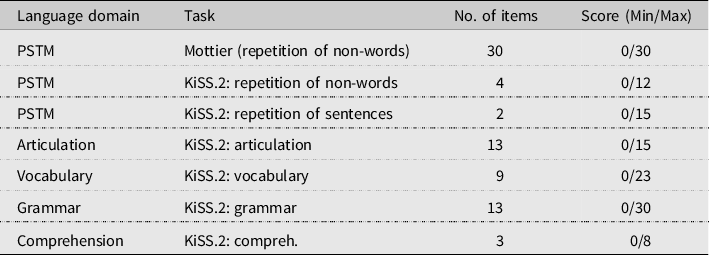
All wrong answers of the children were documented in standardized test batteries. All test sessions were audio recorded to control for possible documentation errors. In case of a low compliance or illness, test sessions were continued on another day. The Mottier Test does not require any special materials, which means that children were asked to repeat several non-words. KiSS.2 utilizes a large picture with objects and situations that are well-known to 4-year-old children (e.g., kindergarten, train, airplane, cars). Children are asked to answer questions such as “What is it?” and “What does it feel like?”. For more details on the procedure of KiSS testings, see, for instance, Zaretsky and Lange (Reference Zaretsky and Lange2017) and Zaretsky et al. (Reference Zaretsky, Lange, Euler, Robinson and Neumann2017). The psychometric properties of KiSS are reported to be very good (e.g., Neugebauer & Becker-Mrotzek, Reference Neugebauer and Becker-Mrotzek2013). Table 1 provides an overview of the applied tests.
Overview of the applied tests

Note. PSTM = phonological short-term memory; Comprehension = speech and language comprehension.
Statistical analyses
To investigate sex differences in several linguistic domains, t tests for independent samples were performed. Additionally, the effect size Cohen’s d was calculated based on mean values and standard deviations (Cohen, Reference Cohen1988). To counteract the problem of alpha-error inflation in multiple statistical comparisons, we applied the Bonferroni as well as the Bonferroni–Holm method (for an overview, see Abdi, Reference Abdi and Salkind2007).
Simple mediation analyses were also performed to investigate whether sex predicts language competence and whether this direct path is mediated by PSTM performance (Mottier/KiSS.2 repetition of non-words/sentences). Specifically, the analyses were performed using the PROCESS macro by Hayes (Reference Hayes2018) for SPSS Statistics, which uses ordinary least squares regression yielding unstandardized path coefficients for total, direct, and indirect effects. Bootstrapping (m = 5,000 bootstrap samples) together with heteroscedasticity-consistent standard errors was employed to compute confidence intervals and inferential statistics. With respect to the tested mediations, effects were considered statistically significant when the confidence interval did not include zero.
Results
Sex differences in language competence
Phonological short-term memory
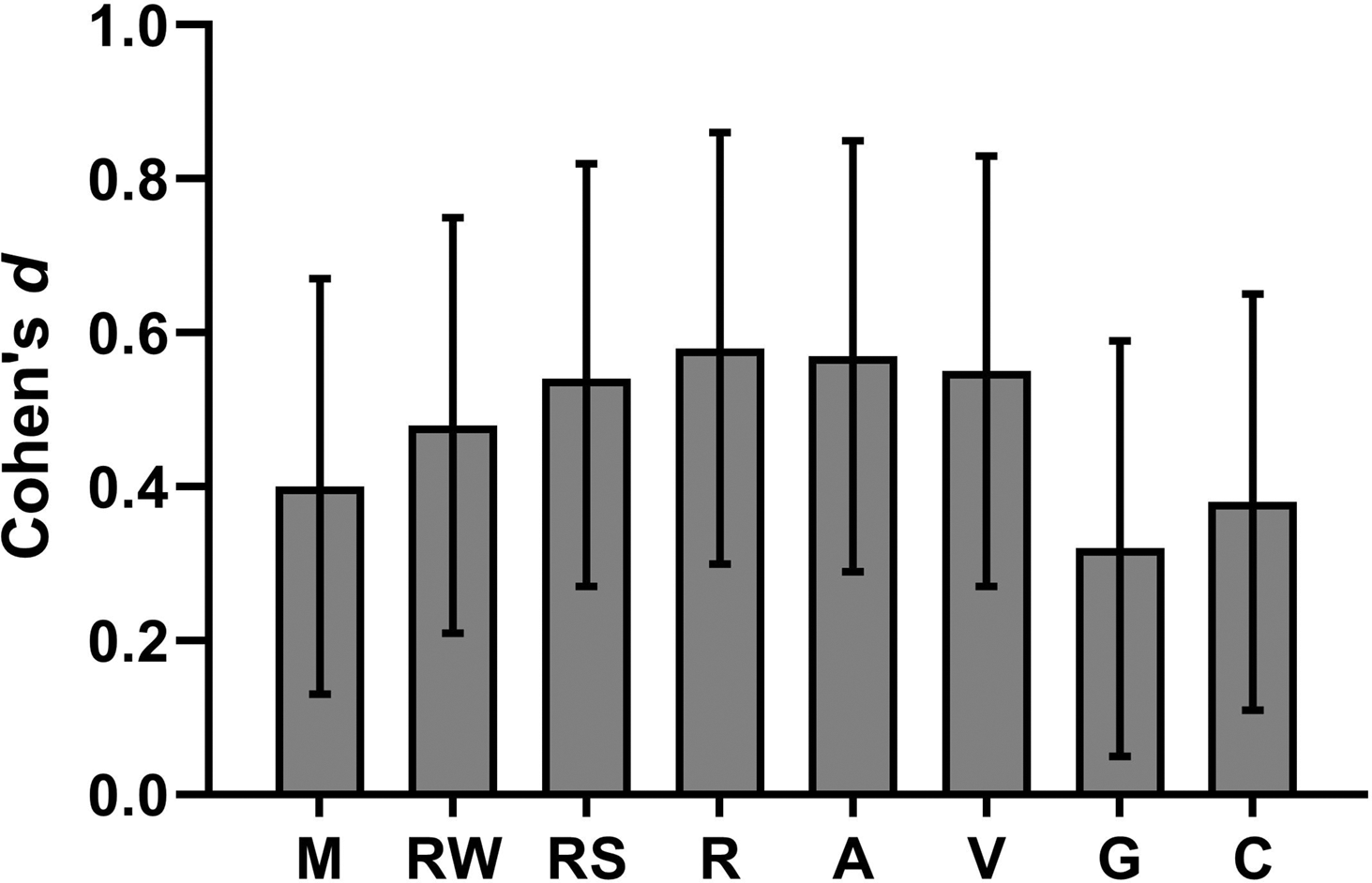
Girls (M = 17.09, SD = 6.05) performed better than boys (M = 14.72, SD = 5.91) on the Mottier Test (t(222) = 2.901, p = .004, d = 0.40, 95% CI[0.13, 0.67]).
Next, we analyzed the KiSS.2 subtests starting with those that investigated PSTM by means of the repetition of non-words and sentences. Girls (M = 2.69, SD = 1.20) performed better than boys (M = 2.07, SD = 1.39) on the KiSS.2 non-word repetition task (t(222) = 3.379, p = .001, d = 0.48, 95% CI[0.21, 0.75]). Girls (M = 11.80, SD = 3.75) also performed better than boys (M = 9.47, SD = 4.94) in the KiSS.2 sentence repetition task (t(213.529) = 3.996, p < .001, d = 0.54, 95% CI[0.27, 0.82]). When investigating the sum score of the two above-noted KiSS.2 PSTM tasks, the advantage of girls (M = 14.49, SD = 4.34) over boys (M = 11.54, SD = 5.89) was—as could be expected given the results of each of the tests—again evident (t(215.647) = 4.294, p < .001, d = 0.58, (95% CI[0.30, 0.86]).
Articulation
Next, we analyzed the remaining KiSS.2 subtests starting with articulation. Girls (M = 8.40, SD = 2.17) performed better than boys (M = 6.96, SD = 2.88) in the subtest of articulation (t(214.319) = 4.246, p < .001, d = 0.57, 95% CI[0.29, 0.85]).
Vocabulary
Girls (M = 7.16, SD = 1.65) demonstrated a better performance than boys (M = 6.11, SD = 2.14) in the KiSS.2 subtest of vocabulary (t(211.836) = 4.142, p < .001, d = 0.55, 95% CI[0.27, 0.83]).
Grammar
The girls’ (M = 7.86, SD = 3.23) performance was significantly better than that of the boys (M = 6.78, SD = 3.54) for the KiSS.2 subtest of grammar (t(222) = 2.305, p = .022, d = 0.32, 95% CI[0.05, 0.59]), although this sex difference was relatively small (see CI).
Speech and language comprehension
Girls (M = 2.56, SD = 0.57) showed better performance than boys (M = 2.28, SD = 0.89) on the KiSS.2 subtest of speech and language comprehension (t(221.936) = 2.899, p = .004, d = 0.38, 95% CI[0.11, 0.65]).
In summary, it became evident that girls performed better than boys in all domains, although some differences were relatively small. Also, after Bonferroni correction, the sex difference in grammar was not statistically significant anymore (adjusted p value = .176), whereas after applying the Bonferroni–Holm method, all sex differences remained statistically significant. Figure 1 illustrates a visual summary of the findings for all language variables mentioned thus far.
Sex differences in different language domains/tests.
Notes: Positive values indicate a female advantage. Error bars show the 95% CI of the effect size Cohen’s d. Abbreviations on the x-axis: M = Mottier Test; KiSS.2: RW = repetition of non-words, RS = repetition of sentences, R = repetition of non-words and sentences, A = articulation, V = vocabulary, G = grammar, C = speech and language comprehension.

When taking the confidence intervals into consideration, five of the eight sex differences (i.e., repetition of non-words, repetition of sentences, repetition of non-words and sentences, articulation, and vocabulary from the KiSS.2) were at least small (d > 0.20; cf. Cohen, Reference Cohen1988) with a probability of 95% and, thus, larger than zero.
The mediation of sex differences in language competence by PSTM
Articulation
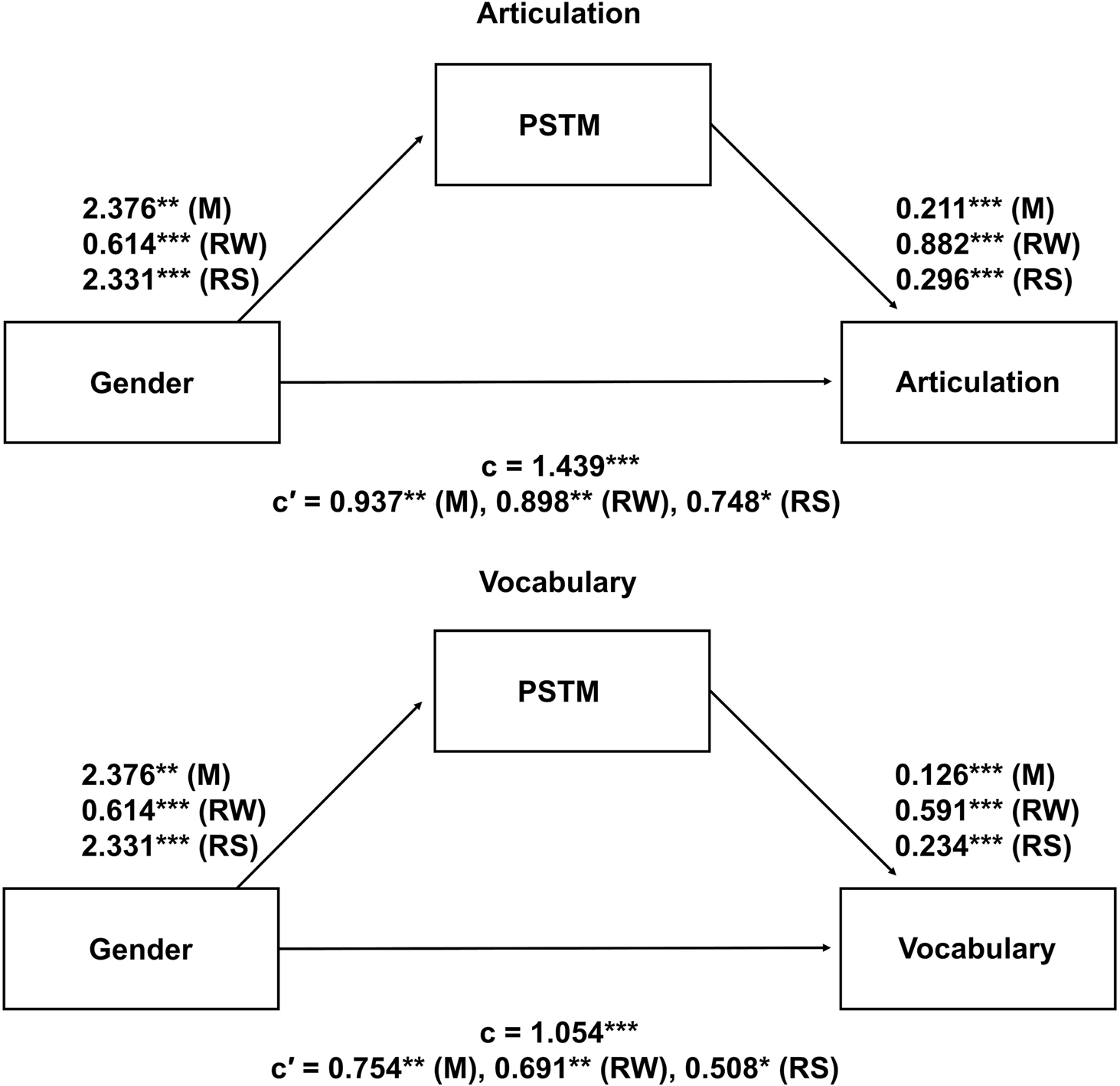
Following the structure established above, we started with articulation. First, we conducted the analysis using the score of the Mottier Test performance as the mediator. As could be expected, a total effect of sex on performance in articulation was observed (B = 1.439, p < .001). After entering the mediator into the model, sex predicted the mediator significantly (B = 2.376, p = .005), which, in turn, predicted articulation (B = 0.211, p < .001). Furthermore, we found that the relationship between sex and performance in articulation was partially mediated by the Mottier Test performance, as the direct effect (B = 0.937, p = .003) was smaller than the total effect. Also, the indirect effect was significant (ab = 0.502, 95% CI[0.167, 0.876]).
Next, we conducted the analysis using the performance on the KiSS.2 subtest of non-word repetition as the mediator. Sex predicted the mediator significantly (B = 0.614, p < .001), which, in turn, predicted performance in articulation (B = 0.882, p < .001). Furthermore, we found that the relationship between sex and articulation was partially mediated by performance on the KiSS.2 non-word repetition task, as the direct effect (B = 0.898, p = .005) was smaller than the total effect. Again, the indirect effect was also significant (ab = 0.541, 95% CI[0.216, 0.909]).
Finally, we conducted the analysis using the performance on the KiSS.2 subtest of sentence repetition as the mediator. Sex predicted the mediator significantly (B = 2.331, p < .001), which, in turn, predicted performance on articulation (B = 0.296, p < .001). We found that the relationship between sex and articulation was partially mediated by performance in the KiSS.2 sentence repetition task, as the direct effect (B = 0.748, p = .015) was smaller than the total effect. The indirect effect was again significant (ab = 0.691, 95% CI[0.333, 1.093]).
Thus, we found evidence for a (partial) mediation of sex differences in articulation by (sex differences in) PSTM.
Vocabulary
The next language domain investigated was vocabulary. Again, the Mottier Test performance was chosen first as the mediator. As could be expected, a total effect of sex on vocabulary performance was observed (B = 1.054, p < .001). Sex predicted the mediator, which in turn predicted vocabulary performance (B = 0.126, p < .001). Furthermore, we found that the relationship between sex and vocabulary was partially mediated by Mottier Test performance, as the direct effect (B = 0.754, p = .002) was smaller than the total effect. Again, we found a significant indirect effect (ab = 0.300, 95% CI[0.093, 0.549]).
Next, we conducted the analysis using the performance on the KiSS.2 subtest of non-word repetition as the mediator. Sex predicted the mediator, which, in turn, predicted vocabulary performance (B = 0.591, p < .001). Furthermore, we found that the relationship between sex and vocabulary was partially mediated by performance in the KiSS.2 non-word repetition task, as the direct effect (B = 0.691, p = .006) was smaller than the total effect. Again, the indirect effect was significant (ab = 0.363, 95% CI[0.149, 0.630]).
Finally, we conducted the analysis using the performance on the KiSS.2 subtest of sentence repetition as the mediator. Sex predicted the mediator, which, in turn, predicted vocabulary performance (B = 0.234, p < .001). Furthermore, we found that the relationship between sex and vocabulary was partially mediated by performance on the KiSS.2 sentence repetition task, as the direct effect (B = 0.508, p = .032) was smaller than the total effect. Again, the indirect effect was significant (ab = 0.547, 95% CI[0.263, 0.885]).
To summarize the results of the mediational analyses thus far, sex differences both in articulation and in vocabulary were partially mediated by PSTM measures. Figure 2 provides a visual summary for both domains.
Partial mediations between sex and performance in articulation (top) and vocabulary (bottom) by measures of phonological short-term memory (Mottier Test, repetition of non-words, repetition of sentences).
Notes: * p < .05, ** p < .01, *** p < .001. Abbreviations: PSTM = phonological short-term memory, M = Mottier Test; KiSS.2: RW = repetition of non-words, RS = repetition of sentences.

Grammar
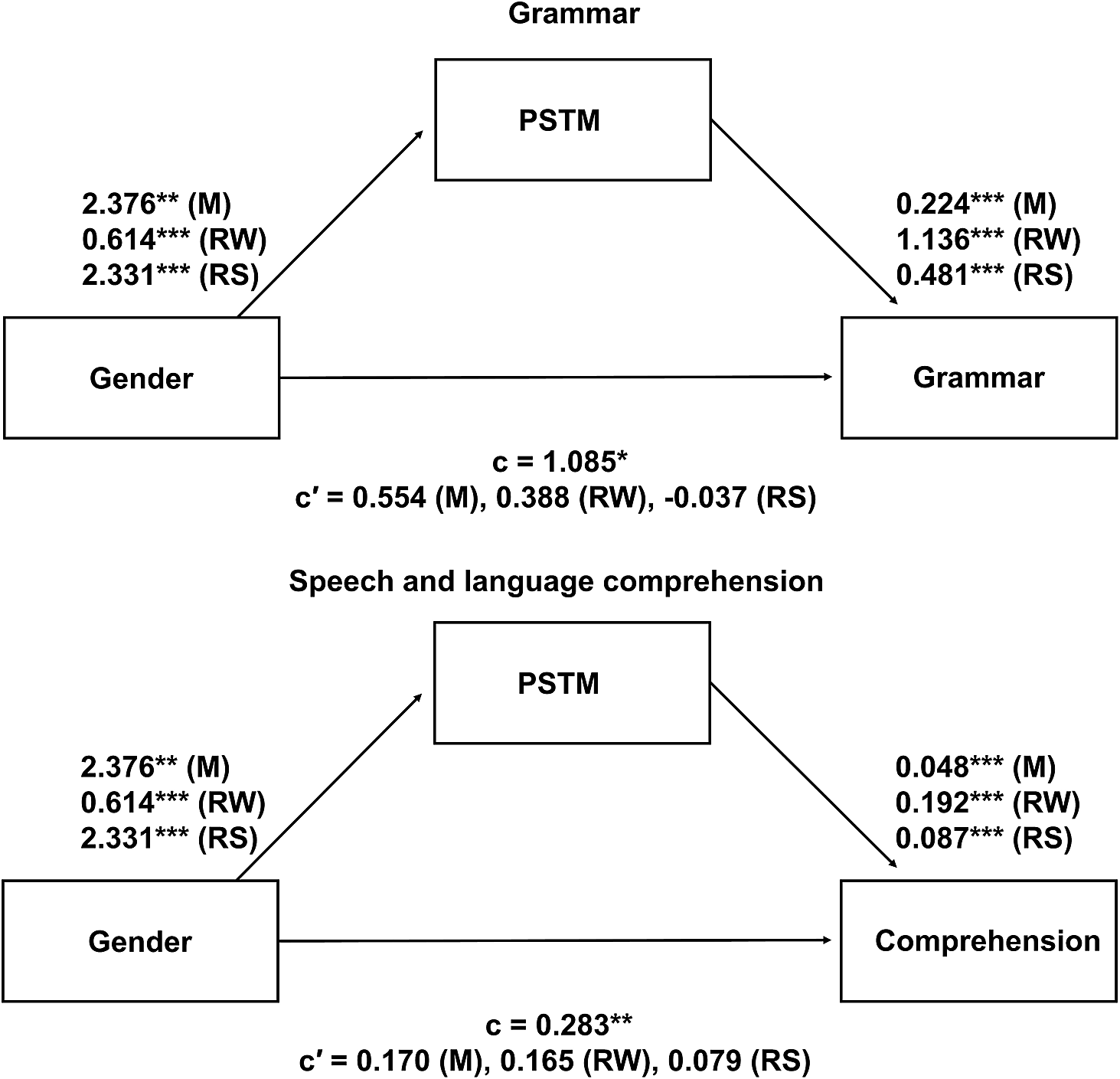
The next language domain investigated was grammar. Again, the Mottier Test performance was chosen first as the mediator. As could be expected, a total effect of sex on grammar performance was observed (B = 1.085, p = .020). Sex predicted the mediator, which, in turn, predicted performance on grammar (B = 0.224, p < .001). Furthermore, we found that the relationship between sex and grammar was fully mediated by the Mottier Test performance as the direct effect (B = 0.554, p = .193) was not significant, whereas the indirect effect was (ab = 0.531, 95% CI[0.156, 0.941]).
Next, we conducted the analysis using performance on the KiSS.2 subtest of non-word repetition as the mediator. Sex predicted the mediator, which in turn predicted performance in grammar (B = 1.136, p < .001). Furthermore, we found that the relationship between sex and grammar performance was fully mediated by performance in the KiSS.2 non-word repetition task because the direct effect (B = 0.388, p = .376) did not reach significance, while the indirect effect did (ab = 0.697, 95% CI[0.278, 1.167]).
Finally, we conducted the analysis using performance on the KiSS.2 subtest of sentence repetition as the mediator. Sex predicted the mediator, which, in turn, predicted grammar performance (B = 0.481, p < .001). Furthermore, we found that the relationship between sex and grammar performance was fully mediated by performance on the KiSS.2 sentence repetition task, as the direct effect (B = -0.037, p = .921) was not even remotely significant, whereas for the indirect effect, a significant result was obtained (ab = 1.122, 95% CI[0.558, 1.701]).
Thus, we found evidence for a (full) mediation of sex differences in grammar by (sex differences in) PSTM.
Speech and language comprehension
Finally, we investigated speech and language comprehension. Again, the Mottier Test performance was chosen first as the mediator. As could be expected, a total effect of sex on performance in comprehension was observed (B = 0.283, p = .004). Sex predicted the mediator, which, in turn, predicted performance in comprehension (B = 0.048, p < .001). Furthermore, we found evidence that the relationship between sex and comprehension performance was fully mediated by the Mottier Test performance, as the direct effect (B = 0.170, p = .063) barely failed statistical significance, whereas the indirect effect was significant (ab = 0.113, 95% CI[0.035, 0.209]).
Next, we conducted the analysis using performance on the KiSS.2 subtest of non-word repetition as the mediator. Sex predicted the mediator, which, in turn, predicted comprehension performance (B = 0.192, p < .001). Furthermore, we found that the relationship between sex and comprehension was fully mediated by the performance on the KiSS.2 non-word repetition task because the direct effect (B = 0.165, p = .081) did not reach significance, while the indirect effect did (ab = 0.118, 95% CI[0.040, 0.219]).
Finally, we conducted the analysis using performance on the KiSS.2 subtest of sentence repetition as the mediator. Sex predicted the mediator, which, in turn, predicted comprehension (B = 0.087, p < .001). Furthermore, we found that the relationship between sex and language comprehension was fully mediated by performance on the KiSS.2 sentence repetition task, as the direct effect (B = 0.079, p = .349) was not significant, whereas for the indirect effect, a significant finding was obtained (ab = 0.204, 95% CI[0.099, 0.328]).
To summarize the results, sex differences both in grammar and speech and language comprehension were fully mediated by PSTM measures. Figure 3 presents a visual summary for both domains.
Full mediations between sex and performance on grammar/speech (top) and language comprehension (bottom) by measures of phonological short-term memory (Mottier Test, repetition of non-words, repetition of sentences).
Notes: * p < .05, ** p < .01, *** p < .001. Abbreviations: PSTM = phonological short-term memory, M = Mottier Test; KiSS.2: RW = repetition of non-words, RS = repetition of sentences.

Discussion
Sex differences in language competence
A large body of psycholinguistic research on sex differences in language development exists (e.g., Lange et al., Reference Lange, Euler and Zaretsky2016; for an overview, see Wallentin, Reference Wallentin2009). That there is an early advantage for girls in regard to vocabulary acquisition, among other domains, that seems to decrease and then vanish with age can be considered a very robust finding (e.g., Lange et al., Reference Lange, Euler and Zaretsky2016; Toivainen et al., Reference Toivainen, Papageorgiou, Tosto and Kovas2017; for an overview, see Wallentin, Reference Wallentin2009; but see also Rice & Hoffman, Reference Rice and Hoffman2015). Despite this plethora of research, one area of language development, namely PSTM, has been mostly neglected with respect to sex differences. Where relevant research exists, it resulted mostly in null or inconsistent findings. To be precise, most studies (e.g., Ash et al., Reference Ash, Redmond, Timler and Kean2017; Kazemi & Saeednia, Reference Kazemi and Saeednia2017; Topbaş et al., Reference Topbaş, Kaçar-Kütükçü and Kopkalli-Yavuz2014) have not found sex differences in PSTM performance. Only a few (e.g., Krishnan et al., Reference Krishnan, Alcock, Carey, Bergström, Karmiloff-Smith and Dick2017; Lange et al., Reference Lange, Euler and Zaretsky2016) found a slightly better performance by girls, while—to the best of our knowledge—one study found a male advantage (Farmani et al., Reference Farmani, Sayyahi, Soleymani, Zadeh Labbaf, Talebi and Shourvazi2018). Furthermore, many findings on sex differences in PSTM were mere side effects of the respective studies, as their goal was not to investigate sex differences in PSTM but differences in other linguistic domains or language development, in general, or to validate a language test such as the HASE (Schöler & Brunner, Reference Schöler and Brunner2008). Therefore, with respect to sex differences in PSTM, there was a strikingly large and significant research gap, which is somewhat surprising given the importance of PSTM for language development (Baddeley, Reference Baddeley2003), while acknowledging the robust finding of an early female advantage in language development (Wallentin, Reference Wallentin2009).
Hence, in the current study, we examined not only sex differences in articulation, vocabulary, grammar, and speech and language comprehension in 4-year-old children but also sex differences in PSTM performance by means of several tests involving the repetition of non-words and sentences.
In line with previous research (e.g., Lange et al., Reference Lange, Euler and Zaretsky2016), we found that girls performed better than boys in all linguistic domains, although not all differences were statistically significant after Bonferroni correction and although some effect sizes were small. Specifically, girls performed better than boys, particularly in articulation and vocabulary but also in the PSTM domain, that is, in the repetition of non-words as well as in the repetition of sentences.
We checked for several variables whether they were confounded with sex (e.g., age, length of kindergarten attendance, and intelligence). As there were no such confoundings, we are confident that we actually found differences between females and males (and not differences between other groups). It has to be noted though that we have only investigated sex differences in language competence in preschool children (for sex differences in language competence from childhood to adult age, see, for instance, Rice & Hoffman, Reference Rice and Hoffman2015).
The mediation of sex differences in language competence by PSTM
Based primarily on the fundamental importance of PSTM for language development, particularly with respect to the acquisition of vocabulary (for an overview, see Baddeley, Reference Baddeley2003; Szmalec et al., Reference Szmalec, Brysbaert, Duyck, Altarriba and Isurin2013) but also on the finding that girls outperformed boys in vocabulary, among other language domains, while also showing better PSTM performance, we further investigated whether the sex differences we found for articulation, vocabulary, grammar, and speech and language comprehension were mediated by sex differences in PSTM (i.e., in the repetition of non-words and sentences). To the best of our knowledge, our study is the first of this kind.
Indeed, mediation analyses revealed that the obtained sex differences in articulation and vocabulary were partially mediated by (sex differences in) PSTM, while sex differences in grammar and speech and language comprehension were fully mediated by such differences in PSTM. Yet it must be emphasized that sex differences in vocabulary and, possibly, even in articulation are relatively robust, while those in other domains (e.g., grammar; see above) are particularly small (cf. Lange et al., Reference Lange, Euler and Zaretsky2016).
The question arises how exactly sex differences in PSTM might lead to sex differences in language development. What are the cognitive mechanisms behind this relation? For now, we can only speculate on this, but deem the following to be likely. Taking vocabulary as an example, any new word has to enter and pass the PSTM successfully to be acquired (e.g., Newbury et al., Reference Newbury, Klee, Stokes and Moran2015). So, if the PSTM constitutes a bottle neck for new words that are about to be acquired, individuals with larger or more advanced PSTM capacities (with girls having such an advantage over boys on average) will end up having larger vocabularies. While this seems reasonable, it automatically leads to another question, namely why girls have better PSTM abilities than boys on average to start with. Despite biological factors, for instance prenatal testosterone (e.g., Lange, Reference Lange2015) or genetic factors (e.g., Galsworthy et al., Reference Galsworthy, Dionne, Dale and Plomin2000; Van Hulle et al., Reference Van Hulle, Goldsmith and Lemery2004), research comes into mind showing that girls and boys are treated and talked to differently in many ways (e.g., Fivush et al., Reference Fivush, Brotman, Buckner and Goodman2000). A meta-analysis by Leaper et al. (Reference Leaper, Anderson and Sanders1998), for instance, found that mothers talk more with their daughters than with their sons. There is a plethora of research demonstrating that such social factors (e.g., the quantity and quality of language input) contribute to children’s language development (e.g., Adams et al., Reference Adams, Marchman, Loi, Ashland, Fernald and Feldman2018; Huttenlocher et al., Reference Huttenlocher, Vasilyeva, Cymerman and Levine2002; Pan et al., Reference Pan, Rowe, Singer and Snow2005; Pancsofar & Vernon-Feagans, Reference Pancsofar and Vernon-Feagans2006; Rowe, Reference Rowe2008, Reference Rowe2012; for an overview, see Hoff, Reference Hoff2006)—probably, among others, by improving the children’s speech processing efficiency (Hurtado et al., Reference Hurtado, Marchman and Fernald2008; Weisleder & Fernald, Reference Weisleder and Fernald2013). It has to be noted though that biological along with socio-cultural factors might best explain language development. For instance, in case of a correlation between child-directed parental speech on the one hand and language competence of the respective children on the other hand, genes and environments are probably not uncorrelated (Huttenlocher et al., Reference Huttenlocher, Vasilyeva, Cymerman and Levine2002). Also, cross-cultural data indicate that an early female advantage in language competence is quite robust, indicating biological factors. However, this does not exclude social factors entirely (Eriksson et al., Reference Eriksson, Marschik, Tulviste, Almgren, Pérez Pereira, Wehberg, Marjanovič-Umek, Gayraud, Kovacevic and Gallego2012).
Summary, conclusion, practical implications, and future research
A large body of research has demonstrated sex differences in early language development (e.g., Lange et al., Reference Lange, Euler and Zaretsky2016). In line with this, we found that girls performed better than boys, particularly in articulation and vocabulary. In addition to the existing research, we found that girls performed better on PSTM tasks (i.e., the repetition of non-words and sentences). Furthermore, sex differences in PSTM were able to explain sex differences in other linguistic domains. As stated above, future studies should replicate the respective findings of the present research, particularly those on sex differences in PSTM performance and on the mediation of sex differences in several linguistic domains by PSTM performance because the results of a single study are not as trustworthy as the results of many studies on a certain research topic. If sex differences in PSTM exist, it is crucial to find explanations for these differences. Hence, future research needs to identify the factors responsible for the sex difference in PSTM.
Our findings from the mediation analyses could turn out to be important for several reasons. One is that this is the first study of its kind, to the best of our knowledge. Another is that the present study underlines the importance of PSTM for language development, in general, and for explaining individual differences (cf. Baddeley, Reference Baddeley2003; Szmalec et al., Reference Szmalec, Brysbaert, Duyck, Altarriba and Isurin2013), in particular—in our case, sex differences in language development. A third reason—given that the results of the study at hand can be replicated—is that the findings help explain sex differences in language development, for instance, with respect to vocabulary (see, for example, Adani & Cepanec, Reference Adani and Cepanec2019, and Lange et al., Reference Lange, Euler and Zaretsky2016, for a discussion on different [and competing] explanations of sex differences in language development). If sex differences in PSTM exist, it could be considered crucial to find explanations for these differences to be able to identify factors that could be used in language-assistance programs, particularly for boys. Future research could try to identify the factors responsible for the sex difference in PSTM to develop appropriate training programs, among other interventions. Hence, a fourth reason is that the study suggests, as a practical consequence, that language-training programs aimed at assisting boys, who are over-represented among children with relatively low language competence (for an overview, see, e.g., Adani & Capanec, Reference Adani and Cepanec2019), might focus on PSTM. This can be derived not only from the fact that PSTM plays a decisive role in language development (Baddeley, Reference Baddeley2003) but mainly from our finding that sex differences in several linguistic domains could be mediated by PSTM performance. Still, it has to be noted that replicating our findings on the mediating role of the PSTM should have priority. There are already several such programs aimed at short-term/working memory resources (see, for instance, Gathercole et al., Reference Gathercole, Dunning, Holmes and Norris2019; Karousou & Nerantzaki, in press; von Bastian & Oberauer, Reference Von Bastian2013) that could aid children (particularly boys) to improve their PSTM competence and, thereby, potentially their language competence, in general, although we must be cautious, as more research is needed to clarify whether the effects of such training are not merely small and short-term and, furthermore, if the effects are generalizable across different domains (see Melby-Lervåg & Hulme, Reference Melby-Lervåg and Hulme2013). Before focusing on the practical application of the research results, however, further research is needed that investigates whether the mediation of sex differences in several areas of language competence by PSTM can be considered robust.