In 1900, French musicology was still in its infancy, and its role in institutions of higher education remained very limited. It was not until the mid-1890s that the Sorbonne accepted musicological topics for doctoral dissertations and the philosopher Lionel Dauriac gave the first open lectures on the psychology of the musician and musical aesthetics. There was one exception: the music-history class at the Paris Conservatoire, led by Louis-Albert Bourgault-Ducoudray, who was appointed professor of music history in 1878. It was only with the following generations – first, that of Romain Rolland (1866–1944) and Jules Combarieu (1859–1916), then that of Louis Laloy (1874–1944),Footnote 1 Henry Prunières (1886–1942)Footnote 2 and Paul-Marie Masson (1882–1954)Footnote 3 – that the situation would change.
In a context where French culture and patrimony were embroiled in issues of Third Republic nationalism, the dynamics with regard to modernism and internationalism quickly became complex. Indeed, the fact that French musicology in 1900 reflected the social and institutional divisions so characteristic of French artistic circles, but in myriad shades, made it all the more unique. Between 1890 and 1914, the field of music was divided into several factions, with the Conservatoire on one side and the Schola Cantorum on the other.Footnote 4 Musicologists moved from one institution to another. The disparate nature of French musicology can be explained by the fact that it encompassed a wide variety of trends. Through the work of Rolland,Footnote 5 Lionel de La LaurencieFootnote 6 and Prunières there were important rediscoveries of the Middle Ages,Footnote 7 as well as renewed interest in the RenaissanceFootnote 8 and, more specifically, the Baroque, both Italian and French. Along with the considerable influence of the Schola Cantorum, which would play a central role in the promotion of these repertories, there was a surge of recognition during the first decade of the twentieth century that the study of history and the analysis of national repertories were of the utmost importance for the edification of living contemporary musical culture.Footnote 9 In other words, even if the discipline tended to favour the return of repertories of the past, some scholars, such as Laloy, worked on the development of modern music.
The first steps towards the institutionalization of musicology were initiated by a series of scholarly events. In 1894, Combarieu defended his dissertation in music history at the Sorbonne; Rolland followed suit in 1895. Meanwhile, Dauriac inaugurated the Sorbonne's first courses on music. In 1902, the École des Hautes Études Sociales (EHES) organized an annual series of lectures on music history under the supervision of Rolland. Combarieu was awarded a chair in music history at the Collège de France in 1904 and, in the same year, Rolland was named professor of music history at the Sorbonne. And yet these events did not lend any real structure to the field, as interests remained too disparate, research was conducted discretely and academic findings were rarely communicated to the public. It would take something more to unify French musicological forces. That catalyst was the International Conference of Music History that took place between 23 July and 29 July 1900, as part of the Paris World Fair. Presided over by Bourgault-Ducoudray, the music-history conference was incorporated in the more general framework of the Conference of Comparative History, which comprised eight sections.Footnote 10 Although most of those who attended the conference were French, among the 87 participants were reputable German and Austrian musicologists such as Hugo Riemann and Guido Adler, as well as the Englishman John South Shedlock, the Belgian Charles Meerens and the Italian Giovanni Tebaldini. In 1901, Combarieu published a summary of the conference that included some of the papers organized by topic: Greek, Byzantine, medieval and modern music.Footnote 11 Following the conference, Combarieu decided to establish a journal dedicated to music history: La revue musicale.Footnote 12 But he did not act alone. He joined forces with Laloy, who would become editor-in-chief of the journal in 1903, as well as with the medievalist Pierre Aubry, and with Maurice Emmanuel and Rolland.
The journal was conceived as a wellspring for the new discipline of French musicology. In a memo circulated in December 1900 to potential subscribers, Combarieu wrote:
It gives me great honour to draw your attention to the following project. It is one that will interest all those involved in history, philology and aesthetics. After coming to a common agreement, MM. Romain Rolland […], Emmanuel […], Vincent d'Indy, Aubry […], former student of the École des Chartes; [and] the undersigned felt it was the right moment to establish a Journal of Music History and Criticism, which would have as its principle objective the application of those methods employed in history's auxiliary sciences to the study of French and early musical works. The journal will fill a lacuna in higher education by connecting to philology [the art of music,] an art without which we could not acquire full knowledge of ancient civilization and poetry, nor of the evolution that has taken place in our civilization and in modern thought since the Renaissance. The journal will also devote much space to the analysis of contemporary works. By grouping these new contributions together, it will, I hope, lead to a General History of Music.Footnote 13
In November 1902, Combarieu and his colleagues printed a letter to their readers in which they specified the objectives of their venture:
We wanted to show that music was not a pariah among the arts; that it deserved, just like poetry or painting, to occupy a place in the history of the human spirit, from which it might translate the most lofty thoughts. […] We wished to respond to the [public's] noble curiosity and its desire to learn. In witnessing our country's musical renaissance, we wanted to act as humanists. Our first concern was to provide studies that are perfectly worthy of those methods that we saw being applied all around us in other branches of history to all the important historical questions. It is possible to speak of Roland de Lassus, Couperin, Rameau or Bach without succumbing to the empty loquacity of one like Fétis, or [using] the pretentious discourse of some fashionable speaker (of former times) […]. And that's not all. The history of music is not finished: it progresses before our eyes through the creation of new works. Thus in addition to [issues of] history, we also provided from the beginning a place for criticism […]. [Musical] works are surfacing everywhere […]. Many of them betray a strong character; some are of quite superior quality. We are devoted to the study of these works; without any bias [towards a particular school], without engaging in coterie, we accept those that appear worthy of public interest. In our criticism as in our history, we proceed with texts in hand, we do not claim anything without evidence, and we have no ambition other than to express our opinions.Footnote 14
The twofold objective of this ‘Journal of Music History and Criticism’Footnote 15 appeared to be to fill the gap left by a musical press that rarely published musicological studies. However, the final sentence in the letter to the readers suggests that these two approaches might be difficult to separate at times. The fact that the journal's founders sought to ‘express their opinions’ eloquently testifies to this potent mix of history and criticism, of musicology and the appraisal of art. In addition to the confusion of epistemological approaches lay another that dominated the structure of a journal which published musicological texts (both historical and analytical), opinion pieces and reviews of books and concerts. The physical organization of the journal, and of those that came after, did not always allow for an easy distinction of textual genres. Although the concert reviews were situated in the second section of the journal and almost always grouped in a segment initially entitled ‘Contemporary Music’ (‘Musique contemporaine’) and later ‘Concerts’, the first section of the journal was much more heterogeneous, with regard both to genre (either scholarly text or piece of criticism) and to the subjects broached.
The Revue musicale's heterogeneity at its initial foundation prevented it from becoming a veritable musicological journal in the long run. It also led to much frustration, particularly for Rolland, who did not really appreciate the work of Combarieu, particularly his music reviews. As for the journal's evolution after 1904, the year in which Combarieu became professor at the Collège de France and Rolland abandoned the project, it is best appreciated in light of the rupture between the two musicologists and the foundation of the journal Le mercure musical (which will be discussed below). Despite some decline in status, as its pages became filled with Combarieu's lectures and criticism after 1905, the Revue musicale nevertheless symbolized the transformation taking place in the field of musicology in France, as those in the field were no longer content with amateurish biographies of musicians or anecdotal concert reviews. Obviously, music history assumed a dominant position. While issues of aesthetics were often placed alongside the study of musical systems or even concert reviews, those studies more relevant to the social sciences – like sociology or psychology – became increasingly prevalent in the pages of the Revue musicale.Footnote 16 The hard sciences were less well represented. Acoustics, for example, was largely integrated into studies of aesthetics.Footnote 17 The diversity of subjects and the disparities in approach in Combarieu's journal would, however, endure in the editorial programming in subsequent journals. The Mercure musical and the Revue musicale would thus not be able during the 1920s and 1930s to escape this assortment of textual genres and subjects. All the same, this diversity and variety of approaches were also part and parcel of those elements that connected the journal to the EHES.
Ties with the EHES
The École des Hautes Études Sociales was founded in 1899 by Dick May, whose real name was Jeanne Weill (1859–1925). Partially modelled on the free universities, the EHES was supported and sustained by many intellectuals of the time.Footnote 18 The director of the Institut Pasteur, Émile Duclaux, the dean of the Sorbonne, Alfred Croiset, the editor Félix AlcanFootnote 19 and Rolland were among those who supported the writer's initiative. The goal of the EHES was the advancement of the social sciences through a moralistic and egalitarian conception of knowledge within a modern society. The EHES was organized into four schools: the School of Ethics and Pedagogy (École de morale et pédagogie), the School of Social Studies (École sociale), the School of Journalism (École de journalisme) and the School of Arts (École d'arts). Not long after launching the Revue musicale, in May 1902 Rolland founded the music section of the School of Arts at May's request. Rolland asked that the journal's principal contributors (Aubry, Combarieu, Laloy, Charles Malherbe and Julien Tiersot) be invited to give lectures.Footnote 20 The links between the EHES and the Revue musicale were important,Footnote 21 not least because they shared common goals. Years later, in 1911, Rolland summarized their objectives in a recollection of the events that led up to the creation of the music lectures at the EHES. In the wake of the conference at the Paris World Fair, which had finally provided French musicologists with an opportunity to assemble, the first of these objectives
consisted of organizing and centralizing the movement, of gathering all the dispersed forces who yielded all too easily to the individualist proclivity of the French character, always inclined towards working alone, and only mildly curious of others’ work [… the] second was to show the wider public a portion of the musical treasure that had been amassed through 20 years of quiet research by those explorers of France's past.Footnote 22
This second objective was vital, as it clarified the reach of a discipline not just towards specialists, but also, first and foremost, towards amateurs of music who sought to further their knowledge. French musicology was thus being constructed in accordance with the republican project of educating the nation. To paraphrase Jann Pasler, here was an attempt at the ‘musicologisation of the citizen’.Footnote 23 A third objective had to be met in order to realize such an achievement: ‘to show the intellectual elite who make up the School's teaching faculty and public the importance of the history of music in the overall evolution of the human spirit, and to claim a place for music history within general history that had been, up until now, denied in France’.Footnote 24
Rolland gave the inaugural address in the lecture series on music in May 1902, and his talk was then published in the next month's issue of the Revue musicale. The article, entitled ‘Music and General History’,Footnote 25 was preceded by a statement from the editors that attested to the close relationship between musicological activity at the EHES and the journal's editorial programme: ‘One thus finds the eloquent expression of those ideas that led to the establishment of the Revue d'histoire et de critique musicales.’Footnote 26 Rolland effectively set the scene, not only for Combarieu's journal but also for the Mercure musical (later the Revue musicale SIM) as well as Prunières's Revue musicale. The principal idea of his article was the integration of music history within the social sciences, in addition to its strong connection with other forms of art:Footnote 27
Music confuses those who cannot understand it on their own; its substance seems elusive; it is beyond reason, it seems to have no contact with reality. How might history help to grasp that which seems, in its very essence, beyond space, beyond history? First of all, it is not precisely the case that music is, in fact, so abstract; it has much in common with literature, theatre and contemporary life. No one would question the fact that the history of opera, for example, furnishes much interesting information on the history of morals, fashionable life and public taste. All forms of music are connected with a certain form of society, and ease its comprehension. On the other hand, in many cases the history of music has strong connections with the histories of other arts. The arts are constantly influencing one another, by interpenetration, by mutual permeation or, as a consequence of their natural evolution, by managing to reach beyond their own borders into those of neighbouring arts.Footnote 28
With the exception of Dauriac's courses on ‘The Psychology of Musical Functions: Studies on Musical Intelligence and Musical Emotion’ (‘Psychologie des fonctions musicales: Études de l'intelligence musicale et de l’émotion musicale’), those of Amédée Gastoué on ‘Psychological Theories of the Scale’ (‘La théorie psychologique de la gamme’) and Combarieu's lessons on ‘Music from a Sociological Perspective’ (‘La musique au point de vue sociologique’), most of the courses at the EHES were historical in nature.Footnote 29 And as for the sociological approach proposed by Combarieu, one should not be misled by the title of his course. As Rémy Campos has shown in his study on philology and sociology in relation to the French musical milieu, Combarieu often ‘yielded to the “tropism of the aesthete”’ and ‘rarely went beyond journalistic rhetoric’.Footnote 30 Although Rolland's initiative made history the backbone of the music section of the EHES, he also advocated for diversity in disciplinary approaches, even if this was not always realized in concrete terms in the programming of the music lectures at the EHES. Combarieu's work, at first sight at least, thus fitted the bill perfectly. The diverse professional profiles of Rolland's colleagues at the EHES were very similar to those at Combarieu's Revue musicale. As Campos has astutely observed, Combarieu was part of a group of music scholars who had very different kinds of academic training from each other and whose professional activities varied between writing books for music amateurs, teaching and music criticism.Footnote 31 This diversity was reflected in the contents of Combarieu's journal. The list of participants in the music lecture series at the EHES in 1903, presented in Table 1, illustrates the remarkable differences with regard to their training and professional activity. Of the 13 speakers, eight (identified by asterisks) published articles related to their talk at the EHES in the Revue musicale in the course of the year.
| Name | Profession | Institution | Topic |
|---|---|---|---|
| Aubry, PierreFootnote * | archivist | Institut Catholique de Paris | The history of French music, from its origins to the Renaissance |
| Combarieu, JulesFootnote * | managing director; professor |
Revue musicale (1901) Collège de France |
Music from a sociological perspective |
| Dauriac, Lionel | professor (honorary) | Université de Montpellier | Richard Wagner |
| Expert, Henry | professor | École Niedermeyer | French music of the Renaissance |
| Hellouin, Frédéric | critic | Gossec | |
| Houdard, Georges | professor (independent) | Sorbonne | The evolution of musical rhythm, from antiquity to the Renaissance |
| d'Indy, VincentFootnote * | composer and professor | Schola Cantorum | César Franck |
| Laloy, LouisFootnote * | editor-in-chief | Revue musicale (1901) | The music of antiquity and Gregorian chant |
| Lichtenberg, Henri | professor | Université de Nancy (Faculty of Arts) | Aesthetics and the history of modern music |
| Malherbe, CharlesFootnote * | archival librarian | Bibliothèque de l'Opéra | Berlioz's Romanticism |
| Reinach, ThéodoreFootnote * | Ph.D. | Melody in Greek music | |
| Rolland, RomainFootnote * | professor | École Normale/Sorbonne | The origins of opera |
| Tiersot, JulienFootnote * | librarian | Conservatoire National de Musique | Music during the Revolution |
* Lecturers who published in the Revue musicale an article related to their EHES lecture.
Although the journal is generally considered to be Combarieu's project (he certainly wrote extensively in it), we might regard Rolland as the real mastermind. The correspondence and observations of his contemporaries attest to the central role he played in getting the project off the ground and in the journal's strong emphasis on history and the cultural history of music.Footnote 32 Indeed, the fact that Rolland envisaged, above all else, an intellectually rigorous project, with the exception of the music criticism section, put him swiftly at odds with Combarieu, who enjoyed the work of criticism. Combarieu was extensively involved with the music criticism in his journal, and devoted an increasing amount of space to concert reviews. The diversity of the journal's contents sheds light on Combarieu's conception of musicology in general and on the teaching and dissemination of musicology to the public; what is more, it also exemplifies the two men's divergent viewpoints. Their mutual hostility was certainly exacerbated when the Collège de France, upon receiving Louis Mors's donation of 30,000 francs, proposed a course on music history and asked Combarieu to teach (which he did until 1910), even though Rolland was also a potential candidate.Footnote 33 It is therefore not surprising that, in his article dedicated to the music section at the EHES published in the 1911 anniversary pamphlet, Rolland listed the names of the speakers and the subjects discussed – all the while omitting Combarieu's lectures.
A brief overview of Combarieu's career may be helpful here. Combarieu studied literature at the Sorbonne and took courses with the German musicologist Philipp Spitta in Berlin in 1888. He began teaching literature first in Cahors, his home town, and then in Paris at two colleges, the Condorcet and the Louis-le-Grand. As already mentioned, he defended his doctoral dissertation, entitled ‘The Connections between Poetry and Music, Considered from the Perspective of Expression’ (‘Le rapport de la poésie et de la musique considérées du point de vue de l'expression’), in 1894. In addition to publishing his work in the Revue musicale, he also published two important books: La musique, ses lois et son évolution (Music, its Laws and its Evolution) in 1907 and La musique et la magie (Music and Magic) in 1909.Footnote 34 In his examination of these two works, Campos provided the keys to understanding Combarieu's musicological and sociological approach,Footnote 35 which, by all accounts, remained unconvincing for Rolland and some of the younger musicologists, including one of his students, Prunières. Even though Combarieu accepted that the study of music relies on acoustics, physiology, mathematics, psychology, aesthetics, history and sociology, he felt that drawing on all these disciplines at once was inconceivable. In doing so, the researcher would certainly be confronted with notions that juxtaposed – or even contradicted – one another, without acquiring any sense of the whole and, what is more, with an excessive amount of information which was then weakened by an ambiguity that plagued the findings of those disciplines new to the study of music.Footnote 36 Combarieu also questioned the historical approach, which
requires the use of a purely historical point of view, where one steps aside only to draw conclusions. One takes music at its first known appearance and describes it, without making any philosophical generalizations, or [accounting for] its progression through time. Acoustics and physiology become but stops along the road; one introduces them at the appropriate place in the order of things, at the moment where they become sciences: in other words, fairly late. Once the long exposition has been completed, one then attempts to get a sense of the whole. This […] method is appealing as, rather than focusing on the theorist, one can to some extent speak about the things themselves. But in reality it is unfeasible. If, before probing some period in history, we do not begin by providing as clear an answer as possible to the question: what is music? how could we even identify, let alone interpret, those things that are of interest to us?Footnote 37
The answer that Combarieu provided to his own question is fairly simple: music is ‘the art of thinking with sound’ (‘l'art de penser avec des sons’). To this answer Campos suggests appending Combarieu's second proposal: ‘Musical thought is the manifestation of a general yet profound instinct, more or less obscure, but widely recognized by humankind’ (‘La pensée musicale est la manifestation d'un instinct général et profond, plus ou moins obscur, mais partout reconnaissable dans l'humanité’).Footnote 38 In postulating that music was intimately linked to social life in the past, and therefore rendering it impossible to approach music as an autonomous object, Combarieu rejected Eurocentrism and historicism by favouring an approach that strives towards the sociological and casts aside aesthetics for a philology ‘defined as the science of disentangling the historical depth of texts’ (‘définie comme science du démêlement de la profondeur historique des textes’).Footnote 39 In questioning the ‘primary and generative’ origins of music (‘le fait premier et générateur de la musique’), Combarieu established the methodological principle that occupied his thinking and that perhaps explains the growing distance between him and his colleagues in musicology who defended the importance of aesthetics, particularly in the evaluation of modern music: ‘Rather than saying: This was the origin of music, we should say: “According to the documents that we possess and based on their appropriate interpretation, this was the original social function of music.”’Footnote 40
Music and musicology for all
The project pursued by Combarieu and his colleagues was important for the field of music largely because it went beyond what was normally expected of a musical news magazine. The Revue musicale disseminated fairly technical musicological research that mixed history, criticism and musical analysis, often accompanied by previously unpublished scores of both early and modern music. Particularly in the journal's early years, some articles were directed towards the general public, much in the same spirit as the courses offered at the EHES. The subjects were meticulously explored and supported by musical examples, demonstrating a skilful blend of technical discourse and simplified explanation. The journal also published analytical ‘exercises’ of harmony and counterpoint, presenting its readers with analytical problems; some of the readers’ answers were even printed and then discussed.Footnote 41 These initiatives had a twofold objective: first, to enrich the discussion of music and reinforce the readers’ musical knowledge; second, to incite the interest not only of the musical enthusiast but also of those readers who became more involved with the journal by writing letters in response to the exercises.
The journal initially published musical supplements sporadically, but from January 1903 they began appearing in every issue. These musical supplements were certainly an attractive feature, particularly for those readers who were interested in unpublished works of early music. However, manuscripts of early vocal music with extreme vocal ranges posed a problem in the context of editions of scores that were generally designed to be played on the piano. While the publication of short pieces and extracts of larger works in journals was nothing novel in itself,Footnote 42 the Revue musicale went further by hiring the composer, musicologist and orchestral conductor Francesco de Lacerda (1869–1934) in 1903 to transcribe these previously unpublished works and devise an appropriate piano accompaniment.Footnote 43 Lacerda was an ideal candidate, as he embodied the diverse inclinations endorsed by the journal; and as a former student of the Conservatoire he had taken courses with Bourgault-Ducoudray as well as studying with Vincent d'Indy at the Schola Cantorum.
From the Mercure musical to the Revue musicale SIM Footnote 44
Unpublished correspondence between Rolland and Jean Marnold, Laloy and others reveals that by 1904 the relationship between the founders of the Revue musicale was deteriorating. In a letter to Marnold of 19 June 1904, Rolland mentioned that the EHES wished to launch an intellectually rigorous music journal, and noted that the proposed journal might be able to accommodate everyone's ambitions: Marnold's desire to establish a journal in support of modern French music and Rolland's, Laloy's and André Pirro's idea of creating a bulletin to report on contemporary musicological research as well as the musicological activities at the EHES.Footnote 45 He wrote to Marnold:
It seems to me that the École des Hautes Études Sociales is quite serious about this idea of a music journal. The school needs to find an editor – if it is successful, I feel that we might find a solid scientific base there, and absolute independence. This project could combine both the old critical Bulletin project, which would be entrusted to Pirro, and yours, which you might discuss with the administration of the School.Footnote 46
In 1905, Rolland resigned from the editorial board at the Revue musicale. Although he supported Marnold in the establishment of the new journal, he was somewhat hesitant and regarded the journal as ‘very advanced, and a little aggressive’ (‘très avancée, et un peu combative’).Footnote 47 At Marnold's insistence, Rolland decided to take part in the Mercure musical;Footnote 48 all the same, he exercised a certain level of caution, as is evident in his response to being asked by Marnold to write a column on opera:
You are probably right, and I'm just exaggerating. It's kind of my compulsion: I'm so scared of making concessions that I have already wrecked my life two or three times over, just to protect an independence that might not even have been in danger […]. I will do my best to help you with the new journal. As for the Theatres [column], I would ask for a delay in giving you my answer until the start of the term in October […]. To tell you the truth, it's also a question of taste. You praise my honesty. Understand that I am sickened by the endless, ridiculous and childish farce that is music theatre. You will tell me it is all the more crucial to take up the battle. I'm quite afraid that it will be a waste of time and that this farce is pretty much inherent in the genre. You are asking me to clean the Augean stables. They should rather be burned.Footnote 49
The first issue of the Mercure musical appeared on 15 May 1905. Laloy was named ‘managing director’, assisted by Marnold and La Laurencie. As it was under the patronage of the Mercure de France, the Mercure musical used a similar structure, while also using the model of the Courrier musical, a news magazine, as well as that of Combarieu's journal. Thus the Mercure musical was closely involved with musical creation in much the same way that the Mercure de France was with literary creation. In 1920, Prunières's Revue musicale would also boast the same kind of association with Jacques Rivière's Nouvelle revue française.
The contents of the Mercure musical comprised a series of feature articles, in the style of a feuilleton, followed by a section devoted to concert listings called ‘The Bi-Monthly Review’ (‘Revue de la quinzaine’).Footnote 50 The first issue gives a good sense of the journal's editorial orientation. At first glance, the freedom of expression appears to be clearly established. The lead article, though signed by Colette Willy, was, in fact, written by Émile Vuillermoz. Entitled ‘Le vieillard et le jeune homme’ (‘The Old Man and the Youth’), the article is a dialogue between two men who personify musical tradition and modernity. Willy thus opens the new journal with biting commentary,Footnote 51 where the camp of traditionalists is crucified by the critics and that of the modernists mocked for its exaggerations. As a way of intensifying the diatribe, he underlined: ‘Pour agacer Louis de Serre’ (‘To Annoy Louis de Serre’). Louis de Serre, a student of d'Indy and an ardent partisan of the Schola who participated in the conflict that set Ravel's friends against the Scholistes during the concerts of the Société Nationale, thus became a scapegoat. Willy (Vuillermoz), through de Serre, attacks d'Indy and his compositional approach. De Serre later reacted to the criticism in an article entitled ‘Réponse à Willy’, which was printed in the 1 September issue.Footnote 52 Willy's combative opening article was immediately followed by the first instalment of Laloy's study of music drama, focusing on d'Indy's Fervaal. The Mercure musical thus opened its doors to the various aesthetic movements that animated the contemporary musical milieu. It was closely associated, on the one hand, with the milieu of the Schola and the Société Nationale (the journal was supported by the editor Edouard Demets, also an organizer and agent for the Société Nationale) and, on the other, with the young musicians supported by Laloy and later by Vuillermoz. The Mercure musical made several gestures in support of young, independent musicians, led by Marnold's rallying cry for Ravel in the very first issue: ‘[Prix de] Rome competition: M. Maurice Ravel intends to participate in the competition. All our best wishes!’Footnote 53 The journal would later devote much space to the scandal surrounding Ravel's disappointment.Footnote 54 Although the Mercure musical emphasized the importance of questions of aesthetics and modern compositional language, it also created a significant platform for music theory and studies on early music. Again, in the first issue, Marnold wrote the first instalment on Riemann's harmonic system,Footnote 55 while Rolland published an article entitled ‘Un vaudeville de Rameau’ (on Le procureur dupe sans le savoir).Footnote 56 Like those in Combarieu's Revue musicale in its early days, the feature articles published in the Mercure musical reflected the current state of the field of French musicology. Besides those by Rolland, Laloy and La Laurencie, one also finds among the pages of the Mercure writings by Aubry, who published an exceptional article on the music of Turkestan in the 15 June 1905 issue, as well as articles by Michel Brenet (pseudonym of Marie Bobillier), Henry Expert and Pirro, who were also still writing for Combarieu's journal.Footnote 57
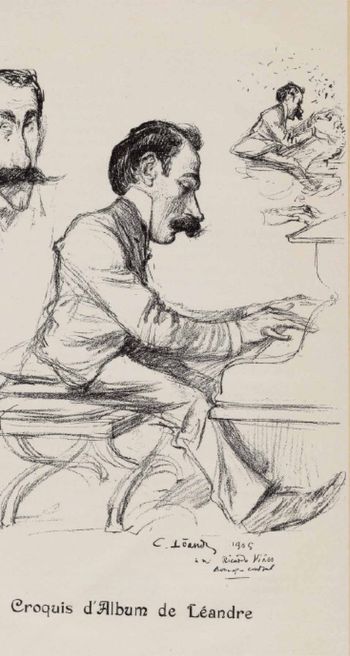
Marnold and Laloy sought to distinguish the Mercure musical from Combarieu's journal by making it more physically attractive. While a journal's character is derived mainly from the quality of its contents, the directors were fully aware of the need to attract a larger readership to bolster the journal's finances. At a time when the journalistic press was constantly evolving, notably with the incorporation of photography, it was imperative for the journal to present an artistic appearance that was both refined and modern. The cover page of the first issue was illustrated by Redon; Raoul Dufy agreed to illustrate certain pages in the journal, and the decorative artwork was entrusted to the artist and painter Charles Léandre (see Figure 1).Footnote 58 The Mercure musical thus acquired a very different image from that of the serious musicological bulletin, all the while aligning itself with the sciences and current events.
Charles Léandre, ‘Croquis d'album de Léandre: Ricardo Vinès’, Le mercure musical, 1/4 (15 July 1905), between pp. 108 and 109.

This image endured, even after January 1907, when the Mercure musical became the journal for the French section of the Société Internationale de Musique, an association founded in 1899. For its first issue of 1907 (15 January), however, the journal's title changed to become the rather unwieldy Mercure musical et bulletin français de la SIM: Société Internationale de Musique (Section de Paris). Under the joint administration of Laloy and Jules Écorcheville,Footnote 59 the journal's character shifted. The departure of Marnold certainly had an influence on the journal's reorientation, as many of the critical leanings of the Mercure musical had been the product of his activities and caustic writings. As the music critic for the Mercure de France, he played a significant role in the initial association of the music journal with the literary periodical. One might suppose that Écorcheville's and Marnold's respective views diverged as they confronted the question of strengthening the position of musicology in the journal and of compiling the SIM's bulletin. There were fewer humorous texts and a greater concentration of musicological articles. To maintain a good balance between musicology and current musical events, the section devoted to the chronicle was expanded with a segment devoted to large concerts, new music, historical concerts and musical life in the provinces. The journal also published international news and events, such as ‘London Seasons’ (‘Les saisons de Londres’), ‘Letters from Brussels’ (‘Courrier de Bruxelles’), ‘Letters from Munich’ (‘Courrier de Munich’), ‘The Czech Chronicle’ (‘Chronique tchèque’, written by William Ritter) and ‘Correspondence from America’ (‘Correspondance d'Amérique’, by Arthur Farwell). Indeed, musicology was closely associated with music criticism at this time. Over the next few years, the list of contributors to the journal became quite impressive, and included the names of most of the French musicologists active at the time, as well as the best-known musicians.Footnote 60 Laloy was able to convince not only Claude Debussy and d'Indy to write for the journal, but also Charles-Camille Saint-Saëns and Erik Satie. At the very least, the journal offered its readers a dazzling aesthetic panorama.
From the SIM to the SFAM
Just as Combarieu's journal had been an important catalyst in the development of French musicology and its diffusion in the circle of the university and the Conservatoire, as well as within the larger public of musical amateurs, the fusion of the Mercure musical with the Bulletin de la Section Française de la Société Internationale de Musique in 1907 marked another key moment in the evolution of the discipline. At the instigation of Écorcheville, French musicology would hereafter have an international presence. In the eyes of its creators, the journal was ‘the only music journal in France capable of publishing in-depth articles, and could already count among its regular contributors most of the French members of the International Society’.Footnote 61 The SIM was quick to invest in the journal: the final section of the 15 February 1907 issue was devoted entirely to the SIM, with information on the society's history, a listing of its publications and the active members in the Paris section,Footnote 62 and the general statutes of the SIM as well as those articles specific to the Paris section. The first objective of the SIM was perfectly consistent with the one Laloy and Écorcheville had established for their journal, as it encouraged the International Society to ‘contribute to the development of music history and scholarship’.Footnote 63 With this in mind, beginning with the January 1907 issue, Écorcheville printed comprehensive listings of current musicological work and reports on those scientific associations that professed an interest in music. Readers thus had at their disposal a fundamental resource for research that anticipated the vast catalogue which the SIM hoped to create.Footnote 64
In January 1908 the journal's title changed again, abandoning the name Mercure musical. The new title was Bulletin français de la SIM: Société Internationale de Musique (Section de Paris), ancien Mercure musical. But this was not the full extent of the changes. In 1909, the journal took on an additional role. Boasting a new mandate and along with the governing documents printed in the first pages of the July 1909 issue, the journal became the bulletin of the Société Française des Amis de la Musique (SFAM). This association would play an important role in the future of the journal and in the relationships between the various collaborators. The journal's investment in music education was thus at an all-time high, as demonstrated by Georges Jean-Aubry's article in the section ‘This month’ (‘Le mois’), which was devoted to concerts given in Le Havre in the winter of 1909. The musicologist criticized the programming of countless concert societies, which inevitably produced ‘a pathetic spectacle, too frequently with a pseudo-programme that shamelessly places Sarasate next to Bach and Popper next to Schumann’, and which ensured that ‘these concerts, constructed in such fashion, merely append one thing to another, without purpose, without teaching, with the sole goal of showing off the virtuosos, an execrable race if ever there were one, while there is never enough appreciation for performers who are attentive to method, logic and music history’.Footnote 65 After praising the Cercle d'Art Moderne, which produced two concerts of modern music, performances by the Capet Quartet and conferences presented by Henri Woollett, Jean-Aubry highlighted the importance of educating the public and thus ‘uniting a minority’ in order to develop a taste for music and its history.Footnote 66 According to the author, the SIM should contribute to this initiative by creating a regional section that could stimulate interest in music among potential amateurs. He thus supported both the activity of the International Society and the objectives of the organizers of the music journal who found their pedagogical ideals faithfully reflected in the goals of the SFAM.Footnote 67
The SFAM was founded in May 1909. While it brought together many musicians, the bedrock of the society was made up of musical amateurs seeking to have their own association that would allow them ‘to support all those musical events worthy of interest, and to contribute judiciously to the artistic life of a great country like France’.Footnote 68 In this light, the first steps taken by the association were to promote music education in secondary schools, to create ‘a homogeneous choir of professionals, rehearsed uniformly [and] regularly’, ‘to justify the existence of a major music journal of a popular nature by securing a wide audience’ and to offer financial assistance ‘to less fortunate musicians, unknown performers, foreign artists, businesses and associations, both Parisian and provincial, etc.’.Footnote 69 Indeed, the SFAM intended to perform a role that the state did not seem interested in playing. Henri Roujon, a member of the Institut de France and permanent secretary of the Académie des Beaux-Arts, became the president of the SFAM. The vice-presidents included Prince Auguste d'Arenberg, also a member of the Institut de France, Louis Barthou, deputy and minister of Public Works, Count Gaston Chandon de Briailles and Adolphe Brisson. Léo Sachs held the position of treasurer, Écorcheville that of secretary-general, and the composer and organist Gustave Bret that of artistic director. The committee was thus composed of various personalities drawn from the intellectual milieu as well as from the high bourgeoisie and Parisian aristocracy.Footnote 70 From its foundation, the society included 150–200 members and appeared to profit from an ‘advantageously’ (‘avantageusement’) balanced budgetFootnote 71 – so advantageously, in fact, that in its agreement with the Bulletin français de la SIM, the SFAM deposited a large enough sum to assure the free delivery of journal issues to all its members.Footnote 72
The society was thus vital to Laloy and Écorcheville's journal, as the members of the former also comprised the latter's principal readership. The agreement with the society guaranteed the journal a sum that amounted to the total subscription costs for all the members of the SFAM. Such an arrangement, however, had important consequences for the editorial orientation of the Bulletin français de la SIM, as the final section of the president's speech seems to intimate:
You will find it natural that a representative of a company who must, first and foremost, preserve the spirit of tradition should also speak about tradition. I have often tried to rationalize my impressions, after having been moved by a listening experience. I have willingly taken as my guide my illustrious colleague and friend Saint-Saëns, who writes exceedingly well on the art that he has mastered. In the great musician's books, I am always reminded of the tradition that the masters have left us and without which there could be no teaching. The academies are conservative, it is their reason for being, it is their duty. He who has the honour of representing you at the Académie des Beaux-Arts is naturally bound to his duty as a faithful representative of tradition. The Société Française des Amis de la Musique will be traditional and liberal – it will be, above all, a society for the public's well-being in fostering the love of this great art.Footnote 73
This alliance was certainly not the doing of Laloy, who until then had supported Debussy just as he had supported musicians of Ravel's generation fairly regularly in the pages of the Bulletin français de la SIM. The decision to associate the journal with the SFAM was probably the work of Écorcheville, who, following the speech of the president of the society, published an article entitled ‘La Société des Musikfreunde de Vienne’. He traced the history of the Viennese Gesellschaft der Musikfreunde, which had been founded in 1812, and seemed to consider it as a model. He concluded the article by emphasizing that
the Musikfreunde have a fund of almost 900,000 francs. They number only a few, but are rich and powerful […] this Society […] has done a great service to music in Austria. We are in the position today to draw some conclusions and, one might say, to learn a century of lessons from the activity of the Musikfreunde. Our society has been inspired by the same principles, as it was founded by friends and not by specialists. Our association thus has analogous goals, and its programme corresponds, on certain points, completely with that of its predecessor.Footnote 74
The Bulletin français de la SIM once again changed its name in November 1909, becoming the Revue musicale SIM.Footnote 75 Between November 1909 and January 1910, the journal also underwent various transformations in its contents and editorial structure. Laloy, however, was no longer director. Might it have been the close association of the journal with the SFAM that encouraged him to jump ship? It is hard to say, as he remained in contact with Écorcheville. But certainly for others the association with the Society caused them to question their participation. Among them was Rolland, who tendered his resignation in 1910. He explained his decision in a letter to his student Prunières:
My dear friend,
I have just tendered my resignation from the committee of the Amis de la Musique, and I wanted to tell you why. For the exposition of Munich, we are organizing three days of concerts of French music: the Amis claimed to have taken charge of the organization, but, in fact, it was the work of Bret, and all they did was endorse it. The concert programming for the three days eliminates, for the most part, all the young generation after d'Indy – (under the pretext that it is not yet established) – Magnard's name was not even mentioned. Obviously, those of Ravel and his kind, even less so. I am not sure that we managed to get Debussy in, even for a work that does not represent him well (however, there is a whole concert devoted to Les béatitudes in its entirety. And more Franck (the Symphony) in another concert!). I felt it was a betrayal of French music and, what is more, nonsense, as the people of Munich are much more capable of appreciating the colourful and rhythmic art coming from the new school than scholastic and academic art. I formally refuse to appear to endorse this act, and so I am leaving a committee whose sole purpose is to celebrate celebrities.Footnote 76
In the same letter, Rolland complained to Prunières of the manner in which Écorcheville was managing the journal:
I am also not satisfied with the SIM, even though I am grateful that he finally acknowledged your Lully. My article on Handel has once again been interrupted, without any warning from Écorcheville. The manuscript has been sitting in the journal's [administration] office since January. Honestly, Écorcheville publishes our articles only too grudgingly. It would be much better if he would just tell us frankly that he did not want to do it. I give up writing for him. When you come to Paris, if you see La Laurencie […] tell him that the day he establishes a journal of music history, he'll also have my cooperation. In the meantime, I am writing for foreign journals.Footnote 77
While Écorcheville henceforth managed the future of the SIM by himself, it remains unclear whether he was, in fact, doing such a bad job. He described his vision of French musicology in an unpublished letter to his wife in 1915:
I am keen to do useful work. And what I mean is that it should be useful now. I don't flatter myself into thinking that my work will survive a long time; in the historical disciplines we fall quickly out of fashion and are forgotten, unless we possess some personal worth, like that of Taine or Michelet, which is just a question of luck. But what I would like is to have a real influence on my contemporaries. For example, to organize international musicology in terms of its methods, to direct its studies, to work on its development. Regardless of what you might say, I am less a builder than an organizer.Footnote 78
It was through the momentous project of the Revue musicale SIM that Écorcheville sought to build international musicology. He was assisted by Charles Legrand, who became the copy-editor, as well as two writers, René Lyr, for Belgium, and Vuillermoz, for France. At the instigation of the new team, the journal also sought new administration, that of the Librairie Charles Delagrave. Écorcheville assembled a new publication committee chaired by Malherbe, a librarian at the Opéra. In 1910, the members of the committee included Alfred Boschot, Brenet, Dauriac, Écorcheville, Emmanuel, La Laurencie, Laloy, Émile Poirée, Jacques-Gabriel Prod'homme, Tiersot and the pianist Eugène Wagner. Within the journal, the new organizers launched a supplement called ‘Music News’ (‘Actualité musicale’). The goal was to structure the monthly news more effectively and to separate it from the musicological content.Footnote 79 The supplement consisted of about 30 pages divided into several sections: ‘Theatres and Concerts’ (‘Théâtres et Concerts’), subdivided into sections for Paris, the provinces, Belgium and other countries; ‘Day and Night’ (‘Jour et nuit’), reserved for various news stories; ‘Courses and Lectures’ (‘Cours et conférences’); ‘International Society of Music’ (‘Société Internationale de Musique’), focusing on the activities of the Paris section; ‘Instruments’ (‘Les instruments’), a section for instrument makers; ‘Social Issues’ (‘Questions sociales’), dealing with the congress of musicians; and, finally, ‘Music Editions’ (‘Édition musicale’). The supplement in the Revue musicale SIM was printed as such only six times until 1914. This structure, originally designed by Écorcheville and his colleagues in two separate parts, would be taken up by Prunières in his journal in 1920. However, rather than separating out the news into a supplement, Prunières adopted a model that allowed the journal to include the information on musical life within its contents on a monthly basis.
War put an end to the Revue musicale SIM's journey, but Écorcheville, ever conscious of its fragility, still hoped it would survive. Shortly after being drafted, he wrote a very touching letter to Vuillermoz:
Tomorrow morning at 8 o'clock I will be at Les Invalides, wearing the uniform of an infantry lieutenant, and I'll be driven by car to a destination still unknown, but in any case, in an active army where I managed to get reinstated. I thought that I had been seen too often in the orchestra seats at the theatre to be thought capable of taking any other position for the great Franco-German performance. I'm part of the eighth division of the Paris trench camp, that's all I know.
If I don't make it back, I entrust our work to you, my dear friend. And please, if you wish to give me some pleasure in the other world, make an effort to maintain harmony and understanding between the different elements that will be present at my passing. Our journal is composed of differently fitting pieces (the Amis, the SIM, etc.) that hold miraculously together; a few more years of cohesion are essential and it's precisely this assemblage of our different strengths that we must maintain. In any case, my passing must not cause the fall of the project that has cost us all so much trouble. Isn't that right? With these recommendations, my dear friend, I leave happy and keen to do my duty by answering ‘present’ to the call. […] What also satisfies me is to see this war as the triumph of global internationalism over blind German nationalism. We leave singing the Marseillaise, but we will return singing the International (SIM)!Footnote 80
Écorcheville's letter was prophetic, as he in fact died on the battleground in February 1915. Nevertheless, his hopes to see the journal's activities continue were soon fulfilled by Prunières who, in 1919, decided to establish a new music journal on the basis of the Revue musicale SIM. Although the financial arrangement had changed,Footnote 81 the musicological objectives remained essentially the same. Prunières, however, jealously protected his intellectual and journalistic independence. The journal managed to retain autonomy over its editorial orientation, even though it was published under the auspices of the Nouvelle revue française until the mid-1920s. Prunières benefited from the administrative and promotional infrastructure of the Nouvelle revue française, but the committee of the latter did not intervene in any way in the content of the music journal. Prunières and André Coeuroy, editor-in-chief, determined the structure and content of the new Revue musicale. Built on the network created through the initiatives of Rolland and Combarieu, and further developed by Laloy, Vuillermoz and Écorcheville, Prunières's Revue musicale became a flagship in the French musical press during the interwar period.
One might wonder why neither Laloy nor Vuillermoz took up the torch. For Laloy, there is an explanation. In 1909, the printer of the Revue musicale SIM went bankrupt. Laloy gave money to save the journal, but decided to leave the arena of the musical press, considering it financially too unstable.Footnote 82 In addition, the position of secretary-general at the Opéra that he accepted in 1914 probably placed restrictions on his time that would have prevented him from managing the journal. In the case of Vuillermoz, the question remains open. In a letter to Madeleine Écorcheville in December 1915, he refused to participate in a memorial tribute to Jules Écorcheville, not wanting to ‘see, in this project like in all the others, the replacement of the key figures called to continue your husband's work and to respond to the aspirations that he expressed in his final wishes’. He added:
I would, in any case, have qualms about taking away a precious occasion for the new editor-in-chief of the SIM to legitimize the trust that he has been accorded and I respect the codes of collegial courtesy too much – even while I might be exonerated in this circumstance – not to step aside promptly in face of a successor.Footnote 83
Vuillermoz thus seems to have been precluded from taking over management of the Revue musicale SIM. As it happens, he did contribute to the commemorative booklet Le tombeau de Jules Écorcheville (Paris, 1916), along with Laloy and La Laurencie. But in the end it would be the latter who took Écorcheville's place. However, a few months later in 1917, La Laurencie, a Germanophobe and nationalist, convinced the members to dissolve the Paris section of the SIM in order to establish the Société Française de Musicologie.Footnote 84 This decision sealed the fate of the Revue musicale SIM once and for all.
Prunières's Revue musicale contributed considerably to the circulation of information and the expansion of knowledge of early and modern music in France and abroad. For the next 20 years, the journal fulfilled an essential pedagogical role, which was of particular importance to Prunières, and, what is more, became an inexhaustible source of documentary material for future generations. The Revue musicale conserved the vision of a rigorous and broad-minded musicology that was directed not only towards musicians and musicologists, but also to anyone interested in music. The strong connection between the establishment of the new field of musicology and the project of educating the ‘citizen of the Republic’ would have significant consequences for the future.