Introduction
Patients with advanced cancer in end-of-life care usually report very distressing symptoms, which may be refractory to the best palliative care and, thus, sedation can be used (Bobb, Reference Bobb2016; Menezes and Figueiredo, Reference Menezes and Figueiredo2019). Diverse studies have reported different practices regarding palliative sedation, such as the number of patients with advanced cancer who were sedated, the main reasons for initiating palliative sedation and differences in survival among those who were and were not sedated (Arantzamendi et al., Reference Arantzamendi, Belar and Payne2021; Heijltjes et al., Reference Heijltjes, van Thiel and Rietjens2020).
Despite being recommended by diverse guidelines (Cherny, Reference Cherny2014; Abarshi et al., Reference Abarshi, Rietjens and Robijn2017) and being reported as an important component in end-of-life care by diverse healthcare providers (Piedade et al., Reference Piedade, Cardoso Filho and Priolli2020; Rodrigues et al., Reference Rodrigues, Menten and Gastmans2020), there is still controversy on ethical aspects as well as comfort or distress associated with palliative sedation use (Voeuk et al., Reference Voeuk, Nekolaichuk and Fainsinger2017; Benítez-Rosario and Ascanio-León, Reference Benítez-Rosario and Ascanio-León2020). It has been widely known that cultural aspects influence end-of-life care (Sprung et al., Reference Sprung, Ricou and Hartog2019) and the same seems to be true for palliative sedation (Rodrigues et al., Reference Rodrigues, Menten and Gastmans2020), which seems to be less used in low- and middle-income countries compared with high-income countries (Arantzamendi et al., Reference Arantzamendi, Belar and Payne2021).
The present study aims to describe the 5-year practice on palliative sedation in a specialized Palliative Care Unit in a large academic hospital in Brazilian Northeast, as well as to compare survival of patients with advanced cancer who were and were not sedated during their end-of-life care.
Methods
Design and setting
This is a retrospective cohort study carried out in the Palliative Care Unit, in a philanthropic and teaching tertiary hospital in Maceio, Brazil. Santa Casa de Misericordia de Maceio is a 466-bed hospital, with 85 beds dedicated to patients with cancer. The oncologic service provides care to around 2,000 patients per month and provides care for Alagoas, the Brazilian state with the second lowest Gross National Income per capita and the lowest Human Development Index. The Palliative Care Unit has 11 beds and started operating in August 2013. The staff is comprised of 3 palliative care physicians, 5 nurses, 14 nurse technicians, 3 physical therapists, 1 social worker, 1 speech therapist, 1 pharmacist, 1 occupational therapist, 1 dentist, 1 psychologist, and 1 nutritionist. All patients admitted to the Palliative Care Unit came referred by their oncologist-in-charge with the aim of palliative and end-of-life care.
The present study encompasses all patients admitted during the first 5 years of experience of the Palliative Care Unit, i.e., from August 2013 to August 2018. The hospital does not have an Institutional Review Board (IRB) and, therefore, according to Brazilian law, the proposal of the study had to be sent to a center with an appropriate IRB. A.C. Camargo Cancer Center IRB evaluated the study, approved it and waived the need for informed consent (CAE 3.189.063). We followed the Strengthening the Reporting of Observational Studies in Epidemiology (STROBE) guidelines for the reporting of observational studies (von Elm et al., Reference von Elm, Altman and Egger2008).
Palliative sedation
Palliative sedation is considered for all inpatients with distress associated with refractory symptoms. The palliative care team explains to patients or their relatives why palliative sedation would be indicated, their aims and consequences. Patients’ or relatives’ consents are registered in the medical chart.
There is not a specified protocol for palliative sedation. The first-choice drug is midazolam, which is infused at a starting dose of 1 mg/h and titrated according to patients’ distress. Other drugs can be used at the discretion of the palliativist in charge. The aim of palliative sedation is to control patients’ distress and symptoms in the end of life. Physicians and nurses do not use any sedation specific scale to target sedation levels. Sedation is considered light when patients could interact with the staff and their relatives, and deep when they could not awaken to verbal or physical stimuli.
Data collection
We retrieved data from the electronic medical records from all patients admitted to the Palliative Care Unit during the study period. We collected patients’ demographic data (age and sex), cancer type (defined as solid local/regional, solid metastatic, or hematologic), site of solid cancer or type of hematologic malignancy, Eastern Cooperative Oncology Group Performance Status (ECOG PS), symptoms presented in the 48 h before Palliative Care Unit admission (pain, dyspnea, vomiting, delirium, bleeding, psychological or psycho-existential suffering, constipation and decreased consciousness), survival days since hospital admission and since cancer diagnosis.
Among patients who received palliative sedation, we also assessed data on palliative sedation characteristics: light vs. deep, continuous vs. intermittent (i.e., continuous infusion of midazolam which was interrupted at some time at the patients’ or relatives’ request mainly due to patients’ wish to be able to interact with their relatives), which drugs were used (morphine, tramadol, dipyrone, antiemetics, hyoscine, diuretics, corticosteroids, other benzodiazepines than midazolam, laxatives, tranexamic acid), if consent was given by the patient or a relative, and survival (in hours) after its initiation. Although it is part of the medical chart to report patients’ prior symptoms, clinicians do not use any scale for symptom assessment and also do not explicitly state which symptoms were ultimately taken into account to start palliative sedation.
Statistical analysis
We presented patient characteristics according to whether or not they received palliative sedation. We presented categorical variables as absolute numbers and percentages and compared them with chi-square or Fisher's test, as appropriate. We presented continuous variables as means and standard deviations and compared them with an independent t-test.
We used Kaplan–Meier plots and log-rank tests to analyze the differences in hospital survival time between patients who received palliative sedation and those who were not sedated. Using the Cox proportional hazard regression model, we assessed the effect of palliative sedation on hospital mortality risk in an unadjusted model and in an adjusted model for age and sex as covariates. The proportional hazards assumption for the models was verified using the Schoenfeld residuals method. We calculated the hazard ratio (HR) and 95% confidence intervals (CIs 95%) for this model. A P-value of less than 0.05 was considered statistically significant. We used R version 3.5.1 (R Core Team, 2016) for all analysis.
Results
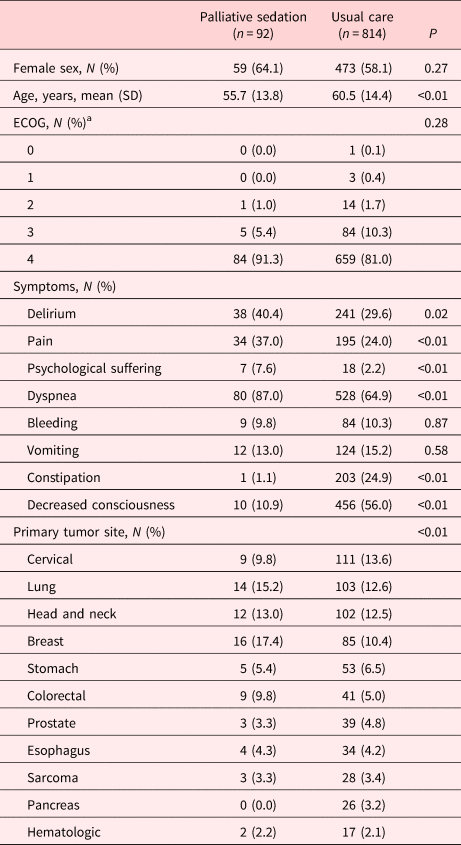
We included a total of 906 patients in palliative care who were admitted to hospital during the study period. Patients were predominantly female (N = 532, 58.7%), mean age was of 60.1 (±14.4) years and most patients had a severe performance status impairment (ECOG 3 and 4, N = 832, 91.8%). Most patients had a solid cancer (N = 887, 97.9%) and the most common primary cancers were cervical (N = 120, 13.2%), lung (N = 117, 12.9%), and head and neck (N = 116, 12.8%) (Table 1). Of these 887 patients, 520 (58.6%) had metastatic disease. The mean time from diagnosis to admission was 43.5 (±55.1) months.
Characteristics of patients who received or not palliative sedation

a Data were missing on ECOG status for 2 (2.2%) patients in the palliative sedation group and for 53 (6.5%) patients in the usual care group.
A total of 92 (10.2%) patients received palliative sedation. Patients who received palliative sedation were predominantly female (N = 59, 64.1%), with a mean age of 55.7 (±13.8 years) and completely disabled (ECOG 4, N = 84, 91.3%). The most common primary cancers were breast (N = 16, 17.4%), lung (N = 14, 15.2%) and head and neck (N = 12, 13.0%). Patients who were sedated were younger, presented with higher rates of delirium, and reported more pain, suffering, and dyspnea than those who were not sedated. Conversely, patients who did not receive palliative sedation presented decreased consciousness more often. Only six patients (6.5%) who were sedated were not bedridden. All these patients had dyspnea as a refractory symptom (Table 1).
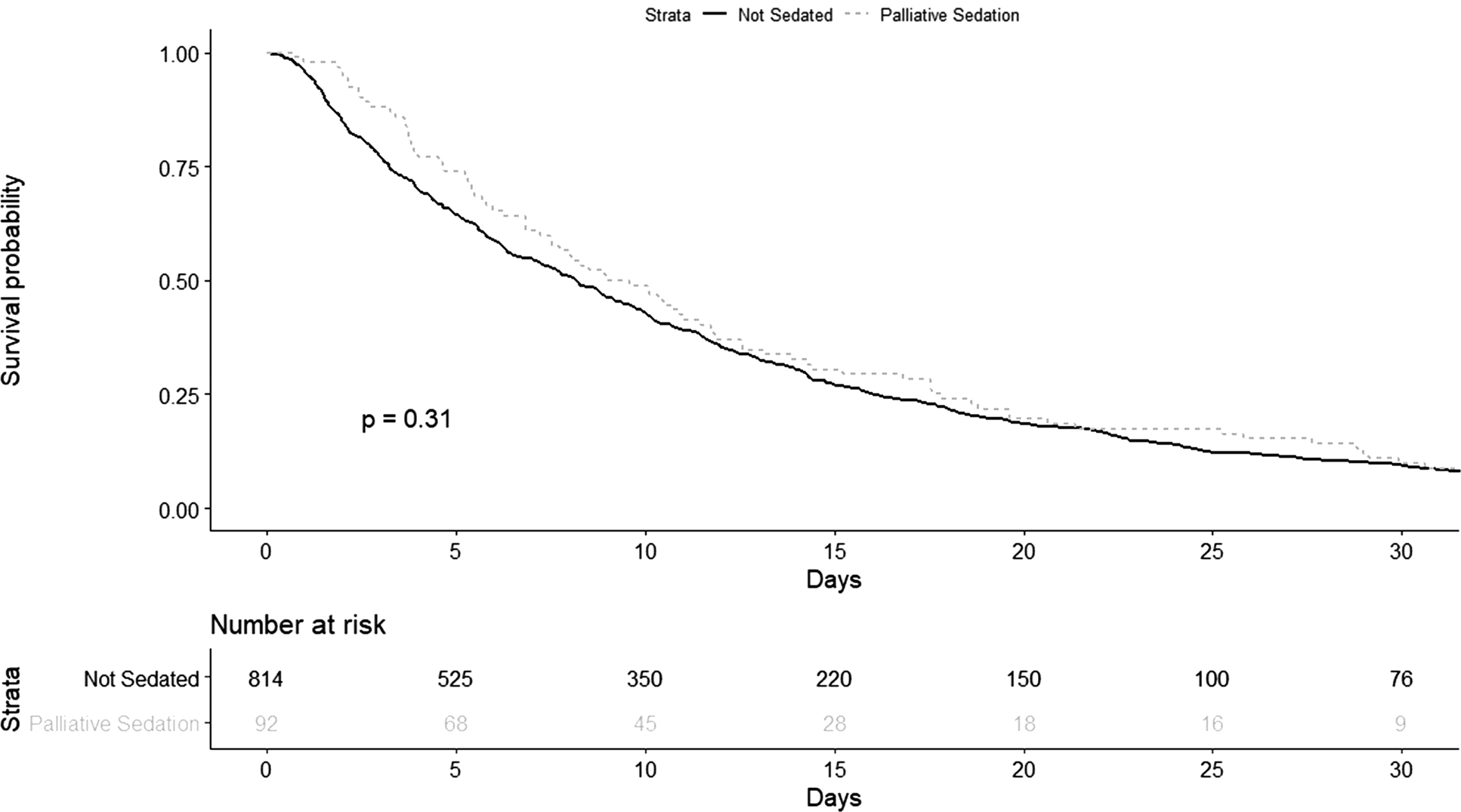
Median hospital survival of patients who received palliative sedation was 9.30 (CI 95%, 7.51–11.81) days and of patients who were not sedated was 8.2 (CI 95%, 7.3–9.0) days (P = 0.31) (Figure 1). Palliative sedation was not significantly associated with hospital survival (unadjusted HR = 0.89; CI 95%, 0.72–1.11; adjusted HR = 0.93; CI 95%, 0.74–1.15).
Median hospital survival of patients who were and who were not sedated.

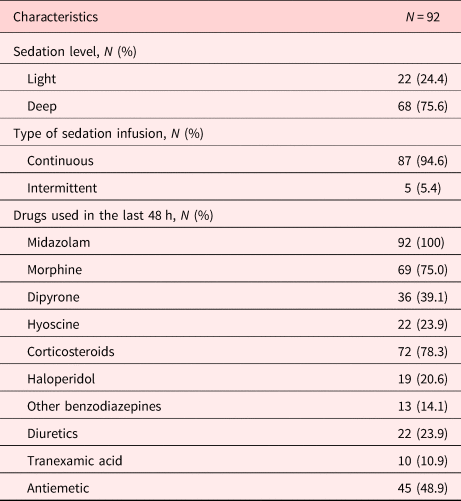
Most patients who received palliative sedation were deeply sedated (N = 68, 75.6%). A total of 87 (94.6%) patients received continuous sedation and only 5 (5.4%) received intermittent sedation. The mean dose of midazolam infusion was 3 mg/h (range 0.2–9.3 mg/h). Thirty patients (32.6%) had their midazolam infusion increased after starting palliative sedation. Additionally to midazolam, most patients received morphine, corticosteroids, antiemetics, and dipyrone (Table 2). The mean time from hospital admission to starting palliative sedation was of 12.2 (±14.1) days. Median survival after beginning palliative sedation and death was of 22.3 (CI 95%, 13.5–41.8) h.
Characteristics of palliative sedation

Discussion
Our study showed that 10% of all patients referred to a specialized Palliative Care Unit during a period of 5 years received palliative sedation. Patients who were sedated were younger than those not sedated. Dyspnea, delirium, and pain were more common among patients who received palliative sedation. Median survival was not different between patients who were or were not sedated.
Although its widespread use, palliative sedation still leads to ethical considerations among clinical providers. Probably, the main distress among clinicians and relatives is the possibility that palliative sedation may hasten death (Rodrigues et al., Reference Rodrigues, Menten and Gastmans2020). Our study suggested that patients who were sedated had a similar survival to those not sedated. These results are in accordance with other studies (Beller et al., Reference Beller, van Driel and McGregor2015; Maeda et al., Reference Maeda, Morita and Yamaguchi2016; Prado et al., Reference Prado, Gomes and Usón Júnior2018). A systematic review of studies which addressed ethical questions on end-of-life care of critically ill patients (Spoljar et al., Reference Spoljar, Curkovic and Gastmans2020) as well as other systematic reviews of studies of patients who received palliative sedation have consistently demonstrated that palliative sedation does not hasten death (Maltoni et al., Reference Maltoni, Scarpi and Rosati2012; Beller et al., Reference Beller, van Driel and McGregor2015). Despite those findings, many clinicians still have their concerns on palliative sedation (Benítez-Rosario and Ascanio-León, Reference Benítez-Rosario and Ascanio-León2020; Piedade et al., Reference Piedade, Cardoso Filho and Priolli2020; Rodrigues et al., Reference Rodrigues, Menten and Gastmans2020) and relatives’ opinion may still be a barrier to implementing palliative sedation (Spineli et al., Reference Spineli, Kurashima and De Gutiérrez2015).
The proportion of patients with advanced cancer who received palliative sedation differs significantly among countries. In our study, 10% of all patients referred to the Palliative Care Unit were sedated during their last days of life. A previous study accomplished in a private hospital in Brazil also reported that 10% of patients who died with cancer had received palliative sedation (Prado et al., Reference Prado, Gomes and Usón Júnior2018). These proportions are lower than that reported in studies carried out in Western Europe and Japan, but are in accordance with that of other Latin American countries (Arantzamendi et al., Reference Arantzamendi, Belar and Payne2021; Heijltjes et al., Reference Heijltjes, van Thiel and Rietjens2020). In a systematic review of recent prospective studies, a lower proportion of patients were sedated in studies carried out in Colombia (Parra Palacio et al., Reference Parra Palacio, Giraldo Hoyos and Arias Rodríguez2018) and Mexico (Monreal-Carrillo et al., Reference Monreal-Carrillo, Allende-Pérez and Hui2017), than in those carried out in developed nations. Previous studies have demonstrated that end-of-life care in critically ill patients differs among countries with different cultural backgrounds (Sprung et al., Reference Sprung, Ricou and Hartog2019). Some Latino cultural values in end-of-life care may lead to a lower proportion of palliative sedation (Soto-Perez-de-Celis et al., Reference Soto-Perez-de-Celis, Chavarri-Guerra and Pastrana2017). First, a family consensus is fundamental for important decisions, such as those regarding end-of-life care (Born et al., Reference Born, Greiner and Sylvia2004). Second, patients seem to prefer a paternalist approach by physicians, who are less prone to withdrawal of treatments in the end of life (Yaguchi et al., Reference Yaguchi, Truog and Curtis2005).
A meaningful difference from our cohort to others was the predominance of female patients due to the large number of patients with cervical cancer. This type of cancer still has a high incidence in the Northeast region in Brazil. Many patients already have advanced disease at the time of diagnosis and mortality rates are still extremely high (Vale et al., Reference Vale, Sauvaget and Muwonge2016; Silva et al., Reference Silva, Jardim and Ferreira2020). Advanced cervical cancer may present with intense pelvic and lower back pain which can be refractory to analgesic drugs and procedures.
Delirium, respiratory distress, and pain were more common in patients who were sedated. These symptoms have been consistently reported as the main refractory symptoms leading to palliative sedation in other studies (Maltoni et al., Reference Maltoni, Scarpi and Rosati2012; Prado et al., Reference Prado, Gomes and Usón Júnior2018; Arantzamendi et al., Reference Arantzamendi, Belar and Payne2021; Díez-Manglano et al., Reference Díez-Manglano, Isasi de Isasmendi Pérez and García Fenoll2020). On the other hand, decreased consciousness was more common among patients who were not sedated. This finding may indicate that agitation was interpreted as a sign of discomfort that may have pointed toward the use of palliative sedation.
Of note, in our study, 7.6% of patients who were sedated had manifested psychological suffering that led to palliative sedation. Psycho-existential distress has only recently been recognized as an end-of-life symptom that may require palliative sedation. The prevalence of psychological distress among patients considered for palliative sedation has been reported to be up to 50% (Arantzamendi et al., Reference Arantzamendi, Belar and Payne2021; Heijltjes et al., Reference Heijltjes, van Thiel and Rietjens2020). Midazolam was the drug of choice for palliative sedation in our study, which is in accordance with guidelines (Cherny, Reference Cherny2014) and clinical practice in other settings (Beller et al., Reference Beller, van Driel and McGregor2015; Parra Palacio et al., Reference Parra Palacio, Giraldo Hoyos and Arias Rodríguez2018; Prado et al., Reference Prado, Gomes and Usón Júnior2018).
The present study has some limitations. First, it is a single-center study and, therefore our findings may not be applied to other settings. However, the study was carried out in a very deprived area in Brazil and, thus, may add important information for clinicians who care for patients with advanced chronic diseases in different settings from those where previous studies were conducted. Second, because of its observational and retrospective design, there would be potential confounding factors which may have influenced the decision to start palliative sedation. This has been a constant in cohort studies which addressed clinical experience on palliative sedation as mentioned before. Third, there was no specific protocol for initiate palliative sedation. Fourth, there was a lack of standardization of symptom assessment in the medical record. Both the absence of protocols and standardization of symptom assessment also limit generalization of our findings.
In conclusion, our study showed palliative sedation can be accomplished even in a deprived area. Median survival was not different between patients who were and were not sedated. In a similar way to other studies, delirium, dyspnea, and pain were more common in patients who received palliative sedation. Future studies should focus on standard protocols and targets for patients considered for palliative sedation.
Authors’ contributions
CZSA and LZSA conceived the study. CZSA collected the data. APNJ supervised data collection and performed the analysis. CZSA drafted the manuscript and LZSA and APNJ revised it critically for important intellectual content. All authors read and approved the final version of the manuscript.
Funding
This research received no specific grant from any funding agency, commercial, or not-for-profit sectors.
Conflicts of interest
The authors do not have any conflicts of interest to declare.