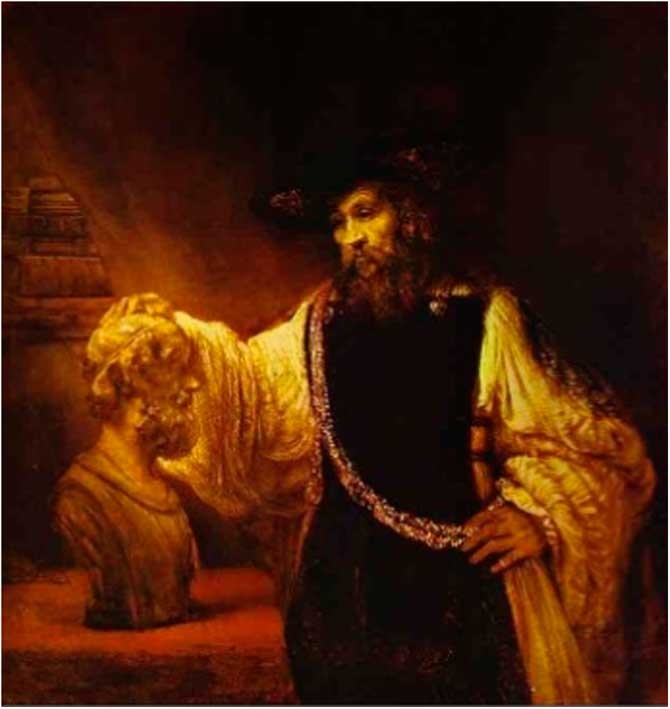
‘Aristotle with a Bust of Homer’, in the Metropolitan Museum of Art, New York, USA, which Rembrandt painted in 1653 for Antonio Ruffo, a Sicilian aristocratic collector, has elicited myriad interpretations (Figure 1). As well as the standing philosopher and the bust of the ancient Greek poet who composed the epic Iliad and Odyssey, Rembrandt has included other important ingredients. A medallion is suspended from a heavy gold chain, adorned with the head of Alexander the Great, Aristotle’s student and patron. So, is the ruminating philosopher contrasting material and spiritual values? Or is he comparing art with other forms of intellectual activity, such a science and philosophy? Or is he reverting back to that ancient quarrel between poetry and philosophy? Or is the primary interest that Homer is blind, while Aristotle, who is touching him but not looking directly at him, was a natural scientist who favoured an empirical method?
Rembrandt’s ‘Aristotle with a Bust of Homer’.

Margaret Carroll argues, rather, that Aristotle’s ‘attitude of mental abstraction’ is ‘contrived to suggest that the philosopher’s thoughts are directed not simply to the sculpture’s ostensive appearance, but also to its other causes, perhaps to Homer, or to the question of causation itself.’Reference Carroll 1 Carroll points out that, for Aristotle, the activity of contemplation, which he called theoria (our word ‘theory’), is not limited to the appearances of things as he finds them contingently, but is always concerned with the causes that produced them – formal, material, efficient and final (explained in more detail below). In Aristotle’s Metaphysics, he repeatedly uses works of sculpture when trying to illustrate what he means by the four different causes. This focus on visual arts inevitably drew the interest of artists such as Rembrandt to the Metaphysics. But the painting’s conjunction of Homer with a golden chain would prompt any classically educated seventeenth-century viewer to think of the golden chain with which Zeus in the Iliad boasts he could drag earth, sea and all the other gods to Olympus, and bind them there to dangle in space (8.18-27). Zeus’ golden chain was adopted by the Neoplatonists as an image of the mind of God or of the divine order in the universe. It was a familiar image in the sixteenth and seventeenth centuries; for example, in Bacon, it is an image of philosophy, dialectic, and reason as well as cosmology. But in 1650, three years before Rembrandt painted the picture, renowned classicist and fellow Dutchman Gerhardus Johannes Vossius suggested a new interpretation. For Vossius, the chain represented the inter-relationship of all the arts and sciences; the chain which connects the knowledge of particulars in the separate fields is the chain of philosophy.Reference Vossius 2 Here, I want to bind together all the arts and sciences as represented by the multidisciplinary fellowship of the European Academy. Since I can’t do it myself with Zeus’ cosmic chain, nor indeed one bestowed upon me by Alexander the Great, then at least I can try to do it with a twenty-first-century celebration of Aristotle’s towering achievements and with thoughts about how we can benefit from one of most ground-breaking ideas – potentiality.
2017 is the 2400th anniversary of Aristotle’s birth in 384 BCE in Stagira, the eastern prong of the triple Chalkidiki peninsula in the northern Aegean Sea. There will be celebrations around his statue there. But these days Aristotle is a controversial figure. His historically contingent ideas about women, slaves, empires and elites, excised from the context of their expression in a single treatise – his Politics – have received much criticism since the impact of feminism and the Civil Rights movement on the Academy. 3 But Aristotle’s socially conservative views on women and slaves must not be allowed to eclipse his monumental achievements in other fields: he wrote over 150 other treatises, which changed intellectual history for ever.
There are many aspects of Aristotle to admire and emulate. He did not patronise thinkers with whom he disagreed; he even talks respectfully about the pre-scientific thinkers on the mythical origins of the universe and the birth of gods, because he understood that their works were attempts at an explanation of First Principles.Reference Palmer 4 Although he understood that religion could be used by despots to manipulate their subjects, he was unlike some more polemical thinkers of his time, in that he did not generally regard the practice of religion – piety – with contempt.Reference Broadie 5 He saw no contradiction between looking for scientific explanations of the things in the universe and assuming that there was some kind of disinterested divinity – his ‘unmoved mover’ – beyond human ken. Indeed, he seems to have sensed some relationship between divinity and his concept of the active intellect, a sense underlying his accounts of how the human intellect develops from its original unthinking state into a thinking state in his On the Soul (3.5.430a10-25), and Metaphysics (12.7-10). It is not clear whether Aristotle’s concept of active intellect is inherent in humans, or externally and independently operating upon them, but he did somehow equate the active intellect, human intellectual potential, when actualised, with the ‘unmoved mover’, and therefore with God.
Aristotle’s scientific works assume the interrelatedness of the natural environment and human activity, an assumption which those who underestimate our current ecological emergency would do well to heed. His reception, at least until the Renaissance, offers a paradigm for emphasising what western and Arabic intellectual traditions have in common, since his Metaphysics in particular, when translated into Arabic, was instrumental in the foundation of Arabic philosophy (‘falsafa’) in the ninth century CE, and elicited a massive commentary by the Spanish Arab philosopher Ibn Rushd (Averroes), studied avidly in the West as well. Just as valuable is Aristotle’s identification of the primary goal of human life with individual mental fulfilment and virtue-based happiness, entailing responsibility to the wider community, rather than with wealth acquisition.Reference Worden 6 He approved of distributive economic justice, and understood that poverty is a cause of revolution and crime. But the achievement of Aristotle on which I am going to focus first, after a brief biographical sketch, is his transcendence of the distinctions between research in different fields. This will lead us into the discussion of his unique concept of the potentiality within things, and how that concept might enrich deliberation about the education of all citizens in our increasingly globalised village.
In 1959, the year I was born, the physical chemist and novelist C.P. Snow delivered the Rede lecture at Cambridge, lamenting the yawning gulf between the two worlds – he called them galaxies – constituting the Sciences and the Arts-plus-Humanities respectively: ‘Literary intellectuals at one pole – at the other scientists, and as the most representative, the physical scientists. Between the two a gulf of mutual incomprehension – sometimes (particularly among the young) hostility and dislike, but most of all lack of understanding’.Reference Snow 7 The ‘lack of understanding’ had prevailed, instead of the nurturing of a ‘clashing-point’ between them, which could produce ‘creative chances’. He argued that, without the industrialisation of the planet, the rich–poor divide globally would only grow; he argued that both the USA and the USSR needed to train squadrons of scientists to bring about the improvement and stabilisation of living conditions for all human beings. 8
Despite the steady subsequent rise of the third academic culture, the social sciences, as documented by Jerome Kagan in The Three Cultures,Reference Kagan 9 the gulf between Snow’s galaxies yawns as widely as ever. Historically, it has been connected with the celebration of Plato rather than Aristotle, and indeed of Erasmus more than Renaissance scientists. It interests me that this research medal of the European Academy is called the Erasmus Prize and not the Kepler Prize or the Copernicus Prize. (Please be assured that I am not objecting to being awarded it – I am very fond of Erasmus if only for his advanced views on female education, developed watching the English daughters of Sir Thomas More study their Classics books). But in my own country, at least, little has happened to bring Snow’s two galaxies closer. Most people who continue at school after 16 specialise in arts or sciences; while most people are dragged through a play by Shakespeare before that age, and acquire a smattering of parochial national history, few can explain the second law of Thermodynamics. It is usually argued that the gap between the two galaxies is a result of the industrial revolution, although the domination of the education of elites by humanities actually has a far longer and more complicated history than this, stretching back to classical antiquity. The natural scientist, the physiologos, is already portrayed as a figure of fun, by the comedian Aristophanes, in the fifth century BCE. The physiologos in question was Socrates, who was interested in the physical constitution of the universe as a young man; unfortunately, he left no written record of these studies or indeed of any other studies. His student Plato, who despised the material universe and regarded it as a set of second-rate simulacra of non-material ideas, must bear much responsibility for the separation between the studies we lump under the headings of arts and sciences. Platonic philosophy is written in alluring, often humorous prose dialogues; although a few rather contrived puns have been identified in Aristotle, and Cicero dutifully expressed admiration of his style,Reference Quandt 10 Plato’s style was in antiquity far more appealing than Aristotle’s to rhetoricians. Plato’s thought was much preferred by ancient Christians, with their need to posit a spiritual world prior to and more important than the material one. Neoplatonism helped to fertilise the animosity between Christianity and scientific enquiry that still reverberates amongst Christian Fundamentalists today, especially American Creationists.Reference Tierney 11 Aristotle, on the other hand, believed that things in the world take their definition from their particular material properties, and not from some immaterial essence or ideal form, nor from any thought of god. He investigated the world through experiencing and recording it empirically and through developing logical systems of analysing the findings.
Of all the great minds of antiquity, Aristotle’s is the one that raised the bar on intellectual enquiry in a way that still profoundly affects what we do as Academicians. There are several ancient sources of biographical information about him, including a Life by Diogenes Laertius (Lives of Eminent Philosophers 5.1), although much of it consists of gossipy fictions invented by detractors. What is certain is that Aristotle was from Stagira, a small but strategically important city-state that had seen conquerors and allies, including Persia, Athens and Sparta. When Aristotle was born, Stagira was increasingly dominated by its mighty neighbour Macedon. Aristotle’s father was physician to King Amyntas III of Macedon, who ruled between 393 and 370 BCE and was the father of Philip II. The royal family and the medical family were close. Aristotle was an almost exact contemporary of Philip, who was born just two years after him in 382.
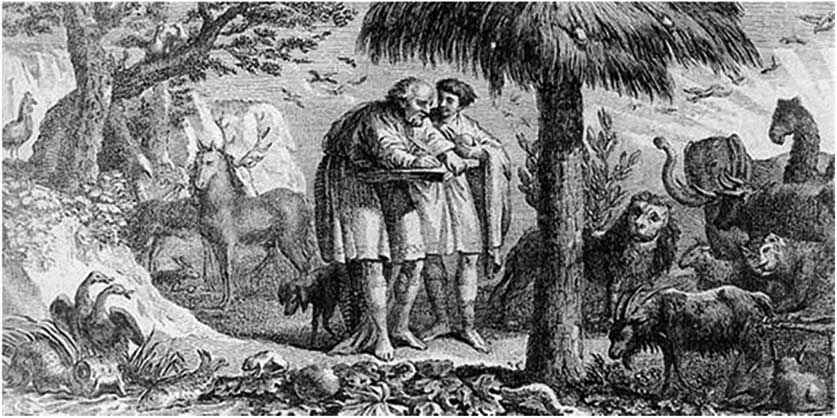
Aristotle went as a youth to Athens, to study with Plato at the Academy, and stayed for 20 years. Much of his work can be read as a response to Plato’s ideas, although the disagreements are fundamental. Aristotle left Athens in about 348, in the year when Philip finally destroyed Stagira. The philosopher travelled to north-west Asia Minor, to the court of his friend Hermias, who had been a fellow student at the Academy. He married Hermias’ daughter Pythias. Thence he went to Lesbos, where he studied zoology intensively alongside his friend Theophrastus, whose specialism was botany (Figure 2); the importance of the wildlife in and around the lagoon at Pyrrha on that island to the development of Aristotle’s science has recently been explained in a beautiful book by Armand Marie Leroi, The Lagoon: How Aristotle Invented Science.Reference Leroi 12 But, in 343, he took up the appointment of tutor to the young Alexander. It was not until eight years later, in 335, when Alexander had succeeded Philip and taken control of Athens, that Aristotle returned there to found his Lyceum and, it is thought, actually write most of his 150 treatises in his sixth decade. He had a son during these golden years by a Stagirite mistress named Herpyllis.
Aristotle and his friend Theophrastus.

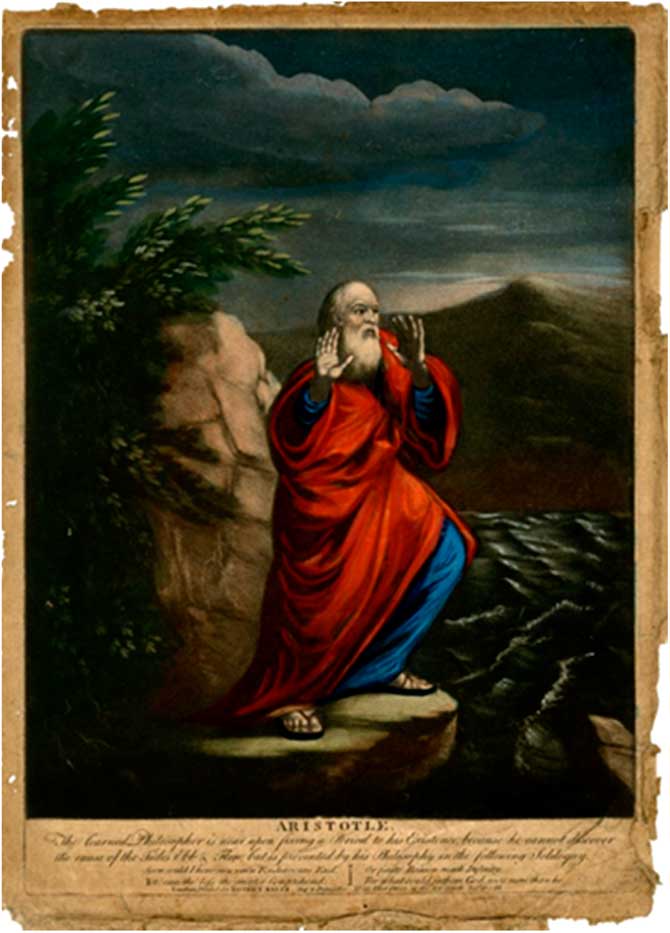
This period of intense intellectual activity was cut short by the death of Alexander in 323 BCE. The Athenians turned against everyone associated with Macedonian rule, and Aristotle, sensing danger and possibly being charged with failing to honour the gods, escaped to the family estate which belonged to his mother in Euboea. He died the year after, either by natural causes or suicide. The place of his burial is not known, although the medieval travelogue of Sir John Mandeville, first printed in 1499, claimed that there was a tomb and saint-like hero cult in Stagira.Reference Mandeville 13 British archaeologist Sir Charles Walston, on the other hand, claimed to have excavated the tomb of Aristotle, complete with writing styluses and a portrait statuette, in Euboea near Chalcis in the early 1890s.Reference Walston 14 The death tradition with most resonance in cultural history, however, claims that Aristotle leapt into the waves of the narrow straits at Euripus between Eubeoa and the Greek mainland. The suicide was allegedly motivated by frustration that he could not understand scientifically the violent tides there, which reverse direction four times a day – a problem not solved until an article published by a Greek astronomer in 1929.Reference Eginitis 15 The suicide was an invention of Aristotle’s Christian detractors, who wanted to present him as having finally acknowledged that he could not explain the universe without God: he was supposed to have cried out as he fell, ‘Since Aristotle did not grasp Euripus, let Euripus grasp Aristotle.’ 16 His (entirely fictional) suicidal acceptance of deism continued to be cited by Christians until Dryden’s catholic conversion tract Religio Laici (1682); Figure 3 shows some lines from that poem inscribed beneath a picture of Aristotle’s supposed Euripus suicide which circulated a century later, in 1786. But the Euripus suicide tradition was put to ideological use by scientists as well as Christians. It was recuperated by Kepler, who in note 9 to his Somnium, published in 1634, includes Aristotle’s death in a list of those figures in history, martyrs of science, who have atoned for their love of science by enduring poverty or the hatred of the ignorant rich.Reference Rosen 17
Aristotle’s supposed Euripus suicide.

The Christian obsession with Aristotle’s position on God and Nature has obscured the range of his interests. There was no constituent of the universe in which Aristotle was not interested, whether it was empirically discernible to the senses, or lying beneath and beyond the perceptible surface of things. In the Nicomachean Ethics and the Eudemian Ethics, he posits happiness (eudaimonia) or ‘living well’ as the fundamental goal in human life. Eudaimonia is an activity rather than an abstract state, and the function of human life is to perform this activity. Living well is equivalent to living rationally, in an examined and deliberated way, in accordance with virtue (arete). Aristotle’s political theory was an extension of his ethical position to the whole community or city-state, since happiness is the goal of the city-state and the reason for its existence. Two of Aristotle’s ideas about living this good life have been the lynchpins of my own morality since I first encountered them as a student. The first is the importance of deliberation. Although, because of the elements of chance, you can never guarantee that you will make what will turn out to be the most advantageous decision when you deliberate, you can guarantee that you have deliberated in a way best equipped to maximise your chances of achieving the most advantageous outcome. This involves a certain method of deliberation. It includes amassing and verifying all relevant information, investigating precedents, consulting disinterested specialists, and calibrating likelihoods where certainty cannot be achieved. The second principle to which I constantly return is the idea that you can commit an injustice by omission as well as by commission. The most succinct expression of it comes in Nicomachean Ethics 3.1113b2:
Where we are free to act we are also free to refrain from acting, and where we are able to say ‘No’ we are also able to say ‘Yes’; if therefore we are responsible for doing a thing when to do it is right, we are also responsible for not doing it when not to do it is wrong.
This vital ethical principle is rarely invoked these days, except in the sole area where the public is routinely invited to think about moral choices – medical ethics – on the question of the morality of withholding medical treatment. But I think the principle has far more to offer. Too much of our moral code these days, especially as regards public figures, revolves around asking if people have ever slipped up or made mistakes. We do not ask enough what politicians, presidents of universities and funding councils have failed to do, and how they have thus abnegated the duties of leadership.
All Aristotle’s writings are unified by the basic methods of reasoning he evolved, expressed in a group of works on logic which subsequent ancient philosophers put together and named his Organon (‘Instrument’). The contents of these works monopolised the entire history of philosophical logic until the critiques by Gottlob Frege and Bertrand Russell appeared in the nineteenth and twentieth centuries. Some philosophers are rehabilitating many of Aristotle’s logical concepts again today. It is still astonishing that he could take the methods of philosophical reasoning which he found in Plato and his predecessors, and treat the actual inferential systems as the topic of analysis themselves. That is, he was interested not only in what made the world work in the way it did, but in the exact form of the arguments on which thinkers based their conclusions about the world. Philosophy itself had become the object of philosophical analysis.
The logical works ask how we make deductions (which Aristotle called syllogisms), or inductions, from evidence and the positing of premises. The rest of his works use these systems of inference to examine the nature of other phenomena. Aristotle also applied consistent categories of explanation in all the different branches of enquiry, for example the fourfold division of causal properties in things, the material, formal, efficient and final causes. In the case of a kitchen table, its material cause is the matter out of which it is made (wood), its formal cause is the shape it takes which makes it a table and not something else made of wood, its efficient cause is the agent who shaped the wood (the carpenter) and its final cause is the purpose, end or goal (telos) for which it was made: providing something for people to put their plates and food on when they eat. The final cause held a crucial position in what is known as Aristotelian ‘teleology’, which becomes especially interesting in the case of living creatures because it seems to anticipate our modern concepts of genetic encoding and DNA: the horns on an animal are produced from the interaction of form and matter which always had an inherent potential encoded within them to produce horns, the telos of which is the self-defence of the animal.
It is no coincidence that the philosopher came from a medical family, since it was the Hippocratic doctors who had produced the only methodical study of living bodies by the fourth century. Aristotle undertook a systematic and astonishingly comprehensive study of animals, which also functions to explain and defend his self-consciously applied analytical method. It was not until the European Renaissance that any comparable contribution to zoology was ever produced. Even today, I have heard biologists make similar statements to the Victorian anatomist Richard Owen, who said that zoological science sprang from Aristotle’s labours, ‘we may almost say, like Minerva from the Head of Jove, in a state of noble and splendid maturity’.Reference Owen 18
Aristotle’s multidisciplinary treatises contain dazzling moments of insight where we see indeed a creative chance produced by Snow’s idea of the clashing point between the galaxies. My first example features Aristotle revolutionising the prevailing theory of the arts by using observations he has made during scientific enquiries in his Poetics. The Poetics is what remains of Aristotle’s lectures on poetry. It is most concerned with tragic and epic poetry. Aristotle defends such poetry against the sustained attacks of Socrates, at least Socrates as reported by Plato in the Republic, whom I prefer to call Platocrates. Platocrates’ objections to epic and theatrical genres comedy are several. He regards them as feeding the irrational part of the soul, and as providing bad moral examples in the conduct of both gods and humans. In the discussion of poetry in books II-III of the Republic, Platocrates rules that no poets should be allowed to perform in his ideal polity unless they are singing hymns to the gods or encomiums of virtuous men. But he does throw down a gauntlet, asking anyone who is a lover of poetry to present a case proving that poetry can be beneficial to the community as well as pleasurable. I take the Poetics as Aristotle’s response to this challenge: his famous theory of catharsis – that tragedy actually helps humans deal with difficult emotions rather than exacerbate their deleterious effects – is an important plank in his case.
Yet the catharsis argument will not answer the most intractable of Platocrates’ arguments against the arts. This is that they are false. They are mimetic media, which use charming arts merely to imitate or represent people in action. They therefore give people false impressions. But there is worse. According to Plato’s idealist model of the universe, what we apprehend by the senses in the physical world is itself but a pale and inferior imitation of the real world, which consists of eternal, unchangeable, immaterial ideas or forms. Mimetic art thus offers us a third-class view of reality, being but an imitation of an imitation.
Aristotle, of course, does not agree that the empirically discernible world is a secondary and mendacious representation of a transcendent and prior world of ideas. He thinks that the empirically discernible world is fascinating and that systematic study of it is valuable. He also seems to have come to the question of the arts with a willingness to be persuaded that they have much to offer humans. A man who grow up at the Macedonian court in the earlier fourth century will have been exposed to many theatrical and musical performances in its theatre, and even more during his two decades studying in Athens.
Aristotle tackles the allegation that as a representation, an artistic imitation of any kind – visual or verbal – is false at best and dangerous at worst. His teleological instincts make him look for the origins and causes of poetry (Poetics 1448b5-15):
Speaking generally, poetry seems to owe its origin to two particular causes, both natural. From childhood humans have an instinct for representation, and in this respect, differs from the other animals that he is far more imitative and learns his first lessons by representing things. And then there is the enjoyment people always get from representations. What happens in actual experience proves this, for we enjoy looking at accurate likenesses of things which are themselves painful to see: the forms of the least regarded beasts, for instance, and corpses. The reason is this: Learning things gives great pleasure not only to philosophers but also in the same way to all other people, though they share this pleasure only to a small degree.
I will return in my conclusion to the final sentence here, and the anti-elitist idea that it is not only lovers of wisdom – philosophers – who feel pleasure when they learn things. But for now I want to focus on the choice of illustrative example Aristotle makes when he wants to describe how people can learn about things too unpleasant to look at in reality by looking at likenesses of them. The two types of unpleasant objects he chooses are low beasts and human corpses. We can learn about low beasts and about corpses from looking at pictures of them.
Learning about corpses is not surprising in a treatise about tragic theatre. Although dissection of human bodies does not seem to have begun until after Aristotle, he almost certainly used scientific sketches of human bodies and their internal workings. We can also imagine here that Aristotle has in mind pictures of dead warriors on the battlefield, or other dead people in heroic myth; there were numerous paintings and sculptures of heroic corpses to be seen in ancient Greece. But the ‘low beasts’ are a surprise. He does not mean exciting mythical beasts who were defeated by heroes – the many-headed Hydra or the snaky-haired Gorgons or the monster Geryon, images of which could be seen in art all over Greece. The adjective he uses means the type of fauna which gets no respect, only disgust, and here it is easier to imagine him talking about insects or primitive sea creatures. I believe he is talking about the type of diagrams of animals which he used in his zoology, and indeed discusses in his ‘Invitation to Biology’ in Parts of Animals (645a 6-19). He uses similar vocabulary: he intends to describe all kinds of animals, both those that are of the meaner sort and those that are not. Even if an animal is ‘unattractive to the senses’, it delights the person of philosophic bent who looks for the causes of things. You can learn about such animals from pictures, and will get pleasure from the process, but it is better to examine the natural animal itself. Aristotle used anatomical diagrams (of which Leroi in The Lagoon has commissioned attempts at reconstruction). He wrote an eight-book work entitled Anatomies, which included diagrams showing the way that parts of animals fitted together. At History of Animals 525a8 he refers to his diagram of a dissected cuttlefish, and often appeals to diagrams or tables in other works.Reference Leroi 19
So Aristotle’s use of visual aids to anatomy in zoological science helped him arrive at his revolutionary defence of art’s utility. There are many examples of such creative intellectual movements in the other direction, where his experience as aesthetician, moralist, political theorist or rhetorician contributes to the formulation of an idea in the natural sciences. The one I have selected illustrates the Aristotelian concept which will be the focus of the remainder of work. It is the idea of the dynamis or potential within things which they actualise in the process of reaching their telos or final state.
In his Generation of Animals, Aristotle is attempting to explain how the raw matter out of which a new animal is created acquires its form. He incorrectly thinks that matter is the female menstrual blood inside the mother’s body, and that the potential form is given to it by male semen. But the movement which allows the matter to achieve that potential does not take effect immediately. It imparts the potential to the matter, but is no longer in direct contact with it at the later moment when the potential is actualised (Generation of Animals 2.1.734b5-17). Semen contains within it the movement which was set in motion by the mover, and that motion can move something else, which moves something else; ‘this works like the miraculous automatic puppets. For, while at rest, their parts somehow have potentiality (dunamin) to move potentially; and when something external moves the first part, then immediately the next part comes to be in actuality (energeia).’ Aristotle concludes that the semen can provide the impetus for something to come to be long after the moment it originally came into contact with the matter. Aristotle sees the material as already being designed by nature to develop in specific ways; in animals, where conception takes only a single instant, form only contributes what Connell calls ‘a final determining momentum’ to those pre-programmed materials which will subsequently self-actualise.Reference Connell 20
Aristotle further clarifies his puppet-parts/potentiality analogy in the next section of the treatise (741b8-9): ‘As the parts of the animal to be formed are present potentially in the matter, once the principle of movement has been supplied, one thing follows on after another without interruption, just as it does in the miraculous automatic puppets.’ What he has in mind is perhaps illustrated in the influential treatise On Mechanical Problems attributed to him or to the Pythagorean Archytas, but more likely compiled by an early Peripatetic follower of Aristotle. The treatise describes gadgets that use friction gears, wheels that transmit movement to other gears edge-to-edge rather than by interlocking teeth. This can be done with two, three or more wheels, and the application described is used for objects dedicated in temples, with which craftsmen aim to astonish the viewer (848a). The wheels, made of iron and bronze, are concealed by the craftsmen so that the objects appear to move on their own. 21 Aristotle has seen mechanical robotic devices which have several parts, and if movement is applied to one of them, then the potential of all the connected parts to move is actualised. He is thus able to experience his everyday world, with all the objects human ingenuity has devised, and from it draw analogies illustrating the mysteries of biological reproduction.
The text in which this analogy occurs, the Generation of Animals, is fundamental to our understanding of the relationship between Aristotle’s philosophy and his biology. Connell shows that the biology has tended to be treated as somehow secondary, ‘that most philosophers have said the “real” Aristotle is philosophical’, and that they object to a methodology ‘which begins with the investigation of issues raised by biological texts and only then attempts to integrate them with better known aspects of Aristotle’s work’. Some start with the promise that insights into the really important thought of Aristotle, which it is assumed is philosophical, can be gleaned from his biology; others speak of reciprocal influence between the two types of text. But, as Connell argues, ‘this is still to separate the two. It is ultimately anachronistic, since it uses ‘a modern distinction between scientific and philosophical pursuits which Aristotle could not have possessed.’Reference Connell 22
Connell’s study reveals how philosophers have seen Aristotle’s biology as ‘a rather embarrassing product of a honeymoon spent on Lesbos. In the case of the Generation of Animals, the tendency to relegate biology to some embarrassingly unphilosophical corner of Aristotle’s mental life becomes particularly acute.’Reference Connell 23 She quotes Allan Gotthelf:
The lagoon at Pyrrha, on Lesbos … was the scene of much of Aristotle’s research into marine biology, and one can imagine that those of his evenings not spent with his new bride were filled with thoughts of the philosophical implications of observations made and collected.Reference Gotthelf 24
Perhaps, suggests Connell, philosophers such as Gotthelf have assumed that is was ‘the mere proximity of a woman that made a great philosopher concentrate so much time on something so ignoble as the mating of animals.’ But her fundamental conclusion is that Generation of Animals and its central concept of potentiality show that ‘Aristotle himself neither regarded the study of living things to be separate from philosophical speculation nor expected to settle metaphysical issues by employing strictly abstract arguments.’Reference Connell 25
Aristotle used the twin ideas of potentiality and actuality in works ranging from Ethics, Physics, Metaphysics to the soul or psyche. Dynamis means the possibilities inherent in a thing, which may or may not be actualised. Some potentialities are inevitably actualised and nothing will stop them; others need conditions to be right if they are to be actualised. If the entity in question is a rationally capable one, it needs to be in the ‘circumstances appropriate to the potency’ and in a condition which admits of being acted upon (Metaphysics 9.1048a). Potentiality has long been monopolised by Catholic moral philosophers who use the idea to argue that embryos should never be aborted because they possess in potential form the attributes that they will later possess in developed form. Potentiality became locked forever into the vocabulary of the abortion wars in 1973, when the US Supreme Court made some abortions legal in its landmark decision of the ‘Roe v. Wade’ case of 1973. It ruled that the state has an ‘important and legitimate interest in protecting the potentiality of human life from the 24th week of pregnancy.’ As Morgan describes, potentiality has subsequently been discussed, in relation to the moral status of the unborn child, by bioethicists, philosophers and theologians, both those who oppose abortion and those, many of whom are openly feminist, arguing for women’s right to choose whether to bear a child. Such intellectuals, on both sides of the debate,
who carry ‘potentiality’ in their conceptual tool kits are called on to comment publicly on subjects such as abortion, cloning, contraception, in vitro fertilization, stem cell research, and the like. Their expertise, then, is germane when potentiality is invoked to make moral claims on the bodies of human (as well as nonhuman) animals.Reference Morgan 26
But the potentiality principle surely has a more edifying potential. Catholic moral philosophers have turned ‘potentiality on its head; they use ideas about potentiality to flow into fertility, pregnancy, and gestation rather than, as Aristotle imagined, out from them.’Reference Morgan 27 Aristotle would have been baffled by the narrowness of the field in which his idea of potentiality is invoked, since for him a central issue was the development of the rational soul or intellect, for which the embryo wars have no room.
Conclusion
Potentiality, surely, is relevant to more than embryology. Potentiality is inherently political because it ‘can be used to formulate, activate, or resist particular imagined futures.’Reference Morgan 28 Humans who have been born also have potentiality, and they have travelled much further along the road to the development of the rational intellect than embryos under 23 weeks old. If we embrace Aristotle’s dynamis in one of the contexts he found it most fascinating – intellectual potentiality – we remember that it may or may not be actualised depending on whether circumstances are right. Moreover, it is not going to be identical in type or quantity in every human. Humans as a species share certain kinds of potential, but Aristotle saw different categories of human as possessing different kinds and levels. Thus, for example, children (by which he means boys) are not yet capable of rational deliberation, but are fully endowed with the potential for it. Women’s capacity for deliberation lacks an essential ingredient and remains under-developed throughout their lives. Slaves do not possess it at all.Reference Hall 29 While these statements seem shocking to us today, they do show him assessing the relative – and uneven and differentiated – intellectual endowments of different categories of human. We can be sure that he maintained that individual humans also have different potentials – indeed, in Generation of Animals we can see him trying to work out how much is given each embryo by an individual father, which makes the potential human individuated from other humans, and how much is simply the ‘species’ code that will allow the embryo to grow into a human like any other.
Aristotle has recently been recuperated as belonging to the category of utopian thinker because his work on ethics and politics assumes that creating circumstances in which humans can flourish and be happy was the goal of human life.Reference Jackson 30 He also envisaged a world where machines could take over most manual labour, thus freeing humans to devote themselves more fully to the contemplative life (Politics 1.1253b-54a). The human race, today, despite all our machines and robots, is still not remotely exploiting its own intellectual potential. Many billions are not put in a situation where their mental dynamis is actualised by education. The ecological and political challenges facing the human race have never been more acute, and it is surely our responsibility as professional thinkers to address our intellectual energies to finding solutions to those problems. Aristotle is a role model for all of us here in that he saw human happiness as the universal human objective and that the project was a collective one requiring associations between individuals, families, and wider communities. He even found language in which to express his prototype of the modern idea of the ‘smart mob’ – that is, a group which, rather than behaving in the loutish manner often associated with crowds, draws on universally distributed intelligence to behave efficiently. The idea, introduced by Howard Rheingold,Reference Rheingold 31 emerged from observations of modern groups, which, with their quadratically increasing network links, can transmit and access information in an actualisation of the potential for collective intelligence.
We saw earlier how Aristotle insisted in his Poetics that all humans – not just trained philosophers – enjoy learning: that passage, since it does not confine this pleasure-in-learning to men, has inspired knowledge-hungry women and campaigners for female education from Christine de Pizan onwards.Reference Wyles and Hall 32 And Aristotle certainly formulated an ancestor of the idea of collective intelligence, in his Politics 3.1281a-b:
For it is possible that the many, though not individually good men, yet when they come together may be better, not individually but collectively, than those who are so, just as public dinners to which many contribute are better than those supplied at one man’s cost; for where there are many, each individual, it may be argued, has some portion of virtue and wisdom, and when they have come together, just as the multitude becomes a single man with many feet and many hands and many senses, so also it becomes one personality as regards the moral and intellectual faculties. This is why the general public is a better judge of the works of music and those of the poets, because different men can judge a different part of the performance, and all of them all of it.
If I were to place one phrase from Aristotle’s own oeuvre on his tomb, it would be this: ‘We have the dynamis theoretike’ (the potential to theorise about the world, Met. 105a 12). Aristotle himself received the right support for the actualisation of his prodigious intellectual endowment. Northern Greece had long produced important scientific and philosophical thinkers including Democritus and Protagoras. Medicine had been practised to a high level there since long before Aristotle’s father trained as a physician. As he grew to adulthood, Aristotle had constant contact with the Macedonian court, to which the kings invited the most innovative inventors, scientists, shipwrights and artists in the known world. He studied with the best philosopher of his day at the Academy in Athens. In Lesbos he lived beside the lagoon and conversed with Theophrastus, who had great local expertise as a native of that island. Aristotle remained in close contact with Alexander’s armies as they went ever eastward, probably receiving regular reports of natural and social phenomena from his great-nephew Callisthenes, who crossed the Hellespont with the king.Reference Leroi 33 Aristotle could compare political systems from direct experience: he had lived under both democracy and monarchy, with Hermias the tyrant, in Lesbos probably under oligarchy, and after Alexander’s conquests, had seen a larger empire than ever before come into the hands of just one man.Reference Nagle 34
Did Aristotle regret the waste of human intellectual potential in a world where most people’s dynamis is never fully actualised? We do not know. If he wrote a treatise on education it has not survived. What we have of his views is scattered in the ethical, political and rhetorical works, in particular the eight book of his Politics. Most of this unfinished book is devoted to the precise curriculum that should be offered to upper-class boys. Yet despite this elitist focus, Aristotle sounds intensely modern. The book opens with his famous dictum, ‘None will doubt that the legislator should direct his attention above all to the education of youth; for the neglect of education does harm to the constitution’. He means education at all levels, from small children through to young adults, and he believes it to be of such fundamental importance to the flourishing of the community under any form of constitution that it must be public. Since the end of the city-state as a whole is to ensure that its citizens live the good life,
it is manifest that education should be one and the same for all, and that it should be public, and not private – not as at present, when everyone looks after his own children separately, and gives them separate instruction of the sort which he thinks best; the training in things which are of common interest should be the same for all. Neither must we suppose that any one of the citizens belongs to himself, for they all belong to the state, and are each of them a part of the state, and the care of each part is inseparable from the care of the whole.
The ‘training in things which are of common interest’ – in our own society this would surely include those socio-political and environmental problems which are becoming so urgent – should be the same for all, so that all understand the issues and can engage in fruitful dialogue with their fellow-citizens. Universal education in the things which concern everyone would mean maximising the possibility of individuals with the relevant dynamis coming up with solutions. By failing to identify and actualise human intellectual potential we are placing shackles on our ankles at the starting-line of our race against time. How much wasted mental potential is out there was painfully brought home to me earlier this year. A report compiled for the government uncovered the appalling statistic that 37% of working British adults say their job is pointless and not making a meaningful contribution to the world. 35
Moreover, as academics it is our responsibility in particular to avoid committing a crime of omission. We need to take the initiative and argue for an education for the global village that covers the ‘things which are of common interest’.
I conclude not with Aristotle but with Dr Martin Luther King. On 7 January 1968, a few weeks before he was murdered, he delivered a sermon at Ebenezer Baptist Church, Atlanta. It was entitled ‘What Are Your New Year’s Resolutions?’
I said to my children, ‘I’m going to work and do everything that I can do to see that you get a good education. I don’t ever want you to forget that there are millions of God’s children who will not and cannot get a good education, and I don’t want you feeling that you are better than they are. For you will never be what you ought to be until they are what they ought to be. 36
We cannot fully achieve the actualisation of our own Aristotelian dynamis as academicians, I believe, until we make part of our work ensuring that everyone else on the planet is given the education and support that allows them to fulfil their potential as well. Perhaps we can think about how this Academy might proactively campaign for less parochial and more interdisciplinary school curricula for all the world’s children. For we will never be fully what we ought to be until they are what they ought to be.
Edith Hall is Professor of Classics at King’s College London, a broadcaster and public advocate for classical subjects in state schools. She has published more than 20 books on ancient Greek and Roman culture and their continuing significance. Her most recent book is Women Classical Scholars (Oxford: Oxford University Press, 2017).