Introduction
In recent years, climate change has manifested itself primarily through the escalating incidence of weather extremes, such as high temperatures and drought spells worldwide (Liu et al., Reference Liu, Dai, Li, Ahmed, Shang and Shi2018). Upsurge in occurrence and potency of drought from the global warming phenomenon can drastically affect various morphological and physiological features of plants and consequently their development and productivity (Cohen et al., Reference Cohen, Zandalinas, Huck, Fritschi and Mittle2021; Seleiman et al., Reference Seleiman, Al-Suhaibani, Ali, Akmal, Alotaibi, Refay, Dindaroglu, Abdul-Wajid and Battaglia2021). From a bottom-up perspective, any changes in plant traits or quality could also affect the abundance, survival, and performance of insect pests (Beetge and Krüger, Reference Beetge and Krüger2019; Sconiers et al., Reference Sconiers, Rowland and Eubanks2020; Han et al., Reference Han, Lavoir, Rodriguez-Saona and Desneux2022).
Water stress (WS) can be plainly defined as a shortage of water that induces considerable morphological, biochemical, and physiological changes in plants. These changes decrease plant growth and crop production (Sallam et al., Reference Sallam, Alqudah, Dawood, Baenziger and Börner2019). Phloem sap feeders are highly susceptible to WS, so it is pretty expected that their life history and population dynamics strongly respond to water shortage (Dale and Frank, Reference Dale and Frank2017; Pons et al., Reference Pons, Voß, Schweiger and Müller2020). Due to their short developmental period and profound reproductive capacity, aphids (Hemiptera: Aphididae) are supreme candidates for assessing the impacts of global warming, such as drought (Beetge and Krüger, Reference Beetge and Krüger2019).
Various studies have hitherto been conducted to assess the impacts of WS on the population and life history traits of aphids (Simpson et al., Reference Simpson, Jackson and Grace2012; Dai et al., Reference Dai, Liu and Shi2015; Nachappa et al., Reference Nachappa, Culkin, Saya, Han and Nalam2016; Quandahor et al., Reference Quandahor, Lin, Gou, Coulter and Liu2019). Nonetheless, predicting the exact effects of WS on the performance, fitness, and outbreaks of aphids, as well as on plant–aphid interactions is inherently intricate and enigmatic (Kansman et al., Reference Kansman, Nalam, Nachappa and Finke2020). This is because the modified physiology of water-stressed plants might positively, negatively, or neutrally influence the aphid performance (Nachappa et al., Reference Nachappa, Culkin, Saya, Han and Nalam2016; Liu et al., Reference Liu, Dai, Li, Ahmed, Shang and Shi2018; Beetge and Krüger, Reference Beetge and Krüger2019; Cui et al., Reference Cui, Wang, Reddy and Zhao2020; Xie et al., Reference Xie, Shi, Shi, Xu, He and Wang2020; Quandahor et al., Reference Quandahor, Gou, Lin, Coulter and Liu2021). Under drought stress circumstances, altering the production of metabolites and increasing nitrogen status might be beneficial for aphids through increasing their growth and reproduction. On the contrary, owing to diminished turgor pressure and reduction in water content, accessing nitrogen might become much more strenuous, which in its turn negatively affects aphids (Simpson et al., Reference Simpson, Jackson and Grace2012; Showler, Reference Showler, Vahdati and Leslie2013, Reference Showler, Gaur and Sharma2014; Kansman et al., Reference Kansman, Nalam, Nachappa and Finke2020). Moreover, not much is known about the simultaneous impacts of WS and drought tolerance of plants on aphid performance (Verdugo et al., Reference Verdugo, Sauge, Lacroze, Francis and Ramirez2015).
For a comprehensive understanding of the drought impacts on pest populations, life tables are the prime tool to include all crucial elements of population fitness, i.e., their development, survivorship, and reproduction. age-stage, two-sex life tables accurately delineate the stage differentiation and take the population of males into account (Liu et al., Reference Liu, Dai, Li, Ahmed, Shang and Shi2018; Chi et al., Reference Chi, You, Atlıhan, Smith, Kavousi, Özgökçe, Güncan, Tuan, Fu, Xu, Zheng, Ye, Chu, Yu, Gharekhani, Saska, Gotoh, Schneider, Bussaman, Gökçe and Liu2020; Xiaomin et al., Reference Xiaomin, Lijuan, Hsin, Guodong and Changying2020). Those have been extensively used in population ecology and management of pests. Although most aphids are parthenogenetic, there is a need to utilize the age-stage, two-sex life tables to properly elucidate their stage differentiation (Akköprü et al., Reference Akköprü, Atlıhan, Okut and Chi2015; Atlihan et al., Reference Atlıhan, Kasap, Özgökçe, Polat Akköprü and Chi2017; Özgökçe et al., Reference Özgökçe, Chi, Atlıhan and Kara2018a, Reference Özgökçe, Chi, Atlıhan and Kara2018b).
Common wheat (Triticum aestivum L.), the third largest grain crop in the world, is greatly affected by various environmental stresses. Among them, WS is the most influential one resulting in limitation of wheat productivity more severely than any other abiotic stress (Raza et al., Reference Raza, Mehmood, Shah, Zou, Yan, Zhang, Khan, Hasanuzzaman, Nahar and Hossain2019; Chowdhury et al., Reference Chowdhury, Hasan, Bahadur, Islam, Hakim, Iqbal, Javed, Raza, Shabbir, Sorour, Elsanafawy, Anwar, Alamri, Sabagh and Islam2021). WS is caused by water deficit, as induced primarily by drought or high soil salinity. Under WS conditions, plant water potential and turgor decline to the extent that interference with normal physiological functions occurs (Shao et al., Reference Shao, Chu, Abdul Jaleel and Zhao2008; Lisar et al., Reference Lisar, Motafakkerazad, Hossain, Rahman, Rahman and Hasegawa2012).
Drought tolerance is an intricate trait governed by multiple factors (Maazou et al., Reference Maazou, Tu, Qiu and Liu2016). Developing drought-tolerant varieties adaptable to arid and semi-arid conditions is a pivotal strategy in drought mitigation. Wheat plants employ various tolerance mechanisms to withstand drought stress, such as upregulating antioxidant enzyme (superoxide dismutase (SOD), catalase (CAT), ascorbate peroxidase (APX), and peroxidase (POD)) activity and accumulating osmotically active solutes like soluble sugars and proline (Bowne et al., Reference Bowne, Erwin, Juttner, Schnurbusch, Langridge, Bacic and Roessner2012; Abid et al., Reference Abid, Ali, Qi, Zahoor, Tian, Jiang, Snider and Dai2018; Nowsherwan et al., Reference Nowsherwan, Shabbir, Malik, Ilyas, Iqbal and Musa2018). Nonetheless, these mechanisms are different and rely on the crop varieties and their cultivars (Chowdhury et al., Reference Chowdhury, Hasan, Bahadur, Islam, Hakim, Iqbal, Javed, Raza, Shabbir, Sorour, Elsanafawy, Anwar, Alamri, Sabagh and Islam2021).
Of cereal aphids infesting leaves of wheat, the rose-grain aphid, Metopolophium dirhodum (Walker, 1849), is one of the most important species that is widely distributed globally. The species frequently reaches economically significant levels of abundance (Ma et al., Reference Ma, Hau and Poehling2004; Shahrokhi Khanghah and Amir Moafi, Reference Shahrokhi Khanghah and Amir Moafi2011). This species causes damage via sap suction and transmission of phytoviruses (Honek et al., Reference Honek, Martinkova, Saska and Dixon2018). Infestation of wheat plants with the rose-grain aphid could result in a significant grain weight reduction (up to 15%) (Wratten, Reference Wratten1975; Watt and Wratten, Reference Watt and Wratten1984).
Considering the extensive wheat cultivation areas worldwide, and the increasing trend of severe drought events, demographic responses of M. dirhodum were studied in response to water availability on two common wheat cultivars: Shiraz and Chamran, as susceptible and tolerant cultivars to drought, respectively. Chamran, a cultivar with low drought susceptibility index, has high grain yield and high grain yield stability under water-deficit conditions. In contrast, in Shiraz cultivar, its yield and yield components are sensitive to water shortage stress (Siahpoosh et al., Reference Siahpoosh, Dehghanian and Kamgar2011; Hashemonasab et al., Reference Hasheminasab, Assad, Aliakbari and Sahhafi2012).
The current research was undertaken due to the paucity of information on the impacts of WS on M. dirhodum. As wheat cultivars might respond differently to drought stress, it seems that there is a research gap concerning the impacts of wheat cultivars on the demographic parameters of M. dirhodum under WS. This study was based on two hypotheses: (1) the aphid performance is increased on a well-watered host; (2) drought stress more negatively affects demographic traits of M. dirhodum on drought-susceptible common wheat cultivar compared to the drought-tolerant one. Hypothesizing that wheat cultivars diversely respond to WS and regarding the significance of soluble sugar and proline accumulation and activities of antioxidant enzymes in drought stress tolerance, the effect of WS on these features was assessed in the wheat cultivars in the current study.
Materials and methods
Plants
The experiments were conducted on two wheat cultivars: one susceptible (Shiraz) and one tolerant (Chamran) to drought, which were reared in a glasshouse in 3–l plastic pots filled with 3 kg soil mixed with sand (1:1). These commercial wheat cultivars are extensively cultivated in some major wheat-growing provinces of Iran, such as Fars and Khuzestan (Siahpoosh et al., Reference Siahpoosh, Dehghanian and Kamgar2011).
Aphids
The aphid adults were originally taken from a laboratory colony maintained on barley cultivar ‘Karoon’ in the Plant Virology Research Center, Shiraz University. The aphids were then reared in segregated colonies on two wheat cultivars (i.e., Shiraz and Chamran) inside clear plastic cylinders (width of 6.5 cm, length of 15 cm) with a fine mesh net on the top under the following conditions: temperature 23 ± 1°C, relative humidity 60 ± 5%, and 16 h light and 8 h dark lighting regime. Insects were reared on well-watered wheat plants for at least five generations before conducting the experiments under the same conditions as were mentioned above.
Experimental design
This study was performed in a factorial layout based on a completely randomized design. The factors consisted of water availability at three levels (well-watered, moderate, and severe water-deficit stress) and two wheat cultivars with various tolerance levels to drought. For each cultivar, six seeds were planted in each plastic pot (25 cm in diameter and 30 cm deep). After emergence, the seedlings were thinned to one plant per pot and plants were watered to maintain soil moisture at field capacity (FC) level prior to initiating irrigation treatments at two leaf stage. From that time to the end of the experiment, three irrigation regimes [40 (severe drought), 60 (moderate drought), and 100% (full irrigation as control) based on FC] were employed (Maghsoudi et al., Reference Maghsoudi, Emam and Pessarakli2016; Zhao et al., Reference Zhao, Liu, Shen, Yang, Han, Tian and Wu2020; Wasaya et al., Reference Wasaya, Manzoor, Yasir, Sarwar, Mubeen, Ismail, Raza, Rehman, Hossain and Sabagh A2021). The levels of WS were chosen to address the primary research question of this study, which was to evaluate the effect of mild and severe WS on demographic parameters of M. dirhodum. Hence, two levels of WS (moderate and severe) were compared to control that was not exposed to stress. For each cultivar, 40 plant specimens (n = 40) were randomly assigned to each water treatment. The FC was determined as 10.9% of soil weight by a pressure plate apparatus (Azarkhakab-PP52, Iran) at the Department of Soil Science, School of Agriculture, Shiraz University.
Aphid life-history data
The experiment was replicated 40 times for each water treatment. Forty apterous adult aphids from the stock culture were placed individually for 24 h inside clip cages made from No. 4 Petri dishes. These cages enclosed both sides of the wheat leaves. The top of each Petri dish had a small hole covered with a fine mesh for ventilation. The average weight of each clip cage was about 9 g and the cages were supported with a wooden stand extending from the soil to the leaf of wheat in order to maintain normal leaf orientation and to minimize the pressure of the cage on the leaf. Each pot of wheat seedlings about 10 days after the four-leaves stage (about 31 days for Shiraz cultivar and 33 days for Chamran cultivar) received one of these clip cages. After 24 h, all aphid individuals inside the previously described clip cages on each test plant were removed except one newborn nymph. The aphids were maintained in growth chambers under previously mentioned conditions (23 ± 1°C, 60 ± 5% RH, and 16L: 8D). The nymphs of aphids were checked daily till the adult stage. Following adult appearance, the survival, mortality, and number of nymphs produced per a female aphid were recorded daily.
Population projection
The life table data for the M. dirhodum on two wheat cultivars were utilized to project the population growth via the TIMING-MSChart computer program (Chi, Reference Chi2020) based on Chi (Reference Chi1990) and Huang et al. (Reference Huang, Chi and Smith2018). The same initial population of ten newborn nymphs was used for simulation in order to predict the population growth of M. dirhodum on two wheat cultivars under different water treatments.
Antioxidant enzymes estimation
Antioxidant enzymes were estimated one month after drought stress for all treatments. The extracts of enzymes for superoxide dismutase (SOD), catalase (CAT), ascorbate peroxidase (APX), and peroxidase (POD) were prepared by grinding 0.5 g wheat leaf sample first with liquid nitrogen and then with 4 ml of 50 mM potassium phosphate buffer (pH 7.0), containing 2 mM Na-ethylenediaminetetraacetic acid (EDTA) and 1% (w/v) polyvinylpyrrolidone.
APX activity was determined by the method described by Nakano and Asada (Reference Nakano and Asada1981). In summary, each 3 ml of the reaction medium contained 50 mM K-phosphate buffer (pH 7.0), 0.1 mM H2O2, and 20 μl of enzyme extract. APX activity was evaluated by monitoring the decrease in absorbance at 290 nm as ascorbate was oxidized. Catalase activity was measured according to Dhindsa et al. (Reference Dhindsa, Plumb-Dhindsa and Thorpe1981). The decomposition of H2O2 was determined by a decline in absorbance at 240 nm. One unit (U) equals the amount of H2O2 (in μmol) decomposed in 1 min. The reaction was carried out in a final volume of 3 ml reaction mixture containing reaction buffer with 3 mM EDTA, 50 μl of enzyme extract, and 50 mM H2O2. The reaction was initiated by adding enzyme extract. CAT activity was expressed as μmol of H2O2 oxidized per min per g fresh weight (FW). The estimation of SOD activity was measured according to Giannopolitis and Ries (Reference Giannopolitis and Ries1977). Three milliliters of reaction mixture containing 1.5 ml 50 mM phosphate buffer saline (pH 7.8), 0.1 mM EDTA, 13 mM methionine, 0.75 μM nitro blue tetrazolium chloride (NBT), 4 mM riboflavin, and 100 μl of enzyme extract was utilized. After exposure to fluorescent light (4000 lux) for 8 min, the absorbance variation was recorded at 560 nm using a spectrophotometer (Dynamica XB-10, Denmark). SOD activity was determined by its 50% inhibition of NBT reduction caused by superoxides generated from the reaction of photo-reduced riboflavin and oxygen. The results were expressed in U g−1 of fresh sample weight (Giannopolitis and Ries, Reference Giannopolitis and Ries1977). Two parallel controls, one without enzyme extract and one with a complete reaction mixture and without light exposure, were run simultaneously. The activity was expressed as U min g−1 FW. POD activity was measured as described by Ozden et al. (Reference Ozden, Demirel and Kahraman2009). For this purpose, the oxidation of guaiacol in the presence of H2O2 at 470 nm over 1 min interval was measured. The assay mixture contained 0.05 ml of guaiacol (20 mM), 2.9 ml of K-phosphate buffer (10 mM, pH 7.0), and 50 ml of enzyme extract. The reaction was initiated by adding 20 ml of H2O2 (40 mM) (Osswaldi et al., Reference Osswaldi, Kraus, Hippeli, Benz, Volpert and Elstner1992). POD activity was expressed as μmol of H2O2 reduced per min per g FW.
Determination of soluble sugar and proline content
Soluble sugar concentration was measured by the spectrophotometric method according to Zhang et al. (Reference Zhang, Li, Zhou, Takeuchi and Yoneyama2006). After boiling dry samples in distilled water in a boiling water bath for 30 min, the extract was centrifuged at 8000 g for 10 min and then the supernatant (0.5 ml) was mixed with 1.5 ml of distilled water, 0.5 ml of 5% phenol, and 5 ml of H2SO4. Afterwards, the tubes with this mixture were transferred to a boiling water bath for 1 min, and ultimately remained at room temperature for 30 min. Color change was estimated using a spectrophotometer (Epoch, Biotech, USA) at 485 nm. Determination of soluble sugar concentration was performed using a standard curve made by using standard sucrose.
Proline content was determined based on the method of Bates et al. (Reference Bates, Waldren and Teare1973) using a standard curve after extraction in boiling water for 10 min with 3% (w/v) of aqueous solution of sulfosalicylic
Statistical analysis
The life-history data for M. dirhodum were analyzed based on the age-stage, two-sex life table approach (Chi and Liu, Reference Chi and Liu1985; Chi, Reference Chi1988; Chi and Su, Reference Chi and Su2006) utilizing the TWOSEX-MSChart computer program (Chi, Reference Chi2020). Age-stage-specific survival rate (sxj) (x = age in days; j = stage), the age-stage-specific fecundity (fxj), the age-specific survival rate (lx), the age-specific fecundity (mx), and the population parameters [the intrinsic rate of increase (rm), the finite rate of increase (λ), the net reproductive rate (R 0), the mean generation time (T), the age-stage-specific life expectancy (exj), and the age-stage-specific reproductive value (vxj)] were calculated accordingly. The means, variances, and standard errors of the life table parameters were estimated with the bootstrap (m = 100,000) method (Akköprü et al., Reference Akköprü, Atlıhan, Okut and Chi2015). The significance of difference between treatments was determined by the paired bootstrap test based on the confidence interval of differences (Smucker et al., Reference Smucker, Allan and Carterette2007; Hesterberg, Reference Hesterberg2008; Wei et al., Reference Wei, Jing and Li2020).
The effects of water treatments and wheat cultivars on antioxidant enzyme activity levels, soluble sugar, and proline contents were determined by analysis of variance according to a completely randomized design by SAS (Version 9.4; SAS Institute, Cary, USA). Mean comparisons were assessed by least significance difference test at P ≤ 0.05.
Results
Development, survival, and reproduction of M. dirhodum
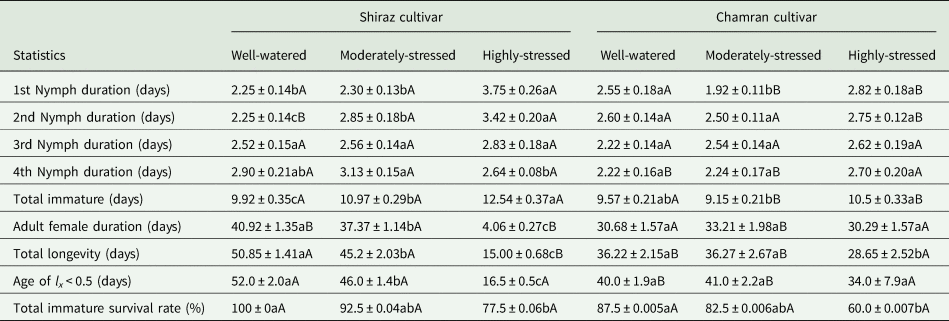
Metopolophium dirhodum had four nymphal instars, which successfully developed to the adult stage at all WS treatments assessed in the current study. Developmental parameters for each life stage and reproduction of the adult aphids under three water treatments on two wheat cultivars are presented in table 1. The duration of its pre-adult stages lengthened with increasing WS, ranging from 9.57 to 10.50 and from 9.92 to 12.54 days on Chamran and Shiraz cultivars, respectively (table 1). This increasing trend was more obvious on Shiraz cultivar (susceptible to drought) compared to Chamran cultivar (tolerant to drought) (table 1). The immature survival rate decreased with increasing WS on each cultivar, whereas significant differences were not observed between two cultivars under same treatments (table 1). Similar decreasing trends for total longevity between drought treatments on each cultivar means that the mean life span of aphids declined with raising water tension. The shortest total longevity was observed on Shiraz cultivar under severe WS conditions (table 1).
Development duration (days; mean ± SE) and survival rate of Metopolophium dirhodum on two wheat cultivars at three water stress treatments

Age of lx < 0.5: when the survival rate will drop before 50%.
Different lower case letters indicate significant differences between drought treatments, while upper case letters indicate significant differences between cultivars of the same treatments determined by the paired bootstrap test.
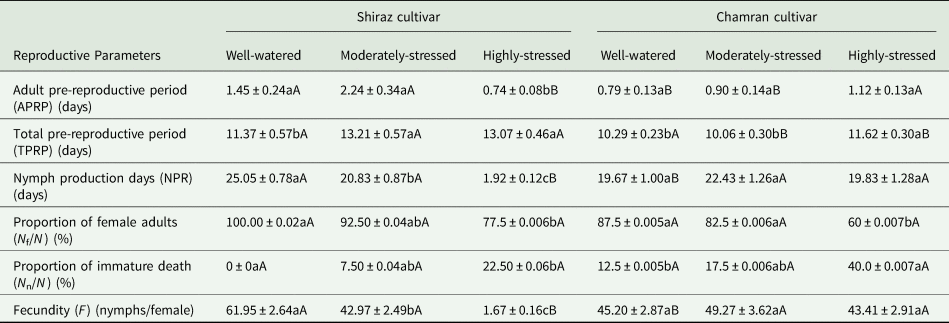
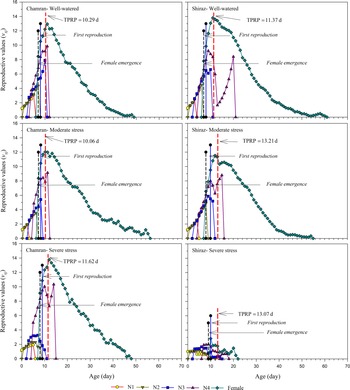
The adult pre-reproductive period of M. dirhodum on Shiraz cultivar was significantly influenced by water deficiency, particularly under severe water-deficit conditions (table 2). Significant differences were found among total pre-reproductive periods (TPRPs) on each wheat cultivar under different water treatments. TPRPs increased from 10.29 to 11.62 and from 11.37 to 13.07 days with increasing drought on Chamran and Shiraz cultivars, respectively. On the drought-susceptible cultivar (Shiraz), both moderate and severe WS treatments led to significant increasing of TPRPs, but on the drought-tolerant cultivar, only high WS significantly affected TPRP (table 2). Under severe WS, a remarkable short period of nymph production (1.92 days) was observed on drought-susceptible cultivar (table 2). Although in both cultivars the proportions of female adults (Nf/N) and pre-adult death (Nn/N) diminished with escalating WS, significant differences were not detected between the same treatments in Shiraz and Chamran cultivars (table 2). The lowest fecundity (1.67 nymphs/female), shortest adult duration (4.06 days) and the lowest total longevity (15 days) were observed on Shiraz cultivar under severe-water stressed treatment (tables 1 and 2). In other words, severe WS profoundly influenced either longevity or fecundity of adult aphids particularly on susceptible wheat cultivar. The highest mean fecundity was recorded on well-watered Shiraz cultivar (61.95 nymphs/female).
Reproductive parameters (mean ± SE) of Metopolophium dirhodum on two wheat cultivars at three water stress treatments

Different lower case letters indicate significant differences between drought treatments, while upper case letters indicate significant differences between cultivars of the same treatment.
N n: number of aphid individuals died before the adult stage, N f: number of individuals reached to adult stage, N: total number of the individuals at the beginning of experiment.
Nymph production days: number of days that fecundity of females was more than zero.
Population parameters of M. dirhodum
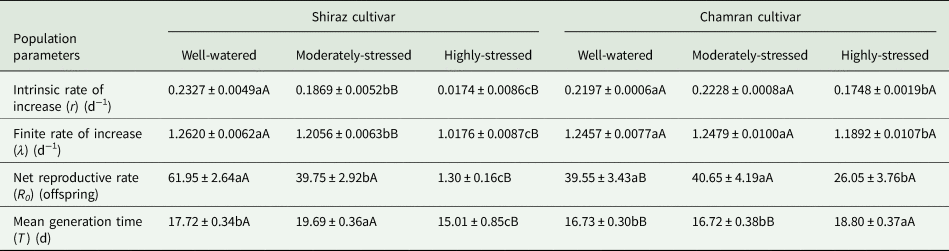
The life table parameters of M. dirhodum indicated the slower development of aphids on water-stressed plants in comparison with those on well-watered ones (table 3). On Shiraz (drought-susceptible) cultivar, the r and λ significantly decreased with increasing WS (table 3). A similar trend was also observed for R 0 (table 3). On Chamran (drought-tolerant) cultivar, r, λ, and R 0 did not significantly vary between well-watered and moderately drought-stressed treatments, but significant differences were observed under severe water-deficiency conditions (table 3). The lowest intrinsic rate of increase was observed on Shiraz cultivar under severe water shortage conditions (0.00174 d−1) (table 3).
Population parameters (mean ± SE) of Metopolophium dirhodum calculated using the age-stage, two-sex life table on two wheat cultivars under well-watered or drought-stress conditions

d−1, Per day.
Different lower case letters indicate significant differences between drought treatments, while upper case letters indicate significant differences between cultivars of the same treatment.
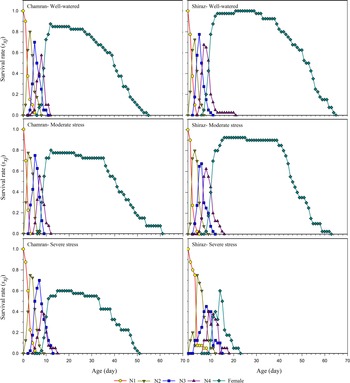
The age-stage-specific survival rate (sxj) represents the possibility that a newly born nymph will successfully live to age x and stage j (fig. 1). A significant variability was found between the well-watered and water-stressed treatments on both cultivars. Water deficiency negatively impacted the survival rate of adult aphid individuals, especially on Shiraz cultivar. The lowest survival rate occurred on Shiraz cultivar under severe water-stressed conditions (fig. 1). On Chamran cultivar, the highest survival rate was observed on moderately water-stressed plants (fig. 1). The variability of developmental rates among M. dirhodum individuals of all stages resulted in significant overlapping between the stages.
Age-stage-specific survival rate (Sxj) of M. dirhodum on Shiraz and Chamran wheat cultivars under different water-stress treatments. First-instar nymph: N1; second-instar nymph: N2; third-instar nymph: N3; fourth-instar nymph: N4.

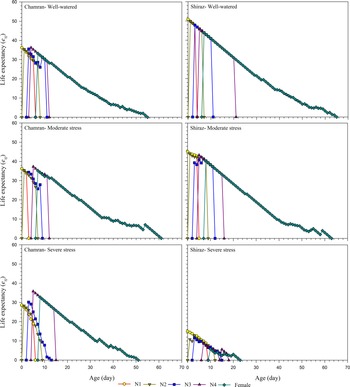
The age-stage-specific life expectancy (exj) and the life expectancy of an aphid individual of age x and stage j are shown in fig. 2. The exj of a newly born nymph at the age = 0 and stage = 1 was 50.92, 45.50, and 15.02 days on Shiraz cultivar, and 36.42, 36.17, and 29 days on Chamran cultivar, under well-watered, moderate, and severe water shortage conditions, respectively (fig. 2). The lowest life expectancy was observed on Shiraz cultivar under severe drought conditions (fig. 2).
Age-stage-specific life expectancy (exj) of M. dirhodum on Shiraz and Chamran wheat cultivars under different water-stress treatments. First-instar nymph: N1; second-instar nymph: N2; third-instar nymph: N3; fourth-instar nymph: N4.

The expected contribution of an individual aphid of age x and stage j to the succeeding population is plotted with the age-stage-specific reproductive value (vxj) (fig. 3). The vxj curves clearly increased with adult emergence and the summit was obtained when females started to produce offsprings at various treatments. The aphids at the age of 12, 12, and 11, and 11, 11, and 12 days made the greatest contributions to the succeeding generation when reared on Shiraz and Chamran wheat cultivars under well-watered, moderate, and severe water shortage conditions, respectively. Nonetheless, the remarkable decrease in the reproductive values of aphids was observed on Shiraz cultivar under severe WS treatment (fig. 3).
Age-stage-specific reproductive rate (vxj) of M. dirhodum on Shiraz and Chamran wheat cultivars under different water-stress treatments. TPRP (total pre-reproductive period). First-instar nymph: N1; second-instar nymph: N2; third-instar nymph: N3; fourth-instar nymph: N4.

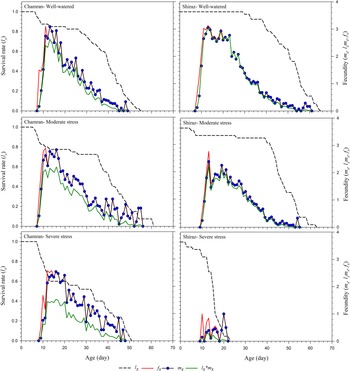
The parameters lx and mx are plotted in fig. 4. A significant variability is discerned between various water treatments. Although the lowest survival rates on both Shiraz and Chamran cultivars were observed under severe water deficiency (fig. 4), this reduction is more obvious on Shiraz cultivar. In other words, the lx curve sharply dropped for severe water-deficiency treatment on Shiraz cultivar. Despite decreasing trend of survival rates with increasing water deficiency, on Chamran cultivar, under moderately stressed conditions the survival rate was higher than in well-watered treatments. The trend of age-specific fecundity (mx) revealed that the greatest fecundities on Shiraz and Chamran cultivars were observed at the age of 13 and 13 (3.07 and 3.09 nymphs) (well-watered), 13 and 16 (2.40 and 2.82 nymphs) (moderately stressed), and 20 and 16 (1 and 2.56 nymphs) (severely stressed) days, respectively (fig. 4). As depicted in fig. 4, the female age-specific fecundity (fx) curves in all treatments were almost similar with their respective mx curves except for that of Shiraz cultivar under severe water deficiency, which was higher than its respective mx curve.
Age-specific survival rate (lx) and age-specific fecundity (mx) of M. dirhodum on Shiraz and Chamran wheat cultivars under different water-stress treatments.

Metopolophium dirhodum population projection
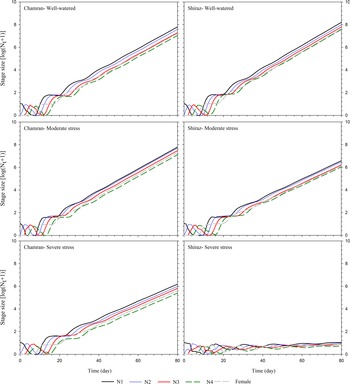
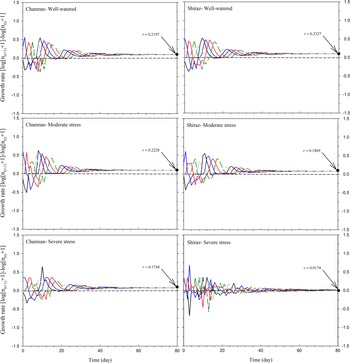
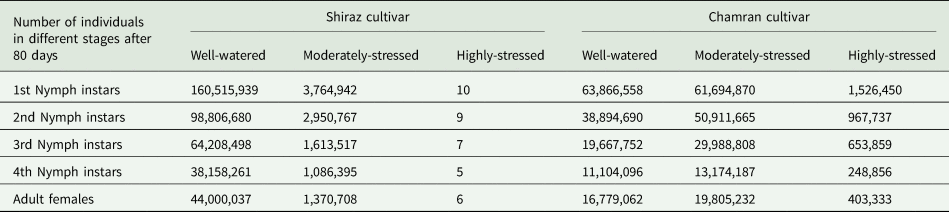
The population growth of M. dirhodum projected via utilizing the age-stage, two-sex life table data is depicted in fig. 5. Regarding precise description of stage differentiation in the age-stage, two-sex life tables, the alterations in stage structure would be easily discerned. As revealed from fig. 5, on the susceptible cultivar, WS negatively influenced the population growth of M. dirhodum, which was more obvious under severe WS conditions. Under moderate and severe water deficiencies, the aphid population grew faster on the tolerant cultivar compared to similar treatments on the susceptible cultivar. After some time, the natural logarithmic scale of growth rates of all stages approaches the intrinsic rate of increase (fig. 6). After 80 days, the number of aphid individuals of each nymphal instar and the number of adult females on each wheat cultivar under different water treatments are depicted in table 4. On Shiraz cultivar under severe drought stress, after 80 days, there were less than ten individuals of each stage, which was strikingly lower compared to the number of individuals of Chamran cultivar under similar water treatments (table 4).
Comparison of the population projection stage curves of M. dirhodum on two wheat cultivars under various water treatments based on the age-stage, two-sex life table. First-instar nymph: N1; second-instar nymph: N2; third-instar nymph: N3; fourth-instar nymph: N4.

Comparison of the population projection stage growth rates of M. dirhodum on two wheat cultivars under various water treatments based on the age-stage, two-sex life table. First-instar nymph: N1; second-instar nymph: N2; third-instar nymph: N3; fourth-instar nymph: N4.

Number of individuals of Metopolophium dirhodum in different stages after 80 days on two wheat cultivars under different water treatments

An initial population of10 newborns was used in each projection.
Antioxidant enzyme activity levels in wheat cultivars
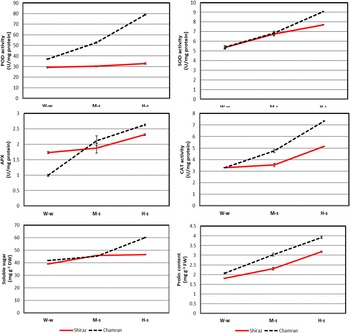
Analysis of variance showed the existence of significant interaction between wheat cultivars and water-deficit treatments for all antioxidant enzyme activities measured (fig. 7). Activities of all the enzymes showed an upward trend with increasing WS (fig. 7, table 5). The wheat cultivars had higher POD activity under water-deficit stress compared to well-watered conditions although this increase was much sharper in Chamran cultivar compared to Shiraz cultivar (fig. 7). A similar trend was also observed for CAT activity. Under well-watered conditions, Chamran cultivar showed less APX activity compared to Shiraz cultivar. Under water-deficit conditions, the situation was reversed, i.e., the interaction between cultivar and water-deficit levels was clearly observed. Under well-watered and moderately-stressed conditions, no significant differences were detected between SOD activities in Shiraz and Chamran cultivars. However, under severe stress, a significant increase was observed in SOD activity in Chamran cultivar. Overall, the highest levels of POD (79.10 mg l−1), SOD (9.06 mg l−1), APX (2.63 mg l−1), and CAT (7.34 mg l−1) activities were recorded for Chamran cultivar under severe water-deficit conditions (fig. 7, table 5).
Effect of drought stress on peroxidase (POD), superoxide dismutase (SOD), ascorbate peroxidase (APX), and catalase (CAT) activities (U mg−1 protein) and proline and soluble sugar contents (mg g−1 DW) in two wheat cultivars, one susceptible (Shiraz) and one tolerant (Chamran) to drought. W-w (well-watered = 100% FC); M-s (moderately-stressed = 60% FC); H-s (highly-stressed = 40% FC). Values are mean ± SE (ten replicates for antioxidant enzymes and six replicates for soluble sugar and proline).

Effect of water stress (mean ± SE) on peroxidase (POD), superoxidase (SOD), ascorbate peroxidase (APX), and catalase (CAT) of drought-tolerant (Chamran) and drought-susceptible (Shiraz) wheat cultivars

LSD, least significant difference; (U mg−1 protein), units per mg protein.
Soluble sugar and proline content in wheat cultivars
Leaf proline content significantly raised due to water deficit in both wheat cultivars. Nonetheless, the proline content was significantly higher in Chamran cultivar under mild and severe water-deficit stress compared to Shiraz cultivar (fig. 7, table 6).
Effect of water stress (mean ± SE) on soluble sugar and proline of drought-tolerant (Chamran) and drought-susceptible (Shiraz) wheat cultivars

DW, dry weight; FW, fresh weight.
Soluble sugar significantly accumulated in the leaves of wheat cultivars under water-deficit conditions. Nonetheless, no significant difference was detected between the cultivars for soluble sugar under moderate WS. Under severe water-deficiency conditions, soluble sugar exhibited a higher level of increase in Chamran cultivar than in Shiraz cultivar. Indeed, Chamran cultivar accumulated more soluble sugar upon severe water-deficit stress compared to Shiraz cultivar (fig. 7, table 6).
Discussion
The vastness of arable lands in arid or semi-arid regions, increasing the frequency, duration, severity, and intensity of dry seasons along with the over-extraction of water resources, has all made water deficiency one of the most paramount challenges the world assuredly come up against, particularly in the field of producing crops (Payus et al., Reference Payus, Ann Huey, Adnan, Besse Rimba, Mohan, Kumar Chapagain, Roder, Gasparatos and Fukushi2020; Malhi et al., Reference Malhi, Kaur and Kaushik2021). Water accessibility is crucial for plants in terms of their development and resistance to various phytophagous pests (Quandahor et al., Reference Quandahor, Lin, Gou, Coulter and Liu2019), so drought has always been regarded as a major abiotic factor that immensely influences plant productivity (Seleiman et al., Reference Seleiman, Al-Suhaibani, Ali, Akmal, Alotaibi, Refay, Dindaroglu, Abdul-Wajid and Battaglia2021).
Insects might experience the impacts of water deficiency directly via changes in their demographic characteristics (Haile, Reference Haile, Peterson and Highley2001). To evaluate how drought stress in wheat plants affects the rose-grain aphid, comparing the life history attributes of M. dirhodum on well-watered and water-stressed wheat cultivars was conducted. Our findings showed that water deficiency negatively affected M. dirhodum performance on the susceptible wheat cultivar. Significant differences were detected in the survival, developmental periods, reproductive times, fecundities, and reproductive rates of aphids under WS conditions. Aphid performance declined with increasing WS probably due to host deterioration (Kuglerová et al., Reference Kuglerová, Skuhrovec and Münzbergová2019). The declined performance of M. dirhodum on water-stressed wheat cultivars detected in our study is in agreement with the findings of Mewis et al. (Reference Mewis, Khan, Glawischnig, Schreiner and Ulrichs2012) and Quandahor et al. (Reference Quandahor, Lin, Gou, Coulter and Liu2019). Nonetheless, moderate water deficiency did not negatively influence aphid performances on the tolerant cultivar. Insignificant differences were detected in demographic features of aphids under moderate water-deficiency conditions compared to well-watered treatments. In other words, aphids performed equally well on the tolerant wheat plants in well-watered and mild-drought treatments. In total, all the measures of aphid population performance on both cultivars revealed a remarkable negative effect of severe WS, with lesser intrinsic rate of increase (r), longevity, and fecundity. The reduced aphid performance on water-deficient plants in this study is in line with previous studies (Mewis et al., Reference Mewis, Khan, Glawischnig, Schreiner and Ulrichs2012; Banfield-Zanin and Leather, Reference Banfield-Zanin and Leather2015; Quandahor et al., Reference Quandahor, Lin, Gou, Coulter and Liu2019). This scenario is not consistently true as each and every neutral, negative, or positive effects of plant drought stress on aphid performance has been reported elsewhere (Hale et al., Reference Hale, Bale, Pritchard, Masters and Brown2003; Rouault et al., Reference Rouault, Candau, Lieutier, Nageleisen, Martin and Warzée2006; Quandahor et al., Reference Quandahor, Lin, Gou, Coulter and Liu2019).
Using population projection on the basis of age-stage, two-sex life table, alterations in insect population size and stage structure over time would be predictable. Such predictions will be undoubtedly profitable in determining the population growth trend and also the time of emergence of various developmental stages (Chi, Reference Chi1990; Bussaman et al., Reference Bussaman, Sa-Uth, Chandrapatya, Atlihan, Gökçe, Saska and Chi2017; Qayyum et al., Reference Qayyum, Aziz, Iftikhar, Hafeez and Atlihan2018; Satishchandra et al., Reference Satishchandra, Chakravarthy, Özgökçe and Atlihan2019; Zhang et al., Reference Zhang, Guo, Atlıhan, Chi and Chu2019), which have great significance in implementing and timing any control program. In the current study, the aphid population projections indicated decreasing trend of population growth with increasing WS, particularly on Shiraz cultivar (fig. 6). On the other hand, drought stress had detrimental impacts on M. dirhodum on drought-susceptible wheat plants. On Chamran cultivar, under mild WS conditions, the population experienced a rise in size; nonetheless, the decline of population growth was obvious under severe water-deficit conditions.
Drought stress could strikingly enhance concentrations of secondary plant metabolites (Yadav et al., Reference Yadav, Jogawat, Rahman and Narayan2021), which take part in the defense mechanisms of plants (ElSayed et al., Reference ElSayed, El-Hamahmy, Rafudeen, Mohamed and Omar2019; Takahashi et al., Reference Takahashi, Kuromori, Urano, Yamaguchi-Shinozaki and Shinozaki2020). Reactive oxygen species (ROS) are produced early in plants and accumulate swiftly in response to biotic or abiotic tensions as part of plant defense (Kapoor et al., Reference Kapoor, Bhardwaj, Landi, Sharma, Ramakrishnan and Sharma2020; Sharma et al., Reference Sharma, Wang, Xu, Tao, Chong, Yan, Li, Yuan and Zheng2020; Takahashi et al., Reference Takahashi, Kuromori, Urano, Yamaguchi-Shinozaki and Shinozaki2020). As high levels of ROS may be deleterious (Zhao et al., Reference Zhao, Sun, Xue, Zhang and Li2016), their generation under water shortage could bring about adverse repercussions at a cellular level (Maurino and Flügge, Reference Maurino and Flügge2008). To diminish or alleviate these detrimental effects, various protective mechanisms for scavenging ROS, including enzymatic antioxidants, become active in plants (Howe and Schilmiller, Reference Howe and Schilmiller2002; Hasheminasab et al., Reference Hasheminasab, Assad, Aliakbari and Sahhafi2012; Wang et al., Reference Wang, Chen, Sharma, Tao, Zheng, Landi, Yuan and Yan2019). The antioxidant enzymes' activity in plants seems to be a sign of their tolerance level to stress (Mao et al., Reference Mao, Yang, Guo, Zhang and Liu2012; Hasanuzzaman et al., Reference Hasanuzzaman, Bhuyan Borhannuddin, Zulfiqar, Raza, Mohsin, Mahmud, Fujita and Fotopoulos2020). In the present survey, POD activity obviously increased by drought stress in both cultivars. Peroxidase activity in Chamran cultivar was remarkably higher than in Shiraz cultivar under water-deficiency conditions (fig. 7). Increasing POD activity under drought might be an adaptive response. Although WS considerably increased SOD activity in wheat cultivars, this activity in the tolerant cultivar (Chamran) was longer than in the sensitive one (Shiraz). There were similar trends for APX and CAT activities in both cultivars under water-deficiency conditions. In addition to its vital role in plant tolerance to high water shortage stress (Zhang et al., Reference Zhang, Wang, Li and Liu2021), CAT also probably takes part in the defensive response of plants against aphids (Zhao et al., Reference Zhao, Sun, Xue, Zhang and Li2016). Our findings are in agreement with some prior studies reporting that drought-tolerant plant varieties have higher activity of antioxidant enzymes compared to non-tolerant ones (Moussa and Abdel-Aziz, Reference Moussa and Abdel-Aziz2008; Kapoor et al., Reference Kapoor, Bhardwaj, Landi, Sharma, Ramakrishnan and Sharma2020).
It is noteworthy to mention that various plants promote their capability to grow and survive during water-deficiency periods via accumulation of soluble sugars and other osmoprotectants. Proline is a crucial organic solute that is accumulated in numerous plants under water-deficiency conditions (Živanović et al., Reference Živanović, Milić Komić, Tosti, Vidović, Prokić and Veljović Jovanović2020). In this survey, water deficiency increased proline and soluble sugar contents in both cultivars, but in the tolerant cultivar it was more remarkable. Our findings are in line with those of some previous studies, which reported a notable increase in free proline and soluble sugar under water-deficiency conditions (Abid et al., Reference Abid, Tian, Ata-Ul-Karim, Liu, Cui, Zahoor, Jiang and Dai2016, Reference Abid, Ali, Qi, Zahoor, Tian, Jiang, Snider and Dai2018). Under water-deficit stress, further agglomeration of soluble sugars and proline might be profitable in stress tolerance in wheat plants (Abid et al., Reference Abid, Ali, Qi, Zahoor, Tian, Jiang, Snider and Dai2018). Based on previous findings, water deficiency notably reduced the relative water content of wheat plants (Marček et al., Reference Marček, Hamow, Végh, Janda and Darko2019; Xie et al., Reference Xie, Shi, Shi, Xu, He and Wang2020), which could impose negative impacts on sap-sucking insects through interfering with their capability to access or use nutrition sources (Sumner et al., Reference Sumner, Need, McNew, Dorschner, Eikenbary and Johnson1983; Huberty and Denno, Reference Huberty and Denno2004). In our study, despite providing additional nutrition to aphids through increasing soluble sugars in both cultivars under drought stress, the water content of cultivars might possibly have played a role in M. dirhodum performance and presumably prevented aphids from benefiting, probably via causing difficulties for M. dirhodum individuals to feed (Rivelli et al., Reference Rivelli, Trotta, Toma, Fanti and Battaglia2013).
Our results indicated that the demographic characteristics and population parameters of M. dirhodum were influenced by drought stress. By advancing our knowledge on M. dirhodum responses to wheat plants across a range of drought intensities, our capacity to forecast the responses of M. dirhodum to fluctuating environmental conditions is improved. From a practical standpoint, gaining knowledge about the population parameters and forecasting the population growth by means of life tables is lucrative in predicting population dynamics and establishing efficacious management strategies against any pest species, including M. dirhodum. However, as this study was performed under laboratory conditions, it is crucial to bear in mind that further studies are required to be conducted in field conditions to achieve more precise results.
Conclusions
The present research provided basic information on the development of various life stages, demographic parameters, and the population growth of M. dirhodum under drought stress conditions.
The aphid M. dirhodum reproduced at a lower rate on wheat plants under acute WS compared to well-watered ones. Because of the higher intrinsic and finite rates of increase, the drought-tolerant cultivar was more suitable for the rose-grain aphid population growth under water-deficit stress. Nevertheless, in comparison to well-irrigated plants, moderate WS caused neutral impacts of M. dirhodum on the tolerant cultivar, so the potential likelihood of M. dirhodum eruptions can differ according to the degree of drought intensity and host plant cultivar. Eventually, under future drought scenarios, severe drought might have capacity to decrease the abundance and outbreak of M. dirhodum. Nonetheless, because of the complicated interactions of host plants, insect pests and bioclimatic variables, forecasting the probability of outbreak of aphids under uncertain predicted drought scenarios and fluctuating environmental conditions is far from linear, so the precise exploration should be done for any particular case.
Acknowledgments
We would like to express great appreciation to the Shiraz University for providing generous support for this study.
Author contributions
Maryam Aleosfoor and Kambiz Minaei conceived research. Maryam Aleosfoor and Maryam Zahediannezhad conducted experiments. Maryam Aleosfoor, Lida Fekrat and Hooman Razi analyzed data and conducted statistical analyses. Lida Fekrat and Maryam Aleosfoor wrote the manuscript. Kambiz Minaei edited the manuscript and provided additional information. All authors read and approved the manuscript.
Conflict of interest
None.
Zenodo dataset
Maryam Aleosfoor, Maryam Zahediannezhad, Kambiz Minaei, Lida Fekrat and Hooman Razi (2021). Drought stress and plant cultivar type affect demographic responses of herbivorous insects: a case study with the rose-grain aphid, Metopolophium dirhodum (Hemiptera: Aphididae) [Data set]. Zenodo. https://doi.org/10.5281/zenodo.5550536