1 Introduction
For a connected and simply connected nilpotent Lie group
 $N$
and a compact subgroup
 $C$
of
 $\text{Aut}(N)$
, the semi-direct product
 $N\rtimes C$
acts on
 $N$
by
 $$\begin{eqnarray}(n,\unicode[STIX]{x1D711})\cdot m=n\unicode[STIX]{x1D711}(m)\quad \text{for all}~m,n\in N~\text{and for all}~\unicode[STIX]{x1D711}\in C.\end{eqnarray}$$
An almost-crystallographic group is a discrete subgroup
 $\unicode[STIX]{x1D6E4}\subseteq N\rtimes C$
that acts co-compactly on
 $N$
. If
 $\unicode[STIX]{x1D6E4}$
is torsion-free, then it is said to be almost-Bieberbach. In this case, the quotient space
 $N/\unicode[STIX]{x1D6E4}$
is a closed manifold called an infra-nil manifold (modelled on
 $N$
).
An almost-flat manifold is a closed manifold
 $M$
such that for any
 $\unicode[STIX]{x1D700}>0$
there exists a Riemannian metric
 $g_{\unicode[STIX]{x1D700}}$
on
 $M$
with
 $|K_{\unicode[STIX]{x1D700}}|\,\text{diam}(M,g_{\unicode[STIX]{x1D700}})^{2}<\unicode[STIX]{x1D700}$
where
 $K_{\unicode[STIX]{x1D700}}$
is the sectional curvature and
 $\text{diam}(M,g_{\unicode[STIX]{x1D700}})$
is the diameter of
 $(M,g_{\unicode[STIX]{x1D700}})$
.
By the results of Gromov [Reference Gromov13] and Ruh [Reference Ruh20], the classes of almost-flat manifolds and infra-nil manifolds coincide. Such manifolds occur naturally in the study of Riemannian manifolds with negative sectional curvature. For example, every complete non-compact finite volume manifold with pinched negative sectional curvature has finitely many boundary components which are all almost-flat manifolds (see [Reference Buser and Karcher4, §1]). Another important occurrence of such manifolds is in the study of collapsing manifolds with uniformly bounded sectional curvature. By a theorem of Cheeger et al, if a manifold is sufficiently collapsed relative to the size of its diameter, then it admits a local fibration structure whose fibers are almost-flat (see [Reference Cheeger, Fukaya and Gromov5]).
It is well known that all closed orientable manifolds of dimension at most three have a spin structure (see [Reference Kirby15, p. 35], [Reference Milnor and Stasheff17, Exercise 12.B and VII, Theorem 2]). In [Reference Gąsior, Petrosyan and Szczepański12], a complete list of non-spin four-dimensional orientable almost-flat manifolds with cyclic 2-group holonomy was given. In the current paper, we introduce an algorithm to determine the existence of a spin structure on an almost-flat manifold using the classifying representation of its fundamental group. We apply it to classify spin structures on all almost-flat manifolds in dimension four that are not flat. The case of four-dimensional flat manifolds has been done in [Reference Putrycz and Szczepański19]. In doing so, we follow the classification of four-dimensional infra-nil manifolds given in [Reference Dekimpe7]. There are 127 orientable families of four-dimensional infra-nil manifolds. Our computations show that there are exactly 15 families that cannot have a spin structure. In Corollary 5.1, we show that the remaining families of 4-manifolds are in fact parallelizable, i.e. have trivial tangent bundle.
We should also point out that we find one family (no. 80) of non-spin manifolds with holonomy group
 $C_{4}$
which was inadvertently omitted in [Reference Gąsior, Petrosyan and Szczepański12].
2 Preliminaries
We will always assume that an almost-flat manifold comes equipped with a structure of an infra-nil manifold when discussing its topological properties. We denote by
 $\text{O}(n)$
the real orthogonal group of rank
 $n$
. It is well known that infra-nil manifolds are classified by their fundamental group which is almost-crystallographic. A classical result of Auslander (see [Reference Auslander2]) asserts that every almost-crystallographic subgroup
 $\unicode[STIX]{x1D6E4}\subseteq \text{Aff}(N):=N\rtimes \text{Aut}(N)$
fits into an extension
 $$\begin{eqnarray}1\longrightarrow \unicode[STIX]{x1D6EC}\stackrel{}{\longrightarrow }\unicode[STIX]{x1D6E4}\stackrel{\unicode[STIX]{x1D70B}}{\longrightarrow }F\longrightarrow 1,\end{eqnarray}$$
where
 $\unicode[STIX]{x1D6EC}=\unicode[STIX]{x1D6E4}\cap N$
is a uniform lattice in
 $N$
and
 $F$
is a finite subgroup of
 $C\subseteq \text{Aut}(N)$
called the holonomy group of the corresponding infra-nil manifold
 $N/\unicode[STIX]{x1D6E4}$
.
We recall a key result from [Reference Gąsior, Petrosyan and Szczepański12] which states that the classifying map of the tangent bundle of an almost-flat manifold
 $M$
factors through the classifying space of the holonomy group
 $F$
.
Proposition 2.1 [Reference Gąsior, Petrosyan and Szczepański12, Proposition 2.1].
Let
 $M$
be an orientable
 $n$
-dimensional almost-flat manifold modelled on a connected and simply connected nilpotent Lie group
 $N$
. Denote by
 $\unicode[STIX]{x1D6E4}$
the fundamental group of
 $M$
and let
 $$\begin{eqnarray}1\longrightarrow \unicode[STIX]{x1D6EC}\stackrel{}{\longrightarrow }\unicode[STIX]{x1D6E4}\stackrel{\unicode[STIX]{x1D70B}}{\longrightarrow }F\longrightarrow 1\end{eqnarray}$$
be the standard extension of
 $\unicode[STIX]{x1D6E4}$
. Then the classifying map
 $\unicode[STIX]{x1D70F}:M\rightarrow BSO(n)$
of the tangent bundle of
 $M$
factors through
 $BF$
and is induced by a composite homomorphism
 $\unicode[STIX]{x1D70C}:\unicode[STIX]{x1D6E4}\stackrel{\unicode[STIX]{x1D70B}}{\rightarrow }F\stackrel{\unicode[STIX]{x1D708}}{\rightarrow }\operatorname{SO}(n)$
where
 $\unicode[STIX]{x1D708}:F{\hookrightarrow}\operatorname{SO}(n)$
is the holonomy representation.
We denote by
 $$\begin{eqnarray}\unicode[STIX]{x1D6EC}=\unicode[STIX]{x1D6FE}_{1}(\unicode[STIX]{x1D6EC})>\unicode[STIX]{x1D6FE}_{2}(\unicode[STIX]{x1D6EC})>\cdots >\unicode[STIX]{x1D6FE}_{c+1}(\unicode[STIX]{x1D6EC})=1,\end{eqnarray}$$
the lower central series of
 $\unicode[STIX]{x1D6EC}$
, i.e.
 $\unicode[STIX]{x1D6FE}_{i+1}(\unicode[STIX]{x1D6EC})=[\unicode[STIX]{x1D6EC},\unicode[STIX]{x1D6FE}_{i}(\unicode[STIX]{x1D6EC})]$
for
 $1\leqslant i\leqslant c$
. By [Reference Dekimpe7, Lemma 1.2.6], we have that the isolator
 , where
 $\unicode[STIX]{x1D6FE}_{i}(N)$
,
 $1\leqslant i\leqslant c+1$
, form the lower central series of
 $N$
. By [Reference Dekimpe7, Lemmas 1.1.2–3], the resulting adapted lower central series

has torsion-free factor groups

Thus, each
 $H_{i}\cong \mathbb{Z}^{m_{i}}$
for some positive integer
 $m_{i}$
. Conjugation in
 $\unicode[STIX]{x1D6E4}$
induces an action of the holonomy group
 $F$
on each factor group
 $H_{i}$
. This gives a faithful representation
 $$\begin{eqnarray}\unicode[STIX]{x1D703}:F{\hookrightarrow}\text{GL}(m_{1},\mathbb{Z})\times \cdots \times \text{GL}(m_{c},\mathbb{Z}){\hookrightarrow}\text{GL}(n,\mathbb{Z}),\quad m_{1}+\cdots +m_{c}=n,\end{eqnarray}$$
which we call the integral holonomy representation.
Proposition 2.2 [Reference Gąsior, Petrosyan and Szczepański12, Proposition 2.4].
The integral holonomy representation
 $\unicode[STIX]{x1D703}:F{\hookrightarrow}\text{GL}(n,\mathbb{Z})$
is
 $\mathbb{R}$
-equivalent to
 $\unicode[STIX]{x1D708}:F{\hookrightarrow}\text{O}(n)\subseteq \text{GL}(n)$
.
We may conclude that the almost-flat manifold
 $M$
is orientable if and only if the image of the representation
 $\unicode[STIX]{x1D703}:F{\hookrightarrow}\text{GL}(n,\mathbb{Z})$
lies inside
 $\text{SL}(n,\mathbb{Z})$
.
3 Spin representations
The goal of this section is to present tools necessary to determine spin structures on almost-flat manifolds and discuss the main algorithm for the calculations. We start with the basic definitions which allow us to introduce some notation. We refer the reader to the original sources [Reference Atiyah, Bott and Shapiro1, Reference Chevalley6] and the textbook [Reference Friedrich10] for a comprehensive treatment of spin structures and its applications to the Dirac operator.
Definition 3.1. Let
 $n\in \mathbb{N}$
. The Clifford algebra
 $C_{n}$
is a real unital associative algebra generated by the elements
 $e_{1},\ldots ,e_{n}$
satisfying the relations
 $$\begin{eqnarray}\forall _{1\leqslant i<j\leqslant n}\;e_{i}^{2}=-1\quad \text{and}\quad e_{i}e_{j}=-e_{j}e_{i}.\end{eqnarray}$$
Remark 3.2. We may view
 $\mathbb{R}^{n}=\operatorname{span}\{e_{1},\ldots ,e_{n}\}$
as a vector subspace of
 $C_{n}$
, for
 $n\in \mathbb{N}$
.
Let
 $n\in \mathbb{N}$
. In the Clifford algebra
 $C_{n}$
we have the following three involutions:
-
(i) *:
 $C_{n}\rightarrow C_{n}$
, defined on the basis of (the vector space)
$C_{n}$
by
$$\begin{eqnarray}\forall _{1\leqslant i_{1}<i_{2}<\cdots <i_{k}\leqslant n}\;(e_{i_{1}}\ldots e_{i_{k}})^{\ast }=e_{i_{k}}\ldots e_{i_{1}};\end{eqnarray}$$
-
(ii) ′ :
$C_{n}\rightarrow C_{n}$
, defined on the generators of (the algebra)
$C_{n}$
by
$$\begin{eqnarray}\forall _{1\leqslant i\leqslant n}e_{i}^{\prime }=-e_{i}.\end{eqnarray}$$
-
(iii)
$\overline{\phantom{a}}$
:
$C_{n}\rightarrow C_{n}$
is the composition of the previous involutions
$$\begin{eqnarray}\forall _{a\in C_{n}}\;\overline{a}=(a^{\prime })^{\ast }.\end{eqnarray}$$


The spin group is the following subgroup of the group of units in the Clifford algebra:
 $$\begin{eqnarray}\operatorname{Spin}(n):=\{x\in C_{n}\mid x^{\prime }=x,x\overline{x}=1\}.\end{eqnarray}$$
Moreover, there exists a covering map
 $\unicode[STIX]{x1D706}_{n}:\operatorname{Spin}(n)\rightarrow \operatorname{SO}(n):x\mapsto \unicode[STIX]{x1D706}_{n}(x)$
defined by
 $$\begin{eqnarray}\forall _{v\in \mathbb{R}^{n}}\;\unicode[STIX]{x1D706}_{n}(x)v=xv\overline{x},\end{eqnarray}$$
which is a homomorphism with kernel equal to
 $\{\pm 1\}$
. For
 $n\geqslant 3$
, the group
 $\operatorname{Spin}(n)$
is simply connected (see, for example, [Reference Szczepański21, Proposition 6.1, p. 86] and [Reference Friedrich10, p. 16]).
A spin structure on a smooth orientable manifold
 $M$
is an equivariant lift of its orthonormal frame bundle via the covering
 $\unicode[STIX]{x1D706}_{n}$
. The existence of such a lift is equivalent to the existence of a lift
 $\tilde{\unicode[STIX]{x1D70F}}:M\rightarrow B\text{Spin}(n)$
of the classifying map of the tangent bundle
 $\unicode[STIX]{x1D70F}:M\rightarrow B\text{SO}(n)$
such that
 $B_{\unicode[STIX]{x1D706}_{n}}\circ \tilde{\unicode[STIX]{x1D70F}}=\unicode[STIX]{x1D70F}$
. Equivalently,
 $M$
has a spin structure if and only if the second Stiefel–Whitney class
 $w_{2}(TM)$
vanishes [Reference Borel and Hirzebruch3, p. 350].
Now, let
 $M=N/\unicode[STIX]{x1D6E4}$
be an
 $n$
-dimensional orientable almost-flat manifold modelled on the nilpotent group
 $N$
with the fundamental group
 $\unicode[STIX]{x1D6E4}$
, that fits into the standard extension
 $$\begin{eqnarray}1\longrightarrow \unicode[STIX]{x1D6EC}\stackrel{}{\longrightarrow }\unicode[STIX]{x1D6E4}\stackrel{\unicode[STIX]{x1D70B}}{\longrightarrow }F\longrightarrow 1.\end{eqnarray}$$
Let
 $\unicode[STIX]{x1D70C}:\unicode[STIX]{x1D6E4}\rightarrow \operatorname{SO}(n)$
be the classifying representation of
 $\unicode[STIX]{x1D6E4}$
. The following corollary of Proposition 2.1 allows us to classify the spin structures on
 $M$
via genuine group homomorphisms from its fundamental group to
 $\text{Spin}(n)$
that lift the classifying representation.
Corollary 3.3. [Reference Gąsior, Petrosyan and Szczepański12, Corollary 2.3] Let
 $M$
be an orientable almost-flat manifold of dimension
 $n$
with fundamental group
 $\unicode[STIX]{x1D6E4}$
. Then the set of spin structures on M is in one-to-one correspondence with the set of homomorphisms
 $\unicode[STIX]{x1D716}:\unicode[STIX]{x1D6E4}\rightarrow \text{Spin}(n)$
such that
 $\unicode[STIX]{x1D706}_{n}\circ \unicode[STIX]{x1D716}=\unicode[STIX]{x1D70C}$
, i.e. the diagram

commutes.
Remark 3.4. In [Reference Pfäffle18], Pfäffle used the analogous result (Proposition 3.2) to classify the Dirac spectra for all three-dimensional orientable flat manifolds.
3.1 The algorithm for computing spin structures
For an almost-Bieberbach group
 $\unicode[STIX]{x1D6E4}$
, there always exists a finite presentation, say
 $\unicode[STIX]{x1D6E4}=\langle S\mid R\rangle$
with the set of generators
 $S$
and the set of relations
 $R$
. A map
 $\unicode[STIX]{x1D716}^{\prime }:S\rightarrow \operatorname{Spin}(n)$
can be extended to a homomorphism
 $\unicode[STIX]{x1D716}:\unicode[STIX]{x1D6E4}\rightarrow \operatorname{Spin}(n)$
if and only if it preserves the relations of
 $\unicode[STIX]{x1D6E4}$
:
 $$\begin{eqnarray}\forall _{r_{1},\ldots ,r_{l}\in S}\forall _{\unicode[STIX]{x1D6FC}_{1},\ldots ,\unicode[STIX]{x1D6FC}_{l}\in \mathbb{Z}}\;r_{1}^{\unicode[STIX]{x1D6FC}_{1}}\cdot \ldots \cdot r_{l}^{\unicode[STIX]{x1D6FC}_{l}}\in R\Rightarrow \unicode[STIX]{x1D716}^{\prime }(r_{1})^{\unicode[STIX]{x1D6FC}_{1}}\cdot \ldots \cdot \unicode[STIX]{x1D716}^{\prime }(r_{l})^{\unicode[STIX]{x1D6FC}_{l}}=1.\end{eqnarray}$$
Moreover, since
 $\ker \unicode[STIX]{x1D706}_{n}=\{\pm 1\}$
, in order to obtain commutativity of the diagram (4), we must have
 $$\begin{eqnarray}\forall _{\unicode[STIX]{x1D6FE}\in \unicode[STIX]{x1D6E4}}\forall _{x\in \operatorname{Spin}(n)}\;\unicode[STIX]{x1D70C}(\unicode[STIX]{x1D6FE})=\unicode[STIX]{x1D706}_{n}(x)\Rightarrow \unicode[STIX]{x1D716}(\unicode[STIX]{x1D6FE})\in \{\pm x\}.\end{eqnarray}$$
Hence, it follows that we can construct a lifting homomorphism
 $\unicode[STIX]{x1D716}$
if and only if for every generator
 $s\in S$
, there exists an element
 $x_{s}\in \operatorname{Spin}(n)$
such that
 $\unicode[STIX]{x1D70C}(s)=\unicode[STIX]{x1D706}_{n}(x_{s})$
and there is a combinations of signed elements
 $x_{s}\in \operatorname{Spin}(n)$
,
 $s\in S$
, that preserve the given relations of
 $\unicode[STIX]{x1D6E4}$
.
Note that in order to find a preimage in
 $\unicode[STIX]{x1D706}_{n}^{-1}(g)$
of an element
 $g\in \operatorname{SO}(n)$
it is enough to use the definition of the group
 $\operatorname{Spin}(n)$
and the formula (2) which gives us a system of
 $n$
linear equations with
 $2^{n}$
variables. In general, this approach is not very efficient. The following lemmas allow us to simplify this problem in our context.
Lemma 3.5 [Reference Gąsior, Petrosyan and Szczepański12, Lemma 2.6].
Let
 $M$
be an orientable almost-flat manifold with the fundamental group
 $\unicode[STIX]{x1D6E4}$
satisfying (3). Let
 $S$
be a
 $2$
-Sylow subgroup of
 $F$
. Then
 $M$
has a spin structure if and only if
 $N/\unicode[STIX]{x1D70B}^{-1}(S)$
has a spin structure.
Lemma 3.6 [Reference Lutowski and Putrycz16, p. 282].
Let
 $\unicode[STIX]{x1D703}:F\rightarrow \operatorname{GL}(n,\mathbb{Z})$
be a representation of a 2-group
 $F$
. Then
 $\unicode[STIX]{x1D708}$
is
 $\mathbb{R}$
-equivalent to a representation
 $\unicode[STIX]{x1D703}^{\prime }:F\rightarrow \operatorname{O}(n,\mathbb{Z})=O(n)\cap \operatorname{GL}(n,\mathbb{Z})$
.
To determine whether
 $M$
has a spin structure, using the above two lemmas and Proposition 2.2, without loss of generality, we can assume that
 $F$
is a 2-group and that the holonomy representation is of the form
 $$\begin{eqnarray}\unicode[STIX]{x1D703}:F\rightarrow \operatorname{SO}(n,\mathbb{Z})=\operatorname{SO}(n)\cap \operatorname{SL}(n,\mathbb{Z}).\end{eqnarray}$$
The group
 $\operatorname{SO}(n,\mathbb{Z})$
is generated by the matrices of the form
 $$\begin{eqnarray}P_{(p\;q)}^{\prime }=\operatorname{diag}(\underbrace{1,\ldots ,1}_{p-1},-1,1,\ldots ,1)\cdot P_{(p\;q)},\end{eqnarray}$$
where
 $p<q$
and
 $P_{(p\;q)}$
is a matrix of the inversion
 $(p\;q)$
. An easy calculation shows that
 $$\begin{eqnarray}\unicode[STIX]{x1D706}_{n}\biggl(\pm \frac{1+e_{p}e_{q}}{\sqrt{2}}\biggr)=P_{(p\;q)}^{\prime }\end{eqnarray}$$
for
 $p<q$
and as a consequence
 $$\begin{eqnarray}\unicode[STIX]{x1D706}_{n}(\pm e_{n_{1}}\cdots e_{n_{l}})=D^{\prime },\end{eqnarray}$$
where
 $D^{\prime }\in \operatorname{SO}(n,\mathbb{Z})$
is the diagonal matrix with
 $-1$
in exactly the entries
 $n_{1},\ldots ,n_{l}$
(see [Reference Lutowski and Putrycz16, Lemma 7]).
Lastly, we can simplify our calculation of spin structures on
 $M$
as follows. Let
 $\unicode[STIX]{x1D6EC}^{2}$
be the normal closure of the group generated by the squares of the generators of the nilpotent lattice
 $\unicode[STIX]{x1D6EC}$
. If the lifting homomorphism
 $\unicode[STIX]{x1D716}:\unicode[STIX]{x1D6E4}\rightarrow \operatorname{Spin}(n)$
exists, then
 $\unicode[STIX]{x1D6EC}^{2}\subseteq \ker \unicode[STIX]{x1D716}$
. Therefore, in the following commutative diagram, the existence of the lifting
 $\unicode[STIX]{x1D716}$
is equivalent to the existence of the lifting
 $\unicode[STIX]{x1D716}_{2}$
:

where
 $\unicode[STIX]{x1D707}:\unicode[STIX]{x1D6E4}\rightarrow \unicode[STIX]{x1D6E4}/\unicode[STIX]{x1D6EC}^{2}$
denotes the natural quotient homomorphism. We have proved the following.
Proposition 3.7. Let
 $M$
be an orientable almost-flat manifold of dimension
 $n$
with fundamental group
 $\unicode[STIX]{x1D6E4}$
satisfying (3). Then the set of spin structures on
 $M$
is in one-to-one correspondence with the set of homomorphisms
 $\unicode[STIX]{x1D716}_{2}:\unicode[STIX]{x1D6E4}/\unicode[STIX]{x1D6EC}^{2}\rightarrow \operatorname{Spin}(n)$
such that
 $\unicode[STIX]{x1D706}_{n}\circ \unicode[STIX]{x1D716}_{2}\circ \unicode[STIX]{x1D707}=\unicode[STIX]{x1D70C}$
.
Reducing (3) mod
 $\unicode[STIX]{x1D6EC}^{2}$
, we have
 $$\begin{eqnarray}1\longrightarrow \unicode[STIX]{x1D6EC}/\unicode[STIX]{x1D6EC}^{2}\stackrel{}{\longrightarrow }\unicode[STIX]{x1D6E4}/\unicode[STIX]{x1D6EC}^{2}\stackrel{\unicode[STIX]{x1D70B}_{2}}{\longrightarrow }F\longrightarrow 1\end{eqnarray}$$
and we deduce the following.
Corollary 3.8. Let
 $M$
be as above and
 $\unicode[STIX]{x1D70C}_{2}=\unicode[STIX]{x1D708}\circ \unicode[STIX]{x1D70B}_{2}:\unicode[STIX]{x1D6E4}/\unicode[STIX]{x1D6EC}^{2}\rightarrow \operatorname{SO}(n)$
. Then the set of spin structures on M is in one-to-one correspondence with the set of homomorphisms
 $\unicode[STIX]{x1D716}_{2}:\unicode[STIX]{x1D6E4}/\unicode[STIX]{x1D6EC}^{2}\rightarrow \operatorname{Spin}(n)$
such that
 $\unicode[STIX]{x1D706}_{n}\circ \unicode[STIX]{x1D716}_{2}=\unicode[STIX]{x1D70C}_{2}$
.
Since the group
 $\unicode[STIX]{x1D6E4}/\unicode[STIX]{x1D6EC}^{2}$
is finite, the above criteria is particularly useful when working with a computer.
4 Preimages in Spin(4)
Let
 $\unicode[STIX]{x1D6E4}$
be a four-dimensional almost-Bieberbach group with the standard extension (3). In this section, we will calculate the subgroup
 $\unicode[STIX]{x1D706}^{-1}(F)$
in
 $\operatorname{Spin}(4)$
where we write
 $\unicode[STIX]{x1D706}=\unicode[STIX]{x1D706}_{4}$
to shorten the notation. For this, we will use the classification of almost-Bieberbach groups of dimension four with two- and three-step nilpotent Fitting subgroup given in [Reference Dekimpe and Eick8, §§7.2 and 7.3], respectively (see also [Reference Dekimpe and Eick8, p. 197] for an addendum to this list). Note that the case of four-dimensional Bieberbach groups, i.e. almost-Bieberbach groups with abelian Fitting subgroup, was considered in [Reference Putrycz and Szczepański19]. We combine and enumerate them in families according to the isomorphism type of the holonomy group
 $F$
. In the classification given in [Reference Dekimpe7], there are always at most three generators of
 $\unicode[STIX]{x1D6E4}$
which lie outside
 $\unicode[STIX]{x1D6EC}$
. We denoted them by
 $\unicode[STIX]{x1D6FC}$
,
 $\unicode[STIX]{x1D6FD}$
and
 $\unicode[STIX]{x1D6FE}$
. We will denote the induced generators of
 $F$
by
 $$\begin{eqnarray}\bar{\unicode[STIX]{x1D6FC}}=\unicode[STIX]{x1D70B}(\unicode[STIX]{x1D6FC}),\quad \bar{\unicode[STIX]{x1D6FD}}=\unicode[STIX]{x1D70B}(\unicode[STIX]{x1D6FD})\quad \text{and}\quad \bar{\unicode[STIX]{x1D6FE}}=\unicode[STIX]{x1D70B}(\unicode[STIX]{x1D6FE}).\end{eqnarray}$$
For each isomorphism type of
 $F$
we give the following data:
-
(i) the presentation of
$F$
; -
(ii) the family number with the given holonomy group according to [Reference Dekimpe7] (if the family is modelled on a two-step nilpotent group, only a number is given; for three-step nilpotent groups, the number is prefixed by the letter “B”; this agrees with the notation given by the GAP package Aclib [Reference Dekimpe and Eick9]);
-
(iii) the character of the holonomy representation (the character tables are given in Appendix A);
-
(iv) the integral holonomy representation given by the images of the generators either in the form
$\unicode[STIX]{x1D703}:F\rightarrow \operatorname{SO}(n,\mathbb{Z})$
, if such a representation exists, or the form
$\unicode[STIX]{x1D703}:F\rightarrow \operatorname{SL}(n,\mathbb{Z})$
, otherwise; -
(v) the structure of the group
$\widetilde{F}=\unicode[STIX]{x1D706}^{-1}(F)$
and the homomorphism
$\unicode[STIX]{x1D706}_{|\widetilde{F}}$
(we will make use of the central extension in finding a presentation of
$$\begin{eqnarray}1\longrightarrow \{\pm 1\}\stackrel{}{\longrightarrow }\widetilde{F}\stackrel{\unicode[STIX]{x1D706}_{|\widetilde{F}}}{\longrightarrow }F\longrightarrow 1\end{eqnarray}$$
$\widetilde{F}$
in
$\operatorname{Spin}(4)$
).


4.1 Preimages of the holonomy and their representations in
$\operatorname{Spin}(4)$

-
1.
$F=1$
.Families: 1, B1.
The character:
$4\unicode[STIX]{x1D712}_{1}$
.
$\widetilde{F}=\{\pm 1\}\cong C_{2}$
,
$\unicode[STIX]{x1D706}(\pm 1)=\unicode[STIX]{x1D703}(1)$
. -
2.
$F=\langle \bar{\unicode[STIX]{x1D6FC}}\mid \bar{\unicode[STIX]{x1D6FC}}^{2}=1\rangle \cong C_{2}$
.Families: 3, 4, 5, 7b, 9b, B3, B3b, B3c, B4, B5, B5b.
In each family, the character is equal to
$$\begin{eqnarray}2\unicode[STIX]{x1D712}_{1}+2\unicode[STIX]{x1D712}_{2}.\end{eqnarray}$$
If we take
then
$$\begin{eqnarray}\unicode[STIX]{x1D703}(\bar{\unicode[STIX]{x1D6FC}})=\operatorname{diag}(1,1,-1,-1),\end{eqnarray}$$
$\widetilde{F}=\langle e_{3}e_{4}\rangle \cong C_{4}$
and
$\unicode[STIX]{x1D706}(e_{3}e_{4})=\unicode[STIX]{x1D703}(\bar{\unicode[STIX]{x1D6FC}})$
.
-
3.
$F=\langle \bar{\unicode[STIX]{x1D6FC}},\bar{\unicode[STIX]{x1D6FD}}\mid \bar{\unicode[STIX]{x1D6FC}}^{2}=\bar{\unicode[STIX]{x1D6FD}}^{2}=1,\bar{\unicode[STIX]{x1D6FC}}\bar{\unicode[STIX]{x1D6FD}}=\bar{\unicode[STIX]{x1D6FD}}\bar{\unicode[STIX]{x1D6FC}}\rangle \cong C_{2}\times C_{2}$
.Families: 27, 29b, 30, 32, 33b, 34, 37, 41, 43, 45.
In each family, the character is equal to
If we take
$$\begin{eqnarray}\unicode[STIX]{x1D712}_{1}+\unicode[STIX]{x1D712}_{2}+\unicode[STIX]{x1D712}_{3}+\unicode[STIX]{x1D712}_{4}.\end{eqnarray}$$
then
$$\begin{eqnarray}\unicode[STIX]{x1D703}(\bar{\unicode[STIX]{x1D6FC}})=\operatorname{diag}(-1,-1,1,1),\qquad \unicode[STIX]{x1D703}(\bar{\unicode[STIX]{x1D6FD}})=\operatorname{diag}(1,-1,-1,1),\end{eqnarray}$$
and
$$\begin{eqnarray}\unicode[STIX]{x1D706}(\pm e_{1}e_{2})=\unicode[STIX]{x1D703}(\bar{\unicode[STIX]{x1D6FC}}),\qquad \unicode[STIX]{x1D706}(\pm e_{2}e_{3})=\unicode[STIX]{x1D703}(\bar{\unicode[STIX]{x1D6FD}})\end{eqnarray}$$
$\widetilde{F}\cong Q_{8}$
. Identifying
$Q_{8}=\{\pm 1,\pm i,\pm j,\pm k\}$
with
$\widetilde{F}$
, we have
$$\begin{eqnarray}\unicode[STIX]{x1D706}(i)=\unicode[STIX]{x1D703}(\bar{\unicode[STIX]{x1D6FC}})\quad \text{and}\quad \unicode[STIX]{x1D706}(j)=\unicode[STIX]{x1D703}(\bar{\unicode[STIX]{x1D6FD}}).\end{eqnarray}$$
-
4.
$F=\langle \bar{\unicode[STIX]{x1D6FC}}\mid \bar{\unicode[STIX]{x1D6FC}}^{4}=1\rangle \cong C_{4}$
.Families: 75, 76, 77, 79, 80.
In each family, the character is equal to
Take
$$\begin{eqnarray}2\unicode[STIX]{x1D712}_{1}+\unicode[STIX]{x1D712}_{3}+\unicode[STIX]{x1D712}_{4}.\end{eqnarray}$$
and
$$\begin{eqnarray}\unicode[STIX]{x1D703}(\bar{\unicode[STIX]{x1D6FC}})=\left[\begin{array}{@{}cccc@{}}0 & -1 & 0 & 0\\ 1 & 0 & 0 & 0\\ 0 & 0 & 1 & 0\\ 0 & 0 & 0 & 1\\ \end{array}\right]\end{eqnarray}$$
We obtain
$$\begin{eqnarray}c=\frac{1+e_{1}e_{2}}{\sqrt{2}}.\end{eqnarray}$$
$\widetilde{F}=\langle c\mid c^{8}=1\rangle \cong C_{8}$
and
$\unicode[STIX]{x1D706}(c)=\unicode[STIX]{x1D703}(\bar{\unicode[STIX]{x1D6FC}})$
.
-
5.
$F=\langle \bar{\unicode[STIX]{x1D6FC}},\bar{\unicode[STIX]{x1D6FD}}\mid \bar{\unicode[STIX]{x1D6FC}}^{4}=\bar{\unicode[STIX]{x1D6FD}}^{2}=(\bar{\unicode[STIX]{x1D6FC}}\bar{\unicode[STIX]{x1D6FD}})^{2}=1\rangle \cong D_{8}$
.Families: 103, 104, 106, 110.
In each family, the character is equal to
If we take
$$\begin{eqnarray}\unicode[STIX]{x1D712}_{1}+\unicode[STIX]{x1D712}_{2}+\unicode[STIX]{x1D712}_{5}.\end{eqnarray}$$
then
$$\begin{eqnarray}\unicode[STIX]{x1D703}(\bar{\unicode[STIX]{x1D6FC}})=\left[\begin{array}{@{}cccc@{}}1 & 0 & 0 & 0\\ 0 & 0 & -1 & 0\\ 0 & 1 & 0 & 0\\ 0 & 0 & 0 & 1\end{array}\right],\qquad \unicode[STIX]{x1D703}(\bar{\unicode[STIX]{x1D6FD}})=\operatorname{diag}(-1,1,-1,1),\end{eqnarray}$$
Taking
$$\begin{eqnarray}\unicode[STIX]{x1D706}\biggl(\pm \frac{1+e_{2}e_{3}}{\sqrt{2}}\biggr)=\unicode[STIX]{x1D703}(\bar{\unicode[STIX]{x1D6FC}})\quad \text{and}\quad \unicode[STIX]{x1D706}(\pm e_{1}e_{3})=\unicode[STIX]{x1D703}(\bar{\unicode[STIX]{x1D6FD}}).\end{eqnarray}$$
$a=(1+e_{2}e_{3})/\sqrt{2},b=e_{1}e_{3},c=-1$
, we obtain
$$\begin{eqnarray}\widetilde{F}=\langle a,b,c\mid c^{2}=[a,c]=[b,c]=1,a^{4}=b^{2}=(ab)^{2}=c\rangle \cong Q_{16}.\end{eqnarray}$$
-
6.
$F=\langle \bar{\unicode[STIX]{x1D6FC}}\mid \bar{\unicode[STIX]{x1D6FC}}^{3}=1\rangle \cong C_{3}$
.Families: 144, 146.
As
$F$
is an odd-order group, we know that there exists
$c\in \operatorname{Spin}(4)$
such that
$$\begin{eqnarray}\widetilde{F}=\langle c|c^{6}=1\rangle \quad \text{and}\quad \unicode[STIX]{x1D706}(c)=\unicode[STIX]{x1D703}(\bar{\unicode[STIX]{x1D6FC}}).\end{eqnarray}$$
-
7.
$F=\langle \bar{\unicode[STIX]{x1D6FC}},\bar{\unicode[STIX]{x1D6FD}}\mid \bar{\unicode[STIX]{x1D6FC}}^{3}=\bar{\unicode[STIX]{x1D6FD}}^{2}=(\bar{\unicode[STIX]{x1D6FD}}\bar{\unicode[STIX]{x1D6FC}})^{2}=1\rangle \cong S_{3}$
.Families: 158, 159, 161.
In each family, the character is equal to
Let us consider for example the integral holonomy representation for the family no. 161:
$$\begin{eqnarray}\unicode[STIX]{x1D712}_{1}+\unicode[STIX]{x1D712}_{2}+\unicode[STIX]{x1D712}_{3}.\end{eqnarray}$$
Taking
$$\begin{eqnarray}\unicode[STIX]{x1D703}(\bar{\unicode[STIX]{x1D6FC}})=\left[\begin{array}{@{}cccc@{}}1 & 0 & 0 & 0\\ 0 & 0 & 1 & 0\\ 0 & 1 & 0 & 0\\ 0 & 0 & 0 & 1\end{array}\right],\qquad \unicode[STIX]{x1D703}(\bar{\unicode[STIX]{x1D6FD}})=\left[\begin{array}{@{}cccc@{}}-1 & 0 & 0 & 0\\ 0 & 0 & 1 & 0\\ 0 & 1 & 0 & 0\\ 0 & 0 & 0 & 1\end{array}\right].\end{eqnarray}$$
$c=-1$
, and
$$\begin{eqnarray}a=\frac{(1+e_{2}e_{4})(1+e_{2}e_{3})e_{3}e_{4}}{2}=\frac{(e_{4}-e_{2})(e_{2}-e_{3})}{2}\end{eqnarray}$$
we get
$$\begin{eqnarray}b=\frac{e_{1}e_{2}(1+e_{2}e_{3})}{2}=\frac{e_{1}(e_{2}-e_{3})}{2}\end{eqnarray}$$
Moreover
$$\begin{eqnarray}\unicode[STIX]{x1D706}(\pm a)=\unicode[STIX]{x1D703}(\bar{\unicode[STIX]{x1D6FC}})\quad \text{and}\quad \unicode[STIX]{x1D706}(\pm b)=\unicode[STIX]{x1D703}(\bar{\unicode[STIX]{x1D6FD}}).\end{eqnarray}$$
where
$$\begin{eqnarray}\widetilde{F}=\langle a,b,c\mid c^{2}=[a,c]=[b,c]=1,a^{3}=b^{2}=(ba)^{2}=c\rangle \cong C_{3}\rtimes C_{4}\end{eqnarray}$$
$C_{3}=\langle a^{2}\rangle$
and
$C_{4}=\langle b\rangle$
.
-
8.
$F=\langle \bar{\unicode[STIX]{x1D6FC}}\mid \bar{\unicode[STIX]{x1D6FC}}^{6}=1\rangle \cong C_{6}$
.Families: 168, 169, 172, 173.
In each family, the character is equal to
There is no representation of
$$\begin{eqnarray}2\unicode[STIX]{x1D712}_{1}+\unicode[STIX]{x1D712}_{5}+\unicode[STIX]{x1D712}_{6}.\end{eqnarray}$$
$C_{6}$
to
$\operatorname{SO}(4,\mathbb{Z})$
with the given character. Consider the integral holonomy representation of the family no. 168: Out of the 5 groups of order 12, only
$$\begin{eqnarray}\unicode[STIX]{x1D703}(\bar{\unicode[STIX]{x1D6FC}})=\left[\begin{array}{@{}cccc@{}}1 & 0 & 0 & 0\\ 0 & 0 & 1 & 0\\ 0 & -1 & 1 & 0\\ 0 & 0 & 0 & 1\end{array}\right].\end{eqnarray}$$
$C_{12}$
and
$C_{2}\times C_{6}$
are central extensions of
$C_{2}$
and
$C_{6}$
, but and, hence,
$$\begin{eqnarray}\unicode[STIX]{x1D703}(\bar{\unicode[STIX]{x1D6FC}}^{3})=\operatorname{diag}(1,-1,-1,1)\end{eqnarray}$$
$\widetilde{F}=\langle a\mid a^{12}=1\rangle$
and
$$\begin{eqnarray}\unicode[STIX]{x1D706}(a)=\unicode[STIX]{x1D703}(\bar{\unicode[STIX]{x1D6FC}}).\end{eqnarray}$$
-
9.
$F=\langle \bar{\unicode[STIX]{x1D6FC}},\bar{\unicode[STIX]{x1D6FD}}\mid \bar{\unicode[STIX]{x1D6FC}}^{6}=\bar{\unicode[STIX]{x1D6FD}}^{2}=(\bar{\unicode[STIX]{x1D6FD}}\bar{\unicode[STIX]{x1D6FC}})^{2}=1\rangle \cong D_{12}$
.Family: 184.
The character is equal to
$$\begin{eqnarray}\unicode[STIX]{x1D712}_{1}+\unicode[STIX]{x1D712}_{2}+\unicode[STIX]{x1D712}_{6}.\end{eqnarray}$$
The representation looks as follows:
Since
$$\begin{eqnarray}\unicode[STIX]{x1D703}(\bar{\unicode[STIX]{x1D6FC}})=\left[\begin{array}{@{}cccc@{}}1 & 0 & 0 & 0\\ 0 & 0 & 1 & 0\\ 0 & -1 & 1 & 0\\ 0 & 0 & 0 & 1\end{array}\right],\qquad \unicode[STIX]{x1D703}(\bar{\unicode[STIX]{x1D6FD}})=\left[\begin{array}{@{}cccc@{}}-1 & 0 & 0 & 0\\ 0 & 0 & -1 & 0\\ 0 & -1 & 0 & 0\\ 0 & 0 & 0 & 1\end{array}\right].\end{eqnarray}$$
$\unicode[STIX]{x1D703}(\bar{\unicode[STIX]{x1D6FD}}\bar{\unicode[STIX]{x1D6FC}})$
has exactly two eigenvalues equal to
$-1$
, its preimage in
$\operatorname{Spin}(4)$
is an element of order four. We obtain the following presentation of
$\widetilde{F}$
: where
$$\begin{eqnarray}\widetilde{F}=\langle a,b,c\mid c^{2}=[a,c]=[b,c]=1,a^{6}=b^{2}=(ba)^{2}=c\rangle \cong C_{3}\rtimes Q_{8},\end{eqnarray}$$
$C_{3}=\langle a^{2}c\rangle$
and
$Q_{8}=\langle a^{3}c,b\rangle$
.


5 Results
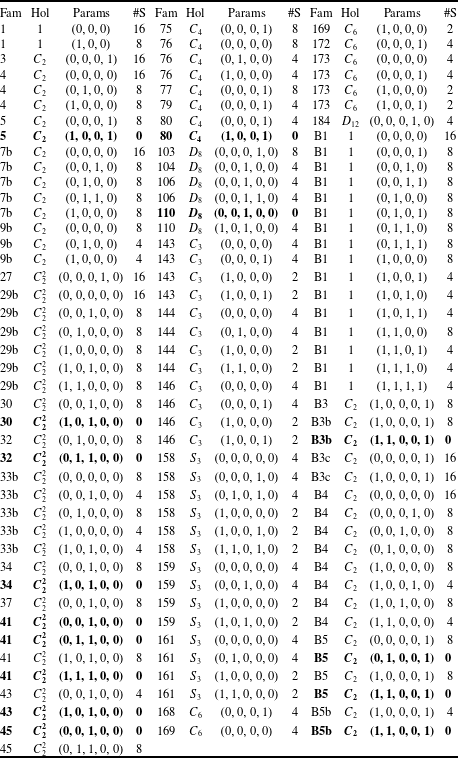
In Table 1, we give the complete information on spin structures of four-dimensional almost flat manifolds. Suppose
 $M$
is an almost-flat manifold of dimension four with the fundamental group
 $\unicode[STIX]{x1D6E4}$
that fits into the short exact sequence (3). In the table, the family of the group is indicated by “Fam” column. The associated parameters are given in “Params” column but only modulo 2, as this makes no difference in the classification (see Proposition 3.7). Note that if
 $\unicode[STIX]{x1D6E4}$
is modelled on a three-step nilpotent group, the first parameter describes the almost crystallographic group
 (see [Reference Dekimpe7, Chs 6.3 and 7.3]). The number of spin structures is given in the column “# S”. The families that do not admit a spin structure are highlighted in bold. In addition, we give an isomorphism type of the holonomy group of
 $\unicode[STIX]{x1D6E4}$
in the column “Hol”.
Spin structures on four-dimensional almost flat manifolds.

Corollary 5.1. All spin families (i.e. not in bold) in Table 1 are parallelizable.
Proof. By a result of Hirzebruch and Hopf [Reference Hirzebruch and Hopf14], a closed orientable 4-manifold
 $M$
is parallelizable if and only if its Euler characteristic, signature (or, equivalently, first Pontryagin class) and the second Stiefel–Whitney class vanish. If
 $M$
is also infra-nil, then it is finitely covered by a nilmanifold which is parallelizable. It follows that
 $M$
must have vanishing Euler characteristic and signature. Therefore,
 $M$
is parallelizable if and only if it has a spin structure.◻
Acknowledgements
The computations were performed with usage of GAP [11] and the GAP package Aclib [Reference Dekimpe and Eick9].
A. Appendix. Character tables of holonomy groups of four-dimensional almost Bieberbach groups
-
1. Character of the trivial group is denoted by
$\unicode[STIX]{x1D712}_{1}$
. -
2.
$C_{2}=\langle \bar{\unicode[STIX]{x1D6FC}}\mid \bar{\unicode[STIX]{x1D6FC}}^{2}=1\rangle$
-
3.
$C_{2}^{2}=\langle \bar{\unicode[STIX]{x1D6FC}},\bar{\unicode[STIX]{x1D6FD}}\mid \bar{\unicode[STIX]{x1D6FC}}^{2}=\bar{\unicode[STIX]{x1D6FD}}^{2}=[\bar{\unicode[STIX]{x1D6FC}},\bar{\unicode[STIX]{x1D6FD}}]=1\rangle$
-
4.
$C_{4}=\langle \bar{\unicode[STIX]{x1D6FC}}\mid \bar{\unicode[STIX]{x1D6FC}}^{4}=1\rangle$
-
5.
$D_{8}=\langle \bar{\unicode[STIX]{x1D6FC}},\bar{\unicode[STIX]{x1D6FD}}\mid \bar{\unicode[STIX]{x1D6FC}}^{4}=\bar{\unicode[STIX]{x1D6FD}}^{2}=(\bar{\unicode[STIX]{x1D6FC}}\bar{\unicode[STIX]{x1D6FD}})^{2}=1\rangle$
-
6.
$C_{3}=\langle \bar{\unicode[STIX]{x1D6FC}}\mid \bar{\unicode[STIX]{x1D6FC}}^{3}=1\rangle$
where
$\unicode[STIX]{x1D709}=\text{e}^{2\unicode[STIX]{x1D70B}\text{i}/3}$
.
-
7.
$S_{3}=\langle \bar{\unicode[STIX]{x1D6FC}},\bar{\unicode[STIX]{x1D6FD}}\mid \bar{\unicode[STIX]{x1D6FC}}^{2}=\bar{\unicode[STIX]{x1D6FD}}^{3}=(\bar{\unicode[STIX]{x1D6FC}}\bar{\unicode[STIX]{x1D6FD}})^{2}=1\rangle$
-
8.
$C_{6}=\langle \bar{\unicode[STIX]{x1D6FC}}\mid \bar{\unicode[STIX]{x1D6FC}}^{6}=1\rangle$
where
$\unicode[STIX]{x1D709}=\text{e}^{4\unicode[STIX]{x1D70B}\text{i}/3}$
.
-
9.
$D_{12}=\langle \bar{\unicode[STIX]{x1D6FC}},\bar{\unicode[STIX]{x1D6FD}}\mid \bar{\unicode[STIX]{x1D6FC}}^{2}=\bar{\unicode[STIX]{x1D6FD}}^{6}=(\bar{\unicode[STIX]{x1D6FC}}\bar{\unicode[STIX]{x1D6FD}})^{2}=1\rangle$